Feeling Unseen After a Breakup—And the Direct Ask That Followed

The 11:40 p.m. Group Chat Aftershock
I recognized the pattern before Jordan (name changed for privacy) finished describing it: a Toronto communications coordinator can edit a four-minute breakup voice note into a polished two-minute story, receive three reaction icons, and still wonder why friends who know everything somehow do not seem to see them.
Jordan sat on the edge of their bed with their phone warm against one palm. The radiator clicked through the quiet apartment, and the blue-white group chat lit their face as weekend logistics continued beneath the voice note they had just sent. A heart. A crying-face reaction. One brief, “That sounds really hard.” Then someone asked where everyone wanted to meet on Saturday.
“I keep telling them what happened,” Jordan said, pressing their tongue against a tense jaw. “I can make the breakup sound meaningful. I can even make it funny. But I still don't know what I'm asking for, and afterward I feel more lost.”
Their shoulders looked as though they were carrying two overpacked tote bags no one else could see. The feeling in their chest was not simply sadness. It was the hollow drop of stepping off a TTC train and discovering that every directional sign had been removed while the crowd kept moving around them.
“They know the whole story, so why do I still feel unseen?” they asked.
I let the radiator complete another small metallic click before I answered. “You told the whole story. You still did not say what you needed.”
Jordan looked down at the phone. “That sounds bad when you say it like that.”
“It isn't bad,” I said. “It is protective. Making the story articulate lets you reach for attention without risking a direct request. We are not going to shame that protection or assume your friends should read your mind. We are going to find out why the conversations create contact without creating the closeness you hoped for. Let us draw a map through the fog.”

Choosing the Compass: A Five-Card Relationship Spread
I asked Jordan to place both feet on the floor and take one unforced breath. I shuffled slowly while they held one question in mind: “Why do I keep sharing breakup feelings but feel lost with friends?” The pause was not a mystical performance. It was a transition from refreshing for answers to paying attention on purpose.
I chose a five-card Relationship Spread. For anyone wondering how tarot works in a friendship problem, I use the cards as an objective pattern-recognition tool, not as a machine for predicting behavior or reading another person's private thoughts. The images create enough distance for a querent to examine assumptions, needs, boundaries, and choices that are difficult to see from inside an emotionally charged group chat.
This was the smallest spread capable of separating the relevant parts of Jordan's situation. The first position would show their current social stance. The second would examine the response field they perceived from friends, while carefully avoiding claims about those friends' hidden motives. The central card would reveal the shared pattern of mixed signals and unclear needs. Beneath it, a fourth card would expose the communication block. Above it, a fifth would act as a beacon toward greater agency.
I placed the cards like a bridge viewed from the front: one side for Jordan, one side for the friends they were trying to reach, the interaction suspended between them, the hidden foundation below, and the clearest available direction above. This structure mattered. Jordan did not need ten new theories about the breakup. They needed to see where the bridge stopped carrying the message.
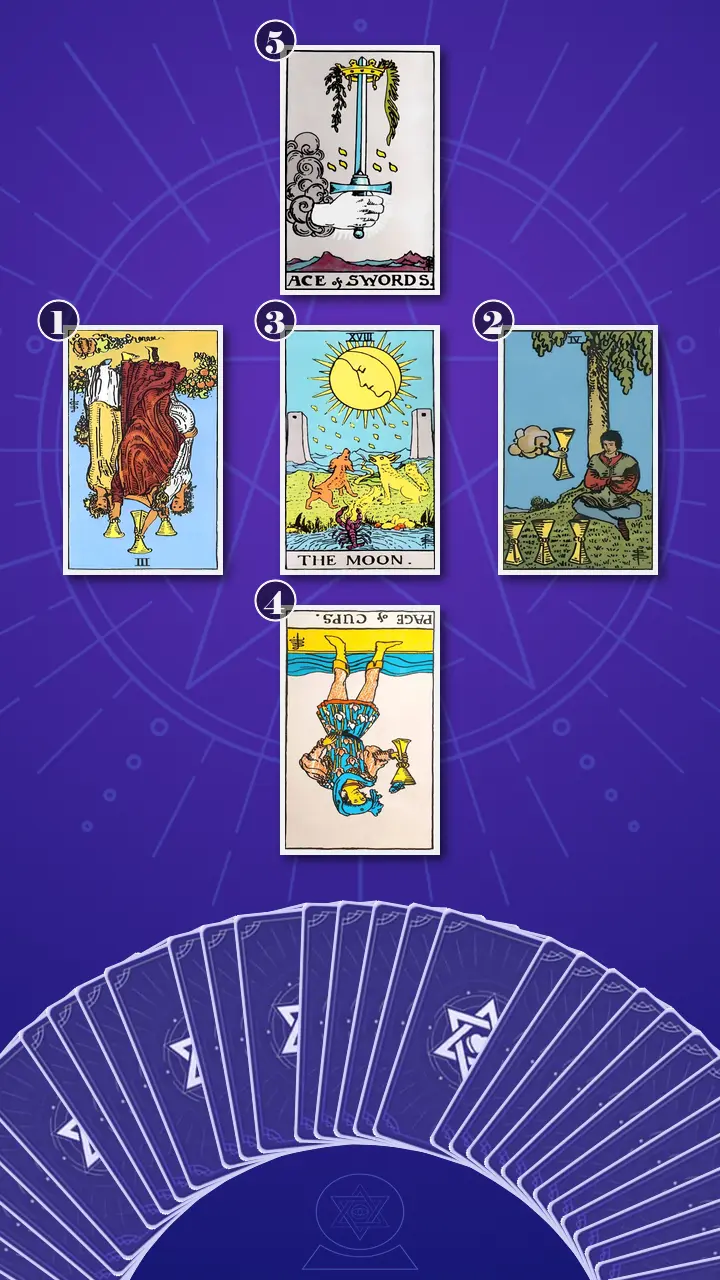
The Unsteady Circle of Breakup Loneliness
Position One: The Circle That Looked Like Closeness
The card I turned over first represented Jordan's current stance: the observable pattern of broadcasting polished breakup feelings while privately experiencing friendship disconnection. It was the Three of Cups, reversed.
In the traditional image, three figures raise their cups inside a shared celebration. Reversed, their visible unity becomes unstable. The communal energy is present, but it is blocked. Jordan was entering the group chat and attending drinks, contributing something emotionally legible, then monitoring the circle from the inside as if participation itself should confirm belonging.
I described the modern scene reflected in the card: Jordan posts a composed breakup reflection to the whole friend group because group participation feels like the safest route back to connection. The message receives hearts, jokes, and brief concern, but no one knows whether Jordan wants a call, a walk, reassurance, practical company, distraction, or space. Social contact is mistaken for felt connection. When the contact fails to satisfy, disappearing from the group begins to look safer than asking more directly.
“It is like publishing a carefully edited Letterboxd review of your own heartbreak,” I said. “Everyone can react to the interpretation, but nobody has been invited to sit beside the reviewer.”
Jordan gave one short laugh, but bitterness caught at the end of it. “That is so accurate it is almost brutal.”
I did not rush to soften the recognition. “The card is not calling you fake. Your disclosure is real. It is showing a blockage in how the disclosure travels. The group sees the raised cup, but the one-to-one need remains protected behind it.”
Jordan's fingers tightened around the phone, then loosened. Their eyes stayed on the inverted circle. “I showed them the story,” they said slowly, “and then I kept checking whether I was still welcome.”
“Exactly. More breakup context is not always more closeness. Before the next group interaction, the useful question is not, 'How do I explain this better?' It is, 'Am I telling the story, asking for connection, or hoping someone will infer the request I cannot say?'”
Position Two: The Cup That Arrived in a Smaller Form
The card I turned over next represented the perceived stance of Jordan's friends: the visible responses Jordan encountered as emotionally flat or limited, without pretending I could know what anyone privately intended. It was the Four of Cups, upright.
The figure on this card sits with crossed arms while a cup is offered nearby. I read the energy as an excess of emotional preoccupation combined with a deficiency of receptivity. That did not mean Jordan should accept scraps or call every low-effort gesture meaningful care. It meant the spread was asking them to distinguish an offer that was genuinely insufficient from an offer that arrived in a quieter form than the one they had imagined.
I asked whether anyone had sent a meme, suggested a walk, or offered a short check-in after the longer disclosures.
“Maya sent me a ridiculous TikTok and asked if I wanted to get coffee,” Jordan said. “But we didn't talk about the breakup in the message, so I assumed she was avoiding it.”
“That may be true, or it may not be,” I said. “The observable facts are that she sent something chosen for you and invited you for coffee. The motive is still unknown. A reaction is contact. It is not the same thing as being met. But a modest invitation may be an opening through which you can ask whether there is room for something deeper.”
I could see the distinction land without fully comforting them. Their mouth softened, but one shoulder remained lifted. Jordan wanted care that required no translation. That longing made sense after a breakup had already destabilized their weekends and their wider social circle. Yet expecting friends to identify an unspoken form of support left everyone working from different briefs.
“So I might be rejecting what is there because it isn't the perfect version,” Jordan said.
“Sometimes. And sometimes what is there really will be too limited. Tarot cannot decide that for you. The card is asking you to gather cleaner information before reaching a conclusion.”
Position Three: The Moonlit Commute Through Mixed Signals
The card I turned over at the center represented the shared dynamic: the way unclear needs, ambiguous social cues, and competing interpretations kept Jordan moving without a reliable direction. It was The Moon, upright.
The Moon's path winds between two towers under low visibility. A dog and a wolf respond to the same light in different ways, while something unformed rises from dark water. I read this as an excess of projection and emotional signal, with a deficiency of verified information. The energy was not evil or ominous. It was incomplete.
I connected the image to a scene Jordan knew well: riding Line 1 north after work, watching a friend's reply arrive the next morning, seeing the group chat change topics, and scrolling past photos of friends together. With no specific support request on the table, each cue could support several stories. Friends were busy. Friends felt awkward. Friends cared but had limited capacity. Friends were quietly pulling away. The Moon did not select one story. It revealed how quickly uncertainty became a referendum.
“They replied with a heart and changed the subject,” I said. “Does that mean they care, feel awkward, have no capacity, or want you gone? Right now, the timestamp cannot answer that.”
Jordan inhaled, held the breath, and looked past the screen as if the towers had become the doors of a subway carriage. “I use read receipts like a weather forecast,” they said. “One delayed reply and suddenly I think I know the whole climate.”
I nodded. In my practice, I call this Vibe Contamination Auditing. I do not use the phrase to label a sensitive or busy friend as toxic. I use it to identify what has entered the psychological atmosphere and begun masquerading as fact. In Jordan's case, grief, Instagram Stories, the ex's continued connection to the wider circle, delayed messages, and Sunday-night loneliness had blended into one heavy accord. No single element could be smelled clearly anymore.
Fifteen years as a perfumer taught me that adding another note to an oversaturated room rarely restores discernment. I have to open a window, clear the air, and test each material separately. I gave Jordan the relational version: first write the observable cue, such as “Maya replied at 9:12 a.m.” Then write the attached story, such as “I am becoming exhausting.” Leave both visible without pretending they are the same sentence.
Jordan's jaw unclenched by a fraction. The apartment radiator went quiet at the same moment, and the silence felt less like abandonment than newly available space.
The Tender Message Still Sitting in Notes
Position Four: The Fish Jordan Kept Editing Out
The card I turned over beneath the center represented the underlying challenge: the performative vulnerability that blocked a direct emotional message and preserved the feeling of drifting. It was the Page of Cups, reversed.
The Page studies an unexpected fish rising from a cup. Upright, the card can carry tentative emotional openness. Reversed, I read its energy as a blockage: sensitivity becomes self-conscious, and the message is inspected, edited, joked about, or redirected before another person can answer it.
The modern-life version was already sitting in Jordan's Notes app. They could draft a clever account of what the breakup had taught them, soften every edge, and add a Fleabag-style joke that made the pain socially manageable. Meanwhile, the less impressive but more useful message remained unsent: “I am having a hard night. Could you stay on the phone for ten minutes?”
“The fish is the sentence that surprises you because it has no polished lesson attached,” I said. “It might be, 'I feel lonely.' It might be, 'I want someone to walk home with me.' The Page keeps staring at the feeling instead of delivering it.”
Jordan's thumb moved across the side of their phone, stopped, then pressed hard enough to whiten at the knuckle. Their focus drifted as though they were replaying the night they had left a Queen West bar before the final round. Traffic had hissed through the cold outside. They had wanted someone to follow, but had told no one they needed company.
“If I ask directly and they say no, I will have an answer I can't soften,” Jordan said. Their voice had lost the polished rhythm I had heard at the beginning.
“Yes,” I said. “The polished version protects you from a clear refusal. It also protects you from a clear yes. That is why this is a blockage, not a character flaw.”
My perfumer's mind returned to the difference between complexity and diffusion. A fragrance can contain fifty materials and still have no defined heart if every note has been blended to avoid contrast. Jordan did not need to become more exposed, disclose intimate details to the entire group, or prove their sincerity through emotional intensity. They needed a smaller container in which one honest note could remain recognizable.
“So the answer isn't to tell everyone more,” they said.
“No. Nor is it to stop mentioning the breakup and decline every invitation. The constructive opening is proportion: one present feeling, one trusted person, and one request that person can answer without having to decode the whole story.”
When the Single Sword Cut Through the Social Fog
Position Five: One Sentence With a Clear Destination
The final card I turned over represented the path toward integration: the communication shift that could create clarity while allowing each friend's actual capacity and boundaries to become visible. It was the Ace of Swords, upright.
The room seemed to become still around the card. After four positions saturated with cups, pools, tides, and circulating feeling, the single blade introduced air. I read its energy as balance through precision: not coldness, not a sweeping verdict on the entire friend group, but one clear statement rising above a complicated landscape.
In practical terms, the Ace looked like Jordan sending one trusted friend a concise message: “I feel lonely after the breakup. Would you have twenty minutes for a walk on Saturday?” The answer might be yes, no, or not right now. Each response would provide more usable relational information than another group-wide narrative followed by hours of reaction monitoring.
Before I gave Jordan the card's central message, I used my Boundary Permeability Diagnosis. Their boundary had become too permeable in one direction and too sealed in the other: friends' reply times bled inward and colored their sense of worth, while Jordan's immediate need could not travel outward without being converted into a polished press release.
Jordan was still caught inside the thought, “I have to make the right disclosure and receive the right response.” The Ace asked for something both simpler and more vulnerable: tell the truth accurately, then let the answer describe the moment rather than define the self.
You do not need a perfectly insightful story to deserve support; name one honest need and let the Ace's single upright sword cut through the social fog.
I stopped speaking. Jordan's breath paused first, shallow and high, while their thumb remained suspended above the phone screen. Then their gaze lost focus. I could almost see the memories passing across their face: the edited voice notes, the early exits, the walk invitation dismissed as too casual, the nights spent refreshing for evidence. Their jaw flexed before the rest of their expression moved.
“But doesn't that mean I did all of this wrong?” they said, suddenly sharper. “All that talking, all that work trying to explain it, and I was still hiding the actual thing?”
“It means the strategy protected you until it began costing more than it helped,” I said. “You were not wrong for wanting a safer route toward care. Now you can decide whether that route still takes you where you want to go.”
The anger stayed for one beat, then shifted. Jordan blinked rapidly; their eyes shone without spilling over. Their fist opened on the blanket, finger by finger. Both shoulders descended, followed by a long exhale that trembled at the end. Relief appeared, but so did the slight blankness that can follow when a familiar defense is no longer the only option. “Then I actually have to let someone answer,” they whispered. “I can't control what the answer says.”
“Now, with that new perspective, can you think of a moment last week when this insight might have changed how you felt?” I asked.
Jordan returned to Maya's coffee invitation. “I could have said yes, and asked whether she had space for a real check-in while we walked. If she didn't, I would at least know what she could do that day instead of turning the meme into proof that she didn't care.”
“That is the Ace,” I said. “A clear answer describes capacity; it does not measure your worth.”
I offered a private reinforcement rather than demanding immediate disclosure. Jordan could set a ten-minute timer and write three lines: “I feel... I need... Would you be willing to...?” They could address one trusted friend and name an answerable form of support, such as a walk, a ten-minute call, or company on Saturday. They did not have to send it. They could keep it in Notes, revise it, send only the feeling, or stop at any point.
This was the emotional transformation I saw in the spread: a first movement from being socially exposed and lost after group disclosure toward precise relational clarity, discernment, and steadier self-trust. The Ace did not guarantee closeness. It returned the next choice to Jordan.
Giving Clarity Room to Breathe
I drew the five cards back into one coherent story. The breakup had disrupted a social routine that once made weekends and group plans feel predictable. Because Jordan's former partner remained connected to the wider circle, every invitation carried extra weight. The Three of Cups reversed showed Jordan trying to restore belonging through visible group participation. The Four of Cups showed why brief or imperfect care could feel too small to receive. The Moon revealed how missing information became a maze of timestamps, reactions, and competing stories. The reversed Page of Cups located the unstable foundation: the emotional message contained context but no answerable request. The Ace of Swords supplied the missing function, translating water into language.
The spread also contained no Wands and no Pentacles. I did not read that absence as bad news. I read it as practical guidance. Jordan did not need a dramatic burst of action or a final judgment about every friendship. The clarity of air needed one small earthly container: one message, one request, one chosen friend.
The cognitive blind spot was now visible. Jordan had assumed that if friends knew the whole breakup story, they should know what support to offer. When they did not, the depth or timing of each response seemed to reveal Jordan's place in the group. In reality, a complete story and a usable request are different forms of communication. Friends might still have limited capacity, but a direct request would make that limitation clearer instead of leaving Jordan to infer it from digital noise.
I framed the next steps as experiments, not tests of loyalty. Jordan remained free to send nothing, adjust the request, choose another person, or decide that a particular friendship could not offer the support they needed.
The One-Feeling One-Ask Practice
- Draft one message for one trusted friend. Within the next seven days, open Notes, set a ten-minute timer, and write exactly three lines: “I feel ____. I need ____. Would you have capacity for ____?” Choose someone who has shown at least some ability to listen or follow through. Make the request answerable, such as a twenty-minute walk near a subway station on Saturday or a ten-minute call tonight. Expect the first draft to feel plain or exposed. Use the minimum version if needed: “I feel lonely today. Could you text me later?” Sending is optional, and the friend must remain free to say no or not right now.
- Use the Space Calibration Ritual after the ask. If Jordan chose to send the message, I asked them to create both digital and physical blank space immediately afterward: put the phone face down for fifteen minutes, step away from the bed or desk, and make tea, stand by an open window, or walk one block. When they returned, they would record only what the friend actually answered before writing any conclusion about belonging. Treat the blank space as ventilation, not punishment or a tactic to appear unavailable. If the reply triggers another spiral, separate the cue from the story: “They replied tomorrow morning” is a fact; “I am too much” is an interpretation.
I called this calibration because a healthy boundary is not a wall. It is the measured air around a relationship. Too little space, and every notification floods the room. Too much, and no honest message can cross. Jordan's task was to let one feeling travel outward while preventing the answer from bleeding into a total judgment of the self.
“One honest feeling can travel farther than a perfect breakup narrative,” I told them. “The cards do not own that change. You do.”

A Week Later: The Quiet Proof
Six days later, I received a short message from Jordan. They had opened the three-line draft on Saturday morning and written: “I feel lonely and weird about the group plans today. Would you have twenty minutes to walk with me before everyone meets? No pressure if you don't have the bandwidth.”
Maya had replied that she could not meet before the plans, but she could call for fifteen minutes that afternoon and take a longer walk on Sunday. Jordan put the phone face down, opened the apartment window, and let cold air move through the room before deciding what the answer meant.
“I still felt the sting of Saturday being a no,” Jordan wrote. “But I didn't turn it into nobody wants me. We talked Sunday. I said I was lonely without giving the full breakup TED Talk, and she actually knew what to respond to.”
That night, Jordan slept through until morning. Their first thought was still, “What if I asked for too much?” This time, they noticed the thought, smiled faintly, and let it pass without opening the group chat.
I did not take that as proof that every friendship was secure or that the breakup loneliness had vanished. It was smaller and more credible than that. Jordan had made one direct request, received an honest answer with both a limit and an offer, and stayed connected to their own worth while reading it.
That was the real Journey to Clarity. Tarot had not predicted who would stay, who would respond perfectly, or how quickly grief would move. The five-card Relationship Spread had helped Jordan distinguish storytelling from connection, ambient social noise from usable information, and another person's capacity from a verdict on belonging. Jordan remained the author of every next step.
I want to leave the same gentle recognition with anyone whose jaw tightens and shoulders grow heavy after everyone has heard the breakup story: the ache may come from wanting closeness while still protecting yourself from the direct ask that could reveal whether one person has room to meet you. Simply noticing that hidden line means you are no longer standing at the beginning of the path.
If one present-tense feeling could remain as clear as the Ace's single sword, without becoming another complete breakup explanation, what small request would you want one trusted friend to have the chance to answer in their own honest way?