Old Photos Delayed the Check-In Until She Sent the Calendar Invite

When Seven Years Outvote an Ordinary Tuesday
I often recognize sunk-cost attachment before a client has a name for it: a 29-year-old Toronto UX researcher drafts a serious relationship check-in, sees a Google Photos anniversary memory, deletes the message, and thinks, "We have too much history for this to mean nothing."
Maya brought me that exact loop. She gave me the time first: 11:40 p.m. As I listened, I could picture her sitting beside her sleeping partner with the phone warm in her palm, the bedroom washed in weak screen light. The radiator clicked near the window. The room smelled faintly of laundry detergent. In Apple Notes, the cursor waited after: "I have been feeling disconnected."
Then the familiar sequence began. Her chest tightened as she imagined saying the sentence aloud. She opened a photo from their first year together, scrolled through twenty minutes of dinners, road trips, and affectionate messages, and deleted the draft.
"Nothing is dramatically wrong," she told me. "But nothing feels newly alive either. I can remember when we were close more easily than I can explain how we are now."
I heard grief-tinged ambivalence in the way her voice kept warming around the past and flattening around the present. It felt like watching someone hold a warm photograph against her chest while the rest of her body slowly went numb in a cold room. One part of her was saying, "I cannot question this because those seven years were real." Another was saying, "I cannot ignore this because the distance is real too."
I did not tell her that the relationship was over. I did not tell her that history meant she should stay. Neither conclusion belonged to me, and tarot should never manufacture a verdict where a person needs room to observe, speak, and choose.
"We are not going to force a stay-or-leave answer tonight," I said. "We are going to make a map of the loop. Then we will look for the place where your choices disappeared from view, even though they never actually left you."

Choosing the Hourglass for a Relationship Tarot Reading
I invited Maya to put both feet on the floor and take one slow breath before I shuffled. I use that pause as a practical transition: it gives the nervous system a moment to leave the late-night scroll and arrive at the question in front of us. The coffee beside me had gone lukewarm, but its familiar aroma kept the room grounded.
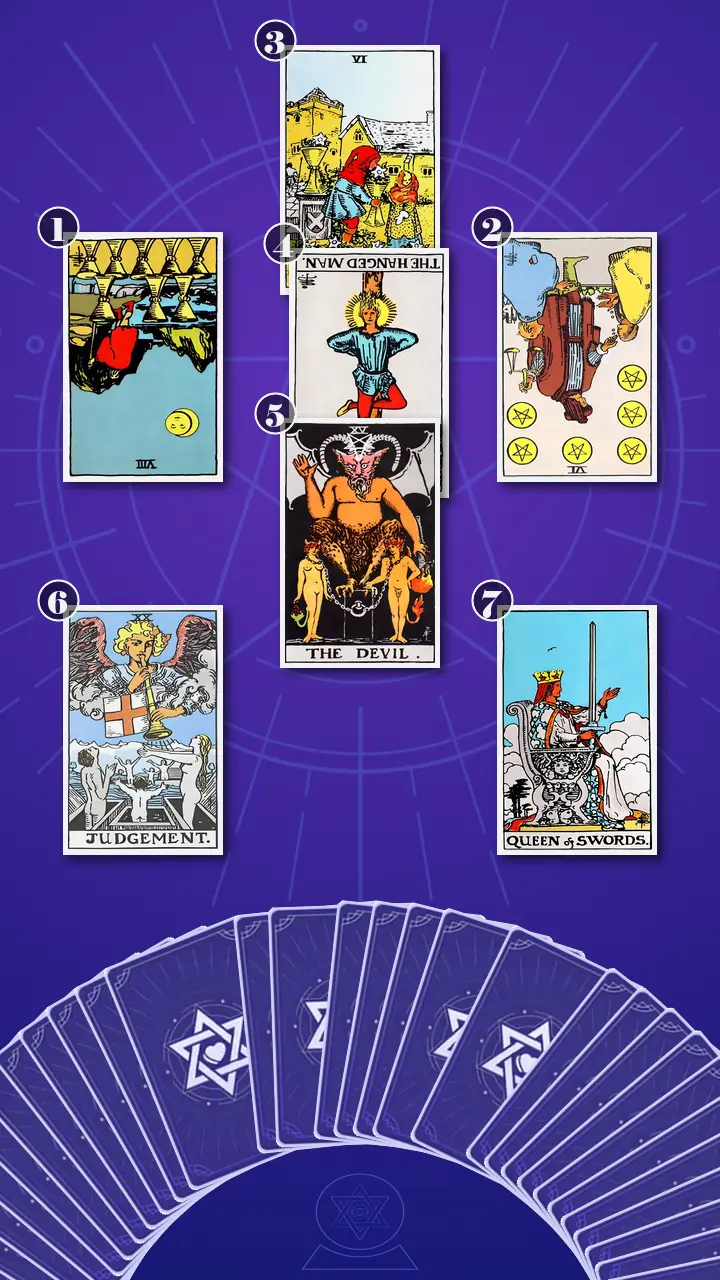
I chose the Relationship Spread - Context Edition, a seven-card relationship tarot spread designed to examine blocked movement, observable reciprocity, shared history, present stagnation, attachment, honest review, and boundaries.
I chose this spread because Maya's question was relational, but I did not want to pretend I could read her partner's private thoughts. In this context edition, the second position examines visible behavior: who initiates, who responds, what receives follow-through, and whether repair occurs. That ethical adjustment matters. Card meanings in context should increase agency, not encourage mind-reading.
I arranged the cards like an hourglass opening into a path. The first card would reveal Maya's pattern of approaching honesty and returning to familiarity. The shared-history card would sit above the spread like a keystone. The center would show how waiting had become stagnation, and the card beneath it would expose the belief making conscious choice feel like betrayal. The final two cards would offer a bridge and clear criteria, not a prediction of whether the relationship would continue.
"The spread can show us how the pattern is organized," I told her. "It cannot make your decision. You remain the person who decides what the evidence means and what you consent to next."
Reading the Loop Before It Closes
Position 1: Eight of Cups Reversed and the Message That Disappears
"Now I am turning over the card that represents your current stance toward the stagnant relationship, especially the moment when you approach an honest conversation and return to familiarity," I said.
I revealed the Eight of Cups, reversed.
I pointed to the cloaked figure, the carefully arranged cups, and the mountain path beyond the water. Upright, the figure recognizes that an emotional arrangement is no longer sufficient and moves toward difficult new information. Reversed, I read the movement as a blockage. The awareness is present, but the next step turns inward and loops back toward what is familiar.
"This is the moment when you open that serious relationship check-in in Apple Notes," I said, "recognize that another routine evening felt emotionally insufficient, and then turn toward old photos before the conversation can begin. The card is not ordering you to leave. It is showing the mechanical loop of approaching a present-tense question and returning to the emotional display case because the unfinished path feels more frightening than the flatness you already know."
Maya gave one short laugh, but there was no amusement in it. "That is so accurate it is almost mean," she said. Her fingers tightened around the sleeve of her mug, then loosened as she looked back at the card.
I let the reaction breathe. "Accuracy does not have to become accusation," I said. "The return to the photos makes sense. It gives you immediate warmth and certainty. We only need to notice the price: the present question goes unanswered."
I asked her what feeling arrived in the few seconds between writing "disconnected" and opening Google Photos.
"A tight throat," she said. "Then this thought that I am being ungrateful. Like I am about to throw away everything we built over one boring week."
"And yet it is not one week," I said. "The same concern keeps returning after ordinary evenings. For now, we are simply allowing that repetition to count as information."
Position 2: Six of Pentacles Reversed and the Invisible Costs
"Now I am turning over the card that audits observable reciprocity, initiative, responsiveness, and follow-through without claiming to know your partner's private motives," I said.
I revealed the Six of Pentacles, reversed.
The scales should measure exchange, but in reversal I read their energy as an imbalance: an excess of compensating effort on one side and a deficiency of mutual initiative or reliable follow-through in the shared system. I was careful to distinguish that observation from a diagnosis of her partner's character.
"This is the present-day reciprocity audit," I explained. "Who proposes the meaningful plan? Who asks the second question? Who responds with more than vague agreement? When a need is spoken, what happens during the following week?"
Maya described a Saturday when she had found a west-end gallery, checked the hours, and added it to their shared calendar. Her partner had said it sounded good but never chose a time, so the afternoon became another grocery run. Maya had carried the bags home with irritation locked between her shoulder blades, then planned the next outing herself.
I used one of my most practical lenses, Daily Friction Deconstruction. I stripped away the dramatic accusation "My partner does not care" and examined the smaller machinery: one person proposes, one person vaguely agrees, no time is chosen, the plan collapses, and the first person compensates by planning again. That sequence is useful because it can be discussed and changed. A global accusation usually cannot.
"Think of it like a shared project board," I said, using language familiar from her UX work. "If one person keeps creating the meaningful tasks, assigning the next step, and checking whether anything moved, the issue is visible in the workflow. You do not need to invent a hidden motive to acknowledge the workload."
"So I track it without turning it into a scorecard?" she asked.
"Exactly. Before asking how long this has lasted, ask what is being reciprocated now. We observe initiation, response, repair, and follow-through. We do not secretly withdraw affection to test whether your partner notices, and we do not use one quiet day as a conviction."
Her gaze shifted from the reversed scales to the unsent note still visible on her phone. I saw recognition arrive alongside embarrassment, then soften into curiosity.
Position 3: Six of Cups and the Gift That Became an Instruction
"Now I am turning over the card that identifies the genuine value and emotional meaning of your shared history, the very value that makes present-day evaluation difficult," I said.
I revealed the Six of Cups, upright.
I placed it beside the reversed Six of Pentacles. The repeated six mattered. Both cards speak to exchange and harmony, but one showed tenderness preserved in memory while the other questioned what was being exchanged now.
I read the Six of Cups as a balanced and available current of affection. The relationship's early closeness, the difficult seasons Maya and her partner survived, the first apartment, and the private language they built were not illusions. The risk came when that balanced gift was used in excess, making remembered care responsible for answering every present-tense question.
"This is the photo notification, the old Spotify song, the first-apartment story, or the anniversary dinner that brings genuine warmth back into the room," I said. "The child offering the flower-filled cup is giving you something real. But a gift is different from an instruction."
Maya looked down for several seconds. "I think I keep trying to prove that we were real."
"You were real," I said. "You do not need to preserve the current arrangement to validate that. A good memory can be true without being a current relationship plan."
Her lower lip pressed inward. I watched her blink quickly, then give a small nod that held both relief and grief. The card had not taken her history away. It had returned the history to its proper place: meaningful evidence about what had been, but incomplete evidence about what was happening now.
The Sunday That Kept Repeating
Position 4: The Hanged Man Reversed and the Pause That Stopped Teaching
"Now I am turning over the card that shows how stagnation currently operates through routine, deferred conversations, and waiting that no longer produces new insight," I said.
I revealed The Hanged Man, reversed.
Upright, the suspended figure can represent a purposeful pause that produces a changed perspective. Reversed, I read the energy as a blockage and deficiency of useful movement. Maya was still paying the cost of waiting, but the wait was no longer generating new information.
"This is another Sunday when the relationship conversation moves to a less busy week," I said. "The same errands happen. The same takeaway arrives. You sit on opposite ends of the sofa with separate screens, and because there is no dramatic fight, the evening gets filed under ordinary fatigue. Then next Sunday gives you the same data."
I thought of research projects I had seen remain in discovery long after discovery had stopped revealing anything. One more interview, one more sprint, one more quiet weekend might finally make the answer obvious. But refreshing a paused app does not produce a different screen when no input has changed.
"Waiting is not automatically patience," I said. "Sometimes it is a calendar event that never leaves draft mode."
Maya inhaled through her nose and sat back. "I keep saying I want to talk when I feel certain. But the silence is the reason I have no new information."
"That is the distinction," I said. "You do not need certainty before one honest question. The question is one way you gather information."
Position 5: The Devil and the Sentence That Sounds Like a Lock
"Now I am turning over the card that exposes the central blind spot: the belief that converts history into obligation and makes conscious choice feel like betrayal," I said.
I revealed The Devil, upright.
I saw Maya's shoulders rise before I said anything. I immediately directed her attention away from the imposing figure and toward the loose chains around the two human figures.
"I am not reading this as a declaration that your relationship is toxic, doomed, or secretly controlled by your partner," I said. "I am reading an excess of attachment, guilt, and sunk-cost reasoning that creates the felt blockage of having no permissible choice."
In Maya's life, the loose chains looked like seven years of photographs, a shared Toronto lease, furniture bought together, group invitations addressed to both of them, and friends calling them "the stable couple." None of those facts made a decision for her. Together, however, they seemed to repeat one private rule: "If I question this, I erase seven years."
"I know I technically have choices," Maya said, pressing two fingers against the base of her throat. "They just feel like betrayal."
I nodded. "That sentence is the chain. The history is emotionally powerful, but it is not an external command. I want you to ask something more precise: which parts of your loyalty come from present love and freely renewed consent, and which parts come from guilt, fear, or the belief that time invested must control time not yet lived?"
Her breath paused. Her eyes lost focus as if she were replaying the anniversary dinner where a friend had toasted them for having "been through everything." Then she exhaled, lowered her shoulders, and said, "I talk about what we survived because I do not know how to describe what we are now."
"That is painful information," I said, "but it is not a command to leave. It is an invitation to stop making the archive answer for the living relationship."
When Judgement's Trumpet Reached the Notes App
Position 6: Judgement and the Truth That Became Audible
The radiator in Maya's room stopped clicking. In the sudden quiet, even the small sound of a card touching my table seemed sharper. I told her we were turning over the spread's key bridge.
"Now I am turning over the card that provides the transformation from nostalgic self-protection toward an honest, structured review of present needs and relationship participation," I said.
I revealed Judgement, upright.
I read its energy as a balanced catalyst: honest self-appraisal, self-permission, accountability, and the courage to bring private recognition into a present-tense conversation. The trumpet was not a supernatural prediction. It was the signal already sounding through repeated ordinary evenings, deleted drafts, and needs that kept returning after nostalgia wore off.
Maya was still caught inside the demand to make the correct decision before she spoke. At 11:40 p.m., the unsent check-in waited beside her sleeping partner while Google Photos supplied a warm image from their first year. The memory was real. The current question was also real. Only one of them kept being silenced.
The past can be honored without being used as proof that the present must stay unchanged. Seven years can explain why the relationship matters; only present reciprocity, curiosity, repair, and emotional presence can show what it is now.
I let a few quiet seconds pass before giving her the card's central message.
History is not a chain you must obey; answer Judgement's trumpet by naming what is true in the relationship now.
I watched her breathing stop for a beat. Her fingers hovered above the phone as if the sentence had physically interrupted the old sequence. Then her gaze slipped away from me and settled somewhere beyond the screen; I could almost see the ordinary Sundays replaying behind her eyes, one after another, stripped of anniversary music and flattering captions. Her pupils widened. Her mouth tightened.
"But does that mean I have been wrong this whole time?" she asked, anger briefly sharpening her voice. "Have I just wasted years avoiding this?"
I saw the anger falter into grief. Her eyes reddened, her clenched hand opened against the duvet, and a long breath left her chest with a faint tremor. Her shoulders lowered, but the release was followed by a moment of blankness, the slight dizziness that can come when clarity returns responsibility to the person who asked for it.
"No," I said. "It means the past is being reviewed, not prosecuted. What you loved does not become false because you need current evidence now. You do not have to call the past a mistake to look honestly at today."
"Now, using this new perspective, think back to last week. Was there a moment when this insight could have made you feel different?" I asked.
Maya remembered Tuesday evening. She had asked whether they could put their phones down and talk after dinner. Her partner had said, "In a bit," and the conversation had never happened. Maya had told herself it was unfair to care because work had been exhausting.
"What would change if you did not turn that moment into a verdict about the whole relationship?" I asked.
"I could write down what happened," she said slowly. "I asked. It did not happen. I still wanted connection."
"Exactly. That is current-state information. It does not prove incompatibility, and it does not disappear because you had a beautiful trip in 2019."
Emotional Clutter Sorting
This was where I brought in my Emotional Clutter Sorting method. I asked Maya to imagine three clear piles on a kitchen table. In the first: external pressure such as long workdays, poor sleep, Toronto housing stress, and household chores. In the second: daily mechanical friction that might be changed through scheduling, phone boundaries, or shared planning. In the third: deeper relationship evidence, including whether both people show curiosity, participate in repair, and respond when a need is clearly named.
"If everything remains in one emotional junk drawer, ordinary fatigue can be mistaken for incompatibility, and incompatibility can be dismissed as ordinary fatigue," I said. "Sorting does not pre-decide the outcome. It allows you to see which problem you are actually trying to solve."
I asked Maya to set a ten-minute timer and write two lines while I stayed with her: one present observation and one unmet need. She wrote, "We have had several evenings without a meaningful conversation," followed by, "I need shared attention and genuine curiosity, not only reliable co-existence."
I told her not to decide whether to stay or leave during those ten minutes and not to open old photos to argue with the observation. If the exercise became overwhelming, she could stop, close the note, and return when her body felt steadier. This was not a test of endurance.
I watched her read the two lines again. The shift was small but unmistakable: from grief-tinged nostalgia and sunk-cost paralysis toward grounded clarity about current needs, boundaries, and self-directed relationship choices. She did not have a final answer. She had something more immediately useful: permission to gather honest present-day evidence.
Position 7: Queen of Swords and the Open Hand Beside the Blade
"Now I am turning over the card that defines your self-directed criteria for integration, boundaries, and the next honest conversation rather than predicting the relationship's outcome," I said.
I revealed the Queen of Swords, upright.
I pointed first to the upright sword and then to the Queen's open hand. I read this as balanced air energy: discernment without contempt, direct language without prosecution, and receptivity that does not require self-abandonment.
"This is you entering the conversation with two clear needs and observable criteria," I said. "You are not prosecuting seven years, demanding instant certainty, or arriving with a secret decision your partner has to guess. You are naming what emotional presence, curiosity, reciprocity, and repair would look like, then listening to the response while keeping your own observations visible."
I told her the Queen's sword could become a simple meeting agenda: two observations, two needs, and one specific question. The open hand meant there was room for a real answer. The sword meant Maya did not have to erase her own data to make that answer comfortable.
"So clarity is not me becoming cold," Maya said.
"No," I replied. "Clear is not cruel. A boundary can protect the conditions for an honest exchange. Clarity can be a conversation, not a verdict."
She looked at the full spread, from the Eight of Cups turning back toward the arranged cups to the Queen holding both discernment and openness. Her jaw unclenched. I could still see sadness in her face, but it was no longer fused with helplessness.
The Present-Tense Relationship Audit
I traced the hourglass shape one final time. The Six of Cups showed why Maya had stayed oriented toward the past: there was real tenderness there, and real belonging. The reversed Eight of Cups showed how that tenderness interrupted movement whenever she approached a difficult question. The reversed Six of Pentacles asked whether present reciprocity could support the weight of that history. The reversed Hanged Man showed waiting after waiting had stopped producing insight, while The Devil exposed the rule underneath it: questioning the present would supposedly betray the past.
Judgement broke that closed loop by turning history from a sentence into material for review. The Queen of Swords translated the review into language, criteria, and compassionate boundaries. I also noted that no Wands appeared. Maya did not lack emotion or thought; the spread was saturated with both. What was missing was deliberately introduced fire: one scheduled, finite action.
The cognitive blind spot was not simply nostalgia. It was treating exceptional memories as stronger evidence than ordinary present experience, then assuming that compassion for the past required silence about current needs. The transformation direction was equally specific: for the next two weeks, Maya would let written observations of reciprocity, curiosity, repair, and emotional presence carry weight before duration was admitted as evidence.
"Think of the relationship as a museum you are allowed to leave without burning down," I said. "You can preserve the archive and still step outside to see what is alive now."
I gave her three small next steps. None required her to decide the entire future, and none treated tarot as the authority over her life.
- Create a Seven-Day Present-Tense Relationship Audit. Open one private phone note with four headings: reciprocity, curiosity, repair, and emotional presence. For seven days, write only observable events within ten minutes of the interaction: who initiated, how the other person responded, whether a stated need received follow-through, and whether either person stayed engaged. Review the pattern once at the end of the week without using the relationship's duration as evidence. Tip: Start with three lines, not a perfect spreadsheet. Put explanations such as "work was stressful" or "they were loving in 2019" in a separate note, and stop tracking if it increases distress.
- Schedule the Twenty-Minute Truth Check-In. Use the shared calendar to choose a neutral window, not 11:40 p.m. beside a sleeping partner. Bring two current observations and two concrete needs. Open with: "I want to talk about how we are connecting now, without trying to decide our entire future tonight." Then ask: "What currently helps you feel connected to me, and what are you willing to try over the next two weeks?" Tip: The two-minute version counts. Name one observation, one need, and one question. If either person cannot stay respectful or regulated, pause instead of forcing a verdict. If direct conversation could expose you to retaliation or feel unsafe, prioritize safety and seek trusted or qualified support.
- Use the 24-Hour Micro-Boundary Reset. For one evening only, establish one non-negotiable time or physical boundary in the shared apartment: thirty phone-free minutes at the kitchen table, or a thirty-minute no-phone walk after dinner. Ask one present-tense question about connection. Treat the reset as a change in conditions, not a secret test of whether your partner notices or performs correctly. Tip: Keep the boundary modest and explicit: "From 7:30 to 8:00 tonight, I would like us both to put our phones away and check in." One completed day gives more information than an ambitious routine neither person can sustain.
I reminded Maya that participation was not something she could manufacture alone. Her power lay in making her observations visible, naming her needs, choosing her boundaries, and deciding what level of reciprocity she was willing to build a life around. The cards had organized the clutter. They had not taken ownership of her future.
A Week Later, the Ordinary Tuesday Counted
A week later, I received a message from Maya. She had made the audit and written nine short entries. She had also sent the calendar invitation for a twenty-minute check-in instead of reopening her first-year photo archive.
"The conversation was not cinematic," she wrote. "I cried a little. We did not solve everything. But I said what I had been deleting, and we agreed to try one phone-free evening and take turns planning it. I am watching the follow-through instead of trying to feel certain immediately."
She added that she had slept through the night after sending the invitation. Her first thought the next morning was still, "What if I am wrong?" This time, she had smiled at the thought, written one current observation, and gone to make coffee.
I did not take that message as proof that the relationship would recover or end. I took it as the first quiet proof of Maya's return to herself. She had honored the relationship's history without granting it authority over every future choice. Her clarity was still tender and unfinished, but it belonged to her.
When an old photo makes your chest soften and the next ordinary evening makes your limbs feel heavy, I know how difficult it can be to tell whether you are protecting a living connection or protecting the proof that the past mattered. I would ask you to remember Maya's hourglass: history may fill the archive, but the ordinary Tuesday is allowed to enter the evidence too.
If you set the anniversary photos aside for one week and listened only for present-day reciprocity, curiosity, repair, and emotional presence, what small truth would you feel ready to write beneath Judgement's trumpet, in your own words, for no one but yourself?