Finding Clarity in the 8:47 p.m. Doorway Pause
“You’re the friend who always says ‘of course’ in the moment—and then lies awake doing math on your own generosity the second the door closes.”
I said it gently, watching Jordan’s face do that tiny flinch people do when a sentence lands too close to home.
She was 28, Toronto tired, the kind that isn’t about sleep as much as it’s about never fully coming down. She told me she lived off Queen West in what she called “a shoebox that somehow still echoes.” And she described the moment that had finally pushed her to book a reading: 8:47 p.m. on a Tuesday, key half-turned in her lock, hearing a second voice inside her apartment before she even stepped in.
“The hallway smells like someone’s takeout,” she said, almost laughing. “The overhead light buzzes. My phone is warm from doomscrolling. And my shoulders go up like I’m bracing for… I don’t know, impact.”
Her friend had started “crashing for a couple nights” after a rough patch. Now it had become night after night. Jordan wanted to be supportive. She also wanted her living room back. She feared that a boundary would make her look selfish—like she’d be the villain in somebody else’s story.
Guilt was the loudest emotion in the room. Not abstract guilt—guilt that lived in her body like a clenched jaw, shoulders pulled tight, and a low-level agitation at home, like she couldn’t fully exhale in her own living room.
“I’m not trying to be cold,” she said. “I just want my space back.”
I nodded. “It makes sense that you feel guilty—your empathy kicks in faster than your boundaries. Let’s see if we can turn this into something clear and doable. Not a personality change. A plan. A small journey to clarity.”

Choosing the Compass: The Celtic Cross · Context Edition
I invited Jordan to take one slow breath with me—not as a ritual for the universe, but as a way to bring her nervous system into the present. While I shuffled, I asked her to hold the question in plain language: “My friend keeps crashing on my couch—how do I set a boundary?”
“Today,” I told her, “we’ll use a spread called the Celtic Cross · Context Edition.”
If you’ve ever Googled how tarot works and found nothing but mystical fog, here’s the practical version: a good spread doesn’t predict your life—it organizes your reality. This issue isn’t just about a script; it’s also about what makes the script feel impossible in the moment. The Celtic Cross is perfect for that because it maps the present dynamic, the immediate blockage, the deeper psychological hook, and the real-world environment pressures—then it ends with integration and best next step (not a fate sentence).
I pointed to the structure as I laid the cards: “The first card will show the current boundary dynamic. The second shows what’s actively blocking you. And the last card—position ten—will be the boundary style to embody, the clearest next step you can actually hold.”
Reading the Map: When “Helping” Turns Into an Open Tab
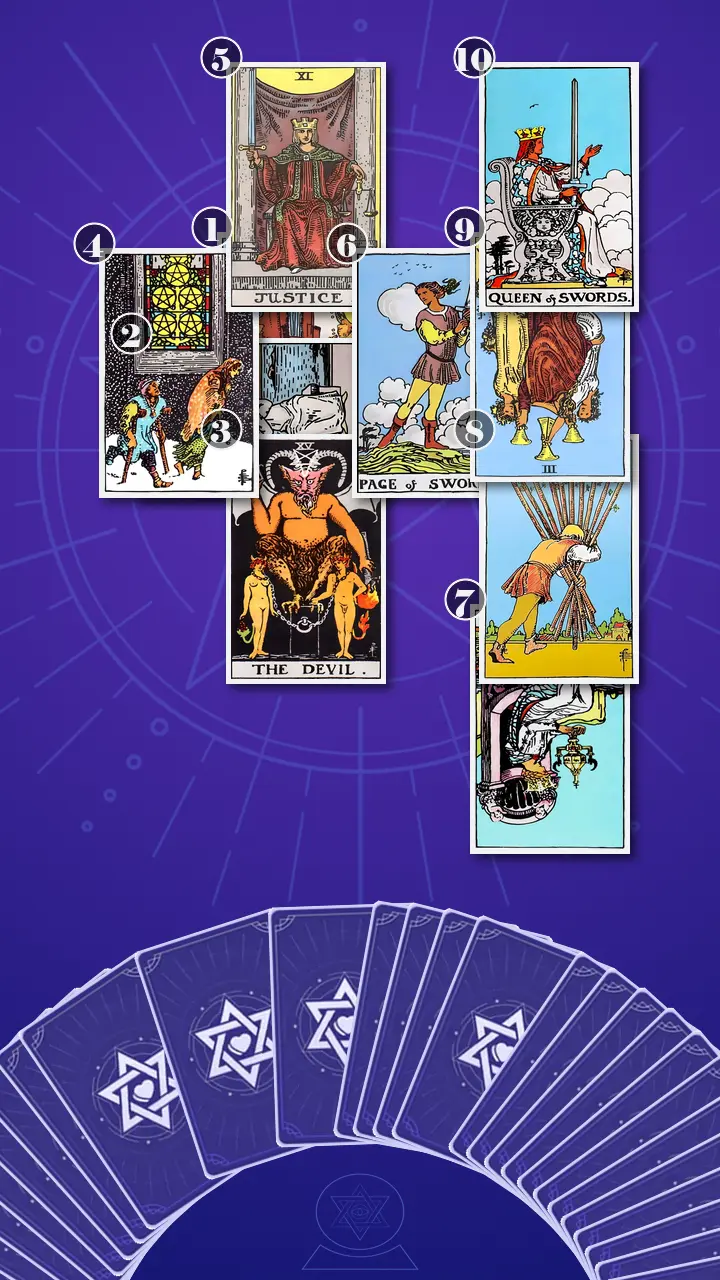
Position 1 — The current boundary dynamic: how the couch-crashing situation is functioning day to day and what it costs you.
Now flipped over, the card representing the current boundary dynamic was Six of Pentacles, reversed.
I tapped the image lightly. “Your living room has turned into an open-ended safety net: ‘sure, just tonight’ keeps auto-renewing. You’re paying with space, routine, and quiet—WFH calls, dating plans, workouts—while they get stability without a shared plan. The vibe is generosity that no longer feels chosen, because the terms were never said out loud.”
Reversed, this card is an energy imbalance: giving that has slipped from chosen into compulsory. The generosity isn’t wrong; the lack of structure is what’s draining it. It’s like an open tab you never agreed to—each “one more night” adds up until the nice thing feels like debt.
Jordan let out a short laugh that had a bitter edge. “That’s… brutal. Accurate, but brutal.” She rubbed her jaw like she’d just noticed she’d been clenching.
“Not brutal,” I said. “Honest. The card is showing why you’re feeling resentful: you’re giving without a clear agreement, so your nervous system treats it like a silent contract you can’t renegotiate.”
Position 2 — What is actively blocking the boundary: the immediate challenge that keeps you from saying the clear thing.
Now flipped over, the card representing what is actively blocking the boundary was Two of Swords, reversed.
“The blockage isn’t that you don’t know what you want—you do. The blockage is the moment-by-moment avoidance: drafting the text, deleting it, hinting, cleaning loudly, waiting for the perfect tone. It keeps you stuck in the same loop where the conversation feels bigger every day you don’t have it.”
This is Air energy in blockage: communication and decision-making are there, but jammed. The blindfold isn’t ignorance; it’s self-protection. Reversed, it’s that protection starting to fail—so you feel scattered, snappy, exhausted.
I described what she’d already told me in a split-screen, because the card practically begged for it:
Screen A: “I should say something.”
Screen B: “Not tonight. Not like this. I’ll wait for the right moment.”
And then the modern blindfold: Notes app draft → delete → draft again with three apologies → delete → send a meme, because it keeps things “normal.”
Jordan stared at the table, eyes unfocusing the way they do when someone is replaying a week in their head. She nodded once, slow. “Peace-now versus peace-later,” she murmured. “I keep choosing peace-now.”
“Exactly,” I said. “And the cost is that your home stops being restorative. You’re not avoiding conflict—you’re postponing it while paying interest.”
Position 3 — The psychological root: the deeper hook (guilt, obligation, fear of being ‘the bad friend’) driving the pattern.
Now flipped over, the card representing the psychological root was The Devil, upright.
“Under the logistics is a belonging fear: you’re not just afraid they’ll be upset—you’re afraid you’ll be cast as uncaring. That fear chains you to over-accommodating, like your worth as a friend depends on being a backup plan. The trap is internal: you feel obligated even when you technically have a choice.”
This is attachment energy in excess. Not love—attachment. The part of you that whispers, “If I set a limit, I’m not a good friend,” then treats that thought like a law.
I leaned back and let my own work show for a second—the Jungian part of me that listens for the story under the story. “The Devil often isn’t a villain outside you. It’s the internal deal you didn’t realize you made.”
Jordan swallowed. Her fingers tightened around her mug, then loosened. “I can literally see the group chat,” she said. “Like… them telling it as ‘Jordan kicked me out when I was struggling.’”
“That’s the chain,” I said softly. “Guilt is information, not instruction.”
Position 4 — What started it: the context that made saying yes feel necessary or urgent at first.
Now flipped over, the card representing what started it was Five of Pentacles, upright.
“This started with a real moment of need: a rough patch, nowhere to go, and you couldn’t bear the idea of them being out in the cold. That first yes came from genuine compassion—and it’s why part of you still feels cruel imagining an end date. The origin story matters, but it doesn’t have to define the forever plan.”
This is Earth energy in hardship. The lit window in the card is your empathy. You saw a friend on the cold side of life and you opened a door.
Jordan’s eyes went glossy for a moment. “The first night, they showed up with a bag. I couldn’t… not.”
“You did a human thing,” I said. “And now you’re being asked to do the next human thing: make it sustainable.”
Position 5 — Your conscious aim: what you believe a ‘fair’ or ‘right’ boundary would look like.
Now flipped over, the card representing your conscious aim was Justice, upright.
“What you’re aiming for is a fair agreement, not a moral verdict. You want a boundary that says: my home has rules, and your situation has next steps—but those are different things. The ‘right’ move is a clear timeline and a consistent follow-through that respects both of you as adults.”
Justice is Air energy in balance: clean truth, clear terms. I’ve seen this card in salary negotiations, breakups, roommate talks—any place where kindness needs structure to stay kind.
My mind flashed briefly to my old life training staff on cruise ships: when emotions ran high and space was tight, the only thing that prevented chaos was clarity. Cabin rules weren’t “mean.” They were what kept 4,000 people from melting down at sea.
Jordan exhaled through her nose. “So… not ‘am I a good person.’ More like… ‘what’s a fair agreement.’”
“Exactly,” I said. “Justice is asking you to stop putting your worth on trial.”
Position 6 — The next opening: what’s likely to help the conversation happen and shift the pattern soon.
Now flipped over, the card representing the next opening was Page of Swords, upright.
“The opening is a simple, scheduled conversation: a 15-minute talk in daylight hours where you lead with one headline sentence before any explaining. It might feel edgy, like your voice is a little shaky, but it’s the first clean move that breaks the pattern—because you’re finally saying the thing you’ve been acting around.”
This is Air energy in activation. The Page doesn’t wait to become fearless. The Page moves with wind in their hair and nerves in their hands.
“Hints are exhausting,” I told her. “A headline is kind.”
Jordan nodded, and I could see the smallest shift: not confidence yet—just willingness. The kind where you think, Okay. I can do fifteen minutes.
Position 7 — Your role in the dynamic: your emotional default and how it impacts your ability to hold a limit.
Now flipped over, the card representing your role in the dynamic was Queen of Cups, reversed.
“You’re emotionally over-responsible: you scan their face, tone, and mood like it’s your job, then soften your boundary mid-sentence to keep them comfortable. You end up carrying guilt for feelings that aren’t yours to manage. Your empathy is real—but it becomes self-erasure when the boundary depends on whether they react well.”
Reversed, Water becomes porous. Your compassion leaks into caretaking. The energy is in excess: too much attunement, not enough separation.
Jordan’s shoulders rose, then she caught herself and dropped them. “I literally change the sentence while I’m saying it,” she admitted. “If their face shifts, I start apologizing.”
“That’s the Queen reversed,” I said. “She’s not wrong to feel. She’s just trying to manage weather that isn’t hers.”
Position 8 — External reality: the home environment pressures and practical burdens that make this unsustainable.
Now flipped over, the card representing external reality was Ten of Wands, upright.
“The environment pressure is brutally practical: extra noise, extra cleaning, extra household coordination, less privacy, and a constant low-level ‘hosting’ mode. Even if they’re grateful, your apartment’s capacity is finite, and you’re carrying the load mostly alone—mentally and materially.”
This is Fire energy in overload. Ten wands is too many. Not because you’re weak—but because your arms are already full.
Jordan’s mouth tightened. “I eat in my room,” she said quietly. “Like I’m renting a corner of my own place.”
“That’s the card,” I said. “When you carry everything, you can’t see the path—only tasks.”
Position 9 — Hopes and fears: what you’re afraid will happen socially or relationally if you set the boundary.
Now flipped over, the card representing hopes and fears was Three of Cups, reversed.
“You’re afraid one boundary will become ‘a whole thing’ in your social world: awkward brunch energy, side texts, mutual friends taking sides, you being labeled unsupportive. So you try to manage the narrative by staying overly accommodating. But the real protection here is clarity—because group harmony built on your resentment isn’t actually harmony.”
This is Water energy in distortion: connection strained by unspoken feelings. It’s the moment a group chat goes quiet after someone finally says something real.
Jordan winced. “I’ve been on AITA Reddit at 1 a.m. like… ‘What if I’m actually the worst?’”
“That makes sense,” I said. “But we’re not crowdsourcing your boundaries from the internet. We’re building them from consent and capacity.”
When the Queen of Swords Spoke: The Boundary That Doesn’t Beg
Position 10 — Integration and best next step: the boundary style to embody and the clearest way to move forward.
When I reached for the final card, the room went noticeably quieter. Even the city noise outside—streetcar rattle, a distant horn—felt like it softened for half a beat. This was the card that would tell us how to move from feeling stuck into actionable advice.
Now flipped over, the card representing integration and best next step was Queen of Swords, upright.
“You embody a calm, clean boundary: one sentence with a date, said without stacking apologies, and followed by consistent action. You pause after you say it. You don’t negotiate against yourself in real time. If you want to offer support, it’s a specific alternative (helping research options, a ride to a viewing), not continued access to your home by default.”
Air here is in maturity. Not sharpness for sport—clarity as protection.
And this is where my own toolkit came in—the thing I used to teach on ships when a hundred cultures, personalities, and expectations collided in one floating city. I call it Social Role Switching: you don’t become colder, you become intentional. You choose a mode.
“Jordan,” I said, “you’ve been living in Supportive Mode, full-time. That’s why your kindness has turned into resentment. The Queen of Swords asks you to switch into Assertive Mode for one conversation—like a clear ship policy. Not personal. Not a debate. Just the structure that keeps everyone safe.”
She started to speak, then stopped—like her throat had temporarily frozen.
Setup (the stuck moment): I could see it on her face: she was back in that hallway with her key half-turned, listening for whether her friend was inside—like she needed to prepare herself before she even entered her own place. She wanted the “perfect” wording that would guarantee no backlash, no awkwardness, no guilt hangover.
Delivery (the line that cuts through the fog):
Not endless explanations—choose one clear line and hold it like the Queen of Swords’ upright blade.
I let the sentence sit between us.
Reinforcement (the body learning it’s allowed): Jordan’s breath caught—just for a second—like her lungs had been waiting for permission. Her eyes went wide, then unfocused. A micro-flash of memories crossed her face: the paper plate on the duvet, the Netflix intro sound through the wall, the sound of couch springs during a WFH call. Her jaw unclenched so suddenly she touched it, surprised. Her shoulders lowered, then she did another thing I always look for: her hands, which had been gripping her mug, loosened one finger at a time.
Then the complicated part: her brows pulled together, and there was a flicker of anger—not at me, but at the trap. “But if I don’t explain,” she said, voice tight, “won’t I look cruel?”
I nodded, steady. “That’s the Devil talking in a different outfit. Here’s the Justice piece: a boundary isn’t a breakup with your values—it’s the sentence that makes your kindness sustainable. And your home rules don’t require a jury—just your consistency.”
I leaned in slightly, lowering my voice the way I used to when a whole lounge was too loud and someone needed one clear instruction. “Now, with this new lens—think back to last week. Was there a moment when you said yes at the doorway, or after a sad story, where this one sentence would have changed your body immediately?”
Jordan blinked fast, then nodded once. “Sunday. 9:41. They told me another hard thing and I offered tea like I was trying to pre-pay for the boundary.” She gave a shaky exhale. “I could’ve just said the date.”
That was the shift—moving from guilt-driven silence toward uncomfortable clarity in one direct talk. Not magically fearless. Just cleaner. This was the first real step in her emotional transformation: from bracing and over-managing to grounded self-respect.
The One-Line Policy: From Insight to Actionable Advice
I looked at the full spread again and told her the story it was clearly telling: an open-ended favor (Six of Pentacles reversed) got stuck in avoidance (Two of Swords reversed) because guilt and belonging fear tightened like a chain (The Devil). The origin was real compassion (Five of Pentacles), and her values were trying to find fairness (Justice). The opening was small and doable (Page of Swords): schedule the talk. The internal pattern was over-caretaking (Queen of Cups reversed), the external reality was overload (Ten of Wands), and the fear was social fallout (Three of Cups reversed). The resolution wasn’t to become harsher—it was to become clearer (Queen of Swords).
The cognitive blind spot was simple and incredibly common: Jordan had been treating clarity like something she needed to earn with perfect wording and extra kindness. But the spread kept pointing to the same transformation direction: shift from hinting and hoping they’ll self-correct to naming a clear, time-bound limit and house rule in one calm, direct conversation.
“Let’s make this real,” I said. “We’ll use a cruise-ship principle I trust: Maritime Social Protocol. Onboard, if you don’t state the policy, you end up enforcing it in chaos. On land, it’s the same. We state it early, calmly, and we don’t renegotiate it in the hallway at midnight.”
- Write the 2-sentence boundary draft (Tonight, 3 minutes)Open Notes and write: “I can’t host after Friday. I can help you look at two next-step options on Wednesday night.” Keep it exactly two sentences—date + bounded support.If you feel the urge to add ten justifications, pause and keep the draft short. You’re aiming for clarity, not a courtroom brief.
- Send the scheduling text (Within 48 hours)Send one text that does one job: “Can we talk for 15 minutes tomorrow after dinner? I need to go over a plan for the rest of this week.” No explaining in the text—save it for the talk.Lower the difficulty: do it in daylight hours or right after dinner, set a 15-minute timer, and pick a neutral spot like the kitchen table—not the couch.
- Use the “clean delivery” script (Before the talk, 5 minutes)Practice your headline line out loud three times: “I can’t have you staying here after Friday.” Then use my ready-to-use boundary script: make eye contact, slow your speech, and add one “I need…” sentence if necessary: “I need my space back and I’m not able to host.”Expect resistance in your body first (tight throat, rush of adrenaline). Pause, breathe once, and repeat the headline line verbatim—same words, same tone.
“And after the talk,” I added, “send a short recap text—two to four lines—so the agreement isn’t held together by vibes. That’s Queen of Swords practicality.”

A Week Later: The Quiet Proof
Eight days later, Jordan texted me a screenshot—not of a dramatic confrontation, but of a calm recap message she’d sent after the 15-minute kitchen-table talk. The last line read: “Thanks for understanding.”
“They didn’t love it,” she wrote, “but they didn’t explode. And I slept a full night. This morning my first thought was still ‘what if I was mean?’—but then I laughed a little. Because I can breathe in my living room again.”
That’s what I love about this work: tarot doesn’t hand you a fantasy. It hands you a map. Jordan didn’t become a different person. She became a clearer version of herself—supportive, but no longer available by default.
When you’re scared that one firm sentence will make you look selfish, it’s easy to stay quiet—until your own home starts feeling like a place you can’t fully exhale.
If you didn’t have to earn your boundary with perfect wording or extra kindness, what’s the simplest time-bound limit you’d feel willing to say out loud this week?

Every reading at AceTarot is a journey to connect with inner wisdom and empower the path ahead. This reading shared here is a psychological mirror, not a private record—crafted to reflect universal emotional loops and help restore personal clarity. Please note that these insights do not replace professional psychological, medical, legal, or financial advice, and should not serve as the sole basis for major life decisions.
Learn more about our Journey to Clarity.
How did this insight land for you?
🫂 This Resonates Deeply
🌀 Living This Story
✨ Now I See Clearly
🌱 Seeing New Possibilities
🧰 Useful Framework
🔮 The Confirmation I Needed
💪 Feeling Empowered
🚀 Ready for My Next Step
Author Profile
AI Giulia Canale
956 readings | 527 reviews
“Having traveled across cultures... I've learned that what we often lack isn't a simple answer, but a moment of being truly understood. I use a Jungian psychological lens to help you deconstruct your subconscious patterns—not to prove anything, but to be the gentle companion who helps you unravel your knots, free of judgment, so you can reconnect with your inner wisdom.”
In this Friendship Tarot Reading :
Core Expertise
- Guilt-Trip Deconstruction: Uncovering the subconscious codependency that forces you to act as an unpaid 'emotional dumping ground' for friends.
- Savior Complex Auditing: Identifying whether your inability to set boundaries stems from a deeply ingrained psychological need to 'fix' others.
Service Features
- The Compassionate Detachment Protocol: A psychological boundary script to validate a friend's emotions while firmly refusing to absorb their psychological toxic waste.
Also specializes in :
Explore Related Patterns:
Boundary DiffusionJordan wanting her living room back while fearing she will become the villain in someone else's story shows a boundary that has become psychologically porous. The issue is not that she lacks empathy; it is that her empathy has started absorbing the other person's housing stress, mood, and potential disappointment as if all of it belongs inside her responsibility zone. That is the mechanism of Boundary Diffusion: the line between kindness and access gets blurred until saying no feels like a moral failure instead of a practical limit. You can see it when she changes the sentence while saying it, starts apologizing if the friend's face shifts, and treats their reaction as the test of whether her boundary is allowed. The pattern matters because the couch is no longer just a couch. It has become a live boundary audit: where does support end, where does self-abandonment begin, and what structure lets care stay chosen rather than compulsory? Naming the limit with a date gives Jordan back the separation her nervous system has been asking for.
Boundary DiscernmentJordan moving from hallway bracing into a two-sentence boundary draft shows discernment replacing emotional autopilot. The practical line, 'I can't host after Friday,' separates the friend's next steps from her own home rules without turning the conversation into a referendum on whether she is kind. Boundary Discernment is the healthier mechanism that lets compassion and self-protection exist at the same time. It does not require coldness; it requires sorting what is hers to offer, what is not hers to carry, and what terms need to be spoken out loud so generosity stays consensual. The pattern fits the resolution because the story's answer is not more empathy. Jordan already has that. The answer is structured empathy: a clear date, bounded support, and follow-through that stops her nervous system from living inside an open-ended favor.
Conflict AvoidanceJordan drafting the text, deleting it, hinting, cleaning loudly, and sending a meme to keep things normal shows the conflict being managed without ever being named. She knows what she wants, but the moment of saying it becomes loaded with imagined fallout, so the conversation gets postponed one more night. Conflict Avoidance works by offering short-term relief at the exact point where directness would create temporary discomfort. You get peace-now, but the unpaid cost becomes peace-later: the couch stay keeps extending, resentment builds, and the home stops feeling restorative because the unsaid sentence is still occupying the room. The pattern is not indecision in the abstract. It is a protective strategy that tries to prevent awkwardness, guilt, and social judgment by delaying the boundary. The cleanest intervention is the one the story points toward: a scheduled, time-limited conversation that removes the fantasy of the perfect moment and replaces it with a clear next step.
Defensive OverfunctioningJordan's 'sure, just tonight' turning into night after night shows her taking over the stabilizing function of the situation without a shared agreement. She becomes the plan by default: the couch, the quiet, the household coordination, the emotional cushioning, and the ongoing flexibility all come from her side. Defensive Overfunctioning is the pattern of managing more than your share because action feels safer than the uncertainty of asking someone else to step up. It can look competent and compassionate from the outside, but internally it builds a silent contract where you keep carrying the load because stopping would create guilt or disruption. The key psychological link is that Jordan is not only helping; she is over-performing responsibility to avoid the discomfort of a limit. The corrective move is not abandonment, but redistribution: a date, next-step options, and a clear distinction between support and continued access to her home.
Guilt ConditioningJordan picturing the group chat before she has even had the conversation shows guilt operating as a prediction engine. She is not only thinking, 'They might be upset'; she is imagining a whole moral narrative where one boundary gets translated into proof that she is uncaring. Guilt Conditioning turns emotional discomfort into instruction. When the friend's possible hurt becomes evidence that Jordan must soften, apologize, or keep hosting, guilt stops being information and starts functioning like an internal rule: good friends absorb the cost, bad friends set limits. The story breaks that rule by reframing the boundary as consent and capacity rather than character. You can care about someone and still refuse an open-ended arrangement. That distinction is what lets guilt become data again instead of the force making every decision.
People-PleasingJordan's automatic 'of course' at the doorway, followed by lying awake doing math on her own generosity, shows care being performed faster than consent can catch up. She says yes in the moment because connection feels safer than disappointment, then her body registers the cost later through jaw tension, bracing, and agitation at home. People-Pleasing is the coping mechanism underneath that sequence. It protects belonging by making the other person's comfort the first priority, even when the private after-effect is resentment, overthinking, and loss of space. You can see the pattern most clearly when she softens the boundary mid-sentence because a facial expression changes. The story does not frame kindness as the problem. The problem is kindness being used as a defense against being disliked. A time-bound boundary lets Jordan stay supportive without making her home available by default, which is the difference between generosity and self-erasure.
CatastrophizingJordan seeing the group chat in her mind before the boundary has even been spoken shows one conversation expanding into a full social-threat simulation. The imagined outcome is not just that her friend may dislike the limit; it is that brunches get awkward, side texts start, and she becomes the unsupportive one in the wider circle. Catastrophizing turns a real but manageable risk into a projected social disaster. The cognitive bias narrows attention around the worst possible interpretation, so the body prepares for impact before reality has actually tested the boundary. That matters because the fear becomes bigger than the practical ask. Once Jordan can separate a possible uncomfortable reaction from a guaranteed relational collapse, the boundary becomes less like a public trial and more like a direct adult agreement.
Explore Related Struggles:
Autonomy Guilt BindJordan knows the sentence she needs: she cannot keep hosting indefinitely. Still, when the moment arrives, her empathy moves faster than her boundary, and her body reacts before her voice does: shoulders up, jaw tight, breath held in the place that is supposed to let her recover. Autonomy Guilt Bind names the trap where wanting your own space starts to feel morally suspicious. You are not simply deciding where someone sleeps; you are fighting the idea that reclaiming your home makes you selfish, uncaring, or socially punishable. That is why the doorway pause matters. The conflict is staged inside one small apartment, but the real bind is between self-governance and the fear of being judged for having limits. The boundary becomes possible when capacity is treated as real information, not as evidence against your character.
Boundary CollapseJordan keeps opening her home past the point where the favor still feels chosen. The couch was meant to be temporary support, but night after night it turns into default access, and her own routines start shrinking around it: work calls, dating plans, workouts, quiet, and even where she eats. The struggle is not that she lacks kindness. The friction is that her kindness has lost its edge of consent. You can feel the collapse in the way she braces before entering her own apartment and then edits herself before she says the clear thing. Boundary Collapse fits because the story shows her home, schedule, and emotional bandwidth being absorbed by an arrangement she never renewed out loud. The task is not to become colder; it is to put structure back around care so that support stops requiring self-erasure.
Emotional Contract DriftThe arrangement begins as “a couple nights,” then keeps renewing without anyone naming new terms. Jordan does not explicitly agree to an indefinite stay, but every avoided conversation lets the old yes carry more weight than it was built to hold. Emotional Contract Drift fits because the real contract is no longer spoken; it is implied through repetition, guilt, and silence. You can see it in the Notes app draft that gets deleted, the hints that replace direct speech, and the effort to keep things normal while the agreement becomes less clear by the day. The strain comes from being bound to terms that were never consciously updated. Once the favor becomes a silent contract, setting a boundary can feel like breaking a promise, even when no sustainable promise was ever made.
Short-Term Maintenance TrapJordan keeps choosing the move that makes tonight easier: delete the draft, hint instead of say it, clean loudly, send a meme, wait for a better tone. Each tiny avoidance protects the room from immediate awkwardness while letting the larger problem keep growing in the background. Short-Term Maintenance Trap captures the cost of buying peace in small installments. You are not avoiding the boundary because you have no values; you are trying to preserve connection in the next five minutes, even as your home becomes less livable over the next five days. The pattern is visible in the phrase “peace-now versus peace-later.” The longer the direct conversation is postponed, the more the favor starts to feel like debt, and the more emotional interest Jordan has to pay before she can speak plainly.
Social Self-Judgment LockJordan is not only speaking to the friend on her couch; she is also speaking to an imagined audience. The group chat, awkward brunch energy, side texts, and the fear of being labeled unsupportive all crowd into the room before she has even said the boundary out loud. Social Self-Judgment Lock names the way a private limit gets filtered through a public verdict. You start measuring the boundary less by consent and capacity, and more by how it might be retold by someone who is disappointed. That social courtroom makes the clean sentence feel dangerous. The work is to bring the decision back to the real facts: her home has limits, the stay needs terms, and being understandable to everyone is not the same as being allowed to have a boundary.
Explore Related Emotions:
Boundary GuiltJordan knows the sentence she needs to say: she wants her living room back, and she cannot keep hosting night after night. The problem is that the sentence instantly gets translated into a moral charge against her, so a practical limit starts feeling like proof that she is failing someone. That is Boundary Guilt: the body treats a clean no as if it must be earned through extra kindness, softer wording, or a long defense. You still have agency here because the guilt is naming a value conflict, not issuing an instruction; it shows where care needs structure so it can remain chosen.
Cautious AutonomyJordan does not withdraw care; she changes its shape. The couch stops being the default offer, while help can still exist as a ride, research, a Wednesday check-in, or another bounded next step. Cautious Autonomy is the careful reclaiming of space without pretending the relationship no longer matters. You can hear it in the line after Friday: not a rejection of the person, but a return to the basic truth that your home, time, and capacity need your consent too.
Conflict HangoverJordan can already picture the aftermath: awkward brunch energy, side texts, mutual friends taking sides, and the late-night question of whether she has become the bad friend. Even after the conversation goes better than feared, the first thought still tries to replay the charge: what if I was mean? Conflict Hangover is the emotional aftershock she is trying to avoid before the conflict has even begun. You can treat that aftershock as information about how much belonging matters to you, while still letting the actual boundary be built from consent, capacity, and a clear date.
Grounded AgencyThe boundary becomes real when Jordan stops searching for the perfect tone and chooses one dated sentence she can actually hold. A 15-minute talk, a short recap text, and a specific alternative turn the foggy problem into a structure she can stand inside. Grounded Agency is not a personality overhaul; it is the felt steadiness that comes from making the next move clear enough to repeat. You can stay kind without negotiating against yourself in real time, because the limit is no longer a mood to defend but a line you have chosen.
Relational ClaustrophobiaBefore Jordan even enters, the apartment has already announced that it is occupied: a second voice inside, a couch that no longer resets overnight, a living room she cannot fully exhale in. The space is not simply shared; it is pressing in on her before she has had a chance to arrive. Relational Claustrophobia shows up when closeness stops feeling chosen and starts feeling spatially inescapable. You can care about someone and still feel your inner room shrinking when the relationship takes over the literal room you need to recover.
Self-Betrayal AcheJordan eats in her room while her own living room is taken over, then offers tea at the exact moment she needs to name an end date. She even catches herself changing the sentence while she is saying it, as though the other person's discomfort has immediate editing rights over her needs. Self-Betrayal Ache is the sore place created by repeatedly stepping around your own capacity to keep a relationship smooth. The ache is not proof that you are selfish; it is the part of you registering that your care has been leaving you outside your own home.
Suppressed ResentmentEach just tonight keeps renewing until the favor starts to feel like an open tab Jordan never agreed to keep paying. Instead of saying the limit directly, the pressure leaks through hints, loud cleaning, a bitter laugh, and sentences that change shape the moment the other person's face shifts. Suppressed Resentment is the heat that builds when a clear no has nowhere safe to land. You are not being asked to become colder; you are being asked to notice where unspoken generosity has stopped being generous and started turning into quiet internal protest.
Clarity ReliefAfter the kitchen-table talk, the proof is quiet: no dramatic blowup, a calm recap message, a full night of sleep, and the first morning breath that feels like the living room belongs to her again. Her jaw and shoulders had already shown the same thing earlier, releasing once the line became speakable. Clarity Relief is the body responding to a problem that finally has edges. You do not need total certainty to feel relief; sometimes the nervous system settles because the next sentence is simple enough, timed enough, and honest enough to carry.
Hypervigilant AnxietyWith her key half-turned, Jordan is already listening for signs of what mood she is about to walk into. Later, she does the same thing inside the conversation: scanning a face, softening a sentence, preparing for the possible group-chat version of events before anything has actually happened. Hypervigilant Anxiety is the feeling of living on alert for relational weather changes. You can see how much energy is being spent on prediction, tone management, and backlash rehearsal; the boundary matters because it gives that attention a fixed point instead of letting it patrol every possible reaction.
Explore Related Contexts:
Cohabitation StrainJordan describes a small Queen West apartment where a friend sleeping on the couch has started reshaping daily life: extra noise, extra cleaning, extra coordination, less privacy, and a constant low-level hosting mode. The clearest image is her eating in her room, as if she is renting a corner of her own place. This is Cohabitation Strain because the arrangement is functioning like shared living without the infrastructure of shared living. There is no roommate agreement, no division of household responsibilities, no privacy protocol, and no mutual plan for how long the setup lasts. You are dealing with the practical pressure of a home that has exceeded its capacity. The boundary question matters because the apartment is no longer just a backdrop to the friendship; it has become the overloaded stage where space, labor, and access have to be renegotiated.
Emotional Labor ImbalanceJordan changes the sentence while she is saying it if her friend's face shifts, starts apologizing, and worries that a simple limit will make her look cruel. The friend is getting a place to stay, while Jordan is also managing tone, timing, comfort, possible disappointment, and the imagined social story that could follow. The imbalance is not just material; it is conversational and relational. You are carrying the work of protecting the other person's feelings while also trying to protect your own space, which means the boundary keeps getting softened before it can become clear. That is the external shape of Emotional Labor Imbalance in this story. The friendship has drifted into a setup where one person's need is visible and urgent, while your labor remains quiet, anticipatory, and easy to erase unless you make the terms explicit.
Friendship Boundary CreepJordan first agreed to a couple of nights after her friend hit a rough patch, but the couch stay has become night after night without a new conversation. The repeated yes at the doorway turns a temporary favor into a default arrangement, and the missing end date makes her home feel governed by implication rather than consent. The structural issue is that friendship care is being used as the operating system for a housing arrangement. You are not only deciding whether to be kind; you are dealing with an informal access pattern where your living room, routine, WFH calls, dating plans, workouts, and quiet are being absorbed without clear terms. That is why this maps cleanly onto Friendship Boundary Creep. The problem is not one isolated sleepover; it is a recurring expansion of access that keeps renewing because the boundary has not been named in a form another person can understand, respect, and plan around.
Friendship Boundary ResetJordan's next workable move is not a dramatic confrontation; it is a 15-minute kitchen-table talk, one clean sentence, a Friday end date, and a short recap text afterward. The story shows her shifting from hints, deleted drafts, and apology-heavy wording into a boundary that can actually be followed. Friendship Boundary Reset fits because the relationship is not being thrown away; the terms of access are being rebuilt. You are moving the friendship out of silent accommodation and into an adult agreement where support can still exist, but not as unlimited use of your home. The reset is practical because it gives both people something concrete to orient around: a date, a house rule, and bounded support such as helping research next-step options. That structure gives your kindness a container, which is what allows the friendship to continue without your living room becoming the default solution.