A Four-Minute Overshare, One Heart Reaction, Then One Honest Layer

The Secret Sent Before Trust Arrived
I have learned that you can read clients perfectly all day and still spend midnight trying to decode a single heart reaction. Maya, a 27-year-old customer success coordinator in Toronto, came to me after sharing a secret with a newer, guarded friend. She had offered the kind of warmth and attention at work that made other people feel understood; now she wanted to know why that same instinct kept turning into oversharing before trust had time to form.
She described the night precisely. At 11:48 p.m., she was lying under a rumpled duvet when she recorded a four-minute voice note containing a story she had planned to keep private. The radiator clicked beside the wall. Blue screen light cut across the dark bedroom, and the phone grew warm in her palm as her face flushed and her words came faster.
The reply was a heart and one kind sentence. Her stomach tightened. She reopened the chat, drafted a second explanation, deleted it, and checked the message again before trying to sleep. She had shared to feel closer; now the sharing had made her less certain where she stood.
“I never know how long I'm supposed to wait before being real,” Maya told me. “Their reserve makes me want to prove I'm safe. I share one big thing, and then I immediately wonder if I misread the room.”
I asked what she feared might happen if she waited.
“Maybe we'd never get past small talk,” she said. Her thumb moved over the edge of her phone case. “I want mutual vulnerability, but I keep trying to create it by myself.”
I could hear the core contradiction clearly: Maya wanted honest closeness, but waiting might reveal that the closeness was not yet mutual. Her longing reminded me of perfume sprayed into a sealed room. The first breath was warm and vivid; then the air had nowhere to move, and every note became harder to distinguish.
“Wanting depth is not the problem,” I told her. “Asking one disclosure to create it is. I don't want these cards to decide which friendships will work or tell us what anyone secretly thinks. I want us to use them as a clear map of what happens between the warm moment and the regret. Then you can choose differently without becoming less genuine.”

A Cross-Shaped Map for Two Different Paces
I invited Maya to take one slower breath and hold the question in simple language: Why do I keep sharing secrets too soon with guarded friends? I shuffled while she silenced her notifications. The pause was not a mystical performance. It was a psychological threshold, a few seconds in which the problem could stop moving long enough for us to examine it.
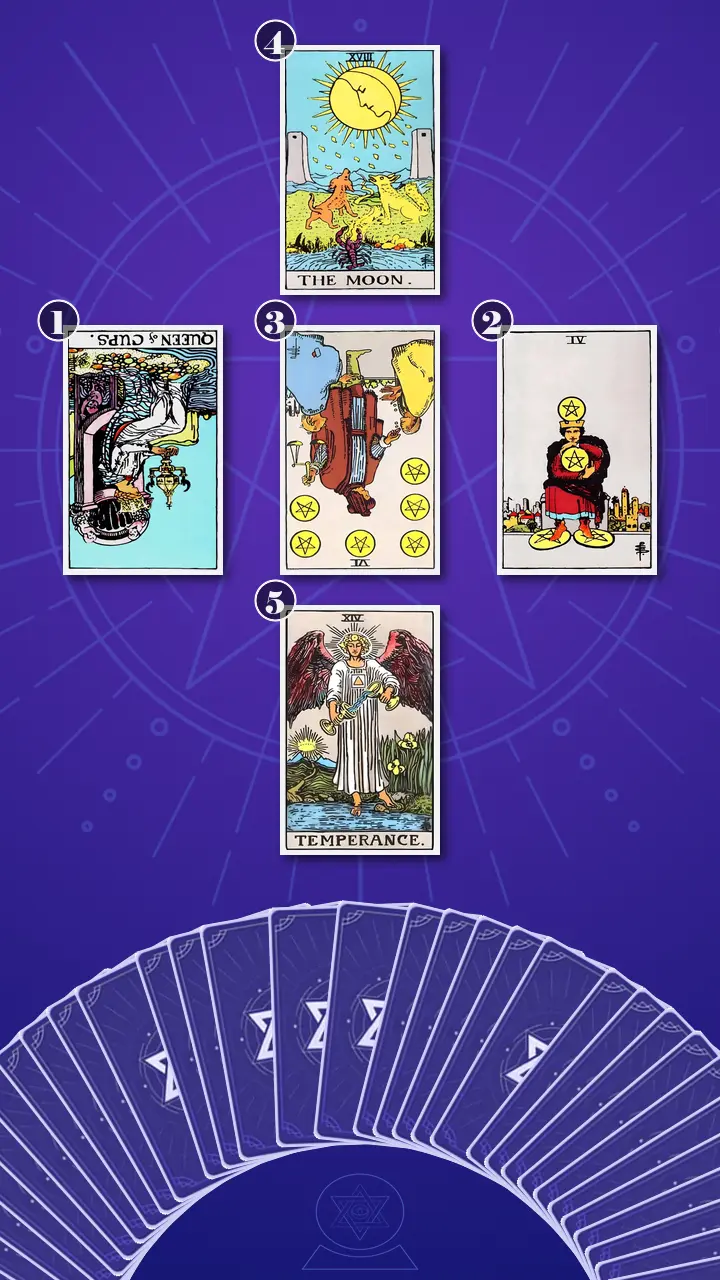
I chose a five-card Relationship Spread. For anyone wondering how tarot works in a friendship-boundaries reading, this spread was useful because it separated five things Maya had been blending together: her own behavior, the guarded behavior she could actually observe, the exchange created between those two styles, the uncertainty underneath it, and the direction she could choose next.
I placed the third card at the center. Maya's openness would sit to the left and the friend's visible pace to the right. Above the center would be the interpretive fog; below it, the grounding response. The shape resembled a balance suspended between two people, but I reminded Maya that I would not use the friend's card to claim access to private motives. Reserve is observable. The reason for it may remain unknown.
“The first card will show what you contribute when warmth appears,” I explained. “The second will describe the pace you encounter. The middle card will expose what those two styles create together. Then we'll look at why uncertainty becomes so difficult and what paced, self-led openness could look like instead.”
The Cup, the Locked Heart, and the Invisible Invoice
Position 1: The Lidded Cup Turned Upside Down
The card I turned over first represented Maya's contribution to the pattern: revealing personal secrets early in an attempt to establish closeness. It was the Queen of Cups, reversed.
I pointed to the Queen's uniquely ornate cup. Unlike the open vessels on many other cards, hers has a lid. I read that detail as discernment, not secrecy. The contents matter, and so does the choice of when, how, and with whom to open them.
Reversed, the Queen showed Water energy in excess and without a reliable container. Maya's emotional depth was not the flaw. The difficulty appeared when one unusually warm conversation made the lid feel unnecessary. At 11:48 p.m., after only a few meaningful exchanges, she had opened level-five private material because the friend's attention felt like a rare chance to discover whether the friendship was real.
“The thought underneath the voice note sounds something like this,” I said. “If I show them the real thing now, then I'll know where we stand.”
Maya gave a short laugh with a bitter edge. Her fingers tightened around the phone, her eyes dropped to the card, and then her mouth pulled into a small, reluctant smile.
“That's painfully accurate,” she said. “Maybe a little brutal.”
“Then let's be precise without being cruel,” I replied. “You weren't fabricating intimacy. You were trying to reduce uncertainty with the tool you trust most: sincerity. The card is asking whether a disclosure expresses something you freely want known or tests what the other person will do. Both motives can exist at once, but only one leaves you dependent on their reply.”
The Queen also warned against the opposite overcorrection. After feeling exposed, Maya sometimes became clipped and detached at the next meetup. I told her that closing the cup permanently would not restore choice. It would simply replace uncontained openness with emotional absence. Privacy is not dishonesty; it is pacing.
Position 2: A Privacy Setting, Not a Verdict
The card I turned over next represented the guarded behavior Maya encountered and the effect of that slower disclosure pace on her. It was the Four of Pentacles, upright.
The figure held one pentacle tightly over the heart and pinned two beneath the feet. I saw controlled Earth energy: access managed carefully, stability protected, personal history kept within chosen limits. In Maya's real conversation, this looked like a friend responding kindly, keeping the details of her own life private, and not answering a personal follow-up with an equivalent confession.
“What did she visibly do?” I asked.
“She reacted with a heart. She said the situation sounded hard and that she was sending love. Then she answered something else we'd been talking about.”
“And what did your mind add?”
Maya looked toward the window. “That she was uncomfortable. Or that she didn't trust me. Or that I had changed how she saw me.”
I tapped the pentacle over the figure's heart. “This card is a privacy setting, not automatically a negative review of the person requesting access. Her visible behavior says, This is the amount of access I am choosing right now. It doesn't tell us whether she dislikes you, lacks depth, or will never become closer.”
I let the distinction settle before adding, “Their privacy is information about pace, not proof of your unworthiness.”
Maya's grip loosened. She did not look relieved exactly. I saw recognition arrive first, followed by a quieter sadness, as if respecting another person's pace also meant surrendering the fantasy that the right disclosure could make closeness happen on demand.
Position 3: The Friendship Spreadsheet No One Agreed To
The card at the center represented the pattern created when accelerated vulnerability met guardedness: an uneven exchange carrying an unspoken expectation of reciprocity. It was the Six of Pentacles, reversed.
The scales in the card offered an exact picture of what happened on Maya's phone. On one side sat a four-minute voice note containing a secret. On the other sat a heart reaction and one supportive sentence. Her mind began comparing duration, sensitivity, response time, and emotional intensity, as if the friendship used a hidden formula for “matching energy.”
“I gave them this,” I said, voicing the calculation I could hear in her story. “So why am I still outside?”
Maya stopped moving. For a moment her index finger hovered over the dark screen. Then she nodded once.
“I almost wrote, What about you?” she admitted. “I told myself I was curious, but I also wanted her to give me something back so I wouldn't feel ridiculous.”
The reversed Six showed a blockage in reciprocity. Openness had begun to function like a trade offer whose expected return was never stated. The friend had not agreed that receiving one secret meant supplying another, yet Maya's sense of safety had become tied to that repayment.
“A secret stops feeling freely given when it arrives with an invisible invoice,” I said.
Her stomach visibly tightened beneath her crossed arms. Her gaze lost focus as she replayed the exchange, and then she released a low breath that sounded almost like an embarrassed “oh.”
I did not ask her to deny the wish for reciprocity. Mutual investment matters. I asked her to distinguish two impulses: “Part of me wants to know them, and part of me wants my disclosure repaid.” The first could remain curious. The second needed to be noticed before it typed another question.
This was the catalyst in the spread. Change did not require a better reply. It began when Maya could see the hidden expectation while it was still optional.
Position 4: The Tunnel Between Two Meetups
The card I turned over above the center represented the deeper challenge maintaining the pattern: difficulty tolerating ambiguity and the tendency to fill relational gaps with assumptions. It was The Moon, upright.
The narrow path disappeared between two towers while a dog and a wolf reacted beneath the moonlight. The card carried uncertain Water, not as a prediction of deception, but as a picture of what limited information feels like when the body wants an answer immediately.
Maya told me about reading the same reply at 8:12 the next morning on Line 1. The train was approaching Bloor-Yonge; the brakes shrieked against the rails, and burnt coffee drifted from a commuter's cup. Between Slack notifications, she kept pulling down on the chat as if refreshing could produce a clearer meaning.
One internal story said, “She's pulling away.” The other said, “She feels close but can't express it.” The stories appeared opposite, but I showed Maya the missing fact underneath both: she did not yet know what the friendship meant to the other person.
A passing cloud dimmed the room as I spoke, and the pale reflection on The Moon card narrowed until its path looked almost submerged. I thought of the waiting periods between scheduled adult-friendship meetups in Toronto, when a calendar gap can become an algorithm that repeatedly recommends the most emotionally charged explanation.
“A read receipt is a low-resolution signal,” I said. “Your mind keeps trying to upscale it into a complete story. But a warm moment is data, not a deadline.”
I asked Maya to separate what she had observed from what she had inferred. She had observed a brief, kind reply and a topic change. She had inferred discomfort, rejection, hidden intimacy, and a shrinking future. None of those possibilities had enough evidence yet.
Her shoulders lowered by a fraction. I could see that uncertainty still felt like standing in a subway tunnel without an arrival display, but it no longer had to masquerade as confirmed rejection.
When Temperance Made Room to Breathe
Position 5: The Vulnerability Dial
The room became unusually still when I reached the card below the center, the position offering Maya a constructive, self-led direction. I turned over Temperance, upright.
The angel moved a steady stream between two cups, with one foot in water and one on land. I read this as balanced energy: emotional honesty remaining connected to consent, observable behavior, and time. Temperance did not ask Maya to become colder. It offered a third option between spilling everything and locking everything away.
In ordinary life, the card looked like Maya sharing one low-stakes but genuine layer and then asking, “I have something a little personal related to that. Do you have bandwidth for it, or should we keep things light tonight?” If the friend said yes, Maya could still choose how much to share. If the answer was hesitant, she could stop without treating the pause as rejection.
I could still feel the 11:48 p.m. scene hanging over the table. The voice note was already sent. The heart and one kind sentence had appeared. Maya's stomach had tightened, and her old strategy insisted that the only way to repair the imbalance was to explain herself again.
You do not have to trade your deepest material for certainty; trust can grow one chosen layer and one reciprocal interaction at a time.
You do not have to pour out everything to earn closeness; mix honesty with pacing, as Temperance moves water steadily between two cups.
I paused. In my fifteen years as a perfumer, I had learned that emptying a bottle onto a blotter does not reveal a fragrance more honestly. It overwhelms the structure. One measured drop, given air and time, allows each note to become legible.
I call the relational version of that assessment my Boundary Permeability Diagnosis. I usually use it to notice when another person's emotional material is bleeding into someone's private space. Here, it revealed an inverse pressure: the friend's guarded pace was entering Maya's psychological atmosphere so completely that Maya abandoned her own measure. Her disclosures were no longer calibrated by what she wanted to share. They were being calibrated by how urgently she wanted the other person to open.
“Your boundary isn't only the right to say no to someone else's access,” I told her. “It is also your right to decide that another person's reserve will not rush you into granting access to yourself.”
Maya's breath stopped first. Her fingers remained suspended above her phone, and her pupils widened as if I had turned on a light she had not expected. Then her eyes drifted away from the cards. I watched her replay a Friday night at a west-end bar, where one quiet family detail from her friend had sent warmth through her chest and pulled her toward her own deepest story.
“But doesn't that mean I've been wrong about honesty this whole time?” she asked. The first edge in her voice was anger; beneath it I heard grief.
“It means the strategy became expensive,” I said. “It doesn't mean your desire to be known was wrong.”
Her jaw unclenched. One shoulder dropped, then the other. She drew a breath that trembled on the way out, and moisture gathered along her lower eyelids without becoming tears. Relief arrived, but so did a moment of blankness. If she could no longer use a secret to force clarity, she would have to tolerate the vulnerable responsibility of choosing what came next.
I asked, “Now, with this new perspective, think back to last week. Was there a moment when one chosen layer would have let you feel real without making that conversation decide the whole friendship?”
“At the bar,” she said quietly. “I could have said that family stuff is complicated for me too. I didn't have to tell the whole story. I could have let that be enough.”
That answer marked the first real crossing in our Journey to Clarity: from urgency-driven oversharing and reply monitoring toward paced openness, relational discernment, and steadier self-trust. Privacy and authenticity had stopped being opposites. Maya could be real without making one moment define whether she belonged.
The Space Calibration Ritual
I drew the five cards together into one story. The Queen showed a rich emotional life opening faster than trust could support. The Four showed the slower, protected pace Maya encountered. Their collision produced the reversed Six, where vulnerability became an implicit exchange. The Moon then filled the waiting period with stories, while Temperance restored a measured channel between honesty and evidence.
The blind spot was not simply “poor boundaries.” Maya had been trying to solve emotional uncertainty with more emotional volume. She assumed that being authentic meant granting immediate access and that reciprocity should arrive as an equally intense confession. The spread showed another definition: mutual care might appear as consistency, remembered details, respected limits, initiated plans, and gradual openness across repeated interactions.
I translated Temperance into what I call the Space Calibration Ritual. In perfumery, blank air is part of the composition; without space, even beautiful notes become indistinguishable. Maya needed deliberate digital and physical blank spaces in which a warm interaction could breathe before she added more material.
- Use the Seven-Minute Vulnerability Dial Before sending one personal voice note to a newer friend, open Notes, set a seven-minute timer, and rate the disclosure from one to five in sensitivity. Share only a level one or two unless comparable trust has developed over time. If the topic is sensitive, ask: “Do you have bandwidth for something a little personal, or should we keep it light?” Minimum version: take one breath, choose a sensitivity number, and remove one layer before sending. A yes to the topic is not unlimited consent to every detail.
- Create a Three-Interaction Reciprocity Check After sharing something personal, do not request an equivalent secret. Across the next three interactions, record only observable care: whether the friend follows through, respects a boundary, remembers a detail, initiates contact, or shares at her own pace. Write one observable action and wait for the next interaction before reaching a conclusion. If the note starts feeling like surveillance or scorekeeping, close it.
- Leave Digital Blank Space After a Brief Reply When a short message activates the urge to explain more, make two columns titled “What I observed” and “What my mind added.” Spend no more than three minutes on them, then choose one time to check the chat again and place the phone out of reach until then. One fact and one interpretation are enough. The exercise is not meant to invalidate a real boundary signal; it prevents uncertainty from automatically becoming a verdict.
I made one final distinction for Maya. Pacing was not a technique for persuading guarded friends to open eventually. It was a way for her to remain the owner of her disclosures regardless of what someone else chose. The cards had identified a pattern, but they held no authority over her next message. That authority belonged to her.

A Week Later, One Chosen Layer
Six days later, I received a message from Maya. A newer friend had mentioned a difficult week, and Maya had felt the familiar warmth rise through her chest. This time, she shared one manageable sentence about having struggled with something similar. Then she asked whether her friend wanted to go deeper or keep the evening light.
The friend chose light. Maya noticed the old drop in her stomach, but she did not negotiate, explain, or send part two. They ordered food, talked about work, and made a plan for coffee the following weekend.
Maya slept through the night. At breakfast, her first thought was still, “What if I got it wrong?” She noticed it, smiled once, and left the chat unopened while the kettle boiled.
I did not consider the reading successful because the friend made another plan or because the relationship might deepen. The quiet proof was Maya's ability to remain honest without handing one conversation responsibility for her belonging. She had not solved friendship uncertainty. She had recovered choice inside it.
That is what this five-card Relationship Spread ultimately offered: not a prediction about a guarded friend, but a way to see the difference between emotional depth and emotional urgency. The cards were the map. Maya was the person who decided how to walk through the uncertainty.
When one warm reply sends a rush through your chest and speeds up your words, giving away the whole secret can feel less frightening than waiting to learn whether the closeness is mutual. If that is where you find yourself tonight, remember the measured stream between Temperance's cups. Noticing the urge means you are already holding the dial.
If closeness did not have to be settled tonight, what one measured drop of honesty might feel like enough for this conversation?