Oversharing With New Friends: Letting Reciprocity Set the Pace

The 8:47 PM TTC Ride Home With the Whole Story
I recognized Maya's question before she finished asking it: why did she keep oversharing with new friends? Maya, a 27-year-old junior product designer in Toronto, had described an after-work drink near King Street West. At 6:40 PM, a new acquaintance asked how her year had been. Before the ice in her glass melted, Maya had moved through a breakup, a private insecurity, and a conflict with an old friend. Her speech kept accelerating even while she could hear herself going too far.
At 8:47 PM, she sat on a northbound Line 1 train from Union Station, scrolling through the new friend's Instagram profile. The carriage lights buzzed above her, the phone warmed her palm, and the train rocked through the tunnel while she drafted and deleted Sorry if that was a lot. Her stomach had tightened; her shoulders were still raised from the conversation. She wanted to be known as genuine, then suddenly wanted to take every sentence back before the other person decided what it meant.
Her longing felt like a train pulling out of the station while another part of her ran along the platform, throwing her entire suitcase through the closing doors. She wanted close new friendships, but she feared trust would not develop unless she accelerated intimacy through disclosure. I had spent years on Wall Street, so I knew the dead-of-night weight of uncertainty and the urge to make one decisive move simply to stop feeling exposed to every possible outcome.
I told her, You are not oversharing because you have nothing to protect; you may be trying to make belonging arrive faster. I would not treat the cards as a verdict, and I would not ask her to become colder or less candid. I wanted to help her separate what had actually happened from what fear had predicted, then draw a practical map from premature vulnerability toward paced trust. We would look for clarity together, while keeping the decision-making power where it belonged: with Maya.

Choosing a Compass: The Five-Card Shadow Spread
I asked Maya to put her phone face down, name the question in one sentence, and take three unforced breaths. I shuffled slowly. The short ritual was a psychological transition, a way to move attention from the replaying train ride into the present room, not an appeal to a supernatural authority.
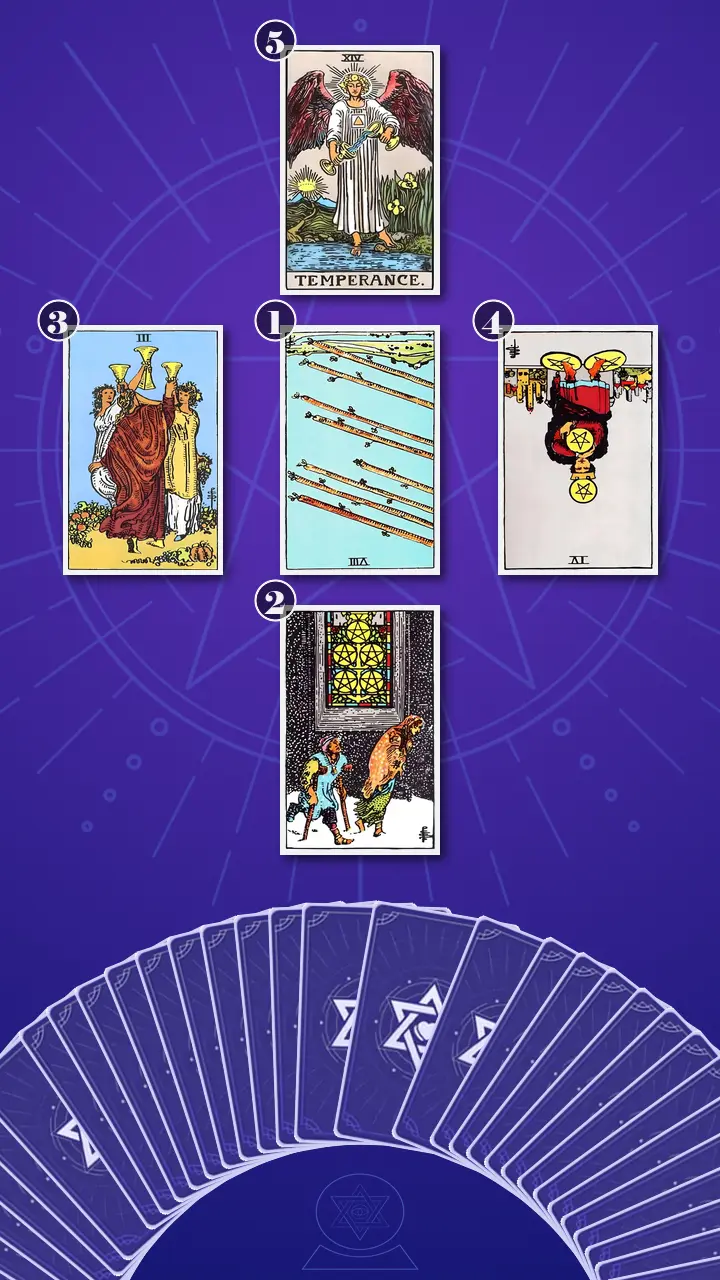
I chose the five-card Shadow Spread, a compact F5 Inner Excavation layout for questions about a repeated personal pattern. For anyone wondering how tarot works in a situation like this, the spread does not predict whether a particular new friend will stay. It maps the visible behaviour, the hidden fear beneath it, the social cue that activates it, the protective strategy that keeps it going, and the practice that can integrate the pattern. That makes it useful for understanding card meanings in context rather than collecting generic definitions.
I explained that the first card would show the conscious pattern, the rapid disclosure followed by message replay or withdrawal. The card beneath it would reveal the hidden root, the fear that slow trust might never become belonging. The side cards would show the activating warmth and the defensive blind spot. The card above the centre would offer an integration path: a way to stay open while allowing reciprocity and consistency to earn deeper access.
The Words That Outran the Pause
The Conscious Pattern: Eight of Wands, Reversed
I turned the card representing the conscious pattern, the observable sequence in which one sign of warmth led to several layers of disclosure. The card was the Eight of Wands, reversed position.
The eight wands were already airborne, crossing an open sky with no visible speaker or receiver directing them. I read that image as communication moving faster than conscious choice. In a Toronto bar or an office kitchen, Maya could answer one ordinary question, notice a flicker of warmth, and send several increasingly private details into the conversation before checking whether the other person was listening with care or merely being polite. It was not simply talking too much. It was hearing her own words gather momentum while her judgment was still trying to catch up, like an unmoderated voice note that had already gone on for five minutes.
Reversed fire showed excess speed and deficient discernment. The energy was not absent; it was poorly directed. The first physical cue was useful evidence: faster speech, restless hands, a second explanation arriving before the first had been received. I told Maya that the acceleration itself could become an early-warning signal, a small gap in which she could take a sip of water, breathe, and decide whether another detail was genuinely chosen.
Maya did not nod in agreement. First, her breath stopped and her fingers froze around the edge of her phone. Then her eyes lost focus, as if she were replaying the bar conversation sentence by sentence. Finally, she gave a dry, almost embarrassed laugh and said, That is almost rude. I can hear myself going too far, but silence feels worse. I let the laugh stand. Her reaction told me that the pattern had become visible without making her wrong for having it.
The Hidden Root: Five of Pentacles, Upright
I turned the card beneath the centre, representing the hidden root and the fear supplying the speed. The card was the Five of Pentacles, upright position.
Two figures moved through falling snow outside an illuminated stained-glass window. Help appeared to exist, yet their attention remained fixed on hardship and difficult movement. I connected the image to a familiar Toronto moment: a new friend sends a friendly but brief reply, writes Good seeing you, let's do coffee sometime, and does not suggest a day until the following week. Maya notices the delay beside her open Figma file and overlooks the invitation already present in the message.
The Five of Pentacles showed an earth-based scarcity lens, not a prediction of rejection. A delayed reply can feel like exclusion without being evidence of exclusion. The hidden line underneath the urgency was, They were only being polite; I have to secure this before it disappears. Immediate disclosure became an imagined admission ticket to a lit room, a way to prove that she belonged before the relationship had developed enough evidence to say anything reliable.
I asked Maya to reread the actual text and name only what the other person had done. Her shoulders lifted once, then lowered. She looked at the invitation for a long moment and said, The welcome was there. I was measuring the missing enthusiasm instead. I could see a little room opening between fear and fact, although the room still felt unfamiliar to her.
The Activating Trigger: Three of Cups, Upright
I moved to the card on the left, representing the activating trigger: early social warmth, a shared joke, or one vulnerable anecdote that Maya interpreted as permission for immediate intimacy. The card was the Three of Cups, upright position.
Three figures raised three separate cups in a circle. The moment was genuinely joyful, but nobody had merged into a single body or surrendered their own history. I told Maya that this card protected something important: her desire for friendship was real. An easy coffee conversation, a laugh at a fitness class, or a new acquaintance sharing one honest story could create genuine chemistry. The problem began when warmth was upgraded into established intimacy before repeated experience supported that conclusion.
Upright water brought connection, emotional exchange, and social ease. In balance, it allowed Maya to enjoy the good moment as it was. In excess, it made one personal anecdote feel like a request for the extended director's cut of her own life. The separate cups offered a practical image: two people could share an emotionally warm moment while remaining distinct people with distinct boundaries.
Maya rubbed her thumb against the edge of the card. One honest question can make me act like we have known each other for years, she said. I asked her to notice the exact switch: was it the question, the other person's warmth, the pause afterward, or the fear that the moment would become forgettable? She did not answer immediately, but she stopped trying to fill the silence.
The Protective Strategy and Blind Spot: Four of Pentacles, Reversed
I crossed back through the centre and turned the card on the right, representing the protective strategy and its blind spot. The card was the Four of Pentacles, reversed position.
The figure on the card clutched one pentacle to the chest while pinning two beneath the feet. Reversed, the hold became unstable and swung into over-release. I connected it to the phone privacy settings Maya had described: public or deleted, with no middle option for selected access. She decided that keeping one topic private would make her look guarded, so when a new friend shared a small story about family stress, Maya answered with the complete version of her own story and then asked whether she had made things uncomfortable.
The energy here was excess release, deficient containment, and a blockage around measured boundaries. Maya was trying to protect herself from being seen as cold, but the strategy placed emotional weight on a relationship that was still forming. Afterward, she tried to regain control through one-word replies, delayed responses, or cancelling the next low-pressure plan. The withdrawal did not prove that she wanted less connection; it was the recoil after feeling exposed.
I said, A boundary is not a wall. It is a valve. Maya's face flushed. She held the card more tightly, then placed it flat on the table. If I do not tell them everything, they will think there is nothing underneath, she said. I answered that privacy could be timing rather than concealment, and that an honest boundary could reveal useful information about how the other person responded.
When Temperance Slowed the Pour
The Integration Path: Temperance, Upright
The room became quieter as I reached for the card above the centre, the integration path and key card of the reading. I turned it over. Temperance appeared upright.
One foot stood on land and one in water while a measured stream moved between two cups. Behind the figure, a narrow path led toward a bright horizon. I read the image as paced vulnerability: honesty, boundaries, reciprocity, and time working together instead of competing. In the modern scene, Maya answered a personal question with one truthful layer, took three breaths while the espresso machine hissed behind the counter, and asked, What made that experience important to you? She stayed candid without treating total access as the price of admission.
Temperance did not ask her to become private, detached, or strategically unavailable. It offered a dimmer switch rather than an on-off switch. The fox in The Little Prince came to mind, not because friendship needed to become a performance, but because repeated visits, recognizable rituals, and time create a kind of trust that a single intense conversation cannot manufacture.
At my old Wall Street desk, I learned to separate a powerful feeling from the signals that could actually support a decision. I use a similar lens here, which I call Reciprocity ROI Analysis. I do not reduce friendship to a balance sheet. I simply ask whether the emotional exchange is doing what Maya hopes: Did the person ask a respectful follow-up? Did they offer something of comparable depth? Did they suggest or keep a future plan? Those observable signs cannot guarantee safety, but they can help distinguish genuine reciprocity from the urgency to secure belonging.
Maya was still inside the old bargain: if she wanted to be real, she had to hand over the whole diary before knowing whether the other person would return the bookmark. The bar was loud, the ice was melting, and her answer had already become three private stories. She wanted connection, but the speed had made her feel less in control.
Closeness is not proven by pouring out everything at once; it is built by mixing honesty with pacing, like Temperance moving water carefully between two cups.
I let the sentence settle between us, then gave the practical centre of the card its full shape.
You do not have to reveal everything to prove that you are available for real friendship. Share one honest layer, then let repeated reciprocity determine the next.
For a moment Maya did not move. Her breath caught and her fingers stopped above her phone. Then her eyes lost focus, replaying the bar: the casual question, the melting ice, and her own voice adding one more detail. A flush rose across her cheeks. She looked down, unclenched her right hand, and let out a low breath that sounded almost like a laugh. Her shoulders dropped, but the new space seemed to unsettle her; clarity had removed a railing she had been leaning on. When she spoke, her voice was quiet and slightly unsteady: So I can be real without handing over the entire file. I let the silence stay ordinary. The radiator clicked, and traffic moved beyond the window. Then I asked, Now, with this new view, can you think of one moment last week when this distinction might have changed what you did next?
She remembered a coffee chat where she had started with one story about a difficult design review, then added the breakup, the old friendship conflict, and an apology text before the other person could answer. This was the first step from urgent disclosure and post-conversation embarrassment toward paced openness and confidence in gradual trust. It was not a personality transplant or a promise that regret would never return. It was a new coordination skill: I can be honest without giving access to everything.
The Valve Between Honesty and Access
When I placed the five cards together, I could see one coherent story. The distance from Maya's longest-standing friends had made in-person belonging feel scarce. Reversed fire in the Eight of Wands pushed words ahead of choice. The Five of Pentacles showed the fear underneath, turning ordinary uncertainty into a threat of being left outside. The Three of Cups confirmed that warmth and chemistry were genuine, while the reversed Four of Pentacles showed the failed attempt to secure that warmth by releasing everything and then withdrawing. Temperance offered a different architecture: emotion could flow through a valve, at a rate that real trust could support.
Maya's cognitive blind spot was not that she cared too much or that she was incapable of boundaries. It was the false binary beneath the pattern: privacy meant rejection, openness meant total disclosure, and chemistry counted as evidence of trust. I also used my Sunk-Cost Decoupling in Loyalty lens to separate the history of her old friendships from the current reality of a new acquaintance. Missing a ten-year rhythm did not mean a new person had to carry ten years of emotional context in one evening.
The transformation direction was clear. Vulnerability would stop functioning as a shortcut to closeness and become a paced exchange. Maya could share one honest layer, check reciprocity, and let consistent behaviour earn deeper access over time. She would not need to predict whether a new friendship would last. She would only need to choose the next layer based on what had actually been demonstrated.
Small Experiments for the Next Conversation
I gave Maya actionable advice that was small enough to try during a real coffee, drinks meetup, fitness class conversation, or Bumble For Friends chat. The aim was not perfect control. It was to create a little space between warmth and automatic disclosure.
- The One-Layer Reciprocity CheckAt the next new-friend conversation, answer one personal question in two or three honest sentences. Pause for three breaths, then ask one reciprocal question such as What was that like for you? or How did you end up feeling about it? Wait for the answer before adding another layer.If three breaths feels too visible, take two while sipping water or looking at the menu. Afterward, record only the facts: what you shared, how the person responded, and whether they showed curiosity or care. Leave predictions about what they secretly think out of the note.
- The Earned-Trust Topic MapBefore one social plan this week, make a three-column note in your phone titled Public, Personal, and Earned Trust. Add three possible topics to each column. During the first or second meetup, choose from Public or Personal unless consistent plans, discretion, reciprocal sharing, and respectful boundaries have already made a deeper topic feel earned.Keep the note to nine topic words so it works as a menu rather than a rulebook. If you want to hold something back, say, I have more to say about that, but I might save it for another time. That keeps warmth while leaving the timing yours.
- Evidence Before the Apology TextAfter a vulnerable conversation, name three observable signs before sending a message that begins with an apology: Did the person ask a follow-up? Did they share something of similar weight? Did they suggest or keep a future plan? Wait at least twenty minutes before sending any explanation, then continue normally if you still want contact.If repeated interactions show low reciprocity or a person ignores a reasonable boundary, use my Friendship Downgrade Strategy: keep replies cordial but shorter, choose lower-stakes plans, and stop offering deeper access without creating a dramatic confrontation. It is a way to match access to evidence, not a punishment and not a demand to stay.
I reminded Maya that a pause was not a test she had to pass. It was a shared space where both people could decide what came next. Let the next layer be earned by consistency, not demanded by chemistry.

A Small Proof on the Next Train
Six days later, I received a message from Maya after coffee with someone she had met through a fitness class. She had answered one personal question honestly, stopped, asked a reciprocal question, and kept a deeper story for another time. The other person had followed up with care and suggested a second plan, but Maya still checked the message twice before putting her phone away.
She slept through the night, woke with the thought What if I get this wrong?, smiled at it, and went to coffee anyway. The fear had not vanished; it had simply stopped driving the train. That was the small proof I was looking for: not that Maya had solved friendship, but that she had stayed present long enough for ordinary consistency to become information.
I told her that the cards had not created her clarity. They had made the pattern easier to see, then helped her test a different response. The journey had moved from urgent disclosure and the shame that followed toward a steadier confidence in gradual trust. Maya remained warm, candid, and fully herself. She was also becoming the person who chose how much access to give.
When a new friendship feels promising, your words can speed up while your stomach tightens, as if giving away the whole story might keep the door from closing before you have found out whether you truly belong.
If one honest layer could be enough for tonight, what small sign of reciprocity would you feel curious to notice next?