Finding Clarity in the 11:40 p.m. Caretaker Shift
I have learned that a person can hold firm boundaries with newer friends and still slip back into the caretaker role the second an old university group chat uses a familiar nickname. In Maya’s case, caretaker-role regression and over-functioning in long-term friendships could begin with one late-night notification.
Maya, a 29-year-old UX researcher in Toronto, showed me a screenshot timestamped 11:40 p.m. She had opened WhatsApp in her West End apartment intending to send one quick reply. Forty minutes later, six calendar screenshots filled the chat, OpenTable glowed in another tab, and three private check-ins waited in draft. The kettle behind her had clicked off and gone cold. Blue phone light warmed her palm while her shoulders crept towards her ears.
“I know they didn’t ask me to fix it,” she said, pressing one thumb into the centre of her other palm. “But I can already see what needs doing. If I leave it, I feel irresponsible. Then I’m annoyed that nobody helps me, which makes me feel awful because I love them.”
I heard affection, guilt, and resentment sharing the same small room. Obligation seemed to lock across her chest like a seat belt bracing for an impact that had not happened. She wanted to participate as an equal adult, but some part of her still feared that stepping out of the caretaker role would weaken her place in the group.
“So why do I become twenty-one again around them?” she asked. “Why do I have to be useful before I can just belong?”
“The strange part isn’t that you care,” I told her. “It’s how quickly care becomes a job you never agreed to take. I’m not going to use the cards to judge your friends or predict whether they will stay. I want us to map the moment when warmth becomes vigilance, and find the place where your present-day choice can return.”

Choosing the Two-Bank Map
I invited Maya to take one slow breath and hold the question without trying to solve it. I shuffled while she lowered both feet to the floor. I treat this small ritual as a change of attention, not a performance of certainty: it gives the nervous system a moment to stop answering before the inquiry has begun.
I chose the Relationship Spread · Context Edition, a six-card contextualized Relationship tarot spread for old-friend roles, boundaries, and reciprocity. I chose it because Maya’s question contained several different strands: her observable over-giving, the historical cues activated by the group, the affection that was still genuine, the fearful rule beneath her behaviour, the boundary practice that could interrupt it, and the possibility of more mutual participation.
I also wanted the reading to remain ethically precise. The second position would show what the old-friend context activated in Maya; I would not claim to know what several absent people privately intended. The first card would describe her current role, the fourth would uncover why that role felt compulsory, and the fifth would offer the central resource. The final position would describe qualities Maya could practise, not a guaranteed outcome.
I laid the cards in two horizontal rows. The upper bank held the inherited pattern; the lower bank held the path towards conscious participation. Between them, the eye would travel like a person testing stepping stones rather than waiting for a bridge to appear.
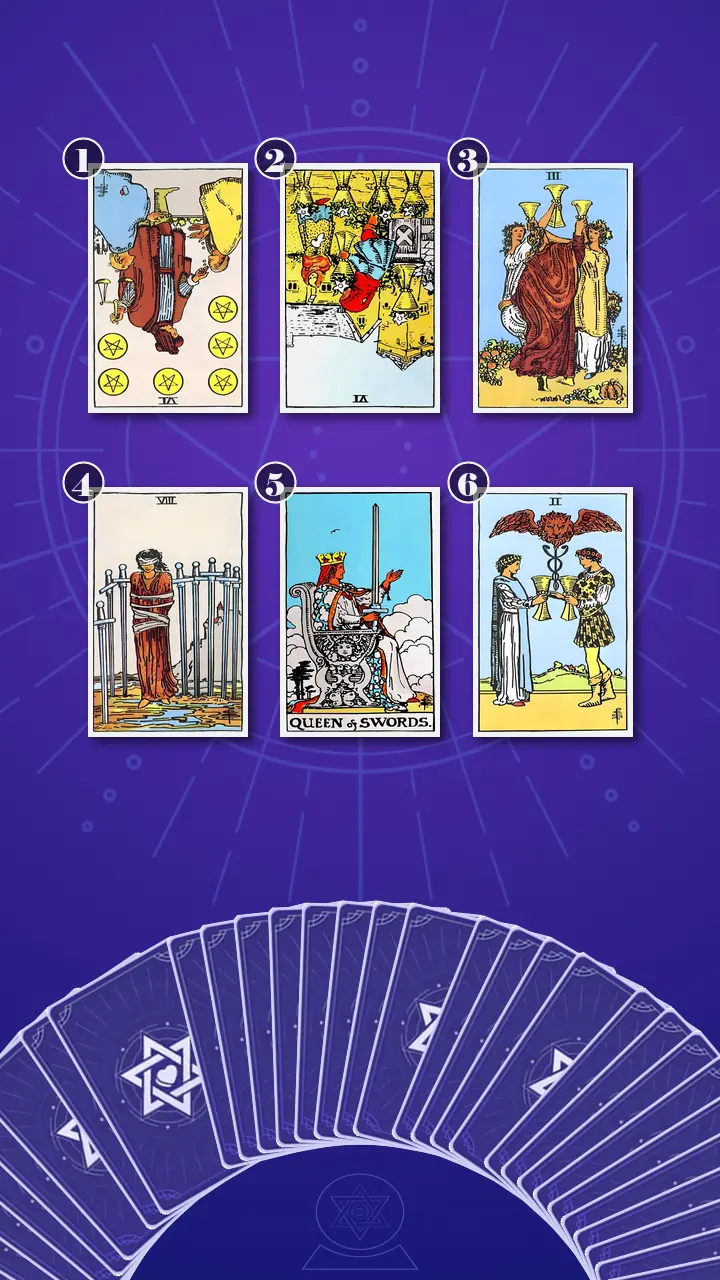
Where Care Became a Job
Position One: The Invisible Planning Dashboard
I turned over the card representing Maya’s observable stance: the point where she automatically became the organiser, adviser, and emotional provider around old friends. It was the Six of Pentacles, reversed.
I asked her to notice the standing figure holding both the coins and the scales. The image did not only show generosity. It showed one person becoming responsible for deciding what everyone needed and how support would be distributed.
I connected it to the Annex café scene she had described. At 4:35 p.m., a friend had casually asked when everyone was free. Before stating her own availability, Maya opened calendars, checked reservations, compared TTC routes, and privately reassured the person who disliked the first option. Nobody had assigned her the job, but taking control made her feel briefly necessary. Later, she tracked the fact that nobody had asked what worked for her, even though she had left no visible pause in which they could ask.
The reversed energy showed excess giving turning into imbalance. Maya was holding the group’s invisible planning dashboard: OpenTable open, calendar screenshots enlarged, and private check-ins queued. Her internal instruction was immediate: Nobody asked me, but I can already see what needs doing, so it feels irresponsible not to do it. Freely chosen care had become care used to secure belonging.
Maya gave one short, bitter laugh. Her fingers stopped moving over the mug in front of her. “That is too accurate. A little brutal, actually.”
“I can see why it lands hard,” I said. “The card isn’t accusing you of giving too much love. It is showing how taking charge can create the very hierarchy you later resent. Care is an offer, not proof of membership.”
Position Two: The Old Login Restores Its Permissions
I turned over the card representing what the old-friend group context activated in Maya, especially the historical cues that returned her to an earlier identity. It was the Six of Cups, reversed.
I described the enclosed courtyard on the card as a familiar interface. An old university nickname flashes above a distressed message, and Maya answers as the twenty-one-year-old fixer before checking her current workload, energy, or preference. The warmth is real, but the old language functions like a legacy login restoring outdated administrator permissions.
Here, Water was flowing backwards as a blockage. Memory was not the enemy; the problem was that familiarity bypassed present-day consent. Rejecting every reunion would only create another extreme. The invitation was to let one current need or quality enter the conversation early enough for her friends to receive new information about who she had become.
Having moved across cultures myself, I have often noticed how quickly an old role can survive a new city, job, vocabulary, or postcode. A person’s life may have changed completely while one familiar room still opens an outdated social script. Familiarity can make an old role feel like a current obligation.
Maya’s breath paused. Her gaze drifted away from the card as though she were seeing an old university kitchen rather than my table. Then her thumb loosened against her palm.
“I know who I am now,” she said quietly. “So why did I answer like the old reliable version of me? Every reunion makes me feel twenty-one again.”
I asked, “The next time that nickname appears, what could the present-day Maya say before the reliable one starts assigning herself tasks?”
Position Three: The Friendship Beneath the Function
I turned over the card representing the genuine foundation beneath the role: shared affection, enjoyment, and belonging that did not require Maya to manage anyone. It was the Three of Cups, upright.
I pointed to the three cups meeting at equal height. Maya remembered a dinner when the group laughed about their disastrous university flat, traded music recommendations, celebrated a new job, and passed around someone else’s dessert. For several minutes, she had not been organising or counselling. She had been making a joke, tasting lemon tart, and occupying her place in the circle.
This card carried a more balanced expression of Water. It did not tell me the friendships were perfect, and it did not erase the unequal labour. It supplied observable evidence that affection existed beyond Maya’s service role. I thought of the evolving friendships in Insecure: shared history can remain meaningful even when the roles attached to it stop fitting cleanly.
Her mouth softened into a smile, though her eyes stayed wet. “That’s what makes this complicated. I don’t want to leave them. I actually like us when nobody needs me to run the room.”
“Then we don’t have to confuse updating the relationship with rejecting its history,” I said. “This card lets us protect what is alive without preserving every old assignment.”
The Trap With More Than Two Exits
Position Four: Rescue or Abandonment
I turned over the card representing the underlying fear that made the caretaker role feel compulsory: Maya’s belief that there was no safe way to stop being useful. It was the Eight of Swords, upright.
I brought her to another scene she had shared. On a crowded Line 1 train, an old friend’s message appeared: “Sorry, I am spiralling.” The brakes screeched, a damp coat pressed against her sleeve, and her chest braced before she reached the second line. In her mind, two response buttons appeared: fix everything now, or become a bad friend who abandons people.
The Eight of Swords showed blocked perspective. The blindfold mirrored tunnel vision, but the loose bindings and incomplete enclosure mattered just as much. Listening briefly, asking what support was wanted, replying after dinner, suggesting another resource, or declining a practical task were all available. Fear had removed those middle options from the menu.
“When you imagine waiting an hour before replying,” I asked, “what is the exact ending your mind predicts?”
First, Maya’s chest held still. Then her eyes lost focus as if an old sequence were replaying behind them. Finally, she exhaled through her nose and said, “They’ll realise I’m not as caring as they thought. Or they’ll stop coming to me, and then I won’t know what my role is.”
I let the sentence remain between us. “That is the binding,” I said. “Not your affection. The rule that affection only counts when you become responsible for the outcome. If the only visible routes are rescue and abandonment, your internal transit app is hiding the local stops called listen, ask, delay, and decline.”
When the Queen Raised Both Sword and Hand
Position Five: The Boundary That Does Not Withdraw Love
The room became unusually quiet as I turned over the card representing the insight capable of restoring clarity and balance. Even the rain against the window seemed to thin. The card was the Queen of Swords, upright.
I showed Maya the Queen’s upright sword and open palm. One established a precise line; the other remained receptive. In contemporary terms, this was Maya typing at 10:58 p.m.: “I care about what is happening. I can listen for ten minutes, but I cannot organise the next step tonight.” She did not add a five-line apology, offer three substitute services, or disappear after sending it. Her limit defined her participation while leaving the other adult ownership of the situation.
I returned her to the scene she had described: it was 11:40 p.m. She had meant to send one line, but the kettle had gone quiet while she compared six calendars, calmed one conflict, and drafted a private check-in. Her own unread messages were still waiting beneath the chat.
I used a Jungian diagnostic lens I call Savior Complex Auditing. I do not use it to shame generosity or attach a label to a caring person. I use it to inspect the hidden function of fixing. I asked: “Was intervention requested? Which outcome are you trying to prevent? And what would it mean about your place in the group if another adult solved this without you?”
Maya stared at the Queen’s open hand. “Fixing is how I make sure I’m still necessary,” she said. “It’s like a membership ritual.”
You do not have to manage everyone’s comfort to keep your place; the pause between caring and taking over is where equal friendship becomes possible.
You are not responsible for keeping every old friendship comfortable; name what is true, and let the Queen's raised sword separate genuine care from self-erasure.
For one beat, Maya did not move. Her breath stopped halfway in, and her fingers froze above the mug. Then her gaze slipped out of focus, as though she were replaying years of answered calls, booked tables, softened conflicts, and personal updates edited down to “I’m fine, just busy.” Her jaw tightened before anything else released.
“But doesn’t that mean I got this wrong for years?” she asked, anger briefly sharpening her voice. “That I trained everyone to expect it?”
“It means the strategy once helped you feel secure,” I replied. “It does not mean you were foolish, and it does not make every friend guilty. We’re examining what the strategy costs now.” Her clenched fingers slowly opened. Her shoulders dropped, her eyes reddened, and a trembling breath left her chest. The relief was real, but so was the slight blankness that followed: clarity had returned responsibility to her choices, and for a moment that freedom felt exposing.
“Now, with this new perspective, think back,” I said. “Was there a moment last week when this insight could have made the experience feel different?”
She remembered the Line 1 message. “I could have asked what she wanted before calling. I decided she needed a rescue before she had even finished typing.”
I invited her to open Notes and place that request under three headings: What was asked, What I automatically added, and What I freely have capacity for. Under the third, she drafted one sentence: “I can listen for ten minutes, but I cannot coordinate this tonight.” I told her she did not need to send it. If her shoulders tightened, she could stop after circling one task that had never actually been assigned to her.
The Queen represented balanced Air: thought becoming discernment, and discernment becoming direct speech. A clear sword and an open hand can belong to the same person. This was the first crossing from automatic obligation and usefulness-based belonging to clear boundaries and reciprocal friendship.
When Her Cup Entered the Room
Position Six: Reciprocity as a Practice
I turned over the card representing Maya’s self-directed integration: the qualities she could practise to build reciprocal friendship without trying to predict anyone else’s response. It was the Two of Cups, upright.
I contrasted its two figures standing at equal height with the reversed Six of Pentacles at the beginning. Here, time, attention, and emotional information could move in both directions. I pictured the one-to-one conversation Maya described wanting: she would say that work had been overwhelming and let the statement remain in the room without minimising it or switching immediately to her friend’s problems. The friend would have room to ask a question, offer support, or state their capacity. Maya’s work would be to notice the exchange without calculating how quickly she must repay it.
The card held the energy of balance, but I was careful about what that meant. It did not guarantee that every friendship would become mutual. It defined the practice Maya could test: two adults able to offer, receive, disagree, and remain visible. Reciprocity was information she could observe, not an outcome she had to manufacture.
She looked back at the first card, then at the two equal cups. Her shoulders lowered another fraction. “I can let them know me before I prove my value,” she said, testing each word.
“Exactly,” I replied. “Equal friendship starts when your cup is allowed into the room.”
The Pause-Ask-Name Reset
I read the spread back to Maya as one coherent story. Two reversed Sixes showed harmony distorted in both exchange and memory: she preserved belonging by repeating an old form of giving. The Three of Cups showed real affection beneath that function. The Eight of Swords revealed the fearful rule that made caretaking seem compulsory. The Queen restored discernment, and the Two of Cups translated that clarity into mutual participation.
The old group chat had behaved like a legacy app that still assigned Maya administrator permissions. Her cognitive blind spot was assuming that anticipatory help was neutral kindness. In practice, taking over before anyone asked made her needs invisible, prevented others from showing what they could contribute, and produced resentment that seemed to confirm she was valued only for usefulness. That did not make her friends villains. It meant the pattern could not update without new information from her.
I pointed out that there were no Wands in the spread. Insight alone would not change the habit; Maya needed one deliberate, observable experiment. Tarot had provided a map of the pattern, not a verdict about her future. She would remain the person choosing where to step.
For that experiment, I adapted my Compassionate Detachment Protocol. Its structure is simple: validate the emotion, name the support freely available, and return ownership of the remaining problem to the other adult. Compassion stays present, but responsibility becomes visible.
- Use the 10-Minute Pause-Ask-Name Check.When the next non-urgent distress message arrives, set a ten-minute timer before replying. Notice your shoulders, decide what you can offer without resentment, and then ask: “Do you want me to listen, brainstorm, or help with one practical thing?” Wait for the answer before adding services nobody requested.If ten minutes feels exposing, use one slow breath. If someone discloses an immediate safety emergency, involve appropriate crisis or emergency resources instead of becoming the sole responder.
- Send One Open-Hand Boundary.With an old friend or in the next planning thread, use one sentence that contains warmth, capacity, and a limit: “I care, and I can listen for ten minutes, but I cannot organise the next step tonight.” For plans, name your preference first: “I can do Saturday after six near the subway, but I cannot book the table.”Do not add a long apology or silently reclaim the task. The minimum version is drafting the sentence in Notes and leaving it there until you feel ready to test it.
I asked Maya to treat both actions as experiments, not loyalty tests. One response would be information about one moment, not a permanent judgment on the friendship or her worth.

A Week Later: The Unclaimed Reservation
A week later, I received a message from Maya. A friend had posted another planning question, and Maya had typed her availability before touching OpenTable: Saturday after six, somewhere near the subway. Then she stopped. Someone else booked the restaurant. The chat continued, and nobody revoked her place in it.
Later that week, she used the support-choice question when a friend said she was spiralling. The friend answered, “Honestly, just listen for a few minutes.” Maya listened, did not build a recovery plan, and ended the call when the ten minutes were up. The care remained; the unpaid project-management shift did not begin.
She slept through the night after sending the boundary. In the morning, her first thought was, What if I got it wrong? She told me she smiled, felt the old pull, and left the chat closed until breakfast.
I did not see a life perfectly resolved. I saw the first evidence of a present-day equal replacing an old uniform one choice at a time. The cards had not created that change. They had made the pattern visible; Maya supplied the pause, the words, and the action.
When an old friend’s name lights up your phone and your shoulders brace before you have even read the message, belonging can seem to be asking you to become useful again. I would invite you to remember the Queen’s open hand beside her raised sword: care can remain, even when automatic responsibility ends.
If you let one small pause belong to the adult you are now, what might your open hand offer, and what might your raised sword decline, before the old role answers for you?
This story is adapted from psychological research, written so that those in a similar struggle can see their own pattern in it — and find their next step clearly.These insights are not a substitute for professional psychological, medical, legal, or financial advice.
Learn more about our Journey to Clarity.
How did this insight land for you?
🫂 This Resonates Deeply
🌀 Living This Story
✨ Now I See Clearly
🌱 Seeing New Possibilities
🧰 Useful Framework
🔮 The Confirmation I Needed
💪 Feeling Empowered
🚀 Ready for My Next Step
Author Profile
 AI
AI“Having traveled across cultures... I've learned that what we often lack isn't a simple answer, but a moment of being truly understood. I use a Jungian psychological lens to help you deconstruct your subconscious patterns—not to prove anything, but to be the gentle companion who helps you unravel your knots, free of judgment, so you can reconnect with your inner wisdom.”
In this Friendship Tarot Reading :
Core Expertise
- Guilt-Trip Deconstruction: Uncovering the subconscious codependency that forces you to act as an unpaid 'emotional dumping ground' for friends.
- Savior Complex Auditing: Identifying whether your inability to set boundaries stems from a deeply ingrained psychological need to 'fix' others.
Service Features
- The Compassionate Detachment Protocol: A psychological boundary script to validate a friend's emotions while firmly refusing to absorb their psychological toxic waste.
Also specializes in :
Explore Related Patterns:
Defensive OverfunctioningAt 11:40 p.m., Maya intends to send one reply but ends up comparing six calendars, searching for restaurants, and drafting private check-ins while her kettle goes cold. At the cafe, she similarly checks routes and reservations before stating her own availability. The repetition shows care expanding into automatic labour whenever uncertainty enters the group. Defensive Overfunctioning uses excessive action to manage a deeper social threat. When you complete tasks before they are assigned, usefulness can briefly protect you from wondering whether you belong without performing. The same defence then makes your needs invisible, limits other people's opportunity to contribute, and creates the resentment that seems to confirm you must keep doing everything yourself.
Friendship Role RegressionA familiar university nickname appears in the group chat, and Maya responds as the twenty-one-year-old fixer before checking the workload, preferences, and limits of the adult she is now. The repeated sense of becoming twenty-one at every reunion shows that the cue is restoring an old relational script, not simply reminding her of happy memories. When old friends activate a role that once helped you feel secure, familiarity can bypass present-day consent. Friendship Role Regression describes this rapid return to an earlier way of earning your place: the historical version of you answers first, while your current identity and boundaries arrive late.
Rescuer IdentityOn the train, Maya decides her friend needs a rescue before the full message has even arrived. Later, she says that fixing keeps her necessary and functions like a membership ritual. These details show that intervention is doing more than solving a practical problem; it is protecting a recognisable identity inside the friendship. A Rescuer Identity forms when being the person who produces relief becomes the most reliable answer to the question of who you are in a relationship. You may then take ownership before support is requested because waiting would expose a more difficult uncertainty: whether you still have a place when another adult solves the problem without you.
Conditional Self-WorthMaya asks why she must be useful before she can simply belong, then identifies fixing as the ritual that proves she is still necessary. Her fear is not limited to an unfinished booking or a delayed reply. She predicts that reducing her service could weaken her place in the group and leave her without a role. Conditional Self-Worth turns contribution into an admission requirement. When you use usefulness as evidence that you deserve connection, capacity checks can feel morally dangerous and rest can resemble social failure. The resulting care may still be sincere, but it is no longer fully free because it is carrying the extra job of proving your value.
Boundary DiscernmentMaya separates what was actually requested from what she automatically added and what she can freely offer. She then names her Saturday availability without booking the table, and she offers ten minutes of listening without accepting responsibility for the next step. In both situations, care remains visible while ownership becomes specific. Boundary Discernment is the capacity to distinguish connection from responsibility instead of treating every limit as withdrawal. When you identify the exact edge of your capacity and communicate it without overexplaining, disappearing, or silently reclaiming the task, you give the relationship accurate information about the adult you are now. The boundary is not a punishment; it is the point where your participation becomes genuinely chosen.
Emotional ReciprocityAt dinner, Maya jokes, shares dessert, and occupies her place without managing the room. A week later, another friend books the restaurant after Maya states only her availability, and a distressed friend asks for a few minutes of listening rather than a recovery plan. These moments provide concrete evidence that friendship can continue without making Maya its operating system. Emotional Reciprocity allows support, preference, and vulnerability to move in more than one direction. When you let others see what you want and what you can offer, you stop manufacturing mutuality through extra labour and begin observing whether it is actually present. Equal connection does not require every exchange to be perfectly balanced; it requires both adults to remain visible and responsible for their own side of the relationship.
Self-SilencingAt the cafe, Maya coordinates other people's schedules and preferences before revealing her own. At night, her unread messages remain underneath the work she is doing for the group, and the story recalls years of reducing her personal updates to 'I'm fine, just busy.' Her needs are not rejected in these moments; they are prevented from becoming visible. Self-Silencing helps preserve a familiar role by removing information that might require the relationship to adjust. When you minimise your workload, preferences, or need for support, other people continue interacting with the endlessly capable version they can see. The caretaker arrangement then appears externally confirmed even though your own self-censorship has helped keep the old data in circulation.
Explore Related Struggles:
Caretaker Role LockSix calendar screenshots, an OpenTable tab, and three private check-ins appear after Maya intended to send one quick reply. The old group does not have to formally assign her a job; a familiar cue is enough for the organizer, adviser, and emotional provider to take over the interaction. A role becomes locked when it starts answering before you decide how you want to participate. You may still care freely, but that care is forced through a narrow position in which being a friend means managing the room, leaving little space for you to be uncertain, supported, unavailable, or simply present.
False Responsibility LoopMaya decides that a friend needs a rescue before the message is finished, and she starts coordinating plans before anyone has asked her to coordinate. Taking ownership prevents others from defining what they need or showing what they can contribute, while Maya's own needs disappear behind the work. The loop tightens when you feel resentful that nobody is helping with responsibilities that were never visibly offered to the group. That resentment can seem to confirm that everything depends on you, so the next request is intercepted even faster and the unequal position recreates its own evidence.
Relational Boundary DriftMaya can hold firm limits with newer friends, yet one old nickname turns a quick reply into forty minutes of planning and emotional administration. The limit has not disappeared from her life; the historical context moves it out of reach long enough for responsibility to expand. A boundary can remain clear in principle and still drift inside relationships that carry older permissions. You recognize the overreach only after your time and attention have already been committed, making the central struggle one of recovering present-day consent before familiarity decides your capacity for you.
Then-Now SplitThe old university nickname appears above a message, and Maya answers as the twenty-one-year-old fixer before consulting the life, workload, or preferences of the person she is now. Her current identity remains available, but the familiar group context activates an earlier response with enough speed to speak first. You can know who you have become and still find an older social self operating inside a particular relationship. The struggle sits between present-day choice and inherited participation, especially when shared history makes an outdated role feel more immediately real than your current capacity.
Utility-Belonging FusionAt 11:40 p.m., Maya intends to send one reply and instead opens calendars, compares reservations, and drafts private check-ins. The extra work gives her a brief sense of being necessary, while her fear that the group may need her less keeps usefulness tied to membership. When service becomes evidence that you deserve your place, ordinary care carries an additional burden. You are no longer deciding only what you want to offer; you are also trying to secure belonging through the offer, which makes stepping back feel socially dangerous even when affection already exists.
Reciprocity DeficitAt the Annex cafe, Maya checks everyone's calendars, reservations, and routes before saying when or where she is available. She later notices that nobody asked what worked for her, although her speed in taking charge left no visible opening for that question. You can be part of a genuinely affectionate friendship and still occupy an unequal position inside its exchanges. When your time, attention, and emotional information move outward first, other people receive little opportunity to respond to your needs, and belonging starts to feel mutual in memory but one-directional in practice.
Self-Erasure ReliabilityMaya's own unread messages remain beneath the group chat while she plans, reassures, and smooths conflict for everyone else. Looking back, she remembers years of answered calls and personal updates edited down to 'I'm fine, just busy,' keeping her dependable function visible while reducing the information others receive about her. Reliability becomes self-erasing when you can remain known as the person who handles things but cannot remain equally visible as someone with limits, preferences, and support needs. Your place may look secure from the outside, yet the version of you occupying that place grows increasingly narrow.
Third Path BlindnessOn the Line 1 train, Maya reads that a friend is spiralling and immediately sees two possible responses: fix everything now or become the friend who abandons people. Listening for a limited time, asking what is wanted, replying after dinner, and declining practical ownership vanish from the decision space. When care is organized around two extreme exits, you can feel trapped even while several workable choices remain available. The difficulty is not a lack of options in reality; it is that the fear of losing your caring identity removes the middle options before you can use them.
Explore Related Emotions:
Backslide AnxietyAn old university nickname appears above a message, and Maya answers as the twenty-one-year-old fixer before checking her current workload, energy, or preference. She knows who she is at twenty-nine, yet every reunion leaves her asking why she suddenly feels twenty-one again. The familiar cue compresses time and makes hard-earned growth feel temporarily unavailable. Backslide Anxiety names the unease that your present-day self may lose access to choice whenever an old relationship restores an outdated social script. You are not literally becoming your former self; you are feeling how quickly a practised role can answer before the person you are now gets a turn.
Belonging AmbivalenceMaya remembers laughing over their disastrous university flat, sharing music, celebrating a new job, and tasting someone else's lemon tart without organising or counselling anyone. She also says that she does not want to leave the group; she likes who they are together when nobody needs her to run the room. That genuine affection occupies the same relationship as the unpaid planning shifts and the fear of becoming unnecessary. Belonging Ambivalence captures what it is like when you want closeness with people you truly value while recoiling from the old assignment that closeness seems to reactivate. The friendship is wanted, but the familiar cost of entry is not.
Boundary GuiltMaya says plainly that nobody asked her to fix the situation, yet leaving it alone makes her feel irresponsible. Even the idea of waiting an hour before replying is translated into a moral failure: perhaps she is uncaring, perhaps she is abandoning someone, perhaps she no longer deserves the role the group knows her for. A limit therefore does not register as a neutral statement of capacity. It feels like evidence against your character. Boundary Guilt is the heaviness that appears when saying "not tonight," asking what support is actually wanted, or allowing another adult to act feels less like ordinary self-definition and more like letting someone down.
Conditional Belonging FearOn the crowded train, Maya sees a friend's distressed message and immediately imagines only two possible responses: fix everything now or become the kind of friend who abandons people. When asked what waiting an hour would mean, she predicts that the group might discover she is not as caring as they thought or stop coming to her altogether. Usefulness has become more than something you offer; it has become evidence that your place is secure. Conditional Belonging Fear names the private alarm beneath the caretaker shift: the fear that affection may weaken, your role may disappear, or your membership may become uncertain once you stop proving your value through immediate labour.
Grounded BelongingMaya types that she is available Saturday after six near the subway and then stops before opening the booking app. Someone else chooses the restaurant, the conversation continues, and nobody removes her from the group because she declined to become its project manager. That ordinary continuation supplies evidence her old rule could not provide: your place can survive a visible preference, an unclaimed task, and another person's contribution. Grounded Belonging is the settled feeling of remaining included as a full person rather than as a service. It grows from observable participation, not from a promise that every relationship will respond perfectly.
Hidden ResentmentAt the café, Maya checks calendars, compares routes, looks for reservations, and privately reassures a friend before stating her own availability. Later, she notices that nobody asked what worked for her, even though her rapid takeover left no visible pause in which anyone could ask. The result is a painful double position: you become indispensable through effort and then feel unseen inside the very arrangement that effort has built. Hidden Resentment names the irritation accumulating beneath genuine affection when your needs keep disappearing, your labour remains largely invisible, and other people seem free from responsibilities you assigned yourself before the group could respond.
Mutuality HungerMaya imagines telling a friend that work has been overwhelming and allowing the statement to remain in the room instead of minimising it or immediately switching back to the other person's problems. She wants to be known before proving her value and to participate as an equal adult rather than as the permanent organiser and emotional provider. The desire is not for less intimacy but for a different direction of movement within it. Mutuality Hunger names the longing to have your own cup enter the room: to offer care, receive attention, state a preference, tolerate disagreement, and remain visible without calculating how quickly every kindness must be repaid.
Obligation DreadAt 11:40 p.m., Maya intends to send one quick reply. Forty minutes later, she is comparing calendars, checking reservations, and drafting private messages while the kettle has gone cold and her shoulders have climbed towards her ears. The speed of that transition shows how familiar contact becomes compulsory readiness before anyone has requested a specific form of help. When an old friend's message makes you brace for responsibility before choice has entered the room, the inner weather is Obligation Dread: care still exists, but each notification arrives with the weight of a job already assigned.
Reciprocal WarmthAt dinner, Maya laughs about the old flat, trades music recommendations, tastes lemon tart, and occupies her place without running the table. A week later, she listens to a friend for the requested ten minutes, ends the call as planned, and leaves the remaining problem with the person who owns it. These moments let care move without turning one person into the group's manager. Reciprocal Warmth is the felt ease of being connected while attention, initiative, and emotional information can travel in more than one direction. You can remain generous inside this atmosphere because your presence, not your total usefulness, is what enters the exchange.
Cautious Self-TrustMaya drafts, "I can listen for ten minutes, but I cannot coordinate this tonight." A week later, she states her availability before touching OpenTable, lets someone else book the restaurant, and leaves the chat closed until breakfast even after the thought "What if I got it wrong?" returns. None of these choices requires complete confidence. Each one gives the adult she is now a small interval in which to assess capacity before the reliable role answers. Cautious Self-Trust is the tentative steadiness of letting your own judgment guide participation even while the old pull remains audible.
Self-Betrayal AcheWhile Maya compares six calendars, calms a conflict, and drafts another private check-in, her own unread messages remain underneath the chat. Looking back, she remembers years of answering calls, booking tables, softening disagreements, and reducing her own updates to "I'm fine, just busy." The loss is not limited to time. Each rescue can require you to remove your preference, capacity, and emotional reality from the exchange before anyone else has the chance to meet them. Self-Betrayal Ache is the quiet pain of recognising that the strategy used to protect belonging has repeatedly asked you to leave yourself outside the relationship.
Explore Related Contexts:
Fixer Friend DynamicAt 4:35 p.m. in the Annex café, Maya opens calendars, compares TTC routes, checks reservations, and reassures one friend before stating her own availability. On Line 1, she begins constructing a rescue before the distressed friend has even finished explaining what support is wanted. Acting before a request turns practical competence into an unassigned social job. Maya becomes the person who identifies the problem, decides what everyone needs, distributes support, and remains responsible for whether the interaction works, while the other adults have less opportunity to define their needs or contribute their own solutions. You encounter a Fixer Friend Dynamic when ordinary participation repeatedly expands into responsibility for other people's logistics, comfort, and outcomes. The useful point of leverage is the instant before a visible need becomes your assignment, because asking what was requested keeps care present while returning adult ownership to the relationship.
Old Friend Role Lock-InAn old university nickname appears in the group chat, and Maya begins answering as the twenty-one-year-old reliable fixer before checking her current workload. The same restoration occurs around reunions, in the Annex planning thread, and after the Line 1 message, so a familiar social cue repeatedly reinstates an earlier function even though her city, job, and adult life have changed. This is a long-standing friendship structure in which continuity is carried partly by an outdated division of roles. Nobody has to issue a direct command for the old position to reactivate; shared history supplies the permissions, and Maya's rapid takeover leaves little space for the group to receive current information about her preferences or limits. You are dealing with Old Friend Role Lock-In when an earlier version of your usefulness remains the quickest route into a familiar circle. Identifying that inherited assignment separates the friendship's real history from the role preserved inside it, giving you a specific moment in which present-day participation can become visible.
Emotional Labor ImbalanceAt 11:40 p.m., Maya intends to send one quick reply but ends up handling six calendar screenshots, an OpenTable search, and three private check-ins. Forty minutes pass, the kettle goes cold, and her own unread messages remain beneath the group chat. The exchange consumes more than visible planning time. Maya also anticipates reactions, privately reassures people, monitors unresolved tension, and edits her own updates down, causing attention and emotional information to travel mainly away from her. Because much of this work is volunteered before anyone can respond, the imbalance can persist without an explicit demand from the group. You can recognize Emotional Labor Imbalance by auditing who notices, coordinates, reassures, follows up, and makes room for whose needs. Once that distribution is visible, reciprocity becomes observable social information rather than another outcome you must personally produce.