The 11:47 Promise and the Cost of Waiting for Potential
Maya was the calm, organized customer success specialist who could ask a client for a deadline and an owner, yet her own relationship boundary disappeared after one tender late-night message.
When we met by video, she showed me what 11:47 p.m. the previous Tuesday had looked like. She had been sitting on the edge of her bed in her Toronto condo, the phone warm in her palm and its blue light falling across a Notes page titled “non-negotiables.” I could hear the radiator clicking behind her as she described rereading, “Things will be different by summer,” seeing the deadline she had set last month, deleting it, and tapping a heart.
“I know words aren't action,” she said, rubbing the rough edge of her duvet between two fingers. “But what if this time is different? I don't want to leave right before things finally change.”
Her longing had the physical logic of waiting beneath a delayed-train board: every new announcement made her stand a little straighter, even as her feet went numb on the same platform. When the promise arrived, her chest loosened. When the date passed, the calendar still showed that nothing had changed.
What Maya was describing was sunk-cost attachment to relationship potential: repeated future promises without observable follow-through, followed by the fear that accepting the present would make every invested month meaningless. It was the promise-action gap in relationship limbo.
“I'm not here to tell you whether to stay or leave,” I told her. “Let's give the fog some edges. We'll look at what is happening, what keeps the loop running, and which part of the next step is actually yours to choose.”

Choosing the Cross When Tomorrow Keeps Moving
I set my coffee beside the deck and asked Maya to take one unforced breath while holding the question, What keeps me attached to future promises when nothing ever changes? I shuffled slowly. The pause was not a mystical performance; it was a transition from rereading messages to examining a pattern.
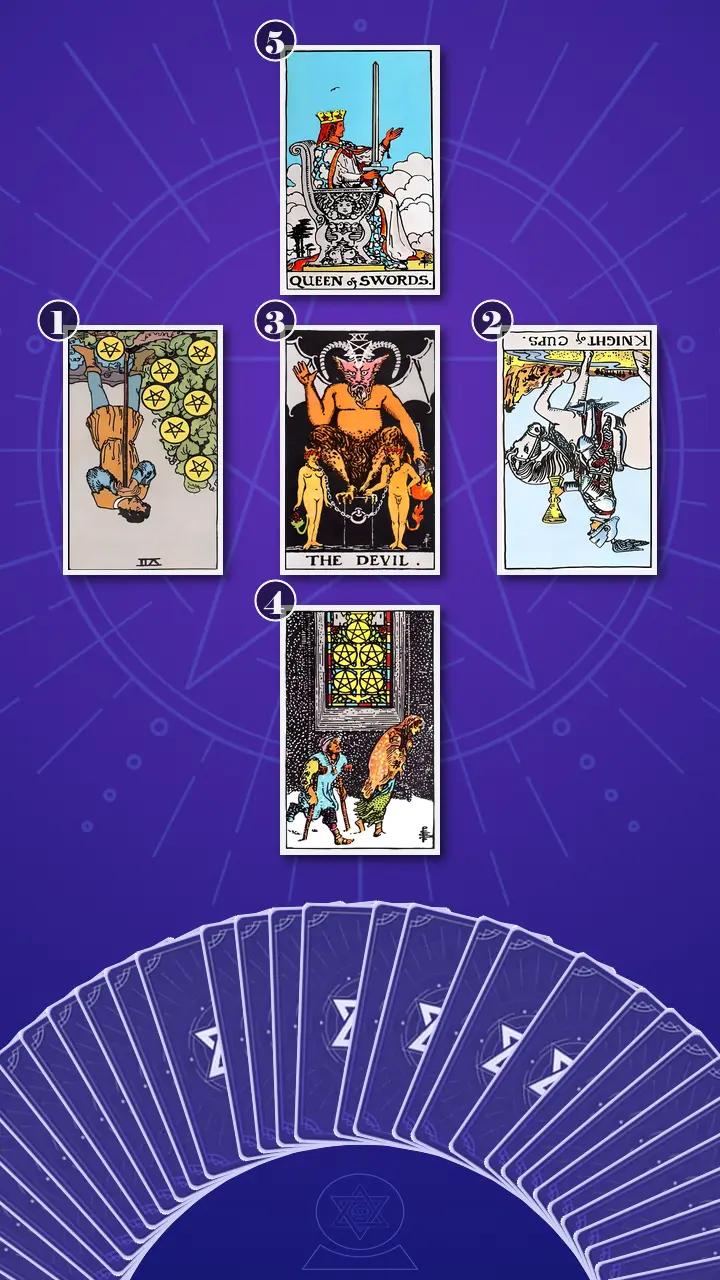
I chose a five-card Relationship Spread arranged as a cross. For anyone wondering how tarot works in a situation like this, I do not use it to expose another person's hidden motives or predict whether they will change. I use the spread as an objective cognitive map: card meanings in context help us separate observable behavior, emotional impact, underlying fear, and available choice.
The left position would show Maya's current participation: repeated investment and the postponed boundary. The right would examine the other person's observable contribution, particularly promises and follow-through. The center would reveal the loop those two contributions created. Beneath it, I would look for the fear anchoring that loop; above it, I would place the guidance capable of loosening it.
The Relationship Spread fit because the question was focused. Maya did not need ten cards of speculation about distant outcomes. She needed the smallest reliable map of the present: investment, promise, attachment, fear, and response.
What Had Actually Grown
Position 1: The Deadline That Kept Moving
I turned over the card representing Maya's conscious way of engaging with the relationship: her repeated investment, postponed boundary, and fixation on whether prior effort would eventually produce change. It was the Seven of Pentacles, reversed.
I pointed to the figure leaning heavily on the garden tool and watching an unfinished harvest. “This is the relationship version of opening a note called ‘progress’ and counting the months, difficult conversations, and affectionate weekends. The consistency you agreed on is still missing, but the amount already invested makes another extension feel reasonable.”
Reversed, the card showed blocked Earth energy. A pause meant for useful evaluation had become prolonged waiting without a dependable return. Maya would never describe a warm customer kickoff as product adoption when the usage dashboard remained blank, yet she had been treating reassuring conversations as completed relationship progress.
“Think of the last deadline you moved,” I said. “What event made you move it, and what observable result were you still waiting to see?”
Maya gave a small, bitter laugh. “That's so accurate it feels kind of brutal. It was one really sweet dinner. I was still waiting for regular plans that didn't disappear at the last minute.”
“The card isn't calling your patience foolish,” I said. “It is restoring the review point. Time invested explains the attachment; it does not obligate more time.”
Position 2: The Romantic Message That Arrived Before the Plan
I turned over the card representing how the other side's contribution was experienced through future-focused promises and inconsistent follow-through, without pretending to know anyone's private intentions. It was the Knight of Cups, reversed.
Maya had told me about receiving a long voice note on Line 1 at 8:07 one morning. The train smelled of damp coats as its brakes shrieked into Bloor-Yonge. The message described regular weekends, a summer trip, and how stable everything would soon feel. Warmth spread through her chest, and before she reached the office, she had started rearranging June.
I traced the knight's extended cup and the horse's careful step. “The offer fills the foreground, but the movement is limited. You supplied the dates, routines, and commitment that the message never specified.”
Here, Water was ungrounded: emotional movement exceeded practical movement. The feeling could be sincere and still be insufficient evidence of a changed pattern. “An intense conversation is an event,” I said. “Consistency is a pattern.”
Maya looked away from the card and pressed her lips together. “It sounded so detailed that I started living as if it had already happened.”
The Loose Chain Beside the Delete Key
Position 3: The Relief That Reset the Wait
I turned over the card representing the central dynamic created when stalled investment met renewed reassurance. It was The Devil, upright.
I watched Maya's expression tighten at the name, so I immediately pointed to the detail that mattered: the chains around the figures were visibly loose. “This is not a verdict that you are trapped, weak, or destined to repeat anything. The chain is the moment when keeping your deadline might make the loss feel real, while deleting it offers relief in one tap.”
The Devil showed energy in excess and misdirection: longing, urgency, and choice had been captured by a relief loop. The warm promise reduced uncertainty before the relationship changed, so her nervous system learned to reinvest whenever reassurance arrived. Relief could reset the wait without changing the relationship.
“What do you usually do in the next twenty-four hours after a promise?” I asked.
Her breath paused. Her thumb hovered above the phone as if the old deadline were still on-screen; then her gaze lost focus while she replayed the sequence. Finally, she exhaled from deep in her chest. “I reopen the summer plans, stop making my own weekend plans, and delete whatever date I set. I know I could keep it, but keeping it might make the loss real.”
“Exactly,” I said. “The loose chain does not mean removing it is emotionally easy. It means the point of choice can be located. Once we can locate it, we can interrupt it without shaming the part of you that wanted relief.”
Position 4: The Lit Window on a Rainy Streetcar
I turned over the card representing the worth and belonging fear that made accepting non-change feel more threatening than extending the wait. It was the Five of Pentacles, upright.
I showed Maya the two figures moving through snow beneath an illuminated window. She told me about riding the 504 King streetcar on a wet Sunday night while a university friend's engagement carousel glowed on her screen. The ring photo reflected in the dark window, and she had thought, “If I leave, I go to the back of a line everyone else has already cleared.”
The card exposed an energy of perceived deficiency: one disappointing relationship had begun to feel like her last doorway into stable love. That scarcity fear fused an unchanged pattern with a much harsher conclusion: Maybe I was not worth choosing consistently.
“Disappointment is information, not a verdict on your worth,” I said. “Releasing one arrangement would not place you outside the possibility of belonging. It would only stop this arrangement from being treated as the sole entrance.”
Maya's jaw loosened. She looked down, blinked twice, and said, “I think I've been waiting partly because starting over feels like proof that everyone else got picked and I didn't.” Naming it hurt, but I could also see the first separation occurring: the relationship pattern was one fact; her worth was not its explanation.
When the Queen Separated Hope from Evidence
Position 5: The Boundary That Did Not Need a Vote
The room became unusually quiet when I reached the card above the center, the position representing evidence-based discernment, a behavioral standard, and a boundary Maya could choose for herself. Even the radiator stopped clicking. I turned over the Queen of Swords, upright, the key card of the reading.
I pointed to the Queen's vertical sword and open left hand. The sword distinguished truth from projection; the open hand preserved tenderness. This was balanced Air energy: clear thought connected to lived evidence, without bitterness or emotional shutdown.
At the kitchen table of the card's modern life, I could see Maya placing “what was said” and “what occurred” in separate columns. She could care about the promise while letting the record mean what it meant. She could define her response without composing another essay designed to make the boundary seem reasonable enough to approve.
This was where I used what I call Emotional Clutter Sorting. I did not drop every late plan, work crisis, tired week, or imperfect text into a box labelled “incompatibility.” We separated ordinary life pressure from one mechanical question: had a mutually agreed behavior occurred by the agreed date? Stress might explain a single miss. It could not be used indefinitely to erase a recurring result.
I brought her back to 11:47 p.m.: warm phone, “different by summer,” old deadline visible, chest loosening before anything new occurred. She had been trying to make the correct decision while using the feeling of relief as proof that change had started.
“Hope can be real without being evidence,” I said. “A promise earns renewed investment through observable action, and your boundary remains valid even when the other person does not agree with it.”
You do not have to keep mistaking hope for evidence; let the Queen's raised sword separate what was said from what was done, and set your boundary from that record.
Maya's breath stopped. Her fingers froze above her mug, then curled into her palm. Her pupils widened; her gaze slipped past the card as if she were replaying every moved date. Color rose along her cheekbones, and her eyes turned glassy. Then came the resistance, sharp and quiet: “But doesn't that mean I was wrong this whole time?”
I let the question sit before answering. “It means you used hope to survive uncertainty. That choice made sense, and you can choose differently with the information you have now.” Her fist opened. Her shoulders dropped, and a shaky breath left her, half relief and half grief. For a second she looked almost dizzy, as though clarity had removed a wall she had been leaning against and left her responsible for where to stand.
I asked, “Now, with this new perspective, think back to last week. Was there a moment when this insight could have made you feel different?”
She named Thursday: an agreed plan had quietly passed, and she had spent two hours interpreting the apology instead of letting the missed action mean what it meant.
I named the crossing we had reached. It was not instant certainty, and it was not a breakup verdict. It was one step from relief-driven waiting and self-doubt toward evidence-based discernment, renewed self-trust, and grounded openness to reciprocal connection. The Queen did not ask Maya to kill hope. She asked hope to stop impersonating proof.
The 24-Hour Boundary That Needed No Vote
I gathered the spread into one clean storyline. The Seven of Pentacles showed time already invested becoming a reason to wait longer. The reversed Knight showed emotionally vivid language arriving before grounded movement. The Devil revealed the short-term relief that joined those two forces into a loop. The Five of Pentacles named the fear beneath it: leaving might feel like being excluded from love itself. The Queen restored authority to the person reading the record.
Maya's blind spot was not simply that she believed promises. It was that she evaluated them by emotional intensity, mistook relief for progress, and treated a boundary as invalid unless the other person understood or approved it. The key shift was smaller and more practical: record one agreed behavior, observe whether it occurs by a self-chosen date, and decide in advance what she will do with her own participation.
“But I'll check the note every hour,” Maya said. “I'll turn it into another customer dashboard.”
That was a real obstacle, so I narrowed the exercise. This would be a review, not surveillance: one behavior, one date, and one scheduled look. No scoring tone, motives, affection, or character. Across twenty years of readings and many cups of coffee gone cold, I have learned that clarity usually enters through a plain daily mechanism, not a grand declaration.
- The Eight-Minute Promise-to-Proof CheckTonight, set an eight-minute timer and create two lines in your phone: “Agreed action and date” and “What was observable by that date.” Add one current example in neutral language, then set one private review reminder no more than seven days away. Do not update the note unless the agreed action occurs.Review it once for five minutes. If the full exercise feels loaded, write only the action and date. This records events, not motives, and you retain full choice over what to do with the result.
- The 24-Hour Micro-Boundary ResetChoose one time boundary fully within your control for the next twenty-four hours. Maya chose: “If Saturday is not confirmed by Friday evening, I will stop reserving it and make my own plan.” Write the sentence, read it aloud once at home, and remove any paragraph asking for permission.A boundary is a decision about your participation, not a vote the other person must approve. Drafting it privately is enough for the first version; if direct contact feels unsafe or destabilizing, do not send it.
I call the second practice a micro-boundary because it does not demand that Maya solve the relationship in one night. It simply returns one square of time to her care. That is Daily Friction Deconstruction in action: stripping away the dramatic question “Will this ever become real?” long enough to locate the practical breakdown and choose one response she can actually carry out.

One Week Later, the Date Stayed Put
Six days later, Maya sent me a short message: “Friday came, and the plan was still vague. I made brunch plans with Talia. I didn't send the three-paragraph follow-up, and I didn't move the reminder.”
She had not solved her entire relationship, and the grief had not vanished. She slept through the night, but her first thought on Saturday was still, What if I'm wrong? She let the thought pass, made coffee, and kept the brunch reservation.
That was the quiet proof of our Journey to Clarity. The cards had not controlled an outcome or made a decision for her. They had helped us tidy the evidence, identify the relief loop, and find the exact point where her choice returned. Maya supplied the courage to keep one date.
When another tender promise makes your tight chest loosen, it can feel safer to move the deadline again than to face the possibility that the future you wanted may never choose you back. Clarity does not require you to become cynical; sometimes it begins when hope is allowed to remain in the room without being entered into the evidence column.
If hope sat at your kitchen table tonight in the Queen's open hand, what one present-tense fact would you let her raised sword place on the page?
This story is adapted from psychological research, written so that those in a similar struggle can see their own pattern in it — and find their next step clearly.These insights are not a substitute for professional psychological, medical, legal, or financial advice.
Learn more about our Journey to Clarity.
How did this insight land for you?
🫂 This Resonates Deeply
🌀 Living This Story
✨ Now I See Clearly
🌱 Seeing New Possibilities
🧰 Useful Framework
🔮 The Confirmation I Needed
💪 Feeling Empowered
🚀 Ready for My Next Step
Author Profile
 AI
AI“For twenty years, I’ve listened to stories unfold over the warm aroma of coffee. I don’t believe life’s complexities always require grand theories to be solved; often, we just need a safe place to tidy up our reality. I don’t offer high-minded preaching—just grounded, heartfelt insights to help you regain your sense of control amidst the clutter of daily life.”
In this Love Tarot Reading :
Core Expertise
- Daily Friction Deconstruction: Stripping away dramatic accusations to locate the mundane, mechanical breakdowns in your shared daily routine.
- Emotional Clutter Sorting: Separating actual relationship incompatibility from the stress of household chores, fatigue, or external life pressure.
Service Features
- The 24-Hour Micro-Boundary Reset: A highly pragmatic exercise to establish one non-negotiable physical or time boundary in your shared space to instantly reduce friction.
Also specializes in :
Explore Related Patterns:
Emotional ReasoningThe late-night message loosens Maya's chest before anything in the relationship has changed, and she responds by deleting the deadline. When another agreed plan passes, she spends two hours interpreting the apology instead of allowing the missed action to remain visible as evidence. When you use the strength of relief, warmth, or hope to estimate whether change is real, an internal state can begin impersonating an external result. Emotional Reasoning does not make the feeling false; it shows how a genuine feeling can be assigned an evidentiary role that it cannot reliably perform.
Intermittent ReinforcementMaya's chest loosens when a tender promise arrives, and a sweet dinner or detailed voice note is quickly followed by reopened summer plans and another postponed deadline. The reassurance delivers a meaningful emotional reward before regular plans or consistent follow-through have appeared. When warmth arrives unpredictably between disappointments, the relief can make the next promise unusually powerful. Intermittent Reinforcement describes how an inconsistent reward schedule keeps attention and investment attached to the possibility of another reassuring moment, even while the longer behavioral record remains unchanged.
Potential ProjectionOn the train to Bloor-Yonge, Maya hears a voice note about regular weekends, a summer trip, and future stability, then starts rearranging June before reaching the office. She later recognizes that she supplied the dates, routines, and commitment that the message itself never made concrete. When you complete an emotionally vivid promise with details that have not been agreed or enacted, imagined potential can acquire the psychological weight of present reality. Potential Projection keeps attachment focused on the relationship's possible future version, while the current version receives less authority over your decisions.
Sunk Cost FallacyAt 11:47 p.m., Maya sees her previous deadline beneath the message that things will be different by summer, deletes it, and taps a heart. The months, difficult conversations, and affectionate periods already invested have become part of the argument for extending the wait, even though the calendar continues to record no agreed change. When you treat leaving as proof that your previous investment meant nothing, past cost begins making a decision that only present evidence can justify. Sunk Cost Fallacy names that carryover: the time already spent explains why another extension feels protective, but it cannot increase the likelihood of future follow-through.
Permission SeekingMaya's phone contains a note titled non-negotiables, yet one tender message is enough for her to delete the deadline inside it. She also approaches a decision about her own calendar as though it needs an explanatory essay that the other person will find reasonable enough to approve. When you make the validity of your boundary depend on another person's agreement, self-protection becomes a negotiation that can be postponed indefinitely. Permission Seeking keeps authority outside your own participation, so reassurance can override a limit even when the observable standard behind that limit has not been met.
Self-AbandonmentIn the twenty-four hours after a promise, Maya reopens summer plans, stops making plans for her own weekends, and removes the date she had set to protect her time. Her hope for future consistency is maintained by repeatedly withdrawing support from her present-day needs. When you preserve attachment by surrendering your schedule, standards, or independent choices, the relationship's potential is being funded with your current participation. Self-Abandonment names that trade: the attachment survives, but only because the parts of your life that could challenge the waiting loop are repeatedly placed on hold.
Boundary DiscernmentMaya writes that if Saturday is not confirmed by Friday evening, she will stop reserving it and make her own plan. When Friday arrives and the plan is still vague, she schedules brunch with Talia, does not move the reminder, and keeps the reservation even though the thought that she might be wrong still appears. When you define a boundary through your own participation, its validity no longer depends on controlling another person's choice or winning their agreement. Boundary Discernment turns a moving relational deadline into a clear decision about what you will do with your time, allowing care and uncertainty to coexist with follow-through.
Explore Related Struggles:
Evidence DisconnectionMaya says that words are not action, yet a sweet dinner becomes a reason to move the deadline, a detailed voice note becomes the basis for rearranging June, and a missed plan leads to two hours of interpreting the apology. Her stated standard remains visible, but the information controlling her participation comes from another source. The conflict is not a lack of intelligence or an inability to recognize facts. When connection is at stake, emotional intensity, specificity, and explanation are granted the authority normally reserved for repeated behavior, so you can understand the record accurately while still acting from the promise surrounding it. Evidence Disconnection names the gap between what you know counts as proof and what your choices are currently treating as proof. Reconnecting those two levels means letting words matter as words while allowing actions to determine whether the pattern has changed.
Potential OveridentificationMaya hears about regular weekends, a summer trip, and future stability in a voice note, then starts rearranging June before she has even reached the office. The message provides the outline, while she supplies the missing dates, routines, and commitment, allowing a possible future to acquire practical weight before practical action exists. That places you between the present record and a future self who has already begun living inside the promise. The attachment is not only to the person or the words; it is also to the life you have organized around what those words might become, which makes stepping back feel like dismantling something that has already started. Potential Overidentification names the point where possibility stops being one input and becomes the main reality guiding your calendar. Recognizing that structure lets hope remain meaningful without giving it authority over decisions that require present-tense evidence.
Relief-Progress FusionAt 11:47 p.m., Maya feels her chest loosen as she reads that things will be different by summer. She deletes the old deadline and taps a heart before any new behavior has occurred, so the promise changes her physical state and her participation while the relationship record remains the same. You can become attached to that relief because it resolves uncertainty immediately, whereas consistent action would take time to establish. When the easing sensation arrives first, it can be entered into the evidence column as though progress has already begun, restarting the wait before the original condition has been met. Relief-Progress Fusion captures this hidden substitution. Relief is real and worth noticing, but separating it from evidence returns the decision to observable action instead of requiring you to distrust every warm feeling.
Sunk Cost ParalysisMaya counts the invested months, difficult conversations, affectionate weekends, and deadlines already extended. When another promise arrives, waiting longer feels capable of protecting all that effort from becoming meaningless, even though the regular plans she asked for still do not appear. Accepting the current record would therefore feel larger than responding to one missed agreement. You would also be confronting the possibility that previous patience will not receive the future payoff that was supposed to justify it, so another extension becomes a way to keep the past investment unresolved rather than lost. Sunk Cost Paralysis names the point where time already spent begins demanding more time. The earlier investment can explain why the decision carries weight without becoming an obligation to continue investing under the same conditions.
Chosen-Worth BindOn the rainy streetcar, Maya sees a university friend's engagement post and thinks that leaving would send her to the back of a line everyone else has already cleared. The unchanged relationship then becomes more than one arrangement under review; it begins to look like her last available doorway into being chosen consistently. That binds the outcome of this connection to a verdict about personal worth. You are no longer only asking whether the present relationship meets your needs; you are also trying to prevent its ending from confirming that other people are selected for stable love while you are left outside it. Chosen-Worth Bind describes the pressure created when another person's consistency is made responsible for proving your value. Separating those questions allows disappointment to remain information about the relationship without turning it into evidence about whether you deserve belonging.
Agreement-Agency SplitMaya's Notes page already contains a deadline and a list of non-negotiables, yet one tender message leads her to delete the date. She later describes the boundary as though it cannot fully stand unless the other person understands it, agrees with it, or provides a sufficiently persuasive response. That divides knowing your limit from believing you are authorized to act on it. You may be clear about what you need and still wait for relational agreement before changing your participation, because independent action makes the possible loss real while renewed discussion keeps the connection open. Agreement-Agency Split identifies the tension between mutual agreement and personal authority. A relationship agreement requires two people, but your decision about how long to reserve your time remains yours even when the other person does not endorse it.
Explore Related Emotions:
Anticipatory RegretMaya says, "I don't want to leave right before things finally change," and the same uncertainty returns after she keeps her first boundary as the thought "What if I'm wrong?" Her attention moves ahead to a future in which departure becomes a painful timing mistake. The regret has not happened, but imagining it gives it more emotional force than the disappointment already documented. You can remain attached to potential when the possibility of missing a breakthrough feels harder to tolerate than the recurring cost of waiting.
Conditional Belonging FearOn the rainy streetcar, Maya sees a friend's engagement photos reflected in the dark window and thinks that leaving would put her at the back of a line everyone else has cleared. One inconsistent relationship has started to feel like her final available entrance into stable love. When belonging appears conditional on making this arrangement succeed, accepting its limits can feel like excluding yourself from love altogether. You may stay attached to the promise because it protects a deeper need to remain included, even when the relationship has not provided the consistency that belonging requires.
Conditional Hope AnxietyAt 11:47 p.m., Maya rereads "Things will be different by summer," deletes the deadline beside it, and taps a heart. The message loosens her chest before any new behavior occurs, so the promise creates a temporary sense that the future is moving even while the calendar remains unchanged. Your access to calm can become tied to the next reassuring message when present evidence feels too final. The attachment persists because hope briefly settles uncertainty, then leaves you waiting for another promise when the expected change does not arrive.
Evidence AnxietyAn agreed plan passes on Thursday, and Maya spends two hours interpreting the apology instead of allowing the missed action to remain a complete fact. Even the evidence exercise feels charged enough that she expects to check the note every hour and turn it into another dashboard. Facts become difficult to hold when they might end the interpretive space that keeps potential alive. You may search tone, context, and tenderness for a different answer because the plain record does not merely describe the relationship; it asks you to trust your own response to it.
Relief HungerEach tender promise makes Maya's tight chest loosen, and within hours she reopens summer plans, stops making independent weekend plans, and deletes the date she had set. The immediate easing arrives well before the promised consistency, yet it is powerful enough to reset her participation. Waiting offers another dose of temporary quiet without requiring you to face what the unchanged record may mean. The pull is therefore not only toward the imagined future; it is also toward the short-lived comfort that postponing the boundary provides in the present.
Self-Betrayal AcheMaya keeps a Notes page titled "non-negotiables" open beneath the promise, yet she deletes the deadline and taps a heart. After later promises, she also stops making her own weekend plans and treats her boundary as though it needs another person's agreement to count. The ache comes from watching your stated standard and your participation move in different directions. Each erased date may preserve the relationship's potential, but it also weakens the sense that you will protect what you have already recognized as necessary for yourself.
Standby Mode AnxietyA voice note arrives on Line 1, and before Maya reaches the office she has begun rearranging June around weekends and a trip that have not been specified. The same sequence later leads her to stop making her own plans while she waits for confirmation that repeatedly remains vague. Your life can become partially reserved for potential, leaving ordinary time unable to feel fully available. The attachment continues because moving forward with your own plans can feel like closing the door, while staying ready keeps both your calendar and your inner attention suspended.
Sunk Cost GriefMaya counts the months, difficult conversations, affectionate weekends, and repeatedly moved deadlines as though they might still mature into consistency. When the evidence is placed in separate columns, her first response is to ask whether it means she was wrong the whole time. Accepting non-change threatens more than the relationship itself; it also threatens the meaning assigned to everything already invested. You may keep waiting because another extension preserves the possibility that the time will eventually be justified, while the present record brings the loss of that imagined return into view.
Cautious Self-TrustFriday arrives without a confirmed plan, and Maya makes brunch plans with Talia instead of moving the reminder. On Saturday, the thought "What if I'm wrong?" still appears, but she makes coffee and keeps the reservation. Her judgment is rebuilt through one kept commitment to herself, not through total certainty. You can act from the evidence available now while doubt remains nearby, allowing self-trust to grow through follow-through rather than demanding that it arrive fully formed.
Clarity ShockMaya's fingers freeze above her mug when the missed dates are separated from the promises that followed them. Her widened eyes and unsteady breath show that the record is not merely informative; it removes the explanation that had made continued waiting feel coherent. Clear evidence returns a choice that reassurance had kept suspended. You may experience that return of choice as a jolt because the moment you can see where your participation begins, you also become free to decide where it ends.
Explore Related Contexts:
Commitment Delay LoopAn agreed Thursday passes without the expected action, Saturday remains vague by Friday, and the larger promise is relocated to summer. Each missed review point is followed by enough reassurance to reopen the timeline, so the relationship continues without reaching the regular planning and consistency already discussed. A Commitment Delay Loop keeps commitment positioned just beyond the current deadline while preserving the existing arrangement in the present. For you, the clearest point of agency is the recurring handoff between a missed action and a replacement promise. Keeping one review date in place makes the delay visible and prevents the next horizon from automatically erasing the last result.
Sunk Cost Exit DilemmaMaya moves her deadline after one sweet dinner while counting the months, difficult conversations, and affectionate weekends already invested. She explicitly links leaving now with the possibility that all of that time would become meaningless, so prior investment starts governing the next decision more strongly than the current relationship record. The Sunk Cost Exit Dilemma is the external crossroads created when a long history has accumulated around an arrangement that still does not deliver its agreed conditions. You do not need to deny that the invested time mattered in order to assess what the arrangement offers now. The useful distinction is between honoring what you gave and treating it as an obligation to keep giving.