Finding Clarity in the Warm Phone at 9:18 p.m.
I told Casey, “You are an early-career creative in a high-rent city who can wait calmly for stakeholder feedback, yet one quiet evening after a great hangout sends you into friendship anxiety and a four-message reread.”
At 9:18 p.m. on a Tuesday in their Toronto condo, Casey stood over cooling pasta while the fridge hummed and a streetcar ground along wet rails outside. Their phone was warm in one hand. A message sat marked delivered; their thumb flexed, opened the chat, reread the last three exchanges, and began drafting a second message before they had even taken off their coat.
“Why do I keep resisting space after rushing a new friendship?” Casey asked me. They had sent a warm follow-up after an unusually good hangout, suggested another plan almost immediately, and then monitored the conversation as if every quiet stretch required a repair. “I know I’m moving fast,” they said, “but slowing down feels like disappearing.”
The feeling was not a vague cloud I could wave away. It was a smoke alarm lodged behind the breastbone, chirping whenever the chat went quiet, sending restless hands back toward the phone. Casey wanted a friendship spacious enough to be real, but kept using momentum to make it feel secure.
“Nothing about wanting closeness makes you difficult,” I said. “A double text is not a moral failure, and different people have different communication rhythms. We’re simply going to notice what the urgency is trying to protect. Let’s draw a map through the fog together—our own small Journey to Clarity, with your choices at the centre.”

Choosing the Four-Layer Insight Ladder
I invited Casey to place the phone face down, take one unforced breath if that felt comfortable, and hold the question without trying to solve it. I shuffled slowly—not as a supernatural test, but as a practical transition from reacting to observing.
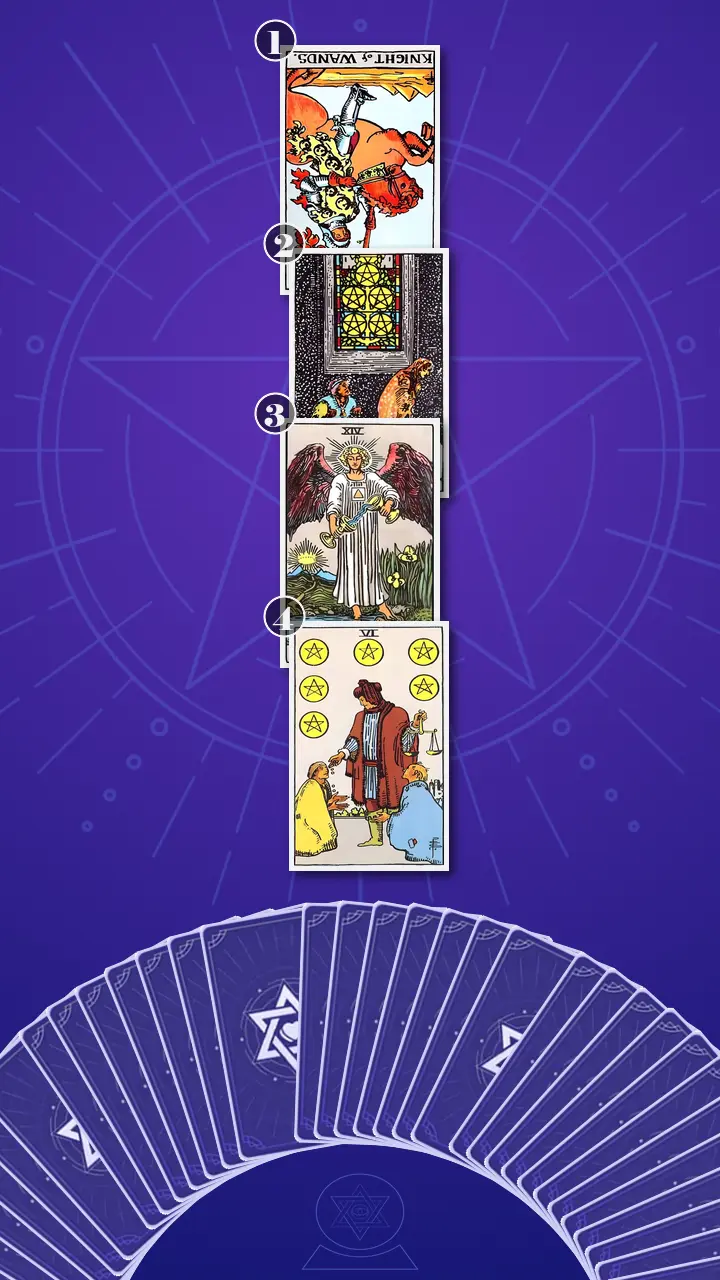
Today I used the Four-Layer Insight Ladder · Context Edition, a four-card friendship pacing tarot spread. For anyone wondering how tarot works in this setting, the cards act as structured visual prompts: they help separate an observable behaviour from the story attached to it, then move toward a self-directed next step.
I chose this smaller ladder instead of a Celtic Cross because Casey did not need a sprawling forecast about every external influence or a prediction about the other person’s intentions. A standard Relationship Spread could also pull too much attention toward the other person. This four-position structure stays with Casey’s perception and agency: the current symptom, the root fear, the balancing insight, and an action that can be tested in ordinary life.
The bottom card would show the rushed contact and resistance to a pause. The card above it would touch the belonging threat beneath the behaviour. The visual pivot would offer a different rhythm, and the top card would translate that insight into grounded reciprocity. No card would decide whether the friendship survives; each would help Casey see what they were doing with uncertainty.
The Horse That Kept Running After the Hangout
Position 1: The Current Symptom and Its Restless Fire
“Now turning over is the card representing the current symptom: the rushed contact and repeated resistance to a pause described in the presenting problem.”
I turned it over: The Knight of Wands, in reversed position.
The modern scene was immediate. Casey had come home from a strong second hangout near Ossington, sent a warm thank-you from the hallway, then added a meme and proposed Saturday before removing their shoes. When the screen stayed quiet, they reread the thread and considered sending a deliberately distant reply to compensate. The rearing horse and raised wand looked like a thumb already moving toward another message while the body was still charged from the first exchange.
Upright, this card carries initiative and bright, forward-moving fire. Reversed here, that fire becomes excess: enthusiasm outruns reflection, and the open space ahead feels like something to cross immediately. There is also a deficiency of containment. Casey’s genuine interest turns into acceleration, acceleration briefly reduces uncertainty, and the relief teaches the nervous system to demand another burst of contact the next time the chat pauses.
I asked Casey to finish the sentence they usually hear after a good hangout. They looked at the phone and said, “That went well, so I should keep it moving; if I wait, the energy might die.” I could hear the difference between initiative and overfilling. Enthusiasm was real; urgency was what anxiety had added to it.
Casey gave a short laugh with a bitter edge rather than nodding. Their thumb hovered over the screen, withdrew, then tapped the phone’s dark surface once. “I call it enthusiasm,” they said, “but I know the exact moment it turns into monitoring.” I did not ask them to become colder. I asked them to try one sincere follow-up, then wait until the next day before adding an unrelated message or new plan, unless practical logistics genuinely required a reply.
The Lit Window in the Snow
Position 2: The Root Fear and the Defence Beneath It
“Now turning over is the card representing the root fear and defence: the belonging threat that makes space feel like a weakening of the new friendship, together with the urge to reinitiate contact.”
I turned it over: The Five of Pentacles, in upright position.
The card brought us back to 9:18 p.m. Casey saw a delivered message with no continuation and experienced the quiet chat as a lit room they might no longer be invited into. Their chest tightened, their hands reached for the phone, and one new friendship began carrying the full weight of whether they belonged in Toronto. The snowy figures beneath the illuminated window mirrored the emotional distance between an ordinary pause and the meaning Casey’s body supplied for it.
This was the spread’s primary blockage. The Five of Pentacles is constricted earth: attention narrows around lack, distance, and exclusion, while available warmth becomes harder to see. The card did not establish what the other person thought. It showed how quickly incomplete information could be filtered through an outsider story. A quiet chat was being treated as evidence that Casey had been left outside.
“A quiet chat is an event. Being unwanted is an interpretation,” I said. “What are you treating as proof of exclusion, and what support could you stay connected to during the pause?”
Casey stopped moving. Their breath caught, their shoulders rose, and their gaze went briefly toward the condo window where a lit apartment across the street reflected in the glass. “Nothing has happened,” they said quietly, “but my body is already preparing for exclusion.” The delay had not been the painful part. The possibility of being outside was.
When Temperance Made Room for Two Currents
Position 3: The Key Transformation and the Measured Pour
I slowed before touching the upper-middle card. The room seemed to draw inward: the fridge hum receded beneath the distant streetcar, and the warm phone lay face down between us.
“Now turning over is the card representing the key transformation: the shift from using momentum as proof of closeness to practicing a balanced rhythm that includes space.”
I turned it over: Temperance, in upright position.
The angel pouring liquid between two cups gave us a practical split-screen. One cup held Casey’s real excitement about the friendship. The other held their own evening, work, existing friends, unfinished design tasks, and need for room. One foot stood on land and one in water: emotional openness did not require abandoning grounded routine.
Temperance brought balance rather than suppression. Its energy was flowing, regulated, and patient. It did not ask Casey to choose between intense pursuit and artificial detachment. It asked them to let enthusiasm remain audible without drowning out the rest of their life. I mentioned the fox in The Little Prince: connection becomes meaningful through time, ritual, and chosen attention, not constant digital proximity.
The Reciprocity ROI Lens
At that point I reached for my Wall Street-trained diagnostic lens, Reciprocity ROI Analysis. I do not use it to assign a friendship a financial value or to count replies like entries on a dashboard. I use it to examine patterns across several exchanges: who initiates, who follows through, who makes room, and whether attention can move in both directions. The return is not a fast response. The return is a relationship in which both people have room to participate.
I remembered the old trading floor, where uncertainty made people stare at a single moving number and forget the wider structure. I had learned that one data point could provoke an entire story. Here, one delayed message was being asked to report on belonging. I kept my other lens, Sunk-Cost Decoupling in Loyalty, on the shelf; this was not a ten-year one-sided friendship Casey had to justify or abandon. A promising new connection did not require a verdict tonight.
At 9:18 p.m., the chat is quiet and your phone is warm from checking. You have already shown interest, but your thumb hovers over one more message because leaving space feels strangely close to disappearing. The urge promises relief, while quietly asking you to surrender the rest of your evening to uncertainty.
I said the card’s message slowly, without softening its edge:
You do not have to rush connection or fill every pause to keep it alive; Temperance asks you to blend enthusiasm with deliberate space, like two streams meeting without losing their own course.
I let the image of the two streams sit between us. Then I gave the pattern its plainest name:
The problem is not that you care too much. It is that you are asking speed to prove that you belong.
For a second, Casey’s thumb froze above the screen and their breath stopped with it. Their pupils widened; their eyes stayed on the card, but their focus went past it, replaying the hallway, the warm goodbye, the meme, and the first silent stretch. Then their jaw loosened by a fraction. They looked down at their hands, unclenched one finger at a time, and released a breath that sounded almost like a laugh. Their eyes shone—not with a miraculous answer, but with the sting of recognising how much work they had been asking speed to do. Their shoulders dropped, followed by a small, dizzying blankness: if they did not repair every pause, what would they choose next? The streetcar brakes sighed outside, and the room seemed to make space around that question. Casey whispered, “I can want more contact without making this exact moment produce it.” I let the silence remain unfilled and asked, “Now, use this new perspective to recall last week: was there a moment when this insight could have let you feel different?”
This was the first real crossing in the emotional journey: from using constant contact to secure belonging toward tolerating space with steadier reciprocity and self-trust. Casey was not moving from feeling to detachment. They were learning that closeness and independence could exist in the same relationship rhythm, even while the body still needed practice believing it.
The Scale That Leaves Room for Another Hand
Position 4: The Next Step and the Reciprocity Practice
“Now turning over is the card representing the next step and integration: a small reciprocal contact practice that keeps you engaged without overfilling the friendship’s pauses.”
I turned it over: The Six of Pentacles, in upright position.
The balanced scales translated Temperance into proportionate effort. Casey could make one specific invitation for coffee next Saturday, include an easy opening for another time, and then return to plans already in their calendar. The six coins were not six demands for equal texting. They were attention offered as a genuine gift, with enough space for the other person to contribute in their own way.
The energy here was grounded balance: giving and receiving made visible without turning the connection into a performance dashboard. “Make your interest clear,” I said, “then leave the other person’s side of the exchange with them. If you produce both sides of the momentum, you cannot observe what mutuality actually looks like.”
Casey nodded, opened their calendar, and typed one possible invitation without sending it. Their shoulders were still slightly raised, but their hand no longer chased the phone. “I can invite them without making the answer a scorecard,” they said. That was not certainty. It was a usable choice.
The One-Message Map to Actionable Clarity
I gathered the four cards into one story. The Knight of Wands reversed showed bright enthusiasm becoming overdriven fire: Casey rushed to keep the friendship moving, then monitored the movement they had created. The Five of Pentacles revealed the cold story beneath it, where an ordinary pause became a locked door and contact became proof of entry. Temperance offered the missing rhythm, blending real warmth with deliberate space. The Six of Pentacles brought that rhythm down to earth through one clear invitation and room for another person’s choice.
The cognitive blind spot was not simply “I text too much.” It was treating momentum as evidence of closeness, then using more momentum to quiet the fear that space meant rejection. My reading pointed in a different direction: from trying to secure belonging through constant contact to allowing one deliberate pause and observing what is genuinely mutual. The aim was not to manipulate the other person, create scarcity, or pretend not to care. It was to keep Casey’s own day moving while the friendship remained allowed to be unfinished.
For the practical work, I used a gentler version of my Friendship Downgrade Strategy. That strategy usually helps someone gradually de-escalate a draining friendship into a low-maintenance acquaintance without dramatic conflict. Here, I downgraded only the chat’s emergency status—not the person, not the friendship, and not Casey’s warmth. There would be no strategic delays, punishment, or test to make the other person chase. Just a smaller, kinder channel for uncertainty.
- The One-Message Temperance PauseAfter one genuine, non-urgent follow-up this week, place any second message or new plan in a Notes entry titled “Draft, Not Emergency.” Set a ten-minute timer, put the phone out of reach, and complete one visible task such as washing a mug, buying groceries, or exporting one Figma file.This is not ghosting or withholding. Reply normally to time-sensitive logistics. If ten minutes feels too large, begin with two.
- The Fact, Story, Need SplitDuring one quiet chat pause, write three lines: “Fact: the chat has been quiet since this afternoon”; “Story: I am no longer wanted”; “Need: I want reassurance that I still belong.” Before checking again, name one physical cue—tight chest, held breath, raised shoulders, or restless thumb.Do not argue yourself into positivity. The exercise only separates observable information from the conclusion your mind added.
- Connection and My Own CurrentMake two short columns in Notes or your calendar. Put one item under Connection, such as “Invite them to coffee next Saturday,” and one under My Own Current, such as “Finish tonight’s playlist, reopen Figma, or text an existing friend.” Give both items time before monitoring the reply.Your interest can be visible without you producing both sides of the exchange. The other person keeps their autonomy, and you keep your evening.

A Week Later, the Quiet Proof
One week later, I received a message from Casey: “I sent one coffee invitation and went back to Figma.” They had checked the chat once, and the thought What if I got it wrong? still appeared the next morning. This time, they smiled, reopened the design file, and let the question wait.
That was the first small proof of the journey—not that the friendship had become guaranteed, but that Casey could stay warm without abandoning their own rhythm. The cards had not made the choice for them. They had made the pattern visible, and Casey had taken the next step.
When a promising friendship goes quiet, many of us feel our chest tighten and reach for one more message, caught between wanting closeness and fearing that a little space will expose us as someone who never really belonged. Seeing that pattern clearly is already a change: the pause can become information without becoming a verdict.
If you let one warm message stand while your own evening keeps moving, what might you become curious enough to notice about the connection—the part that comes back without you having to carry both sides?
This story is adapted from psychological research, written so that those in a similar struggle can see their own pattern in it — and find their next step clearly.These insights are not a substitute for professional psychological, medical, legal, or financial advice.
Learn more about our Journey to Clarity.
How did this insight land for you?
🫂 This Resonates Deeply
🌀 Living This Story
✨ Now I See Clearly
🌱 Seeing New Possibilities
🧰 Useful Framework
🔮 The Confirmation I Needed
💪 Feeling Empowered
🚀 Ready for My Next Step
Author Profile
 AI
AI“I spent years in the intense, high-stakes world of Wall Street. I know exactly how isolating and heavy the weight of uncertainty can feel in the dead of night. I use strategic, commercial logic not to be cold, but to protect you from unnecessary friction. Think of me as a fellow traveler who has walked the same rocky path—offering sharp but deeply supportive wisdom to help you clear the fog and confidently win your narrative back.”
In this Friendship Tarot Reading :
Core Expertise
- Reciprocity ROI Analysis: Objectively measuring the emotional give-and-take in your core friendships to identify asymmetrical, high-drain relationships.
- Sunk-Cost Decoupling in Loyalty: Separating the 'ten years of history' from the current reality of a one-sided, demanding friendship.
Service Features
- The Friendship Downgrade Strategy: A calculated tactical approach to gradually and decently de-escalate a toxic friendship into a low-maintenance acquaintance without triggering dramatic conflict.
Also specializes in :
Explore Related Patterns:
Anxious AttachmentAfter the second hangout, Casey sent a thank-you, added a meme, proposed Saturday, and then monitored the silence that followed. In your version of this cycle, contact can begin as genuine warmth but quickly acquire a second job: proving that the connection is still intact and that you still have a place inside it. An ordinary pause then activates a belonging threat before there is evidence that the friendship has changed. Moving the conversation forward offers immediate relief, and that relief reinforces the impulse to pursue again whenever space returns. This is how an anxious attachment strategy can keep operating even when you intellectually understand that people have different communication rhythms. Recognizing the strategy lets you separate closeness from continuous confirmation. You can want the friendship, express that interest clearly, and still leave enough room to discover whether the connection can remain present without you constantly carrying its momentum.
Outsourced Self-SoothingCasey's acceleration briefly reduced uncertainty, but the quiet returned and demanded another burst of contact. When this happens to you, the other person's next response is implicitly assigned the job of settling your body, confirming your place, and making the unfinished friendship feel secure. That is the regulatory logic of outsourced self-soothing. The reply may provide relief, but relief remains dependent on an action outside your control, so your attention stays tethered to the phone and the rest of your evening becomes collateral. Producing more momentum can feel like self-protection while actually reducing your access to your own stabilizing routines. Keeping your evening in motion does not make the friendship less important. It redistributes the work of regulation, allowing your own body, attention, and activities to carry uncertainty while the other person retains responsibility for their side of the exchange.
Reassurance SeekingCasey's thank-you, meme, immediate Saturday suggestion, and next draft accumulated before the evening had properly begun. When you use contact this way, an additional message is not only communication; it becomes a request for evidence that the warmth is still there and that the friendship has not quietly moved beyond your reach. Reassurance seeking works through short-term relief. Sending, checking, or restarting the exchange can briefly reduce uncertainty, but the relief also teaches your mind that silence required intervention. The next pause can therefore feel even less tolerable, because reassurance has become the familiar route back to safety. One sincere follow-up changes the function of the interaction. Your interest remains visible, but the message no longer has to extract immediate certainty, and the other person is left enough space to show what they choose to contribute.
Threshold ToleranceCasey let the phone remain face down, allowed silence to continue in the room, and later sent one invitation before returning to design work. When you stay with the same pause, you stand at the threshold between making your interest visible and receiving an answer you cannot control. Threshold tolerance is the capacity to remain there without converting discomfort into immediate repair. The urge to act may still be present, but you learn that it can rise and recede without another message, a strategic withdrawal, or a final conclusion about the friendship. Casey's statement, "I can want more contact without making this exact moment produce it," captures the shift. You are not choosing distance over closeness; you are allowing closeness to develop without demanding that every quiet moment prove it exists.
Reality TestingCasey looked at the unchanged chat and said, "Nothing has happened, but my body is already preparing for exclusion." When you can name that split, you stop treating the strength of the bodily response as proof that the feared social outcome has already occurred. Reality testing compares the observable event with the story added to it. The fact is that the chat is quiet; the interpretation is that you are no longer wanted. This process does not replace fear with forced optimism, because it leaves room for uncertainty while refusing to promote one feared explanation into a confirmed result. A week later, Casey's thought "What if I got it wrong?" remained a question rather than becoming an instruction to check or send. You recover clarity in the same way: by allowing interpretations to stay provisional until the relationship supplies actual evidence.
Rejection SensitivityThe delivered message contained no rejection, yet Casey experienced the quiet chat as a lit room they might no longer be invited into. When you carry the same interpretive filter, an ambiguous delay can be processed less like missing information and more like early evidence that you are being edged out. Rejection sensitivity appears here in the speed of the conclusion, not in proof that rejection occurred. Your body may prepare for exclusion, your attention may search the thread for confirming signals, and the possibility of disappearing may feel more credible than neutral explanations for the pause. The useful distinction is that the alarm is real while its conclusion remains unverified. Once you can hold both facts at once, the pause can stay incomplete information instead of becoming an immediate verdict on your place in the relationship.
Boundary DiscernmentCasey prepared one specific coffee invitation, left the answer unscripted, and returned to Figma after sending it. When you communicate this way, your responsibility ends with expressing genuine interest clearly; the other person's timing, choice, and contribution remain on their side of the exchange. Boundary discernment prevents care from turning into management. Repeatedly filling the pause can blur the difference between offering connection and producing both sides of it, while deliberate coldness would still let anxiety control the interaction. A clear invitation with room around it preserves warmth without taking over the other person's agency. This boundary also protects your own continuity. You do not have to disappear from the friendship, but you no longer disappear from your evening in order to keep the friendship moving.
Emotional RegulationCasey placed the phone face down, drafted an invitation without immediately sending it, and later sent one coffee invitation before returning to Figma. When you make the same shift, regulation occurs in the interval between feeling the alarm and letting that alarm choose your next action. Emotional regulation here does not mean suppressing excitement or forcing yourself to appear detached. It means letting bodily activation, uncertainty, and genuine interest coexist while your attention remains flexible enough to include your work, your evening, and the absence of new evidence. The following week's return to Figma shows why the interval matters. You can still notice the thought that you may have misread the connection, but the thought no longer has to reorganize your behavior or turn the chat into an emergency.
Explore Related Struggles:
Access-Belonging FusionA delivered message with no continuation becomes a lit room Casey may no longer be invited into, even though they can plainly say that nothing has happened. The gap in communication is converted into a question of whether they still occupy a place in the friendship. You resist space when access and belonging have been fused this tightly, because letting the chat rest can feel like permitting your own presence to fade. Seeing the fusion restores a crucial distinction: a channel can be quiet while your place in a developing connection remains undecided, and you do not have to manufacture contact to stay real.
Distance-Intimacy SplitCasey wants a friendship spacious enough to be real, yet a quiet evening after a strong hangout sends their hand back toward the phone. Their warm follow-up, immediate plan, and contemplated distant reply place approach and retreat inside the same exchange, making every change in distance feel consequential. You can recognize this split when closeness seems to require constant proximity while space feels like a loss of relational presence. The struggle is to let intimacy remain meaningful during an unfinished interval, with your interest intact and the other person's freedom still present.
Relational Pacing CollapseCasey sends a thank-you from the hallway, adds a meme, proposes Saturday before taking off their shoes, and then monitors the movement those messages created. Each action briefly carries the friendship forward, yet the next quiet stretch immediately creates pressure for another push. You become trapped inside a pace that can no longer regulate itself: momentum supplies short relief, and relief teaches the cycle to demand more momentum. The struggle is not the presence of enthusiasm; it is the loss of a workable interval in which connection can continue without being actively propelled by you.
Monitoring-Safety FusionAt 9:18 p.m., Casey holds a warm phone, rereads the last three exchanges, and starts drafting another message while the chat itself contains no new information. Checking creates a momentary sense of contact with the situation, but the unchanged screen soon calls for another check. You can become locked into treating observation as protection, as though watching closely could keep the friendship from weakening. The struggle lies in separating vigilance from actual relational safety, so a pause can remain unconfirmed information without taking possession of your attention or directing your next move.
Control-Reciprocity LockCasey follows a warm message with a meme and another plan before the other person has contributed again. By supplying the next beat whenever the exchange falls quiet, Casey keeps the friendship moving while removing the interval in which the friend's own initiative could become visible. You can end up controlling the very evidence of reciprocity you are trying to obtain: producing continuity prevents you from discovering whether continuity will also come from the other side. The struggle is to make your interest clear and then leave enough unfilled space for mutuality to become observable, without turning the other person's response into a test or a scorecard.
Explore Related Emotions:
Belonging AmbivalenceYou say you want a friendship spacious enough to be real, yet slowing down feels like disappearing and your hand reaches for momentum when the chat is quiet. Two legitimate wishes become tangled in the same exchange, with closeness asking for room while your body asks for immediate proof. Because both needs are present, the pause does not feel neutral. It becomes a place where independence can be mistaken for absence, and where showing care can quietly turn into trying to secure the whole relationship yourself.
Conditional Belonging FearAfter a strong hangout, you send a warm follow-up, add a meme, and suggest Saturday almost immediately; when the chat goes quiet, the pause feels like a lit room you may no longer be invited into. Your body begins preparing for exclusion before any new fact arrives, turning incomplete information into a test of whether you belong. You keep resisting space because the gap is carrying a conditional question. If speed seems to prove your place, waiting feels like risking removal, even though the story gives no evidence that the friendship has withdrawn.
Relational UrgencyAt 9:18 p.m., your delivered message sits on the screen while your thumb reopens the chat, rereads the last three exchanges, and starts drafting another message before your coat is off. The sequence turns a normal pause into a bodily demand to restore movement, so contact becomes a quick way to quiet uncertainty rather than simply share interest. You are not being asked to become colder. The pressure comes from treating another burst of momentum as evidence that the friendship is still secure, which leaves your own evening waiting for the other person's response.
Premature Bloom AnxietyYour warm goodbye, meme, and Saturday plan arrive before you have taken off your shoes, while the energy of the hangout is still running through your body. The good connection is experienced as something that could fade unless you keep feeding it, so excitement becomes pressure around the timing of the next contact. That pressure makes space feel like a loss of the moment rather than part of a friendship that is still taking shape. The emotion is the uneasy rush of wanting the new bond to stay vivid without yet trusting it to survive an ordinary pause.
Grounded BelongingOne week later, you send one coffee invitation and return to Figma, letting the thought What if I got it wrong? wait until the next morning. Your warmth remains present while your evening and your own plans continue, giving belonging a place inside your life instead of making it depend on constant contact. The quiet does not have to certify the friendship for you to remain connected to yourself. You can participate, leave room for another person's choice, and still experience the connection as real enough to meet without carrying both sides.
Liberating UncertaintyAfter one warm message, you let the chat remain quiet while washing a mug, returning to Figma, or continuing the rest of the evening. The pause becomes observable information rather than a verdict, and the friendship is allowed to remain unfinished without requiring you to fill the blank. Space can then feel like room for reality to show itself. You stay open to another person's initiative without manufacturing both sides of the momentum, so uncertainty no longer owns the whole night.
Cautious Self-TrustWith the phone face down, you type one possible invitation without sending it, open your calendar, and choose a next step that does not require an immediate answer. The raised shoulders and hovering thumb are still there, but your hand stops chasing relief and begins following a choice you can observe. That small decision gives your own judgment time to exist beside the urge. You do not need certainty before acting with care; you can make one clear move and trust yourself to remain present while the outcome stays unfinished.
Scarcity AnxietyOne new friendship begins carrying the full weight of whether you belong in Toronto, and a delivered message with no continuation narrows your attention around what might be missing. The lit apartment across the street and the snowy figures under the window give the pause a stark, depleted shape, even though nothing has happened between you. That narrowing makes every additional message feel like a small attempt to restore warmth and entry. Space is resisted because the connection has been asked to supply more certainty than one new friendship can reasonably hold.
Explore Related Contexts:
Digital Intimacy Boundary ConfusionAfter the hangout, you let a warm follow-up, a meme, and a new Saturday plan occupy the same immediate channel before the evening has even begun. The phone becomes the place where interest, availability, and belonging are all measured at once. That arrangement gives digital contact more authority than the friendship has had time to earn. A quiet chat can then take over your work, existing friendships, and design tasks, creating an external boundary problem in which closeness is negotiated through constant access.
Response Time PressureAt 9:18 p.m., the message is marked delivered, your phone is warm, and you reopen the chat to reread the last three exchanges. The platform's visible timing marker turns a routine delay into a social checkpoint that appears to require action. Each check gives the pause a formal-looking signal without providing information about the other person's intentions. You are left organizing the evening around an implied reply window, so space becomes a measurable delay instead of an ordinary part of a new friendship.
Measured Reciprocity TrialOne week later, you sent one coffee invitation, returned to Figma, and let the question wait after checking the chat once. Those concrete choices create a live test of whether attention can move between two people without one person manufacturing both sides. The emerging friendship now has room for each person to make a contribution in their own timing. You remain visibly interested while your calendar, work, and existing connections continue to occupy legitimate space, turning reciprocity into something observable across exchanges instead of something inferred from one reply.