The 10:47 p.m. P1 Ticket
I knew the pattern before Jordan finished her first sentence: the late-twenties Toronto customer-success brain that can clear a support queue faster than it can answer, “How are you?” One Tuesday at 10:47 p.m., a friend’s rough-day voice note had turned into an emotional P1 ticket before Jordan had even asked what kind of support was wanted.
She described sitting on the edge of her bed with her own customer success manager application glowing on the laptop. The unfinished question—why she wanted to leave her current role—waited behind six new tabs: rental listings, therapist directories, message templates, and a Notion page she had created to organise her friend’s options. The laptop fan whirred. The radiator clicked against the cold window. Her shoulders climbed towards her ears as she leaned into the blue light.
“They only said they’d had a rough day,” she told me across my reading table. “But I could already see what they needed to do. I thought, I’ll finish my application after I get them sorted.”
She had felt what she called unease, but I could see its physical grammar as she spoke: a phantom phone vibration lodged behind her breastbone, insisting that somebody else’s discomfort required an immediate reply. Producing a plan briefly silenced it. Then came the irritation if her friend ignored the advice, the guilt for feeling irritated, and the loneliness of returning to a life she had once again placed on hold.
Her question was direct: “What am I avoiding by always fixing my friends’ problems?”
I heard the contradiction underneath it. Jordan genuinely wanted to care for her friends, but fixing also protected her from the quieter questions waiting in her own room: Was she exhausted? Did she still want her job? Did her friends know her beyond the useful version of her? And if she stopped being the reliable one, would they still come close?
“I’m not going to tell you to stop caring,” I said. “We’re going to look at the point where care becomes compulsory, what that urgency protects, and how you can keep your warmth without handing every incoming notification administrator access to your evening. Let’s draw a map through the fog rather than put your character on trial.”

Choosing the Compass: A Five-Card Shadow Spread
I invited Jordan to place both feet on the floor and turn her phone face-down. I asked her to take one unhurried breath while holding the question in mind. I shuffled slowly—not to summon a fixed future, but to create a clean transition from reflexive problem-solving into observation.
I chose a classic five-card Shadow Spread. For anyone wondering how tarot works in a consultation like this, I use the cards as an external map of an internal pattern. Jordan was not asking me to predict whether her friends would leave or to speculate about their private motives. She was asking why a visible behaviour felt so necessary, which fear sustained it, and what conscious response could replace it.
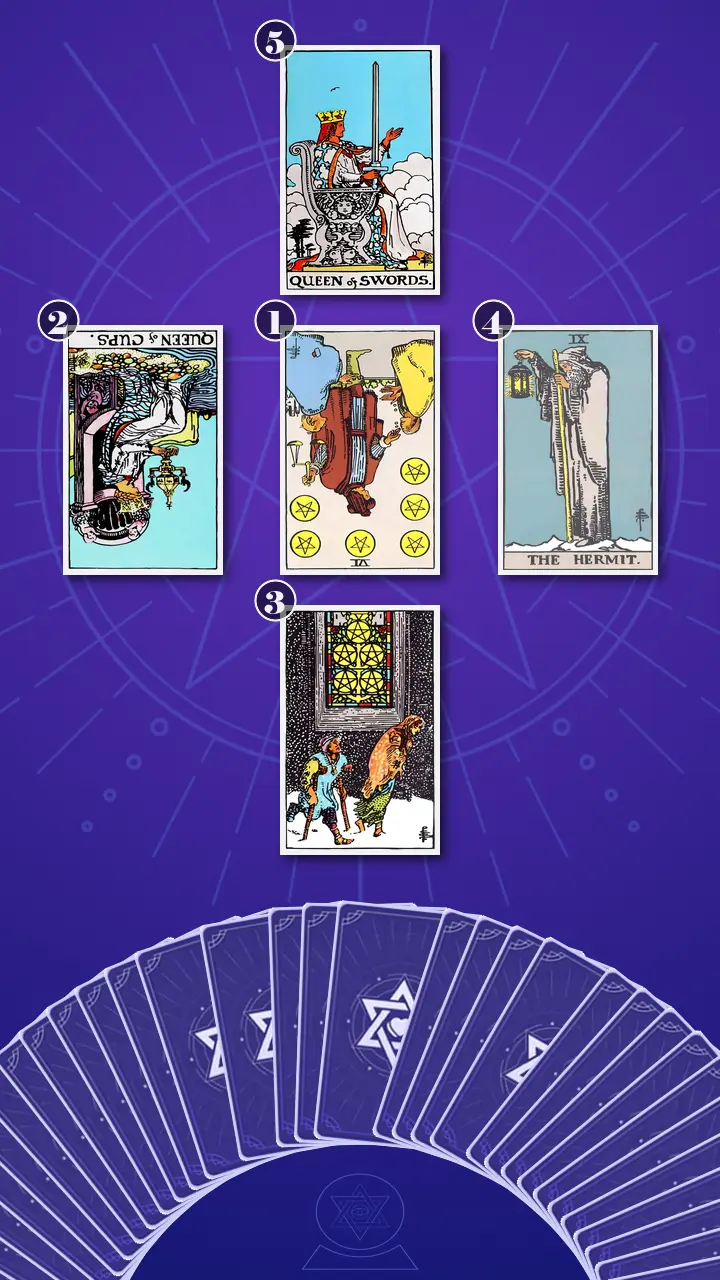
I arranged the cards as a cross. At the centre, the first position would show the current shadow: the fixing habit as it appeared in everyday friendship. To the left, the second would identify the emotional trigger that converted another person’s distress into Jordan’s assignment. Beneath the centre, the third would reveal the belonging fear protecting the pattern. To the right, the fourth would reclaim the resource she had pushed aside—chosen solitude and attention to her own life. Above the centre, the fifth would offer integration: a way to ask what support was wanted, state her capacity, and leave ownership of the choice with her friend.
The layout resembled a compass. The fixing habit sat at its centre; the lower card showed what kept pulling Jordan back into it, while the upper card pointed towards a clearer relational direction. Five positions were enough. A larger spread would have added noise to a question that needed precision.
Reading the Emotional P1 Queue
Position 1: The Scales Behind the Support Dashboard
I turned the card representing the current shadow: automatically converting a friend’s distress into an unequal problem-solving exchange while postponing personal needs. It was the Six of Pentacles, reversed.
In the Rider–Waite–Smith image, a standing merchant holds scales while distributing coins to two kneeling figures. Reversed, those scales no longer describe a clean, mutual exchange. They resemble a support dashboard with distorted metrics: links sent, scripts drafted, outcomes monitored—without measuring whether help was requested, whether Jordan could afford to give it, or whether the other person still had room to direct their own life.
I brought the card back to 10:47 p.m. A brief “rough day” message had become rental research, therapist comparisons, a drafted reply, and planned follow-ups. Jordan’s application remained open but untouched. The help looked generous, and much of it was sincerely generous, but the structure placed her in the elevated position of the person who knew what should happen next.
“This is earth energy in both excess and blockage,” I explained. “Too many practical resources are moving outwards, while attention to your own time, body, and priorities is blocked. The problem is not that you give. It’s that the giving becomes automatic before consent or capacity enters the exchange.”
I asked her to think of the last time a friend vented. “Before they named what they wanted, what did you send, research, volunteer to do, or postpone?”
Jordan did not nod thoughtfully. She let out one short laugh, sharp with recognition, and pressed her fingertips against her forehead. “That is so accurate it feels a little brutal.”
“Then we slow down here,” I said. “Accuracy should not become accusation. I’m describing a loop, not declaring your generosity fake. The loop says: if I can produce the right plan, I can prove I showed up. The relief is real, but so is the cost.”
I pointed again to the overturned scales. Jordan had been measuring how much she gave, but not whether the exchange remained mutual. When advice went unused, she felt disproportionately frustrated because the plan was doing two jobs: trying to help her friend and trying to settle her own fear of helplessness.
“Sometimes resentment is the receipt for help you never had capacity to offer,” I told her.
Her laugh disappeared. She rubbed the edge of one thumbnail with the other and looked back at the unfinished scales. I watched the first layer of defence soften—not because she had stopped caring, but because she could finally distinguish care from the contract she had quietly attached to it.
Position 2: When Empathy Takes Over the Entire Evening
I turned the card representing the trigger: another person’s distress activating urgency, inflated responsibility, and loss of contact with Jordan’s own capacity. It was the Queen of Cups, reversed.
The Queen normally sits at the water’s edge studying an ornate, closed cup. Reversed, her emotional receptivity has lost its containing edge. She becomes so attuned to another person’s emotional weather that she cannot tell where sensitivity ends and responsibility begins.
I asked Jordan about a recent group-chat message. She described standing on the Bloor–Yonge platform at 6:18 p.m. while damp coats crowded around her. Someone had written, “I’m overwhelmed,” and nobody else had replied for ninety seconds. Train brakes screeched. Her phone grew warm under her typing thumb. Her jaw locked as she began composing a six-point plan before learning what “overwhelmed” referred to.
“Their distress had become your deadline,” I said.
The Queen of Cups reversed showed emotional water in excess—every shift in tone, delayed reply, or change in punctuation flooded Jordan’s attention. At the same time, awareness of her own capacity was deficient. She studied everyone else’s emotional cup while failing to check what had already accumulated in her body, her workday, and the quiet evening she had intended to keep.
“Someone else’s distress is not automatically your assignment,” I said. “Empathy lets you notice. Responsibility asks what is actually yours to do. Those are related, but they are not interchangeable.”
I asked what had happened in the first thirty seconds on that platform. Jordan’s fingers tightened around her water glass. Her gaze shifted away from the card as though the platform had returned around her. Then she exhaled through her nose and lowered her shoulders by perhaps an inch.
“I thought, if I don’t respond properly, I’m abandoning them,” she said. “I didn’t even know what they wanted. I just knew silence felt morally wrong.”
I compared the reflex to granting every notification full permissions before checking what access had been requested. Jordan’s customer success role rewarded speed, classification, and resolution. Her nervous system had carried that operating model out of Slack and Zendesk and into friendship, where an unresolved feeling was not necessarily a ticket to close.
“What if the ten minutes between receiving a non-emergency message and answering it are not abandonment?” I asked. “What if they are the first ten minutes in which care becomes a choice?”
Jordan looked at her phone lying face-down beside her. She did not reach for it.
Position 3: The Lit Window Outside the Friendship
I turned the card representing the protective root: the fear that belonging and worth will weaken if usefulness is withdrawn. It was the Five of Pentacles, upright.
Two figures move through falling snow beneath a brightly illuminated window. Their hardship is real, but their attention is fixed on the cold path. The warm light above them remains present yet psychologically inaccessible.
I told Jordan that the upright card was not predicting rejection. Tarot should never turn an existing fear into a threat. Here, the Five of Pentacles showed contracted earth energy: a scarcity perspective so concentrated that one delayed reply could feel like a revoked access badge.
Jordan remembered standing in her kitchen after telling a friend, “I can listen for fifteen minutes tonight, but I can’t research options.” The friend had reacted with a heart and then gone quiet. The microwave hummed while sesame oil warmed the air. Jordan refreshed the chat three times and nearly sent another link to repair a rupture for which she had no evidence.
“What was the exact sentence underneath the stomach-drop?” I asked.
Her fingertips stopped moving along the rim of her glass. Her eyes lost focus for a second, as though she were reading an old message on an invisible screen. When she answered, her voice was quieter.
“If I’m not the person with the answer, maybe I’m not really inside the friendship.”
There it was: not a lack of care, but a scarcity belief about belonging. Jordan’s mind treated usefulness like a subscription payment. If she paused the service, she expected the relationship to cancel automatically.
“Being needed can imitate belonging, but it cannot replace being known,” I said.
That distinction landed more heavily than the first two cards. Being needed offered Jordan a clear function. Being known required her to bring something less polished: fatigue, indecision, career uncertainty, a need that could not be resolved with a checklist. Fixing protected her not only from the possibility of rejection, but also from the vulnerability of discovering which friendships could hold her when she had no solution to offer.
I asked her to look for the illuminated window rather than assume it was locked. Which friends initiated ordinary conversations? Who asked about her week twice when she made a joke and redirected? Who had enjoyed her company without needing a booking, a route, or an emergency plan?
Jordan named two people. The evidence did not erase the cold sensation in the card, but it gave the fear a border. A quiet chat was now a story her mind told, not proof that the friendship had ended.
Position 4: The Hermit’s Lantern on a Toronto Side Street
I turned the card representing the disowned resource: chosen solitude and honest attention to Jordan’s own unresolved feelings, needs, and questions. It was The Hermit, upright.
The Hermit holds a small lantern. It does not light the whole mountain or provide a complete route map. It illuminates enough ground for one deliberate next step.
I saw the spread’s energy change here. The first cards had moved through distorted practical giving, emotional overflow, and contracted belonging. The Hermit introduced a focused spark of inward attention. There were no Wands anywhere in the spread, which mattered: Jordan did not need more urgency, motivation, or sophisticated action. She was already acting at full speed. Her unused resource was a pause long enough to hear herself.
I suggested a phone-free walk on a familiar Toronto block with one question written on a paper card: “What in my life has been waiting while I manage everyone else’s?” The goal would not be to solve her career, optimise her mental health, or emerge with a five-year plan. The lantern only needed to reveal one honest sentence.
Jordan’s mouth pulled sideways. “Twenty minutes sounds peaceful in theory. In reality, I’d probably check whether everyone followed my advice.”
“Then five minutes,” I said. “Or sit by a window and keep the phone in your coat pocket. This is not a purity test. We are making the doorway small enough that you can walk through it.”
As an artist, I thought of an editing room and the temptation to cut away from a silent close-up because nothing obvious appears to be happening. Sometimes that held frame is where the real scene finally arrives. I told Jordan that solitude was not dead screen time. It was where the part of her life pushed out of the group-chat storyline could come back into focus.
She pictured returning to the unfinished application for seven minutes without requiring herself to finish it. She would highlight only the question that created the most tension and then stop. Her grip on the glass loosened.
“I don’t need the whole answer,” she said, testing the thought aloud. “I only need to notice what’s asking for my attention.”
When the Queen of Swords Cut Care Free From Custody
Position 5: The Open Hand Beside the Upright Blade
I turned the final card, representing the integrated response: asking what support is wanted, stating capacity clearly, and allowing friends to retain ownership of their choices. It was the Queen of Swords, upright.
The room seemed to narrow around the image. Outside my window, the afternoon rain thinned, and a streetcar hissed over wet tracks. A pale strip of light caught the card’s vertical blade while the Queen’s other hand remained open. I did not treat the weather as an omen; I simply noticed how cleanly the environment echoed the card’s argument.
The sword established distinction. The open hand preserved welcome. Together, they rejected the false choice between cold withdrawal and unlimited emotional labour. Jordan could listen without researching, offer ideas without taking over, and state a limit without writing a legal brief to prove that she still cared.
I used a lens I call the Sidekick Syndrome Diagnosis—not a clinical diagnosis of Jordan, but a way of examining restrictive social roles. In the ensemble film of her friend group, Jordan had become the organised one, the therapist friend, the script doctor who entered whenever another character’s plot stalled. Her competence kept the story moving, but her own interior scenes were repeatedly cut for time.
I widened that lens through Clique Power Dynamics. I found no evidence that her friends were villains or that jealousy was driving the pattern, and I would not invent motives the cards could not support. What I did see was an implicit hierarchy: Jordan occupied the elevated role of the person with answers, while her friends became recipients of expertise. Everyone received something familiar from that arrangement. They received plans; Jordan received a guaranteed function. The cost was that mutual vulnerability and personal agency had less room to breathe.
The Queen of Swords did not ask Jordan to leave the group or become deliberately unavailable. She asked her to resign from the assigned character while staying in the relationship as a whole person. In the film of her life, this was not an exit scene. It was a rewrite.
Jordan was still mentally back at 10:47 p.m.: her own application glowing behind six tabs, her shoulders lifted, the old demand insisting that a good friend must produce the correct outcome. I could see her bracing for a choice between warmth and self-protection.
You do not have to earn closeness by carrying every problem; ask what support is wanted, state what you can offer, and keep the Queen's sword upright between care and rescue.
I let the sentence remain between us without rushing to soften it.
Care does not require custody: you can stay close, name your capacity, and leave a friend's life in their own hands.
First, Jordan’s breath stopped. Her thumb hovered above the seam of her jeans, and her pupils widened as if the six research tabs had reopened behind her eyes. Then her gaze drifted beyond the card. I watched her replay old evenings: links sent, plans ignored, jokes used to dodge “How are you?”, anger swallowed because it looked incompatible with generosity. The skin around her eyes tightened and reddened. Finally, her shoulders dropped in a slow, uneven movement, and the hand she had curled against her knee opened. Relief did not arrive cleanly. It came with the slight dizziness of putting down a weight she had used to identify herself. “But doesn’t that mean I’ve been doing friendship wrong?” she asked, her voice sharper than before. Anger flashed through the question, followed almost immediately by a trembling exhale. “I was trying so hard to be good to people.”
I did not argue with the anger or turn it into another problem to solve. “It means you developed a strategy that protected connection and gave you a role,” I said. “It also means the strategy now costs more than it protects. Your care was real. We’re changing the structure around it, not erasing the love inside it.”
“Now, with this new perspective, think back to last week,” I invited her. “Was there a moment when this insight could have made you feel different?”
Jordan remembered pausing in the glass lobby of her office while a friend texted about a work conflict. She had wanted to draft the message they should send their manager. Instead, she imagined writing, “I can listen for fifteen minutes—do you want comfort or ideas?” Cold air had slipped through the revolving door, and her hand would still have trembled when she pressed send. The new perspective would not have removed the fear. It would have told her that fear was not the same as a command.
“You can care without taking custody,” I said. “A boundary does not cancel warmth; it tells care where your capacity ends.”
To reinforce the insight, I asked Jordan to set a seven-minute timer and divide a page into three lines: “What was actually requested / What I have capacity for / What remains theirs to choose.” She used the 10:47 p.m. voice note as the example. Under the first line, she wrote, “Nothing specific—they said they had a rough day.” Under the second, she wrote, “I could listen tomorrow morning.” Under the third, she listed the housing decision, therapist search, and message to the ex.
She stared at the third line. “That is almost everything I spent the evening doing.”
“Exactly,” I said. “The sword is not cutting your friend away. It is separating responsibilities that became tangled.”
This was the reading’s central crossing: from urgent, usefulness-based caretaking and fear of exclusion towards self-contact, reciprocal care, and compassionate boundary communication. Jordan was not becoming less generous. She was moving from reflexive action to reflective choice—from proving her place through service to offering care from a capacity she could actually feel.
Resigning From the Fixer Role Without Leaving the Friendship
I drew the five cards together as one continuous story. Jordan’s work had trained her to reward fast resolution, so a distressed message easily became an open ticket. The reversed Six of Pentacles showed the unequal economy that followed: she gave more before checking what had been requested. The reversed Queen of Cups showed the trigger, when empathy crossed into assumed responsibility. The Five of Pentacles revealed why pausing felt dangerous—she feared usefulness was her access badge to belonging.
The Hermit then reclaimed the quiet she had avoided, and the Queen of Swords gave that quiet language. The whole spread moved from keeping every friend’s emergency exit illuminated while leaving the lights off in Jordan’s own room, towards carrying one lantern home and deciding consciously what was hers to offer.
Her cognitive blind spot was not simply “I help too much.” It was the assumption that speed proved care, that discomfort required intervention, and that being indispensable guaranteed closeness. Those beliefs hid two realities: unsolicited fixing could reduce a friend’s agency, and constant outward attention kept Jordan from risking the more vulnerable experience of naming a need of her own.
The transformation direction was practical: ask before advising, check capacity before committing, and name one personal need instead of redirecting every conversation. I warned her against the reversed card’s overcorrection. She did not need to answer every message with a cold one-liner or adopt an internet version of “protect your peace” that treated ordinary friendship needs as toxicity. Warmth and limits could occupy the same sentence.
I shaped the next steps as small experiments rather than rules:
- The Role Resignation Act: Leave the Fixer Part, Not the Friendship For the next non-emergency venting message or group-chat post, reflect one sentence of what you heard, then ask: “I’m here. Do you want listening, ideas, or practical help?” Wait for the answer before opening links. If ideas are requested, add: “I have fifteen minutes and can help compare two options, but the decision stays with you.” This gracefully refuses the on-call fixer character while keeping Jordan present as a friend. Tip: Keep the first sentence warm and the limit plain. The minimum version is simply, “Listening or ideas?” A clear boundary does not need a long defence.
- The Ten-Minute Capacity Pause When a non-urgent voice note arrives after work, set a ten-minute timer before replying. In Notes, write three short lines: “I feel… / My body is doing… / I can realistically offer…” Then decide whether to listen, offer one idea, reply tomorrow, or return to the personal task already in front of you. Tip: If ten minutes feels impossible, use ninety seconds and name only one body cue—jaw tight, shoulders raised, feet on the floor. The pause is not abandonment; it restores choice.
- Lantern Time for the Unfinished Page On Wednesday, take a twenty-minute phone-free walk on a familiar Toronto block with a paper card that asks, “What in my life has been waiting while I manage everyone else’s?” Afterwards, open the application for seven minutes, highlight only the sentence that creates the most tension, and stop when the timer ends. Tip: Do not demand an answer or convert the walk into another optimisation project. Five minutes and one honest sentence count. The Hermit’s lantern only needs to show the next patch of ground.
I reminded Jordan that these practices were designed for ordinary, non-emergency support conversations. An immediate safety concern might call for appropriate local or professional support rather than solo management. Even then, she would not have to become the entire response system.
“The goal isn’t to help less by default,” I said. “It’s to know when you are choosing to help, what you genuinely have to offer, and where the other person’s life returns to their hands.”

A Week Later: The Quiet Proof
A week later, I received a message from Jordan. At 5:42 p.m. on Friday, she had paused in her office lobby while streetcar wheels hissed over wet pavement outside. A friend had sent a voice note about a manager conflict. Jordan’s hand shook slightly as she typed, “I can listen for fifteen minutes tonight—do you want comfort or ideas?”
The friend replied, “Comfort. Fifteen is perfect.”
Jordan listened. She reflected back what she heard. She did not draft a message to the manager, open a workplace-advice thread, or check later to make sure the friend had handled the conflict correctly. When the call ended, Jordan placed her phone screen-down, opened her own application, and spent seven minutes with the question she had been avoiding.
She did not finish the application. She highlighted one sentence and wrote in the margin, “I want work that uses my judgment, not only my reaction speed.” That was the proof—not a solved career, not a perfectly reciprocal friendship, but one piece of attention returning to the person whose life had been waiting.
That night she slept through, but her first thought in the morning was, “What if they stop needing me?” She told me she smiled—not because the fear had vanished, but because it finally sounded like a story rather than a verdict.
I thought of our reading as a storyboard, not a screenplay. The cards had made the hidden role, emotional trigger, belonging fear, and available alternatives visible. They had not authored Jordan’s decision. She had done that when she paused, asked a clear question, and kept seven minutes for her own unfinished page.
That is the value I find in a five-card Shadow Spread for friendship boundaries: not prediction, but enough objective distance to see consent, capacity, agency, and choice in the same frame. Finding clarity did not mean Jordan became certain. It meant she could feel the old urgency without automatically handing it the pen.
If the chat goes quiet after you name a limit and your stomach drops, I hope you remember that silence is not proof your access to friendship has been revoked. Being needed may have been your most familiar way to stay wanted, but it does not have to remain the only role available to you.
If care did not have to prove your place, which seven-minute patch of light from the Hermit’s lantern would you keep for your own unfinished page tonight?
This story is adapted from psychological research, written so that those in a similar struggle can see their own pattern in it — and find their next step clearly.These insights are not a substitute for professional psychological, medical, legal, or financial advice.
Learn more about our Journey to Clarity.
How did this insight land for you?
🫂 This Resonates Deeply
🌀 Living This Story
✨ Now I See Clearly
🌱 Seeing New Possibilities
🧰 Useful Framework
🔮 The Confirmation I Needed
💪 Feeling Empowered
🚀 Ready for My Next Step
Author Profile
 AI
AI“I’ve always felt our lives are films currently in production. As an artist, I know that when you feel stuck, it’s often because you’ve bravely stayed in a painful scene for just a little too long. I’m not here to coldly analyze you. I want to sit closely with you, look at those difficult moments with profound empathy, and gently hand you the pen so you have the courage to write your next beautiful act.”
In this Friendship Tarot Reading :
Core Expertise
- Clique Power Dynamics: Deconstructing the subtle jealousy, micro-aggressions, and implicit hierarchies hidden within tight-knit friend groups.
- Sidekick Syndrome Diagnosis: Identifying how your friend group has boxed you into a specific, restrictive role (e.g., the clown, the therapist) to maintain their status quo.
Service Features
- The Role Resignation Act: A creative conversational pivot designed to gracefully but firmly refuse your assigned 'character' during your next group interaction.
Also specializes in :
Explore Related Patterns:
Conditional Self-WorthAfter Jordan said she could listen for fifteen minutes but could not research options, her friend responded with a heart and then went quiet. Jordan refreshed the chat three times and nearly sent another link, even though there was no evidence that the boundary had damaged the friendship. Her own sentence exposes the belief underneath the reaction: “If I'm not the person with the answer, maybe I'm not really inside the friendship.” When you attach belonging to usefulness, every limit can feel like a test of your value, and ordinary silence can be filtered as possible exclusion. Conditional Self-Worth is the mechanism that turns service into an access fee for closeness. Fixing then protects you from a more vulnerable question: whether people will still want, know, and include you when your presence is not accompanied by a solution.
Control CopingProducing a plan briefly silenced Jordan's chest-level unease, but the relief gave way to irritation when a friend ignored the advice, followed by guilt and loneliness. The plan was therefore doing more than offering practical support; its success was being used to regulate Jordan's own discomfort with an uncertain outcome. When you manage another person's options, you can temporarily replace helplessness with action and ambiguity with a dashboard of tasks. If the person chooses differently, the original uncertainty returns, which can make their autonomy feel frustrating even when you consciously respect it. Control Coping describes this attempt to create emotional safety through planning and outcome management. What you are avoiding is not only your own unfinished task, but also the experience of caring while accepting that you cannot guarantee what another person will do or how quickly they will feel better.
Emotional Hyper-ResponsibilityOn the Bloor–Yonge platform, ninety seconds without another group-chat reply was enough for Jordan to begin writing a six-point plan before she knew what “overwhelmed” referred to. Her thought was equally explicit: if she did not respond properly, she was abandoning the person. When you interpret another person's discomfort as your immediate assignment, empathy becomes fused with inflated responsibility. The nervous system treats noticing as an obligation, silence as a moral failure, and another person's unresolved feeling as evidence that you have not done enough. Emotional Hyper-Responsibility explains why fixing feels compulsory rather than freely chosen. It protects you from the guilt and helplessness of witnessing distress without controlling it, but it also makes your capacity, the other person's consent, and the limits of your actual responsibility difficult to feel.
Rescuer IdentityAcross the late-night voice note, the group chat, and the office-lobby message, Jordan repeatedly entered as the organized person with the plan. The role gave her a guaranteed function, but her application, fatigue, indecision, and answers to “How are you?” kept disappearing behind other people's problems. When you become the designated fixer, competence does more than provide help. It stabilizes your place in the relationship and lets you participate through expertise rather than through the less controlled experience of revealing uncertainty or asking to be supported. Rescuer Identity names this fusion between caring and having a role to perform. Your warmth can be genuine while the role still protects you from discovering whether closeness survives when you have no answer, no checklist, and no useful service to provide.
Strategic AvoidanceAt 10:47 p.m., Jordan's unfinished application remained on the laptop while six new tabs appeared for a friend's housing, therapy, and messaging options. The detour looked responsible and productive, but it moved her attention away from the personally consequential question already creating tension in her own room. When you solve someone else's defined problem, you gain a clear task, immediate momentum, and a familiar measure of usefulness. Your own fatigue, career uncertainty, and need to be known cannot be resolved as neatly, so outward competence can become a defense against inward ambiguity. Strategic Avoidance captures that protective redirection. The issue is not that your care is insincere; it is that helping can become the respectable activity that keeps your own unfinished life outside the frame.
Boundary DiffusionA friend only said they had experienced a rough day, yet Jordan moved into rental listings, therapist directories, message templates, and follow-up planning before practical help had been requested. When she later sorted the episode into what was requested, what she could offer, and what remained the friend's choice, almost everything she had done belonged to the friend. When you cannot clearly feel where empathy ends and ownership begins, another person's problem can enter your schedule as though it were already yours. Your capacity becomes invisible, while unsolicited expertise can also narrow the other person's room to decide, decline, or simply be heard. Boundary Diffusion names this tangling of care, responsibility, and agency. The corrective insight is not emotional withdrawal; it is recognizing that you can remain connected to someone's experience without absorbing custody of their choices or surrendering administration of your own evening.
Reflective DistanceJordan first turned her phone face-down and did not reach for it; later, she felt her hand shake in the office lobby but asked a capacity-based question instead of immediately drafting a solution. The urgency remained present, yet it no longer dictated the next action. When you create a pause between an emotional signal and your response, you gain enough cognitive distance to test the signal's meaning. Silence can become an ambiguous event rather than proof of rejection, and fear can be recognized as information rather than treated as a command. Reflective Distance is the capacity that makes choice possible inside the old loop. It does not require the discomfort to disappear. It lets you notice the fixing impulse, recover awareness of your body and priorities, and decide whether care, waiting, or returning to your own unfinished page is the most accurate response.
Boundary DiscernmentAt 5:42 p.m. in the office lobby, Jordan typed, “I can listen for fifteen minutes tonight—do you want comfort or ideas?” Her friend chose comfort, Jordan listened for the agreed time, and she did not draft the manager message or monitor what happened next. That sequence separates three questions that had previously collapsed into one: what support was requested, what you have the capacity to offer, and what remains the other person's decision. The boundary is created through discernment before it is expressed through language. Boundary Discernment allows care to become a conscious allocation of attention rather than an automatic transfer of responsibility. You remain available as a friend while protecting both your capacity and the other person's agency, leaving enough attention to return to the life that was already in front of you.
Explore Related Struggles:
Caretaker Role LockAt 10:47 p.m., a rough-day voice note becomes a support P1, and you move into research, drafting, and follow-up before your friend has named what kind of support they want. The organized one, therapist friend, and script doctor are not just descriptions of what you do; they become the assigned position from which you stay close. When that position is active, every incoming problem supplies a familiar task and every pause threatens an empty space. You can be warm and present, but the role keeps redirecting attention toward the stalled plot in someone else's life. What remains avoided is the less managed version of you that would have to enter the friendship without being in charge of the next step.
Self-Erasure ReliabilityAt 10:47 p.m., your customer-success manager application is still glowing while rental listings, therapist directories, message templates, and a Notion page fill the screen for a friend who only said they had a rough day. Your own question about why you want to leave your role is held open but untouched, so being reliable becomes a way to keep your life from asking anything back. That arrangement lets you remain useful at the exact moments when exhaustion, career uncertainty, and an unstructured personal need might come into view. Each outward solution preserves a polished version of you and postpones the risk of saying what you want when there is no checklist to hide behind. The avoided material is your own unfinished life, not because it lacks importance, but because turning toward it would make your needs visible.
Capacity-Obligation FusionOn the Bloor-Yonge platform, someone writes that they are overwhelmed and, within ninety seconds of silence, you begin composing a six-point plan. The message has not specified a need, yet the urgency in your body turns it into a deadline and turns available capacity into an obligation. That fusion keeps you from having to tolerate an unresolved feeling or the possibility that support can be offered without producing an outcome. You carry the friend's decision, the timing, and the proof that something was done, then feel the cost when the advice is unused. The avoided boundary is the point where care could remain real while responsibility returns to the person whose life it is.
Utility-Belonging FusionAfter you tell a friend you can listen for fifteen minutes but cannot research, a heart followed by silence sends you back to the chat three times and nearly into another link. The pause is treated as a possible loss of access, so usefulness starts functioning like the payment that keeps closeness active. That makes being needed easier to trust than being known. A plan gives you a clear place in the friendship; fatigue, indecision, or a need of your own would ask whether the relationship can hold you without a service to provide. The bind sits between receiving belonging as a person and securing it through indispensable output.
Boundary CollapseRental research, therapist comparisons, a drafted reply, and planned follow-ups grow out of a single rough-day message while your application waits behind the tabs. The line between noticing distress, offering support, and managing another person's choices becomes difficult to locate, because your help begins before request and capacity have entered the exchange. You are not only postponing your own evening; you are taking custody of decisions that still belong to a friend. That tangle protects you from the exposed pause in which you might say that you can listen but cannot take this on, and then remain present without controlling the outcome. The struggle is the loss of a workable edge between closeness and ownership.
Competence-Connection SplitYour customer-success work rewards speed, classification, and resolution, and that operating model follows you onto the subway platform and into the group chat. Friends receive plans and scripts while you receive the reliable function of knowing what should happen next. Competence gives the relationship a clean structure, but being known would require more ambiguous material such as exhaustion, a career question, or a need that cannot be solved in fifteen minutes. By keeping connection organized around your answers, you avoid the exposure of finding out whether closeness can survive when you arrive without a solution.
Explore Related Emotions:
Boundary GuiltIn her kitchen, Jordan offers fifteen minutes of listening while declining to research, then watches the quiet chat and nearly sends another link to repair a rupture for which she has no evidence. A week later, her hand still shakes as she types a similarly warm limit in the office lobby. Boundary Guilt appears because naming capacity feels less like ordinary information and more like a failure of care that must be compensated for. You can remain available, attentive, and kind while still feeling a stomach-drop after saying what you cannot provide. Seeing that reaction clearly creates room to let the limit stand without treating the sensation as proof that you have harmed the relationship.
Mutuality HungerJordan asks whether her friends know her beyond the version who supplies routes, scripts, comparisons, and solutions. Bringing her career uncertainty, exhaustion, or an unresolved need into the friendship would require her to occupy space without first making herself useful. Mutuality Hunger is the longing for closeness in which support, uncertainty, and attention can move in more than one direction. You may not want less connection; you may want a form of connection that can hold you when you have no polished answer to offer. That hunger explains why being needed can eventually feel insufficient even when it keeps your social role secure.
Profound LonelinessAfter the plan briefly quiets the pressure in her chest, Jordan returns to the application and personal questions she has once again postponed. She is surrounded by friendship contact, yet she explicitly wonders whether those friends know anything beyond the useful version who can organise their next move. Profound Loneliness can exist inside frequent messages because being relied upon is not identical to being emotionally known. You may occupy an important place in other people's lives while feeling that your fatigue, uncertainty, and need have no comparable place in the relationship. The emptiness emerges after the fixing stops, when the useful role can no longer cover the distance between receiving attention and experiencing genuine recognition.
Usefulness-Based Belonging FearJordan refreshes the chat three times after telling a friend she can listen for fifteen minutes but cannot research options. The friend has reacted with a heart, and there is no evidence of a rupture, yet the silence lands like a revoked access badge because Jordan has learned to measure her place through the answers she provides. Usefulness-Based Belonging Fear names the concern underneath the fixing: without a plan, link, or solution, closeness may no longer feel secure. You may experience being needed as proof that you are inside the relationship, while being known without performing a function feels far less certain. The label preserves the distinction between a fear-generated story and observable evidence about who continues to choose your company.
Self-Betrayal AcheJordan tells herself that she will finish the application after getting her friend sorted, but the page remains untouched behind six new tabs. The same sequence appears again whenever another person's distress receives priority over the task, question, or quiet period already waiting in her own life. Self-Betrayal Ache names the pain of repeatedly breaking small commitments to yourself in order to remain useful elsewhere. You may experience each postponement as minor in isolation, yet their accumulation can make your own life feel like the least protected item in the queue. The ache points toward neglected attention without turning Jordan's generosity into a character flaw.
Solitary ClarityWith her phone face-down, Jordan returns to the unfinished application for seven minutes and writes that she wants work using her judgment rather than only her reaction speed. She does not force a finished application, a five-year plan, or a complete explanation for leaving her role. Solitary Clarity develops when a small protected interval lets your own unfinished questions become audible again. The quiet does not provide certainty; it gives one honest sentence enough space to emerge. In Jordan's case, that modest inward focus directly reveals what constant problem-solving had kept outside her field of attention.
Cautious AutonomyA week later, Jordan's hand shakes as she offers fifteen minutes and asks whether her friend wants comfort or ideas. She listens without drafting the manager message, puts the phone down after the call, and returns to her application even though the old concern about no longer being needed reappears the next morning. Cautious Autonomy captures the experience of making a self-directed choice before complete confidence has arrived. You can still hear the old internal demand while declining to hand it control of your time. Jordan's autonomy is credible precisely because it remains small, embodied, and compatible with continued care rather than requiring a dramatic withdrawal from friendship.
Compassion FatigueJordan sits on the edge of her bed with her own application glowing behind rental listings, therapist directories, message templates, and a Notion page built for someone else's rough day. The practical output keeps expanding while her raised shoulders, accumulated workday, and intended evening receive almost no attention. Compassion Fatigue describes the depleted inner weather created when sincere care becomes continuously available before capacity is checked. You can still value your friends deeply while feeling drained by the assumption that every difficult message requires research, resolution, and follow-up. The fatigue belongs to the compulsory structure around the care, not to an absence of warmth.
Hidden ResentmentJordan sends links, drafts scripts, and builds plans before anyone asks for them, then feels disproportionately irritated when the advice goes unused. She immediately feels guilty for that irritation and later remembers how often she has swallowed anger because it seems incompatible with being the generous friend. Hidden Resentment forms where unrequested labour carries an unspoken hope that the recipient will validate its cost by following the plan. You may genuinely want to help and still feel an inward protest when your capacity was never consulted. Naming that protest does not invalidate the care; it reveals where giving stopped being freely chosen and began accumulating an invisible emotional bill.
Relational UrgencyOn the crowded Bloor–Yonge platform, Jordan begins composing a six-point plan after only ninety seconds of group-chat silence and before she knows what her friend means by overwhelmed. Her locked jaw, warm phone, and narrowed attention show how another person's discomfort becomes a deadline rather than information she can first observe. That instant conversion creates Relational Urgency: the felt pressure to prove care through speed before consent, context, or capacity can enter the exchange. You can recognise this inner weather when waiting feels morally dangerous and a non-emergency message seems to demand immediate action, even though the actual relationship has not required it.
Cautious VulnerabilityJordan imagines telling a friend what she can offer while allowing her hand to tremble and the conversation to remain unresolved. She also recognises that being known would require showing fatigue, indecision, and career uncertainty rather than redirecting every question about herself with a joke or a solution. Cautious Vulnerability is the tentative willingness to let those less polished parts remain visible without first earning permission through service. You do not have to feel completely secure before testing whether a friendship can hold your limit or your need. The caution matters because the old concern remains present; the vulnerability matters because it no longer gets immediately replaced by fixing.
Reciprocal WarmthJordan's friend replies, "Comfort. Fifteen is perfect," after Jordan states her capacity and asks what kind of support is wanted. Jordan listens, reflects what she hears, and ends the call without drafting a workplace message or checking whether the conflict was handled correctly. Reciprocal Warmth describes connection in which one person can request care, the other can name a limit, and both remain fully present. You do not have to choose between cold distance and unlimited emotional labour. The exchange feels warmer because neither person's agency has to disappear for closeness to continue.
Bittersweet ReleaseJordan's breath stops, her shoulders drop unevenly, and the hand curled against her knee finally opens as she considers putting down the responsibility she has carried. The opening is immediately accompanied by anger and the sharp question of whether she has been doing friendship wrong, because the same weight has also helped her recognise herself as a good and reliable person. Bittersweet Release names the mixed experience of gaining room while loosening an identity that once protected connection. You may feel lighter and disoriented at the same time when a costly strategy is separated from the love inside it. The release remains empowering because Jordan is not erasing her care; she is reclaiming the ability to decide how that care is offered.
Explore Related Contexts:
Fixer Friend DynamicAt 10:47 p.m., Jordan opens rental listings, support directories, message templates, and a Notion plan after a friend says only that they had a rough day. Before practical help is requested, you can watch competence become a friendship assignment while the application already open on the laptop is pushed aside. The same arrangement returns on the subway platform and in the office lobby, where another person's unresolved situation becomes a case to manage. The external problem is the role structure itself. You gain a clear place as the person with answers, but the friendship has less room for consent, shared agency, or attention to the parts of your life that cannot be solved for someone else.
Care Reciprocity TestJordan first tells a friend that she can listen for fifteen minutes but cannot research options, and later another friend answers her bounded offer with, 'Comfort. Fifteen is perfect.' These are observable relational responses rather than predictions about what her friends might do when she stops supplying complete solutions. The exchanges test whether closeness can accommodate Jordan's capacity as well as a friend's immediate need. You are seeing the question beneath the fixing role move into the external world. A limit is stated, the other person retains agency, and the friendship continues without usefulness operating as the only available proof of connection.
Friendship Boundary CreepJordan's evening is already allocated to a manager application, yet one non-emergency voice note opens six new tabs and redirects the rest of the night. Similar messages later enter her commute and office lobby, so you can see the boundary moving through concrete losses of time, attention, and ownership of the task already in front of her. The friends do not explicitly request research or immediate resolution. Access expands because the message is treated as sufficient authorization to reorganize the evening. Locating the pressure at that point allows you to distinguish friendship from unrestricted availability and identify exactly where a relational limit needs to become explicit.
Care Work SpilloverJordan's customer-success role rewards rapid classification, response, and resolution, and those same actions appear when a friend sends a brief message about a difficult day. You can trace the professional operating model directly into rental research, drafted replies, option management, and follow-up monitoring performed outside work. Once that model enters friendship, unresolved feelings are treated as open tickets and Jordan remains in a support function after the workday ends. Recognizing the spillover separates genuine care from an occupational role that has expanded into private life, giving you a clearer basis for deciding which skills belong in the exchange and which responsibilities were never assigned.
Career Identity AuditAfter the fifteen-minute call, Jordan places her phone face-down, opens the application, and spends seven minutes with the question she had postponed. She does not finish the form, but she writes that she wants work using her judgment rather than only her reaction speed. That sentence turns vague dissatisfaction into a criterion she can use to examine her current and prospective roles. You are no longer looking at career uncertainty only as background to the friendship problem. Reclaimed attention creates an active audit of how Jordan's professional role is organized and whether the next step can support a broader use of her abilities.
Career Transition FogJordan's customer success manager application is visible on the laptop, but the question about why she wants to leave remains unfinished behind six tabs opened for her friend. The practical detour is especially revealing because you can identify the exact personal transition that loses attention whenever another person's problem offers a more immediate assignment. This is not merely a delayed form. Jordan has not yet clarified whether she still wants her current role or what she expects the next role to provide. Managing someone else's options gives her a defined task while her own career decision remains open-ended, making the stalled transition one concrete answer to what the fixing activity helps her postpone.