Finding Clarity in the 10:22 p.m. Screen Glow
You’re the kind of person who can run a clean project plan at work, but one “Can we rain check?” text makes you reread the entire thread like it’s evidence in a trial.
Jordan said it like she was confessing to a crime she didn’t even believe in. She was twenty-eight, a marketing coordinator downtown, the kind of person who could keep a campaign timeline on track and still remember someone’s oat-milk order. But she sat across from me in my café with her phone face-up like it might vibrate again and finish the thought for her.
“It’s always the same moment,” she told me. “10-ish p.m. The TV is on but I’m not watching. The radiator clicks. The only real light is my phone screen. And then: ‘Something came up, can we reschedule?’”
I watched her swallow. Her shoulders climbed a fraction, like her body was bracing for a hit she’d already taken. “My stomach drops,” she said, one hand hovering over her midsection. “My throat gets tight. And then my brain… it’s like it opens a tab called Proof I’m Not a Priority.”
She laughed once—small, sharp, embarrassed. “I scroll up three weeks. I compare ‘lol’ versus ‘haha.’ I notice they didn’t use an emoji this time. I hate that I care this much.”
Underneath the disappointment was the real engine: Jordan wanted closeness and reliability, but she was terrified that any wobble meant she was unwanted—replaceable—an easy cut from someone else’s calendar.
The hurt sat in her like cold syrup: heavy, slow, and sticky. Not dramatic. Just relentlessly there.
I set down two cappuccinos—the kind with a warm cinnamon smell that makes your chest loosen before your mind catches up. “Okay,” I said gently. “Let’s not shame the part of you that reacts. Let’s understand it. We’re going to do a Journey to Clarity—one where we separate what happened from what your nervous system concludes happened.”
Choosing the Compass: The Celtic Cross · Context Edition
I didn’t light candles or speak in riddles. I asked Jordan to take one slow breath in, then out, and to hold one question in her mind: “Why do canceled plans trigger rejection—what old story is this?”
I shuffled while the espresso machine hissed behind me, a familiar sound like ocean foam. “This part,” I told her, “isn’t magic. It’s focus. Your attention is the fuel. The cards just give it a structure.”
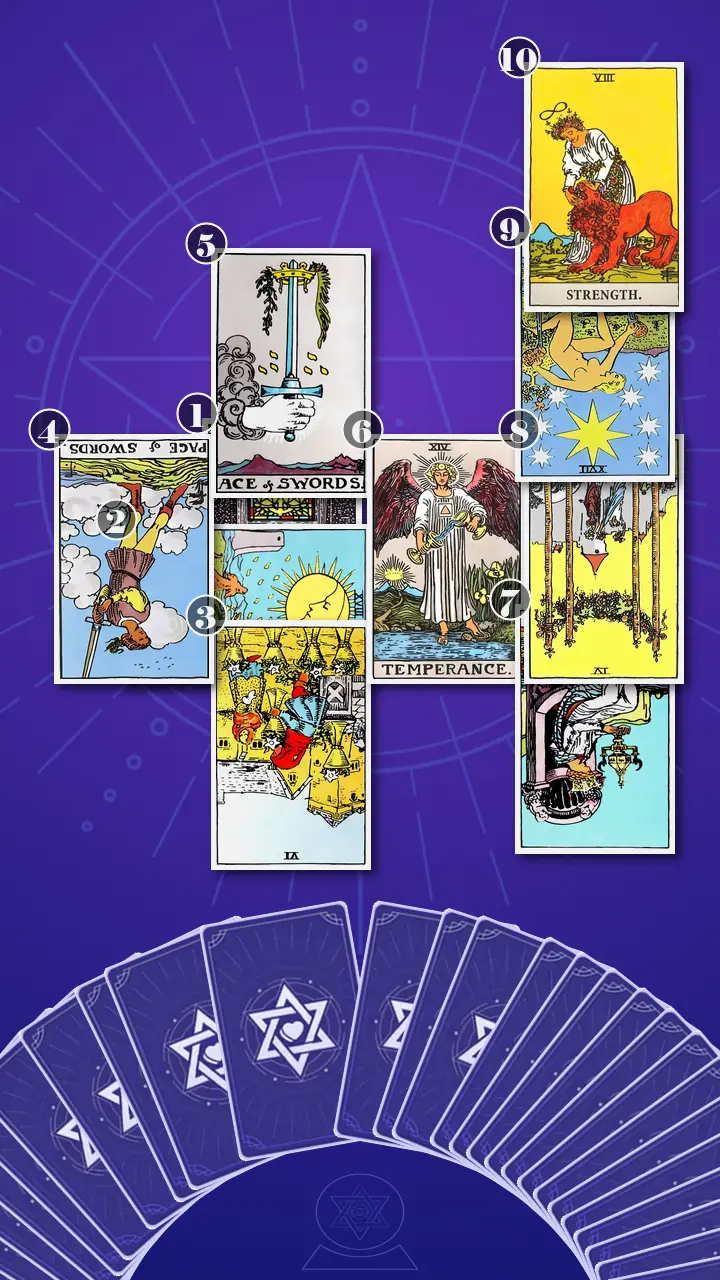
“Today we’ll use the Celtic Cross · Context Edition,” I said, laying out the cloth on our table near the front window.
For you reading this: I use this version when someone’s stuck in a trigger-loop and needs a clean chain from the present moment to the deeper root, and then into practical next steps. The classic Celtic Cross can sound like fortune-telling if it’s handled lazily. So I don’t read position 6 as “what will happen,” but as the next integrative step. And position 10 isn’t “the result,” but the integration path—how you carry the lesson forward with agency.
I tapped three spots on the spread. “We’ll start with the moment of impact—what you do right after the cancellation. Then we’ll name the main tension that keeps it charged. And we’ll end with the stabilizing path—the practice that turns this from a spiral into a skill.”
Reading the Map: From Trigger to Old Story
Position 1: The Moment of Impact
“Now the card we turn over represents the moment of impact: what you’re experiencing and doing right after a cancellation,” I said.
Five of Pentacles, upright.
“This is like when the cancellation text hits while you’re in motion—coat on, Uber open, calendar blocked—and your body reacts like you’ve been quietly uninvited from warmth,” I told her, keeping my voice steady. “Not just disappointed. Excluded. Like everyone else has a place and you’re the person left outside scrolling for proof you belong.”
In tarot terms, the Five of Pentacles is an energy of scarcity and exile. In real life, it’s that instant nervous-system math: Plan changed → I’m outside. It’s not a thought you choose. It’s a body memory that arrives first.
Jordan gave a tight, bitter little laugh. “That’s so on the nose it’s rude.”
I nodded. “I know. And it’s not calling you dramatic. It’s naming the sensation. This card is the cold tile under your bare feet, the phone glow, and the sudden social winter.”
Position 2: The Main Tension That Crosses the Moment
“Now the card we turn over represents the main tension: what complicates the moment and keeps it charged,” I said, sliding the crossing card over the first.
The Moon, upright.
“Ambiguity turns into a spiral,” I said. “You read ‘something came up’ and your brain writes the missing details for them. You analyze response time, punctuation, emojis, and then cross-check their social media activity like it’s going to deliver closure—except it just makes the fog thicker.”
The Moon is not “intuition” in the cute TherapyTok sense. It’s projection under low light—when the facts are thin and fear is loud. Energetically, it’s a blockage: uncertainty becomes a trigger, and your mind tries to solve emotional discomfort by inventing a story.
I leaned in a little. “This is the detective montage,” I told her. “Refreshing the thread. Zooming in on punctuation. Opening Instagram Stories like it’s Exhibit A.”
Then I mirrored the pattern in short lines, the way it actually hits at night:
If they didn’t suggest a new time, then it means I’m not a priority.
If they’re active ‘5m ago,’ then it means they’re choosing something else over me.
If I reply too fast, I look needy. If I reply too slow, I look cold. Either way I lose.
Jordan’s mouth pressed into a line. She nodded once, like she didn’t want to, like agreement cost pride. “This is exactly what my brain does at 2 a.m.”
“You’re not ‘too much,’” I said, letting the sentence land without theatrics. “You’re trying to get certainty from a foggy situation.”
Position 3: The Old Story Underneath
“Now the card we turn over represents the old story: the deeper root and learned association that gets activated by cancellations,” I said.
Six of Cups, reversed.
“The hurt feels older than the situation,” I told her. “A simple reschedule lights up a whole internal scrapbook of being the one who cared more, being left out, being the backup plan. You’re reacting to a pattern you once survived—not necessarily to what’s actually happening right now.”
Reversed, this card isn’t nostalgia; it’s a pull backwards. Energetically, it’s a blockage of time: the present gets hijacked by an old file labeled Not Chosen.
Jordan’s eyes unfocused for a second. Her fingers tightened around the warm cup, then loosened. “It’s embarrassing,” she whispered. “Because it’s not even this person. It’s like… everyone.”
“Not embarrassing,” I corrected softly. “Specific. There’s a difference.”
I asked, “When you feel that stomach-drop, what age does it feel like?”
She exhaled through her nose, almost a laugh, almost a sigh. “High school. Or like… early twenties. Being the extra invite.”
“Good,” I said. “That’s the old story showing itself. We don’t argue with it. We locate it.”
Position 4: What Trained the Pattern
“Now the card we turn over represents what trained the pattern: the context that made this reaction feel necessary,” I said.
Page of Swords, reversed.
“You learned to protect yourself by staying on high alert,” I told her. “Checking timestamps, rereading tone, preparing a ‘perfect’ response so you can’t be blamed for being too needy. It’s less communication and more defense—like you’re bracing for impact before anything has actually hit.”
In terms of energy, this is excess in the mind: too much scanning, too much editing, too much crisis-comms energy aimed at one tiny text.
For a second I had an inner flashback—not mystical, just human. Twenty years of running my café means I can tell, from the way someone grips a cup, whether their day has already taken too much from them. Some people stir and stir and stir, trying to get the sweetness to dissolve faster. But it just makes the liquid cloudy.
Jordan swallowed. “I literally live in my drafts folder,” she said. “Like, twelve unsent messages and none of them feel safe enough to be real.”
“Exactly,” I said. “Your brain treats tone like receipts. It’s trying to prove something you’re already afraid is true.”
Position 5: The Conscious Script You’re Trying to Live By
“Now the card we turn over represents the conscious script: the mental rule you reach for,” I said.
Ace of Swords, upright.
“This is the part of you that wants self-respect,” I said. “It chooses one clean sentence over ten anxious drafts. Instead of decoding hints, you name reality: you were looking forward to it, you’re open to rescheduling, and you want clarity about whether it’s happening.”
Energetically, the Ace of Swords is balance in the mind—sharp, but not cruel. It’s clarity as relief, not confrontation.
I watched Jordan’s shoulders drop about five percent—like someone finally lowered the volume on a buzzing fluorescent light.
“One clear sentence beats ten anxious drafts,” I said, because I wanted it to become a reflex for her.
She gave me a look like she was about to screenshot the air. “Okay. Yeah. I’d save that as a template.”
Position 6: The Next Integrative Step
“Now the card we turn over represents the next integrative step: what becomes possible when the trigger is met differently,” I said.
Temperance, upright.
“You practice holding two truths at once,” I told her. “This disappoints me, and this doesn’t decide my worth. You don’t swing between cold withdrawal and reassurance-chasing. You blend honesty with steadiness and respond in a way you won’t regret tomorrow morning.”
Temperance is balance—emotional alchemy. It’s the skill of letting feelings move without letting them flood.
In café terms? It’s learning to pour milk into espresso slowly, not dumping it in and ruining the texture. There’s an art to mixing. There’s an art to staying warm without spilling.
Jordan nodded, slower this time. “So I don’t have to be… unbothered.”
“No,” I said. “You get to be honest and steady.”
Position 7: How You Show Up Internally
“Now the card we turn over represents your self-position: how you show up internally in this dynamic,” I said.
Queen of Cups, reversed.
“You’re deeply attuned—maybe too attuned,” I told her. “A shift in tone feels like a shift in your value. You absorb their availability like it’s a scoreboard, and when you can’t get certainty, your feelings get loud and your boundaries get blurry.”
Energetically, this is a deficiency of containment—not a lack of feelings, but a lack of a sturdy inner cup to hold them when uncertainty hits.
Jordan stared at the card like it was too accurate to be polite. “I tell myself I’m ‘intuitive,’” she said, then her voice turned smaller. “But it’s not intuition. It’s… panic with good vocabulary.”
“That’s a brave distinction,” I said. “And it’s the doorway back to your own center.”
Position 8: The External Field
“Now the card we turn over represents the external field: what your environment actually provides,” I said.
Four of Wands, reversed.
“Your social world is schedule-dependent,” I said. “Work runs late, transit is chaos, people are tired—so the container of plans is wobblier than you want. Each cancellation feels like the doorway to belonging moved again, and your nervous system hates unstable thresholds.”
Energetically, this is instability around the outside structures—nothing personal, but still real. This card matters because it tells us: part of your trigger is contextual. Modern life really does make consistency harder. That doesn’t mean you’re unchosen. It means you need a different kind of safety than “perfect plans.”
Jordan gave a small, resigned nod. “It does feel like making a social calendar is a second job.”
“Exactly,” I said. “So the skill isn’t ‘never feel disappointed.’ The skill is building a home base inside you.”
Position 9: Hopes and Fears
“Now the card we turn over represents your hopes and fears: what you long for, and what you dread being confirmed,” I said.
The Star, reversed.
“You want to hope and relax into connection,” I told her, “but part of you believes hope is how you get hurt. After a cancellation, you feel tempted to stop investing early—either by giving up or by demanding more proof—because both feel safer than being softly optimistic.”
Energetically, this is deficiency in renewal: hope dims fast, not because you’re cynical, but because you’re trying to protect the part of you that has been disappointed before.
Jordan’s eyes flicked away toward the streetcar passing outside. “I think, ‘Why bother rescheduling?’ and I hate that I think that,” she said. “Because I do want people.”
“You want people,” I repeated, letting it sound like it was allowed. “And you want dignity. We can build both.”
Position 10: The Integration Path
I let my hands rest on the deck for a moment. The café had that late-afternoon lull—murmured conversations, the soft clink of a spoon, steam fading into quiet. “We’re turning over the most important card in this reading,” I told Jordan. “Not because it predicts someone’s behavior, but because it shows you what to do with your power.”
Strength, upright.
“The cancellation triggers the lion—heat, tight throat, urgency to fix it—but you meet it with gentleness,” I said. “You ground first, then choose a response that protects your dignity and keeps the door open for real connection: clear, warm, and not begging for reassurance.”
Jordan’s face tightened like she was about to argue. The first reaction came fast: her breath caught. Then her eyes went distant, as if replaying a dozen unsent drafts. Then her jaw unclenched with a shaky exhale that sounded like surrender and relief at the same time.
“But if I have to soothe myself first,” she said, a flash of frustration rising, “doesn’t that mean I’m… too needy? Like I’m the problem?”
I shook my head. “No. It means you’re human. And it means you’re refusing to outsource your worth to somebody else’s schedule.”
Then I used my signature lens—the one I’ve learned from a lifetime of coffee grounds and human patterns.
“In Venice, my grandmother taught me to read coffee sediment,” I said. “If you keep swirling the cup, you can’t see anything. The grounds stay suspended. But if you stop—if you let the cup rest—the pattern settles into something readable. Your nervous system is like that. The cancellation hits, and your mind starts stirring: scroll, refresh, analyze, compare. Strength is the moment you stop stirring.”
Jordan blinked hard, like her eyes were hot.
In the space that followed, I delivered the line that matters—because it changes the story, not just the mood.
Stop treating every cancellation like proof you’re unchosen, and practice calm, courageous self-soothing—the way Strength holds the lion without force.
I let the quiet do its job.
Her hands—still wrapped around the cup—softened. Her shoulders dropped, not dramatically, but enough that her neck looked longer. Her mouth opened like she might say something sharp, then closed. Her eyes went shiny, and she laughed once under her breath, disbelieving. “Wow,” she said. “That is… not how I’ve been doing it.”
I watched the full wave move through her: 1) the freeze (breath held, shoulders up), 2) the seep (eyes unfocusing, memory replaying), 3) the release (an exhale that finally reached her belly).
“Here’s the setup you know too well,” I said softly. “You’re half-ready to leave, the text lands, your stomach drops—before you’ve even decided what you think, your body already thinks it’s being left outside the warmth.”
Jordan nodded, slower, more present. The anger in her face softened into something like grief—then into steadiness.
“This is the shift,” I added, making it explicit: “This isn’t about becoming someone who doesn’t feel. It’s moving from ‘a single notification becomes a courtroom verdict’ to ‘I can feel the sting without turning it into a sentence about my worth.’ That’s the first step from self-doubt into grounded confidence.”
I asked her, “Now, with this new lens—can you think of one moment last week when this could have helped?”
She didn’t answer right away. She stared at the Strength card, then at her own hands. “Friday,” she said finally. “I saw ‘active 5m ago’ and I spiraled. If I’d put the phone down for even five minutes… I think I would’ve stayed warmer. I wouldn’t have sent the icy ‘k.’”
The One-Page Plan: Actionable Advice You Can Actually Use
I gathered the whole spread into a single thread, the way I would explain it to a friend who wants the truth but also wants hope.
“Here’s the story the cards told,” I said. “When plans change, your body gets hit with exclusion (Five of Pentacles). The uncertainty lights up your imagination like a smoke machine (The Moon), and it pulls in older memories of being ‘extra’ or forgotten (Six of Cups reversed). You learned vigilance as protection—editing, scanning, bracing (Page of Swords reversed). But the part of you that wants to live with self-respect is already here (Ace of Swords). The next step is integration, not suppression (Temperance). And the long path—the integration path—is Strength: feel it, soothe it, then speak from self-respect.”
“Your blind spot,” I continued, “is treating ambiguity as proof. The text is a fact. Your interpretation is a story. Your nervous system is trying to keep you safe, but it’s doing it by shrinking your world.”
Then I gave her what she actually came for: next steps that would still make sense on the TTC, in a condo hallway, or under that 10:22 p.m. phone glow.
- The 20-Minute “Moon Pause”When you get a cancellation text, set a 20-minute timer. Put your phone face-down. Do one body reset: wash your hands slowly with warm water, make tea, or step outside for 2 minutes and feel the air.If 20 feels impossible, do the 5-minute version. The point is to let the “grounds settle” before you reply.
- Two Columns in Notes (Queen of Cups Check)Open your Notes app and write: Column A = “What I know (facts).” Column B = “What I feel / the story.” Don’t debate it—just separate it.Treat this like sorting laundry: whites and colors. You’re not solving the whole relationship—just stopping emotional cross-contamination.
- One Ace of Swords Text (Clarity Isn’t Begging)Send one clean sentence: “Thanks for letting me know—do you want to pick another time? I’m free Tue after 7 or Thu lunch.”Pre-write two “Strength Replies” in Notes (one for friends, one for dating). Copy/paste when activated so you’re not inventing language mid-spiral.
- My Morning Espresso Ritual (Strength Training, Not Performance)The next morning—before you check messages—make your first coffee or tea and take three sips slowly. With each sip, silently label: “Feel it.” “Soothe it.” “Speak from self-respect.”This isn’t about “good vibes.” It’s about building an internal seatbelt before the day’s notifications try to throw you out of your body.
Jordan looked at the list like it was permission. “This feels… doable,” she said, and the word held surprise, like she hadn’t expected doable to exist here.

A Week Later: The Quiet Proof
A week later, Jordan messaged me a screenshot—cropped, like she didn’t want to make a big deal out of it.
At the top was a text: “Hey, something came up—can we reschedule?”
Below it was her reply: “Thanks for telling me. I was looking forward to it—want to pick another time? I’m free Wed after 7 or Sat afternoon.”
Her caption to me was just: “I did the phone face-down thing. My shoulders dropped. I didn’t send five drafts. I’m still a little shaky, but I didn’t go icy.”
Later she told me something even smaller, and somehow more important: she slept a full night. In the morning her first thought was still, “What if I’m wrong?”—but this time she made coffee, took one slow sip, and didn’t punish herself for being human.
That’s what I call a Journey to Clarity. Not certainty. Ownership. The moment you stop treating a reschedule like a verdict, and start treating it like information you can respond to with steadiness.
When a plan gets canceled and your stomach drops, it can feel like you’re standing outside the warmth of belonging—trying to look “chill” while your body is begging to know you still matter.
If you didn’t have to treat ambiguity like a verdict, what’s one small, self-respecting sentence you’d want to send the next time plans change?
This story is adapted from psychological research, written so that those in a similar struggle can see their own pattern in it — and find their next step clearly.These insights are not a substitute for professional psychological, medical, legal, or financial advice.
Learn more about our Journey to Clarity.
How did this insight land for you?
🫂 This Resonates Deeply
🌀 Living This Story
✨ Now I See Clearly
🌱 Seeing New Possibilities
🧰 Useful Framework
🔮 The Confirmation I Needed
💪 Feeling Empowered
🚀 Ready for My Next Step
Author Profile
 AI
AI“For twenty years, I’ve listened to stories unfold over the warm aroma of coffee. I don’t believe life’s complexities always require grand theories to be solved; often, we just need a safe place to tidy up our reality. I don’t offer high-minded preaching—just grounded, heartfelt insights to help you regain your sense of control amidst the clutter of daily life.”
In this Personal Growth Tarot Reading :
Core Expertise
Service Features
Also specializes in :
Explore Related Patterns:
Anxiety SpiralJordan's spiral has a concrete sequence: the cancellation lands, her stomach drops, then she scrolls, compares, checks, drafts, and rechecks. Each action is trying to reduce uncertainty, but the loop keeps producing more evidence to inspect rather than more safety. Anxiety Spiral fits because the mind is not calmly problem-solving; it is trying to outrun an activated nervous system. The more you search for the perfect clue, the more the cancellation turns into a maze where every tiny signal can be used against you. The old story adds fuel because the spiral is not only about this specific plan. It is about the fear that the same relational script is happening again: you cared more, you got left out, and now you need to catch the rejection early before it catches you off guard.
Anxious AttachmentJordan's longing for closeness is not the problem; the charge comes from how quickly a wobble in availability becomes a threat to the bond. When someone cancels, her body does not only register inconvenience. It registers possible abandonment, social demotion, and the fear of being easy to remove. Anxious Attachment shows up here as a security system that depends heavily on external responsiveness. You absorb the other person's schedule, tone, and follow-through as signals of whether the connection is safe, so a vague cancellation can feel much larger than the actual logistical change. This pattern also explains why the story asks about an old narrative. The current person may not be the real origin point; they are the trigger point. The old association says that if someone changes plans, you may already be losing your place, so your mind rushes to restore certainty before the hurt becomes unbearable.
Boundary DiscernmentJordan's clean reply after the later cancellation shows the integration in action: she says she was looking forward to it, offers two concrete options, and asks whether the other person wants to choose another time. She does not collapse into reassurance chasing, and she does not protect herself by going icy. Boundary Discernment is the upright pattern because it separates warmth from self-abandonment. You can acknowledge disappointment, ask for clarity, and stay available for real connection without handing your worth over to the other person's schedule. This matters because the old story tries to force an all-or-nothing response: either chase proof or shut down first. The self-respecting sentence creates a third path, where your boundary is not a wall or a plea, but a clear line around what you know, what you want, and what you are willing to do next.
Certainty SeekingJordan's checking is aimed at one thing: making the ambiguous text settle into a definite answer. She wants to know whether 'something came up' means a real conflict, fading interest, or proof that she is not a priority. Certainty Seeking appears when emotional safety is outsourced to more information. You look for one more clue, one more timestamp, one more interpretation that will finally make the situation feel knowable, but the extra data keeps the nervous system activated instead of resolved. The old story matters because uncertainty is not neutral for Jordan. It has become associated with being forgotten or demoted, so the mind treats not knowing as intolerable. The practice in the story directly interrupts this pattern by separating facts from feelings before any reply is sent.
Emotional ReasoningJordan's first response is physical: stomach drop, tight throat, shoulders rising, breath catching. Before she has chosen a thought, her body has already registered the cancellation as a social hit. Emotional Reasoning enters when that body alarm becomes treated as evidence. Because it feels like rejection, the mind concludes that rejection must be happening. You start trusting the intensity of the feeling more than the limits of the facts. The story's practical shift is built around this exact distinction: the text is a fact, the nervous-system conclusion is a story. When you can feel the sting without turning it into a sentence about your worth, the body still gets to be heard without being placed in charge of the verdict.
HypervigilanceJordan's twelve unsent drafts and timestamp checks show a protective strategy that has become overactive. She is not just communicating; she is monitoring, editing, and bracing as if one wrong response could confirm the rejection she already fears. Hypervigilance is the pattern underneath that scanning. You try to stay safe by noticing every shift in tone, timing, and availability, but the cost is that ordinary ambiguity starts to feel like danger. The mind treats the smallest details as threat data because it is trying to prevent another experience of being left out. In this story, the old association trained vigilance as protection. If being the extra invite once hurt, then the nervous system learns to watch the door before it closes. The work is not to shame the scanning, but to recognize when protection has turned into surveillance of your own belonging.
Mind ReadingJordan's mind fills the blank space inside 'something came up' with a full relational script. When the message does not provide enough context, she supplies the motive: they are choosing something else over her, they are pulling away, or she matters less than she thought. Mind Reading is the cognitive shortcut at work. You are not responding only to what was said; you are responding to what you imagine the other person's silence, timing, or punctuation secretly means. The interpretation may feel precise, but the story shows that the facts remain thin. This pattern keeps the old story alive because assumed motives can feel like confirmed rejection. The more you infer, the less room there is for alternative explanations, and the cancellation stops being a scheduling issue and becomes a narrative about your place in someone else's life.
Rejection SensitivityJordan's rereading of the thread after one rain-check text is the clearest behavioral anchor: she compares punctuation, emojis, response timing, and social media activity as if the cancellation has become evidence in a trial. The factual event is small and specific, but her nervous system converts it into a verdict about whether she matters. That is the core mechanism of Rejection Sensitivity: ambiguous social information gets processed through a threat filter where uncertainty feels like exclusion. You are not simply disappointed that plans changed; your mind starts scanning for proof that you were never really chosen in the first place. The old story underneath is not invented by the current text. The story explicitly names earlier experiences of being the extra invite, the backup plan, and the one who cared more, so the present moment gets fused with a remembered pattern. The useful audit is separating the cancellation as information from the rejection story your body automatically attaches to it.
Relational Baggage LoopJordan explicitly recognizes that the reaction is not only about the current person. The reschedule lights up a wider memory field: being the extra invite, the one who cared more, the backup plan, the person left outside the warmth of belonging. Relational Baggage Loop fits because the present moment is being read through an older relational template. You are not inventing the pain from nowhere; you are replaying a learned association where a small shift in availability once meant a bigger loss of belonging. This is why the question asks what old story is being activated. The point is not to blame the past or excuse the spiral, but to locate the file that keeps getting reopened. Once the older story is named, the current cancellation can be treated as information instead of automatic confirmation.
Reflective DistanceJordan's two-column exercise directly targets the moment where the cancellation turns into a verdict. One column holds the facts; the other holds the feeling and the story. That separation interrupts the automatic merger between what happened and what it seems to mean. Reflective Distance is the upright cognitive pattern because it gives you space to observe the reaction without being swallowed by it. Instead of arguing with the feeling or obeying it, you can place it beside the facts and see the difference. This is central to the old-story question. The old file labeled 'Not Chosen' may still open, but reflective distance helps you recognize it as an activated template rather than fresh evidence. The reschedule becomes something you can respond to, not a sentence you have to accept about yourself.
Self-SoothingJordan's phone face-down practice is not a productivity trick; it is a nervous-system intervention. The moment she pauses before replying, she gives the body alarm time to settle instead of letting the cancellation dictate the next move. Self-Soothing is the upright mechanism because it returns regulation to the self before asking the relationship to provide it. You still get to feel shaky, disappointed, and human, but the feeling no longer has to become an urgent text, an icy response, or a search for proof. The story gives a concrete before-and-after: earlier, she spiraled after seeing 'active 5m ago' and sent the icy 'k'; later, she paused, felt her shoulders drop, and sent a clear reply. That shift is the practical answer to the trigger loop: soothe first, then speak from self-respect.
Explore Related Struggles:
Chosen-Worth BindJordan does not only receive a rain-check text; she receives it under the 10:22 p.m. phone glow as if the screen has been handed the authority to decide her place in someone else's life. Her shoulders brace, her stomach drops, and the message turns into 'Proof I'm Not a Priority' before the facts have had room to breathe. Chosen-Worth Bind fits because the story keeps fusing availability with value. You are watching a calendar wobble become a verdict: if they reschedule, you are replaceable; if they do not suggest a new time, you must not matter enough. The core struggle is the way being chosen by another person starts standing in for the steadier knowledge that you are still worthy when plans change.
Projection-Connection SplitWhen the text says 'something came up,' Jordan's mind starts writing the missing scene: response time, punctuation, emoji absence, Instagram activity, and the dreaded active five minutes ago. Each clue promises closure, but the more she cross-checks, the thicker the fog gets. Projection-Connection Split fits because the desire for connection is being filtered through imagined evidence. You want contact with the real person, but the uncertainty creates a second relationship with guesses, screenshots, and silent verdicts. The struggle is not caring too much; it is trying to build closeness out of projections when the facts are still incomplete.
Wound-Compass FusionThe old story shows itself when Jordan says it is not even this person, it is like everyone. A simple reschedule opens an internal scrapbook of being the one who cared more, the extra invite, the backup plan from high school or early adulthood. Wound-Compass Fusion names the moment when past social pain stops being a memory and starts steering the present. You are not just responding to a timestamp or a vague excuse; you are navigating with an old map that points every ambiguity toward the same destination: Not Chosen. The work is locating the old map before it decides the route.
Dignity-Belonging SplitJordan says the trap out loud in miniature: if she replies too fast, she looks needy; if she replies too slowly, she looks cold. She wants people, and she wants dignity, but the cancellation makes those needs feel like they are competing for the same narrow doorway. Dignity-Belonging Split fits because the story is not asking you to choose between being warm and protecting yourself. The struggle is that belonging starts to feel expensive, as if staying open requires self-abandonment and staying dignified requires withdrawal. A clear, warm sentence matters here because it lets you remain available without begging for proof.
Vigilance-Connection SplitJordan's protection strategy is precise: check timestamps, reread tone, draft twelve possible replies, and prepare the version of herself that cannot be accused of being needy. The phone becomes less like a communication tool and more like a control room where every signal has to be monitored. Vigilance-Connection Split fits because the same alertness meant to keep you safe also blocks the ease needed for connection. You are trying to stay close without being caught off guard, but constant scanning turns a small text into crisis comms. The struggle is living as if connection can only be earned by catching rejection early enough.
Emotional Containment StrainThe cancellation lands in Jordan's body before it becomes a thought: shoulders rise, throat tightens, stomach drops, and the urge to fix the feeling arrives fast. By the time she considers replying, the choice has already narrowed into familiar exits, like an icy one-letter response or five anxious drafts. Emotional Containment Strain fits because the feeling itself is not the problem; the problem is having too little inner room to hold it while reality is still unclear. You do not have to become unbothered. The struggle is learning to feel the sting without letting the sting turn into a sentence about your worth or a message you regret by morning.
Explore Related Emotions:
Ambiguity Dread'Something came up' gives Jordan almost no usable information, so her mind starts reading response time, punctuation, emoji changes, and social media activity like hidden evidence. The fewer facts she has, the more pressure each tiny detail has to carry. You experience ambiguity as a threat field because the blank space feels too dangerous to leave blank. Ambiguity Dread names the foggy inner weather where uncertainty itself becomes the trigger, and the mind tries to protect you by inventing a verdict before the situation has actually spoken.
Certainty HungerJordan cross-checks the thread and opens social media because the cancellation text does not give her the one thing her body wants most. She is looking for a clean signal that the connection is still intact. You are not trying to control every detail of another person's night; you are trying to stop the room from filling with unanswered meaning. Certainty Hunger names the ache for one stable piece of proof that you still matter, especially when the available facts feel too thin to hold you.
Hypervigilant AnxietyTwelve unsent messages sit in Jordan's drafts, and every possible reply feels unsafe. She scans timestamps, tone, punctuation, and activity status as if a tiny text thread has become a room full of alarms. You become over-alert because the interaction feels like it could expose whether you are wanted or dismissed. Hypervigilant Anxiety names the keyed-up state where attention stops being simple awareness and turns into constant monitoring for the next sign of relational danger.
Rejection ChillJordan keeps her phone face-up under the late-night screen glow, and when the reschedule text arrives her shoulders climb, her stomach drops, and her throat tightens. The body reacts before the mind has enough facts, treating the message like a sudden loss of warmth rather than a calendar change. You meet the cancellation as a physical coldness because the old association has already translated it into being left outside. Rejection Chill names that first instant when belonging feels temperature-based, like one text can move you from inside the room to the other side of the window.
Relational FreefallJordan says that if she replies too fast she looks needy, and if she replies too slow she looks cold. In that split second, the relationship stops feeling like shared ground and starts feeling like a narrow ledge where every move can cost her. You fall out of ordinary connection and into a search for where you stand. Relational Freefall names the drop that happens when one person's availability seems to decide your value, your safety, and your next move all at once.
Replaceability DreadThe phrase 'Proof I'm Not a Priority' opens in Jordan's mind almost immediately after the plan changes. A simple reschedule gets pulled into older scenes of being the extra invite, the backup plan, or the one who cared more. You are not only reacting to disappointment; you are reacting to the fear that your place can be removed without much cost to the other person. Replaceability Dread captures the old story underneath the trigger, where a changed plan feels like evidence that you were never securely chosen in the first place.
Grounded AgencyA week later, Jordan puts the phone face-down before replying, then sends a clear message that keeps the door open without begging for reassurance. The reschedule becomes information she can respond to, not a verdict she has to absorb. You reclaim agency when your worth stops being outsourced to someone else's schedule. Grounded Agency names the inner shift from being managed by the trigger to choosing a response that protects dignity while still allowing real connection.
Clarity ReliefThe reading keeps separating the text from the story her body builds around it. Facts go in one column, feelings and interpretations go in another, and one clean sentence begins to replace the pressure of ten drafts. You get relief because the situation no longer has to be solved through decoding. Clarity Relief names the moment when the facts become small enough to hold, and the old conclusion stops swallowing the entire present.
Hard-Won ComposureJordan is still a little shaky, but she does not send five drafts and does not go icy. Her shoulders drop, the phone goes face-down, and the first wave no longer gets to write the whole response. You do not become untouched by the sting; you become steady enough to stay with yourself while it moves through. Hard-Won Composure names that earned steadiness, the kind built inside the trigger rather than after everything already feels easy.
Shame SpiralJordan laughs sharply and says she hates that she cares this much, then later wonders whether needing to soothe herself means she is too needy or the problem. The original sting of the cancellation starts folding into judgment about her own reaction. You are carrying two layers at once: the hurt of the changed plan and the harshness toward the part of you that wants to matter. Shame Spiral names the inward turn where the need for steadiness gets mistaken for something embarrassing, even though the need itself is deeply human.
Explore Related Contexts:
Soft ExclusionJordan hears 'Can we reschedule?' and immediately connects the present moment to being the extra invite, the backup plan, and the person left outside the warmth. The plan has changed, but the sharper social fact is that her place in the arrangement suddenly feels negotiable. Soft Exclusion fits because the story is built around quiet displacement rather than open rejection. No one has slammed a door, yet the doorway to belonging keeps moving through late texts, vague timing, and a lack of immediate repair. You are looking at an external social pattern where access to closeness feels conditional on someone else's calendar, clarity, and follow-through. Naming that structure helps separate the real sting of being deprioritized from the larger conclusion that you have no place at all.
Mixed Signal LimboThe text Jordan receives is not a clean ending or a clean repair. 'Something came up, can we reschedule?' leaves the plan suspended, especially when no firm replacement time arrives and the person may still appear active elsewhere. Mixed Signal Limbo is the social space where a relationship has not broken, but it has not been clearly reaffirmed either. The facts are too thin to settle the question of priority, so the open loop starts carrying more weight than the message itself can hold. You are dealing with a real ambiguity in the external exchange: the other person's availability, intent, and follow-through are not fully legible. The work is not to pretend ambiguity feels fine, but to ask for enough structure that you can respond to the situation instead of living inside the gap.
Timing Signal OverloadJordan scrolls up three weeks, compares 'lol' with 'haha,' notices the missing emoji, and checks whether someone was active five minutes ago. The phone does not just deliver a cancellation; it floods the moment with tiny social signals that look meaningful but remain unstable. Timing Signal Overload fits because the external communication channel is doing too much work. Read receipts, timestamps, punctuation, reply speed, and platform activity all start behaving like a public scoreboard for private belonging. You can treat those signals as data without letting them become the whole case. The useful distinction is simple: a timestamp is a fact, but the conclusion that you are replaceable is a story built under pressure.