When Dinner Cooled, Casey Replaced the Fast Yes With a Capacity Check

At 8:47, the Automatic Yes
When Casey (name changed for privacy) sat across from me in my Toronto studio, they did not begin with a dramatic crisis. They began with a question that had been following them through dinners, commutes, and late-night Notion pages: "Why do I keep accepting tasks assigned to me in the group chat?"
They described Tuesday at 8:47 PM in the shared apartment kitchen. Pasta steam had fogged the window. The fluorescent light buzzed above the counter. Their phone felt warm in one hand while the group chat sat open in the other: Who can take this? Before checking Google Calendar, before considering the evening plan they had protected all week, Casey typed, "I can do it."
Then came the private cost. Dinner cooled. A personal plan moved to next week. The task became a hidden line on a private list after the public thread went quiet. Casey told me their chest tightened at the send button, their jaw locked, and their hand kept reaching for the phone as if a reaction might make the sacrifice feel worthwhile. It was like trying to keep a place at a table by paying for every round before anyone had asked.
"If I wait," they said, looking down at the screen between us, "someone will think I am difficult. Or less helpful. And it feels easier to say yes now than explain why I cannot later."
I nodded. "A fast yes can be a relief response, not a clear decision. We do not need to make you into someone who never helps. We are going to map the moment between the notification and the commitment, so you can find clarity about what is yours to carry and what is simply a group need waiting for a fair response."

Choosing a Map for Group-Chat Boundaries
I invited Casey to put both feet on the floor, take one slower breath, and hold the question in mind without trying to solve it. Then I shuffled. I use this small ritual as a change of pace: a way to move from the speed of notifications into observation.
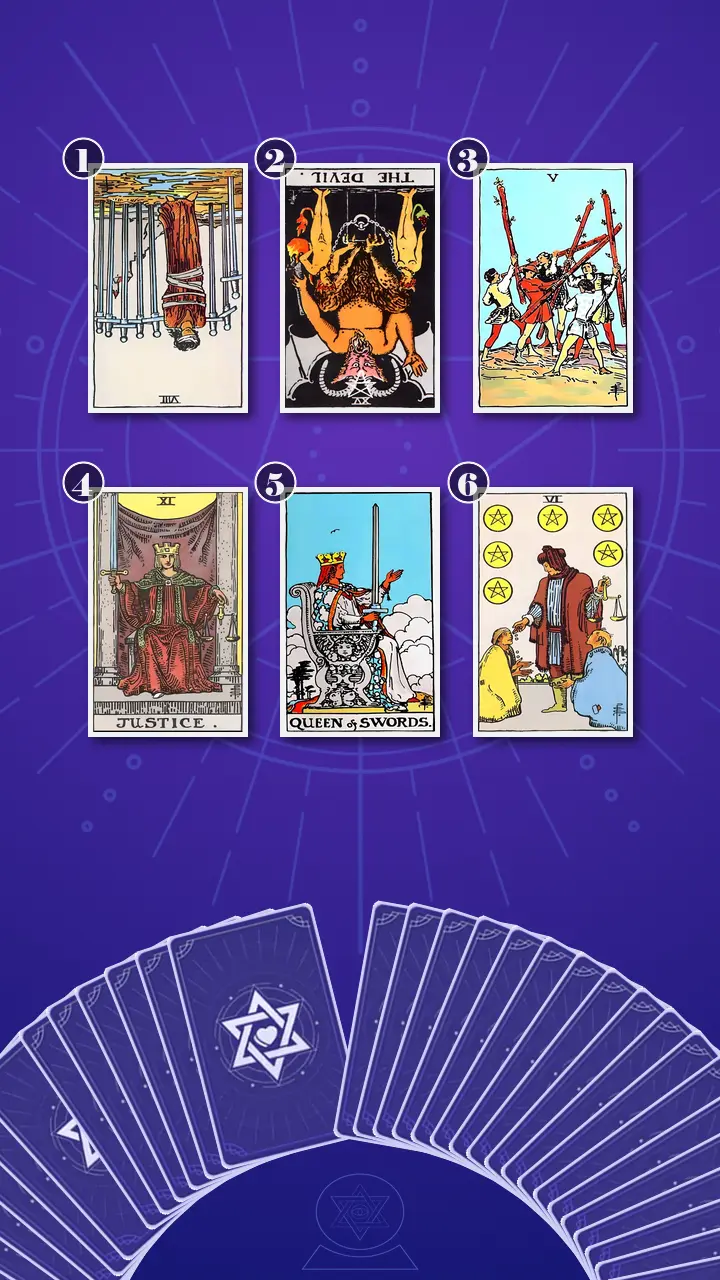
I chose the Transformation Path Grid (6) - Context Edition, a six-position tarot spread for tracing a repeated yes. I did not need a broad Celtic Cross, because this was not one enormous life question scattered across unrelated areas. Nor was it a simple choice between two paths. Casey was caught in a self-reinforcing system: a public request, an internal bargain, an instant response, private resentment, then another request.
The top row would show the visible loop, the hidden pressure behind it, and the group-chat trigger that kept activating it. The bottom row would show the turning point, a practical boundary response, and a more reciprocal form of participation. I explained that tarot cards do not decide what Casey must do. They make a pattern visible enough for Casey to choose differently.
The First Three Cards: How the Loop Holds
The Blindfold and the Empty Reply Field
I turned over the card representing the presenting loop: the observable moment when a group-chat task arrives and Casey accepts before checking capacity. It was the Eight of Swords, reversed.
The blindfolded figure, surrounded by swords but only loosely bound, brought me straight back to Casey's thumb hovering over the reply field. In the group chat, the empty space beneath "Who can take this?" had started behaving like a user interface with only one visible button: Yes. Yet pause, clarification, a bounded offer, and no were still technically available.
Reversed, this card showed a blockage beginning to loosen. The restriction was not that Casey had no choices. The restriction was the speed with which imagined social consequences made those choices disappear. An unanswered group-chat request is information, not an instruction.
"What other responses are actually available in that first minute?" I asked.
Casey gave a short, bitter laugh and rubbed the side of their mug with one thumb. "That is too accurate. Kind of brutal. I draft a question sometimes, delete it, and send the yes because silence feels worse."
"That makes sense," I said. "The point is not to judge the reflex. It protected you from a feeling in the moment. We are just noticing that relief is not the same thing as agreement."
The Loose Chain Behind the Helpful Role
Next, I turned the card representing shadow pressure: the unspoken belonging bargain and private resentment behind the automatic yes. It was The Devil, reversed.
I did not read it as a verdict about Casey's character. I read the loose chains. This was the private late-night scene Casey had described: the group chat silent, a Notion page filling with unchecked tasks, the laptop fan humming, and Casey refreshing the thread to see whether anyone noticed the work they had taken on.
The modern version of this card sounded like: I will carry this, and maybe then nobody can question whether I belong. The task gets called a quick favor, but it quietly charges the evening, rest, and whatever personal plan gets moved aside. It is an auto-renewing subscription to being needed: a brief hit of reassurance, followed by a bill nobody else can see.
Reversed, The Devil showed that attachment becoming visible. The useful-person role had been a way to feel secure, but it had also become binding when Casey could not name the wish underneath it: to be valued, included, and noticed without having to earn it through instant availability. Being useful is one way to participate, not the price of admission.
Casey's fingers tightened around the mug, then loosened. Their eyes dropped to the card and stayed there for a beat. "I want them to notice I am carrying it," they said quietly. "But asking to be noticed feels so embarrassing."
"Wanting recognition is human," I replied. "The resentment is useful information too. It is often the part of us that knows an agreement was made without full consent."
Five Browser Tabs Playing at Once
I turned the card representing the system trigger: the public ambiguity, silence, and competing demands created by group-chat voluntolding. It was the Five of Wands, upright.
The five crossing wands showed a crowded coordination system, not a moral failure by anyone in it. Several people react, suggest, tag, and mention deadlines. No one names an owner. The fastest responder becomes the unofficial owner before the thread has a plan. It is group-project energy: plenty of movement, no clear handoff.
In Casey's life, I saw the TTC Line 1 ride home at 6:12 PM: wet coats, a screech at the next stop, several messages arriving at once, and an evening commitment already sitting in Google Calendar. The chat's noisy Fire energy made everything feel urgent. But urgency was not evidence of responsibility.
"This is the external part of the pattern," I told Casey. "You are not inventing the ambiguity. A vague request can genuinely create pressure. But a task that is floating publicly is different from a task clearly assigned to you."
Casey sat back slightly. Their shoulders had not fully dropped, but they were no longer pulled toward their ears. "So I have been treating speed like proof that it is mine," they said.
"Exactly," I said. "The chat may stay imperfect. Your leverage is in checking what was actually asked before you turn public silence into a private obligation."
When Justice Held the Reply Box Still
The Scales Between Guilt and Responsibility
The room grew quieter as I turned the card representing the key transformation: the fair boundary or decision rule that can interrupt the inner conflict without deciding for Casey. It was Justice, upright.
The upright sword and level scales gave us a different question from "How do I avoid looking unhelpful?" Justice asked Casey to place four facts on the same surface: the actual owner, the deadline, the people available to contribute, and Casey's real capacity. This was not a demand to say no. It was a request to let facts arrive before guilt made a moral verdict.
As an artist, I have always thought of lives as films in production. I call this my Narrative Fork Analysis. In one plotline, Casey types yes immediately. The scene ends with brief social relief, but the hidden cost becomes another late night and another unspoken grievance. In the second plotline, Casey pauses long enough to let the group see accurate information about their capacity. The discomfort remains, but the story gains another character who can carry part of the work.
I also recognized what I call Safe-Choice Sabotage: the supposedly logical quick acceptance was not only kindness. It was a defense against the inciting incident of letting other people encounter an honest limit. That did not make Casey manipulative or weak. It showed how cleverly a protective habit can disguise itself as the only reasonable option.
In the kitchen at 8:47 PM, Casey's thumb had been moving toward the familiar ending before the calendar was even open. The notification brought an immediate forecast of disappointment, and that forecast had felt more convincing than the evidence of their actual evening. They were caught between looking helpful immediately and participating honestly in proportion to what they could give.
Automatic acceptance is not proof of belonging; make a fair and explicit choice about your capacity, letting Justice weigh responsibility against guilt before the sword moves.
Casey's breath stopped first, almost invisibly. Then their gaze lost focus and moved from the card to the rain-dark window, as though they were replaying every dinner, commute, and Sunday afternoon that had disappeared into a "quick favor." Their pupils widened. A flush rose across their cheeks. For a moment, their hands stayed flat against their knees, very still.
Then their mouth tightened. "But does that mean I got it wrong all along?" There was a flash of anger in the question, followed by something more tender. Their shoulders finally lowered, and their fingers slowly unclenched. "I thought being dependable was the good version of me."
"It is one good quality," I said. "Justice is not taking it away. It is asking whether dependability includes being dependable to yourself. Let guilt be a feeling in the room, not the person making the decision."
I let that settle before asking, "Now, using this new perspective, can you think back to a moment last week when this insight might have helped you feel differently?"
Casey exhaled with a small tremble. "Thursday. I could have said I was checking my calendar. I did not have to rearrange my whole night before anyone even asked me to." Their expression held relief, but also the slight disorientation of someone setting down a weight and realizing their hands are empty.
That was the essential shift: not from caring to indifference, but from reflexive compliance and private resentment to deliberate, capacity-based participation. Casey did not need certainty or universal approval before inserting a pause. They needed a fairer rule for the next live request.
The Queen's Clear, Kind Slack Message
I turned the card representing the action experiment: one concise, bounded response Casey can test the next time a task is assigned. It was the Queen of Swords, upright.
Her raised sword was precise language. Her open hand was collaboration. This was the energy of a boundary that does not punish the group, vanish into silence, or arrive wrapped in five paragraphs of apology. In balance, the Queen of Swords turns Justice's internal capacity check into real information others can use.
I offered Casey a response shaped by the card: "I cannot own the full task this week, but I can review the draft for 15 minutes on Thursday after 6 PM." It named a limit, offered only what Casey genuinely wanted to give, and left room for another owner.
"A boundary does not close the conversation," I said. "It gives the conversation real information."
Casey read the message aloud. Their voice was quiet at first. On the second read, it steadied. "It sounds almost too simple," they said.
"Simple is useful here," I replied. "You do not have to submit your entire schedule as evidence. A clear limit is not a character statement."
A Table With More Than One Pair of Hands
The final card represented integration: how contribution, rest, and belonging can be held as separate choices rather than one automatic yes. It was the Six of Pentacles, upright.
The balance scales and coins moving between people shifted the story from private sacrifice to visible exchange. In modern terms, this looked like a shared Google Sheet with task, owner, and deadline columns. Casey could take one defined piece, let another person own another, and receive help without apologizing for the handoff.
The card's grounded Earth energy was not about keeping score or refusing every request. It was about reciprocal participation. Casey could ask, "Who else has capacity for part of this?" and wait long enough for the group to answer. If nobody did, that would be useful data about the system, not a command for Casey to rescue it alone.
Casey looked at the Six of Pentacles and gave a smaller, clearer nod. "I want to help," they said, "but I want it to be a choice, not the thing that proves I get to stay."
"That is the whole reading," I told them. "Contribution, rest, and belonging do not have to arrive as one package."
The Ten-Minute Capacity Check
When I gathered the six cards into one story, the pattern was clean. The reversed Eight of Swords showed the hand raised before the question was finished. The reversed Devil showed the hidden bargain: useful labor would buy inclusion. The Five of Wands showed why the bargain kept getting activated in a noisy system with unclear ownership. Justice gave Casey a fair-share decision rule; the Queen of Swords gave it language; the Six of Pentacles made mutual support visible.
The cognitive blind spot was not that Casey cared too much. It was the belief that a pause, a limit, or another person's disappointment would prove they were unhelpful. The transformation direction was to treat a group request as information, check capacity, and make an explicit choice. The group could then coordinate around reality instead of Casey silently absorbing its uncertainty.
I gave Casey three small experiments. I framed them as rehearsal, not a new performance standard. I call the first 24-hour practice the Protagonist Pivot Action: one micro-action toward the more authentic plotline before the old reflex can rewrite the scene.
- The Ten-Minute Capacity CheckFor the next seven days, when a group-chat task appears, wait ten minutes before replying. Open Google Calendar and check the deadline, named owner, available contributors, and the time the task would truly take.Save "Let me check my calendar and come back by 7 PM" as a text shortcut. Begin with one low-stakes request; the pause itself is the practice.
- The Fair Share ReplyWithin 24 hours of the next live request, send one two-sentence response that names what Casey cannot own and one defined contribution they genuinely can make, such as a 15-minute Thursday review.Do not add a long apology or a list of past favors. Read the message once, check whether it is true, and send the version that matches actual capacity.
- The Reciprocal Participation CheckAt the next shared-task discussion, ask in the existing chat, "Who else has capacity for one part of this?" Then use a simple task-owner-deadline list to claim only Casey's chosen portion.Make the first handoff tiny, such as asking someone else to check three links. Let them complete their portion without rewriting it or apologizing for receiving help.

A Week Later: The Quiet Proof
A week later, I received a message from Casey. A vague request had appeared in the chat while they were making dinner. They used the holding message, checked their calendar, and asked who could take the main task. Casey offered a 15-minute review instead of moving their evening plan.
They kept checking the thread twice before putting the phone face down. The discomfort had not vanished. But their dinner stayed warm, another person claimed the task, and Casey later sent me a screenshot of a small shared task list with three names beside it.
I thought of Justice's scales, balanced not by magic but by a pause, a calendar, and a sentence honest enough to let other people participate. Casey had not solved every group-chat dynamic. They had created the first evidence that belonging could survive accurate information.
When the group chat goes quiet and the reply box makes your chest tighten, you can want to belong, want to help, and still feel the unfair weight of turning every request into proof that you deserve your place.
When the next request appears, what would a fair contribution look like if you gave yourself ten minutes to keep both your willingness to help and the rest of your evening in the frame?