A Meme Replaced the Truth, Then Three Sentences Made It Speakable

The Message That Became a Meme
I recognized the pattern before Casey (name changed for privacy) finished describing it: they could lead part of a pitch in a Shoreditch office, but one familiar WhatsApp message from their oldest friend could turn them back into the agreeable supporting character. They were outgrowing a long-term friendship while feeling guilty for wanting the friendship to grow with them.
Casey took me to 8:47 p.m. on a Tuesday, aboard the northbound Victoria line leaving Oxford Circus. The fluorescent lights buzzed over the carriage, and their phone felt warm against their palm. They typed, “I wanted to say that lately our plans have felt a bit one-sided,” watched the cursor blink, deleted the sentence, and sent a meme instead. Their jaw locked. One foot tapped against the floor as the train moved through the dark.
“I know I’ve changed,” Casey told me, “but I keep acting like I need permission to show it. I’m tired of being the audience for a life I’m also living.”
I heard resentment first: the hot, metallic feeling of another honest no being edited into an easy yes. Beneath it, I heard guilt, grief, and longing braided together. Casey’s shoulders were pulled so high that they looked as if they were carrying an invisible backpack filled with every conversation they had rehearsed but never allowed the friendship to hear.
“If I stop being the easy one,” they said, “what’s left of us?”
I did not tell Casey that the friendship was doomed, that their friend was secretly using them, or that one boundary would reveal some predetermined truth. I said, “It makes sense that this feels frightening. You want to be met as an equal, so you keep trying to speak in a way that guarantees you won’t lose the friendship. But no wording can guarantee another person’s response. Let’s use the cards to map the pattern, separate fear from observable reality, and find one next step that still belongs to you.”

Choosing a Map for the Friendship’s Changing Orbit
I invited Casey to put both feet on the floor and take one unforced breath before I shuffled. I treat this pause as a transition of attention, not a mystical performance: it helps the mind stop drafting ten future conversations long enough to examine the one relationship that exists now.
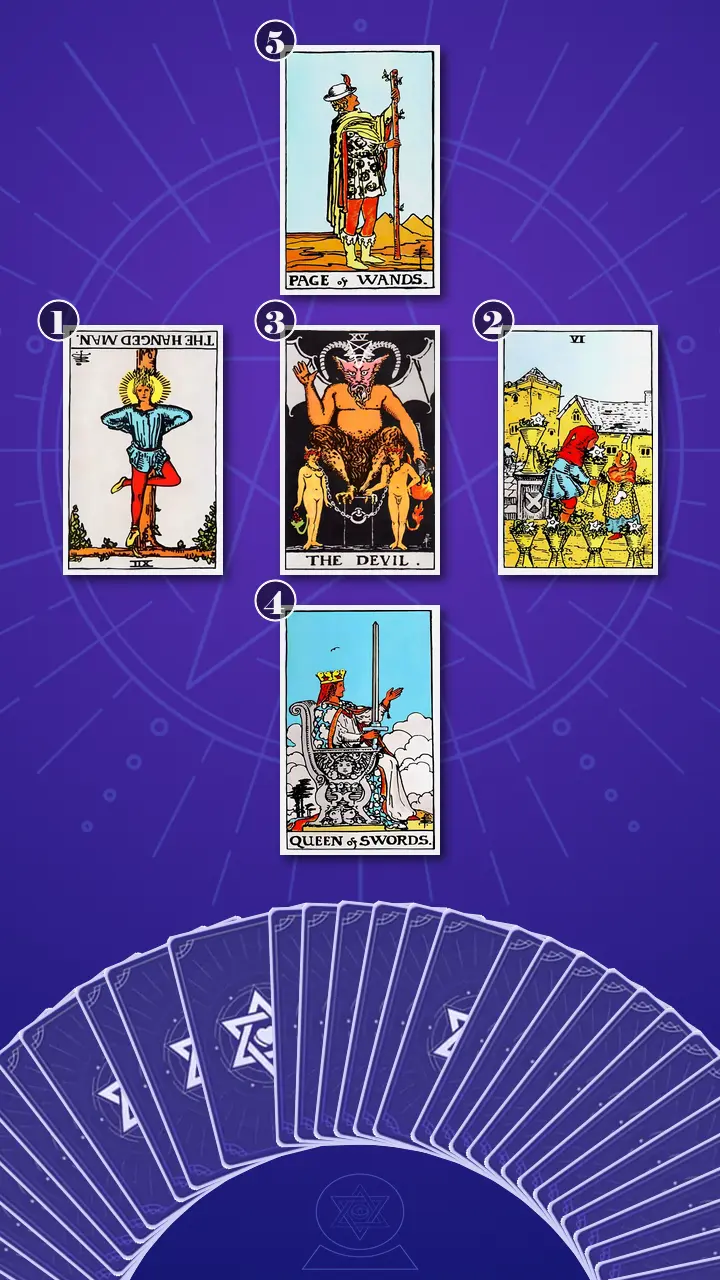
I chose the Relationship Spread · Context Edition, a focused five-card relationship tarot spread. A Celtic Cross would have introduced broader life themes, but Casey’s question was specific: What role were they performing, what history kept that role familiar, what exchange bound it in place, what truth were they avoiding, and what small experiment could produce present-day evidence about mutuality?
This is how tarot works in my practice. The cards do not issue a verdict about whether a friendship will survive. They provide structured images through which I can compare behavior, emotional memory, attachment, boundaries, and available choices. Card meanings in context matter more than dramatic prediction.
I placed the first card to the left for Casey’s current self-position and the second to the right for the familiar friendship script. The third sat between them, representing the bond’s binding exchange. Beneath it, the fourth would reveal the direct truth Casey had avoided; above it, the fifth would offer a self-authored experiment. The layout looked like two sides of a bridge meeting over a knot, with a vertical path leading from pressure toward clearer air.
The Roles That Kept Auto-Renewing
Position 1: The Calendar Kept Permanently Tentative
“Now I’m turning over the card for your current self-position: the observable sidekick behavior and its emotional cost,” I said. The card was The Hanged Man, reversed.
I pointed to the figure’s tied foot, inverted body, and halo. In reversal, the Hanged Man showed Blockage: insight was present, but action remained suspended. Casey could already see that the dynamic had changed. The blockage came from waiting to express that change until they could predict the friend’s reaction.
I returned to the Victoria line. A Friday plan would arrive; Casey would draft a different suggestion, delete it, and reply that the friend’s choice worked. On the journey home, they would replay the exchange and call their silence patience. Meanwhile, their calendar, preferences, and honest voice stayed suspended, preserving the very sidekick role they wanted the friendship to outgrow.
“The thought begins as, ‘I’ll say it when I can say it kindly,’” I said. “Then it becomes, ‘I need wording that makes rejection impossible.’ That is not patience anymore. It is like waiting on a Tube platform after the service has been cancelled and treating continued waiting as proof of loyalty.”
I asked, “Think about the last plan you accepted while wanting something else. What did you type, what did you delete, and what happened in your jaw or shoulders after you agreed?”
Casey’s breath caught. Their eyes shifted away from the card as if an old message had reopened behind them. Then they gave one short, bitter laugh and rubbed the hinge of their jaw. “That’s so accurate it’s almost cruel. I keep saying I’m waiting for the right moment, but I’m also making sure the moment never happens.”
“I’m not asking you to shame the part that waited,” I replied. “That part was trying to protect belonging. We’re simply noticing that its protection now has a cost. Resentment often grows where an honest no keeps being edited into an easy yes.”
Position 2: The Archived Version of Home
“Now I’m turning over the card for the familiar friendship script: the history and expectations shaping your role without assuming anything about your friend’s intentions.” I revealed the Six of Cups, upright.
The flower-filled cup being offered in the foreground held one living exchange. The cups preserved behind the children looked more like an emotional archive. Upright, the card carried the Balance of tenderness, memory, and genuine affection. The problem was not that Casey still loved what they had shared. The imbalance appeared when archived warmth was given more authority than present experience.
Casey described lying in bed at 12:38 a.m. after another familiar night out, scrolling through old Instagram photos of festivals, birthdays, and cramped student kitchens. Blue light filled the room while tyres hissed across wet pavement outside. Their chest softened at the memories, and then their stomach dropped at the thought of asking for something different now.
“The inner argument sounds like, ‘We have years of proof that this matters, so maybe I’m asking too much of the present,’” I said. “But shared history is context, not a permanent role contract.”
I thought of the long-term friendship tensions in Insecure: real love, accumulated history, and current misattunement could coexist without forcing either person into the role of villain. I also thought of the planetary charts I had studied for years. An old alignment can explain why two lives once moved easily together; it cannot require either life to stop developing.
Casey’s fingers tightened around their water glass, then loosened. Their expression softened before becoming still. “The memories aren’t fake,” they said quietly. “But I use them to overrule what keeps happening now.”
“Exactly,” I said. “You do not have to reject the warmth in order to ask whether the present exchange is warm in both directions.”
Position 3: The Usefulness-for-Belonging Bargain
“Now I’m turning over the card for the bond’s binding dynamic: the exchange that has made usefulness and self-silencing feel like the price of closeness.” I placed The Devil, upright at the center.
I directed Casey’s attention to the two figures joined by loose chains. The Devil’s energy appeared here as Excess: too much attachment to a familiar bargain, too much power assigned to an automatic response, and too little space between receiving a request and offering an answer. The chains were loose, but that did not make removing them emotionally simple.
I asked Casey to picture 11:06 a.m. on a Sunday in their narrow flatshare kitchen. The kettle clicked off. Burnt toast left a sharp smell in the air. A four-minute WhatsApp voice note arrived from the friend, asking whether Casey was free to talk through another crisis. Before checking the afternoon they had planned for themselves, Casey typed, “Of course, call whenever.” Their shoulders rose as their thumb moved.
“No one forced the reply,” I said, “but no did not feel emotionally available. The unspoken bargain was: you provide responsiveness, emotional labor, and flexibility; you receive immediate closeness and a familiar sense of belonging. Then your own news gets delayed, your plan disappears, and resentment arrives later when you are finally alone enough to feel it.”
I described the pattern as an algorithm trained on Casey’s fastest supportive responses. Every time they hid a need and replied immediately, the relationship received more data telling it to serve the same role again. That did not prove malicious intent. It showed how an unspoken social script could become increasingly accurate at predicting Casey’s self-erasure.
“A loose chain can still feel familiar enough to wear automatically,” I said. “What does the immediate yes give you in the first ten minutes, and what does it cost you by the journey home?”
Casey went completely still. Their thumb hovered over the dark screen of their phone, their gaze lost focus as if they were replaying a dozen voice notes, and then a breath left their chest in a low, uneven rush. “It gives me proof that I matter,” they said. “Then I hate that I had to earn the proof by disappearing.”
“That is the knot,” I replied. “Seeing it does not make you guilty, and it does not make your friend guilty by default. It gives you a point of agency: the next automatic renewal can include a pause.”
When the Queen of Swords Cut Through the Rehearsal
Position 4: The Truth With an Open Hand
The rain against my window softened as I reached for the fourth card, and the room seemed to hold the quieter rhythm with us. “Now I’m turning over the card for the truth, boundary, or direct communication you have been avoiding because it would let this friendship encounter the present version of you.”
I revealed the Queen of Swords, upright.
Her sword stood vertical and steady. Her other hand remained open. In this position, her energy was Balance: clarity without punishment, care without self-abandonment, and direct language without the impossible task of controlling how another person receives it.
I showed Casey how the card translated into modern life. Instead of writing a message designed to prevent every possible negative reaction, they could name three present facts: they valued the friendship, they had been leaving their preferences out, and they needed plans and conversations to make room for both people. No joke. No dissertation about the friendship’s entire history. No accusation about motives.
On the Tube home, the honest message had been glowing in Casey’s Notes app while a meme sat in the actual chat. Their jaw was tight because they wanted the friendship to change without ever making it respond to their changed voice.
You do not need to preserve the old friendship by disappearing inside it; raise the Queen of Swords' truth, name what has changed, and let clarity make room for mutuality.
I let the sentence settle before giving Casey the central message more plainly.
The friendship cannot meet the equal version of you through messages sent by the sidekick.
For this card, I used what I call Orbital Drift Recognition. I drew two small circles on a sheet of paper, each with its own center, and mapped the changes Casey could actually observe: a more demanding career, newer relationships in which initiative was welcomed, less unstructured time, and a growing need for reciprocity. I explained that personal growth can change the frequency of an old friendship before either person has done anything morally wrong. The painful friction often comes from trying to force both lives back into an earlier alignment. This was a diagnostic map, not a breakup forecast. The Queen’s truth would allow the friendship to reveal whether it could adjust to two centers instead of continuing to orbit only one.
Casey’s eyebrows drew together. “But doesn’t that mean I’ve been doing friendship wrong for years?”
“No,” I said. “It means a role that once helped you feel close has stopped fitting. Growth does not retroactively corrupt the care you gave. It does make you responsible for what you choose after you can see the pattern.”
Casey’s breath stopped first. Their fingers remained suspended above the paper, and their pupils widened as they looked from the two circles to the Queen’s open hand. Then their gaze slipped out of focus; I could almost see the Victoria line, the Brixton café, and the Sunday voice note passing through their mind in sequence. Their mouth tightened with a flash of anger before their eyes reddened. The anger did not disappear so much as change shape, losing some of its aimless heat. Their shoulders descended by a fraction. Their clenched hand opened against their knee. Finally, they released a shaky breath and said, very softly, “I kept waiting for them to notice someone I was making sure they couldn’t see.” Relief crossed their face, followed by the slight dizziness that can come when clarity removes an old burden and leaves responsibility in its place. I asked, “Now, with this new perspective, think back to last week. Was there a moment when this insight could have made you feel different?”
“Friday,” Casey said after a pause. “I wanted to see my newer colleagues, but I went to the same pub because my friend needed to vent. I treated my own plan like evidence that I was abandoning them. I could have said I already had plans and offered another time. They might not have liked it, but I would at least have been answering as myself.”
I nodded. This was the first clear movement from resentful self-silencing and nostalgia-bound usefulness toward self-respect and direct communication. More specifically, it was a shift from proving loyalty through usefulness to practicing mutuality: one present need, spoken without using the friend’s response as a verdict on Casey’s worth.
A Small Flame With Its Own Address
Position 5: The Plan Made Before Permission
“Now I’m turning over the card for a small self-directed experiment: an action that can express mutuality without deciding the friendship’s outcome in advance.” The final card was the Page of Wands, upright.
I pointed to the wand’s fresh leaves and the Page’s alert gaze. This upright Page offered an emerging Balance of curiosity and initiative. Casey’s Fire had been deficient because so much energy went into anticipating another person’s needs. The Page did not demand a dramatic reinvention. It asked Casey to let one preference become visible while it was still small and unfinished.
I brought back the Friday scene outside their wet Soho office: the message reading, “Same place as usual? I need to vent,” the rain spitting against the pavement, and a bus exhaling warm diesel air. In the old script, Casey typed, “Perfect,” while wanting to meet newer colleagues across town. In the Page’s version, Casey could keep the plan they had already chosen and reply, “I’m out with work tonight, but I can do a twenty-minute call Sunday afternoon if that helps.”
They could also create one Saturday event under their own name before opening the friend’s calendar: a Barbican exhibition, a bookstore visit, a class, or coffee somewhere they actually wanted to try. An invitation could remain open, but the plan would not vanish if the friend declined. In the next conversation, Casey could share one genuine update before asking their first attentive question.
“Think of this as a beta test, not a product launch,” I said. “One preference, one invitation, and one piece of lived evidence. One preference is evidence; it is not a friendship referendum.”
Casey looked at the Page, then opened their calendar. Their shoulders dropped before they seemed to notice. “There’s an exhibition I’ve wanted to see,” they said. “I keep waiting until I know whether they’re free.”
“What happens if your interest gets to exist before their availability?” I asked.
Casey gave a cautious smile. “I suppose I find out whether I actually want to go, instead of only finding out whether they do.”
Three Sentences, One Saturday, and a Looser Orbit
I gathered the cards into one story. The Hanged Man reversed showed Casey suspending their preferences while waiting for certainty. The Six of Cups explained why that suspension felt loving: the friendship contained real warmth and years of emotional memory. The Devil exposed the hidden exchange beneath the nostalgia, where usefulness bought short-term belonging and resentment arrived with the bill. The Queen of Swords restored clear language, and the Page of Wands returned initiative through one small act.
The blind spot was not simply that Casey had failed to set a friendship boundary. It was the belief that if they found perfect wording, they could express a need without causing discomfort or learning anything unwelcome. That attempt to control the outcome kept the relationship in an old orbit. The transformation was not from loyalty to disloyalty. It was from loyalty performed through usefulness to care practiced through mutuality, self-respect, and present-tense information.
I gave Casey three actionable next steps. None required sending a dramatic message, ending the friendship, or deciding immediately what the relationship should become.
- The Three-Sentence Mutuality Check.On one evening this week, set a ten-minute timer and open the Notes app. Write: “I have noticed…”, “I need…”, and “I still value…” Keep each line in the present tense. If the words feel accurate, ask the friend for a twenty-minute call or a walk: “There’s something about our friendship dynamic I’d like to talk through. When would you have space?”Tip: Read the three lines aloud once without adding an apology. Sending them remains your choice; completing only the first line is a valid minimum version.
- The One-Plan Page Experiment.Before checking the friend’s availability, put one two-hour plan based on your own interest into this week’s calendar. If you want company, invite them with: “I’m going to the Barbican exhibition Saturday at two. You’re welcome to join if that sounds good.” Keep the plan if they decline unless you independently decide you no longer want it.Tip: Reduce the plan to a thirty-minute coffee, walk, or bookstore visit if two hours feels too exposed. The experiment measures your participation, not their approval.
- The Constellation Release Protocol.At the end of the week, make two columns titled “Warmth that is alive now” and “History I am preserving.” Add one observable interaction to each without diagnosing the friend. Circle what you freely choose to keep offering, and place a line through any sidekick duty you no longer consent to renew.Tip: This protocol does not require a friendship breakup. It allows care to remain in the constellation without requiring your life to orbit the old role.
I reminded Casey that discomfort after stating a need would not prove the boundary was wrong. It would mean their body was encountering a new behavior before it had evidence that the behavior was survivable. If a conversation became insulting, coercive, or overwhelming, Casey could pause it. Direct communication did not require remaining available for mistreatment, and self-respect did not require turning the friend into an enemy.

A Week Later, Casey’s Calendar Had a Center
Six days later, I received a message from Casey. They had written the three lines and read them aloud twice. They had not delivered a flawless speech; they had simply asked their friend for a walk and said there was something about the current dynamic they wanted to discuss. The friend replied, “Yeah, of course. Thursday?” The conversation was still ahead of them, which meant uncertainty had not disappeared.
Casey had also booked the Barbican exhibition before opening WhatsApp. Their friend could not join, so Casey went alone, drank coffee beneath the concrete terraces, and felt both lighter and oddly bereft. The next morning, “What if I’m wrong?” arrived first; this time, it did not edit the plan.
I considered that the quiet proof. Casey had not solved the whole friendship. They had created one piece of reality in which their preference existed, their history remained intact, and their worth was not decided by another person’s availability.
The Relationship Spread · Context Edition did not give Casey courage by magic. It made the old contract visible, offered language for a present need, and returned the final choice to the person whose life would carry it. Casey was becoming a participant rather than an accessory, one honest sentence and one self-directed plan at a time.
If your phone lights up tonight with another familiar request and your shoulders tighten before you have even replied, the hardest part may not be wanting more space. It may be fearing that the moment you take it, you will discover you were loved most securely when you stayed useful. Simply recognizing that fear means the automatic orbit has already begun to loosen.
If mutuality were one small experiment rather than a verdict on the friendship, which preference could you let exist out loud before checking whether anyone else will orbit around it?