The Album Glow and the Blue-Light Audit
If finding your parents’ wedding album made you immediately audit your own relationship for signs of permanence—like love needs receipts—you’re not alone.
Jordan came to me on a grey Toronto Sunday with that particular kind of quiet panic that doesn’t look dramatic from the outside—until you notice what their hands are doing. Their thumbs kept rubbing the edge of their phone case like they were trying to erase a thought.
They described the moment like a time-stamped clip: 9:42 PM, cross-legged on their apartment floor, their parents’ wedding album open in their lap. The plastic sleeves stuck a little when they turned the pages. The photo paper had that dusty-sweet smell, like an old closet and a clean memory. Their phone screen threw a cold blue rectangle onto a picture of two smiling faces under warm lighting.
“I closed the album,” Jordan told me, voice careful, like they didn’t want to startle the feeling. “And my hand just… went to my messages. I reread the thread three times. Like it was evidence.”
I watched their chest rise in small, guarded sips of air. That tightness wasn’t abstract. It sat on them like a seatbelt pulled one click too far—secure in theory, constricting in practice. Their stomach had that restless, watchful buzz, like their body was bracing for a shift in someone’s mood.
“I hate that I need reassurance,” they said, then looked away, embarrassed at their own honesty. “But I also hate pretending I don’t.”
Underneath the album question was a sharper one: craving secure closeness versus fearing rejection if they wanted too much. Jordan wanted to feel chosen. But the moment they reached for that feeling, they started bargaining with themselves about being “too much,” then tried to win safety through perfect interpretation—tone, timing, emoji, reply speed.
I kept my voice soft and steady. “We can work with this,” I said. “Not by judging the spiral—by mapping it. Let’s figure out what attachment pattern the album is waking up, and what would actually help you feel grounded in real-time connection.”

Choosing the Compass: How This Tarot Spread Works for Attachment Triggers
I’m Alison Melody. Most people know me as a radio host who talks about music therapy—what a bass line does to your breath, why certain songs make you cry on the TTC, how sound can shift a nervous system without needing a TED Talk about it.
In my tarot practice, I don’t treat cards like fortune cookies. I treat them like a language for pattern-recognition—especially the kind of patterns that show up in relationships as “Why am I like this?” energy at 11:26 PM with seventeen Notes-app drafts.
I asked Jordan to take one slow inhale and an even slower exhale, just long enough to feel their feet on the floor. While I shuffled, I framed the ritual in plain terms: a small transition from “spinning” to “observing.” Not magic—focus.
“For this,” I said, “I want to use a six-card layout called the Four-Layer Insight Ladder · Context Edition.”
If you’ve ever googled how tarot works for relationship anxiety, this is the kind of spread that’s actually useful: it’s not trying to predict whether someone will text you back. It’s designed to show why your system reacts the way it does—and what to do next.
The reason I chose this spread is simple. Jordan’s question wasn’t “What will happen?” It was “What am I replaying?” That’s deep inner work: identifying an inherited relationship script, tracking the repeating dynamic, finding the root fear beneath it, and then building one practical next step. A minimal six-card ladder gives enough structure to find clarity without drowning in a ten-card diagnosis.
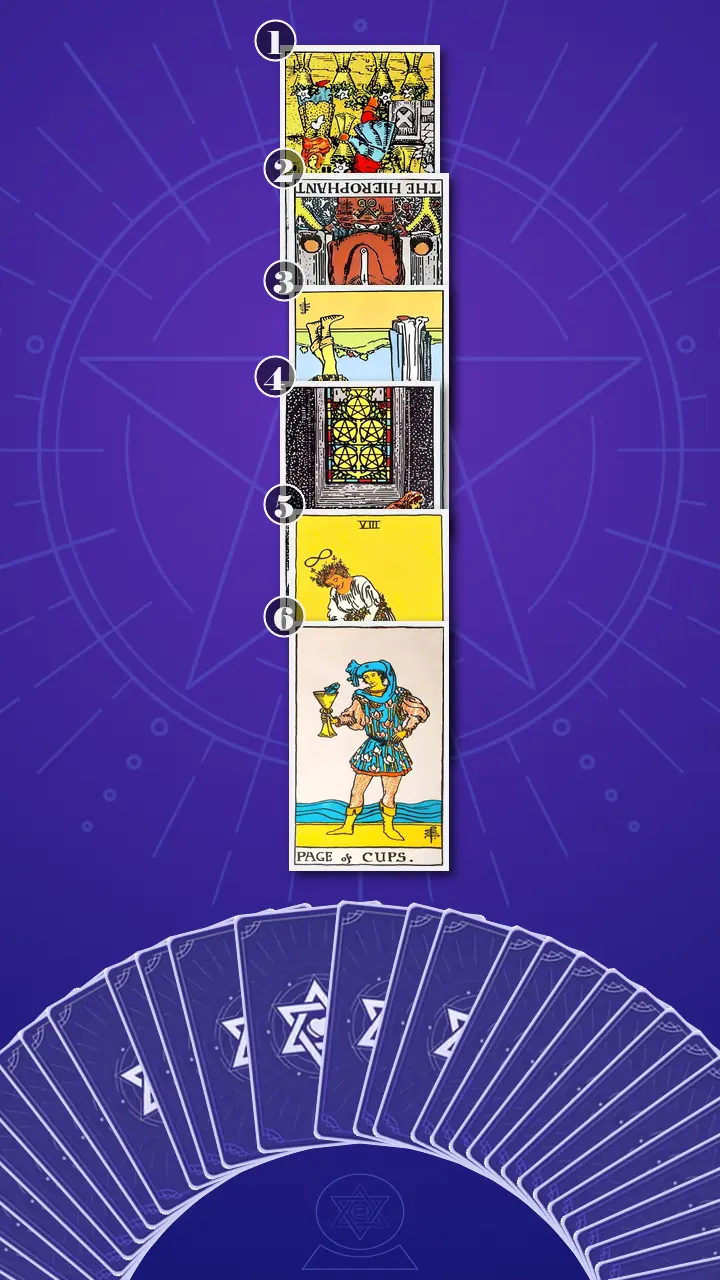
I pointed to the empty vertical line where the cards would land. “Card 1 will show the album-trigger in the present—your first reflex. Card 3 will name the attachment pattern you run when uncertainty shows up. And Card 5 is the turning point: the inner resource that changes how you respond in real time.”
Reading the Ladder: From Highlight Reel to Root Need
Jordan’s eyes stayed on the deck like it was a weather report they were scared to hear. I’ve seen that look in studio guests right before they admit something true: the tiny flinch that says, If this is real, I’ll have to do something different.
Position 1: The Present Trigger Loop
“Now flipping over,” I said, “is the card that represents what the wedding album is triggering in the present: the observable replay loop and the immediate emotional reflex.”
Six of Cups, reversed.
I let the image sit between us. “This reversal is nostalgia becoming a pressure-cooker,” I said. “Not comfort—comparison.”
I tied it directly to what Jordan had told me, using the exact modern scenario that fit like a key: “This is you at 11:30 PM, scrolling that one perfect wedding photo again, then immediately opening your chat thread and comparing: ‘Why don’t I feel that safe?’ The memory isn’t landing as warmth. It lands as a standard.”
Reversed, the Six of Cups becomes an energy blockage: sweetness gets distorted into a measuring stick. A curated image of love starts acting like a scoreboard, and your body tightens as if it’s about to be graded.
I added one sentence I’ve learned people need to hear out loud: “The album is a highlight reel—not a rulebook.”
Jordan gave a small laugh that wasn’t really a laugh—more like air escaping through a cracked door. “That’s… rude,” they said, then swallowed. “But yeah. It’s exactly what I do. I look at it and then I’m like, ‘Okay, now prove it in my relationship.’” Their fingers tightened around their phone and then loosened, like they’d been caught doing something they didn’t want to admit.
Position 2: The Inherited Relationship Script
“Now we’re flipping the card that represents the inherited relationship script you internalized—what love was supposed to mean or look like based on family messaging.”
The Hierophant, reversed.
I nodded, almost to myself. “Okay. This is the ‘rules’ card. But reversed, it says: the script is not the truth.”
I used an analogy that usually lands—because it’s how modern life actually works. “Think of it like a relationship Terms & Conditions page you never actively agreed to. It’s an auto-renewing subscription. Every time you feel uncertainty, your brain opens the policy manual: ‘If it’s not official, it’s not real… right?’”
I pointed at the crossed keys in the imagery. “These keys are about access—what counts as valid love, who gets ‘in,’ what milestones feel like permission to relax.”
Then I translated it cleanly into their world: “The album doesn’t just show romance. It shows ‘approved’ romance. So you start chasing labels and public proof like they’re verification badges—even if what you truly need is day-to-day emotional reliability.”
Jordan exhaled fast, surprised. Then they did that thing people do when something is so accurate it’s almost funny. “Oh,” they said. “I say ‘should’ about love constantly.”
“That’s the pivot,” I told them. “Not to shame it—just to notice it. Hierophant reversed is your adult self deciding what to keep and what to unlearn.”
My mind flashed, briefly, to my radio booth: the way an old station jingle can live in your body for decades. Not because you chose it—because you heard it every morning. That’s what inherited scripts are like. The question isn’t ‘Why do I have it?’ The question is ‘Do I still want to play it on repeat?’
Position 3: The Attachment Pattern You Replay
“Now flipping over,” I said, “is the card for the attachment pattern being replayed today: how you try to secure closeness when uncertainty appears.”
Two of Cups, reversed.
“This is the major blockage,” I said gently. “Because the Two of Cups is mutual rhythm—two people meeting each other in the middle. Reversed, it turns connection into a signal-reading task.”
I used the modern montage exactly as it’s lived: “Read receipts. Drafts. Unsent paragraphs. Checking timestamps like it’s a relationship metrics dashboard—response time, emoji frequency, who initiated last.”
In my voice, I held up the split-screen conflict Jordan had already described: “On one side: ‘I want closeness.’ On the other: ‘I can’t look needy.’ And the inner monologue becomes: ‘If I explain it perfectly, they’ll reassure me. If I ask plainly, I’ll scare them off.’”
Reversed, the Two of Cups is not a lack of love—it’s misattunement. The energy is there, but it’s blocked by strategy. Instead of two nervous systems settling into a shared pace, one person (often Jordan) tries to engineer safety by monitoring the edges.
I said it plainly, because this is where people lose years: “If you need a paragraph, you probably need a pause.”
Jordan nodded so quickly it looked like their neck already knew. They swallowed hard, like they were trying not to cry but also trying not to laugh at themselves. “I literally have drafts,” they admitted. “Like… multiple versions. I’m trying to write the ‘perfect’ message instead of making the ‘clear’ message.”
Position 4: The Root Fear Beneath the Pattern
“Now we’re looking under the texting and the thinking,” I said. “This next card represents the core fear or need beneath the pattern—the belonging question driving the reaction.”
Five of Pentacles, upright.
The image always changes the room. It’s simple: cold outside, warm light inside. And your body understands it instantly.
I didn’t rush. “Under the spiral,” I said, “is the fear of being outside the warmth. Not being chosen. Not belonging.”
I translated it into a Toronto winter scene because Jordan had already lived it: “It’s like walking past a warmly lit restaurant on Queen West. You see a couple laughing behind the glass. Your phone is cold in your hand. No new message. And your nervous system says, ‘They’re inside. I’m outside. I knew it.’”
Jordan went very still—first the physiological freeze, then the distant focus like their brain was replaying a memory, and finally a small, shaky exhale that sounded like surrender.
“I don’t even think I’m mad at my partner,” they whispered. “I’m mad at… how fast I go there.”
“That makes sense,” I said. “This isn’t a moral failing. It’s a protection strategy. But it’s expensive.”
Then I anchored the reframe I wanted them to borrow this week: “Their reply is information—not a verdict on your belonging.”
When Strength Held the Lion: The Moment the Pattern Can Change
I touched the deck once—my way of marking a threshold. “We’re flipping the turning point now,” I said. “This is the card for the turning point toward secure attachment: the inner resource that changes how you respond in real time.”
Strength, upright.
For a second, even the radiator in my studio apartment seemed to click quieter, like the environment was conspiring to make space. Strength does that. It’s not loud. It’s stabilizing.
Setup. I looked at Jordan and named the loop without dramatizing it. “If you’ve ever closed a wedding album and immediately opened your messages to re-read a ‘goodnight’ text like it’s evidence, you know that tight, watchful feeling—like one missing emoji could mean your whole relationship is changing.”
I watched their shoulders lift a millimeter, bracing for the old conclusion: So I have to get better at reading people.
Delivery.
Not ‘tame your need’—tame the panic, and let gentle hands hold the lion so your request can be simple and real.
I let the sentence hang in the air like the last note of a song that doesn’t resolve right away.
Reinforcement. Jordan’s reaction came in layers—the kind that tells me something actually landed in the body, not just the brain. First: their breath stopped for half a beat, like their nervous system had been interrupted mid-script. Second: their gaze softened and unfocused, not dissociating—more like a mental rewind, seeing themselves hovering over “Send” on the fifth follow-up text. Third: their face changed. The tension around their mouth loosened, and their eyes went glossy with relief that looked almost suspicious, like, Wait, I’m allowed to need closeness without performing for it?
“So… I don’t have to pretend I’m chill,” they said, voice small.
“Exactly,” I told them. “Strength isn’t you becoming less needy. Strength is you becoming less hijacked.”
This is where my sound-research brain always chimes in. “When I’m producing audio,” I said, “and something’s distorting, I don’t fix it by rewriting the lyrics. I lower the gain. Panic is distortion. Your ‘perfect text’ is you rewriting lyrics. Strength is lowering the gain first.”
Then I brought in my signature lens—the one I call Conflict Mediation, even when the conflict is internal. “We can use frequency as a bridge here,” I said. “Not as a cure-all—just as a lever. A longer exhale is already a frequency shift. And humming—quietly, even under your breath—can be a way to cue your body into steadiness before you speak. You’re not taming the lion by wrestling it. You’re calming it by changing the room you’re asking it to live in.”
I leaned in, gentle but direct. “Now, with this new perspective, can you think back to last week—was there a moment when you felt that surge to send ‘just one more’ clarifying text? If Strength had been in the room, what would have been different?”
Jordan blinked, then nodded once, slow. “Tuesday,” they said. “They replied ‘busy tonight’ and my brain went straight to ‘they’re fading.’ I wrote this whole… PR statement. If I’d paused—like actually paused—I think I could’ve just asked for a plan. Like a normal person.”
I smiled, because that’s the shift: from hypervigilant proof-chasing and ‘perfect text’ performance to grounded self-regulation and one clear, direct ask. Not a personality transplant. A nervous-system move.
Position 6: The Next Step That’s Actually Doable
“Now we flip the last card,” I said, “representing a grounded next step: one small, doable way to communicate or act differently this week.”
Page of Cups, upright.
“This is your new relational language,” I said. “Curiosity. Emotional honesty. Beginner energy.”
I pointed to the fish popping out of the cup. “The fish is the surprise feeling—the younger part of you that gets activated by something random, like an album. Page of Cups says: don’t turn that surprise feeling into a courtroom case. Let it be a message.”
And I grounded it in Jordan’s exact modern-life scenario: “This is you saying, ‘Seeing my parents’ wedding photos stirred something in me.’ Then one small request: ‘Can we set a time to see each other this week?’ It’s not a breakup talk. It’s not a thesis.”
Jordan’s face softened into something like relief. A tiny smile, like they could imagine sending that message without feeling like they were handing someone a grenade.
“A clear ask beats a perfect text,” I reminded them. “And whatever comes back—remember—information, not verdict.”
From Proof-Chasing to Actionable Advice: Your Next 48 Hours
I slid the cards into a single story, so Jordan could feel the logic instead of getting lost in symbolism.
“Here’s the map,” I said. “The album (Six of Cups reversed) isn’t just memory—it’s a warped lens that makes your present feel like it has to match a curated standard. The Hierophant reversed shows why: you’re running inherited Terms & Conditions about what ‘real love’ looks like—official, obvious, publicly affirmed. Then the Two of Cups reversed is the lived pattern: when uncertainty hits, you try to secure closeness through monitoring and strategy instead of mutual rhythm. Under that is the Five of Pentacles truth: the fear of being outside the warmth. Strength is the antidote—steady the body first. Then Page of Cups: one human sentence, one clear request.”
“Your cognitive blind spot,” I added carefully, “is thinking that if you can just interpret the signals correctly, you’ll finally feel safe. But this spread is showing the opposite: safety comes from self-regulation plus one clean ask.”
Jordan raised a hand, practical objection ready. “But I swear I don’t have time,” they said, half-laughing. “Like… I’m working late. I can’t do a whole routine every time I get triggered.”
I nodded. “Good. Don’t do a whole routine. We’re not building a new personality. We’re building a two-minute bridge.”
Then I gave them the smallest, most usable steps—grounded, specific, and deliberately unglamorous.
- The 60-Second ‘Lower the Gain’ PauseBefore sending any reassurance-seeking text, put your phone face-down on the table. Plant both feet on the floor. Do one long exhale that’s longer than your inhale, then decide: are you asking for info (a time/plan) or reassurance (care/commitment)?If your brain says “This is silly,” do the 90-second version anyway and treat it as data. Self-regulation is not self-silencing—it’s how you ask without panicking.
- The One-Note Proof-to-Connection LogOpen a note titled “What I actually need (not what I’m trying to prove).” Each time you feel yourself checking timestamps or rewriting drafts, add one line: “Right now I need ____.” (Examples: “a plan,” “a check-in,” “a reminder I matter,” “sleep.”)Keep it to one line. If you start writing a paragraph, that’s your cue: pause, breathe, return to one sentence.
- The Page of Cups Message (One Feeling + One Request)Send one simple text this week: “Hey—seeing some family wedding stuff stirred me up. Can we pick a time to see each other this week? It helps me feel grounded.” No backstory. No evidence. Just human.If you feel the urge to add three softeners (“lol,” “no worries if not,” “sorry”), stop and re-read: a clear ask beats a perfect text. Their reply is information—not a verdict on your belonging.
Because I’m me, I offered one optional add-on from my sound-based toolkit—my Soundproof Barrier strategy. “If late-night scrolling is your trigger zone,” I said, “pick a specific ‘barrier sound’—brown noise, a low-volume ambient track, even a boring podcast you don’t care about. Not to numb you. To give your nervous system a boundary while you do the 60-second pause. Think of it as turning down the room’s emotional reverb so you can hear your own voice.”

A Week Later: The Quiet Proof
A week later, Jordan messaged me—not a novel, just a screenshot and one line: “I did the pause. I sent the one sentence. We’re seeing each other Thursday.”
They added, almost as an afterthought: “I still woke up the next morning thinking, ‘What if I ruined it?’ But then I remembered the lion. I didn’t spiral. I made coffee. That felt… new.”
That’s what a real Journey to Clarity usually looks like. Not certainty. Ownership. Not erasing the need for closeness—stopping panic from being the ghostwriter of your texts.
When love doesn’t come with a glossy caption or a guaranteed timeline, it’s easy to start scanning every message like it’s a test—because some part of you is trying not to feel like the person left out in the cold again.
If you didn’t have to earn safety by interpreting every signal perfectly, what’s one small, direct request you’d be willing to try—just to see what real-time connection feels like?
This story is adapted from psychological research, written so that those in a similar struggle can see their own pattern in it — and find their next step clearly.These insights are not a substitute for professional psychological, medical, legal, or financial advice.
Learn more about our Journey to Clarity.
How did this insight land for you?
🫂 This Resonates Deeply
🌀 Living This Story
✨ Now I See Clearly
🌱 Seeing New Possibilities
🧰 Useful Framework
🔮 The Confirmation I Needed
💪 Feeling Empowered
🚀 Ready for My Next Step
Author Profile
 AI
AI“Through ten years of sound energy research, I’ve found that when we struggle, it's usually just our internal rhythm falling out of sync under pressure. I know firsthand the frustrating helplessness of wanting to move forward but feeling paralyzed. Without overwhelming theories, I want to be the soothing background track that helps you recalibrate, turning your heavy burdens back into a light, effortless, and harmonious melody.”
In this Family Tarot Reading :
Core Expertise
Service Features
Also specializes in :
Explore Related Patterns:
Anxious AttachmentJordan closing the album and immediately rereading the message thread three times turns a family memory into an attachment test. You can see the nervous system trying to answer one question: am I safely chosen, or am I about to be left outside the warmth? The coping strategy is to monitor closeness rather than simply ask for it. Read receipts, reply speed, emoji, and drafts become emotional evidence because the need for connection feels risky when it is spoken plainly. That is why Anxious Attachment fits this story. The pattern is not that Jordan wants closeness, but that uncertainty makes closeness feel unstable enough to audit, manage, and prove.
Reassurance SeekingJordan's hand going straight to the message thread after the album shows reassurance being pursued through evidence rather than contact. You can feel the logic of the loop: if the thread still looks warm enough, maybe the relationship is still safe enough. The defense is indirect. Instead of saying, "I need a little grounding," Jordan rereads, rewrites, and checks for proof that the partner is still emotionally there. The perfect text becomes a way to request care without looking like care is being requested. Reassurance Seeking is the right pattern because the behavior briefly lowers uncertainty while keeping the deeper fear intact. The more the phone is used as proof, the harder it becomes to trust a simple, real-time connection.
Rejection SensitivityJordan hearing "busy tonight" and immediately translating it into "they're fading" shows how quickly a neutral cue can become a rejection cue. You are watching the mind move from information to threat before the relationship has actually changed. The body is part of the evidence here: guarded breaths, bracing for a mood shift, and the fear of being too much all point to a system trained to detect exclusion fast. That detection may feel protective, but it also makes ordinary ambiguity feel like proof of being unwanted. Rejection Sensitivity fits because the central pain is not just uncertainty. It is the speed with which uncertainty gets read as not being chosen, not belonging, or being emotionally left outside.
Relationship Performance AnxietyJordan looking at the wedding album and then asking the current relationship to prove itself turns love into an audit. The album stops being a memory and starts acting like a benchmark for what a real bond is supposed to look like. The anxiety becomes measurable: labels, public proof, reply speed, emoji frequency, and who initiated last. You can see the relationship being treated like it needs visible performance data before the body is allowed to relax. Relationship Performance Anxiety fits because the pressure is not only about the partner's behavior. It is about needing the relationship to look legitimate enough, official enough, and permanent enough to soothe the inherited rulebook about what love should be.
Secure VulnerabilityJordan saying they do not have to pretend to be chill marks the relational turning point. You can see the need for closeness becoming speakable instead of being hidden inside drafts, softeners, and evidence gathering. The new message matters because it uses one feeling and one request. It does not turn the album trigger into a trial, and it does not ask the partner to decode distress through indirect signals. Secure Vulnerability fits because the pattern allows need and dignity to exist at the same time. The request becomes simple and real, which gives the relationship a chance to respond to Jordan rather than to the panic around Jordan's fear.
Self-SoothingJordan putting the phone face-down before texting creates a small space between activation and action. You can see the shift from proving safety through the screen to giving the body enough steadiness to choose a cleaner response. The mechanism is regulation before interpretation. Longer exhales, feet on the floor, and naming whether the ask is for information or reassurance stop panic from becoming the ghostwriter of the message. Self-Soothing fits because the change is not about suppressing the need for closeness. It is about lowering the internal alarm enough that the need can be expressed without being distorted by urgency.
Explore Related Struggles:
Chosen-Worth BindJordan describes the root fear through the image of being outside the warmth: a cold phone in hand, no new message, and the body jumping to I knew it. The partner's response is not just taken as a schedule update or a moment of distance; it starts to feel like a verdict on whether Jordan is wanted. The bind is visible even after the story gives Jordan a better outcome. They send the one clear sentence, make a plan for Thursday, and still wake up thinking, What if I ruined it? That moment matters because the relationship has not collapsed, yet the nervous system still treats being chosen as something that can be revoked by one imperfect request. Chosen-Worth Bind names the pressure of tying personal worth to signs of being selected, prioritized, or reassured. You are not only looking for a text back; you are trying to confirm that you have not been left outside the room. The work is not to stop caring about being chosen, but to stop making every reply carry the full weight of your belonging.
Expression-Reception GapJordan admits to having multiple drafts, not because they have nothing to say, but because the simple ask feels too exposed in its original form. A request for a plan, care, or steadiness gets rewritten into a safer-looking version, then softened, justified, and edited until the message carries more self-protection than contact. The friction lives between expression and reception. Jordan wants the partner to receive a real need, but the fear of seeming needy keeps altering the signal before it leaves their phone. You can feel the body-level hesitation in the story: hovering over Send, building a whole PR statement after a casual busy tonight, trying to write the perfect message instead of the clear one. Expression-Reception Gap names the struggle of needing to be understood while distrusting the raw shape of your own need. You are not failing at communication because you lack words; you are carrying the belief that the request must be perfectly packaged before it deserves to be received. The practical shift in the story is small but structural: one feeling, one request, no courtroom case.
Monitoring-Safety FusionJordan closes the wedding album and goes straight to the message thread, rereading it three times as if love can be verified through screenshots, timestamps, and tiny changes in tone. The phone becomes less like a communication tool and more like an inspection panel, with every emoji, delay, and reply speed treated as evidence about whether the bond is still safe. That monitoring does not create the closeness Jordan wants. It pulls their attention away from the living relationship and into a private audit where safety has to be calculated before it can be felt. You can see the struggle in the split between the real need and the chosen method: wanting reassurance, but trying to earn it through perfect interpretation instead of asking plainly. Monitoring-Safety Fusion names the point where signal-reading starts standing in for security. You are not simply checking your phone too much; you are trying to turn uncertainty into a measurable system because direct dependence feels exposed. The clarity begins when the message thread stops carrying the whole burden of proof and becomes just one piece of information inside a real-time connection.
Security-Connection SplitJordan wants secure closeness, but the route toward it keeps bending away from contact. The album triggers the need to feel chosen, then the phone audit takes over: rereading, comparing, drafting, checking timestamps, and trying to calculate whether the relationship is still safe. The split is that safety and connection are moving on different tracks. Jordan's body wants the warmth of mutual rhythm, yet their behavior reaches for control before it reaches for the person. A direct request feels risky enough that monitoring starts to look safer than contact, even though it leaves the core need untouched. Security-Connection Split names the internal divide between wanting to feel held and trying to protect yourself from the vulnerability of asking to be held. You can see the repair in the story when Jordan lowers the panic first, then sends one human sentence. The connection becomes more available when safety is no longer outsourced to surveillance, proof, or perfect wording.
Milestone-Foundation SplitThe wedding album does not stay a family memory for Jordan; it turns into a standard. Warm photos, formal permanence, and the visible shape of approved love start pressing against the present relationship, making labels and public proof feel like the quickest route to emotional safety. That is where the split forms. The story keeps separating what looks permanent from what actually steadies Jordan in real time. The album points toward milestones, officialness, and proof, while Jordan's deeper need is much more immediate: reliable contact, a clear plan, and the ability to ask for closeness without turning the ask into a trial. Milestone-Foundation Split captures the mismatch between chasing signs that a relationship is legitimate and building the day-to-day conditions that make it feel livable. You can want commitment without letting inherited images of commitment grade every current interaction. The album becomes less controlling once it is seen as a symbol of one relationship's public chapter, not the foundation your own connection must copy to count as real.
Explore Related Emotions:
Conditional Belonging FearThe Five of Pentacles image makes the room colder: warm light inside, your phone cold in your hand, no new message, and the mind jumping to the old sentence that everyone else is inside while you are outside. The album's glow does not just show love; it raises the question of whether you are securely included in your own. Conditional Belonging Fear names the feeling that closeness is only safe when it is visibly confirmed. A delayed reply, a missing plan, or a softer tone starts to feel like your access to warmth has become conditional again.
Dependency ShameThe sentence 'I hate that I need reassurance' lands right after your hand moves to the messages, and it carries the sting of being embarrassed by your own need. You do not only want comfort; you also want to disappear the part of you that wants it. Dependency Shame is not the need itself. It is the self-conscious heat that appears when wanting closeness feels like evidence against you, so you try to make the request smaller, cleaner, funnier, or more acceptable before anyone else can judge it.
Guarded LongingOn one side, you want closeness; on the other, you cannot bear to look like you want too much. That split shows up in drafts, unsent paragraphs, and the hope that a perfectly worded message can ask for comfort without fully admitting the need. Guarded Longing captures the tenderness under the strategy. The desire to be chosen is real, but it arrives wearing armor, filtered through careful wording and self-editing before it can reach the other person.
Hypervigilant AnxietyYour thumbs keep rubbing the edge of the phone case, your breath comes in small guarded sips, and your attention keeps catching on tiny signs: reply speed, emoji frequency, who initiated last. The body behaves as if one subtle shift in tone could change the floor beneath the relationship. Hypervigilant Anxiety fits because the story keeps returning to watchfulness as a form of self-protection. You are not simply waiting for contact; you are scanning the edges of contact, trying to detect rejection before it fully arrives.
Rulebook ShameThe album does not only show romance; it shows approved romance. The milestones, labels, public proof, and warm lighting become a silent Terms and Conditions page for what love is supposed to look like before you are allowed to relax. Rulebook Shame names the exposed feeling that comes from measuring your relationship against rules you never consciously agreed to. The ache is not that you lack love; it is that some inherited standard keeps grading your present connection before you can inhabit it.
Security HungerUnder the rereading, the drafts, and the search for proof, the request is very simple: you want to feel chosen through day-to-day reliability. A plan, a check-in, or a clear moment of contact matters because it gives your body something real to land on. Security Hunger keeps the need from being misread as weakness. It points to the healthy core beneath the strategy: the wish for closeness that is steady enough to be lived, not constantly verified.
Self-Audit AnxietyThe wedding album is still open when your hand goes to the messages, rereading the thread three times as if the chat could produce a certificate of permanence. Love becomes something you inspect for receipts: reply timing, tone, emoji, and whether the evidence is strong enough to let your body settle. Self-Audit Anxiety names the pressure to become your own investigator before you let yourself believe you are chosen. The relationship is not being felt in real time; it is being checked, scored, and cross-examined against an inherited image of what secure love is supposed to look like.
Verdict DreadOne missing emoji starts to feel like the whole relationship is changing, and a simple 'busy tonight' can pull your mind straight toward 'they are fading.' The message thread stops being a channel for information and becomes a courtroom where belonging is being decided. Verdict Dread names the way an ordinary reply carries too much authority. You are not just waiting to know what happens next; you are bracing for the response to tell you what you are worth to someone.
Cautious VulnerabilityThe Page of Cups message is small enough to send: one feeling, one request, no evidence file. 'Seeing some family wedding stuff stirred me up' becomes a doorway into contact instead of a thesis about whether the relationship is secure. Cautious Vulnerability fits because the openness here is not dramatic or performative. It is careful, adult, and specific, letting you ask for connection without handing over your whole nervous system for approval.
Hard-Won ComposureA week later, the screenshot is not a novel: you did the pause, sent one sentence, and made coffee the next morning instead of letting the old loop run the room. The shift is quiet, but it is physical: phone down, feet on the floor, breath longer than the first impulse. Hard-Won Composure names the steadiness that appears after effort, not after certainty. You still have the thought that you might have ruined it, but it no longer gets to become the ghostwriter of your next move.
Explore Related Contexts:
Commitment Criteria Black BoxJordan keeps circling the same external question: what makes love real enough to relax into? The album offers one answer through marriage, public memory, and permanence, while the present relationship offers another through messages, timing, plans, and day-to-day reliability. You are watching a hidden criteria problem take over the relationship field. Instead of asking for the concrete thing that would help, Jordan starts searching for the correct category: official enough, proven enough, visible enough, permanent enough. The criteria keep moving, so the relationship becomes something to evaluate rather than something to participate in. Commitment Criteria Black Box fits because the issue is not simply wanting commitment. The harder pressure is not knowing which external signs are supposed to count, then treating every label, reply, and milestone as if it might finally unlock certainty.
Family Script PressureJordan does not only see two parents smiling in an old wedding album. They run into an inherited approval system where love appears official, visible, milestone-shaped, and already validated by family history. You can see the pressure in the way Jordan moves from the album to their messages, as if the present relationship now has to meet the requirements of a rulebook they never actively signed. The story even names that rulebook as a relationship Terms & Conditions page: if it is not official, if it is not clearly labeled, if it is not publicly legible, then maybe it does not count. Family Script Pressure fits because the external force is not just Jordan's private insecurity. It is a family-coded model of what valid love should look like, pressing itself onto a modern relationship that may need reliability, timing, and plain communication more than inherited proof of permanence.
Receipts CultureJordan says their hand went to the messages after closing the album, and they reread the thread like it was evidence. The story repeatedly frames love through proof: receipts, verification badges, a scoreboard, a courtroom case, and the urge to document permanence before trusting connection. You are watching intimacy get pulled into Receipts Culture, where the relationship has to produce visible proof before it is allowed to feel legitimate. The album sets up one kind of receipt, an archived image of official love, and the phone supplies another through timestamps, texts, and reply patterns. The label fits because Jordan is not only seeking reassurance from a partner. They are moving through a broader proof economy where love is expected to document itself, and that structure makes ordinary uncertainty feel like missing paperwork.
Relationship Hypervigilance LoopJordan closes the album and immediately rereads the message thread three times, treating the chat like a file of evidence. The story keeps returning to the same behavior field: timestamps, reply speed, emoji frequency, drafts, unsent paragraphs, and the attempt to write the perfect message. You are not looking at ordinary texting. You are looking at a relationship being audited through micro-signals, where closeness has to be inferred from every delay, punctuation choice, and tiny shift in tone. That creates a loop because each signal can be checked again, interpreted again, and used to postpone the one clear request that might actually create contact. Relationship Hypervigilance Loop fits because the external stage is a modern, digitally mediated relationship where the phone becomes the inspection site. Jordan is trying to create safety through monitoring, but the monitoring keeps the connection trapped inside evaluation instead of moving it toward real-time exchange.