When a Dry Text Rewrites the Friendship
If you are the hybrid-office friend who can calmly interpret vague Slack feedback but treats one dry personal text as a full friendship post-mortem, I know the particular spiral you are in.
At 11:40 p.m. on a Tuesday, Jordan (name changed for privacy) sat on the edge of their bed in a Toronto apartment with the same iMessage thread open on a warm phone and a humming laptop. Streetcar brakes scraped through the damp street below. On both screens, last week's affectionate voice note sat directly above today's one-word reply: yeah.
Jordan's thumb kept moving upward through months of messages, then down again to that one small word. Their chest had pulled tight beneath an oversized T-shirt; their stomach had the sudden empty-drop feeling of missing a stair in the dark. Beside the unsent check-in, they had drafted a colder reply, deleted it, and drafted it again.
"One cold reply makes every warm moment feel counterfeit," Jordan told me. "I don't know how to miss someone without questioning the whole friendship."
I heard the exhaustion underneath it. Jordan was not only reacting to a dry text. They were watching it rewrite a friendship's warm history in real time: the voice notes, the cross-city dinners, the remembered details, the sense of finally having local connection in a city where everyone seemed to live forty-five minutes away. Part of them wanted to trust what had been real; another part believed trusting it again would make them look foolish.
"Nothing about this makes you foolish," I said. "Your mind has found a fast way to seek safety: turn uncertainty into an evidence problem. Tonight, we do not have to solve the friendship. We can make a map of what happens when the alarm goes off, then find your way back to choice."

Choosing a Map for Friendship Texting Anxiety
I asked Jordan to put both feet on the floor and take one unforced breath. Then I shuffled slowly, not as a performance of mystery, but as a small interruption to the two-screen investigation. A pause gives the body a chance to arrive before the mind appoints itself judge, jury, and archivist.
I chose the Relationship Spread · Context Edition, a five-card relationship tarot spread for warm-then-cold friendship anxiety. I use it when the question is not simply whether someone cares, but how a person can distinguish their own activated response, the signals they are receiving, the history that is actually there, the uncertainty filling the gaps, and the next practice that returns agency to them.
This is how tarot works for me: not as a machine that claims access to another person's private motives, and never as a verdict about what someone is destined to do. The cards give us a structured set of images and questions. I use them to slow a story down enough that facts, feelings, assumptions, requests, and boundaries stop getting poured into the same cup.
I told Jordan that the first card would show the knot in their own response when reciprocity felt uneven. The second would examine the stop-start signals as Jordan received them, without pretending to know the friend's intentions. The centre card would preserve the friendship's observable foundation; the card above it would show the active mechanism of the spiral; and the final card would point us toward a self-directed practice for sustainable closeness.
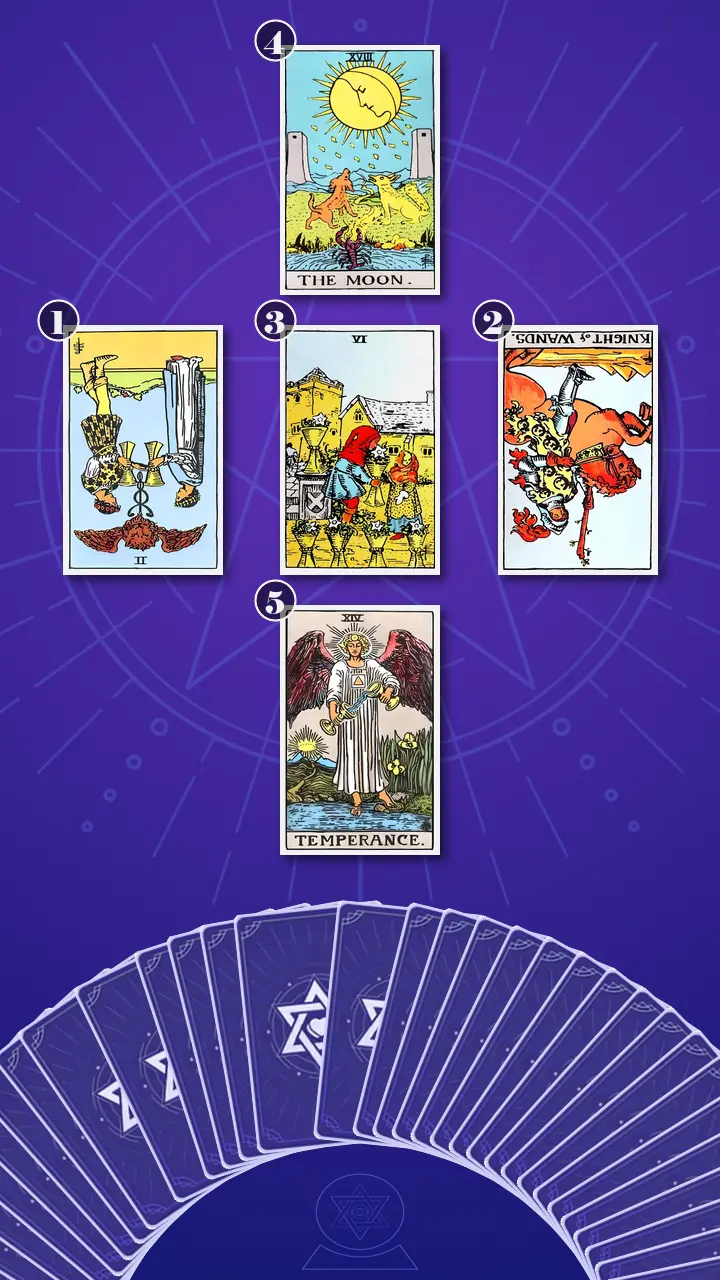
Reading the Relationship Map
The Exchange That Tilted: Two of Cups Reversed
I turned the first card. "This is the card representing the diagnosis-level knot in your own stance: the checking, reinterpretation, and withdrawal that happen when reciprocity feels disrupted." It was the Two of Cups, reversed.
In its upright image, two figures offer one another cups in a visible exchange. Reversed, that symmetry feels unstable. I saw Jordan's two message bubbles in it: one carrying a warm check-in, the other returning as yeah. The mismatch was real, but Jordan had been treating unequal communication tempo as proof that mutual recognition itself had disappeared.
"The pattern here is not that you care too much," I said. "It is that your care becomes an emergency when the exchange stops looking balanced. You reread old messages, watch online activity, rewrite your response, or become brief in return because immediate proof feels safer than waiting inside the gap."
I returned to the bedroom scene: the affectionate voice note above the dry reply, the laptop fan, the hot rectangle of the phone. The thought beneath the scrolling was painfully logical in its own way: If this exchange is not equally warm, maybe I imagined the reciprocity. But mutual care and equal warmth in every single exchange are not the same thing.
Jordan gave a small laugh that had no amusement in it. "That is so accurate it is almost rude." Their fingers curled around the sleeve of their mug, then loosened. I let the moment land without making their protective instinct something to be ashamed of.
The Transit Board That Kept Changing: Knight of Wands Reversed
I turned the second card. "This is the card representing the warm-then-cold signals as you receive them. It lets us describe the observable rhythm without assigning a hidden motive to your friend." It was the Knight of Wands, reversed.
The rearing horse and raised wand looked like a notification arriving at full speed. Reversed, that charge becomes a TTC arrival board that says two minutes, then abruptly changes to fourteen. The uncertainty is real. The board still does not tell us why the vehicle is delayed.
"This is Tuesday's excited brunch voice note and Friday's vague replies," I told Jordan. "You can observe bursts of enthusiasm and weak follow-through. You cannot responsibly build a private explanation for why it happens from the rhythm alone."
Jordan looked down at the card. "On Tuesday, I rearrange my whole week because it sounds real. By Friday, I feel ridiculous for believing it."
That was the reversed Knight's blocked fire: excitement without a dependable landing. It invited Jordan to move fast when the signal was warm, then protect themselves by becoming cold when momentum disappeared. Their actual wish was not constant contact. It was steadier contact and plans that did not strand their time, transit fare, or social energy.
The Evidence That Still Belongs in the Archive: Six of Cups
I turned the centre card. "This is the card representing the friendship's observable foundation: what has genuinely brought you together, so one current cue is not allowed to rewrite every prior fact." It was the Six of Cups, upright.
In the image, one figure offers a flower-filled cup to another inside a sheltered courtyard. I asked Jordan for evidence, not mood. They named a check-in after a difficult design review, the evening their friend crossed the city during a lonely week, and a tiny detail about Jordan's family that their friend had remembered months later.
"That care happened," I said. "It cannot guarantee what happens next, and it does not excuse present inconsistency. But it happened. One message can update the present; it cannot edit the archive."
Jordan's gaze left the newest text on their phone. Their shoulders came down a fraction, as if the room had made enough space for a third option between idealizing the friendship and declaring it imaginary. I felt the usual quiet shift I know from making art: a final frame can change the tone of a scene, but it cannot erase every image already captured on film.
"So I do not have to call the good parts fake just because I am hurt now," Jordan said.
"Exactly. Past care can be real, and present availability can still be insufficient."
The Story Built From a Status Dot: The Moon
I turned the fourth card. "This is the card representing the current relational challenge and the psychological mechanism beneath it: ambiguity activating an attachment alarm and turning one cue into a verdict about belonging." It was The Moon, upright.
I did not read The Moon as proof of deception. I read its winding path between two towers as limited visibility. The dog, wolf, and crayfish all respond from different instinctive places, just as Jordan's body, hope, and self-protection competed to explain a reply gap before there was enough information to explain.
I asked them to remember Sunday at 7:18 p.m.: rain tapping the kitchen window, the refrigerator hum suddenly loud, Instagram showing their friend active while Jordan's message stayed unanswered. The sequence had been fast: They saw it. They are avoiding me. The warmth was fake. I do not belong.
"The active-status dot is a cue," I said. "Avoidance is an interpretation. The friendship being fake is a verdict. Those are three different things, even when they arrive in your body as one hard hit."
Jordan held their breath first. Then their eyes went unfocused, as if replaying a dozen Sunday nights at once. Finally, they exhaled through their nose and pressed a hand briefly to their chest. "I keep calling it intuition," they said, "but it is usually my brain trying to finish the story before I have to feel the waiting."
"That is an important distinction," I said. "Ambiguity is a gap in information, not proof of rejection. You are allowed to take your discomfort seriously without promoting its first explanation to fact."
When Temperance Held Both Tabs Open
The Practice of Sustainable Closeness: Temperance Upright
The room seemed to become quieter as I turned the fifth card. "This is the card representing an ethical next practice: regulation, pattern-over-time assessment, direct communication, and a boundary you choose for yourself." It was Temperance, upright.
The angel poured water between two cups, one foot on land and one in water. I saw the two browser tabs Jordan had been unable to keep open together: the friendship has contained real care and the current pattern may not support the closeness I want. Temperance did not demand that they choose one tab and close the other. It asked them to let both be true long enough to make a grounded decision.
Jordan was still caught in the old demand for a flawless answer. If the friendship was real, surely the warmth should stay constant. If it was not constant, surely the friendship must have been a lie. That split had made every notification feel like a referendum and every quiet stretch feel like a personal failure to judge who was safe.
A cold moment does not have to erase a warm history; measure the pattern, name the need, and let Temperance's two cups hold both truths while you decide what level of closeness is sustainable.
For a few seconds, Jordan did not move. Their breathing paused; their thumb hovered above the phone rather than opening the chat again. Their eyes widened slightly, then softened, and I watched the realization work through them in layers: the memory of every long message they had almost sent, the embarrassment of every deliberately flat all good, the relief of not having to prove the entire friendship false in order to admit that it hurt.
Then their jaw tightened again. "But if I need a boundary, does that mean I was wrong about us? That I made the good parts bigger than they were?"
"No," I said. "It means you are letting history be history and the present be present. A boundary is not a punishment or a revision of the past. It is information about what access the current pattern can hold."
Jordan's hands unclenched in their lap. Their shoulders dropped, though the openness that followed looked a little dizzying, like stepping out of a loud club into cold night air and realizing they could finally hear themselves think. "I can let both things be true," they said, quietly. "I just have to decide what I can actually keep doing."
"Yes. Now, with this new lens, think about last week. Was there a moment when you could have treated the feeling as an alarm to settle, rather than a verdict to obey?"
Jordan named the Saturday cancellation. They could see that the cancellation had been disappointing and practically disruptive without using it as proof that every past brunch, voice note, and kindness had been counterfeit. This was the first move in their emotional transformation: from treating each cold cue as proof that the friendship meant nothing to holding real past care alongside present capacity and choosing sustainable closeness.
I also offered a lens from my own practice, one I call Sidekick Syndrome. Sometimes a friendship quietly assigns someone a role that keeps the connection easy for everyone else: the therapist, the comic relief, the endlessly flexible person who says no worries while their weekend and feelings absorb the cost. I asked Jordan which character they had been playing.
"The low-maintenance friend," they said immediately. "The person who is never supposed to need confirmation."
That answer made Temperance more practical. I introduced my Role Resignation Act: not a confrontation, and not a demand that the other person become someone else, but a calm refusal to keep performing the character who cannot name a need. The special power of this shift was that Jordan no longer had to choose between chasing reassurance and vanishing. They could speak as themselves.
From Card Meanings to a Clearer Next Move
I gathered the spread into one story. The reversed Two of Cups showed Jordan's understandable urge to turn an uneven exchange into a total loss of meaning. The reversed Knight of Wands showed that the stop-start rhythm itself had real consequences, especially in a city of crowded calendars and cross-town plans. The Six of Cups restored the evidence of real care. The Moon revealed how incomplete information became a rejection story. Temperance offered a way to hold feeling and practical reality together.
The blind spot was not that Jordan had imagined the friendship or that they should simply stop feeling hurt. It was giving the latest message more authority than the full pattern, then forcing emotion to do the missing work of language and structure. This spread had no Swords or Pentacles: not enough clear words, not enough concrete agreements. Jordan could add those missing elements themselves.
Consistency is not constant warmth; it is a pattern you can name and plan around. I suggested two small, specific practices, each designed to create clarity without turning Jordan into a full-time investigator.
- The Thirty-Minute Temperance PauseThe next time a dry reply, read receipt, or cancellation lands, Jordan will put both feet on the floor, name the body signal in plain language, and set a thirty-minute phone timer before sending any message meant to get certainty. In Apple Notes, Jordan will write one line under Observed, one under Assumed, and one under Askable, then close the note.If thirty minutes feels impossible, Jordan can use three minutes or one slow exhale. The note is not a prosecution file; one observable fact is enough.
- The Role Resignation RequestBefore the next plan with this friend, Jordan will draft a two-sentence message in Notes: I value this friendship, and the stop-start planning has been hard for me to read. Could we confirm plans by the night before, or let each other know when we do not have capacity? For Saturday plans, Jordan will use a Friday 7 p.m. confirmation cutoff and keep a near-home backup plan.Jordan does not need to send it while activated. A request is information, not a demand for a particular answer; no response by the cutoff is also information for choosing the backup plan.
"This is not about controlling whether they reply," I told Jordan. "It is about letting your own time, money, and nervous system count in the friendship. A boundary does not erase the friendship; it decides what access the current pattern can hold."

A Week Later, the Quiet Proof
Six days later, Jordan sent me a short update. Their friend had floated another Saturday plan, and instead of rearranging everything immediately, Jordan used the confirmation cutoff and made a backup reservation near home. They sent the two-sentence request after work, not at midnight. The reply was imperfect but clear: their friend apologized for the missed follow-through and agreed to confirm earlier when possible.
Jordan did not call it a solved friendship. They still felt a flicker of doubt the next morning, and they sat alone in a coffee shop for an hour after their backup plan. But they did not reopen six months of chat history. They had made room for care, disappointment, and self-respect to exist in the same frame.
That is the Journey to Clarity I try to offer. I do not hand anyone a final ruling on what another person feels. I hand the pen back to the person living the scene, so they can notice the pattern, name what they need, and write the next honest act.
When one cold reply makes your stomach drop, it can feel as though you must erase every warm memory before it becomes evidence that you were foolish to believe you belonged. But one warm memory can remain true without being forced to guarantee the future.
When your own phone screen goes hot with the urge to decide everything at once, what small sign of present-day consistency would you be curious to notice before you let the newest message rewrite the archive?
Every reading at AceTarot is a journey to connect with inner wisdom and empower the path ahead. This reading shared here is a psychological mirror, not a private record—crafted to reflect universal emotional loops and help restore personal clarity. Please note that these insights do not replace professional psychological, medical, legal, or financial advice, and should not serve as the sole basis for major life decisions.
Learn more about our Journey to Clarity.
How did this insight land for you?
🫂 This Resonates Deeply
🌀 Living This Story
✨ Now I See Clearly
🌱 Seeing New Possibilities
🧰 Useful Framework
🔮 The Confirmation I Needed
💪 Feeling Empowered
🚀 Ready for My Next Step
Author Profile
 AI
AI Juniper Wilde
1056 readings | 537 reviews
“I’ve always felt our lives are films currently in production. As an artist, I know that when you feel stuck, it’s often because you’ve bravely stayed in a painful scene for just a little too long. I’m not here to coldly analyze you. I want to sit closely with you, look at those difficult moments with profound empathy, and gently hand you the pen so you have the courage to write your next beautiful act.”
In this Friendship Tarot Reading :
Core Expertise
- Clique Power Dynamics: Deconstructing the subtle jealousy, micro-aggressions, and implicit hierarchies hidden within tight-knit friend groups.
- Sidekick Syndrome Diagnosis: Identifying how your friend group has boxed you into a specific, restrictive role (e.g., the clown, the therapist) to maintain their status quo.
Service Features
- The Role Resignation Act: A creative conversational pivot designed to gracefully but firmly refuse your assigned 'character' during your next group interaction.
Also specializes in :
Explore Related Patterns:
Anxious AttachmentJordan moves from a one-word "yeah" and an unanswered message beside an active-status dot to the conclusion, "I do not belong." The narrative explicitly describes an attachment alarm: incomplete contact is received as a possible loss of connection, which makes scrolling, checking, and obtaining immediate proof feel urgent. You can recognize that urgency as a response to ambiguity rather than reliable evidence of what the friend feels. The later confirmation cutoff and backup plan show a different way to protect connection with yourself while the relationship remains uncertain. You are not required to decide whether every warm moment was false in order to notice that the present rhythm activates your need for steadier contact.
Black-and-White ThinkingJordan says that one cold reply makes every warm moment feel counterfeit, then later recognizes the old rule that if warmth is not constant, the friendship must have been a lie. This collapses a complicated relationship into two mutually exclusive options: perfect consistency or total falseness. You are left trying to resolve every notification as a referendum on the whole bond. The remembered check-in, cross-city visit, and small family detail interrupt that split without excusing present inconsistency. You can hold that past care was real and that current availability may still be insufficient, which gives you a clearer basis for deciding what closeness is sustainable now.
Certainty SeekingAt 11:40 p.m., Jordan keeps both screens open, scrolls through months of messages, and repeatedly drafts a reply because an immediate answer feels safer than sitting inside the gap. The problem is not simply curiosity about the friend's mood; uncertainty becomes an emergency that must be solved through more evidence. You can see why each new cue acquires disproportionate authority. The pause, the Observed-Assumed-Askable note, and the confirmation cutoff create alternatives to demanding certainty from a single interaction. You can seek information that is genuinely available while allowing unresolved parts of the friendship to remain unresolved until the pattern becomes clearer.
Intermittent ReinforcementJordan receives an excited Tuesday voice note, rearranges the week around the warmth, and then meets vague replies or a cancellation by Friday. The signal is not simply cold; it is inconsistent enough to keep hope and self-protection alternating at speed. You can see why a warm moment feels especially persuasive and a cold one feels like a collapse in meaning. The confirmation cutoff does not diagnose the friend or try to control their availability. It lets you measure follow-through over time and protect your plans from a rhythm that repeatedly leaves your time, transit fare, and social energy carrying the uncertainty.
Rejection SensitivityJordan's Sunday sequence moves from seeing a friend active online to "They are avoiding me," then to the fear that the warmth was fake and that they do not belong. A small cue is not merely disappointing here; it lands as a high-stakes signal of exclusion. You can see how the body alarm gives the first interpretation the force of a fact. The story does not ask you to dismiss the hurt of a reply gap. It separates the cue from the conclusion, so you can take the discomfort seriously without letting sensitivity to rejection decide the friendship's entire meaning before more information arrives.
Reality TestingJordan is asked to separate an active-status dot, the interpretation that the friend is avoiding them, and the verdict that the friendship was fake. This restores a distinction that the spiral had flattened: what happened, what it may mean, and what is still unknown. You can use that separation to keep a painful cue from becoming the sole historian of the relationship. The friendship archive also includes the check-in after a difficult review, the cross-city visit during a lonely week, and the remembered family detail. You do not have to idealize those facts or use them to excuse inconsistency; you can let them remain true while assessing what the current pattern supports.
Boundary DiscernmentJordan sends a direct request for earlier confirmation or notice of limited capacity, then uses a Friday cutoff and a near-home backup plan. These actions do not demand that the friend become perfectly consistent; they define what Jordan needs in order to plan without repeatedly paying the practical and emotional cost of ambiguity. You can turn a vague hope for steadiness into information you can actually use. The story frames a boundary as neither punishment nor a rewrite of the good parts. You can preserve what was meaningful while deciding what level of access the current pattern can realistically hold.
Self-SilencingJordan immediately names the role of the low-maintenance friend, the person who is not supposed to need confirmation and who says "no worries" while absorbing the cost. The deliberately flat "all good" messages keep disappointment out of the conversation, but they also leave the friendship without usable information about Jordan's actual needs. You can see how silence pushes the emotional work back into private rumination. The two-sentence request changes the role without turning it into a confrontation. You can let a need be visible and still leave the other person free to show what capacity and consistency they can realistically offer.
Uncertainty ToleranceJordan describes two browser tabs that had seemed impossible to keep open together: the friendship has contained real care, and the current pattern may not support the closeness they want. Holding both truths removes the false demand for a flawless answer before Jordan can act. You can allow disappointment and uncertainty to exist without promoting either one into a final ruling. The phone pause, confirmation cutoff, and backup reservation make that tolerance practical rather than passive. You can wait for a clearer pattern while still giving your own time, money, energy, and need for connection a concrete place in the decision.
Mind ReadingJordan sees an active-status dot while their own message remains unanswered and rapidly supplies the missing motive: "They are avoiding me." The story makes the factual boundary clear: online activity is observable, while avoidance is an interpretation. You can notice how the mind tries to close an uncomfortable gap by making another person's private intention feel knowable. That distinction does not require you to assume the most flattering explanation. It gives you room to ask for clarity, observe follow-through over time, and make choices from the pattern you can actually see rather than from a story built in the waiting.
Explore Related Struggles:
All-or-Nothing BelongingJordan's rule leaves only two outcomes: constant warmth proves the friendship was real, while a cold stretch proves the warmth was counterfeit and that they do not belong. The active-status dot then becomes more than a cue; it becomes a demand to choose one total story. You do not have to erase your hurt to make room for a middle position. Past care, present disappointment, and a boundary around what you can keep doing can occupy the same frame, giving belonging a basis wider than the newest notification.
Care-Certainty SplitJordan does not ask for constant contact; they ask for enough steadiness to trust a plan and stay connected without reopening the entire chat history. Yet when the exchange loses its balance, care suddenly needs to be proven again before it can feel safe to receive. You can value the friendship and still feel pulled to demand a verdict from each gap. Naming that split makes a different kind of choice possible: seek clear information about present capacity without requiring instant reassurance to validate every warm moment that came before.
Then-Now SplitJordan scrolls upward through months of messages while one current reply sits at the bottom of the screen, threatening to rewrite everything above it. You are left holding two timeframes that both matter: the friendship's documented history and the present moment's disappointing limit. The strain appears when the present is treated as a retroactive editor rather than new information about current availability. Letting history remain true without forcing it to guarantee the future restores your ability to assess what the relationship can hold now.
Tone-Truth FusionJordan places last week's affectionate voice note directly above today's "yeah," then lets the one-word tone answer a much larger question about whether the friendship is real. You can see a small, observable feature of communication being asked to carry the full weight of mutual recognition. When tone becomes the standard of truth, a dry reply can make the archive feel unreliable before any new relational fact has arrived. Separating the cue from the conclusion gives you room to notice the actual pattern without letting one text dictate the meaning of every earlier exchange.
Affection-Workability SplitJordan can point to a difficult-week visit, a remembered family detail, and a thoughtful check-in, while also naming cancellations and planning that leave their time, transit fare, and social energy exposed. You are not required to call those earlier acts fake in order to recognize that the current rhythm is hard to live inside. Care and workability answer different questions. Holding both lets you decide what access is sustainable on the pattern that exists, rather than using affection as a reason to absorb every practical and emotional cost of inconsistency.
Monitoring-Safety FusionJordan moves between message history, online activity, and unsent drafts while the phone and laptop keep the relationship active in the room long after the conversation has stopped. You can see how checking offers a temporary task when waiting feels too unstructured to bear. The loop tightens because each new detail is asked to settle a question that the detail cannot answer: what the friend means, what will happen next, and whether Jordan still belongs. Returning to an observable fact, an assumption, and an askable question creates distance between the screen's information and the authority it has been given.
Low-Maintenance Worth LockJordan names the role immediately: the low-maintenance friend who is never supposed to need confirmation. The unsent long messages and deliberately flat "all good" replies show how a need for clarity gets converted into a performance of effortless flexibility. You can protect yourself from seeming demanding and still end up without a way to say what the relationship costs you. A calm request changes the role without rewriting the friendship, because it allows your time, capacity, and needs to be present in the exchange.
Explore Related Emotions:
Evidence AnxietyWith the same iMessage thread open on a warm phone and a humming laptop, you reread old messages, watch online activity, and keep revising a reply you do not send. The uncertainty becomes a research task because collecting more clues briefly feels safer than sitting inside a gap you cannot yet explain. But the archive cannot provide the certainty you are asking it to provide. Each warm message and each cold moment can be made to support a different conclusion, leaving you more tightly bound to the question instead of closer to a clear answer. Writing down what was observed, what was assumed, and what can actually be asked returns the evidence to its proper scale. You can let facts inform your next choice without making yourself the investigator of another person's private motives.
Grounded Self-RespectInstead of rearranging everything as soon as another Saturday plan appears, you use the confirmation cutoff, make a near-home reservation, and send your request after work rather than at midnight. Your calendar is no longer being held open solely by the possibility of someone else's reply. This changes the meaning of a boundary. You are not trying to punish your friend or force a particular answer; you are allowing your own time, money, and social energy to count as facts in the relationship. The friendship remains open to care and repair, but you no longer have to abandon yourself to keep that opening available. You can choose closeness at a level that matches what the present pattern can actually carry.
Mutuality HungerWhen you name the difficult-design-review check-in, the cross-city visit, and the family detail your friend remembered, you are naming the kind of contact that makes a friendship feel mutual. Those moments show that your wish is not for constant messaging or perfect availability. What you want is room to rely on the connection without having to reorganize your life around every warm signal. A need for steadier follow-through holds both the tenderness of what you valued and the practical reality that your time, fare, and social energy also matter. Letting that need be visible gives you language beyond either chasing reassurance or pretending you need nothing. It makes a direct request possible while preserving your freedom to decide whether the ongoing pattern can meet you halfway.
Relational WhiplashTuesday's excited brunch voice note leads you to rearrange your week, while Friday's vague replies leave you wondering why you believed the warmth in the first place. The relationship's stop-start rhythm asks you to mobilize quickly, then leaves you holding the practical and emotional cost when the plan does not land. That sharp change in pace makes a colder reply feel larger than its words. You are repeatedly pulled toward closeness and then pushed into self-protection, which can make becoming brief in return feel like the only way to regain some control. Noticing the rhythm as a pattern helps you stop treating every burst of warmth as a commitment and every quiet stretch as a final rejection. You can set the level of time and energy you offer according to what has been consistently available.
Retroactive Rejection DreadAt 11:40 p.m., the affectionate voice note sits directly above “yeah,” and you keep moving from months of messages back to that single word. Your body reacts as though the newest cue has authority over the whole record, so a moment of distance begins to feel like evidence that every warm moment was unsafe to trust. The fear moves backward through the friendship rather than staying with the unanswered question in the present. You are not only missing a reply; you are trying to protect yourself from the humiliation of having invested in something that might no longer hold. When the current cue, the interpretation, and the final verdict are separated, the archive can remain factual rather than becoming a courtroom. That leaves you able to acknowledge present hurt and decide what access the current pattern can support without erasing what genuinely happened.
Low-Maintenance ShameWhen you call yourself the low-maintenance friend who is not supposed to need confirmation, the problem is no longer only the dry text. The ordinary wish to know whether a plan is real becomes charged with the fear that asking for clarity will expose you as too invested. That pressure helps explain the colder reply you draft and delete. Keeping your need hidden may protect you from feeling exposed for a moment, but it also leaves you alone with the task of guessing what the friendship can hold. A calm request does not make the good parts less real or make you unreasonable. It allows you to step out of the role that absorbs uncertainty in silence and speak from the actual limits of your time and capacity.
Cautious TrustWhen your gaze leaves the newest text and your shoulders lower, you make space for a third position between idealizing the friendship and declaring it imaginary. The check-in, the cross-city dinner, and the remembered detail can remain true even while the current rhythm still disappoints you. You do not need a flawless answer before you can trust your own observations. Cautious trust lets you hold the warmth that was offered without using it to excuse every present inconsistency. The later reply is imperfect but clear, and that distinction matters. You can let future choices be guided by patterns over time, while keeping your account of the past accurate and your expectations grounded.
Explore Related Contexts:
Ambiguous Text EscalationJordan is looking at last week's affectionate voice note directly above today's "yeah," then sees an unanswered message beside an active-status dot. Those are externally visible communication cues, but the thread does not contain a shared explanation for the shift, and the interface places each fragment beside a much longer archive of contact. You are dealing with a channel that makes limited evidence instantly available while leaving the meaning of that evidence unresolved. Separating the dry reply, the active-status cue, and the request you could make gives you a way to respond to the present exchange without allowing one unclear signal to determine the friendship's entire record.
Friendship WhiplashTuesday's enthusiastic brunch voice note leads Jordan to rearrange the week, while Friday brings vague replies and Saturday brings a cancellation. In a city where friends can live forty-five minutes apart, the relationship's communication rhythm also determines whether time, transit, and other plans can be organized around it. You are encountering a stop-start social pattern whose consequences extend beyond a single text. Tracking whether warm invitations reliably become confirmed plans lets you assess the actual level of access this friendship can sustain, rather than treating every burst of warmth as a commitment or every quiet stretch as a final answer.