Friendship Mediator Burnout at 11:48 p.m.
If you are a junior project coordinator in Toronto who can make any tense message sound harmless, the late-night “Can you tell them...?” arriving while you are trying to log off may be your version of friendship mediator burnout.
At 11:48 p.m., Maya (name changed for privacy) appeared in my video window on the edge of her bed with two private chats open. She had copied one friend’s complaint into the Notes app and deleted its sharpest sentence; blue phone light washed across the bedsheets, the radiator clicked in the quiet, and the device felt warm in her palm while her shoulders hovered near her ears.
“I’m not even in the argument,” she said, pressing her thumb into the hinge of her jaw. “But one of them tells me what the other did, I rewrite it so it won’t sound aggressive, and then I carry the reply back. I want them to speak directly. I just can’t shake the feeling that if I stop, the whole group will split and everyone will think I chose a side.”
I could see the weight of responsibility-laced anxiety without needing to label it first. It looked like trying to carry a tray of full glasses through a moving subway car while someone kept adding another drink. Underneath the careful balance sat resentment, guilt, and the cold little drop in her stomach that asked whether she would still belong if she stopped being useful.
“You can care about both people without carrying both messages,” I told her. “I’m not going to predict whether your friends reconcile, and I’m not here to tell you whom to keep or leave. Let’s use the cards to map the pattern, find the part that is actually within your control, and hand the next line of the story back to you.”

Choosing the Compass: A Five-Card Friendship Map
I asked Maya to put her phone face down, place both feet on the floor, and take one unforced breath. I use that pause as a practical threshold: it gives the nervous system a moment to leave the group chat before the reading begins.
I shuffled slowly, then invited her to cut the deck while holding one question: “Why do I keep carrying messages between friends who won’t talk?”
I chose the five-card Relationship Spread · Context Edition for understanding friendship triangulation and communication boundaries. For anyone wondering how tarot works in a situation like this, I treat the spread as a structured relationship map, not a supernatural verdict. Its five positions are enough to distinguish Maya’s participation, the observable behavior reaching her from the other people, the shared dynamic, the blockage beneath it, and the response available within her control. A larger spread would have produced more information without necessarily producing more clarity.
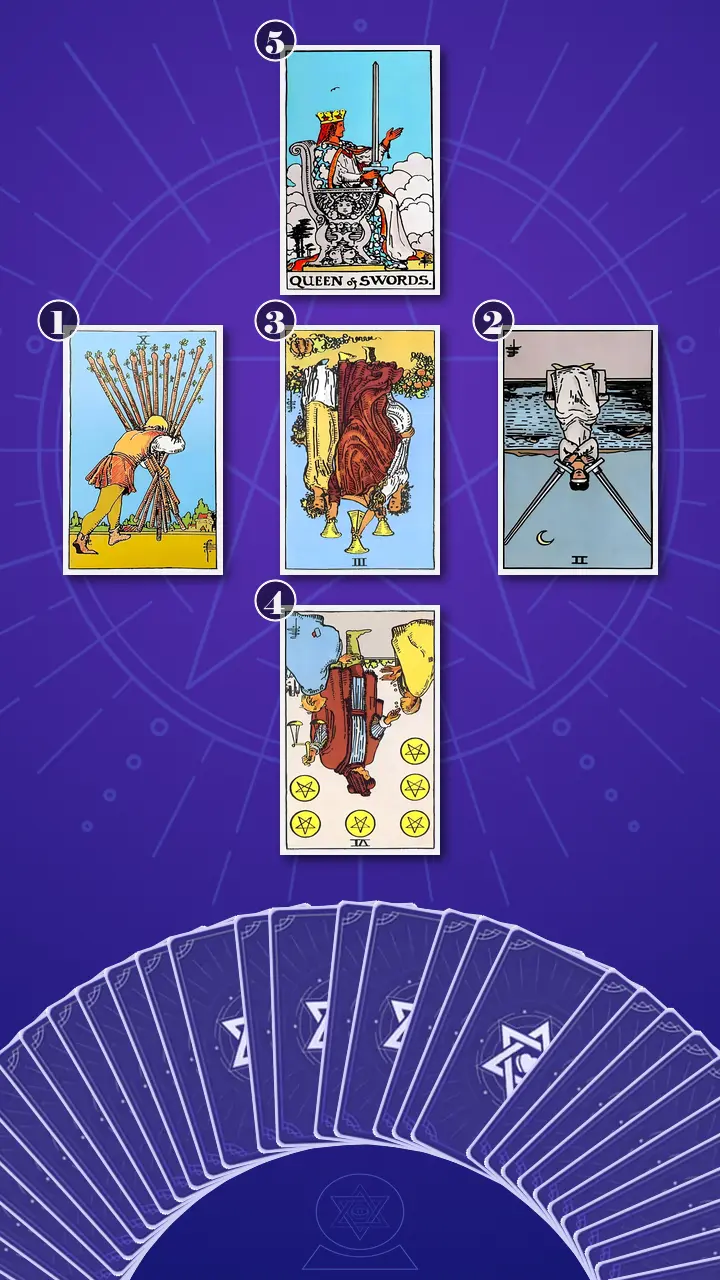
I placed the third card at the center, with the first and second cards forming the horizontal relationship axis. The fourth sat below as the hidden support holding the pattern in place; the fifth rested above as the available corrective. I told Maya that we would begin with what she was carrying, cross to the blocked direct exchange, examine the friendship triangle, descend into its unequal labor arrangement, and then rise toward one clear boundary.
“The cards can help us separate what feels urgent from what is actually yours,” I said. “They will not decide what your friends do next. That part belongs to them, just as your participation belongs to you.”
The Load That Blocked the Road
Position One: When Care Becomes Cargo
Now I turned over the card representing Maya’s current contribution to the relationship pattern: the part where caring had expanded into carrying, editing, and tracking every message. It was the Ten of Wands, upright.
I showed her the bent figure with ten wands bundled across his field of vision. In Maya’s life, those wands were two private message threads, a softened draft in Notes, read receipts, birthday logistics, follow-up questions, and the silent calculation of who knew which version of the conflict. She had become the figure in the card, moving every reply toward the promise of a calmer group while losing sight of where listening ended and delivery began.
“This is fire in Excess,” I explained. “You respond to other people’s blocked communication by producing more effort. The quieter they become with each other, the busier you become between them. Caring is not the problem. The accumulated workload is blocking your view of your own limit.”
For a second, I remembered an editing room where I had once watched a scene become less honest with every unnecessary cut. That was what Maya’s softened rewrites were doing. She was not creating the conflict, but by making every difficult sentence easier to avoid, she was staying inside a painful scene long after her own part should have ended.
“When the next private message arrives,” I asked, “which part do you automatically take on: listening, rewriting, explaining, following up, or all of it?”
Maya gave one short laugh, but there was no amusement in it. Her eyes stayed on the card. “All of it. That’s so accurate it’s almost rude.” Then she rubbed both palms over her thighs and added, “I keep saying it’s only one message, but somehow I’m running the entire conversation.”
Position Two: The Message With the Wrong Recipient
Now I turned over the card representing the observable communication pattern brought by the two friends as it reached Maya: difficult words were being routed through her instead of sent to their intended recipient. It was the Two of Swords, reversed.
The blindfold and crossed blades made the structure plain. A private complaint arrived in Maya’s inbox, but its real destination was another friend. Maya then studied punctuation, screenshots, timing, typing bubbles, and possible reactions as though she had been appointed to decide how the two people should communicate.
“This is air in Blockage,” I said. “Direct speech is stalled, and the stalled energy spills into side channels. The reversal does not promise that the friends are ready to talk. It simply shows that the current stalemate is no longer contained. Their unsent words are landing elsewhere, and that elsewhere is you.”
I was careful not to claim that either friend was malicious, secretly jealous, or consciously using her. Tarot did not give me access to their private motives. I could name the visible routing pattern: one person was speaking, the intended recipient was absent, and Maya was being handed a communication decision she had not created.
“What exact conversation is being redirected through you?” I asked.
Her thumb moved toward her phone before she caught herself. “One of them wants the other to apologise for what happened at a birthday dinner. But she keeps asking me whether the other person is ready to hear it.”
“Then the choice to send that message still belongs to its original speaker,” I said. “You do not have to force them into a group chat, forward everything without consent, or schedule a confrontation. Those reactions would keep you in charge of the exchange. You can simply decline to become its route.”
Position Three: The Toast That Never Meets
Now I turned over the card representing the shared friendship dynamic: the Three of Cups, reversed.
Upright, the three figures lift their cups toward one shared point of contact. Reversed, I saw Maya’s group chat surrounded by active side threads, screenshots, Close Friends stories, and different versions of the same disagreement. The birthday remained in Google Calendar. Everyone might still react to the same meme. Yet the meaningful conversation never reached the middle.
“This is water in Blockage,” I told her. “The friendship may still contain real affection, but its emotional circulation has fragmented into private pairings. A calm group chat can still be hiding an exhausting private system.”
I asked her to picture the most recent dinner plan that had looked fine on the surface. “Which part was discussed openly, and which part continued in separate chats?”
Her gaze shifted away from the spread. One finger traced the rim of her water glass, tightened around it, and then released. “The restaurant was agreed in the group. The seating, the apology, who might leave early, and whether anyone was still mad all came through me.”
“So here is the harder question,” I said. “Are you connected, or are you keeping the triangle operational?”
She looked back at the three inverted cups. I watched recognition settle more slowly than agreement. The card was not accusing the friendship of being fake; it was distinguishing visible harmony from mutual communication. Maya had been treating every relay request as an isolated favor. The spread showed one repeating structure.
Position Four: The Invisible Invoice
Now I turned over the card representing the recurring blockage beneath the triangle: the Six of Pentacles, reversed.
I pointed to the scales in the standing figure’s hand and the coins flowing in one direction. In Maya’s life, the currency was time, edited wording, immediate availability, emotional risk, and follow-up attention. She supplied the communication triage while the other people received temporary relief from contacting each other directly.
“This is an Excess of giving paired with a Deficiency of returned responsibility,” I said. “Your support has become an unequal labor arrangement. You keep hearing, ‘They only need a little help.’ Then, once the immediate tension settles, another thought arrives: ‘Why am I responsible for whether they reply?’ That second thought is the resentment created when voluntary listening turns into unpaid delivery work.”
This was where I used the lens I call Clique Power Dynamics. I was not looking for a villain. I was looking at the implicit hierarchy created by repeated behavior. The friends who handed over the message received distance from the difficult exchange; Maya absorbed its wording, timing, and consequences. Because she was known as thoughtful and diplomatic, her strength had quietly become the role everyone expected her to perform.
At work, an incorrectly routed project ticket could be acknowledged without being accepted as Maya’s responsibility. I invited her to bring that same distinction home: “I can care about this without taking the task.” The Six of Pentacles reversed did not ask her to stop being generous. It asked her to notice who owned the work before she automatically picked it up.
Her breath caught. Her eyes lost focus as if she were mentally counting old conversations, and then her shoulders dropped by a fraction. “I draft the words, check whether they were seen, and follow up if no one answers,” she said. “Nobody even asks whether I have time. They just know I’ll do it.”
“The next request is not an emergency automatically assigned to you,” I said. “It is a choice being handed over. A ten-minute pause can give you enough room to decide whether you accept it.”
When the Queen Raised One Clear Line
Position Five: Care With an Edge and an Open Hand
The radiator stopped clicking for one strange beat as I reached for the final card. Now I turned over the card representing the constructive response available to Maya: a consistent boundary that preserved care while ending her participation in message delivery. It was the Queen of Swords, upright.
I held the card closer to the camera. The Queen’s sword formed one clean vertical line, while her other hand remained open toward the world. Her sword did not punish anyone. It defined a limit. Her open hand did not surrender that limit. It showed that contact and care could remain available without compliance.
“This is air in Balance,” I said. “The Two of Swords showed language blocked and crossed. The Queen restores language as precise, direct, and repeatable. In ordinary life, she is you sending the same brief boundary to both friends, without editing it for each person, defending it in three extra paragraphs, or monitoring every reaction afterward.”
I also recognised what I call Sidekick Syndrome. Maya’s group had come to know her through a restrictive supporting role: the fixer, the diplomatic one, the unofficial communications department. Whether or not anyone had assigned that character deliberately, every successful relay reinforced the same script. The Queen was not asking Maya to become cold or leave the cast. She was inviting Maya to stop performing one part that had consumed the rest of her friendship.
I returned her to 11:48 p.m.: two private chats open, one softened sentence waiting in Notes, the phone lighting her bedsheets. She had wanted sleep, yet each notification had become a referendum on whether the group, and her place inside it, would survive.
You are not the group's human inbox; choose one clear, respectful boundary and hold it as steadily as the Queen of Swords holds her upright blade.
I let the sentence remain between us without rushing to make it easier.
Maya’s breath stopped first. Her fingers stayed suspended above the face-down phone, and her pupils widened as if the room had moved a few inches away. Then her eyebrows pulled together. “But doesn’t that mean I’ve been doing this wrong for years?” she asked, sharper than she had sounded all evening. “If I stop now, it’s going to look like I suddenly don’t care.”
“No,” I said. “It means this strategy helped you feel useful and reduced conflict in the short term. Now you can see the cost. Outgrowing a role does not turn your earlier care into a mistake.”
Her gaze drifted to the dark phone. I watched her replay something silently: her jaw tightened, her fist closed against the duvet, and then both loosened together. Her eyes shone, but she did not cry. The exhale that followed carried relief and a slight tremor of anger. After it came a brief, almost dizzy blankness. A clear boundary meant she no longer had to control the outcome, but it also meant tolerating whatever the others chose. “So I can return the conversation without abandoning either of them,” she said quietly.
“Now, using this new perspective, think back to last week,” I invited her. “Was there a moment when this insight could have made you feel different?”
“The birthday seating messages,” she said after a pause. “I could have told each of them to speak directly. I would still have felt guilty, but I could have watched the show I’d planned to watch instead of spending two hours making a seating chart nobody asked me to make.”
I named the shift carefully. This was not instant confidence or a guarantee that the group would stay unchanged. It was the first step from responsibility-laced anxiety and compulsive usefulness to compassionate clarity and steadier belonging without constant mediation. Maya was beginning to separate her worth as a friend from her performance as the person who kept every conversation moving.
The Role Resignation Act: Finding Clarity in One Sentence
I drew the cards together into one storyline. Maya’s project-coordinator instincts had taught her to notice unresolved handoffs and make them smoother. In the friendship, the Ten of Wands showed that useful skill running in Excess. The reversed Two of Swords showed direct speech stopping before it reached the right person. The reversed Three of Cups revealed the resulting triangle, and the reversed Six of Pentacles exposed the unequal labor contract beneath it. The Queen of Swords offered the resource that had been missing: one clear line separating care from communication ownership.
The cognitive blind spot was subtle. Maya had been treating temporary calm as proof that mediation worked, even though each successful relay made direct communication less likely. She had also treated another person’s disappointment as evidence that her boundary must be wrong. The transformation direction was not toward a perfect way to mediate, nor toward cutting everyone off. It was toward setting one consistent no-relay boundary that returned each message to its original speaker while preserving care.
“Your friendship is not a customer support line,” I said. “Listening is a choice; delivery is a responsibility transfer. You are allowed to offer the first without accepting the second.”
I called the practical intervention the Role Resignation Act. In film terms, Maya was not quitting the production or rewriting every other character. She was handing back one role: messenger. Her only job was to say the new line clearly and decline to improvise her way back into the old scene.
“But when that message arrives, ten minutes feels long,” she said. “I’ll spend the whole time imagining them deciding I’m selfish.”
“Then the pause is not a test of how calm you can become,” I replied. “You can feel the guilt and still avoid opening the other chat. The goal is only to interrupt the automatic handoff long enough for you to make a choice.”
- Use the ten-minute Role Resignation Act. The next time either friend asks for delivery, interpretation, or follow-up, wait ten minutes and notice your shoulders, jaw, and impulse to open the other thread. Then send: “I care about both of you, but I will not pass messages between you; please contact each other directly.” Stop there unless you genuinely choose to add something. Keep the sentence in Notes and use it unchanged for seven days. Consistency reduces the temptation to soften, defend, or negotiate the boundary.
- Run the listener-versus-messenger check. When a private complaint arrives, ask: “Do you want me to listen, or are you asking me to pass this on?” If the answer is listening, set a fifteen-minute timer and do not open the other friend’s chat. When the timer ends, say: “I hear that this matters, but I can’t deliver or manage the conversation for you.” If checking pulls you back into the relay role, mute both private threads for the evening. You can shorten the listening window or decline it entirely when you do not have the capacity.
I reminded Maya that neither action guaranteed reconciliation. One friend might be irritated; another might remain silent. The success measure was smaller and more honest: Did Maya return the message to its rightful speaker? Did she keep her own evening? Did she allow other adults to make their own choices without converting those choices into her task list?
The cards had not ordered Maya to change. They had made the system visible enough for her to choose differently. The boundary belonged to her, including the right to revise it, delay it, or try a five-minute version first.

A Week Later: One Message Stayed Put
Six days later, I received a message from Maya. A friend had sent a screenshot followed by the familiar request: “Can you tell her I didn’t mean it like that?” Maya waited ten minutes, pasted the Queen of Swords sentence, and put the phone across the room. One friend replied, “Okay, wow.” The other said nothing because Maya never forwarded the screenshot.
“My stomach dropped after I sent it,” Maya wrote. “But then I watched my show. I didn’t draft a follow-up, and the world did not end during the episode.”
That night she slept through without checking either thread. In the morning, her first thought was, “What if I made it worse?” She noticed the thought, gave a small, uncertain smile, and made coffee before touching her phone.
I did not call that a solved friendship. I called it evidence of authorship. Our Journey to Clarity had not revealed a flawless ending; it had shown Maya the pen in her own hand. Tarot supplied the storyboard, but she chose which role to resign and which line to deliver.
If a private “Can you tell them...?” makes your shoulders rise and your jaw lock tonight, it may feel safer to stay useful than to discover whether the friendship can hold without your translating. Simply noticing that old script gives you a moment in which another line becomes possible.
Which message could stay with its rightful speaker tonight, and what would your own small, no-explanation-needed version of caring sound like?
Every reading at AceTarot is a journey to connect with inner wisdom and empower the path ahead. This reading shared here is a psychological mirror, not a private record—crafted to reflect universal emotional loops and help restore personal clarity. Please note that these insights do not replace professional psychological, medical, legal, or financial advice, and should not serve as the sole basis for major life decisions.
Learn more about our Journey to Clarity.
How did this insight land for you?
🫂 This Resonates Deeply
🌀 Living This Story
✨ Now I See Clearly
🌱 Seeing New Possibilities
🧰 Useful Framework
🔮 The Confirmation I Needed
💪 Feeling Empowered
🚀 Ready for My Next Step
Author Profile
 AI
AI Juniper Wilde
1056 readings | 537 reviews
“I’ve always felt our lives are films currently in production. As an artist, I know that when you feel stuck, it’s often because you’ve bravely stayed in a painful scene for just a little too long. I’m not here to coldly analyze you. I want to sit closely with you, look at those difficult moments with profound empathy, and gently hand you the pen so you have the courage to write your next beautiful act.”
In this Friendship Tarot Reading :
Core Expertise
- Clique Power Dynamics: Deconstructing the subtle jealousy, micro-aggressions, and implicit hierarchies hidden within tight-knit friend groups.
- Sidekick Syndrome Diagnosis: Identifying how your friend group has boxed you into a specific, restrictive role (e.g., the clown, the therapist) to maintain their status quo.
Service Features
- The Role Resignation Act: A creative conversational pivot designed to gracefully but firmly refuse your assigned 'character' during your next group interaction.
Also specializes in :
Explore Related Patterns:
Boundary DiffusionMaya says she automatically handles all of it: listening, rewriting, explaining, checking, and following up. Nobody asks whether she has time because the group has learned to treat her availability as part of the communication system. The sender's decision to speak and the recipient's possible response cross into Maya's responsibility before she has consciously agreed to anything. Boundary diffusion occurs when caring, listening, delivering, and managing consequences stop feeling like separate choices. You may know intellectually that the message belongs to someone else while still experiencing refusal as abandonment or disloyalty. Re-establishing the boundary means identifying the exact point where support ends and responsibility transfers, then making acceptance of that transfer an explicit choice rather than an automatic handoff.
Compulsive PeacekeepingMaya copies a friend's complaint into Notes, deletes its sharpest sentence, and rewrites the message until it feels safer to deliver. The editing lowers the immediate temperature, which makes the strategy feel effective. Yet every softened relay also protects the original speakers from having to communicate clearly, tolerate discomfort, or repair the disagreement themselves. When you repeatedly make conflict harmless enough for everyone else to avoid, peace can become a defensive project rather than a shared relationship skill. You receive short-term relief when nobody openly clashes, but that relief negatively reinforces the same mediation ritual. Recognizing this pattern lets you preserve your diplomacy without using it to carry every difficult conversation to completion.
Emotional Hyper-ResponsibilityMaya studies punctuation, screenshots, timing, and possible reactions as though she has been appointed to manage the emotional consequences of the exchange. She does not merely receive a complaint; she assumes responsibility for whether it is safe to send, how it will land, whether anyone replies, and whether the group remains intact. Other people's communication choices are therefore converted into her personal obligations. If you carry this kind of responsibility, caring can become fused with preventing every foreseeable disappointment. The defense offers a sense of usefulness and preparedness, but it also makes other adults' silence, anger, or indecision feel like evidence that you have failed. Clarity comes from separating compassion from outcome ownership: you can care about what happens without treating every possible reaction as yours to regulate.
Friendship OverfunctioningMaya answers blocked communication by taking on listening, rewriting, explaining, checking, and following up. A request framed as one small message becomes an entire conversation for her to manage, so the less her friends do with each other, the more work she supplies between them. That extra effort reduces immediate tension, but it also teaches the friendship system that unresolved communication will be absorbed by her. If you recognize this pattern, your competence may have shifted from a freely chosen strength into an automatic response to other people's inaction. You are not causing the original conflict, but repeatedly filling every gap can make your effort look indispensable while keeping the real speakers from carrying their share. The key distinction is whether you are choosing to help or reflexively compensating for responsibility that never belonged to you.
Illusion of ControlMaya treats the temporary calm after each relay as evidence that mediation is protecting the friendship. She manages wording, timing, reactions, and follow-up, even though each successful handoff makes direct communication less necessary. The short-term result feels controlled, while the long-term structure becomes increasingly dependent on her intervention. If you equate managing the process with securing the outcome, uncertainty can feel like a task you have not finished. This cognitive bias overestimates how much your effort can determine whether other people apologize, respond, reconcile, or stay silent. Returning a message to its speaker does not guarantee a comfortable result, but it restores reality testing by separating what your actions can influence from what they cannot control.
People-Pleasing Resentment CycleMaya repeatedly accepts a request framed as only one message, then supplies editing, delivery, monitoring, and follow-up. Her friends receive immediate relief from the difficult exchange, while she loses time and becomes increasingly resentful about responsibility she never consciously chose. The resentment arrives after compliance, so it signals a boundary that was overridden rather than clearly expressed. In this cycle, saying yes reduces guilt and interpersonal tension in the short term, but the personal cost reappears as anger, exhaustion, and a sense of being taken for granted. You may then judge the resentment instead of examining the automatic agreement that produced it. Interrupting the cycle does not require becoming less caring; it requires allowing another person's disappointment to exist without using compliance to erase it.
TriangulationA private complaint reaches Maya while its intended recipient remains absent, and the reply is routed back through her. The group chat looks calm, but apologies, screenshots, seating concerns, and unresolved anger continue in side threads. Maya becomes the third point through which two friends maintain contact without having to address each other directly. When you occupy the middle of a triangle, every successful relay can make the arrangement feel necessary even as it blocks mutual communication. The pattern does not require malicious motives; it only requires a repeated structure in which one relationship is managed through a third person. Declining to serve as the route may create temporary discomfort, but it returns each person's voice, decision, and reaction to the relationship where they belong.
CatastrophizingMaya moves quickly from one no-relay boundary to a forecast in which the whole group splits, everyone thinks she chose a side, and her care is called into question. During the ten-minute pause, she imagines her friends deciding she is selfish before that judgment has actually occurred. A limited interpersonal risk is mentally expanded into a threat to the entire friendship and her place within it. Catastrophizing makes immediate mediation feel safer because action appears to prevent the worst-case scenario. You are then responding not only to the message in front of you but also to a chain of predicted consequences that has not been tested. Maya's evening provides useful counterevidence: discomfort and an unimpressed reply occurred, but she watched her show, slept, and allowed the conversation to remain with its rightful speaker.
Usefulness-Based Self-WorthMaya's late-night effort is accompanied by a specific question: would she still belong if she stopped being useful? Her friends know her as the diplomatic fixer, and every successful relay reinforces that identity. When she considers declining the role, the boundary does not feel like a limited change in behavior; it feels as though it could erase the proof that she cares. When usefulness becomes the price of belonging, saying no can activate guilt even when the request is unreasonable. You may then keep performing competence to secure your place, while your own capacity becomes secondary. The pattern becomes visible when you ask whether your friendship is being measured by mutual connection or by how efficiently you solve problems that other people could own themselves.
Assertive CommunicationSix days later, Maya waits ten minutes, sends the same concise no-relay sentence, and places her phone across the room. She does not forward the screenshot, draft a defense, or monitor the other friend's response. The action keeps care available while clearly returning responsibility to the original speaker. Assertive communication works here because the boundary is specific, consistent, and limited to Maya's own participation. You do not need to prove that the other person's request is wrong or guarantee that nobody will be disappointed. You state what you will not do, leave the next decision with its owner, and allow guilt to be present without giving it authority over the boundary.
Explore Related Struggles:
Autonomy Guilt BindMaya wants to put down her phone, watch her show, and let the two friends speak for themselves. The moment she considers doing that, she imagines the group splitting, other people deciding she is selfish, or her refusal being mistaken for choosing a side. Even after she sends a clear boundary, her stomach drops and the urge to repair the reaction remains. Your freedom is constrained here by the guilt attached to using it. Keeping the role reduces that guilt but costs you time and choice; leaving the role restores autonomy but requires you to tolerate reactions you cannot control. The struggle is not an inability to find the boundary. It is learning that discomfort after a boundary is not proof that the boundary was wrong.
False Responsibility LoopMaya tells herself it is only one message, but the request expands into listening, rewriting, forwarding, checking read receipts, and following up. The relay lowers the immediate tension, yet it also allows both friends to avoid the conversation that could make another relay unnecessary. Short-term relief keeps the cycle credible. You carry the message, the group settles briefly, and that calm appears to confirm that carrying was your responsibility. Because the underlying ownership never returns to the original speakers, the next silence generates another task for you. Interrupting the automatic handoff creates a point where temporary discomfort no longer has to become permanent responsibility.
Harmony-Safety FusionMaya removes the sharpest sentence, makes difficult messages sound harmless, and keeps the public friendship looking calm. The group can agree on a restaurant or react to the same meme while the apology, anger, and fear of someone leaving continue through separate chats. When calm becomes the main evidence that the friendship is safe, direct speech starts to feel like a threat rather than a necessary part of connection. You may keep smoothing the route because visible harmony seems to protect both the group and your place within it. The cost is that each successful relay preserves the appearance of stability while postponing the direct exchange on which more durable trust would depend.
Responsibility-Authority SplitMaya edits complaints, studies timing and read receipts, carries replies, and follows up when no one answers. Yet the decisions that determine the outcome still belong to her friends: only they can choose to speak directly, offer an apology, hear each other, or remain silent. You become caught when responsibility for keeping the exchange moving exceeds your actual authority over it. Every silence can start to look like another task, while every reaction can feel like a result you should have prevented. Naming this split allows care to remain available without making you accountable for choices only the original speakers can make.
Triangulated BelongingMaya sits between two private chats while the intended recipients remain absent from each conversation. The public group still has shared plans, memes, and visible affection, but the apology, anger, seating concerns, and possible reactions travel through her instead of meeting in the middle. Your place in the triangle can begin to feel indistinguishable from your place in the friendship. Stepping out then seems like abandoning both people or choosing one of them, even when you are only declining to remain their communication route. The deeper struggle is whether belonging can rest on direct, reciprocal connection rather than on staying permanently positioned between people who will not speak to each other.
Utility-Belonging FusionMaya is known as the thoughtful, diplomatic friend who will listen, soften the wording, deliver the reply, and check what happens next. Nobody asks whether she has time because repeated success has made her availability seem built into the friendship. Beneath the next request is her explicit question about whether she will still belong if she stops being useful. When usefulness becomes the admission price for connection, declining a task can feel like placing the whole relationship at risk. You are no longer deciding only whether to forward a message; you are confronting whether your place can survive without the function you perform. Separating friendship worth from communication labour restores the possibility of being valued as a person rather than retained as infrastructure.
Systemic DepletionAt 11:48 p.m., Maya has two chats open, a softened draft in Notes, a warm phone in her hand, and shoulders held near her ears. A later seating problem consumes two hours, and the same labour extends from listening into editing, delivery, monitoring, and follow-up even though she is not part of the original argument. The system stays functional by drawing repeatedly on your attention while offering no dependable route for restoring it. Other people receive distance from an uncomfortable exchange, but you absorb its wording, timing, consequences, and interruption of rest. Recognising the depletion as structural makes capacity relevant before another request is accepted, rather than only after the evening has already disappeared.
Explore Related Emotions:
Messenger GuiltOne friend tells you what the other did, you rewrite the complaint so it will not sound aggressive, and then you carry the reply back. Even while you say that they should speak directly, the possibility of stopping feels like leaving a message unfinished and making yourself responsible for what follows. That guilt keeps the route open because returning the conversation feels more dangerous than carrying it yourself. Messenger Guilt describes the pressure to deliver words that belong to someone else, especially when refusing the handoff feels like choosing a side.
Peacekeeper GuiltYou say that if you stop, the whole group might split and everyone might think you chose a side. Later, a birthday seating plan and the question of who is still angry become matters you feel compelled to track, even though the underlying apology belongs to the original speaker. The guilt is tied to preserving the appearance and continuity of the group, not merely to sending one text. Peacekeeper Guilt names the feeling that other people's conflict has become your responsibility to contain, making a simple boundary seem like a betrayal of shared belonging.
Usefulness-Based Belonging FearThe phone lights your bedsheets while you wonder whether the group will still hold you inside it if you stop being useful. When you imagine refusing, the question is not only whether the friends will reply; it is whether they will still recognize you as someone who belongs once you are no longer fixing the exchange. That makes usefulness feel like the price of membership. Usefulness-Based Belonging Fear captures the deeper pull beneath each relay request, where protecting your role in the group seems safer than discovering that your friendship can exist without your constant service.
Compassion FatigueYou are still answering late at night, rewriting the sharpest sentence, and carrying the reply even after saying that you want the two friends to speak directly. Your concern for both people keeps you available for the parts of the conflict they are not bringing to each other. When care repeatedly requires you to absorb wording, timing, and emotional risk, concern can begin to feel like an obligation that consumes the person offering it. Compassion Fatigue captures the worn-down inner weather of caring past your available capacity while still believing that caring is what keeps the relationship together.
Enmeshed ResentmentYou are asked to carry an apology, interpret whether someone is ready to hear it, manage seating, check whether a reply arrived, and follow up when it did not. The friends receive temporary distance from the difficult conversation while your time and attention become the place where the conflict is processed. Resentment grows because the arrangement looks voluntary from the outside while the responsibility keeps accumulating inside your day. Enmeshed Resentment describes the sharp, crowded feeling that appears when caring for people and managing their communication become difficult to separate.
Resentful ExhaustionAt 11:48 p.m., you are trying to log off while two private chats remain open, one sentence has been softened in Notes, and the phone keeps adding another task. You carry wording, timing, read receipts, and follow-up while the two friends remain outside the direct exchange. That accumulation turns care into a workload with a residue of anger, because the more smoothly you absorb the handoff, the less visible the cost becomes. Resentful Exhaustion names the drained, tight-shouldered feeling of being relied on to keep a conversation moving that you did not create.
Grounded AgencyYou put the phone face down, wait ten minutes, paste the same boundary into the conversation, and place the device across the room. The friends remain free to reply or stay silent, but your next action no longer depends on controlling their response. Grounded Agency is the felt return of choice to your own hands. The story locates that choice in one repeatable sentence, keeping your care available while ending the automatic transfer of another person's communication work onto you.
Boundary GuiltAfter you send the same brief sentence to both friends, your stomach drops and you immediately imagine that the boundary will make you look selfish. You have made the limit clear, but your body still waits for the reaction that might confirm you have done something wrong. Boundary Guilt is the discomfort of protecting your participation while refusing to manage the outcome. It keeps the old role tempting because carrying the message offers immediate relief from having to sit with another person's disappointment.
Explore Related Contexts:
Designated Peacekeeper BurdenAt 11:48 p.m., Maya is trying to log off while editing the sharpest sentence out of one friend's complaint. What begins as one request expands into rewriting, delivering, checking read receipts, monitoring reactions, following up, and even producing a seating plan for a conflict she did not start. Your ability to make tense communication safer can become an unofficial group assignment when every new dispute is routed to you. Other people gain distance from the difficult exchange, while your time and availability become the infrastructure keeping the group functional. Designated Peacekeeper Burden identifies the accumulated work attached to that externally reinforced position, rather than treating each message as an isolated favor.
Emotional Labor ImbalanceMaya drafts the words, checks whether they were seen, and follows up when nobody answers, yet neither friend asks whether she has time to take on the exchange. They receive temporary distance from an uncomfortable conversation while Maya supplies the wording, timing, attention, and exposure to both sides' reactions. That distribution makes support operate like one-way labor rather than a balanced friendship exchange. When you repeatedly provide communication management while the original speakers retain relief from direct contact, the practical and social costs collect on your side of the relationship. Emotional Labor Imbalance names the unequal allocation visible beneath the individual requests, including the personal time that disappears whenever the group needs stabilizing.
Friend Group TriangulationA complaint intended for one friend arrives in Maya's private chat, gets softened in Notes, and travels through her before any reply can return. The birthday dinner follows the same structure: the restaurant is settled publicly, while the apology, seating, possible early departure, and unresolved tension all move through separate conversations with Maya. When two people repeatedly use you as the route to each other, their conflict acquires a third operating point. You are no longer merely hearing about the disagreement; you are being given responsibility for whether, when, and in what form communication crosses the gap. Friend Group Triangulation names that externally visible routing structure and makes it possible to separate your participation from the conversation the original speakers still own.
Friendship Role Lock-InMaya is known as the thoughtful, diplomatic friend who can make any tense message sound harmless. Each time she listens, rewrites, delivers, explains, and follows up, that full service becomes easier for the group to request again, until she describes herself as running the entire conversation and recognizes that she has occupied the position for years. A useful contribution can harden into a narrow social identity when other people repeatedly organize their access to you around that function. You may still be present as a friend, but the group has learned to rely on your usefulness as its unofficial communications department. Friendship Role Lock-In captures how repeated external expectations keep restoring the same supporting part even when you want ordinary connection rather than another mediation assignment.
Friendship Role RenegotiationMaya does not leave the friendship or demand a confrontation between the other two people. She hands back one specific function, message delivery, and then remains outside the relay when one friend responds with surprise and the other provides no response because the screenshot was never forwarded. That action asks the group to relate to you without relying on the supporting role that previously organized your place inside it. You are testing whether listening and care can remain voluntary while conflict management returns to the people directly involved. Friendship Role Renegotiation names the social transition underway: the old expectation has been interrupted, but the broader shape of connection is still being worked out through real interactions.