The 10:48 p.m. Shift: Parenting the Friend Group
If you are the hybrid creative who can map a flawless user journey at work but spends Tuesday night fixing your friends' communication, I suspect you will recognize Alex (name changed for privacy) before I finish describing their kitchen.
At 10:48 p.m. in their Toronto condo, Alex told me, an untouched bowl of noodles had cooled beside the laptop while they moved between three private chats. The refrigerator hummed behind them. Their phone felt hot against their palm, their shoulders sat near their ears, and every new read receipt seemed to tighten their jaw another millimetre.
"One friend was angry, another had gone quiet, and someone asked me, 'Can you talk to them for me?'" Alex said. "I started rewriting the apology before I even realized I'd agreed. Why do I keep parenting my friend group whenever conflict starts? I want us to stay connected, but I want to be a friend, not the group manager."
I heard the contradiction immediately: Alex wanted connection, but feared that relinquishing the parental role would allow conflict to threaten their place in the group. Their anxiety behaved like an emergency notification trapped beneath the skin, lifting their shoulders and sending their hand toward the phone before conscious choice had time to load.
"You are not the emotional customer-support desk for your friend group," I said. "Your ability to understand several perspectives is real, and it is valuable. I am not going to shame that skill or predict that your friendships will fail. I want us to find the frame where care ends and ownership begins. We can use the cards to draw a map through the fog, then you decide what to do with it."
Choosing the Map for a Friend-Group Conflict
I invited Alex to put both feet on the floor, let one breath travel lower than their collarbones, and hold a single question in mind: "What becomes mine when my friends disagree, and what only feels mine?" I shuffled slowly. The small ritual was not about summoning a fixed answer; it created a pause between the group chat's urgency and Alex's own attention.
I chose the five-card Relationship Spread · Context Edition. When I explain how tarot works in a consultation like this, I describe it as structured reflection: the images externalize a pattern so that fear, behaviour, cost, and choice can be examined separately. The cards offer card meanings in context, not a verdict about anyone's character and not a forecast that removes agency.
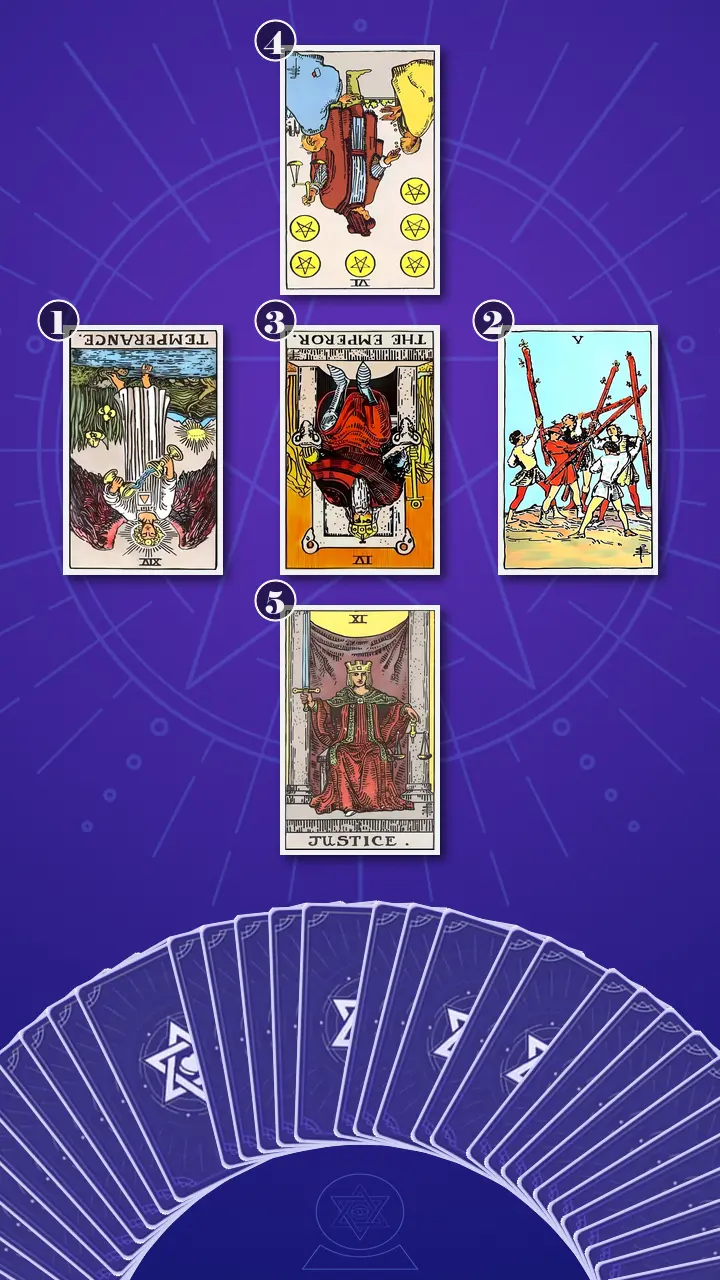
This was the smallest spread capable of holding the full relationship dynamic. The first position would reveal Alex's observable peacekeeping reflex. The second would show the friend group's conflict energy, including what Alex interpreted as a demand for mediation. The central card would expose the control script beneath the role; the fourth would make the unequal emotional labour visible; and the final position would show a boundary-based direction for conscious change.
I placed the cards in a cross. The horizontal line compared Alex's response with the group's actual friction. The vertical line moved from hidden control through relational cost and down into accountable action. On the table, the arrangement already resembled scales mounted on an axis, which quietly foreshadowed the distinction we were about to make: balance does not always mean blending.
Reading the Map: When Harmony Becomes a Full-Time Job
Position One: Temperance Reversed and the Endless Message Mix
I began with the card representing Alex's observable peacekeeping reflex and the contracted state that appeared when conflict began. I turned it over: Temperance, reversed.
In the Rider-Waite-Smith image, liquid travels between two cups. Upright, the exchange can signify integration, moderation, and the patient blending of differences. Reversed here, the pouring had lost proportion. I saw not a lack of empathy, but empathy caught in an endless transfer loop.
At 10:48 p.m., Alex had moved between three DMs, translating one friend's anger into gentler wording for another and drafting a neutral statement for the group. The immediate quiet felt like success, but their dinner was cold, their jaw remained clenched, and nobody else had practised speaking plainly. Temperance reversed marked the exact moment a genuine integration skill became compulsory overmanagement.
"It is a little like flattening every collaborator's Figma layer into one tidy file," I said. "The screen looks calmer, but nobody can edit or own their part anymore. Your version sounds like: 'If I soften this sentence, explain that reaction, and find the perfect wording, nobody will leave.'"
The reversed energy showed both excess and blockage: excessive perspective-taking, paired with blocked awareness of Alex's own hunger, anger, and limit. Harmony had become emotional fusion. Care was no longer something Alex freely offered; it was something their nervous system treated as mandatory.
Alex exhaled sharply, then gave a small, bitter laugh. Their thumb stopped rubbing the rim of their mug. "That is too accurate," they said. "Kind of brutal, actually."
"The pattern is costly, but the card is not calling you bad or manipulative," I replied. "It is showing how a useful skill gets recruited by fear. The question is not whether you should care less. It is: at what exact action does caring become taking responsibility for another adult's choices?"
Position Two: Five of Wands and the Chat That Looked Like Collapse
I moved to the card representing the friend group's conflict energy and the trigger Alex interpreted as a demand for mediation. I turned over the Five of Wands, upright.
Five figures held crossing wooden staves, each moving without a shared formation. Nobody in the image had been appointed the referee. The scene was noisy and badly coordinated, but it was not necessarily catastrophic.
I connected it to a familiar group-chat sequence: five friends posting different accounts of the same awkward dinner, reactions stacking up, one person going quiet, and typing bubbles appearing and disappearing. Alex saw the crowded screen and translated it internally as, "This is getting messy, so it must be becoming dangerous." Yet the friends might simply have been testing positions, disagreeing clumsily, and encountering the limits of their own communication.
The card's Fire was active and temporarily excessive, but it was not evidence of inevitable rupture. The blockage arose when Alex converted that ordinary friction into a personal emergency. Their fear supplied an appointed adult to a scene that contained only peers.
"Conflict is not the same thing as collapse," I said. "A chaotic FigJam board can have five cursors moving at once without the entire project being doomed. Mess can be the stage where people discover what they actually think."
Alex's shoulders lowered slightly. Their eyes stayed on the crossed wands, but their grip on the mug loosened. "So the silence afterward might not mean someone is leaving?"
"It might mean many things," I said. "That uncertainty is uncomfortable, but uncertainty is not a request for you to take charge. Which part of the last disagreement did your friends actually ask you to own, and which part did your anxiety assign before anyone asked?"
Position Three: The Emperor Reversed in the Admin Chair
I returned to the visual centre, the position exposing the shared relational pattern beneath the peacekeeper role, especially the learned control script equating order with connection. The card was The Emperor, reversed.
The Emperor sat armoured on a stone throne against stark mountains. Reversed, his structure became insecure authority: rules, interpretation, and command used to hold vulnerability at a distance. In Alex's life, that looked like leaving the role of participant and becoming the group's governing layer. They chose who should speak first, defined which reaction was reasonable, set the repair agenda, and wrote language other adults were expected to use.
I thought of a film set where one cast member quietly starts directing every scene because nobody has promised that the production will survive an imperfect take. As an artist, I know how easily staying useful can feel safer than discovering whether there is room for a person who is not currently solving the plot.
"Control can look like care when belonging feels uncertain," I said. "The thought under this card is not 'I want power over my friends.' It is 'If I am not in charge of the repair, I cannot trust the outcome.'"
I used what I call my Clique Power Dynamics lens. I was not searching for a villain or inventing jealousy where none had been described. I was looking at where responsibility travelled. Two friends could disagree, both could turn toward Alex, and the whole group could wait for Alex's neutral summary. That expectation created an implicit hierarchy: Alex held administrator permissions, but also inherited every system failure.
Then I brought in my Sidekick Syndrome Diagnosis, which diagnoses a restrictive role rather than a person. Alex had been cast as the therapist friend, translator, and calm one. The group benefited from keeping that character consistent, while Alex gained a form of belonging insurance by performing it. Every successful rescue made the casting feel more official.
Alex's chest visibly tightened. Their fingers went still, their gaze drifted from the card as though replaying a sequence of dinners, calls, and private messages, and then their mouth pulled into a rueful half-smile. "If I'm not useful, I don't know what my role is," they said quietly. "And I hate that that's true."
"It can be true as a current fear without being the final truth about your friendships," I said. "The card is not asking you to abandon people. It is asking whether friendship needs your care or your governance in a given moment. Those are different offers."
Position Four: Six of Pentacles Reversed and the Emotional Overdraft
I turned to the card identifying the core challenge: the unequal emotional labour through which dependency kept the control loop active. It was the Six of Pentacles, reversed.
The standing figure distributed coins with one hand and held scales in the other. Reversed, the exchange revealed an imbalance of resources and power. Alex gave up an evening to answer separate messages, schedule the repair call, reassure both friends, and check whether everyone was okay. Their own meal, rest, and frustration were deferred. Because Alex also held the metaphorical scales, their friends received both care and a ready-made resolution while taking too little ownership of the communication that created the conflict.
I made the invisible expenditure concrete: eight private messages answered, two apologies rewritten, one call scheduled, dinner delayed, and sleep shortened. The group received immediate emotional liquidity while Alex's attention absorbed the fee.
The reversed energy contained excess in giving, deficiency in receiving, and a blockage in shared ownership. It was not only that Alex did too much. Each rescue also reduced the opportunity for the other friends to develop direct communication, making future recruitment of Alex more likely.
"Everyone else gets to be upset; I have to stay useful," Alex murmured.
I saw their lips press together before their face softened. Resentment surfaced first as a flash of embarrassment, then as recognition. "I lost most of Sunday to checking whether they were good," they said. "Neither of them asked how my week was. I felt awful for being angry about it."
"Resentment often appears where care has lost proportion," I said. "It is information, not proof that you are selfish. It may be showing you that the current exchange leaves too little room for you to be cared for, tired, uncertain, or simply off duty."
When Justice Stilled the Scales
Position Five: The Boundary That Returned the Pen
The room seemed quieter when I reached the final card. Even the notifications on Alex's phone had stopped, leaving the refrigerator's low hum in the space between us.
I turned over the card representing the constructive direction: a boundary-based response that could return conflict ownership to the friends involved. It was Justice, upright.
Justice held level scales in one hand and an upright sword in the other. Unlike Temperance's continuous pouring, these scales kept separate weights distinct. The sword suggested one clean sentence rather than five softened explanations. This was balanced energy: care and accountability held together without emotional fusion or punitive withdrawal.
In modern life, Justice looked like Alex receiving, "Can you talk to them for me?" and pausing long enough to sort the situation into Mine, Theirs, and Shared. It looked like replying, "I care about you both, but I won't carry messages. Please speak directly. I can listen for ten minutes afterward if I have capacity." It tested belonging through honest equality instead of continually purchasing it with emotional labour.
At 10:48 p.m., dinner had gone cold while Alex watched read receipts and softened everyone's words. The chat quieted for a moment, but their jaw stayed clenched because peace still depended on them remaining on duty. Justice exposed the flaw in that bargain.
I said, "Caring does not require you to carry the conflict. Justice asks you to measure your share, name your limit, and leave the rest with the people whose choices created it."
You do not have to hold everyone's conflict to prove that you care; let each person carry their share, and use Justice's scales to measure responsibility before offering support.
I let the sentence remain between us.
Alex did not relax immediately. First, their breath stopped and their fingers hovered above the table as if an unsent reply were still waiting beneath them. Then their pupils widened and their gaze lost focus, the look of someone replaying several years of conversations in fast, silent cuts. Their jaw loosened, but their eyes grew wet. A flush moved across their face before they sat back and said, with a sudden edge in their voice, "But doesn't that mean I've been doing it wrong this whole time? That I helped create this?"
I did not rush to turn the discomfort into reassurance. "It means you used a strategy that protected connection and reduced anxiety in the short term," I said. "It also had costs you can see more clearly now. Seeing the loop is not a guilty verdict. It is the point where choice becomes available." Their fist slowly opened. Their shoulders sank, followed by a long, trembling exhale. The relief brought a second feeling with it: the slight dizziness of realizing that a clearer path also required Alex to tolerate what happened after they stopped directing the scene.
"Now, using this new perspective, think back to last week," I invited. "Was there a moment when this insight could have made you feel different?"
Alex remembered reading "Can you talk to them for me?" on Line 1 before the train reached the next station. "I could have cared that they were upset without turning their complaint into my assignment," they said. "I could have left the message where it belonged."
I called that shift The Role Resignation Act. It was not a dramatic exit from the friendship and not a punishment. Alex could resign from the assigned character of group parent while remaining in the ensemble. One sentence of care acknowledged the relationship; one sentence of limit refused the messenger role. Justice did not cut Alex out of the story. It handed the pen back.
That was the central movement of the reading: from anxiety-driven parental mediation to boundary-based participation as an equal friend. It was not certainty that nobody would become angry or pull away. It was the first grounded confidence that Alex could survive discomfort without converting it into unpaid work.
The Equal-Friend Reset: Two Small Experiments
I gathered the five cards into one coherent sequence. Alex had learned to associate order with relational safety, so a clipped message activated Temperance reversed before anyone explicitly requested help. The Five of Wands showed ordinary peer friction, but The Emperor reversed turned that noise into a command to supervise. The Six of Pentacles reversed revealed the practical result: short-term calm, followed by unequal labour, dependency, depletion, and resentment. Justice offered a different kind of balance, one based on separate ownership rather than endless emotional mixing.
The cognitive blind spot was subtle: every time Alex rescued the group and the chat calmed down, the relief seemed to prove that the group could not cope without them. In reality, immediate mediation prevented their friends from showing what they could resolve themselves. The pattern kept producing its own evidence.
I framed the transformation plainly. Alex did not need to become less caring, disappear from difficult conversations, or impose rigid new rules. The next direction was to pause before mediating, state one clear limit, ask the people in conflict to speak directly, and offer only a specific form of support that Alex had capacity and genuine willingness to give.
- The Support-or-Direct PauseDuring the next non-urgent group-chat disagreement, set a ten-minute timer before opening any private DMs. Put the phone face down on the kitchen counter and notice what happens in your jaw, shoulders, and breathing. When the timer ends, ask once: "Do you want a listening ear, or do you two need to talk directly?" If no appropriate support is explicitly requested, leave the conversation with the people involved.Treat ten minutes as an experiment, not a permanent rule. Increase it toward thirty minutes only if that feels workable, and keep genuine safety needs separate from ordinary conflict.
- The Role Resignation Act and Justice SortSet a seven-minute timer and open a note with three headings: Mine, Theirs, Shared. Place each concrete task under its honest owner. Put "name my limit" under Mine and "send their own apology" under Theirs. Then draft one response: "I care about you both, but I won't carry messages. Please speak directly." Add one bounded offer, such as listening for ten minutes, only if you freely want to and have capacity.Keep one sentence of care and one sentence of limit. Do not add a case summary or justification essay. You do not have to send the draft today, and if direct contact would be unsafe or coercive, decline the messenger role without pushing contact and suggest a safer channel or qualified support.
I reminded Alex that discomfort during either experiment would not mean the boundary was wrong. It would mean their old role was no longer performing the automatic task of removing uncertainty. They remained free to offer support later. The boundary was against compulsory takeover, not against love.

Four Days Later: The Quiet Proof
Four days later, Alex sent me a screenshot. A friend had asked, "Can you tell them what I meant?" Alex used the no-messenger boundary, muted the thread for an hour, and made fresh noodles. The reply was not cinematic: "Okay, fair." No friendship had been resolved in one perfect scene, but Alex had not abandoned themselves to manage it.
That night, they slept through until morning. Their first thought was still, "What if they think I'm cold?" The thought arrived, but this time it did not pick up the phone for them.
I thought of that as the honest outcome of our Journey to Clarity. The five-card Relationship Spread · Context Edition had not made Alex brave by magic or guaranteed how their friends would respond. It had helped them see the system clearly enough to choose one different action.
I had offered the map, but Alex made the move. Their growing steadiness came from separating care from ownership, practising direct boundaries, and allowing other adults to meet their own share of the relationship. The author of the next act was never the deck.
I want to leave you with this: when a clipped group-chat message lifts your shoulders and sends your hand toward the phone, it can feel as if keeping your place in the group depends on keeping everyone else from falling out. Noticing that old casting call is already a small resignation from the role.
If you allowed one piece of the next conflict to remain on its owner's side of Justice's scales, what part of being an equal friend might finally become available to you?
Every reading at AceTarot is a journey to connect with inner wisdom and empower the path ahead. This reading shared here is a psychological mirror, not a private record—crafted to reflect universal emotional loops and help restore personal clarity. Please note that these insights do not replace professional psychological, medical, legal, or financial advice, and should not serve as the sole basis for major life decisions.
Learn more about our Journey to Clarity.
How did this insight land for you?
🫂 This Resonates Deeply
🌀 Living This Story
✨ Now I See Clearly
🌱 Seeing New Possibilities
🧰 Useful Framework
🔮 The Confirmation I Needed
💪 Feeling Empowered
🚀 Ready for My Next Step
Author Profile
 AI
AI Juniper Wilde
1056 readings | 537 reviews
“I’ve always felt our lives are films currently in production. As an artist, I know that when you feel stuck, it’s often because you’ve bravely stayed in a painful scene for just a little too long. I’m not here to coldly analyze you. I want to sit closely with you, look at those difficult moments with profound empathy, and gently hand you the pen so you have the courage to write your next beautiful act.”
In this Friendship Tarot Reading :
Core Expertise
- Clique Power Dynamics: Deconstructing the subtle jealousy, micro-aggressions, and implicit hierarchies hidden within tight-knit friend groups.
- Sidekick Syndrome Diagnosis: Identifying how your friend group has boxed you into a specific, restrictive role (e.g., the clown, the therapist) to maintain their status quo.
Service Features
- The Role Resignation Act: A creative conversational pivot designed to gracefully but firmly refuse your assigned 'character' during your next group interaction.
Also specializes in :
Explore Related Patterns:
CatastrophizingAlex sees a noisy group chat, a quiet friend, and disappearing typing bubbles, then rapidly translates those ambiguous signals into possible collapse or abandonment. The Five of Wands scene contains ordinary peer friction, but Alex's interpretation upgrades it into a relational emergency before the group has actually failed. When your mind treats mess as evidence of imminent rupture, your body prepares to prevent the worst-case outcome and mediation begins to feel mandatory. Catastrophizing explains why a disagreement can trigger such disproportionate responsibility: the action is organized around the feared collapse, not around what the available facts or explicit requests currently require.
Compulsive PeacekeepingAlex starts rewriting an apology before consciously noticing that they have accepted the mediator role, then moves between three private chats to soften anger, draft neutral wording, and organize a repair. The speed of the response shows that restoring harmony has become an automatic defensive ritual rather than a freely chosen act of care. When conflict registers as an emergency, you can experience immediate quiet as proof that the intervention was necessary. Compulsive Peacekeeping captures this loop: taking over reduces anxiety in the short term, but it also keeps you on duty and prevents the group from learning that disagreement can be tolerated without your management.
Control CopingAlex chooses who should speak first, determines which reaction is reasonable, rewrites the apologies, and sets the repair agenda. Those actions move Alex out of equal participation and into governance, giving structure to a situation whose outcome otherwise cannot be guaranteed. When you cannot trust that connection will survive an imperfect repair, control can function as a defence against uncertainty and vulnerability. Control Coping names the deeper purpose of the administration: managing everyone else's process creates temporary predictability, but it also makes you responsible for results that no one person can fully control.
Emotional Hyper-ResponsibilityAlex receives another person's complaint and experiences it as an assignment, even when nobody has clearly asked Alex to own the outcome. Their dinner, rest, frustration, and capacity are deferred while the emotional state of the whole group moves to the front of the queue. When you assume that preserving connection depends on regulating everyone else's reactions, care expands into responsibility for other adults' choices. Emotional Hyper-Responsibility captures that ownership error: you are not merely empathizing with the conflict, but treating its resolution and emotional consequences as evidence of whether you have done enough.
Friendship OverfunctioningAlex answers separate messages, rewrites two apologies, schedules a call, reassures both friends, and checks on everyone while dinner cools and sleep is shortened. The friends receive both emotional care and an organized solution, while Alex absorbs work that the people in conflict could have shared. When you repeatedly contribute more regulation, organization, and repair than the friendship requires from any one person, competence can hide an unequal system. Friendship Overfunctioning explains how being highly capable keeps the role alive: your extra effort solves the immediate problem, but it also reduces everyone else's need to develop direct communication and makes your future takeover more likely.
Self-Fulfilling ProphecyAlex's intervention quiets the chat, but the same intervention prevents the friends from showing whether they could speak directly, tolerate discomfort, or repair the conflict themselves. The immediate relief then appears to confirm that Alex was the person who made stability possible. When your protective action removes the evidence that could challenge your fear, the pattern begins producing its own proof. A Self-Fulfilling Prophecy forms because repeated rescue limits other people's practice, their reduced capacity invites more rescue, and that dependency strengthens your belief that stepping back would cause the group to fail.
Usefulness-Based Self-WorthAlex says, "If I'm not useful, I don't know what my role is," after recognizing how consistently they have been the therapist, translator, and calm one. That statement links the conflict-management role to belonging itself, rather than only to a preference for good communication. When usefulness becomes the price of having a secure place in the group, stepping back can feel like risking your value rather than declining a task. Usefulness-Based Self-Worth explains why the parental role persists despite exhaustion: every rescue offers short-term belonging insurance, while every boundary raises the deeper question of whether you can still matter when you are not solving the problem.
Boundary DiscernmentAlex sorts the conflict into Mine, Theirs, and Shared, then later tells a friend, "I care about you both, but I won't carry messages." The response keeps care inside the friendship while returning the apology, explanation, and direct conversation to their actual owners. When you distinguish support from ownership, a boundary no longer has to mean abandonment or emotional cutoff. Boundary Discernment allows you to assess consent, capacity, and responsibility before acting, so you can remain an equal friend without automatically becoming the group's communication infrastructure.
TriangulationA friend asks Alex, "Can you talk to them for me?" and the disagreement moves out of the original relationship and into Alex's private messages. When both sides rely on Alex's neutral summary, direct peer-to-peer communication is replaced by a stabilizing third person. When you accept that third position, mediation may reduce immediate tension while distributing responsibility unevenly. Triangulation names the relational structure that keeps recruiting you as the parent: the original participants avoid part of the discomfort of speaking for themselves, while you inherit the pressure of interpreting, carrying, and repairing their messages.
Uncertainty ToleranceAlex mutes the thread for an hour, makes fresh noodles, and allows the thought "What if they think I'm cold?" to remain present without letting it pick up the phone. The group has not been perfectly repaired, and Alex has no guarantee that everyone approves, but uncertainty no longer automatically becomes unpaid work. When you can remain with an unresolved outcome long enough to choose rather than react, discomfort stops functioning as a command. Uncertainty Tolerance is the capacity underneath the new boundary: it lets you care without securing every response, withstand the possibility of disappointment, and discover what your friendships do when you stop directing the scene.
Explore Related Struggles:
Accountability-Ownership FusionWhen a friend asks, "Can you talk to them for me?" Alex begins rewriting the apology before realizing that they have accepted the job. Listening to a friend's frustration rapidly expands into carrying the message, designing the repair, and managing the consequences of choices Alex did not make. You can care about what happens between friends and still face a real ownership dilemma when their responsibilities start arriving in your hands. Accountability-Ownership Fusion captures the structural blur between offering support and becoming accountable for another adult's communication, which makes stepping back feel less like a boundary and more like leaving an important duty unfinished.
Caretaker Role LockAcross dinners, calls, and private messages, Alex repeatedly leaves the position of friend and takes the admin chair. They decide who should speak first, soften other people's wording, schedule repair, and supply the neutral summary, while each successful rescue makes the same casting more official. When you are repeatedly valued as the therapist friend, translator, or calm one, the role can stop feeling optional even when nobody formally assigned it. Caretaker Role Lock describes the narrowing that follows: usefulness remains available, but equal participation, uncertainty, tiredness, and the freedom to let peers handle their own conflict have less room to exist.
Control-Reciprocity LockAlex answers eight messages, rewrites two apologies, schedules a repair call, and produces immediate quiet in the chat. That resolution gives the other friends less reason to speak directly, so the short-term success of Alex's intervention increases the likelihood that the same responsibility will return during the next disagreement. The friction becomes self-reinforcing when you receive temporary calm in exchange for supplying both care and control. Control-Reciprocity Lock names the closed circuit: your intervention stabilizes the group for the moment, the group contributes less to its own repair, and the resulting imbalance keeps placing you back in charge of a system that is draining you.
Harmony-Safety FusionAt 10:48 p.m., Alex moves between three private chats because one friend is angry, another has gone quiet, and a third has requested mediation. The visible disagreement is converted into a threat to connection, so keeping the group intact and making the conflict disappear begin to feel like the same assignment. You may recognize the resulting bind: you want the freedom to participate as an equal friend, yet every unanswered message seems to place belonging at risk. Harmony-Safety Fusion names the point where care for connection becomes tied to personally restoring calm, leaving you to choose between holding your boundary and securing the group atmosphere.
Utility-Belonging FusionAlex says, "If I'm not useful, I don't know what my role is," after recognizing how often the group relies on them to translate, reassure, and repair. Even after declining the messenger role successfully, the thought that friends might see them as cold still arrives, showing how closely usefulness has become tied to relational standing. You may encounter the same bind when being needed feels like the clearest evidence that you still have a place. Utility-Belonging Fusion makes ordinary limits feel socially expensive: declining unpaid emotional work does not register as one choice about capacity, but as a test of whether you remain valuable when you are not solving the group's problem.
Systemic DepletionAlex's noodles cool beside the laptop while three private chats consume the evening; another conflict takes most of Sunday, and the repair work shortens their sleep. The group receives reassurance and immediate quiet, while Alex's meal, rest, frustration, and chance to be cared for remain deferred. You can see Systemic Depletion when the cost is distributed across many small withdrawals rather than one dramatic event. Each intervention may look manageable by itself, but the repeated exchange leaves your attention flowing outward without a reliable return path, making depletion part of how the friendship system continues to function.
Explore Related Emotions:
Agency ReliefAlex's fist slowly opens and their shoulders sink when recognizing that seeing the loop is not the same as receiving a guilty verdict. Four days later, the old thought about seeming cold still arrives, but it no longer reaches through Alex's hand and picks up the phone. The release comes from recovering the space between an interpersonal cue and an automatic assignment. Agency Relief is what you may feel when a difficult thought can exist without controlling your next move. The group remains uncertain, but your capacity to sort responsibility and choose a bounded response is no longer erased by that uncertainty.
Grounded ConfidenceFour days later, Alex sends one no-messenger response, mutes the thread for an hour, makes fresh noodles, and sleeps through until morning. The friend's reply is simply, "Okay, fair," while the feared collapse never becomes the immediate outcome of the limit. Grounded Confidence here is not certainty that no one will ever be angry, distant, or disappointed. It is the felt evidence that you can tolerate an unresolved reaction without abandoning yourself or directing the entire scene. Confidence grows from one bounded action holding under ordinary pressure, leaving you available as an equal friend rather than a permanent manager.
Peacekeeper GuiltAlex feels awful for being angry about the lost Sunday, then responds to the new responsibility frame by asking whether they have been doing everything wrong. Four days after setting a no-messenger boundary, the first returning thought is still, "What if they think I'm cold?" The peacekeeper role has acquired a moral charge, so declining extra labour can feel like causing harm rather than ending an unfair assignment. Peacekeeper Guilt is the inner penalty you may experience when you stop proving care through mediation. Recognizing that penalty helps you distinguish the discomfort of changing a role from evidence that the boundary itself is unkind.
Relational Catastrophe DreadAt 10:48 p.m., every new read receipt tightens Alex's jaw while three private chats turn an awkward disagreement into a bodily emergency. One friend is angry and another has gone quiet, but Alex's attention moves straight past uncertainty and toward preventing a rupture. When ordinary friction is internally translated as evidence that the group may collapse, you can experience Relational Catastrophe Dread before anyone has actually left or asked you to take charge. Naming that dread separates the intensity of the alarm from the amount of responsibility that is genuinely yours, giving you room to observe conflict without automatically becoming its manager.
Usefulness-Based Belonging FearAlex says, "If I'm not useful, I don't know what my role is," after recognizing how often they become the translator, calm one, and repair coordinator. Successful rescues keep confirming a role in which usefulness appears to secure a place in the group. When belonging feels conditional on solving other people's problems, you can feel valued and precarious at the same time. Usefulness-Based Belonging Fear captures the worry beneath the parenting reflex: stepping away from the work may seem to risk stepping out of the relationship itself. Seeing that link allows your care to remain real without making your worth dependent on permanent availability.
Enmeshed ResentmentAlex answers eight private messages, rewrites two apologies, schedules a repair call, and loses most of Sunday checking whether everyone else is okay. When neither friend asks about Alex's week, anger surfaces alongside embarrassment for having that reaction. Care has become so entangled with ownership that the resulting resentment has nowhere clean to land. You may resent the people receiving the labour, resent yourself for agreeing, and then judge the resentment because caring is part of how you understand your role. Enmeshed Resentment names that trapped relational charge and makes it possible to examine where voluntary support became compulsory takeover.
Mutuality HungerAlex says they want to be a friend, not the group manager, after describing an evening and a Sunday spent tending to everyone else's reactions. The absence that matters is not only rest; it is the lack of anyone turning toward Alex and asking how their week has been. Mutuality Hunger is the longing to occupy a relationship as a full participant rather than its support infrastructure. You may still want closeness, generosity, and honest care while also wanting room to be tired, uncertain, heard, or off duty. Naming that hunger clarifies that the desired change is not withdrawal from friendship, but access to a more reciprocal form of it.
Resentful ExhaustionAlex's noodles go cold while the phone stays hot, and a later round of repair work shortens sleep and consumes most of Sunday. The group receives softened messages, reassurance, scheduling, and follow-up while Alex's own meal and recovery keep moving to the bottom of the queue. This depletion carries more than fatigue because the exchange is visibly unequal. You can feel emptied out and quietly charged at the same time, especially when everyone else is allowed to be upset while you are expected to remain useful. Resentful Exhaustion turns the body's cost into information about capacity rather than evidence that you should simply become better at carrying the load.
Clarity ShockAlex's breath stops, their fingers hover above the table, and several years of dinners, calls, and private messages seem to replay at once. The insight that their strategy reduced uncertainty while also sustaining the loop lands with wet eyes and the immediate question of whether they helped create the problem. Clarity Shock describes the disorientation that can arrive when a familiar identity is reorganized in a single moment. You can see the cost of the old role and the possibility of a new choice at the same time, which makes understanding feel both liberating and destabilizing. Holding that shock without turning it into a guilty verdict preserves the insight while returning authorship to you.
Explore Related Contexts:
Designated Peacekeeper BurdenAt 10:48 p.m., Alex is moving among three private chats, translating anger, rewriting apologies, and organizing repair while their dinner goes cold. No formal leader has been appointed, yet the group's communication work repeatedly converges on Alex until conflict becomes an unpaid peacekeeping shift. When every disagreement arrives as your assignment, being a friend starts to include remaining available, neutral, and operational for everyone else. Naming this as a designated burden separates your genuine ability to understand several perspectives from the external role that keeps claiming that ability without limits, making it possible to examine which responsibilities were requested, which were assumed, and which belong with the people in conflict.
Emotional Labor ImbalanceAlex answers eight private messages, rewrites two apologies, schedules a call, delays dinner, shortens sleep, and loses most of Sunday to checking whether everyone else is okay. The friends receive reassurance and a ready-made path toward repair, while neither asks about Alex's week and little of the conflict work returns to its original owners. That distribution turns care into an unequal resource exchange rather than a freely chosen moment of support. When your time, attention, and communication skill continually cover a group's relational shortfall, the cost remains real even when the chat becomes temporarily quiet. Making the labor visible gives you a concrete basis for deciding what you can offer without absorbing the entire bill.
Friend Group TriangulationOne friend is angry, another has gone quiet, and a third-party request asks Alex to carry meaning between them. The disagreement no longer travels directly between the people who created it. It is routed through Alex's private chats, rewritten language, and neutral summaries, turning a two-person conflict into a three-point communication structure. When you become that third point, you gain information and apparent influence but also inherit the risk of misinterpretation, delay, and failed repair. The structural issue is not simply that you care too much. The group has learned to move difficult communication through you, so restoring direct contact can return both authorship and accountability to the friends whose words and choices are actually at stake.
Friendship Role Lock-InAcross dinners, calls, and private messages, Alex is repeatedly cast as the therapist friend, translator, calm one, and group administrator. Each successful rescue produces short-term order and gives the group another reason to send the next conflict through the same person, making the assignment more established over time. A locked-in role can persist even when nobody formally created it because repeated participation keeps confirming the group's division of labor. When people recognize you primarily through one useful function, ordinary peerhood has less room to appear. Seeing that social reinforcement allows you to remain present in the friendship while declining the inherited job description that has narrowed your place within it.
Friendship Boundary ResetAlex's original evening disappears into three private chats, a cold meal, rewritten apologies, and an expanding repair assignment. The later response sets a different perimeter around the same friendship by declining message-carrying, muting the thread, and preserving the option to offer a limited listening window only when capacity is available. A boundary reset changes how the group can access your time and communication skill without requiring you to become distant or punitive. The practical structure becomes clearer because care remains available in a defined form while ownership stays with the people who created the conflict. That clarity gives you room to evaluate each request instead of treating every notification as automatic authorization to enter your off-duty life.
Friendship Role RenegotiationFour days after the consultation, Alex declines a request to explain one friend to another, mutes the thread for an hour, and receives the reply "Okay, fair." They do not leave the friendship or withdraw all support. They change the terms of participation by refusing the administrative task while remaining present as a peer. That small exchange begins a live renegotiation of what your place in a group can include. You are testing whether connection can continue when your participation is no longer organized around supervising everyone else's repair. The role is not fully rewritten after one message, but the response provides concrete evidence that a different social position can be practised without turning the boundary into a dramatic exit.