The 8:47 p.m. Streetcar and the Draft That Wouldn’t Send
If their name lighting up your phone makes your throat tighten and turns one simple boundary into a full Notes-app revision cycle, I already know I’m looking at boundary guilt, not a lack of words.
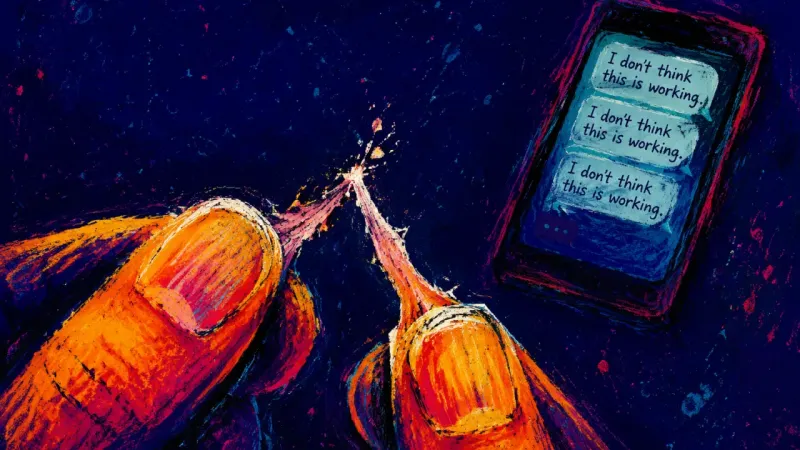
That was the energy Casey (name changed for privacy) brought into my studio in Toronto: late-20s, smart, funny, a content designer who could ship polished copy all day and still freeze over a three-line breakup draft on the ride home. Before she told me anything about the relationship, she gave me the scene. Tuesday, 8:47 p.m., westbound on the 504 King streetcar. Fluorescent lights buzzing overhead. Brakes squealing at each stop. Her phone warm in her palm while she mouthed the same three lines under her breath, changing ‘I can’t keep doing this’ to ‘I don’t think this is working,’ then locking the screen because a final version felt too final.
A few minutes later, instead of sending the honest text, she sent something soft and ordinary — a little check-in that kept the bond half-open for one more night. She looked at me and said, ‘I know what I need to do, so why am I still editing the same three lines?’ It had the exact ache of someone who has already Googled how to break up over text without being cruel at midnight and still can’t hit send.
What she was feeling wasn’t vague. It lived in her body. The second the goodbye became concrete, her throat tightened, her jaw locked, and her chest dropped as if an elevator had suddenly given way under her ribs. Her dread felt like trying to close a browser tab while her own body kept throwing up an are-you-sure-you-want-to-leave-this-page pop-up.
I told her, as gently as I could, ‘We’re not here to make you colder than you are. We’re here to see why one honest text has started feeling like a moral referendum. Let’s make a map through the fog and find the clearest next step.’

Choosing the Compass: A Shadow Spread for Breakup Clarity
I asked her to put both feet on the floor and listen to the room for a moment — the rain tapping the studio window, the radiator clicking once, the low hum from the speaker near my bookshelf. Then I shuffled. I never treat that pause like mysticism for its own sake. It’s simply a way to move from panic into attention, the way a producer asks for room tone before the real recording starts.
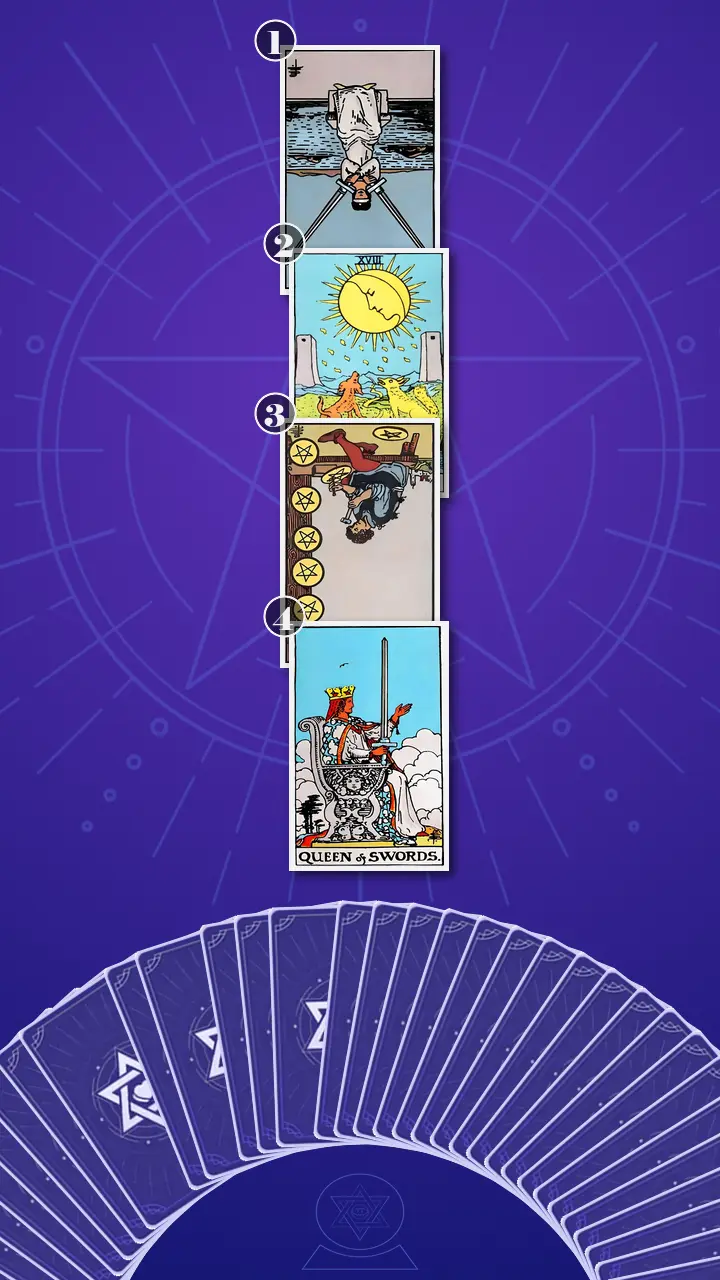
For this session, I chose The Shadow Spread, a four-card shadow reading I use when the question isn’t really ‘What are my options?’ but ‘Why can’t I do the thing I already know I need to do?’ This is why the spread works so well for breakup text paralysis: card one names the visible symptom, card two reveals the fear under it, card three shows the protective habit that keeps the loop going, and card four points to the integrated expression — the healthier voice that can finally act.
So I told her exactly what we were tracking. The first card would show the concrete stuck behavior: the repeated drafting, editing, and delaying. The second would go underneath that into the shadow fear — especially the fear of becoming the hurtful one. The third would show how that fear tries to protect itself, and the fourth would show the antidote: the clearer, more self-respecting tone that could help her send a brief, honest boundary without waiting to feel perfectly innocent.
Tarot doesn’t make the decision for someone in a case like this. What it does is expose the chain more cleanly than another night in the Notes app ever will.
Reading the Static Between Drafts and Truth
Position 1: The Loop That Calls Itself Care
Now I turned over the card for the surface symptom: Two of Swords, reversed.
It matched her real life almost too perfectly. On the ride home from a screen-heavy job, she kept toggling between Notes and the text thread, changing small words like ‘can’t’ to ‘don’t think,’ reading the message once under her breath, then locking the phone because seeing a final version felt too final. A few minutes later, the ordinary text went out instead, and the relationship stayed half-open for one more night.
Reversed, this card shows blocked air energy under pressure — not absent clarity, but clarity that has become unbearable to act on. The blindfold here isn’t confusion. It’s editing without any new information. The crossed swords over the chest read like self-bracing so intense that action gets mistaken for danger. She wasn’t actually missing the truth. She was trying to protect herself from the feeling of delivering it.
I said, ‘You didn’t turn a boundary into a wording problem because you’re dramatic; you turned it into a wording problem because wording feels safer than grief.’
She gave one short laugh, the kind with a bruise in it. Then her breath stalled, her eyes dropped to the card, and her thumb started rubbing the edge of her water glass. ‘Okay,’ she said. ‘That’s almost rude. I do exactly that.’
Position 2: The Moon and the Aftermath She Already Lived
Then I turned over the card for the shadow fear beneath the loop: The Moon, upright.
This is the late-night card. Not because something has already gone wrong, but because the nervous system has started living in imagined fallout before reality has even arrived. As soon as I saw it, I could feel the scene she’d described without needing her to repeat it: 11:36 p.m., condo window cracked open, blue phone light on her face, a siren fading somewhere below while she rehearsed hurt replies, cold silence, screenshots, anger, and the possibility of being remembered as the villain before a single text had been sent.
That is The Moon’s energy in excess. Not intuition, but projection. The winding path between the towers is the stretch between known attachment and unknown freedom. The dog and wolf are instinct and fear both making noise at once. In real life, it looks like this: nothing has happened yet, but your nervous system is already living inside the aftermath.
Years in radio taught me that midnight changes scale. When the studio goes quiet, the faintest hiss can sound enormous if I mistake it for signal. Emotional static behaves the same way. Casey wasn’t only afraid of hurting him. She was afraid that his hurt would become proof that she was careless, unkind, or secretly not who she believed herself to be.
I asked her, ‘If you sent the message tonight and he replied with hurt, anger, or cold distance, what would you instantly make that mean about you?’
Her shoulders froze first. Then her gaze went unfocused, as if memory had opened a tab behind her eyes. When she finally answered, her voice came out smaller. ‘That I handled it badly. That maybe I’m not as considerate as I think I am.’
Position 3: When the Draft Became a Deliverable
Next I turned over the card for the protective pattern — the habit that tries to save her from that fear: Eight of Pentacles, reversed.
I know this card well. It’s what I see when somebody turns a feeling into a work task. It landed exactly in the life she’d already shown me: Sunday afternoon at a café on Queen Street, oat latte gone lukewarm, breakup draft in Notes, a second version texted to herself, one trusted friend replying, ‘Honestly, this is fine,’ and still more punctuation tweaks, sentence shuffling, tone-softening, and paragraph rearranging — like a Figma file with infinite rounds of feedback.
Reversed, the Eight is misapplied earth. The effort is real, but it isn’t building the right thing. She’s productive, yes — but productively avoiding. The workbench becomes a place where she tries to earn emotional safety through labor, as if enough version history could manufacture a painless ending. It can’t. More editing only keeps the relationship lingering, the mixed signals multiplying, and the resentment quietly growing.
I told her, ‘The draft keeps growing when the real wish is innocence.’ Then I added, ‘This is why the problem feels bigger now than it did at the start. The first split became a routine. Now the routine feels responsible, but it’s still delay.’
She pressed her lips together, then let out a full-body ‘ugh’ that ended in a nod. ‘I’ve been treating this like copy,’ she said. ‘Like if I just find the right version, nobody gets hurt.’ Her spine softened an inch. That was the moment I felt the defense start to loosen.
When the Queen of Swords Spoke
Position 4: The Boundary That Didn’t Need Permission
When I turned over the final card, even the room seemed to change shape around it. The rain had eased. The speaker in the corner went so quiet I could hear the soft slide of cardstock against the table. This was the card I’d been waiting for — the integrated expression, the antidote. Queen of Swords, upright.
People sometimes ask me what the Queen of Swords means in a breakup reading. In real life, it means sent mail instead of draft folder. It means a clean unsubscribe rather than a long apology newsletter. It means choosing a send time instead of a perfect mood, writing one honest message, and refusing to add the extra paragraph designed to control how you’ll be perceived.
The energy here is balanced air. Not coldness. Not emotional shutdown. Discernment. The uncovered face answers the blindfold from the first card. The upright sword answers the crossed swords over the chest. The open hand matters too, because this Queen is not cruel — she is humane without surrendering the boundary. The ending can be sad and still be clean.
This was the moment I brought in one of the sound frameworks I use in my work, something I call Conflict Mediation. In the studio, when two frequencies are fighting, I don’t beg one of them to disappear. I lower the distortion so the real signal can come through cleanly. That’s what this Queen does. She does not erase guilt, grief, or tenderness. She cuts the static of over-explaining, forecasting, and tone-policing so the truth can finally be heard.
I leaned toward Casey and said, ‘When you’re on the streetcar mouthing the same three lines for the fifth time, it really can seem like the problem is wording. But the body tells on the deeper truth before the draft ever does. You’re not stuck because the message needs better phrasing. You’re stuck because part of you still wants honesty to come without guilt — and that deal doesn’t exist.’
Stop treating discomfort as proof the message is wrong; raise the Queen’s sword, cut away the extra cushioning, and let clear truth be the kindest thing you send.
She didn’t melt into relief right away. First her breath stopped. Then her jaw shifted, like she was holding back an argument with me or with herself. ‘But if I stop cushioning it,’ she said, sharper now, ‘doesn’t that mean I’ve been making it worse?’
I let the question sit for a beat. Outside, a car passed over wet pavement, and the sound moved along the window like a brushstroke. ‘It means you’ve been trying to keep both your kindness and your innocence,’ I said. ‘Most people do. But kindness and cushioning are not the same thing. Your job is clarity, not emotional air traffic control.’
That was when it landed. Her eyes widened first, then glossed. The muscles in her shoulders dropped so suddenly it looked unfamiliar on her body. One hand came to her mouth; the other opened over her lap. Then came the sound I wait for in readings like this — not a dramatic sob, just a shaky exhale from deep in the chest, the sound of someone setting down a weight they didn’t realize they’d been rehearsing around. There was relief in it, but also that odd dizziness that comes after putting down a heavy box: a little emptiness, a little responsibility, a little grief.
I asked her, ‘Now, with this new angle, think about last week. Was there a moment when this would have changed the feeling?’
She nodded immediately. ‘Friday. In the hallway after we hung out. I was holding groceries and I knew.’ She looked back at the Queen. ‘I thought if I couldn’t make it painless, I had to wait.’
‘That’s the shift,’ I told her. ‘Not from confusion to certainty — you already had the certainty. It’s from dread-driven tone-policing and self-doubt to shaky clarity, honest grief, and steadier self-respect. Clear is kinder than endlessly almost-leaving.’
From Insight to Action: Send Time Over Perfect Mood
Once all four cards were on the table, the story was clean. The Two of Swords reversed showed the visible loop: the breakup privately decided, the phone repeatedly reopened, the message endlessly softened. The Moon showed the shadow under it: imagined backlash treated like fact, and a deep fear that someone else’s hurt would rewrite her identity. The Eight of Pentacles reversed showed the defense: turning a boundary into a work task, mistaking more effort for more truth. And the Queen of Swords showed the correction: brief, direct, humane language that does not wait for zero guilt before it acts.
The blind spot was simple and brutal. Casey had been measuring the morality of her boundary by how little discomfort it created. But discomfort after sending a breakup text is not reliable proof that the message was cruel. Sometimes it is just the sound of reality arriving. The transformation direction was equally clear: stop editing toward innocence, and start acting from self-respect.
The Three Tools I Gave Her
- Choose the send windowI had her pick one specific slot that week — Wednesday at 7:30 p.m., after dinner — and put it in her calendar as ‘send, not edit.’ The task was not to feel calm. The task was to decide when the message would leave drafts and become real.When the mind says tomorrow will sound kinder, repeat this line: Pick a send time, not a perfect feeling.
- Write the three-sentence boundaryI told her to open a fresh note and write only three sentences: sentence one names the relationship truth, sentence two states the boundary, sentence three offers brief goodwill without reopening debate. Then stop. No fourth sentence. No apology paragraph. No committee review beyond one trusted friend, and that friend is for accountability, not co-writing.Set a 15-minute timer. If the draft still feels imperfect when it ends, that is not a sign to keep polishing — it is the stopping point.
- Do a Fact vs Forecast Check, then use my Soundproof BarrierRight before sending, I had her make a two-column note: ‘What I know’ and ‘What I’m predicting.’ Under facts, she listed the flatness, the private certainty, the delay, and the mixed signals. Under predictions, she put the feared meanings: he’ll think I’m cruel, I’ll be the villain, everyone will hear his version first. After sending, I gave her one of my own post-conflict tools, the Soundproof Barrier: mute the thread for one hour, put on one low-lyric track, and do one physical task — dishes, shower, short walk — so panic doesn’t grab the keyboard back.Keep the fact-vs-forecast note under five bullets total. If your throat closes or your jaw locks, unclench once, take three slower breaths, and return to the chosen send time rather than restarting the edit spiral.
Those were her next steps. Small. Concrete. Actionable. No grand reinvention — just one clear humane message, one fact check, and one hour of not letting guilt run post-production.

A Week Later, the Quiet Proof
Six days later, Casey messaged me. Just one line at first: ‘Sent. Three sentences. No fourth paragraph.’ A minute later she added, ‘Muted the thread, put on the playlist, cried a bit, didn’t reopen Notes.’
She told me the evening wasn’t cinematic. It was sad and ordinary. She ate takeout alone at her kitchen counter while a soft instrumental loop played in the background, and the next morning her first thought was still, what if I was too blunt? But this time she noticed the thought, smiled once, and didn’t go hunting for another edit. Clear, not perfect. Lighter, not untouched.
That is what I trust about a good Shadow Spread tarot reading for breakup paralysis, hidden fear, and people-pleasing boundary guilt: it doesn’t hand out magical wording. It gives a clean map from symptom to fear to protective pattern to integration. It helps a person stop treating dread like proof and start using discernment instead.
When I tidied my studio that night, I thought again about the small sound Casey made when the Queen of Swords finally landed — that breath from deep in the chest, half grief and half release. You are allowed to disappoint someone without cross-examining yourself into silence. Sometimes the tight throat isn’t a sign you’re doing the wrong thing; it’s what it feels like when you’re ending something honestly while still afraid that someone else’s hurt will rewrite who you are.
If you let the guilt come along without giving it the keyboard, what would your clearest three sentences sound like?

Every reading at AceTarot is a journey to connect with inner wisdom and empower the path ahead. This reading shared here is a psychological mirror, not a private record—crafted to reflect universal emotional loops and help restore personal clarity. Please note that these insights do not replace professional psychological, medical, legal, or financial advice, and should not serve as the sole basis for major life decisions.
Learn more about our Journey to Clarity.
How did this insight land for you?
🫂 This Resonates Deeply
🌀 Living This Story
✨ Now I See Clearly
🌱 Seeing New Possibilities
🧰 Useful Framework
🔮 The Confirmation I Needed
💪 Feeling Empowered
🚀 Ready for My Next Step
Author Profile
AI Alison Melody
996 readings | 597 reviews
“Through ten years of sound energy research, I’ve found that when we struggle, it's usually just our internal rhythm falling out of sync under pressure. I know firsthand the frustrating helplessness of wanting to move forward but feeling paralyzed. Without overwhelming theories, I want to be the soothing background track that helps you recalibrate, turning your heavy burdens back into a light, effortless, and harmonious melody.”
In this Family Tarot Reading :
Core Expertise
Service Features
Also specializes in :
Explore Related Patterns:
Emotional ReasoningThe second the goodbye becomes concrete, Casey's throat tightens, her jaw locks, and her chest drops as if her body is throwing up an are-you-sure pop-up. Later, the reading names the blind spot directly: she has been treating discomfort as proof that the message is wrong. Emotional Reasoning makes the body alarm feel like a verdict. You feel dread, so the mind concludes the boundary must be cruel, premature, or unsafe. In this pattern, guilt becomes the judge, not just a feeling passing through the room. The work is not to force yourself into calm; it is to stop letting intensity decide what is true.
Guilt-Driven People-PleasingCasey mouths the same three breakup lines on the 504 streetcar, then sends a soft ordinary check-in instead of the honest text, keeping the bond half-open for one more night. That move is not about lacking vocabulary; it is an attempt to reduce guilt by making the other person's discomfort less likely, even when the cost is her own clarity. Guilt-Driven People-Pleasing shows up when kindness gets fused with responsibility for another person's reaction. You can know the boundary is real and still keep cushioning it because being disliked, blamed, or seen as careless feels like a moral verdict. The pattern keeps you stuck by making no one gets hurt the entry fee for telling the truth.
Shame-Driven DelayWhen Casey is asked what a hurt or angry reply would instantly mean about her, she says it would mean she handled it badly, maybe that she is not as considerate as she thinks. Later she remembers the hallway moment when she already knew the relationship was over, but believed that if she could not make it painless, she had to wait. Shame-Driven Delay protects the self-image from indictment. You are not waiting for clarity; the clarity is already there. You are waiting for a version of the truth that cannot make you feel like the bad person. That impossible standard keeps the breakup in draft mode, because sending would make the identity risk real.
CatastrophizingAt 11:36 p.m., before a single breakup text has been sent, Casey is already rehearsing hurt replies, cold silence, screenshots, anger, and the possibility of being remembered as the villain. The feared aftermath arrives in her nervous system before it arrives in reality. Catastrophizing turns a possible reaction into a felt certainty. You are no longer responding to the actual text in front of you; you are responding to an imagined chain of consequences that has been emotionally upgraded into proof. The fear that keeps you stuck is not only that the breakup will hurt. It is that the worst possible meaning of that hurt has started to feel inevitable.
Perfectionism-Driven AvoidanceCasey can ship polished copy all day, but the three-line breakup text turns into a revision cycle: wording changes, punctuation tweaks, tone-softening, a version sent to herself, and still another pass after a trusted friend says it is fine. The emotional decision gets converted into a professionalized editing task where effort feels safer than finality. Perfectionism-Driven Avoidance is the mechanism underneath that loop. You keep polishing because the draft seems like the controllable part, while the grief, guilt, and possible backlash are not controllable. The more perfect the language has to become, the longer the boundary can stay suspended in drafts, and the avoidance can keep calling itself care.
Boundary DiscernmentThe Queen of Swords moment turns the draft spiral into a cleaner structure: choose a send window, write three sentences, do a fact-versus-forecast check, and refuse the fourth paragraph designed to manage perception. Six days later, Casey sends the message, mutes the thread, cries, and does not reopen Notes. Boundary Discernment is the corrective pattern because it separates clarity from cruelty. You can be humane without making yourself responsible for a painless ending. The boundary does not need zero guilt before it becomes valid; it needs honest language, proportionate care, and the steadiness to let the other person have their own reaction.
Explore Related Struggles:
Autonomy Guilt BindCasey mouths the boundary on the streetcar, then sends a soft ordinary check-in that keeps the bond half-open. The action she needs is simple in form, but it carries the weight of disappointing someone on purpose. When you are caught here, autonomy does not feel like clean self-respect; it feels like a moral cost you have to justify in perfect language. The wish is to leave without making anyone feel the leave-taking, so each draft becomes an attempt to make the boundary harmless. Autonomy Guilt Bind is the place where choosing yourself feels confused with harming someone else. The way out is not becoming colder; it is separating kindness from cushioning so the boundary can be clear without waiting for guilt to disappear.
Clarity-Exposure SplitCasey already knows the relationship truth before she opens Notes. She changes 'I can't keep doing this' to 'I don't think this is working,' then locks the screen because a final version would make the private knowing visible. The pressure is not confusion; it is exposure. You can have enough clarity to act and still stall at the moment that clarity leaves your body, enters the thread, and becomes something another person can react to. Clarity-Exposure Split captures why the draft stays in rehearsal. The send button is not just a communication step; it is the threshold where an internal decision becomes relational reality, with no more soft edits left to hide behind.
Identity Verdict LockCasey is not only editing a breakup text; she is rehearsing a trial before the message has been sent. At 11:36 p.m., the imagined aftermath already has witnesses: hurt replies, cold silence, screenshots, anger, and the possibility of being remembered as the villain. The stuck point forms when his possible pain becomes evidence about her character. You can know the relationship is flat, know the delay is creating mixed signals, and still freeze if one disappointed response feels capable of rewriting you as careless or unkind. Identity Verdict Lock names that collapse between impact and selfhood. The fear keeping the draft alive is not that the wording is imperfect; it is that sending it might hand someone else the power to decide what kind of person you are.
Perfect Innocence TrapAt the café, Casey has a lukewarm oat latte, a breakup draft in Notes, a second version texted to herself, and a trusted friend saying the message is fine. Even then, the work continues: punctuation tweaks, sentence shuffling, tone-softening, another pass at making the ending land without pain. The trap is that the task keeps pretending to be craft when it is asking for innocence. You may keep polishing because better wording feels like it could protect everyone, but a breakup cannot be edited into a consequence-free event. Perfect Innocence Trap names the impossible standard underneath the loop. The draft grows because part of you is trying to send a boundary that creates no hurt, no guilt, and no evidence for self-doubt, and that standard keeps action permanently one revision away.
Partial Exit LockCasey does not send the breakup text; she sends a soft check-in that keeps the relationship half-open for one more night. The breakup has already happened privately, but the thread still receives messages that make the bond look less finished than it is. That halfway position can feel safer because it postpones the moment of being the person who ends things. You are no longer fully choosing the relationship, yet you are still feeding it just enough contact to avoid the weight of a clean goodbye. Partial Exit Lock names the limbo that forms when almost-leaving becomes its own routine. The longer the half-exit continues, the more each next attempt carries the added pressure of previous delays, mixed signals, and unspoken truth.
Explore Related Emotions:
Boundary GuiltCasey mouths the same three breakup lines on the 504 King streetcar, changes the wording, then locks the screen because the final version feels too final. The body has already registered the boundary before the message does: throat tight, jaw locked, chest dropping as if the send button has become a moral checkpoint. You are seeing the specific weight of Boundary Guilt here. The problem is not that the sentence is unclear; it is that the boundary feels like it has to prove it is harmless before it is allowed to leave drafts. That is why a soft ordinary check-in goes out instead of the honest text, keeping the bond half-open for one more night. The emotional logic is clean: when kindness gets confused with cushioning, every direct sentence starts to feel like evidence against you. Boundary Guilt names that stuck place where you know what is true, but your nervous system still treats someone else's discomfort as a reason to cross-examine yourself into silence.
Finality DreadThe phrase that gives Casey away is not the wording of the breakup text; it is the moment she locks the screen because a final version feels too final. The draft is still reversible, private, and editable. Sending it would move the breakup out of rehearsal and into reality. You can feel Finality Dread in the way her whole system braces at the threshold. She is not searching for new information about the relationship; she is trying to delay the moment when the known attachment turns into unknown freedom. The unsent message becomes a tiny doorway that feels much larger than its three lines. This fear keeps her stuck because finality removes the comfort of almost-leaving. Once the text is sent, she can no longer live inside the temporary shelter of revisions, tone checks, and possible versions. Finality Dread names that suspended state where clarity exists, but making it real still feels like stepping off solid ground.
Quiet Self-RespectCasey does not leave the session with a dramatic victory pose. A week later, the proof is quieter: three sentences sent, no fourth paragraph added, the thread muted, Notes left closed. Quiet Self-Respect is the steadier emotional state that appears when she stops asking the message to erase every ounce of discomfort. It lets her be humane without surrendering the boundary, and direct without trying to become cold. The self-respect is not loud; it is visible in the refusal to keep negotiating with the draft. You can feel the change in the line 'clear, not perfect.' That is the emotional shift from seeking permission to letting truth stand. Quiet Self-Respect names the grounded inner posture that can act while still tender, still sad, and still aware that someone may not like the boundary.
Verdict DreadBefore Casey sends anything, she is already rehearsing hurt replies, cold silence, screenshots, anger, and the possibility of being remembered as the villain. The aftermath has moved into her body ahead of the event, turning a future response into present pressure. Verdict Dread is the fear that another person's pain will become a ruling on your character. For Casey, the imagined reply is not only something uncomfortable to receive; it threatens to rewrite her sense of herself as considerate and kind. That is why the text feels less like communication and more like standing trial. You can see how this traps the draft in place. If every possible reaction becomes evidence about who you are, no wording will feel safe enough. Verdict Dread names the inner weather of waiting for judgment before you have even acted, then treating that imagined judgment as a reason to keep delaying the truth.
Identity PR FatigueCasey imagines screenshots, anger, cold distance, and a version of the story where she becomes the villain. Her draft starts carrying two jobs at once: ending the relationship and managing the future narrative about what kind of person she is. Identity PR Fatigue captures the exhaustion of trying to make yourself impossible to misread. The breakup text stops being a clean statement of truth and turns into reputation management, with every softened phrase attempting to control how her character will be interpreted. That pressure is draining because no message can guarantee a generous reading from someone who is hurt. You can write with care, but you cannot fully manage the emotional press release that forms in another person's mind. This emotion names the tiredness that comes from trying anyway.
Innocence GriefAt the café on Queen Street, Casey keeps polishing the breakup draft after one trusted friend has already said it is fine. The edits are not adding truth anymore; they are trying to create a version of the ending where no one hurts and no one can accuse her of harm. Innocence Grief lives in the moment she has to release that deal. She can be humane, brief, and respectful, but she cannot make the breakup painless enough to feel morally spotless. Something has to be mourned: the wish to end things without becoming the source of anyone's disappointment. That is why the insight brings relief and a strange emptiness at the same time. You can put down the overworked draft, but you also have to put down the fantasy that perfect kindness will protect you from guilt. Innocence Grief names the sadness of accepting that clean boundaries can still leave emotional residue.
Self-Audit AnxietyCasey keeps reopening the draft, changing small words, testing tone, and asking whether less cushioning means she has made things worse. The breakup message becomes a mirror she keeps holding up to herself, looking for signs that she is still considerate enough to be allowed to act. Self-Audit Anxiety names that internal inspection loop. Instead of asking whether the relationship truth is clear, the mind starts auditing the self: Was that too blunt, too cold, too much, not enough, secretly unkind? The sentence is no longer just a sentence; it becomes a character report. You can feel the cost of that audit in the repeated delay. As long as the draft has to certify her goodness, it can never simply communicate the ending. The fear keeps her stuck by moving the focus away from what needs to be said and toward an impossible search for emotional innocence.
Bittersweet ReleaseWhen the Queen of Swords lands, Casey's shoulders drop and a shaky exhale comes from deep in her chest. The release is real, but it arrives with emptiness, responsibility, and sadness rather than a clean emotional high. Bittersweet Release names that mixed inner weather. The loop loosens, the body gets some room back, and the ending becomes possible, but the relationship still matters enough to hurt. Nothing in the story turns clarity into instant lightness. You can see the same texture a week later when she sends the three sentences, cries a bit, and does not reopen Notes. The relief is not untouched; it is earned through the act of letting the boundary become real while allowing grief to come with it.
Analysis ParalysisCasey knows what she needs to do, yet she keeps changing 'I can't keep doing this' into 'I don't think this is working' and cycling through the same three lines. The editing looks productive from the outside, but it has stopped moving her toward action. Analysis Paralysis fits because the loop is no longer about clarity. The draft has become a place where thought can keep moving while the decision stays suspended. Every punctuation tweak buys another minute away from the send button. For you, this label points to the emotional texture of being mentally active but practically frozen. The mind keeps offering refinements because refinements feel safer than consequence. Casey is stuck not because she lacks insight, but because endless analysis has become the least exposed place to hide.
Clarity ReliefOnce the four-card chain is on the table, Casey can see the pattern without needing another night in the Notes app: repeated drafting, fear of being hurtful, protective overworking, and a cleaner voice that can finally act. The fog does not vanish magically; it becomes mapped. Clarity Relief is the feeling that comes when the mind stops treating every detail as equally threatening. The static lowers enough for the real signal to come through: the issue is not better phrasing, but the wish for honesty without guilt. For you, this emotion matters because relief here comes from structure, not avoidance. Casey can still feel shaky, but she is no longer lost inside the loop. Clarity Relief names the breath of recognition that arrives when a stuck pattern becomes visible enough to move through.
Explore Related Contexts:
Boundary BacklashWhen their name lights up your phone, the body moves before the sentence does. The goodbye becomes concrete and immediately carries the anticipated shape of hurt replies, anger, cold distance, and the possibility of being written off as the cruel one. That is why the text keeps getting softened before it leaves the screen. The pressure is not just to end things, but to absorb the likely reaction in advance, so the boundary gets edited under the shadow of backlash.
Post-Breakup No-Win DecisionYou are trying to end the relationship without any version of the message feeling like an attack, a performance, or a cold exit. That is why the draft keeps changing shape: every wording seems to solve one problem by creating another. The story puts you inside a narrow decision space where honesty, kindness, and finality all pull against each other. When every option feels like it will land badly, the decision itself becomes the trap.