Texting Your Ex or Staying Away: From Longing to a Chosen Boundary

The Warm Phone Between Two Locked Doors
I recognized the search-shaped pain of post-breakup ambivalence when Jordan (name changed for privacy) told me, 'I see my ex active on Instagram at 11:26 p.m., reread the last few messages, and tell myself my no-contact rule is about control while secretly waiting for the notification that would make me feel chosen again.'
At 8:47 p.m. on a Tuesday, in Jordan's small Toronto apartment, they sat at the kitchen table after work with one thumb hovering over the old message thread. The phone was warm in their palm, the radiator clicked beside them, and the kettle hummed without being poured. They typed, 'Hope you are good,' deleted it, and opened the ex's profile instead.
'What keeps me stuck between texting my ex and staying away?' Jordan asked. They wanted intimacy and reassurance, but contact felt like surrendering power, while staying away felt like proof that the bond was fading and that they had never really been chosen.
I could see the longing in the way their hand returned to the phone before the screen had even gone dark. It seemed to sit in their chest like a phone held between two locked doors: every possible reply promised access, while every silence sounded like a door closing. Anxiety, grief, and resentment gathered underneath it.
I am Luca Moreau, and after fifteen years as a perfumer, I have learned that relationships also need enough air to breathe. I did not need to tell Jordan whether to text or stay away. I wanted to help them separate missing someone from contacting them, then find a boundary that did not depend on the ex's response. 'We can let the feeling be real without letting it run the whole decision,' I said. 'Today, we are going to draw a map through the fog.'

Choosing a Map for Post-Breakup Ambivalence
I asked Jordan to take one slow breath and name the question without trying to solve it. Then I shuffled slowly, not as a performance of hidden forces, but as a small transition from the bright noise of the day into focused attention. A spread can give a difficult question separate places to stand.
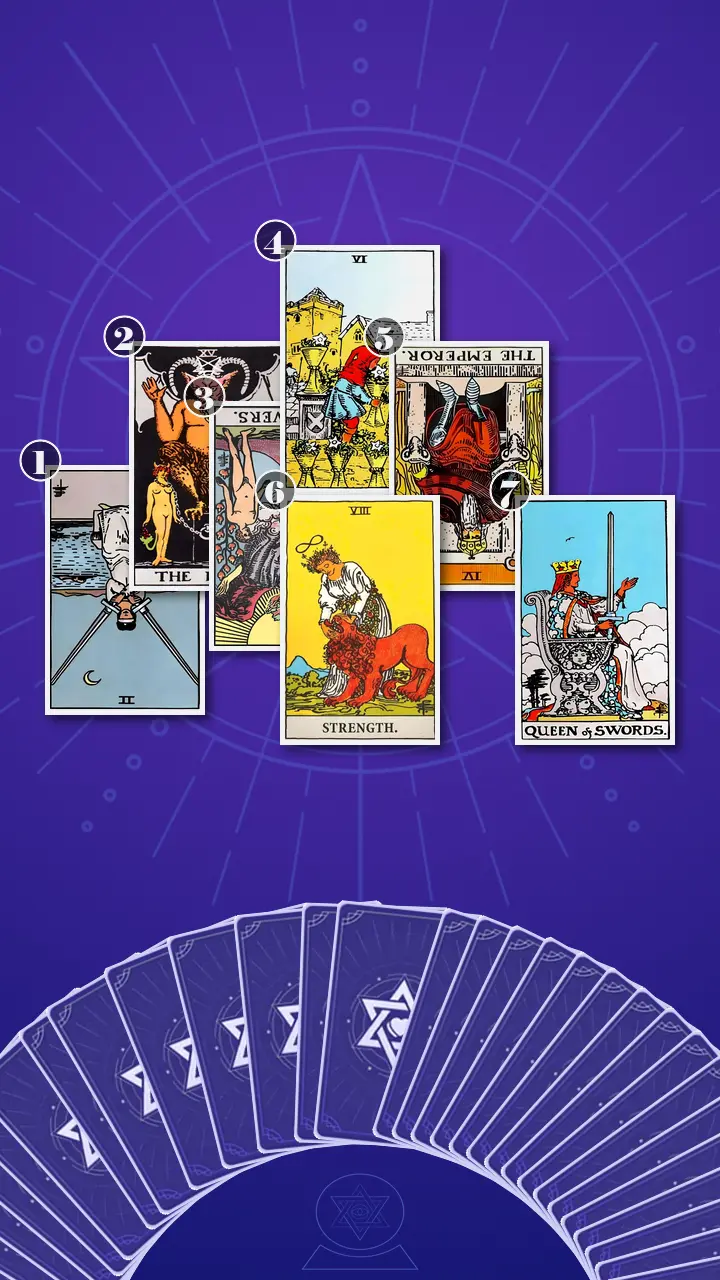
I chose the Relationship Spread: Context Edition, a custom seven-card relationship spread for texting-versus-no-contact conflict. Its purpose was not to reveal what the ex secretly thought or to predict reconciliation. It was designed to examine how intimacy, distance, power, communication, memory, and emotional reciprocity were being experienced by Jordan.
For anyone searching for how tarot works after a breakup, this distinction matters. A purely comparative decision spread could reduce the situation to the pros and cons of texting or staying silent. This spread could show why both options felt charged, what kept the attachment loop alive, and where Jordan still had choice. The first position would show the observable stuck behavior. The middle positions would examine attachment, the nature of the connection, nostalgia, and the control strategy creating distance. Strength would form the bridge, and the Queen of Swords would turn insight into a self-directed criterion.
I arranged the seven cards in a shallow bridge-shaped arc. The first card sat at the far left, the fifth at the upper right, Strength at the lower middle, and the Queen of Swords at the lower-right edge. I told Jordan, 'We are not asking the cards to take your agency. We are using them as a structured mirror so the next step can belong to you.'
Reading the Map: Card Meanings in Context
The Crossed Swords Above the Send Button
I turned over the card for the querent's current stance: reveal the observable stuck behavior of drafting, deleting, checking, and postponing a personal decision. It was the Two of Swords, in reversed position.
After work in their Toronto apartment, Jordan kept the phone face down while mentally rehearsing every possible reply. They drafted a neutral check-in, deleted it, checked the ex's online status, and repeated the sequence because not choosing felt safer than facing either a cold response or the fear that silence meant the bond was fading. The crossed swords had become two competing phone scripts held over the same tight chest.
Reversed, this was not a bad omen. It was a blockage becoming internal pressure. The attempt to remain neutral had stopped being genuine neutrality and had become a way to postpone the need, the boundary, and the fact that no message could guarantee closeness. I asked, 'When you open the thread, what decision or feeling gets postponed for the next few minutes?'
Jordan gave a small, bitter laugh instead of nodding. 'That is almost rude,' they said. 'I keep calling it thinking, but I am just editing the same three feelings.'
I welcomed the resistance. 'You do not have to agree with the card because it is dramatic,' I said. 'Let it be useful only if it describes something you can observe. The point is not that you are incapable of deciding. The point is that your phone behavior may be showing you where the real question has not yet been typed.'
The Notification Loop With Loose Chains
I turned to the card for the former bond as experienced by the querent: reveal how attachment and the ex's symbolic pull are felt without claiming access to the ex's private thoughts. The card was The Devil, in upright position.
Late at night, Jordan reread one familiar exchange, felt briefly soothed by the words, and then checked the ex's profile for a mood change or clue. The old thread offered a few seconds of relief, but the relief made the next check feel more necessary. The loose chains in the image resembled an online-status loop: technically possible to stop, emotionally reinforced every time it was repeated.
The Devil's energy here was excess attention and short-term reassurance, not fate and not evil. I asked what contact was being asked to regulate: loneliness, uncertainty, or the wish to feel chosen. Then I repeated the private logic I had heard in Jordan's careful silences: 'If I text, they have the power; if I stay silent, I keep the power.' Both positions, I pointed out, were organized around the same need to feel safe and wanted.
As a perfumer, I call this Intimacy Distance Calibration. I use the metaphor of scent diffusion to notice whether a connection is emotionally suffocating because there is no room around it, or so distant that no honest signal can reach it. Jordan had been changing the distance not according to their values, but according to the ex's imagined reaction. The room around their own identity kept disappearing.
Jordan's shoulders rose toward their ears. Their eyes stayed on the loose chains, then moved to the phone, and finally dropped to their lap. 'I think I am checking for permission to stop missing them,' they said. The admission was quiet, but it gave the attachment loop a name without making Jordan ashamed of having it.
The Divided Garden of Closeness and Power
I turned over the card for the nature of the connection now: expose the Power-Intimacy Split that turns texting into surrender and staying away into a test of strength. It was The Lovers, in reversed position.
Jordan wrote one message designed to prove they still mattered and created one silence rule designed to prove they were powerful. Neither choice expressed the kind of intimacy they actually wanted. The divided garden became two private scripts: send it to prove I still matter, or stay silent to prove I do not care.
Reversed, The Lovers showed misalignment rather than a verdict on whether the relationship should resume. Intimacy had been fused with exposure, while distance had been fused with control. That split turned every ordinary action into a test of worth. I asked, 'What value would texting serve? What value would staying away serve? And what kind of connection gets lost when closeness equals surrender or distance equals strength?'
Jordan's fingers tightened around the edge of the chair. They looked toward the rain-dark window and said, 'I do not know how to miss them without making it mean I should do something.'
'That is an important distinction,' I said. 'Longing can be information without being an instruction. The card is not asking you to choose the option that looks strongest. It is asking you to stop using either option as evidence of your worth.'
The Flower-Filled Cup of Familiarity
I turned over the card for what keeps the bond emotionally active: identify the memories, familiarity, and longing that make contact feel like a return to safety. It was the Six of Cups, in upright position.
A shared song or an old message could bring Jordan back to the gentleness of the relationship during a lonely afternoon. The flower-filled cup became an old good-morning text, a saved voice note, or a familiar Toronto cafe. The warmth was genuine. I did not ask Jordan to invalidate it, mock it, or pretend the past had meant nothing.
But the Six of Cups also made a careful distinction. Memory can hold emotional truth without supplying present-day evidence. A familiar message could tell Jordan what the relationship had once given them; it could not, by itself, establish whether contact now would be mutual, clear, or aligned with their boundaries. The energy was water moving backward through tenderness, while the present question still needed clear air.
Jordan touched the screen without opening it. Their mouth softened for a moment, then their brow tightened again. 'The memory feels safer than the current situation,' they said. 'That is probably why I keep treating it like proof.'
I nodded. 'The old thread can hold a memory without holding the authority to define today. We can honor what was warm while still checking what is factual now.'
The Armored Throne Behind the Silence
I turned over the card for what creates distance: identify the control strategy, rigid role, or power concern that makes vulnerability feel unsafe. It was The Emperor, in reversed position.
Before sending, Jordan removed every sentence that sounded vulnerable and delayed the message until it felt impossible to reject. They edited the text to sound casual, unaffected, and emotionally untouchable. Staying away then became a rigid no-contact rule, not necessarily because it reflected a chosen value, but because controlling access felt like the only way to avoid handing the ex the upper hand.
Reversed, The Emperor showed an excess of defensive control and a deficiency of flexible authority. Jordan was trying to govern the ex's impression, timing, and possible reply by governing every syllable of the draft. I used my Boundary Permeability Assessment and asked, 'Where does your identity end and the ex's response begin? Which part of this boundary describes what you will do, and which part is secretly trying to control what they do?'
Jordan looked at the carefully blank message and exhaled through their nose. 'Silence is not automatically a boundary if it is waiting for a reaction,' they said, testing the sentence as though it belonged to somebody else.
'Exactly,' I said. 'A boundary can include distance, contact, or a pause. What makes it yours is that it states your choice and limit, not a strategy for making the other person prove something.'
When Strength Held the Lion
The Gentle Hand at the Center of the Bridge
The room grew still as I reached for the visual center of the spread. The radiator clicked once and went quiet; somewhere beyond the apartment, a streetcar bell faded into the wet Toronto evening. I turned over the card for the bridge and self-directed guidance: identify the inner quality that can hold attachment without acting impulsively or using distance as a performance. It was Strength, in upright position.
Strength offered regulated courage, compassion, patience, and self-command through gentle influence rather than force. The woman's calm hand on the lion did not suppress instinct, and it did not obey instinct. In Jordan's life, it became the possibility of placing the phone across the room, allowing the feeling to remain present, and noticing what the urge needed before deciding whether contact belonged in the conversation.
My perfumer's mind returned to Intimacy Distance Calibration. A scent needs air. Too much closeness can suffocate the room; too much distance can make warmth impossible to detect. The answer is not a perfect measurement that guarantees attraction or reconciliation. It is enough space for a person to tell the difference between an honest signal and an emergency flare. I told Jordan that a ten-minute pause could create oxygen for their own judgment, not manipulate the ex into coming closer.
At 8:47 p.m. on a Tuesday, after a Toronto office day, Jordan sat at the kitchen table with the old thread open, the phone warm in their palm, the radiator clicking. They wrote 'Hey, hope you are good,' deleted it, and felt longing turn into a fight over dignity.
Jordan was still caught in the belief that a perfect message could settle the relationship, while silence could preserve control. I let the old scene sit beside the card's quiet lion. Then I said:
You do not have to prove strength by staying away or prove intimacy by texting; let the woman gently holding the lion show that you can feel the pull without obeying it, then choose the boundary that fits your values.
For a moment, Jordan did not move. Their breath paused, and their fingers remained suspended as if the send button had become physically heavy. Their gaze lost focus while the kitchen table, the warm phone, and the last unanswered thread seemed to replay behind their eyes. Then their hand lowered to their knee. The jaw that had been locked all evening loosened by degrees, and their shoulders dropped with a shaky exhale. It was not simple relief. A thin grief came with the space, along with the dizzying responsibility of realizing that no card, friend, or reply could make the decision for them. 'The urge is strong,' Jordan whispered, 'but it is not in charge.' I asked them to set a ten-minute timer, place the phone face down, and notice what the feeling was asking for. 'Now, use this new angle to revisit last week,' I said. 'Was there a moment when this insight could have made you feel differently?'
I placed a blank sheet beside the phone and suggested three lines: What I need. What boundary would protect that need. What evidence I would need before contacting them. Jordan did not have to send anything at the end of the timer, and they did not have to promise permanent distance. The exercise was a small bridge between feeling and action.
This was the first real movement from attachment-driven urgency toward self-trust. Jordan was not suddenly certain, and they were not finished grieving. They had taken one crucial step from treating texting as surrender and silence as proof of strength to holding longing without obeying it.
The Upright Blade With an Open Hand
I turned over the card for self-directed integration: define a practical clarity criterion for texting or staying away without predicting the ex's response or outsourcing the decision. It was the Queen of Swords, in upright position.
The upright sword, the Queen's direct gaze, and her open hand brought the spread's air into focus. The question was no longer, 'Which move will make me feel chosen?' It became, 'What is the purpose of contact, what boundary will I keep, and what present-day evidence do I actually have?' The Queen did not prescribe texting, and she did not sanctify no contact. She asked for honest language shaped by experience.
I asked Jordan to write one concise criterion: a message could belong in the thread only if it expressed a clear present need without asking the ex to settle Jordan's worth. If they chose not to contact, that distance could also be valid when it protected a stated value rather than performed indifference. The standard had to remain true even if the ex replied warmly, coldly, or not at all.
Jordan read the sentence aloud. Their voice wavered at the beginning, then steadied. They kept the phone where it was. 'I can miss them and still decide what contact is for,' they said.
A Boundary That Belongs to Jordan
When I gathered the cards into one story, the pattern became clear. The reversed Two of Swords showed the visible loop of drafting, deleting, and checking. The Devil explained why the loop offered brief relief and then demanded another check. The reversed Lovers showed the split that made contact equal surrender and distance equal strength. The Six of Cups explained why nostalgia felt like safety, while the reversed Emperor showed the defensive control underneath the carefully indifferent message. Strength interrupted that loop by making room for longing, and the Queen of Swords gave that room a clear language.
The deeper blind spot was not a lack of information. It was asking a relationship decision to carry the weight of belonging. Jordan had been holding the phone between two locked doors and treating the next message as a verdict about whether they mattered. The seven-card Relationship Spread showed another possibility: the phone could return to being a tool, while purpose, boundary, and present-day evidence became the actual decision-making criteria.
The spread began with blocked air and ended with clarified air. The Six of Cups supplied the water of memory and tenderness, but the spread contained no automatic earth or fire for practical grounding and forward movement. That was why I wanted the action to be deliberately small. Clarity would not arrive because Jordan discovered one perfect interpretation. It would begin when they created a little space, named the need underneath the urge, and chose a boundary that remained theirs regardless of the ex's response.
I offered these actionable next steps as experiments, not rules. The Blank Space Protocol was not a tactic to make the ex miss Jordan or to reignite attraction through strategic absence. It was a behavioral challenge to create enough emotional and physical distance for Jordan's own judgment to breathe.
- Use the Blank Space ProtocolOnce this week, when the urge to text spikes after work or after seeing the ex's Activity Status, set a ten-minute timer and place the phone across the room. In the Notes app, write three lines: What I need, What boundary would protect that need, and What evidence I would need before contacting them. When the timer ends, record whether the urge changed, stayed the same, or became more specific.Two minutes is the minimum version. The pause is for noticing, not for forcing contact or permanent no contact.
- Write a response-independent boundaryIn the Notes app, write: I will decide about contact when I can name its purpose and emotional cost. I will not use the ex's response to measure my belonging. Read it once before opening the old thread on three separate days this week, and revise it so it describes your action and limit rather than the ex's timing or tone.Keep it to two lines. If it starts sounding like a message designed to provoke a reaction, return to first-person language.
- Separate warmth from evidenceChoose one message, song, photo, voice note, or shared Toronto place that triggered the urge. Write two short headings: What this memory gives me, and What it cannot tell me about today. Under the second heading, record one present-day fact you know and one thing that remains unknown without filling the gap with social media clues.Do not argue with the memory or turn it into a case against the ex. Stop if the comparison becomes too activating and name one neutral detail in the room instead.
None of these next steps decides whether Jordan will ever contact the ex. They make the choice less likely to become a referendum on personal worth. A boundary is yours when it describes your choice, not the response you are trying to control.

A Week Later, the Quiet Proof
Four days later, Jordan messaged me: 'I used the note before opening the thread. I did not text. I still woke up thinking, What if I am wrong? But I made coffee before checking Instagram.' The question remained; it simply no longer held the phone.
That was the first small proof of the Journey to Clarity. Tarot had not chosen contact or distance, and it had not promised a particular outcome with the ex. Jordan had chosen to let longing speak without giving it the authority to decide. The change was quiet, unfinished, and real.
When the old thread makes your chest tighten, you can miss the person and still refuse to make a text prove you are chosen or make silence prove you are strong.
If you let the longing be real without letting it hold the phone, what need, boundary, or piece of present-day evidence would you want to name quietly before choosing contact or distance?