Finding Clarity in the 8:43 p.m. Group Chat
You’re 28, you live in a big city, and a simple “What are you doing tonight?” still hits your body like a mini-interrogation—classic people-pleasing meets boundary setting.
Jordan said that to me like she was testing whether I’d judge her for it. We were on a video call—me in my tiny Tokyo apartment with a star chart pinned above my desk, her in a Toronto condo living room where the light from her laptop made a pale rectangle on the wall.
She turned her phone face-up on the coffee table like it might accuse her. “I found my old ‘you’re grounded’ texts,” she told me. “And now I can’t stop… lying about my plans. Not big lies. Just… edits. Safer versions.”
As she spoke, I watched the exact body math happen: her shoulders rose a fraction, her jaw tightened, and her throat looked like it was trying to swallow a stone. The room around her seemed to conspire—HVAC humming steadily, the blue glow of the group chat pulsing as if it had a heartbeat.
“It’s Thursday night,” she said, almost narrating herself. “My friend texts: ‘What are you up to this weekend?’ I draft three replies. I hover over send. And then I pick ‘Keeping it low-key’ even though I already have plans. Because if I’m honest, it turns into a debate I didn’t consent to.”
Her apprehension wasn’t abstract. It was a tight-throat, stomach-drop kind of dread—like stepping onto an escalator you didn’t choose and realizing it’s already moving.
“You’re not flaky—you’re managing access,” I said gently. “And I get why. Tonight, let’s not moralize the lying. Let’s map the mechanism—so you can have adult freedom and closeness without your nervous system acting like you’re still grounded. Our whole journey is about finding clarity: what’s actually happening, and what your next step can be.”

Choosing the Compass: The Four-Layer Insight Ladder Tarot Spread
I asked Jordan to take one slow breath in through her nose and let it out like she was fogging up a window—nothing mystical, just a nervous-system handoff from “react” to “notice.” While she did that, I shuffled, letting the sound of the cards be a steady metronome.
“For this,” I told her, “I’m using a spread I call the Four-Layer Insight Ladder · Context Edition.”
And for you reading along: this is the kind of situation where a simple yes/no pull doesn’t help. The behavior—being vague, giving cover stories, editing the truth—usually isn’t about the plan itself. It’s an internalized authority response. A ladder spread works because it traces the arc in a psychologically coherent way: symptom → learned imprint → core fear → corrective emotional experience → rebalancing principle → actionable integration. It’s how tarot works best in real life: not as fate, but as a structured mirror that turns a messy feeling into something you can actually work with.
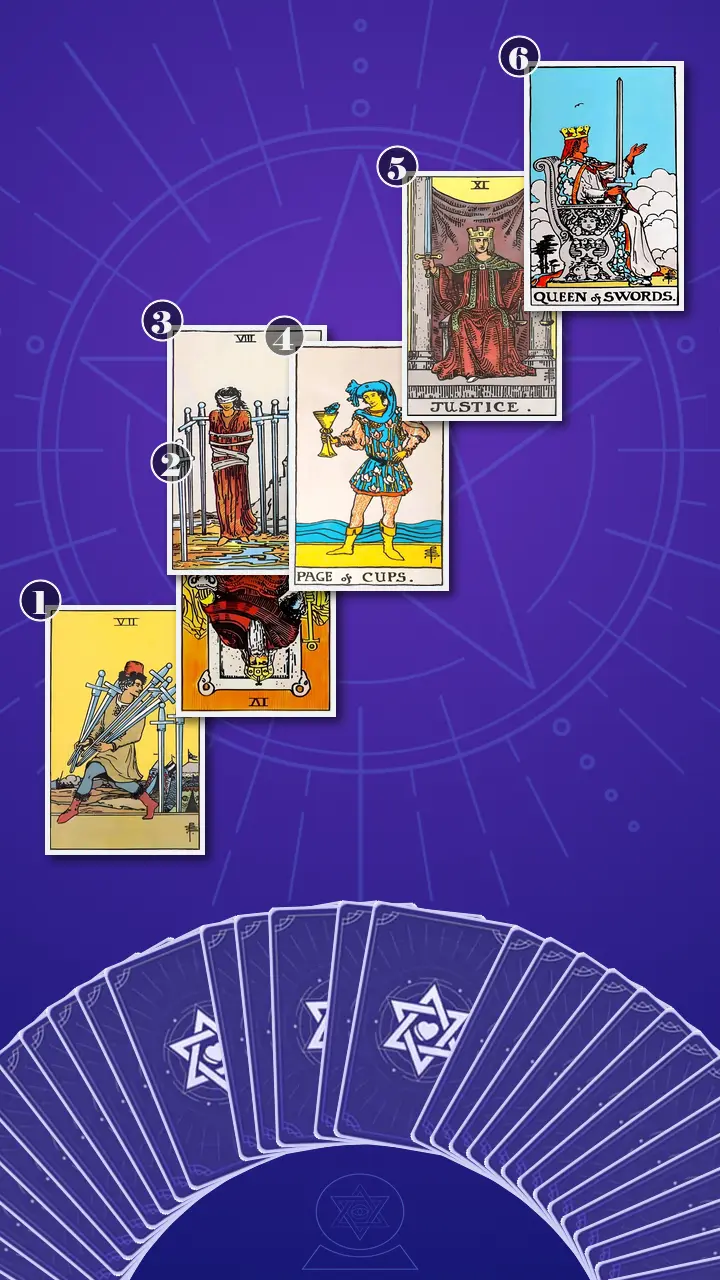
“We’ll lay six cards like steps,” I said, angling my camera down so she could see the layout. “The first card shows the pattern as it shows up in your texts and conversations. The second shows the old ‘grounded’ rulebook your body still obeys. The third is the fear under the fear. Then we look for the emotional antidote, the recalibration principle, and finally one grounded next step you can use immediately.”
Reading the Ladder: The Loop That Feels Like ‘Just Being Private’
Position 1: The current visible pattern
“Now flipped over,” I said, “is the card representing the current visible pattern: how the lying/vagueness about plans shows up in daily behavior right now.”
Seven of Swords, upright.
“This is Thursday night and you’re composing a text reply like it’s damage control,” I told her, using the most modern translation of the card. “Technically plausible, strategically vague, designed to stop follow-up questions before they start. You keep your real plan in a private lane—maybe you tell one person—and you’re already bracing to maintain the story if anyone asks again.”
In tarot terms, Seven of Swords energy is strategy. But here it’s strategy as blockage: an overactive safety system. Your mind is doing PR for your life—writing a press release for a Saturday night that shouldn’t require one.
Jordan let out a small laugh that wasn’t amused. It had that bitter edge of being recognized too accurately. “Okay,” she said, looking down at the card and then away. “That’s… actually kind of brutal.”
“It’s not a character flaw,” I said. “It’s a tactic. The question is: what reaction are you trying to prevent when you pick the vague reply over the true one?”
Position 2: The conditioning imprint
“Now flipped over,” I said, “is the card representing the conditioning imprint: what the old ‘grounded’ dynamic taught you about safety, power, and information.”
The Emperor, reversed.
“This is the iMessage search bar rabbit hole,” I said, and I watched her face tighten because she knew exactly what I meant. “You type ‘grounded.’ Old texts pop up like a jump scare. And even though you’re 28, your body reacts like your adulthood is conditional. A casual question today—‘Where are you going?’—gets processed through yesterday’s rulebook: disclosure equals permission equals potential punishment.”
The Emperor is supposed to be structure and protection. Reversed, it’s structure that feels like surveillance. Authority that doesn’t negotiate.
Jordan’s eyes went unfocused for a second, like she was seeing two timelines at once. Her shoulders lifted, then she tried to drop them on purpose—an adult move that didn’t quite convince her nervous system.
“That’s the invisible curfew talking,” I said quietly. “Not because anyone is literally grounding you now. But because your system learned: if they know the plan, they can take it away.”
For a moment I flashed to my day job: standing under a dome of projected constellations, explaining to school groups how gravity keeps bodies in orbit. The thing most people miss is that gravity isn’t just force—it’s relationship. And in families, the ‘heaviest’ person can unintentionally bend everyone else’s path.
Position 3: The core fear beneath the lie
“Now flipped over,” I said, “is the card representing the core fear beneath the lie: the internal consequence you’re trying to prevent when you withhold the truth.”
Eight of Swords, upright.
“You know you could say the real plan,” I told her. “But your nervous system treats honesty like a trap. You imagine the chain reaction—opinions, questions, bargaining, someone acting entitled to your time—so you choose a half-truth to avoid feeling cornered. The bind isn’t the plan; it’s the story that truth will cost you control.”
This card is Air energy again—thoughts, scripts, mental rehearsals—but as enclosure. Not balance. Eight of Swords is what decision fatigue looks like when it turns into self-censorship: the blindfold, the loose ties, the sense of “I can’t” when the reality is “I don’t feel safe enough to.”
Jordan swallowed. I could see the throat-tightening she’d described like it was happening in real time. “If I tell the truth,” she said, “I feel like I’m signing up for… a hearing.”
“Exactly,” I replied. “And this is the pivot point: a boundary can replace the lie. If the lie is doing the job of protecting you from interrogation, we can give that job to something cleaner.”
Position 4: A healthier emotional alternative
“Now flipped over,” I said, “is the card representing a healthier emotional alternative: what honest disclosure could feel like when it’s gentle, human, and not a courtroom.”
Page of Cups, upright.
“This is ‘beginner honesty,’” I said, and my voice softened on purpose. “One small, warm sentence that’s true—no courtroom tone, no defensiveness. You say, ‘I’m going out tonight,’ and you let it be simple. The surprise is realizing you can share a little without handing over the whole story.”
Page of Cups is Water energy entering an Air-dominated system. Not to drown it—just to make it human again. This card says you’re allowed to be sincere in a low-stakes way. Not a big confession arc. Not a TED Talk about your boundaries. Just… a sentence.
I watched Jordan’s posture change in a micro-way: her shoulders lowered a centimeter, and she exhaled like she’d been holding her breath in tiny installments all week. “That feels… doable,” she admitted. “But also weirdly scary. Like I’m being rude.”
“That sensation,” I said, “is your old rulebook trying to reassert itself. We’re not forcing honesty. We’re re-associating honesty with safety—one rep at a time.”
When Justice Spoke: Truth Without Giving Away the Keys
Position 5 (Key Card): The key recalibration
Before I turned the next card, I let the moment breathe. The call got quieter—not because the world changed, but because Jordan did. Even the HVAC hum in her condo sounded suddenly louder, like the room was waiting too.
“We’re turning over the most important step on this ladder,” I said. “This card represents the key recalibration: the principle that restores self-trust and fairness so truth doesn’t feel dangerous.”
Justice, upright.
“Instead of treating every question like a cross-examination,” I said, “you answer like an adult setting terms: truthful, brief, and fair. You decide that ‘truth’ and ‘access’ are separate knobs you control—so you can disclose what’s real without inviting anyone to debate it.”
She blinked hard and then frowned, like part of her wanted to argue with the relief. “But if I start doing that,” she said, and her voice sharpened, “doesn’t it mean I was… wrong? Like I made myself into this secretive person for no reason?”
I nodded. “That reaction makes sense. And here’s the reframe I want you to try: you weren’t wrong. You adapted. What we’re doing is updating your system.”
Setup (the moment right before the pivot)
You’re staring at the group chat, typing and deleting, trying to find the one version of your weekend that won’t trigger anyone’s opinions—like your plans are evidence and you’re about to be cross-examined.
Stop treating honesty like a trial you have to win, and start treating it like a clear statement—like Justice holding the scales steady.
Reinforcement (what it feels like in your body, and what to do next)
Jordan’s reaction came in layers, not all at once: first a brief freeze—her mouth parted, but no sound came out; then her eyes softened and unfocused, like she was replaying every “What are you doing tonight?” text she’d ever received; then the breath finally arrived, low and shaky, like her ribs were remembering how to move.
Her shoulders dropped, but not in a victorious way—more like something heavy had been set down and her muscles weren’t sure what to do without it. She pressed her lips together and then laughed once, quietly, with a little disbelief. “Honesty isn’t a courtroom,” she whispered, like she was tasting the sentence. “It’s a statement.”
“Yes,” I said. “And I want you to make it concrete.”
I continued, following the practice exactly: “Open Notes and write your two-line script: Line 1 (truth): ‘I have plans tonight.’ Line 2 (boundary): ‘I’m keeping details to myself, but thanks for checking in.’ Practice reading it once. If you feel your body spike, pause and breathe; you can stop anytime, and you can choose to use this only with people who feel safe enough for a first try.”
Then I leaned in—coach energy, but kind. “Now, with this new lens: in the last week, was there a moment—thumb hovering over Send—when this would’ve changed how you felt?”
She nodded immediately, eyes wet but steady. “Tuesday. Kitchenette. Coworker asked about the weekend. I basically blacked out and said ‘Nothing much’ like I was hiding a crime.”
“That’s the exact moment we’re working with,” I said. “This isn’t just about being ‘more honest.’ It’s a move from invisible-curfew vigilance and shame-driven vagueness to self-trusting clarity and clean, calm boundaries.”
Galactic Gravity Analysis (my signature lens)
“Can I give you an astronomy version of what just happened?” I asked, because this is where my brain naturally goes.
“Please,” Jordan said, wiping under one eye with the side of her thumb, almost annoyed at her own emotion.
“In Galactic Gravity Analysis,” I said, “I look at family dynamics like orbit models. When you were younger, the ‘authority’ in your life had a lot of mass—meaning their opinions had gravitational pull. Sharing your plan pulled you into their orbit: debate, permission, consequences. So you learned to reduce ‘signal’ to reduce pull—secrecy as thrust.”
“Justice changes the physics,” I continued. “It’s you becoming the central body of your own system. You don’t have to disappear to stay free. You set the orbit with two forces: the scales—measured disclosure—and the sword—clean scope. That’s stable. That’s adult autonomy.”
Jordan stared at the card for a long beat. “Truth and access are separate knobs,” she repeated. “I’ve… never let that be true.”
The Queen’s Script: What to Say When Plan-Questions Feel Like an Interrogation
Position 6: Grounded next step
“Now flipped over,” I said, “is the card representing the grounded next step: a practical communication and boundary move you can implement immediately.”
Queen of Swords, upright.
“Someone asks what you’re doing and you don’t improvise a cover story—you use a clean script,” I told her. “ ‘I already have plans.’ If pressed: ‘I’m not getting into details.’ No apology, no extra paragraphs, no emotional labor. You protect your autonomy through clarity, not secrecy.”
This is Air energy finally in balance: the mind changing jobs—from escape planner to boundary keeper. The Queen of Swords isn’t cruel. She’s just done negotiating her basic right to choose her evening.
Jordan made a face—half relief, half resistance. “That sounds so… blunt.”
“It will feel blunt the first few times,” I said. “Because your system is used to performing friendliness by over-explaining. But listen—you can be clear without being available for cross-examination. That’s what this Queen teaches.”
I sat back and looked at the ladder as a whole. “Here’s the story your cards just told,” I said, keeping it clean and practical.
“You started with Seven of Swords—cover stories that feel like safety. That makes sense when your imprint is Emperor reversed: questions used to come with consequences. But that old authority gravity got internalized, and now Eight of Swords shows your nervous system enforcing an invisible curfew even in situations that aren’t dangerous. Page of Cups is the first softening: one human sentence, no defense brief. And then Justice is the new rulebook: truth without surrendering control. Queen of Swords makes it repeatable.”
“Your cognitive blind spot,” I added, “is that you’ve been treating honesty and access as the same thing. Like telling the truth automatically hands someone the keys to debate, approve, or revoke. The transformation direction is simpler—and harder: shift from preemptive cover stories to concise truth plus a boundary when questioned.”
I watched her nod, slowly, like she was letting her body catch up.
“Truth + boundary beats a cover story,” I said, and I saw her mouth curve—because it sounded like something she could actually do on a Thursday night when her phone is warm from being in her hand too long.
A small, practical plan (the next 48 hours)
- Copy/Paste Your Default ReplyIn your Notes app, write one reusable line for plan-questions: “I have plans tonight, but I’m keeping it low-key.” Use it in one low-stakes text (friend, coworker, acquaintance) the next time someone asks what you’re doing.Make it short enough to remember under stress. If your throat tightens, you’re allowed to pause and reply later—timing is part of your boundary.
- Run the Two-Scale Check (Justice)Before you answer, do a 5-second mental check: Scale A = “What’s true?” Scale B = “What do I actually want to share?” Only send what passes both scales. (Example: True = “I’m going out.” Want to share = “I’m out tonight.” Not sharing = names/locations/timeline.)If you feel yourself drafting a PR statement, that’s your sign you’re about to overshare or fabricate. Go down one tier of detail.
- Use Solar Eclipse Mediation if Someone PushesIf a person presses for details, use my “Solar Eclipse Mediation” sequence: (1) State the truth again (“Yep, I have plans.”). (2) Block the glare with scope (“I’m not getting into details.”). (3) Redirect (“How’s your weekend looking?”). Repeat once if needed—broken record, no extra justification.Expect it to feel “rude” at first—that’s the Emperor-reversed imprint talking. You’re practicing self-governance, not being mean.
Jordan looked at the list on her screen and let out a breath that sounded like a decision settling into place. “I can do three lines,” she said. “I can do one sentence. I can stop writing… the extra paragraph.”

A Week Later: Ownership, Not Permission
A week later, Jordan messaged me a screenshot: a group chat bubble with her own reply circled like evidence—but the good kind.
“I have plans tonight, keeping it low-key,” she’d written.
Someone responded, “Ooo fun 👀” and that was it. No interrogation. No debate. No follow-up trial. Under the screenshot, Jordan typed: “My stomach still did the drop thing for a second. But then it passed. And I didn’t send the extra paragraph.”
That’s what progress looks like most of the time: not a personality transplant—just one clean moment where you don’t abandon yourself.
In my work at the planetarium, I tell people that navigation isn’t about eliminating darkness. It’s about learning what to trust when the sky is huge. This reading felt the same. Jordan didn’t need to hide her life to keep her autonomy. She needed a new internal rulebook—and one sentence she could actually use.
When a simple question about your plans makes your throat go tight and your stomach drop, it’s not because you’re doing something wrong—it’s because some part of you still expects honesty to cost you your freedom.
If you didn’t have to earn permission to live your own evening, what’s one small truth you’d let yourself say this week—without adding the extra paragraph?
This story is adapted from psychological research, written so that those in a similar struggle can see their own pattern in it — and find their next step clearly.These insights are not a substitute for professional psychological, medical, legal, or financial advice.
Learn more about our Journey to Clarity.
How did this insight land for you?
🫂 This Resonates Deeply
🌀 Living This Story
✨ Now I See Clearly
🌱 Seeing New Possibilities
🧰 Useful Framework
🔮 The Confirmation I Needed
💪 Feeling Empowered
🚀 Ready for My Next Step
Author Profile
 AI
AI“After a decade of guiding people through the stars, I’ve come to see life much like the orbits of planets: everything has its inevitable cycles. When you feel lost, please don't blame yourself; you might just be in a natural low tide. I’m here to sit under the night sky with you, offering a gentle cosmic perspective to distinguish temporary pain from the beautiful breakthroughs just around the corner.”
In this Family Tarot Reading :
Core Expertise
Service Features
Also specializes in :
Explore Related Patterns:
Authority HypervigilanceJordan's old "you're grounded" texts make a casual "What are you doing tonight?" land like an interrogation. Her shoulders rise, her jaw tightens, and the group chat starts to feel less like a social space and more like a place where her freedom could be questioned. The mechanism is not random dishonesty. It is a learned authority response where disclosure gets coded as permission, and permission gets coded as possible restriction. You can be an adult with your own plans while the body still scans ordinary questions for control, judgment, or consequences. Authority Hypervigilance names that scanning habit. The clarity comes from noticing that the alarm is tied to access, not to truth itself. Once you separate what is true from how much access someone gets, the question no longer requires a cover story; it becomes a boundary decision.
Strategic AvoidanceJordan drafts three replies, hovers over send, and picks "Keeping it low-key" even though she already has plans. The behavior is precise: she is not lying for thrill, advantage, or drama; she is editing the truth down to a version that feels less likely to invite questions. Strategic Avoidance shows up when the mind tries to prevent discomfort by controlling the amount of reality other people can react to. In the short term, the safer version reduces the chance of debate. In the long term, it keeps your nervous system trained to treat honesty as something that must be managed like damage control. The pattern becomes visible because the plan itself is not the real problem. The feared sequence is opinions, bargaining, pressure, and feeling cornered. When you can name that sequence, the goal shifts from inventing a smoother cover story to building a cleaner boundary before the avoidance loop starts.
Boundary DiffusionJordan's key blind spot is named directly in the story: she has been treating honesty and access as the same thing. If she tells the truth, it feels as if she has also handed over the right to debate, approve, or revoke what she is doing. Boundary Diffusion is the mechanism underneath that collapse. The self knows it wants autonomy, but the relational field still feels like other people can cross the line from asking into managing. The lie then becomes a substitute boundary, because it keeps people out without requiring the risk of saying where the line is. The cleaner move is not radical transparency and not total secrecy. It is measured disclosure. You can say what is true without giving every detail, and you can keep details private without turning privacy into a cover story.
Family Role RegressionJordan is 28, living in her own city life, but the old "grounded" texts make her body react as if her adulthood can still be taken away. Her shoulders try to drop on purpose, yet the nervous system has not fully caught up with the facts of the present. Family Role Regression describes that temporary slide back into the old relational position. The current friend or coworker is not literally grounding her, but the plan-question activates the younger role where sharing information meant entering someone else's rulebook. This pattern explains why the reaction feels disproportionate. You are not responding only to the text in front of you; you are also responding to the role your body learned inside an older power structure. Naming the regression creates a pause where the adult self can choose a boundary instead of obeying the invisible curfew.
Boundary DiscernmentJordan's two-scale check gives her a different internal order of operations. First she asks what is true, and then she asks what she actually wants to share. Those are no longer treated as one merged demand. Boundary Discernment is the healthy pattern that replaces the cover story. It lets you stay honest without becoming fully available, and it lets you protect privacy without turning the interaction into a secret operation. The nervous system gets a cleaner job than hiding. The week-later screenshot shows why this matters. She says she has plans, keeps it low-key, and does not add the extra paragraph. The body still spikes for a second, but the boundary holds long enough for the old alarm to pass.
Guilt-Driven People-PleasingJordan hears a clean boundary and immediately feels the social sting of it, as if "I have plans" might be rude. That reaction matters because it shows the lie is not only about privacy; it is also about staying acceptable, easy, and non-disruptive in other people's eyes. Guilt-Driven People-Pleasing works by making directness feel morally suspicious. You start editing yourself before anyone has objected, because the body reads friction as proof that you have done something wrong. The safer version of the truth becomes a way to stay liked while quietly abandoning your own clarity. The repair is not to stop caring about people. It is to stop making other people's potential discomfort the authority over your own evening. You can be warm and still be unavailable for cross-examination.
Assertive CommunicationJordan practices a specific line instead of trying to improvise under pressure. "I have plans tonight" becomes a direct truth, and "I am keeping details to myself" becomes the scope limit that stops the conversation from becoming a hearing. Assertive Communication is not harshness in this story. It is the mind changing jobs from escape planner to boundary keeper. You still answer the question, but you stop offering your whole evening up for review. The pattern becomes real when she uses a concise group chat reply a week later and does not send the extra paragraph. The success is not that her stomach never drops. The success is that she can feel the spike and still communicate from self-trust instead of secrecy.
Defensive OverexplainingJordan's phone turns a simple weekend question into a tiny communications campaign. She drafts, deletes, edits, and searches for the version that will not trigger opinions, as if her plans need a press release before they are allowed to exist. Defensive Overexplaining is the mind trying to reduce scrutiny by getting ahead of it. The extra context is meant to prove innocence, warmth, reasonableness, or harmlessness before anyone has accused you of anything. It feels safer than bluntness because it gives the nervous system the illusion that every possible reaction has been pre-managed. The story's correction is important because it does not ask you to become cold. It asks you to stop using explanation as emotional insurance. A short truthful sentence plus a boundary protects the relationship with less performance and protects your autonomy with less cognitive load.
Explore Related Struggles:
Boundary Ambiguity LockJordan's cover story is doing boundary work without ever saying the boundary out loud. 'Keeping it low-key' protects the details, but it also keeps the real line blurry: what she wants to share, what she wants to withhold, and what she is willing to discuss. Boundary Ambiguity Lock sits in that blur. The problem is not that she needs to tell everyone everything, and it is not that privacy requires concealment. The stuck point is the missing middle: a true sentence with a clear scope. When the reading gives her a two-line script, the ambiguity starts to loosen. You can say what is true and still decline the follow-up, which means the boundary no longer has to arrive disguised as a lie.
Inherited Vigilance LoadJordan finds the old 'you're grounded' texts and her 28-year-old body reacts before her adult life can fully enter the room. A modern Toronto group chat gets filtered through an older system where information led to consequences. Inherited Vigilance Load names the weight of that old monitoring map. The vigilance is not a present-day fact-check of danger; it is a carried-over readiness to reduce signal before someone with more power can use the signal against her. That is why the stomach drop can happen even when the later reply is benign. The story shows the load becoming visible enough to update. You are not broken for bracing; you are noticing that the body learned a rule under one set of conditions and kept applying it after the conditions changed.
Inner Tribunal LockA casual plan-question sends Jordan into three drafts, a hovering thumb, and the feeling that honesty would sign her up for a hearing. The group chat is not literally a courtroom, yet her body prepares as if a verdict is coming. Inner Tribunal Lock fits because the judge has moved inside the decision point. Before she can say what she is doing, she starts building a defense for why she is allowed to do it. The lie is not random; it is an attempt to avoid being cross-examined by a rulebook that still treats ordinary choices as evidence. The breakthrough comes when truth stops needing a defense brief. You are not trying to win a trial over your own weekend; you are practicing a statement that can be accurate, brief, and closed to debate.
Permission ParalysisJordan already has plans, but the clean answer freezes at the edge of the send button. The choice is made in real life, yet it still feels unfinished until some imagined authority has been managed. Permission Paralysis fits the moment where adult agency exists but cannot move smoothly into disclosure. The old grounding logic makes a normal question feel like a checkpoint, so she edits the answer before anyone has even challenged her right to choose. The shift is not about becoming confrontational. It is about letting the decision remain complete after it leaves your mouth. A brief truth plus a boundary gives the plan back to the person who made it.
Privacy-Consent SplitJordan tells a friend she is 'keeping it low-key' even though she already has plans, because a true answer feels like it might open the floor to questions she never agreed to take. The pressure point is not the plan itself; it is the way truth, detail, and access have been welded together. You can see the struggle in the tiny edit. A truthful sentence should be able to stand on its own, but her system treats it like handing someone the keys to debate, approve, or revoke her evening. Privacy-Consent Split names that jammed mechanism: the place where sharing what is real starts to feel the same as consenting to full access. The corrective move in the story is not total disclosure. It is the clean separation of two knobs: what is true and what is available for discussion. That distinction lets you keep closeness without turning your private life into public evidence.
Visibility-Safety SplitJordan says that if people know the plan, they can take it away, and that sentence turns visibility into a risk. Being seen with a real evening, a real choice, and real details feels less like connection and more like exposure to review. Visibility-Safety Split is the clash between wanting to exist openly and needing to stay ungrabbable. Hiding keeps freedom intact for the moment, but it also teaches connection to happen through a narrowed signal. The price of safety becomes being only partially visible. The one-week follow-up matters because she lets a small truth be seen and the world does not rush in to confiscate it. You are not proving that everyone deserves full access; you are building evidence that visibility can be measured, chosen, and still safe enough.
Strategy-Integrity SplitJordan composes a reply like damage control for a Saturday night that should not require public relations. The safer version works strategically: it lowers the chance of debate, protects the plan, and keeps the conversation smooth. Strategy-Integrity Split appears because the tactic protects autonomy while pulling her away from self-trust. The edit may prevent conflict, but it also asks her to manage a version of reality that is slightly less honest than the one she is living. Over time, that makes the strategy feel expensive. The story does not shame the tactic; it shows why it once made sense and why it now needs a cleaner replacement. You get to keep the intelligence of the strategy while moving the protective job to a boundary that does not make you abandon your own clarity.
Explore Related Emotions:
Authority ClaustrophobiaOld grounded texts pop up from the search bar, and even at 28 the body processes a present-day question through an old rulebook: disclosure equals permission, and permission can become consequence. The authority figure is no longer in the room, but the room still behaves as if someone has the right to inspect it. Authority Claustrophobia names the squeezed feeling inside that setup. You are not simply being private; you are trying to keep enough air around your adulthood so a question cannot collapse into a hearing. The emotional pressure comes from feeling watched by a rule that has outlived the situation that created it.
Boundary GuiltThe healthier sentence is almost painfully simple: 'I have plans tonight.' But Jordan's body reads that simplicity as blunt, maybe even rude, because she is used to softening her choices with explanations, edits, and extra paragraphs. Boundary Guilt fits because the clean line does not immediately feel clean inside. You can tell the truth and still feel the old pressure to add cushioning so nobody feels blocked from access. The work in the story is not becoming colder; it is letting a short answer be enough without treating someone else's curiosity as an emergency.
Cautious AutonomyA week later, Jordan sends the group chat a clean line: she has plans and is keeping it low-key. Her stomach still drops for a second, but the moment passes, nobody turns it into a trial, and she does not send the extra paragraph. Cautious Autonomy is the right name because the freedom here is not loud or effortless. You are watching autonomy return in a small, tested form: truthful enough to be real, private enough to stay yours, and steady enough to survive the body spike. The feeling is adult choice coming back online without demanding instant fearlessness.
Cautious Self-TrustThe Two-Scale Check gives Jordan a compact ritual for everyday pressure: what is true, what she actually wants to share, and what can stay private. Instead of improvising a cover story under stress, she has a structure that lets her pause before abandoning her own terms. Cautious Self-Trust fits because the trust is being rebuilt through evidence, not pep talk. You can feel the old pull to over-explain and still choose the smaller, cleaner answer. Each time the moment passes without the extra paragraph, the body gets a new data point: your clarity can hold.
Exposure DreadJordan chooses 'keeping it low-key' even though she already has plans because the true version feels too exposed. A simple answer starts to look like evidence, and evidence can be questioned, challenged, or used to pull her into a debate she did not consent to. Exposure Dread captures the body-level flinch before being seen too clearly. You are not hiding because the plan is shameful; you are bracing for what visibility might invite. The real fear is that once the truth is out, privacy will no longer belong to you.
Message DreadJordan's phone sits face-up on the coffee table like it might accuse her, and the blue group chat glow keeps pulsing while one casual plan-question turns into three drafts and a hovered thumb. The message is not just information arriving; it becomes a demand her body prepares to answer before she has chosen what she wants to share. That is why Message Dread fits here. You are watching a text thread take on the weight of a checkpoint: throat tight, stomach dropping, mind trying to write the version that will not trigger follow-up. The emotion is not about hating messages; it is the body bracing for the moment a notification can turn ordinary privacy into a test.
Permission AnxietyWhen Jordan says honesty feels like signing up for a hearing, the plan itself is not the real threat. The threat is the old equation underneath it: if someone knows the plan, they may get a say in whether it is allowed. Permission Anxiety is the inner weather that grows from that equation. You can be legally free, socially capable, and still feel your choice shrink the second it becomes visible to another person. The lie works like a decoy because it keeps the feeling of needing approval from taking over the whole evening.
Rulebook ShameAfter the recalibration lands, Jordan frowns and asks whether changing now means she made herself into a secretive person for no reason. That question matters because it shows the old rulebook turning inward: the strategy that once protected her now becomes something she judges herself for. Rulebook Shame names that painful self-audit. You are not just noticing a habit; you are looking back at all the edited replies and wondering what they say about you. The more useful reading is sharper and kinder: the cover story was an adaptation, and now the rulebook can be updated without making your younger self the villain.
Truth ReliefWhen Jordan whispers that honesty is not a courtroom, the body shift is immediate but small: breath returns, shoulders drop, and the room stops feeling quite so loaded. Nothing magical happens; a sentence simply becomes a sentence again. Truth Relief belongs to that recalibration. You are seeing what happens when honesty is separated from total access: the truth can leave the body without dragging a whole defense brief behind it. The relief comes from discovering that a clear statement can protect your integrity and your privacy at the same time.
Explore Related Contexts:
Access as Proof PressureJordan says she does not tell big lies; she makes edits, safer versions, and low-detail replies. The repeated image is not secrecy for its own sake, but a social environment where giving one true detail seems to invite more access than she agreed to give. That is why the reading keeps returning to the distinction between truth and access. The pressure point is the assumption that if you answer honestly, you must also provide names, locations, timelines, explanations, and emotional availability for anyone who wants to question the plan. For you, Access as Proof Pressure captures the way ordinary disclosure can turn into a loyalty test or availability test. The path forward is not forced transparency; it is learning that a true sentence can be complete without becoming an open door.
Authoritarian Parent DynamicJordan finds the old 'you're grounded' texts and immediately connects them to the way her body treats ordinary plan-questions today. A simple 'What are you doing tonight?' is not processed as small talk; it lands as a request for information that could once be used to limit her movement. The external structure underneath that reaction is an authority dynamic where disclosure was tied to permission, monitoring, and consequence. The story repeatedly shows that her current cover stories are not random dishonesty, but a strategy built around an old rule: if someone knows the plan, they may try to control the plan. For you, this context names the outside pressure that trained the behavior before it became automatic. The useful audit is not whether you are a bad communicator, but where your adult conversations are still being shaped by an authority model that made privacy feel like the only available route to autonomy.
Delayed Autonomy NegotiationJordan is 28, living in a big city, and making her own plans, yet an old 'you're grounded' text can still change the rules of the room. Her adult life is materially present, but the social script around permission has not fully updated. Delayed Autonomy Negotiation names that mismatch. The external pressure is not that someone is currently grounding her; it is that ordinary social questions still activate a permission-based framework where independence has to be defended before it can be enjoyed. For you, this context points to the real reason the lies persist. They are not mainly about the weekend plan; they are about trying to preserve adult freedom in situations where your system still expects autonomy to be conditional.
Family Privacy NegotiationJordan's new script is deliberately small: 'I have plans tonight,' followed by a boundary if someone presses. That shift matters because the story does not ask her to become fully transparent; it asks her to stop using falsehood as the only way to protect privacy. The family imprint in the background made plan details feel like negotiable property, as if other people could approve, challenge, or revoke them once they were spoken aloud. Family Privacy Negotiation names the adult repair of that structure: you can be truthful without granting full access. For you, this context offers a cleaner middle path between hiding and overexplaining. Privacy becomes a legitimate boundary rather than a secretive performance, and the practical work is deciding what is true, what is shareable, and what stays yours.
Direct Communication TrialJordan's practical next step is not a dramatic confession. It is one short line in a real conversation: 'I have plans tonight,' with a second line ready if someone pushes for details. Direct Communication Trial fits because the story treats clarity as something that has to be rehearsed under realistic social pressure. The old tactic was to preempt discomfort with a vague answer; the new tactic is to let a true sentence stand without adding a defense brief. For you, this context frames the next move as an experiment rather than a personality overhaul. You are testing whether a clean statement can protect your autonomy more effectively than a cover story, especially in low-stakes exchanges where the risk is manageable.