The 9:40 p.m. Group Chat and the Price of Belonging
You’re a 28-year-old hybrid project coordinator in Toronto who can keep a messy stakeholder meeting on track, yet one clipped family group-chat message can trigger peacemaker burnout before you have finished dinner.
When Maya joined our video session at 9:40 on a Tuesday night, an untouched bowl sat beside her laptop. Her condo radiator clicked against the quiet, cooling garlic lingered in the kitchen, and her phone vibrated hard enough to rattle the table. Three private iMessage threads glowed on the screen. The phone looked hot in her palm.
Her jaw tightened as another typing bubble appeared. “I know their feelings aren’t my job,” she said, “but they still end up in my inbox. Who am I in this family if I stop being the peacemaker?”
She wanted closeness without managing everyone. Yet whenever two relatives disagreed, she translated, softened, and proposed because stepping back felt like watching her place at the table disappear. The apprehension under her ribs was like a phone trapped on permanent vibrate: small, relentless, impossible to ignore.
“I’m not going to tell you whether your family will reject a boundary,” I said. “Tarot cannot honestly promise that. What I can do is help us see the role-based belonging and unpaid emotional labor already shaping your choices. Let’s give this fog a map, then put the pen back in your hand.”

Choosing the Compass: A Five-Card Shadow Spread
I invited Maya to put both feet on the floor, take one slower breath, and hold the question without trying to solve it. I shuffled while she let the latest typing bubble remain unanswered. The pause was not a mystical performance. It was a deliberate transition from reacting to observing.
“I’m using a five-card Shadow Spread,” I told her. I chose it because her question was not simply how to settle the latest family argument. She was asking who remained when an overused role stopped directing the scene. A relationship spread would have focused too heavily on competing relatives, while a Celtic Cross would have added more layers than this identity question needed.
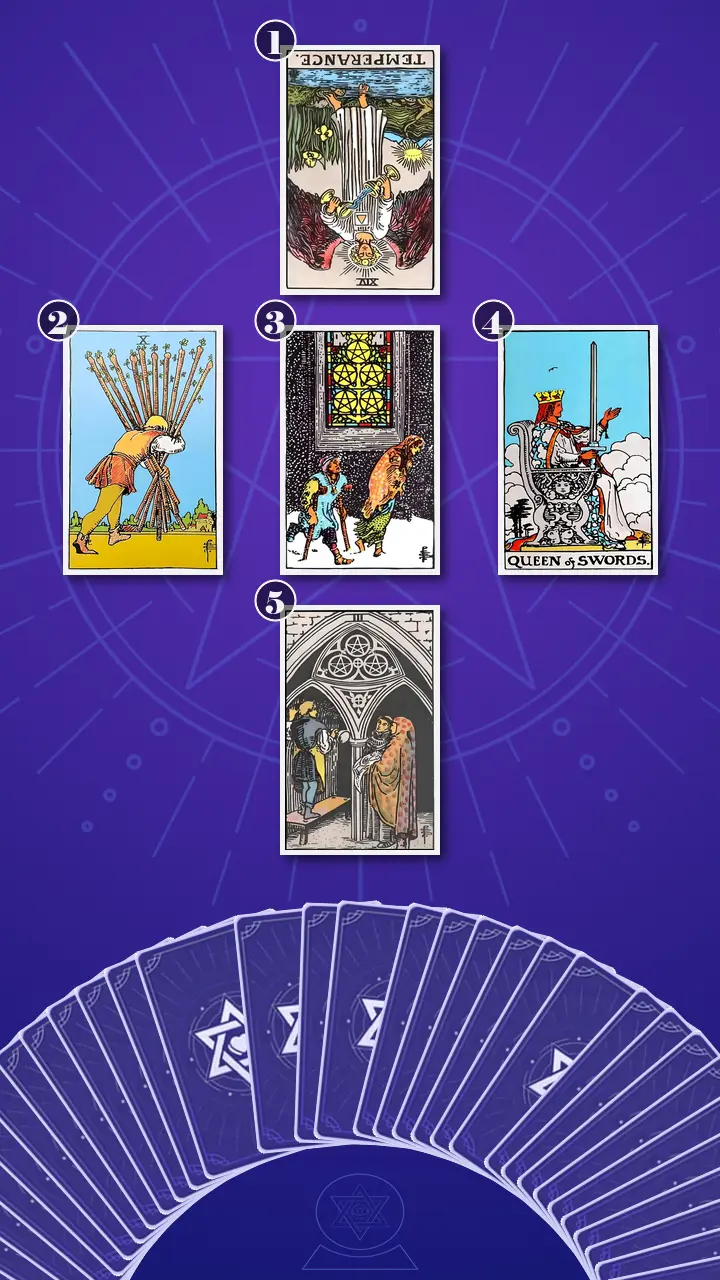
I arranged the cards like a compass being reoriented. The upper position would show the visible peacemaker persona. The left would expose the hidden labor keeping that persona alive. The center would reveal the fear beneath it. To the right, the key card would identify an integrating voice, and the lower card would turn that insight into an everyday practice.
That is how tarot works in my practice: not as a supernatural verdict, but as an external storyboard. The images slow a fast emotional loop long enough for us to examine it. Card meanings in context can separate what happened, what fear predicts, and what choice is actually available.
When Two Cups Became Three Message Threads
Position 1: The Relay That Erased Its Translator
“The card I’m turning over now represents your observable role: blending opposing family viewpoints while leaving out your own,” I said. “It is Temperance, in the reversed position.”
In the Rider-Waite-Smith image, water normally passes between two cups in a measured exchange. Reversed, that flow had become a blockage tipping into excess. At 9:40, Maya was moving between three message threads, translating one relative’s tone for another and revising each reply until nobody sounded openly angry. Her dinner cooled while she blended incompatible demands into one acceptable version.
I pointed to the cups. “The gift here is perspective-taking. The problem is not that you notice emotional nuance. The problem is that every difficult feeling is being routed through you, as if the family group chat quietly turned you into its unpaid customer-support escalation queue.”
The inner script sounded like this: If I can just phrase this correctly, then maybe nobody will get hurt, nobody will leave, and nobody will blame me. But participation requires a person with a perspective. Compulsory management requires a channel. Maya had become so skilled at being the channel that her own opinion vanished from the exchange.
Her inhale caught first. Her thumb froze above the phone, then her gaze drifted toward the three threads as if she were replaying every edit. Finally, she gave a short, bitter laugh. “That’s so accurate it’s almost cruel.”
“The accuracy isn’t an indictment,” I said. “Your sensitivity is not the flaw. We’re looking at what happened when a real strength lost its limits. You are allowed to be in the family picture without standing in the middle of it.”
Position 2: The Load Blocking the Way Home
“The next card represents the shadow behavior maintaining the role: carrying communication and emotional responsibility that belongs to several people,” I said. “This is the Ten of Wands, upright.”
The figure’s ten bundled staves blocked the road ahead. For Maya, one disagreement became three calls, six drafted messages, a softened recap, a proposed compromise, and a late cancellation text to a friend. She would tell herself, It will be faster if I handle it, even as her shoulders ached and another evening closed around a task she had never consciously accepted.
Upright, the card showed fire in excess: competence concentrated into over-responsibility. Because Maya could organize a complicated conversation, she treated the whole conversation as hers to complete. The burden then narrowed her field of vision. She could see the next person who needed calming, but not the meal, film, or personal opinion hidden behind the load.
“Think of the last disagreement that interrupted dinner, sleep, work, or plans,” I said. “Which calls, summaries, apologies, and follow-ups could the people involved have handled themselves?”
Maya rubbed the ridge where her neck met her shoulder. “Most of them,” she said. “The horrible part is that I volunteer, and then I’m furious that nobody notices what it costs.”
“That resentment is not proof that you don’t care,” I said. “It may be the part of you that knows an automatic yes is not the same as freely choosing to help. Being good at emotional labor does not make you permanently on call for it.”
Position 3: The Window Fear Had Already Locked
“The center card represents the underlying fear: that declining mediation will reduce your worth or leave you outside family closeness,” I said. “It is the Five of Pentacles, upright.”
Two figures moved through falling snow beneath an illuminated window. I watched Maya’s eyes settle on the warm glass. The card did not establish that rejection would occur. It externalized the scene her body had already rehearsed: she waits twenty minutes before answering, then imagines colder replies, fewer invitations, and relatives no longer confiding in her. Nothing has happened yet, but her stomach drops as if exclusion is already underway.
This was the central blockage. Her fear behaved like an algorithm trained on worst-case engagement: one delayed reply generated an entire feed of predicted rejection. The thought beneath it was not merely, What if they stay angry? It was, What if this one no proves I was only wanted for what I handled?
I asked, “When you imagine writing, ‘Please speak directly,’ what is the first consequence your mind predicts?”
Her fingers tightened around the mug beside her. “That they’ll stop telling me things. That I’ll find out the family works fine without me.” The words came out flat, and then her eyes glistened. The grief was not only about future exclusion. It was grief for an identity built around being needed.
“That fear deserves to be taken seriously,” I said, “but seriousness is not the same as certainty. I’m not going to promise every relative will respond well. I do want us to distinguish a credible fear from a guaranteed outcome. What has the fear edited out of the window?”
After a long pause, Maya remembered ordinary exchanges that required no fixing: a relative sending her a ridiculous video, a sibling asking about her work, an invitation built around company rather than crisis. Those moments did not erase the risk of an unpleasant reply, but they were evidence that some connection existed outside mediation.
“I’m predicting exile before anyone has responded to a specific limit,” she said.
“Exactly. Guilt can mark an unfamiliar boundary; it does not automatically prove a harmful one.”
When the Queen of Swords Raised One Clear Line
Position 4: An Open Hand Beside a Boundary
The radiator clicked off. In the sudden quiet, even the traffic below Maya’s window seemed to recede. I turned the card to the right of the Five of Pentacles.
“This position represents the integrating resource: independent judgment and a direct boundary that does not require you to withdraw care or manage everyone’s response,” I said. “The card is the Queen of Swords, upright.”
Her sword stood vertical, defining one unmistakable line. Her other hand remained open. I read that pairing as balanced air energy: discernment without punishment, receptivity without surrender. A relative could ask Maya to explain their hurt to someone else, and Maya could answer, “I care about this, but I’m not going to speak for either of you. Please contact them directly.” She could let the sentence stand without adding an apology, a psychological profile of both sides, or a backup solution.
This was where I brought in my Family Casting Analysis. I use it to separate a person from the forced role a family system repeatedly assigns. I mapped Maya’s familiar scene in four beats: the casting cue was tension; her stage direction was to translate; the immediate reward was visible usefulness; the scene left on the cutting-room floor was whatever Maya actually thought, wanted, or had planned.
I was not declaring her family irredeemable from five cards. I was identifying a repeated script. “The Peacemaker is a part you’ve become exceptionally good at playing,” I said. “It is not the full cast list of who you are. The Queen does something deliberately out of character: she speaks one truth and allows the other adults to continue their own scene.”
At 9:40, Maya was still trying to meet an impossible brief: write one response that calmed three threads, revealed none of her preferences, and guaranteed nobody would pull away. The Queen exposed that brief as reaction management rather than the only possible form of care.
You do not have to earn belonging by carrying every conversation; raise the Queen of Swords' clear blade, name your limit, and let direct relationships form around it.
I left the words in the quiet instead of explaining them away.
Maya’s breath stopped first. Her thumb stayed suspended above the Notes app, and her pupils widened before her jaw pulled tight again. “But doesn’t that mean I got my whole role wrong?” she asked, sharper than before. I did not rush to turn her anger into relief. “No. It means a strategy that helped you stay connected has become compulsory. We can respect what it protected without keeping it permanently on call.” Her eyes drifted past the screen as if replaying the previous Sunday’s request to carry a message. The rims of her eyes reddened. Her fist loosened one finger at a time, and her shoulders dropped on a long, uneven breath. For a second, she looked almost unsteady, like someone whose heavy bag has been taken while the body still braces for its weight. “Oh,” she said quietly. “Then I have to let them have reactions I can’t fix.” Relief appeared beside the exposed responsibility of having a choice.
“Now, with this new perspective, think back to last week,” I said. “Was there a moment when this insight could have made you feel different?”
She returned to the Sunday message she had been asked to forward. “I could have cared that they were hurt without accepting the delivery job,” she said. “I kept treating those as the same thing.”
I distilled the option once more: You do not have to translate everyone to remain family. One clear sentence can keep your care visible without making you the bridge.
I invited her to open a note and make three headings: “What happened,” “What I fear will happen,” and “What is actually mine.” Under the first, she wrote that two relatives had disagreed. Under the second, she wrote that they might call her selfish and stop including her. Under the third, she wrote: “My reply, my time, and whether I agree to mediate.”
Then she drafted an optional response: “I care about both of you, but I’m not going to carry messages between you. Please speak directly.” I told her she did not need to send it that night. If the exercise became too activating, she could stop after saving the three headings. A boundary can be one clear sentence, not a closing argument.
I named the crossing plainly. This was a movement from earning family belonging through constant peacemaking to belonging through honest, self-defined participation. It did not erase her guilt or settle every relationship. It gave her a distinct voice inside the uncertainty.
The Plans Everyone Could See
Position 5: A Structure With More Than One Owner
“The final card represents the everyday practice that can embody this role reset: redirecting indirect messages and participating through clear, shared responsibility,” I said. “It is the Three of Pentacles, upright.”
Three people consulted beneath a stone arch with architectural plans visible between them. Unlike the solitary figure carrying ten wands, nobody was hidden behind the whole structure. The earth energy had returned in balance: roles were named, requests were discussed in the open, and each participant remained responsible for their own contribution.
In Maya’s life, this could look like agreeing to one twenty-minute family call only if both people were present, spoke for themselves, and clarified what they wanted from her. She might listen or offer one opinion. She would not become the messenger, sole facilitator, or owner of the outcome.
“If the next request involves two relatives, what changes when both people have to be present, use their own words, and tell you exactly what they are asking from you?” I asked.
Maya looked from the shared plans to the Ten of Wands. “Then I’m in the conversation,” she said. “I’m not the entire infrastructure.”
I saw her posture settle into the chair, not dramatically, but enough that the neckline of her sweater no longer pulled tight across lifted shoulders. The new inner line was simple: I can contribute one defined part without becoming the entire structure.
“Yes,” I said. “Care can stay; the courier job can go.”
Recasting the Next Family Scene
I looked across the whole spread. Temperance reversed showed the visible role: endless emotional transfer disguised as balance. The Ten of Wands showed how repeated competence had become an unspoken contract to carry the entire task. The Five of Pentacles revealed why the load felt dangerous to put down: Maya was protecting belonging, not merely solving a communication problem. The Queen of Swords restored her own judgment, and the Three of Pentacles gave that judgment a practical structure through direct contact and visible ownership.
I did not invent a dramatic origin story the cards could not prove. The past influence was already visible in the loop Maya described: conflict arrived, she repaired it, temporary calm made her feel useful, and everyone learned to send the next conflict through her phone. Each repetition strengthened the casting.
Her cognitive blind spot was treating three different things as if they were identical: capability as assignment, guilt as a moral verdict, and temporary calm as closeness. The transformation direction was not from caring to detachment. It was from automatic translation to one direct boundary, followed by a request that the people involved speak to each other.
To make that shift usable, I introduced my Script-Flipping Rehearsal. As an artist, I know a new line can look convincing on paper and still disappear when the familiar actor enters the scene. So I played a relative and said, “Can you tell them why I’m hurt?”
Maya began, “I’m sorry, I completely understand why you’d want me to, and I don’t want you to think I don’t care, but maybe...” Then she stopped and smiled without much amusement. “There’s the four-paragraph Notes app boundary.”
“Let’s rehearse the out-of-character version,” I said. “One statement of care. One limit. One redirect. No closing argument.”
She tried again. “I care about both of you, but I’m not going to carry messages between you. Please speak directly.”
I pushed once in character: “But you’re better at explaining what I mean.”
Maya’s fingers curled, then released. “I hear that. I’m still not going to pass the message on.”
The rehearsal did not guarantee a relative would like the boundary. Its purpose was smaller and more honest: to let Maya’s body experience a different line before the next live scene asked her to improvise under pressure.
- Rehearse the One-Clear-Line Boundary.For five minutes, practise the saved script with a trusted friend or alone before the next low-stakes request to relay a message. When the request arrives, reply once, then mute the thread for ten minutes and return to the meal, commute, or plan that was interrupted.Tip: Keep it to care, limit, and redirect. If sending feels too intense, draft it and put the phone face down; rehearsal still counts.
- Make Responsibility Visible.The next time a family request is vague, ask in the same thread, “Are you asking me to listen, give my opinion, or mediate?” If you choose to participate, offer one defined option, such as a twenty-minute call with both people present and speaking for themselves.Tip: Set the time limit before joining. You may answer only the clarified request, and ending at the agreed time is not a punishment.
These were experiments, not loyalty tests. Maya could start with the safest available situation, gather evidence, and revise. The cards had supplied a storyboard; they did not own the next scene. Maya did.

A Warm Dinner and an Unfinished Answer
Three days later, I received a message from Maya. A relative had asked her to explain someone else’s silence. She used the one-clear-line script, muted the thread for ten minutes, and finished her dinner before checking the reply. The food was still warm.
The response was not magically perfect. Her relative sent a chilly “Okay” before contacting the other person directly. Maya’s guilt still rose fast enough to put her thumb over the muted chat, but she left it closed until the timer ended.
That night she slept through until morning. Her first thought was still, What if I’ve made this worse? This time, she smiled faintly, noticed it was a prediction rather than a fact, and got out of bed without reopening the conversation.
I saw that as the first honest proof of our Journey to Clarity. Maya had not solved her entire family or discovered a flawless new identity. She had participated as a person with a voice, a limit, and care that did not require self-erasure. The change came from her choice, not from the cards.
When one clipped family message makes your jaw tighten and your own plans disappear, it can feel as though keeping everyone connected is the price of staying visible. If you recognize that relay, remember this: noticing the role is already different from automatically performing it.
If care could stay while the courier job went, what one honest sentence would you let belong to you the next time the typing bubble appears?
This story is adapted from psychological research, written so that those in a similar struggle can see their own pattern in it — and find their next step clearly.These insights are not a substitute for professional psychological, medical, legal, or financial advice.
Learn more about our Journey to Clarity.
How did this insight land for you?
🫂 This Resonates Deeply
🌀 Living This Story
✨ Now I See Clearly
🌱 Seeing New Possibilities
🧰 Useful Framework
🔮 The Confirmation I Needed
💪 Feeling Empowered
🚀 Ready for My Next Step
Author Profile
 AI
AI“I’ve always felt our lives are films currently in production. As an artist, I know that when you feel stuck, it’s often because you’ve bravely stayed in a painful scene for just a little too long. I’m not here to coldly analyze you. I want to sit closely with you, look at those difficult moments with profound empathy, and gently hand you the pen so you have the courage to write your next beautiful act.”
In this Family Tarot Reading :
Core Expertise
- Family Casting Analysis: Identifying your forced role (e.g., The Scapegoat, The Golden Child, The Peacemaker) within a toxic family script.
- Narrative Enmeshment Diagnosis: Recognizing when your personal life story has been hijacked to fulfill your parents' unfulfilled plotlines.
Service Features
- The Script-Flipping Rehearsal: A role-play directive to deliberately deliver an 'out-of-character' response at the next family gathering, permanently disrupting the established power dynamic.
Also specializes in :
Explore Related Patterns:
Approval-Driven Self-SilencingMaya revises each message until nobody sounds openly angry, but the acceptable version contains none of her own preferences. Even her first boundary expands into apologies, explanations, and possible alternatives, making her care unmistakable while making her actual position harder to locate. When you edit yourself around anticipated disapproval, silence can happen inside a message that contains many words. Approval-Driven Self-Silencing describes the defense of keeping your independent view out of the relational field so that other people's comfort is less likely to endanger your inclusion.
Boundary DiscernmentMaya writes that her reply, her time, and whether she agrees to mediate belong to her, then offers one sentence that combines care with a refusal to carry messages. She also defines a limited alternative in which both relatives must be present and speak for themselves. When you distinguish caring from taking ownership, a boundary stops being a verdict on the relationship and becomes information about your actual participation. Boundary Discernment is the capacity to identify what is yours to choose, what belongs to another adult, and how much involvement remains consistent with your own limits.
Compulsive PeacekeepingWhenever two relatives disagree, Maya translates, softens, edits, and proposes until open anger has been reduced. That sequence turns family tension into an urgent assignment and uses reaction management as a defense against the possibility that unresolved conflict could threaten her place in the family. When you repeatedly create calm this way, the relief can reinforce the very role that exhausts you: everyone learns to route conflict through you, and your nervous system learns that intervening is how belonging is protected. Compulsive Peacekeeping names that self-reinforcing coping loop, not the fact that you care or notice emotional nuance.
Defensive OverfunctioningOne family disagreement becomes three calls, six drafts, a recap, a compromise, and a cancellation text to a friend. Maya's competence is converted into total ownership, allowing action and productivity to contain relational uncertainty while the adults directly involved contribute less to the process. When you are capable of organizing difficult situations, taking over can feel faster and safer than discovering what happens if you do only your part. Defensive Overfunctioning appears when competence becomes a defense that assigns you more responsibility than you consciously accepted, until your time, body, and relationships absorb the hidden cost.
Family Role RegressionMaya can navigate a messy stakeholder meeting with professional flexibility, yet one clipped family message rapidly narrows her options to translating, softening, and calming. The contrast shows how family tension acts as a cue for an overlearned role, rather than proving that peacemaking is her whole personality. When a familiar relationship activates an old script, your current range of choices can temporarily shrink to the behavior that has historically kept your place recognizable. Family Role Regression describes that context-triggered return to a narrower role, while preserving the fact that you already function with a broader identity elsewhere.
TriangulationThree private threads ask Maya to translate hurt, forward messages, and explain another person's silence while the relatives involved remain in separate conversations. Her participation keeps communication moving, but it also lets the direct relationship between those relatives remain deferred. When you repeatedly become the third point between two people, mediation can feel like connection even as it concentrates responsibility around you. Triangulation names this relational mechanism: tension travels through an intermediary, and stepping out requires returning each person's words, reactions, and relationship to their actual owner.
Uncertainty ToleranceMaya lets the typing bubble remain unanswered, mutes the thread after sending her limit, and finishes dinner before checking the response. The reply is chilly rather than reassuring, yet she leaves the conversation closed until the timer ends and later recognizes "What if I've made this worse?" as a prediction. When you can allow another person's reaction to remain unresolved, you no longer need immediate harmony to prove that your boundary was legitimate. Uncertainty Tolerance is the capacity to keep your care and your limit intact while the outcome is still unknown, without using renewed mediation to force certainty.
Rejection SensitivityA twenty-minute delay is enough for Maya's mind to predict colder replies, fewer invitations, and relatives no longer confiding in her. Later, a chilly "Okay" activates guilt and an urge to reopen the chat even though the relative has already contacted the other person directly. When you scan ambiguous reactions for signs of exclusion, a small shift in tone can feel like the opening scene of a much larger rejection. Rejection Sensitivity names this anticipatory filter: it accelerates the meaning of incomplete evidence and pressures you to repair the relationship before anyone has actually withdrawn it.
Usefulness-Based Self-WorthMaya does not merely fear that relatives will remain annoyed; she fears that refusing to mediate could prove she was wanted only for what she handled. The Peacemaker role therefore supplies more than a task: it supplies visible usefulness, a recognizable family identity, and a conditional route to belonging. When your worth becomes fused with what you can fix, putting down a responsibility can feel like putting your whole relational value at risk. Usefulness-Based Self-Worth names the underlying rule that makes an unwanted task difficult to refuse, while leaving open the possibility that connection can also form around your company, perspective, and presence.
People-Pleasing Resentment CycleMaya volunteers because handling the disagreement herself appears faster, then becomes furious that nobody notices the evening, meal, or friendship plan the task consumed. When she tries to refuse, guilt and overexplaining pull her toward making the request easier for everyone except herself. When your yes arrives before you have checked your willingness, short-term approval can be followed by resentment toward people who never saw the unspoken cost. The People-Pleasing Resentment Cycle captures that repetition: automatic accommodation suppresses a limit, resentment signals the suppressed cost, and guilt makes the next accommodation more likely.
Reality TestingMaya leaves the typing bubble unanswered, separates what happened from what fear predicts, and remembers family contact that was built around company rather than crisis. These actions interrupt the automatic equation between a delayed reply, a guilty feeling, and confirmed exclusion. When you compare a prediction with observable evidence, fear remains relevant without becoming the sole narrator of reality. Reality Testing names that cognitive process: you identify the signal, examine the interpretation attached to it, and choose without pretending that either reassurance or rejection is guaranteed.
Explore Related Struggles:
Autonomy Guilt BindYou want closeness without managing everyone, yet stepping back makes your place at the family table seem vulnerable. Even after using the one-clear-line boundary, your thumb hovers over the muted chat as guilt tries to turn another person's chilly reply into a reason to resume the courier job. The bind forms because choosing how to use your own time and voice appears to carry a relational cost. You are not choosing between care and indifference; you are trying to keep care visible while allowing a limit to exist without treating the discomfort around it as a verdict against you.
Belonging-Authenticity SplitWhile Maya blends incompatible family demands into one acceptable version, her own opinion vanishes from the exchange. The family receives a polished channel through which everyone else can be heard, while her dinner, plans, preferences, and distinct point of view remain outside the conversation. You are caught between staying recognizably included and arriving as a person who may disagree, decline, or speak without smoothing the response. The split becomes visible when belonging seems easiest to preserve through self-editing, even though that same editing prevents the family from relating to the unfiltered person who wants to belong.
Triangulated BelongingThree private message threads glow while Maya translates one relative's tone for another, and a disagreement between two people becomes work performed by a third. She stays central to the exchange, but that central position requires her to function as the route through which other family relationships operate. You can feel closely connected while still being connected primarily as the bridge. The structure locks in when leaving the middle appears equivalent to leaving the family, even though asking people to use their own words could let you participate as a relative with one defined part rather than as the entire communication infrastructure.
Utility-Belonging FusionWhen Maya imagines telling her relatives to speak directly, the first predicted consequence is that they will stop confiding in her and discover that the family works without her. The peacemaker role offers visible usefulness after every conflict, so putting down the task can feel like removing the evidence that secures her place. You are held inside a structure where being needed and being valued have become difficult to distinguish. The question is larger than whether you should answer a message: it is whether connection can remain real when you are no longer proving your worth by making yourself indispensable to everyone else's repair work.
Capacity-Obligation FusionOne family disagreement becomes three calls, six drafted messages, a softened recap, and a proposed compromise because Maya knows how to organize a complicated exchange. Her competence makes intervention possible, but each successful intervention is quietly converted into evidence that the entire conversation belongs to her. You become trapped when being able to carry something is treated as proof that you are obligated to carry it. The real friction is between capacity and consent: your skill remains yours even when you decline the assignment that other people, or your own automatic response, have attached to it.
False Responsibility LoopConflict arrives, Maya repairs it, temporary calm follows, and the next conflict is routed through her phone. Each intervention appears to solve the immediate scene, yet it also teaches everyone involved that the next disagreement should return to the same mediator. You carry responsibility that the cycle itself keeps recreating. The short-term relief makes the work look necessary, while the unchanged communication structure ensures that completion never lasts; seeing that reinforcement loop separates genuine care from the endless job of preventing other adults from owning their conversations.
Explore Related Emotions:
Agency ReliefMaya's fist loosens when she realizes that she can let other adults have reactions she cannot fix. By separating the event, the predicted consequence, and what belongs to her, she recovers choices that had been hidden inside an automatic response loop. You may feel a distinct release when care stops requiring control over every outcome. That relief comes from recognizing that your reply, your time, and your level of participation remain yours even when another person dislikes the limit.
Cautious AutonomyMaya drafts one statement of care, one limit, and one redirect, then allows the sentence to stand without a four-paragraph defence. She is still participating in the family, but she is doing so from a position that belongs to her rather than from the middle of everyone else's exchange. You can claim autonomy without feeling instantly fearless or detached. Here it takes the quieter form of choosing one honest contribution, protecting a small amount of time, and allowing other people to carry their own words.
Peacekeeper GuiltWhen Maya considers telling two relatives to speak directly, the limit immediately feels larger than the request itself. Her body has learned to connect mediation with care, so declining the delivery job can feel like withholding love rather than declining unpaid emotional labor. You may recognize this as guilt that arrives before any actual harm has occurred. It marks the discomfort of acting outside a familiar role, while leaving you free to examine whether care truly requires carrying the conversation.
Usefulness-Based Belonging FearWhen Maya imagines saying, “Please speak directly,” her mind predicts fewer invitations, colder replies, and a family that functions without her. The feared loss is not merely influence over an argument; it is the possibility that usefulness was the condition keeping her visible. You may experience this as a deep uncertainty about whether people want your presence or only your function. Naming that fear creates room to look for evidence of connection that does not depend on fixing, translating, or remaining permanently on call.
Voice Erasure DreadMoving among three message threads, Maya edits each reply until every relative sounds calmer and her own position is no longer present. She remains central to the exchange as a channel, yet barely participates as someone with preferences, limits, or an opinion. You can become highly visible for what you manage while feeling increasingly absent as a person. The dread comes from sensing that continued belonging in the translator role may require your distinct voice to keep disappearing.
Grounded Self-RespectThree days later, Maya keeps the thread muted long enough to finish a warm dinner, even after receiving a chilly reply. The action is modest but concrete: her meal, time, and nervous system are no longer automatically placed beneath another person's demand for mediation. You express grounded self-respect when your limits become observable choices rather than ideas you abandon under pressure. It allows your care for others to remain visible while treating your own plans and preferences as equally real.
Resentful ExhaustionOne family disagreement becomes three calls, six drafts, a recap, a compromise proposal, and a cancelled plan while Maya's dinner goes cold. Her competence keeps the process moving, but it also hides how thoroughly the process consumes her time and attention. You can feel both depleted and angry when work you technically volunteered for no longer feels freely chosen. The resentment does not cancel your care; it reveals the personal cost of being treated, and treating yourself, as permanently available.
Identity GriefMaya's eyes glisten after she says that the family might work fine without her. The realization unsettles more than a communication habit because the peacemaker identity has provided a recognizable place, a source of value, and a way to understand who she is among her relatives. You can grieve a role even when it has become costly. Letting it become optional means losing a familiar definition of yourself before a fuller identity has had time to become equally recognizable.
Hard-Won ComposureDuring rehearsal, Maya's fingers curl when the relative pushes back, but she releases them and repeats the limit without expanding it. Later, guilt still sends her thumb toward the muted chat, yet she waits until the timer ends and lets the unfinished exchange remain unfinished overnight. You do not need the old reaction to disappear before steadiness becomes real. Hard-won composure is the felt experience of staying with your chosen line while your body is still learning that urgency does not have to control the next move.
Explore Related Contexts:
Conditional Family BelongingWhenever two relatives disagree, Maya translates their tones, revises their messages, and produces a compromise while leaving her own position out of the exchange. The temporary calm makes her usefulness highly visible, and each repetition encourages the family to send the next conflict through her. Her place in the group has therefore become organized around what she handles, even though ordinary videos, conversations about work, and crisis-free invitations show that other forms of connection also exist. Conditional Family Belonging names the external pressure created when access to closeness appears tied to continuing a service role. It does not establish that your family will reject a limit. It helps you separate a request for connection from a request for regulation, then observe what the relationship actually does when you participate with a perspective instead of purchasing visibility through unpaid mediation.
Family Boundary NegotiationThree days after the session, Maya tells a relative that she cares but will not explain someone else's silence. The relative sends a chilly acknowledgment, and Maya leaves the thread muted until the timer ends rather than expanding her sentence into another round of mediation. The other person then makes direct contact, while Maya's dinner remains part of her evening instead of becoming collateral to the disagreement. Family Boundary Negotiation describes the live stage where a clear limit meets another person's real response. Your agency does not depend on securing an enthusiastic reaction or writing a perfect closing argument. It becomes visible through the terms you consistently control, including your reply, your time, and the role you agree to perform, while the relationship produces new evidence about what it can support.
Family Peacemaker Role ResetMaya separates the latest disagreement into what happened, what she predicts, and what is actually hers, then rehearses a sentence that combines care with a refusal to carry messages. Three days later, she uses that sentence, mutes the thread, and finishes dinner while the relative contacts the other person directly. These actions create the first observable evidence that family communication can continue without her performing every part of it. A Family Peacemaker Role Reset is an unfinished social transition, not a declaration that every relationship has already adapted. You remain available as a family member who can listen, speak, disagree, or offer one bounded contribution, while other adults retain ownership of their words and reactions. The reset gives you a distinct place in the family scene without requiring the courier role to remain the price of entry.
Triangulated Family MediatorAt 9:40 p.m., three private message threads place Maya between relatives who are not speaking directly to one another. She translates one person's tone for another, softens replies, and is later asked to explain someone else's silence. The arrangement gives each relative access to an intermediary while concentrating the risk, interpretation, and follow-up work in Maya's inbox. A Triangulated Family Mediator is not merely someone who is good at communication. It is a third-party position sustained by other adults routing their relationship through you. Once that structure is visible, you can return authorship to the person who has something to say, decline the delivery role, and decide separately whether you want to listen or contribute an opinion of your own.
Family Mediation Second ShiftOne family disagreement becomes three calls, six drafted messages, a softened recap, a proposed compromise, and a cancellation text to a friend. This work begins after Maya has already spent the day coordinating stakeholders, then continues through dinner and into the private hours of her Toronto home. The family receives a managed conversation while she supplies the time, attention, and interruption cost without an agreed scope or endpoint. Family Mediation Second Shift makes that hidden workload legible as an external allocation of labor rather than a vague failure to cope. When your competence becomes the family's default after-hours infrastructure, care and unlimited availability are treated as the same commitment. Naming the second shift gives you a basis for choosing one defined contribution while leaving the rest of the workload with the adults whose conflict produced it.