Three Family Threads Open, Then One No-Relay Message She Didn't Revise

The 10:45 p.m. Family Peacemaker Trap
If you are the early-career communications person who can edit a campaign email in minutes but spends an hour rewriting “I don’t want to be in the middle,” I may already know something about the role you have been asked to play.
When Maya came to me, she described the previous Tuesday at 10:45 p.m. She had been sitting on the edge of her bed in her Toronto apartment with the family group chat and two private threads open beside an unanswered work email. The radiator clicked behind her, traffic hissed over wet pavement below, and the phone had grown hot in her palm as she deleted the same paragraph for the fourth time.
Her jaw was locked. Her breathing barely reached the bottom of her chest. Apprehension had become a smoke alarm wired directly to her phone: one sharp message, one missed call, one typing bubble, and her whole body prepared to run into a fire that other adults had started.
“I keep thinking that if I can explain everyone to everyone else, the fight will stop,” she told me. “But the minute I step in, I become the problem. I know it’s not mine to fix, but silence feels irresponsible.”
I heard the contradiction clearly. Maya wanted the conflict to settle because she valued family connection, yet stepping back felt as if she were risking that connection. So she entered every dispute to preserve closeness, and the dispute redirected its frustration toward her.
I named the structure without blaming her. This was the family peacemaker trap. More specifically, it was family triangulation: two people who needed to speak directly were recruiting a third person to carry the emotional weight between them. Maya had become the family switchboard, valued for her emotional labour and then blamed whenever peace could not be manufactured.
“I’m not going to use tarot to decide who is right or predict whether they’ll stop fighting,” I told her. “I want us to see the pattern clearly, find where your responsibility actually ends, and give you a next line you can deliver without abandoning yourself. Let’s draw a map through the fog.”

Choosing the Junction: A Five-Card Map for Family Conflict
I asked Maya to place her phone face down and take one slow breath before I shuffled. The pause was not a mystical performance. It was a way of telling her nervous system that, for the next few minutes, no notification would decide the direction of our attention.
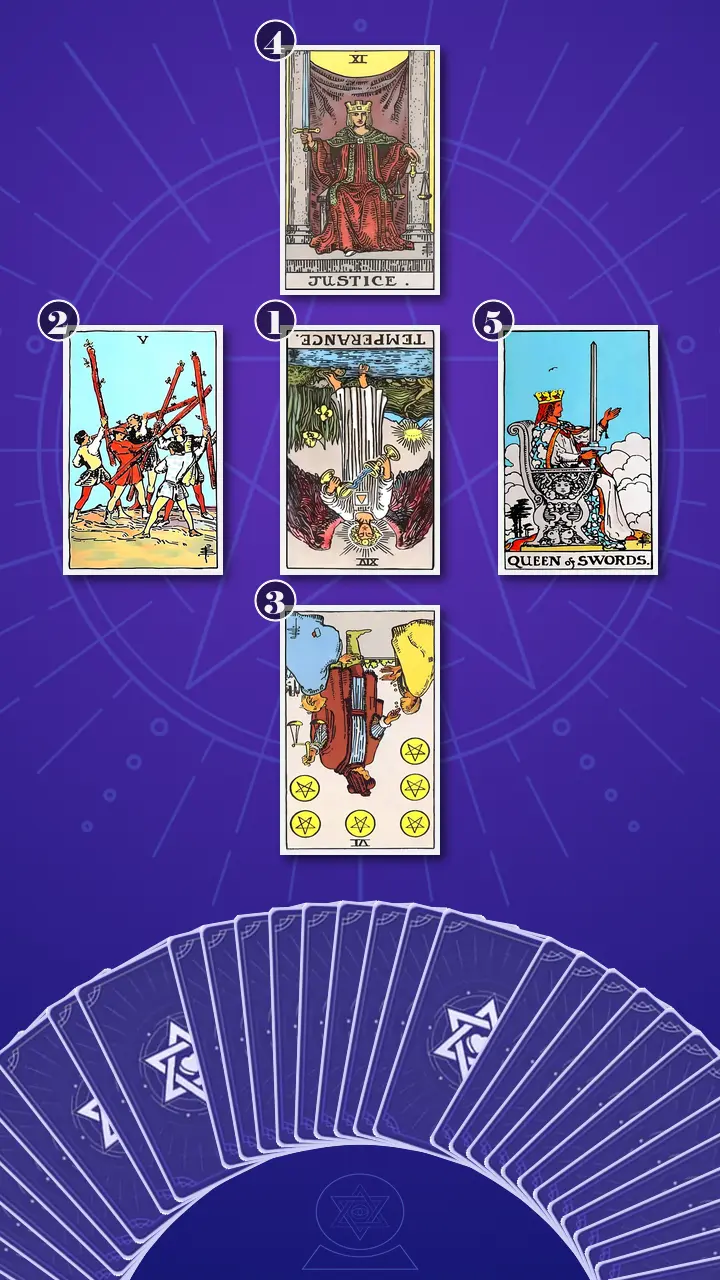
I chose the Five-Card Cross · Context Edition. For anyone wondering how tarot works in a family-boundary reading, I use this spread as a reflective structure rather than a prediction engine. Five positions were enough to trace the visible behaviour, the pressure pulling Maya into it, the hidden bargain underneath it, the corrective principle, and the communication practice that could carry the insight into real life.
I placed the first card in the centre as the dominant condition. The second sat to its left, showing the immediate relational pressure. The third went below, revealing the exchange and belonging fear sustaining the mediator role. Above the centre, the fourth card would identify the key transformation. The fifth waited on the right as an exit point, showing what clear integration could look like in an actual message or call.
The cross resembled a junction. I wanted Maya to see where she had been circling, what kept sending her back into the argument, and which route could let her stand beside the conflict without standing inside it.
Reading the Threads No Perfect Message Could Fix
Position One: Temperance Reversed and the Overfilled Cups
The card I turned over first occupied the position representing Maya’s diagnosis-level symptom: repeatedly entering family disputes to manufacture calm while becoming steadily more depleted. It was Temperance, reversed.
In the card, water normally travels with purpose between two cups. In Maya’s life, that water had become a stream of screenshots, softened accusations, revised intentions, and private explanations. At 10:45 p.m., she had the family group chat and two separate conversations open beside that unanswered work email. She kept transferring emotional content between relatives, convinced that one perfectly balanced paragraph could end the argument. Instead, every edit kept her inside it and gave everyone more wording to challenge.
The Temperance energy was not absent. It was overloaded and blocked by overcorrection. Maya had a real gift for finding nuance, but she was applying that gift to a mixture that required everyone’s willing participation. “One more explanation, one softer phrase, one final message, then everyone will calm down,” I said, giving voice to the loop I could hear underneath her editing.
“Think about the last family argument,” I asked. “At which exact message did listening turn into rewriting, relaying, or trying to produce a compromise?”
Maya let out a short laugh, but no amusement reached her eyes. Her fingers tightened around the edge of her sleeve. “That’s so accurate it feels a little brutal,” she said. “It was when my aunt wrote, ‘Tell her that’s not what I meant.’ I didn’t even question why it had become my job.”
“Accuracy can sting without becoming an accusation,” I said. “Temperance is not telling me that you care too much. It is showing me the exact moment care gets converted into emotional handling. The problem is not that you lack mediation skill. It is that you have been made responsible for a blend that cannot be created by one person.”
Position Two: Five of Wands in the Unmoderated Group Call
The next card represented the immediate relational pressure: several people defending competing positions and pulling Maya into the clash. I turned over the Five of Wands, upright.
Maya recognised the scene before I finished describing it. During the workday, contradictory versions of the same fight arrived while Slack alerts flashed on her laptop and the office coffee machine hissed nearby. Each relative wanted her to confirm that their account was the reasonable one. Every thread answered a different part of the disagreement, so Maya tried to organise the clash. The moment she entered it, however, her wording, timing, and loyalty became new subjects to contest.
The fire of the Five of Wands was in excess: movement without coordination, contact without a shared process, argument without an agreed purpose. The crossed staffs looked to me like overlapping chat threads. There were plenty of points of contact, but no common direction.
“They are all talking to me,” I said, “but none of them is talking to each other.”
The dynamic carried the body-level charge of the family dinner in The Bear’s “Fishes”: several histories active at once, everyone scanning for the next escalation, and no single careful sentence capable of organising the room. Maya’s communications training could facilitate a meeting with an agenda. It could not create an agenda among people who preferred fighting by proxy.
I asked what each relative actually requested when they contacted her alone. Maya counted on her fingers: “Agree with me. Explain what I meant. Tell them they’re being unreasonable. Make them call me.” Her hand stopped halfway through the list. Her eyes moved from the card to her silent phone.
“So you weren’t only being asked to witness distress,” I said. “You were being recruited as another participant. Entering a five-way intersection with no traffic lights does not make you responsible for directing every driver who is still accelerating.”
Position Three: The Six of Pentacles and the Cost of Being Useful
The third card occupied the position representing the hidden emotional bargain beneath Maya’s mediation: excessive emotional labour exchanged for belonging, usefulness, or a brief sense of control. It was the Six of Pentacles, reversed.
I asked her to return to a Friday evening she had mentioned. At 6:40 p.m., she had been standing in her apartment lobby with her coat on and a dinner reservation fifteen minutes away when a relative asked her to make one “quick” call to clear things up. The elevator motor hummed. Cold air slipped through the doors. Someone’s food delivery filled the lobby with the smell of garlic while Maya cancelled her ride and spent forty minutes distributing reassurance between two adults.
On the reversed card, the exchange moved in one direction. Maya supplied time, attention, edited explanations, and emotional regulation. Her relatives retained the option to avoid direct conversation, then blamed her when the support failed to produce peace. The earth energy of the Pentacles was being drained through an unequal arrangement: everyone could assign Maya a task, while her dinner, rest, work, and personal plans had no protected place on the dashboard.
This was where I used a lens I call Family Casting Analysis. I listen for the role a family repeatedly assigns to one person, especially when that role begins to feel like their only secure route to belonging. Maya had been cast as the Peacemaker, with a secondary role as the Calm One. Her lines were familiar: translate, soften, stay available, never appear to take sides. The impossible stage direction was to keep every other actor connected while showing no needs of her own.
The role offered a painful bargain: “If I keep giving, I remain needed. If I stop giving, I may find out whether I’m wanted when I’m not useful.”
Maya’s breathing paused. Her gaze slipped past me as if she were replaying the cancelled dinners, interrupted commutes, and nights spent refreshing the group chat. Then her fingers loosened, and she pressed both palms against her knees.
“That’s the part I hate admitting,” she said quietly. “If I’m not the one who can fix it, I don’t know what my place is.”
“You don’t have to turn that fear into a verdict about your family or yourself,” I told her. “We only have to recognise what the role costs and whether you still consent to playing it. The fight did not end when you intervened; it changed form and became your job.”
When Justice Put Every Message Back on Its Own Scale
Position Four: The Boundary That Did Not Need a Verdict
The room seemed to grow quieter as I reached for the card above the centre. Even the soft rattle from the studio window stopped for a moment. This position represented the key transformation: separating fairness from rescuing and returning responsibility for words, choices, and consequences to each family member.
I turned over Justice, upright.
Temperance had shown liquid being carried back and forth. Justice showed two scales held separately. A single sword rose between them, clear and undiluted. The card’s energy was balanced, not because everyone felt satisfied, but because responsibility had stopped leaking from one person’s side into another’s.
I thought of an editing room and the strange power of a scene that runs too long because no one is willing to choose its ending. As an artist, I know that handing someone the pen does not erase the previous act. It simply restores authorship over the next line. Justice was not asking Maya to abandon the family film. It was asking her to stop performing a forced role in every argument.
I returned to the Family Casting Analysis. “Your family script has treated the Peacemaker as if she must remain onstage until every other character is calm,” I said. “Justice changes the script. You can acknowledge that a scene is painful, decline to carry anyone else’s dialogue, and leave each person responsible for speaking in their own voice.”
I asked Maya to picture 10:45 p.m. again: three conversations open, her work email unanswered, and her jaw tight while she searched for the sentence that would make everyone understand each other without deciding she was the problem.
You do not create fairness by becoming everyone’s messenger; let each person hold their own side of Justice’s scales and speak in their own voice.
I let the sentence rest between us. Then I made the distinction even more concrete.
You do not create fairness by carrying both sides of the fight; fairness begins when each person carries their own words and you carry only your boundary.
For one beat, Maya did not move. Her breath stopped first, and her fingertips remained suspended above her knee. Then her eyes lost focus as if she were scrolling backward through years of calls, rewritten texts, and plans cancelled in the name of keeping everyone connected. Her jaw tightened again, but this time anger arrived before relief.
“But doesn’t that mean I’ve been doing this wrong the whole time?” she asked. The words came out sharper than anything she had said before. “I’ve given up so much time trying to help.”
“It means you used a strategy that once made connection feel safer,” I said. “It does not make you foolish, and it does not make those lost evenings meaningless. It means you can stop paying that price now.”
Her eyes reddened. She inhaled unevenly, held the breath, and finally let it leave in a long, trembling exhale. Her shoulders lowered. Her hands opened. Relief appeared, followed almost immediately by the light dizziness of seeing a clear path and realising she would have to choose it herself.
“Then who’s responsible if it gets worse?” she whispered.
“The people having the conflict remain responsible for the conflict,” I said. “You remain responsible for your participation. Someone else’s anger can be information without becoming your assignment.”
I invited her to test the insight against reality. “Now, with this new perspective, think back to last week. Was there a moment when this distinction could have changed how the situation felt?”
Maya returned to the apartment lobby and the supposedly quick call. “I could have said I was heading to dinner and that they needed to speak directly,” she said. “They might still have been angry. But I wouldn’t have had to stand there proving that the boundary was fair.”
That was the key crossing in her Journey to Clarity. It was not a leap from conflict to certainty. It was a smaller, more honest movement: from a hypervigilant family switchboard to a compassionate boundary setter who could tolerate another person’s reaction without using it as a verdict on her character.
Fairness is not forwarding everyone’s pain until it lands on you.
Position Five: The Queen of Swords Leaves One Message Clear
The final card represented cognitive integration rather than a predicted outcome. It showed how Maya could communicate one concise boundary, refuse triangulation, and remain compassionate without becoming the messenger. I turned over the Queen of Swords, upright.
The Queen held an upright sword in one hand and extended the other hand openly. I read those gestures together. The sword established precision; the open hand kept respectful contact possible. Her air energy was balanced and available, offering discernment without emotional withdrawal.
I asked Maya to imagine the next time a relative wrote, “Can you tell them...?” In this version, she replied once: “I care about both of you, but I won’t pass messages between you. Please speak to each other directly.” Then she left the message clear, turned on Focus mode, and returned to dinner without drafting a second explanation designed to make the first one impossible to dislike.
“I can leave this sentence clear even if their feelings are not settled,” Maya said, trying the thought aloud.
Her mouth pulled into a cautious half-smile. I watched her thumb move toward the face-down phone and then stop. That tiny interruption mattered. The Queen of Swords did not promise that everyone would approve. She modelled a repeatable choice that remained valid while someone else was disappointed.
“Direct does not mean cold,” I said. “Connection does not require constant access. Care can stay present even when message-carrying stops, and a boundary is complete before the other person agrees with it.”
The One-Rule Justice Check
I drew the five cards into one coherent story for Maya. She had learned that calmness and articulate communication could secure a valued place in the family. In the present, Temperance reversed showed that skill becoming forced emotional blending. The Five of Wands showed relatives recruiting her into conflicts with no shared process. The Six of Pentacles reversed revealed the hidden cost: she gave time, access, and regulation in exchange for temporary control and the hope of secure belonging. Justice restored separate ownership, and the Queen of Swords translated that principle into one clear sentence.
The central blind spot was not hidden in her wording. Maya had been judging whether a boundary was fair by whether everyone accepted it. That standard made fairness impossible, because any angry response could reopen the negotiation. The transformation was to move from managing other people’s reactions to defining her own participation: one consistent no-relay rule, applied regardless of which relative she sympathised with most.
I also kept the boundary humane. We defined a clear exception for immediate safety concerns or genuinely time-sensitive logistics. Outside those circumstances, urgency in someone’s tone would not automatically become ownership of Maya’s evening.
Insight needed rehearsal, so I gave her two deliberately small practices.
- The Script-Flipping Rehearsal In her Notes app, Maya would save: “I care about both of you, but I won’t pass messages between you. Please speak to each other directly.” I played the relative who pushed back with “So you don’t care?” and Maya practised repeating the limit once, without defending her character. At the next low-intensity request to relay a message, she would use the line and turn on Focus mode for twenty minutes. Start with the easiest relative or the least heated disagreement. If the full sentence feels too formal, keep the core: “Please send that to them directly.” The goal is an out-of-character response, not a flawless performance.
- The Thirty-Minute Justice Pause During the next non-urgent family dispute, Maya would place her phone face down and set a thirty-minute timer before deciding whether any reply was needed. On paper, she would make two columns: “Mine” for her availability and wording, and “Theirs” for their claims, reactions, and repair. The exercise would take no more than five minutes. If thirty minutes feels impossible, begin with five. A pause is not abandonment, and the note is not another project to perfect. Immediate safety concerns use the agreed exception and appropriate local support.
I told Maya that these were rehearsals, not moral tests. The Script-Flipping Rehearsal worked precisely because the Peacemaker’s expected line was a long explanation. A concise refusal disrupted the established dynamic while leaving Maya free to offer what she genuinely had capacity for, such as listening for ten minutes without contacting anyone on the caller’s behalf.
Her task was not to force a new ending for the entire family. It was to write one different line in the next scene and observe what became possible when she no longer volunteered as the forwarding service.

A Week Later: The Evening That Stayed Hers
Six days later, I received a message from Maya. A relative had asked, “Can you tell her that I’m done trying?” Maya had used the shorter boundary: “Please send that to her directly. I’m not going to pass messages.” The reply came back almost immediately: “Fine. Don’t get involved then.”
Maya watched the typing bubble disappear. Her chest tightened, and she opened a second draft. Then she remembered the separate scales, deleted the paragraph, turned on Focus mode, and finished the dinner that was already cooling beside her.
The family disagreement did not resolve that night. Maya slept through it anyway. In the morning, her first thought was, “What if they think I don’t care?” Then she smiled faintly, left the phone face down, and made coffee.
I did not read that moment as a tarot prediction fulfilled. The cards had given Maya a visual language for the pattern, but she had supplied the courage, the sentence, and the twenty minutes of follow-through. Her clarity was not universal approval. It was ownership of what she would carry and what she would return to its rightful owner.
When the family chat turns sharp, many of us know the tight chest and hovering thumb of trying to hold everyone together while quietly fearing that putting the phone down could cost us our place. Noticing that fear does not make the boundary disappear, but it does mean the old family script is no longer operating unnoticed.
If you let one message remain on its owner’s side of Justice’s scales tonight, what small part of your evening might become yours again?