Finding Clarity in the Tight Smile
If your parent tells your cringey teen story like it’s ‘cute,’ you laugh along like a good sport… and then feel weirdly gross in the Uber/Lyft home, replaying it like a failed performance review.
Jordan sat across from me with the particular kind of composure that reads as “I can run a meeting,” but their hands kept twisting the paper sleeve of their iced coffee like it was the only thing holding the day together.
They described Sunday dinner in North York like it was a clip they couldn’t stop rewatching: 8:12 p.m., the overhead light a little too bright, forks clinking against plates, and them halfway through chewing when their dad did the little pause—the setup—before: “Remember when Jordan…”
“My smile just… snaps on,” Jordan said, and their shoulders lifted a fraction like bracing for impact. “I laugh like it’s fine. Sometimes I even add details so it lands. And then later I feel gross. Like I just signed off on being the joke.”
I could hear the contradiction inside the sentence: I want to be respected as who I am now vs I’m terrified I’ll look dramatic or ungrateful if I set a boundary.
The embarrassment wasn’t abstract. It was physical—like trying to hold a fragile glass in a moving streetcar: a tight smile that doesn’t reach your eyes, a fluttery stomach, shoulders subtly raised as if you’re waiting for the next line of the story to hit.
“You’re not alone,” I told them, keeping my voice steady, the way I do when someone’s nervous system is already doing overtime. “And we’re not here to ‘win’ against your parents. We’re here to find clarity—how to stay warm without self-erasing. Let’s draw a map for that moment when the story starts.”

Choosing the Compass: The Relationship Spread · Context Edition
I asked Jordan to take one slow breath—not as a ritual for the universe, but as a clean transition for the body. Then I shuffled, letting the cards make their soft, papery sound, the way a workbook page turns: practical, not mystical.
“Today, we’ll use something I call the Relationship Spread · Context Edition,” I said. “It’s built for moments like this—parent/adult child dynamics—because it separates love from the mechanism that keeps the pattern looping.”
For you reading this: the reason I like this spread for family boundaries is that it’s structured like an actual conversation moving from bond to boundary. It gives us six specific lenses: you, them, the repeating block in real time, the inner resource you need, the bridge move you can say out loud, and the new ‘rule set’ that stabilizes things over time.
“We’ll start with what you’re actually trying to protect,” I told Jordan, nodding at the first position. “Then we’ll look at what your parents are reaching for when they tell the story. The third card will show the exact point your voice disappears. And the fifth—our bridge card—will be the sentence you can steal in the moment.”
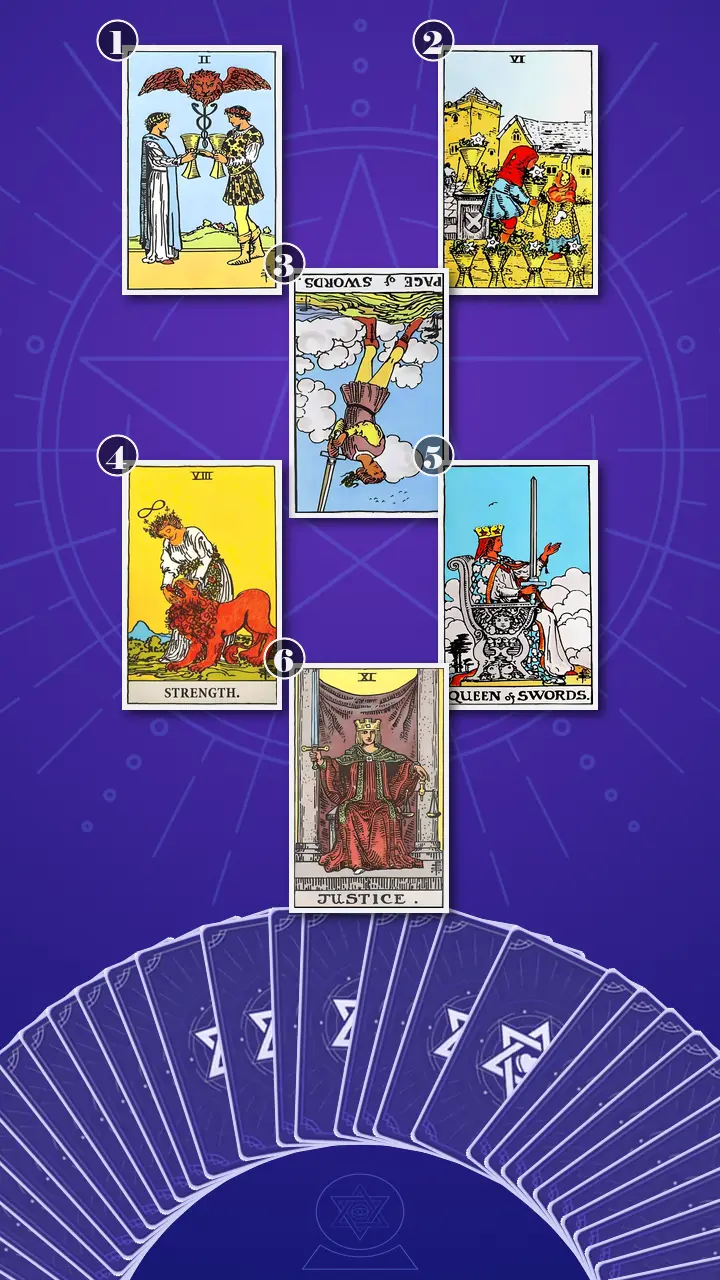
Reading the Map: What’s Love, What’s a Script
Position 1 — Your underlying need in this dynamic
“Now flipped over,” I said, “is the card representing your underlying need in this dynamic—the adult-to-adult respect you’re trying to preserve even while laughing along.”
Two of Cups, upright.
“This is the part of you that genuinely wants it to feel like two adults catching up,” I explained. “A respectful exchange. Mutual regard.”
I linked it directly to their real life: “You said it yourself—sometimes dinner starts off good. Normal. Then the cringe story comes out and the vibe flips you from participant to object. From ‘we’re relating’ to ‘I’m being presented.’ Two of Cups is you trying to stay on the same team without having to pay for closeness with self-deprecation.”
Energetically, this card is balance—equal posture, shared cup. It’s not asking you to be colder; it’s showing what you’re aiming for: warmth that doesn’t cost you dignity.
Jordan let out a small breath through their nose—almost a laugh, but softer, like recognition instead of performance.
Position 2 — Your parents’ energy when they retell the story
“Now we’re looking at your parents’ energy when they retell the story—what they’re seeking or reinforcing through it,” I said.
Six of Cups, upright.
“This is nostalgia as bonding,” I told them. “Like pulling out an old photo because it reliably gets warm reactions.”
I kept it unflinching but fair: “It doesn’t mean the impact is harmless. But it suggests the motive isn’t always ‘let’s humiliate Jordan.’ It’s often ‘let’s create instant closeness’—especially with relatives or family friends. It’s social currency.”
Here’s the contrast I wanted Jordan to feel in their bones: I love them… and I still hate this. You can care about your parents and still not consent to being frozen as your teenage self in public.
Jordan nodded, jaw tightening for a second, then releasing. “That’s… exactly it. Like, I don’t think they’re evil. I just hate the feeling of being reduced.”
“Right,” I said. “You’re not trying to start a fight. You’re trying to stop a script.”
Position 3 — What keeps the pattern going in real time
“Now flipped,” I said, “is the card representing what keeps the pattern going in real time—the exact mental/communication block that triggers the laugh-along response.”
Page of Swords, reversed.
“This is the freeze,” I told them. “Not because you’re weak. Because your system is choosing safety.”
I used their own lived moment as the translation: “The story starts and your mind becomes a live editing bay. You track everyone’s faces, predict reactions, draft five responses… and your voice times out.”
Then I let the quick-cut inner monologue run, the way it actually happens:
“Don’t—”
“Can we not—”
“It’s fine, it’s fine—”
“Oh my god, stop— (but in the joking voice that means keep going).”
“Okay, I’ll just laugh.”
“And what comes out,” I said gently, “is a laugh plus a self-roast.”
Jordan gave a tiny, bitter little chuckle. “That’s… kind of brutal.”
“Yeah,” I said, holding their eye contact. “But brutal and accurate is useful. Because it means we can work with a mechanism, not a character flaw.”
Then I offered the pivot cue I’ve watched work in real rooms: “This is the moment where the soundtrack drops out. The dinner noise goes muffled for one second. You notice your shoulders. Your feet. One breath.”
I tapped the table lightly once—an anchor. “Internal prompt: One sentence. Not a speech.”
Jordan’s shoulders lowered a millimeter, like their body believed me before their brain fully did.
Position 4 — The inner resource you need to stay grounded
“Now flipped,” I said, “is the card representing the inner resource you need to tolerate mild discomfort and still stay grounded.”
Strength, upright.
“This is ‘soft voice, solid boundary,’” I told them. “Not suppression. Regulation.”
I pointed to the lion in the image. “That surge—the heat in your face, the urge to laugh harder or snap—that’s the lion. Strength is the hand that says, ‘I can feel this and still choose my behavior.’”
As a perfumer, I think about nervous systems in sensory terms. “Strength is also about atmosphere,” I added. “When the room feels unsafe, your body tries to make it safe by performing. Strength is you making yourself safe from the inside first.”
Jordan looked down at their hands. “I can feel it. Like… my shoulders go up before I even decide.”
“Exactly,” I said. “That’s the doorway. You catch it earlier than you think.”
When the Queen of Swords Spoke
Position 5 — The bridge move you can use in the moment
I let the room go quieter on purpose. Even the café’s background music felt like it slid a few feet away.
“We’re flipping the most important card for your question,” I said. “This one is the bridge move—a boundary/communication approach you can use in the moment without escalating.”
Queen of Swords, upright.
“This is not a ‘big talk’ card,” I told Jordan. “It’s not a lecture. It’s clean. It’s short. It’s emotionally neutral.”
Then I gave them the dialogue they could steal, exactly as it would sound at a table:
Parent: “Remember when you—”
You (even tone): “Hey, I’d rather we retire that story.”
(Beat.)
You (redirect): “So—how’s your new project going?”
Jordan stared at the card, then at the table, like they were testing whether something this simple was allowed.
Setup: I could almost see the exact scene playing behind their eyes—the pause before “Remember when Jordan…,” the smile locking in, the stomach flipping, the brain drafting ten different responses while their face stays pleasant. They were trapped in the belief that if they didn’t play along, they’d ruin the vibe and lose belonging.
Stop auditioning for ‘easygoing’ and start holding the Queen of Swords’ upright blade: one clear sentence, no apology, then redirect.
There was a small silence after I said it—long enough to feel like a held breath. Jordan’s reaction came in layers, not all at once: first a physical freeze, their fingers pausing mid-twist on the paper sleeve; then a faraway look, like their mind replayed a dozen dinners and FaceTime calls in fast forward; then their shoulders dropped on an exhale they didn’t seem to plan.
“But if I say it like that,” they said, voice a little thinner, “won’t everyone think I’m… mad?”
“They might notice you’re not performing,” I said. “That’s different from being mad. And I want to name the real fear under this: it’s not the sentence. It’s the half-second of mild discomfort after you say it—when you don’t rush to fill the silence with a joke.”
Jordan swallowed. Their eyes were a touch brighter. “I hate that beat.”
“Of course you do,” I said. “You’ve been trained to manage the room. But this is the shift: from cringe laughter and bracing to grounded self-respect with calm, emotionally neutral boundary-setting. Warmth with backbone is still warmth.”
I leaned in slightly. “Now—use this new lens and think back. In the last week, was there a moment—maybe at work, maybe with a friend—where this one-sentence clarity would’ve changed how you felt?”
Jordan blinked once, slow. “Yeah. My mom did it on FaceTime on Tuesday. I did the high-pitched laugh. I could’ve just… said the line. And asked about her trip planning. That would’ve been so much cleaner.”
“That’s it,” I said. “Not perfect. Clean.”
And because I’m Luca—perfumer brain always on—I added one layer that made it stick: “The Queen of Swords is like a crisp, citrus note in a heavy room. One slice of clarity cuts through the syrupy nostalgia without ruining the whole dish.”
Position 6 — Integration: the new ‘fair rules’
“Now flipped,” I said, “is integration—what a healthier new normal looks like when your boundary is consistent.”
Justice, upright.
“This is the part most people skip,” I told Jordan. “They try it once, it feels awkward, and they assume it didn’t work. Justice says: make it a policy, not a mood.”
“You’re not punishing them,” I continued. “You’re rewriting the implicit rules of access to your narrative. Fair means both closeness and dignity matter.”
As someone who’s spent years mapping family patterns through sensory memory, I softened my tone: “When families retell stories, they’re often trying to keep a certain emotional fragrance alive—comfort, nostalgia, ‘we belong.’ Justice doesn’t rip that away. It just says: not at your expense.”
The One-Line Boundary Drill (and a Scented Shortcut)
I threaded the whole spread together for Jordan in plain language, like tightening bolts on a chair that’s been wobbling for years.
“Here’s the story your cards told,” I said. “You start from love and connection (Two of Cups). Your parents reach for nostalgia as a bonding tool (Six of Cups). In the live moment, your system scans for approval and your voice locks, so you default to the safest script—laughing along (Page of Swords reversed). The resource you need isn’t a sharper comeback; it’s nervous-system steadiness (Strength). The bridge is one clean sentence plus a redirect (Queen of Swords). And the new normal is consistency—fair rules that don’t depend on how brave you feel that day (Justice).”
“Your cognitive blind spot,” I added, “is believing you have two options: laugh and be ‘easygoing’ or confront and be ‘dramatic.’ The spread shows a third option: calm boundary, then move on. Mild awkwardness is allowed.”
Then I offered next steps—small, doable, and built for real life.
- Choose your one sentence (and keep it the same)Tonight, open Notes and pick one line you’ll use every time: “I’d rather we retire that story.” Write it at the top of a note like it’s a template.Consistency beats cleverness. Expect the awkward beat—silence is the boundary landing, not a failure.
- Add one redirect questionRight under your boundary line, write one redirect you can always ask: “So what’s new with you lately?” or “How’s the trip planning going?” Practice the pairing: boundary + redirect.If they push back, repeat the boundary once, then redirect again. No over-explaining.
- Rehearse in your body (10 minutes, private)Do the “one-line boundary” drill: say your chosen line out loud three times at normal volume while looking at your own eyes in your dark phone screen (or a mirror). Then say the redirect question.Notice what your shoulders do. If your chest tightens, stop. This is practice, not a performance.
- Use a built-in pause at the tableIf the story starts at dinner, take one sip of water first. Then say your line once and stop talking. Let the sentence do its job.Your tone goal matters more than your wording goal: calm, even, no sarcasm.
Then I brought in my own lane—because I’ve watched atmosphere make or break a boundary.
“One more tool,” I said. “It’s optional, but it’s powerful.”
I explained my Dialogue atmosphere enhancement with calming scents strategy—not as a gimmick, but as environmental support. “Before a gathering, put a small citrus scent in your space—something clean like bergamot or grapefruit. Citrus reads as ‘fresh start’ to the nervous system. It won’t make your parents behave differently. But it can help you feel less trapped in the old script.”
Jordan tilted their head. “So it’s… like a reminder I’m not 16?”
“Exactly,” I said. “A sensory anchor. Your brain has been storing these dinners as a kind of emotional perfume—same notes, same ending. We’re changing the blend.”

A Week Later: Ownership, Not Certainty
A week later, Jordan texted me on a Wednesday evening. Just two lines:
“They started the story on FaceTime. I took a sip of water. I said, ‘I’d rather we retire that story.’ And then I asked about my mom’s trip.”
“There was a beat,” the next message said. “My heart was pounding. But it worked. I didn’t die. And afterward I didn’t feel gross.”
That’s the quiet proof I look for: not a perfect family transformation montage—just a single moment where someone stops auditioning for approval and starts acting like the adult they already are.
When you laugh along, it’s not because you’re fake—it’s because belonging has felt like something you have to earn by making everyone comfortable, even when your stomach drops.
If you didn’t have to prove you’re “easygoing” tonight, what’s the one simple sentence you’d let yourself say—just once—so the room learns the adult version of you?
This story is adapted from psychological research, written so that those in a similar struggle can see their own pattern in it — and find their next step clearly.These insights are not a substitute for professional psychological, medical, legal, or financial advice.
Learn more about our Journey to Clarity.
How did this insight land for you?
🫂 This Resonates Deeply
🌀 Living This Story
✨ Now I See Clearly
🌱 Seeing New Possibilities
🧰 Useful Framework
🔮 The Confirmation I Needed
💪 Feeling Empowered
🚀 Ready for My Next Step
Author Profile
 AI
AI“As a perfumer for fifteen years, I’ve learned to perceive human boundaries through the delicate metaphor of scent. Relationships need the right amount of space to breathe, and I've seen too many kind souls exhaust themselves trying to please everyone. I’m here with warmth and understanding—not to teach you to be guarded, but to help you gently clear the air and rediscover the comforting, safe boundaries that are rightfully yours.”
In this Family Tarot Reading :
Core Expertise
- Enmeshment & Permeability Diagnosis: Using scent diffusion as a metaphor to identify suffocating families where personal boundaries are virtually non-existent.
- Atmospheric Toxicity Auditing: Detecting passive-aggressive tension and unstated resentment quietly polluting the family emotional climate.
Service Features
- The Quarantine Zone Protocol: Establishing an impenetrable psychological 'airlock' to prevent family toxicity from bleeding into your independent adult life.
Also specializes in :
Explore Related Patterns:
Approval SeekingJordan's fear that everyone will think they are mad, dramatic, or ungrateful turns the dinner table into an approval test. The laugh becomes a way to secure the room's favorable reading before anyone can accuse them of being difficult. Approval Seeking is the mechanism because the imagined audience reaction starts governing the behavior more than Jordan's actual preference does. You can feel the internal bargain: if you stay easygoing enough, maybe you get to keep belonging without anyone noticing the cost. The phrase 'auditioning for easygoing' exposes the pattern with precision. The performance is not random; it is an attempt to be seen as lovable, chill, and low-maintenance, even when the body is clearly registering embarrassment and threat.
Family Role RegressionThe dad's 'Remember when Jordan...' does more than introduce an embarrassing anecdote; it flips Jordan from adult participant to object being presented. The family table stops relating to the person sitting there now and starts relating to a preserved teenage version of them. Family Role Regression fits because the old script pulls Jordan into the behavior that once kept the family rhythm intact: smile, play along, be harmless, do not disrupt the bond. You can be fully grown and still feel your body reach for the role the family room recognizes fastest. The repeated dinners and FaceTime calls matter because this is not a single awkward joke. The same script keeps reactivating the same smaller posture, which is why the boundary has to address the rule of access to Jordan's narrative, not just one annoying story.
Fawning ResponseJordan's smile snapping on at the exact 'Remember when Jordan...' pause shows the body choosing the fastest socially acceptable exit: laugh, add details, keep the table warm. The behavior protects connection in the moment, but it also turns their discomfort into material the room can keep using. That is the logic of Fawning Response here: safety is pursued through appeasement, not through truth. You can care about your parents and still notice how the joke becomes a contract you never consciously agreed to, where belonging feels earned by being a good sport. The gross feeling in the Uber/Lyft afterward is the audit trail. It is not proof that the laugh was fake; it is the delayed cost of making everyone else comfortable before your own boundary had a chance to speak.
Freeze ResponseJordan's mind becoming a live editing bay while the story starts is the clearest behavioral anchor: they track faces, predict reactions, draft possible lines, and then the voice times out. The laugh is not presented as a thoughtful choice; it arrives after the system has overloaded on social risk calculations. Freeze Response fits because the body holds action in suspension when every option feels socially dangerous. You are not looking at a lack of intelligence or courage here; you are looking at a pressure moment where too many possible consequences collapse into no usable sentence. The eventual laugh plus self-roast is the exit route the body can access quickly. It ends the unbearable pause, but it also postpones the boundary, which is why the scene keeps replaying later like unfinished business.
Self-SilencingJordan saying 'I laugh like it's fine' while also feeling like they signed off on being the joke captures the exact split: the boundary exists internally, but it does not reach the room. The adult preference is present, yet it gets muted at the moment it needs a voice. Self-Silencing shows up when keeping the peace requires withholding the sentence that would make the interaction honest. You can see the defense working through restraint, not drama: no big confrontation, no visible anger, just the quiet disappearance of a clear 'I do not want this story told that way.' The one-line boundary matters because it reverses the mechanism without escalating the scene. It lets warmth remain available while giving the self a clean edge, which is exactly what the old laugh could not do.
Black-and-White ThinkingJordan's cognitive blind spot is stated plainly: laugh and be easygoing, or confront and be dramatic. That frame makes the calm middle option almost invisible, even though the whole reading later proves it exists. Black-and-White Thinking is the mechanism because a small, neutral boundary gets mentally inflated into a full relational rupture. You are not just deciding whether to speak; you are trying to escape a false binary where every option seems to threaten either dignity or belonging. The one-sentence redirect breaks the distortion. It shows that the real choice is not self-erasure versus conflict, but unclear consent versus clean consent, with enough emotional regulation to let a mildly awkward beat pass without treating it as failure.
Boundary DiscernmentJordan's line, 'I'd rather we retire that story,' followed by a redirect, creates a clean separation between love and access. The sentence does not attack the parents; it simply marks that this specific story no longer gets automatic permission. Boundary Discernment is the upright pattern because Jordan learns to tell the difference between closeness and self-erasure. You can keep the relationship warm while refusing the part of the script that turns your old embarrassment into group entertainment. The FaceTime follow-up proves the mechanism in real life: sip of water, one sentence, redirect, and the awkward beat survived. The goal is not certainty or perfect confidence; it is a fair rule that lets the adult version of you remain present in the room.
Explore Related Struggles:
Dignity-Belonging SplitJordan wants Sunday dinner to feel like two adults catching up, yet the moment the teen story begins their smile snaps on and the adult seat disappears. They laugh, sometimes adding details so the joke lands, because the room seems to offer only two bad options: protect dignity and risk looking dramatic, or keep belonging by making the old story easy for everyone else to enjoy. The struggle is not that they dislike their parents or cannot take a joke. The friction is that closeness has been routed through a small public surrender: staying warm requires them to approve a version of themselves that feels reducing. You can feel that split afterward, when the ride home becomes a replay of the moment you performed agreement while wanting respect. Dignity-Belonging Split names the pressure point where connection and self-respect feel like competing needs. The clean boundary works because it refuses the false trade. You can stay in the room, keep your tone warm, and stop offering your younger self as the price of being included.
Low-Maintenance Worth LockJordan's fear is not only that the sentence might sound harsh. It is that needing anything at all might change how the room sees them. The 'good sport' laugh becomes a way to prove they are low effort, low conflict, and still safe to include. You can feel the cost in the belief that there are only two roles available: easygoing or dramatic. When those are the only options, a simple preference starts to look like a character problem. The body learns to shrink the request before anyone else can object to it. Low-Maintenance Worth Lock names the pressure to stay lovable by requiring almost nothing. The one-line boundary breaks that contract gently. It lets you take up a small, specific amount of space without turning your need into an apology or a courtroom defense.
Performative HarmonyJordan does not just laugh along; sometimes they improve the bit so it lands. That detail matters because the performance is doing real social labor. Their discomfort gets converted into timing, friendliness, and a self-roast that tells the table nothing is wrong. The room looks harmonious because Jordan is absorbing the cost of that harmony. The awkward beat after a boundary feels unbearable, so they rush to smooth it over before anyone else has to feel it. You may recognize the shape of that performance when being 'easygoing' starts to mean making your own discomfort invisible. Performative Harmony names the bind where peace is preserved by turning yourself into the maintenance system for the room. The shift is not toward coldness or confrontation; it is toward letting warmth survive without requiring you to act amused by your own reduction.
Voice-Safety FusionAt the setup pause before 'Remember when Jordan...', their mind becomes a live editing bay. They track faces, predict reactions, draft five possible responses, and then the window closes. What reaches the table is not the sentence they needed, but a laugh that keeps everyone comfortable. You can hear the bind in their fear that one clear line will make them seem mad. The voice is not simply absent; it has been fused with the risk of losing social safety in the room. Speaking feels like it might puncture the family mood, so the body chooses the safest output available in the half-second it has. Voice-Safety Fusion names the moment when clarity feels dangerous before it even becomes words. The boundary sentence matters because it separates voice from threat: You are allowed to say one clean thing without turning it into a speech, a fight, or proof that you are ungrateful.
Nostalgic Belonging LockJordan's parents reach for the teen story like a reliable family shortcut, the kind of memory that gets a quick laugh and makes everyone feel like they share history. From their side, it functions like an old photo pulled out for warmth. From Jordan's side, the same memory freezes them as someone they no longer are. That is why the moment can be affectionate and still feel wrong. The bond is real, but the route into the bond keeps passing through an outdated version of Jordan that other people get to display. You are not rejecting closeness when you dislike being reduced; you are noticing that the form of closeness has become too narrow. Nostalgic Belonging Lock names the way family warmth can get attached to a past identity until the present self has no clean entry point. The boundary does not destroy the shared history; it updates the rules for how that history is handled around the adult version of you.
Explore Related Emotions:
Belonging ShameJordan laughs along because the table is offering closeness through an old script, and refusing the script feels like risking the warmth attached to it. Even when the story lands at their expense, they help it land because belonging seems to depend on keeping the room comfortable. The shame comes from how expensive that belonging feels. You are not just laughing at a memory; you are quietly proving that you can take the hit, stay pleasant, and not make anyone deal with the discomfort of your boundary. Belonging Shame names the emotional trade underneath the question. Jordan wants family connection, but the connection starts to feel conditional when it requires them to become the joke before they are allowed to remain safely in the room.
Low-Maintenance ShameJordan does not only laugh; they sometimes add details so the story lands better. That detail matters because it shows how quickly their discomfort gets converted into room management, as if being easy to be around matters more than being accurately seen. The dreaded part is the beat after a boundary, when no joke rushes in to soften the air. You can feel how much pressure Jordan carries to stay low-maintenance, to keep everyone comfortable, and to make sure no one has to notice the cost of the anecdote. Low-Maintenance Shame fits because Jordan's private grossness is tied to having made themselves too convenient. The laugh says, on the surface, that nothing is wrong; underneath it, the body knows it has just paid for peace by shrinking.
Micro-Performance ShameJordan's smile snaps on before they have even chosen it, and the laugh arrives as if the room has already assigned them a role. Their body is braced, their mind is editing possible responses, and the safest visible option becomes the tiny performance of being fine. That performance carries a private cost because it makes Jordan feel like they helped approve the joke at their own expense. You can see the shame forming in the gap between the pleasant face at dinner and the gross, replaying feeling on the ride home. Micro-Performance Shame fits because the pain is not only public embarrassment. It is the smaller, sharper feeling of watching yourself act easygoing in order to stay acceptable, then realizing afterward that the performance asked you to step away from your own dignity.
Performative WarmthJordan is not trying to reject the family table. They want the dinner to stay warm, and the laugh is partly an attempt to keep connection intact when the old story starts moving through the room. The problem is that the warmth has become staged. You can feel Jordan holding up the friendly atmosphere with a tight smile, a high-pitched laugh, and extra details that make the anecdote work better for everyone else. Performative Warmth fits because the connection is real but the expression of it has become costly. Jordan is offering softness that looks generous on the outside while privately monitoring how much of themselves is being erased to keep the vibe intact.
Quiet Self-RespectJordan's shift is almost deliberately small: a sip of water, one sentence, then a redirect. Nothing about it requires a dramatic speech, and that is exactly why it gives the adult self room to stand up without setting the whole room on fire. You can feel the difference in the aftermath. The heart still pounds, the beat still happens, but Jordan does not leave the moment with the same gross residue because they did not hand over their dignity to keep the script running. Quiet Self-Respect names the steadier emotional weather that appears when warmth and backbone exist together. It is not certainty, dominance, or a perfect family reset; it is the grounded relief of letting the room meet the adult version of you one clear sentence at a time.
Approval AnxietyWhen the story begins, Jordan's attention does not stay only on the words. It spreads across everyone's faces, the possible reactions, the imagined judgment, and the risk that one calm sentence could suddenly make them look difficult. That scanning creates a narrow internal corridor where the laugh feels safer than the truth. You are not laughing because the story is harmless; you are laughing because approval in the room feels like something that has to be protected second by second. Approval Anxiety fits because the central pressure is anticipatory and social. Jordan is trying to predict whether they can still be liked after interrupting the family script, and the fear of losing that approval keeps the boundary trapped behind the smile.
Invalidation AcheDinner starts with the possibility of adult-to-adult connection, then the old story pulls Jordan out of the present and turns them into material for the room. The warmth does not disappear, but it gets routed through a version of Jordan they no longer want to be publicly stuck inside. That is why the impact feels different from ordinary teasing. You are sitting there as your current self, but the room keeps handling you like an old family clip that can be replayed whenever closeness needs a quick spark. Invalidation Ache captures the quiet hurt of being remembered without being updated. The ache is not a demand that the past vanish; it is the need for the people closest to you to recognize that the adult in front of them deserves a different kind of regard.
Regulated CourageJordan's courage shows up through regulation rather than force. They take a sip of water, speak one sentence, and let the beat exist instead of rushing to repair the room with a joke. The heart pounding matters because the moment is still uncomfortable. You can feel the body registering risk while Jordan's behavior stays clear enough to protect the boundary without turning it into a fight. Regulated Courage fits because the emotional achievement is staying with mild discomfort while acting from choice. Jordan does not need to feel fearless; they need just enough steadiness to stop the old laugh from making the decision for them.
Explore Related Contexts:
Conditional Family BelongingJordan names the fear clearly: if they stop laughing, they might look dramatic or ungrateful. That fear sits right beside the behavior of helping the story land, adding details, and becoming the easygoing version of themselves the room already knows how to accept. The pressure here is that belonging feels conditional on comfort management. You are not only responding to a parent retelling a story; you are responding to a social contract where warmth seems available as long as you do not make anyone confront the cost of the joke. Conditional Family Belonging explains why the laugh can come out even when the body is already saying no. The laugh preserves access to the room, but it does so by making you pay with self-deprecation. Seeing that trade clearly lets you separate closeness from compliance, which is the first step toward keeping connection without making yourself the fee.
Family Album Performance PressureThe parent tells the teen story like it is cute, and the reading frames it as nostalgia that reliably gets warm reactions, especially around relatives or family friends. The anecdote works almost like a family album brought out for entertainment, except you are still in the room while other people handle your image. That is why the pressure has a public edge. You are not just remembering something with your parents; you are being asked to co-host your own embarrassment so the group can enjoy a familiar moment of closeness. Adding details so the story lands turns you from the subject of the memory into part of the performance machinery. Family Album Performance Pressure captures the specific social awkwardness of being made into family content. The old story may look affectionate from the outside, but inside the scene it asks you to approve a version of yourself that feels smaller than who you are now. Your boundary is not an attack on nostalgia; it is a limit on being used as the prop that keeps nostalgia warm.
Family InfantilizationAt Sunday dinner, the pause before "Remember when Jordan..." shifts you from adult participant to archived teen self. The story says the meal can begin normally, but once the cringe anecdote starts, the room stops relating to you as the person sitting there now and starts presenting you through a version of yourself that no longer has equal standing. That is the external pressure behind the laugh. The family setting has a ready-made role for you: be the good sport, validate the old story, and let everyone enjoy the harmless-looking memory. Laughing along becomes a way to avoid challenging the family hierarchy in real time, even when the cost is being reduced to a younger version of yourself. The deeper issue is not whether the story is objectively funny. It is that your current adult identity is being asked to yield to a family archive that others still control. Naming this as Family Infantilization gives you a cleaner map: the task is not to prove that the memory was bad, but to reclaim who gets to define you in the room now.
Family Script PressureThe moment Jordan hears the setup, the whole scene already has choreography: the pause, the "Remember when...", the bright dinner table, the faces waiting for the old punchline. Your smile snaps on because the script has started before your consent can catch up. In that structure, laughing is not random or fake. It is the role the room has made available to you: play along, add details, keep the tone light, and prevent the silence that would follow a boundary. The external system is the repeatable family script, not a single awkward dinner. This is why the same pattern can show up again on FaceTime. The location changes, but the script still carries authority because everyone knows their part. Family Script Pressure names the loop that makes your voice feel late to the moment, and it also shows why one clear sentence can interrupt more than one anecdote; it interrupts the rule set underneath it.
Family Boundary NegotiationA week later, Jordan takes a sip of water on FaceTime and says, "I'd rather we retire that story," then asks about the trip. The important detail is not that the whole family system transforms instantly; it is that one clean sentence creates a new rule inside a familiar pattern. This is Family Boundary Negotiation in its active form. You are not trying to win a confrontation or withdraw warmth. You are testing whether the relationship can keep its connection while changing the terms of access to your personal history. The new external stage is delicate because the room has to learn a different version of you through repetition. A calm boundary plus a redirect gives the family somewhere else to go, which matters because it protects dignity without making closeness the enemy. The negotiation is the bridge between being the joke and being an adult participant in the conversation.