Family Anger and Emotional Boundary Confusion: Naming What Is Yours

The Anger With No Sender Label
Jordan was a 27-year-old UX designer in Toronto who could read a user’s hesitation all day, then open her family group chat after work and mistake one sharp message for proof that she had done something wrong.
When our video session connected at 10:40 p.m., I saw her sitting on the edge of her bed with the chat still open. Cold screen light spread across the duvet. A radiator clicked beside her, and her phone had been in her palm long enough for her to shift it between hands and say, “It’s actually getting hot.” She had read the same accusatory line six times, drafted an apology, deleted it, and pressed two fingers against the hinge of her jaw as though the tension might reveal who had put it there.
“I can walk into a call feeling fine and leave convinced I’m furious,” she said. “Then I match their tone, and that becomes more evidence that I was angry all along. Maybe I’m the angry one and just didn’t know it yet.”
The confusion seemed to move through her like bass from a speaker placed too close to the body: the vibration was undeniably real, but its source had become impossible to locate. Underneath it, I could hear the more vulnerable question. If she stopped carrying the family’s emotional volume, would that make her cold? Would she still belong?
I asked her to put the phone face down for the length of our session. “I’m not going to use tarot to declare who is right, diagnose your relatives, or tell you to cut anyone off,” I said. “I want us to examine the sequence. You were neutral before contact. A sharp tone arrived. Your body activated. Then you called the activation yours and tried to repair the entire exchange.”
I let the distinction settle before adding, “Anger is present here and I am angry are not automatically the same sentence. Let’s give this emotional boundary confusion a visible map, then find the point where you can choose your own line.”
Choosing the Bridge Between Contact and Ownership
I invited Jordan to feel both feet against the floor and take one ordinary breath, without trying to make it especially deep or calm. I shuffled slowly while she held one question in mind: “What happens between noticing my family’s anger and deciding it belongs to me?” The small ritual was a transition for attention, not a claim that the cards possessed secret access to anyone’s motives.
I chose the Relationship Spread · Context Edition, a contextualized five-card tarot spread for family emotional boundaries. For anyone wondering how tarot works in a situation like this, I use the cards as an external cognitive map. Card meanings in context help separate elements that feel fused inside the body. They do not establish facts about another person’s private intentions, and they do not make decisions for the querent.
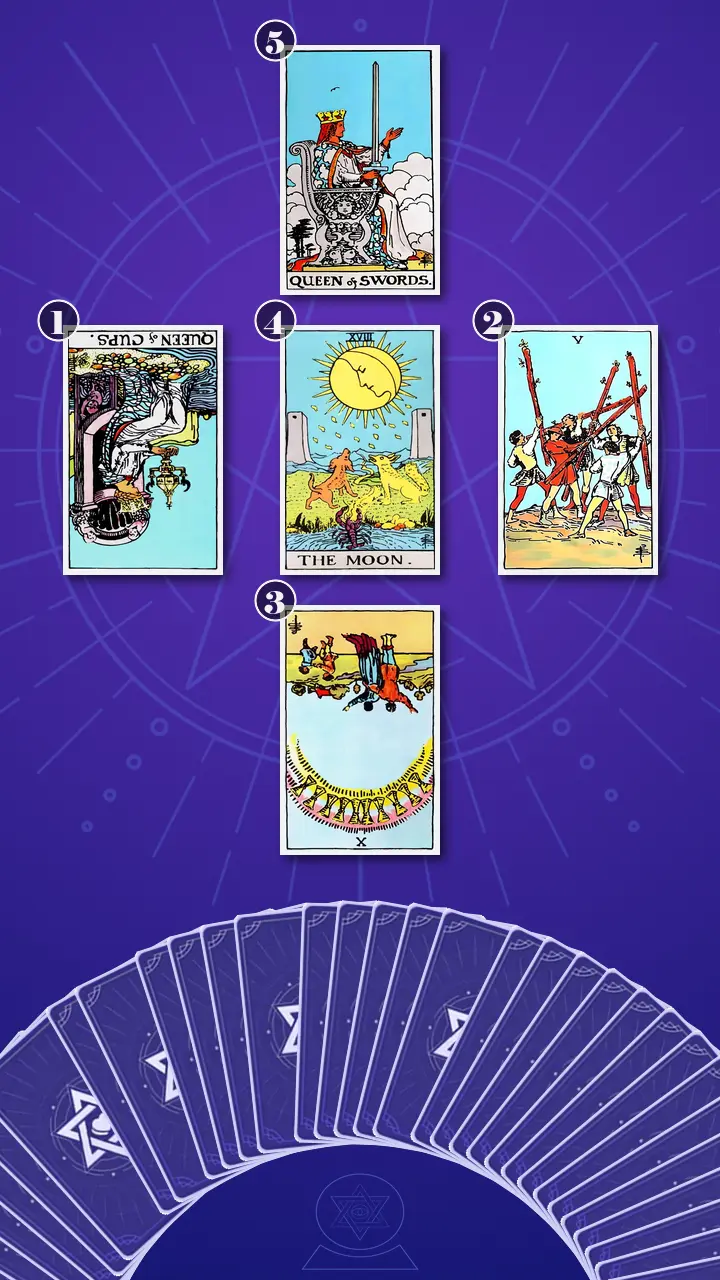
The first card would show Jordan’s receptive state. The second would place the family’s expressed anger on the opposite side as distinct relational information. Beneath them, the third would reveal the old rule about harmony and belonging. The fourth would occupy the centre, where bodily activation was becoming an identity claim. The fifth would rise above that centre as a self-led practice for clarity and compassionate boundaries.
I laid the cards in a cross resembling a bridge: Jordan on the left, the family’s emotional field on the right, uncertainty between them, the inherited foundation below, and a signpost above. The five-card structure was focused enough for this question. A larger spread would have added detail without necessarily improving discernment.
“This reading will not predict whether your family approves of a boundary,” I told her. “It will help you see which part of the interaction is observable, which part happens inside you, and which response remains yours to choose.”
The Cup That Held the Whole Room
Position 1: Queen of Cups Reversed, the Overextended Receiver
“The card I’m turning now represents your current stance and the observable symptom of the pattern: receiving family anger, mirroring its tone, and labelling the resulting activation as your own before checking its source.” I turned over the Queen of Cups, reversed.
The Queen held an ornate, sealed cup close to her body, her gaze fixed so completely upon it that the rest of the shoreline almost disappeared. I asked Jordan to imagine the cup as the emotional material she examined after every tense exchange. Her sensitivity was detecting that something had entered the room, but she was studying the evidence inside herself before asking whether it had arrived through someone else’s voice.
In modern life, this card looked like a sharp family voice note landing while Jordan was finishing a UX task. Heat rose in her chest. She studied the sensation, softened a neutral Figma comment three times, and assumed that being affected meant she must be angry too. Sensing the room had quietly become the same thing as owning the room’s feeling.
Reversed, the Queen’s water showed a blockage of emotional containment and an excess of inward scanning. Jordan’s empathy was not defective. It was operating without a reliable sender label. The more closely she examined the sealed cup, the less clearly she could tell what had already been present before contact.
“Before the last call, what were you feeling?” I asked. “Not what did they feel, and not what did your body do afterward. What was yours before the call began?”
Jordan gave a small laugh with no amusement in it. “Honestly? Tired. Maybe neutral. This is so accurate it feels a little brutal.”
Her fingers tightened around her sleeve, then released it. I told her the accuracy was not an accusation. It simply made a very fast sequence slow enough to observe. I also named the overcorrection risk: differentiation did not require ignoring every message for days or turning silence into punishment. The task was not to become less sensitive. It was to let sensitivity report information without automatically assigning responsibility.
Position 2: Five of Wands Upright, the Conflict Outside the Self
“Now I’m turning the card that represents the family’s expressed emotional field as something distinct from you,” I said. “I’m describing what is visible in the interaction, not guessing anyone’s hidden motive.” The card was the Five of Wands, upright.
Five figures occupied the same crowded space, their staves crossing while remaining separately held. I saw the family group chat immediately: several sharp messages arriving within minutes, different positions colliding, every notification making the exchange feel like one huge wave of anger.
Upright Fire was active here, but it appeared as an excess of uncoordinated expression. The friction was real. The volume was real. Yet each figure still owned a separate staff. Contact did not create a single author, just as a crowded Slack thread can contain overlapping reactions without making one person responsible for every post.
“Try the sentence, ‘Anger is present in this interaction,’” I said. “Notice how different that is from, ‘I am the anger in this interaction.’ What can you name as something they expressed without interpreting why they expressed it?”
Jordan looked at the face-down phone and said, “The message was sharp. It blamed me for something without asking what happened first.”
“Good,” I said. “That is an observation. You don’t have to make it smaller, and you don’t have to climb inside it. A sharp tone is data about the conversation, not automatically a task assignment for you.”
Jordan set her phone farther from her knee. It was a movement of only a few inches, but I watched her shoulders drop with it.
Position 3: Ten of Cups Reversed, the Price of Keeping the Picture Calm
“The card I’m turning now represents the relationship’s foundation: the established pattern that makes these separate emotional energies difficult to distinguish.” I revealed the Ten of Cups, reversed.
The familiar rainbow of cups hung upside down over the family home. In Jordan’s daily life, the image became the moment after a tense exchange when she apologized, explained, or mediated before she knew what she felt. Calm had become linked with belonging, so separate feelings began to resemble a rupture, and repair arrived as her automatic assignment.
The reversed Cups showed blocked belonging, not an absence of love. The family picture had become too narrow to include conflict, limits, delayed replies, or unresolved moments. Jordan was trying to keep the emotional equivalent of a polished Instagram grid intact while every unposted disagreement continued outside the frame.
At this point I used the lens I call Family Casting Analysis. When a family scene becomes heated, I listen for the role a person has been expected, pressured, or repeatedly reinforced to play. Jordan’s recurring role looked like The Peacemaker: the character who reads every face, translates every sharp line, and restores continuity before anyone can accuse the family story of falling apart.
I was careful not to claim the cards could prove exactly who assigned that role or when. A family role can be demanded outright, volunteered for safety, rewarded over time, or built from several of those experiences. What mattered was the cue Jordan’s body had learned: raised voice means enter the scene and fix the mood.
My mind flashed to the unfinished storyboards stacked in my studio. As an artist, I know how easily continuity can be mistaken for truth. A character may repeat the same action from scene to scene because the production expects it, not because the action still belongs to her.
“If I don’t fix it,” Jordan said, “it feels like I’m choosing the fight.”
“That is the old script’s false binary,” I replied. “It offers you two roles: manage everyone’s anger or abandon the relationship. This card asks whether connection could include separate feelings, a pause, and a problem that remains unresolved tonight. Connection does not require one shared emotional weather system.”
The Moon Path Between Sensation and Certainty
Position 4: The Moon Upright, Where a Tight Chest Becomes a Verdict
“The card I’m turning now represents the present dynamic and central blind spot: bodily activation and emotional ambiguity are being treated as proof that your family’s anger belongs to you.” I placed The Moon, upright, in the centre of the cross.
I never treat The Moon as a threat or a prediction that something terrible is hidden. In this reading, its narrow path between two towers showed the short interval between registering emotional intensity and deciding what that intensity meant. The dog and wolf reacted beneath the same moon, but their reactions did not have to be identical.
For Jordan, the card mirrored the walk from ending a tense call to opening the same message again. The room might be quiet, but the conversation kept replaying. Her inner line was, “My jaw is clenched, so I must be angry.” She then reread the chat as if refreshing a map while its location pin was still loading.
The Moon’s upright energy was active uncertainty. The blockage came from placing an excess of interpretation on top of an incomplete signal. The body’s response was genuine, but genuine did not mean fully identified. A tight chest is information, not a verdict.
I asked her to compare three points without forcing an answer. “What was present before contact? What changed during the exchange? What remains now?”
Her breath paused first. Her eyes then shifted away from me and lost focus, as though she were replaying last Sunday’s call frame by frame. Finally, her fingers opened against her knee and a long exhale left her chest.
“Before the call, I was tired but fine,” she said. “During it, I got startled. Afterward, I was worried and irritated. I don’t actually know if I was angry. I only know my body reacted.”
“Not knowing yet is not a failure of self-awareness,” I told her. “It is the first honest point on The Moon’s path. Curiosity gives you more reliable information than forcing the fastest available label.”
When the Queen’s Sword Cut the Feedback Loop
Position 5: Queen of Swords Upright, the Discerning Witness
The radiator beside Jordan had clicked throughout our session, but it fell quiet as I reached for the final card. I placed it above The Moon, at the point of integration.
“This position represents the relationship’s constructive direction,” I said. “It asks how clear emotional language and compassionate boundaries could help you distinguish observation, personal feeling, and chosen responsibility.” I turned over the Queen of Swords, upright.
Before I went further, I asked Jordan to picture 10:40 p.m. again: the warm phone, the sixth reread, and the apology waiting in drafts. In the old sequence, she had to answer correctly and immediately because delay felt like disloyalty. Her body had been promoted from sensor to judge.
I pointed first to the Queen’s open left hand, then to the sword held vertically in her right. The open hand allowed honest contact. The blade created a visible line of discernment. In modern life, the image sounded like, “I can hear that you are upset. I need a moment to work out what I feel before I respond.” It was neither ghosting nor emotional surrender.
The old operating script said, “If I don’t match their tone, they’ll think I don’t care.” The Queen offered a different structure: They expressed...My body registered...I feel... Only after those three lines would Jordan decide what responsibility, if any, she wanted to accept.
I returned to Family Casting Analysis because the spread’s cast list was now visible. The reversed Queen of Cups was the overextended Receptive Caretaker. The reversed Ten of Cups supplied The Peacemaker’s stage direction. The Moon showed her improvising in the dark. The Queen of Swords introduced a new part: The Discerning Witness, present in the scene but no longer responsible for carrying every other character’s emotional line.
I paired that lens with what I call Narrative Enmeshment Diagnosis. This is not a clinical diagnosis of a family member. It is a storytelling check: has an inherited plot about belonging started writing the querent’s next line before she can consult her own experience? For Jordan, the answer was visible in the speed of her apology. What felt cold was often simply out of character for The Peacemaker. Discomfort did not prove the new line was wrong; it proved the old role had been well rehearsed.
You do not have to carry every raised voice as proof of your own anger; name what is yours, release responsibility for what is not, and let the Queen's upright sword draw a clear but humane boundary.
I stopped speaking.
Jordan’s breath caught. Her index finger froze halfway to the phone, and her pupils widened before her gaze slipped beyond the screen as though another memory had started playing. The muscles beside her mouth tightened; then her shoulders lowered and her hand opened slowly against the duvet. Her eyes became bright, but the first feeling to reach her voice was not relief.
“But doesn’t that mean I’ve been wrong all those times?” she asked, the words sharper than anything she had said all evening. “Like I created half the problem by trying to fix it?”
I watched the anger flicker into grief, then into a shaky exhale. The clarity had removed a burden, but it had also left a blank space where an automatic role used to be. That space carried responsibility, and for a moment it made her look slightly unsteady.
“No,” I said. “It means you used a strategy that helped you feel connected and useful when the emotional room became unpredictable. We can respect why it developed without requiring you to repeat it forever. Clarity is not a courtroom for prosecuting your past self. It is an editing room for choosing what stays in the next scene.”
I brought her attention back to the card. Upright Air appeared here in balance: precise enough to distinguish facts from sensations, but humane enough to keep the hand open. Feeling her family’s anger in her body did not make that anger hers. The turning point was the space between noticing their intensity and deciding what she actually felt, what she was responsible for, and what could remain with them.
“Now, with this new perspective, think back to last week,” I said. “Was there a moment when this insight might have let the experience feel different?”
Jordan described a family notification appearing during a Figma review. Her shoulders had risen before she finished reading it, and she had rewritten a neutral comment to a colleague three times. “I could have said, ‘My body is bracing because of the message,’ instead of acting like my coworker had also become angry with me,” she said. “I could have waited before making the whole morning about damage control.”
That was the key crossing in the reading: not a dramatic jump from confusion to perfect certainty, but a first movement from absorbing and mirroring family anger as proof of personal responsibility toward clearer emotional ownership, self-trust, and compassionate interpersonal boundaries.
Two Small Edits to the Family Script
When I read the spread as one continuous story, its logic was clean. The Five of Wands showed real external heat. The reversed Queen of Cups received that heat without a clear container. The reversed Ten of Cups explained why conflict felt like a threat to belonging. The Moon turned the resulting steam into fog, and Jordan mistook the fog inside her body for proof that the fire had begun there. The Queen of Swords finally introduced enough Air to name separate elements.
No Pentacles appeared in the spread, which mattered to me. Insight needed Earth: a timer, a phone note, one observable quote, and a sentence that could be spoken aloud. Without those concrete anchors, emotional analysis could simply become another hour of rereading.
I named the central blind spot directly. Jordan was treating a clenched jaw as evidence of personal anger and rapid repair as evidence of care. The transformation was not to become unaffected. It was to change the sequence: observe what was expressed, record what the body registered, identify her own feeling, and only then choose a response.
“But ten minutes can feel huge in my family chat,” Jordan said. “If I wait, they’ll think I’m ignoring them, and then I’ll spend the whole timer imagining it getting worse.”
“Then the practice has to fit your actual capacity,” I replied. “The timer is not a morality test. One breath counts. Closing the note counts. A short message saying you need time is available, but you are not required to send even that. The purpose is to restore choice, not perform a perfect boundary.”
The Three-Line Check and the Out-of-Character Reply
- Use the Ten-Minute Emotional Ownership Check For one tense family message this week, Jordan would open a prewritten phone note before replying. She would set a ten-minute timer and complete four short lines: Before contact, I felt...; They expressed...; My body registered...; and I feel.... She would use one exact quote, one body sensation, and one or two personal feelings, without guessing anyone’s motive. After the timer, she could answer the specific question, request a calmer time to talk, or leave the message unanswered for now. Start with the smallest workable version. If writing increases the intensity, close the note after one breath. The pause exists for observation, not to prove anyone wrong or guarantee a reply.
- Run the Script-Flipping Rehearsal Before the next family call or gathering, Jordan would spend three minutes role-playing with a trusted friend or recording herself in a private voice note. The other person would read a representative sharp line, and Jordan would rehearse an intentionally out-of-character response: I can hear that this is upsetting. I need a little time before I decide whether I can continue this conversation. She would then practise stopping, without adding an apology, a defence, or an analysis of everyone’s mood. She could use the sentence during real contact only when it felt accurate and safe. If the full wording feels too formal, rehearse: I saw this and need time before I respond. The goal is one deliberate interruption of The Peacemaker sequence, not a flawless performance or control over the family’s reaction.
I called the second practice The Script-Flipping Rehearsal because an established dynamic often feels most powerful at the exact moment someone goes off-script. The rehearsal could not control what Jordan’s relatives said next, and I did not promise that it would permanently transform the family. It changed the part of the production she actually owned: her response, her timing, and her willingness to keep holding the pen.
Neither action required Jordan to withdraw, forgive, confront, or stay in a conversation that became disrespectful. The cards offered a structure for actionable advice. Jordan remained the person with authority over whether that structure fit her life.

A Week Later, the Apology Stayed in Drafts
Six days later, Jordan sent me a message from TTC Line 1. A sharp family text had arrived while the train pulled out of St. George. She had felt her jaw lock and the old urge to write a paragraph, but she opened the note instead.
She wrote: Before contact, I felt tired and okay. They expressed blame. My body registered a tight jaw and raised shoulders. I feel startled, worried, and a little irritated.
Jordan waited ten minutes. Then she sent the shorter rehearsed line: “I saw this and need time before I respond.” She answered the specific question the following afternoon, without explaining every pause or taking responsibility for the other person’s reaction.
She told me she slept through the night, then woke with the old first thought: “What if I was cold?” The thought still arrived. This time, she smiled once, checked her note, and let it pass without reopening the chat.
I did not read that as a solved family system or a final scene wrapped in perfect lighting. I read it as credible proof of a new sequence. The cards had not created the pause; Jordan had. Tarot had made the pattern visible, and she had chosen what to do with the clarity.
That was the heart of our Journey to Clarity: sensitivity did not need to disappear for self-trust to emerge. Jordan could keep the Queen’s open hand for connection and the upright sword for discernment. She could hear anger without becoming its spokesperson.
When a family member’s anger hits your chest and locks your jaw before you can name your own feeling, carrying it may seem safer than discovering whether separation could threaten the belonging you are trying to protect. I hope Jordan’s quiet pause leaves you with another possibility: noticing the old script means it is no longer writing the scene entirely on its own.
If you kept the Queen’s open hand for contact and her upright sword for responsibility, what might you notice in the ten quiet minutes before your next reply, once the family script stops feeding you your line?