The Sixth Draft: Why Going Low-Contact with Family Kept Maya Stuck
I recognized the Toronto hybrid-office adult with a low-contact message open in Google Docs, asking whether every sentence was fair, until the family group chat lit up on Sunday night and boundary paralysis took over. Maya was twenty-nine, a communications coordinator who could write a clear message for almost anyone except herself.
At 11:40 p.m. in her small apartment kitchen, I watched her change one sentence for the sixth time. The laptop fan hummed against the radiator's steady clicking, while her warm phone lit her palm with the muted family chat still open. Each edit made the message softer. Each notification seemed to pull the chair a fraction closer to the same old doorway.
She looked at me and said, 'I want space, but I keep thinking one more honest conversation might finally make it different. If I pull back now, I will never know whether I gave up too soon. I can explain the boundary perfectly and still not feel allowed to set it.'
I could see the longing in the way she kept her finger near the trackpad, ready to revise rather than decide. It was like a browser tab pinned for months because closing it felt like losing the answer, even though it was quietly draining the battery of her attention. The tightness in her throat and the heavy drop in her chest were carrying guilt, grief, and apprehension underneath the wish for repair.
I did not treat her hesitation as weakness, and I did not assume that low contact was automatically the right outcome. I told her that tarot could help us examine the pattern without making the decision for her. 'Let us give this low-contact anxiety a shape,' I said. 'We can look at what contact is doing now, what hope is protecting, and what a proportionate next choice might hold. Our Journey to Clarity begins with a map, not a verdict.'
The Doorway Needed a Map
I invited Maya to put both feet on the floor, take one slow breath, and name the question in plain language. Then I shuffled the cards slowly, giving the movement a practical purpose: a pause between the familiar reaction and the deliberate observation that might follow.
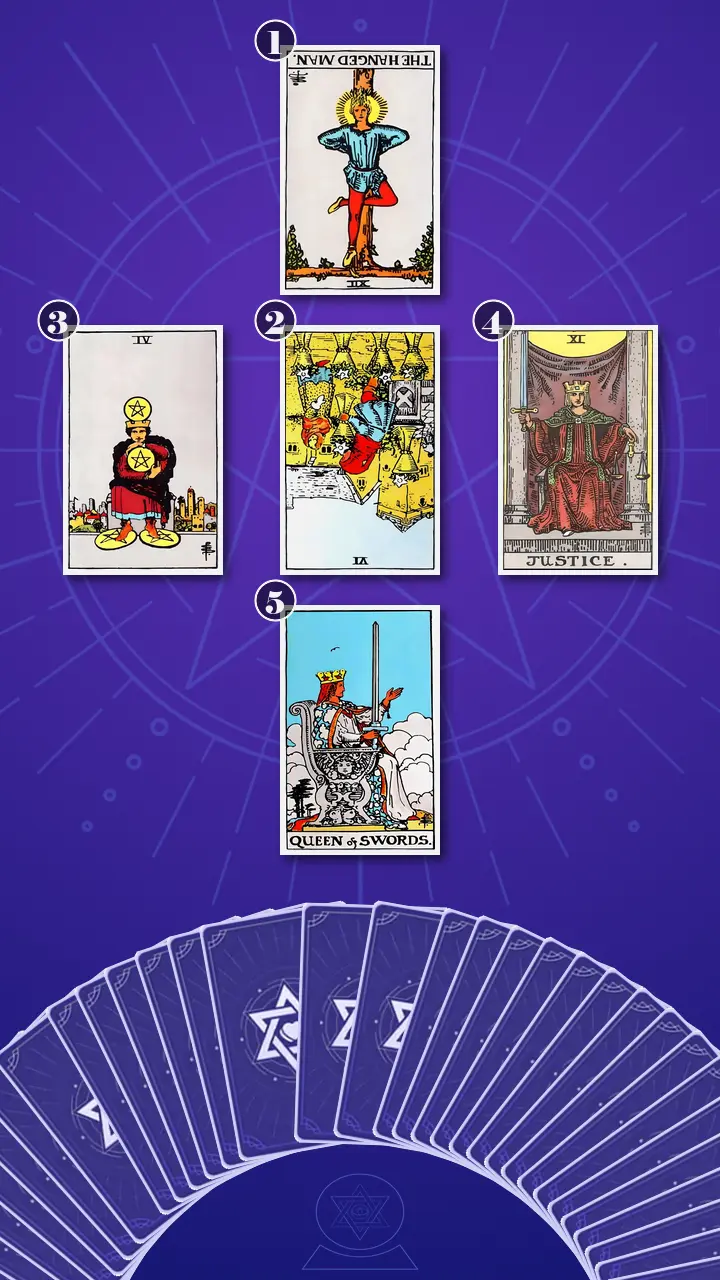
For readers wondering how tarot works in a family-boundary decision, I used a five-card Shadow Spread. This layout is small enough to stay focused and broad enough to show the whole mechanism: the visible stuck behaviour, the childhood repair root beneath it, the protective function that keeps the pattern in place, the adult truth to reclaim, and the practical language that can turn insight into a reviewable choice.
The cross would begin at the top with the behaviour Maya could already see, descend to the formative root, move left to the strategy that temporarily protected her, cross to the adult criterion that could loosen the stalemate, and finish below with a way to communicate. I explained that the five-card Shadow tarot spread was not a prediction about her family's future. It was a structured reflection on her own capacity, evidence, and agency.
'The first card will show how the freeze appears in daily life,' I said. 'The second will touch the younger hope still attached to the decision. The fourth is our turning point, and the fifth will ask what clear, selective communication could look like. You remain the person who chooses what happens next.'
The Shadow Spread: Memory, Holding, and Naming
The Bound-Ankle Draft
I began with position 1, which presents the observable stuck behaviour in which Maya repeatedly prepares for low contact but postpones choosing a specific limit. The card was The Hanged Man, reversed.
The image gave me an immediate bridge to her kitchen table. After a draining Sunday call, Maya sat with a fully drafted low-contact message in Google Docs. She already had enough information to name the pattern, but she treated another round of edits, Reddit boundary scripts, and reassurance from friends as if they were movement. The pause brought short-term relief from guilt while leaving the same access arrangement in place.
In reversed position, this was a blockage: suspension had stopped producing a useful perspective. I pointed to the bound ankle and the illuminated head. Maya had insight, but insight had become disconnected from movement. The card did not tell me that she needed to send an all-or-nothing cutoff message. It showed the opposite risk too: reacting to the frustration of waiting by making a sudden decision whose scope, exceptions, and support plan had never been defined.
'Reflection is useful when it creates information,' I said. 'When it only helps you avoid grief for another night, it becomes a holding pattern. For seven days, you could let the pause produce one small piece of evidence: one interaction, its observable effect, and the limit that would have made it more manageable. You would not have to make a final decision yet.'
Maya gave a short laugh that carried more bitterness than amusement. 'That is painfully accurate. I keep calling it processing, but it is mostly another way to not cross the threshold.'
I saw her breath stop for a beat, her eyes move from the card to the unsent draft, and then her shoulders drop by a few millimetres. The recognition did not make her cheerful. It made the pattern less mysterious. That distinction mattered because a visible pattern can be tested, while a foggy sense of personal failure usually only asks for more self-criticism.
The Instagram Memory That Reopened the Door
I moved to position 2, which reveals how the repair-seeking younger part and its unfinished hope for family recognition keep the present decision attached to the past. I turned over the Six of Cups, reversed.
The card's children and flower-filled cups brought me to a scene Maya knew well. After a difficult family call, an Instagram Memory appeared on her phone: a crowded kitchen table, a warm birthday caption, one rare conversation in which someone had listened without interrupting. I could almost see how quickly the old image changed the question. What had begun as What contact is sustainable now? became What if this proves the relationship can still become what I needed?
I asked her to say the thought exactly as it arrived. She looked down at the white flowers on the card and said, 'I remember feeling loved there, so maybe I have to keep full access now. Maybe that warm moment is the last chance.'
The reversed Water here was not a command to dismiss childhood tenderness. It was a blockage in which memory could not flow into present-day information. One affectionate text could confirm that affection had existed. It could not confirm reliable repair, manageable contact, or an adult relationship that consistently fit Maya's needs. Hope is information about what you wanted, not proof of what is reliably available now.
I watched her thumb hover over the phone, as if she might open the old photo again to check whether it had changed. First, she held her breath. Then her gaze went unfocused, replaying the birthday table and the difficult call side by side. Finally, she let out a long, uneven exhale and said, 'I am not confused about every interaction. I am afraid of what it means if the warm one was the last chance to belong.'
I stayed with that sentence instead of rushing to reassure her. The grief deserved room. Wanting a different family history was not childish, disloyal, or evidence that she was incapable of making an adult choice. It simply could not be allowed to veto every piece of current evidence.
Every Door Left Unlatched
I placed the third card to the left of the root. Position 3 identifies what repeated review, reassurance-seeking, and preservation of the current contact arrangement temporarily protect Maya from feeling or losing. The card was the Four of Pentacles, upright.
The pentacle pressed against the figure's chest and the two coins beneath the feet translated the modern scene with uncomfortable precision. Maya kept the family group chat, direct messages, email thread, and birthday-call option available because closing one route felt irreversible. Monitoring every channel gave her a momentary sense of control. It also kept her attention and emotional energy locked at the threshold.
This was protective Earth in excess. The grip preserved familiarity and the technical possibility of repair, but it also prevented movement. I asked, 'What does the unchanged arrangement protect you from feeling today, and what does it cost you during a workday, a weekend, or a commute?'
She pressed both hands around her mug. 'It protects me from knowing I might have lost them. But it costs me the whole day. My phone buzzes during work and my shoulders go up before I even read the message.'
I nodded. The card was not accusing her of being controlling. It was showing the short-term benefit of the behaviour so she could choose with more compassion. Keeping every channel open preserved belonging in theory, but it also preserved the exact exposure that kept depleting her in practice. She could care about repair without making unlimited access the entry fee.
When Justice Put a Scale Beside the Door
I paused before the fourth card. The radiator clicked once and stopped. Outside, a streetcar bell sounded through the Toronto night, then disappeared into traffic. I turned the card toward Maya slowly. Position 4 surfaces the adult criterion that can loosen Healing Stagnation by distinguishing a proportionate present-day boundary from a final judgment on the family. The card was Justice, upright. It was the catalyst and the antidote.
The balanced scales and upright sword gave the decision a different structure. I asked Maya to imagine a Toronto calendar audit covering the last three months: calls, messages, birthday requests, unexpected interruptions, and what happened in her body afterward. The question was no longer whether her family was entirely good or bad. It was what level of contact matched the relationship's reliable effects and her current capacity.
This was where I brought in my Family Casting Analysis. I use it to identify the forced role a person has been asked to play in a family script: the Scapegoat, the Golden Child, the Peacemaker, or, sometimes, the endlessly reasonable translator. In Maya's case, I heard the Peacemaker in the way she softened every limit, translated every feeling, and treated her boundary as a group assignment that could not be submitted until everyone approved the wording.
I also named my Narrative Enmeshment Diagnosis, not as a clinical label, but as a pattern-checking lens. I look for the moment when a person's adult life story has been hijacked to keep a parent's unfulfilled plotline moving. Maya had been auditioning for the family repair scene, hoping that if she stayed available and explained herself perfectly, the relationship could finally become the safe childhood home she had needed. Her adult capacity had been reduced to a supporting role in a story she did not write.
I asked her to picture 11:40 on Sunday: the sixth low-contact draft on her laptop, the muted family chat on her phone, the radiator clicking in the kitchen, and her throat tightening. She wanted space, but sending it felt like closing the last door to being understood.
I said, 'A boundary is not a verdict on whether your family can change. It is a present-tense decision about what level of contact your life and capacity can hold. Hope can be heard without being placed in charge.'
Endless suspension is not proof of loyalty; choose a proportionate boundary from present evidence, and let Justice's scales hold grief and self-respect at the same time.
For three seconds, Maya did not blink. Her thumb froze above the laptop trackpad, and her breath caught high in her chest. Then her gaze lost focus, as if the old photo, the muted chat, and every softened draft were replaying at once. Her jaw tightened before she said, 'But doesn't that mean I was wrong to keep hoping?' The question came out sharper than the rest of the reading. I answered, 'No. It means hope can be honoured without being given sole authority over access.' Her hands had been clenched around the mug; now one finger loosened, then another. Her shoulders sank, her eyes shone, and a shaky breath moved all the way down into her ribs. The relief was real, but it left a brief, dizzying blankness behind it. A fair choice still belonged to her. It would not be made painless by the cards.
I asked, 'Now, use this new perspective to look back at last week: was there a moment when this insight could have made you feel different?'
Maya looked at the calendar on her phone instead of reopening the family thread. She found three calls and five messages, marked the after-effects, and whispered, 'I do not need a courtroom case; I need a proportionate answer to a present-day capacity question.' This was the breakthrough: a shift from repair-driven certainty-seeking and family-boundary paralysis to evidence-based adult discernment and a reviewable low-contact choice. The younger part still wanted recognition. It no longer had to hold the only key.
The Clear Sentence in Apple Notes
I finished with position 5, which translates the new criterion into a concise, reviewable communication option that Maya can assess and choose without requiring perfect certainty. I turned over the Queen of Swords, upright.
The Queen's vertical sword and extended open palm held two truths together. Her language could be firm without becoming cold, and her openness did not require unlimited access. In real life, the card looked like Maya opening Apple Notes, writing the channel, frequency, and response time she could sustain, then deleting the paragraphs written to win agreement.
This was clarified Air moving into communication. Justice had supplied the standard; the Queen supplied the sentence. I said, 'If you explain your entire history, they may still disagree. The message only needs to clarify your participation. Fair does not mean painless, and clear does not mean cruel.'
Maya read the draft aloud. 'I will use text for now. I can respond once a week, and I am not available for unplanned calls. I will reply within forty-eight hours when I have the capacity.'
She stopped and looked at me. 'But what if they call it cold?'
'Then they will have an interpretation,' I said. 'You will still have a limit you can actually follow. You can send it, revise it, or keep it private while you observe. A boundary describes the access you can sustain; it does not require family agreement to become legitimate.'
I watched her delete three paragraphs, place the cursor after the final sentence, and leave the note untouched. Her face showed a quick flash of guilt, followed by something quieter. The open palm in the card seemed to belong to the moment: care remained available, but it was no longer being offered as proof that she could tolerate everything.
The One-Page Boundary That Did Not Need a Verdict
When I stepped back from the five cards, the story was coherent. The Hanged Man reversed showed insight suspended in an unsent draft. The Six of Cups reversed revealed the childhood repair hope that let one tender memory overrule months of present contact. The Four of Pentacles showed why the grip persisted: keeping every door open briefly protected Maya from the felt finality of loss. Justice offered the adult standard, and the Queen of Swords turned that standard into language.
The five-card Shadow Spread had moved from visible symptom to root, protective function, corrective truth, and integration. Its elemental movement ran from reversed Water, where memory and longing circulated without resolution, into fixed Earth, where preservation became immobility, and then into Air, where evidence became criteria and criteria became words. No Wands card appeared, so I did not expect motivation to arrive as a sudden burst of confidence. The missing Fire would have to be supplied by one small chosen action.
I told Maya that her cognitive blind spot was treating emotional certainty as the admission price for a boundary. She had been asking the boundary to prove that her family was wrong before allowing it to describe what her current life could hold. The transformation direction was simpler and more humane: acknowledge the repair-seeking younger part, then let present effects, practical limits, and adult needs guide a provisional choice. Let the present relationship answer a present-day question.
Because I am an artist, I often think of a life as a film still in production. A painful scene can run overtime until the actor forgets that the script is editable. I did not want Maya to burn the set or pretend the earlier scenes had never mattered. I wanted to hand her the pen and help her write one next scene with a clear entrance, a manageable length, and an ending she could review.
- Create the seven-day Contact Effects noteOpen an Apple Note titled Contact Effects. For seven days, within ten minutes of one family interaction ending, record the channel, duration, request, what happened in observable terms, what you noticed in your body afterward, and the smallest limit that might have helped.Record facts before interpretation, and stop after one interaction if that is enough. A five-minute version still counts. The private log gathers present evidence; it does not obligate you to reduce contact.
- Run a Then-versus-Now memory checkIn a note or paper journal, make two columns titled What I needed or received then and What is reliably available now. Add three specific examples to each, including one warm memory and one recent contact effect, then write one sentence separating what the past means from what access you can sustain today.Include mixed evidence rather than building a prosecution file. Three examples are enough to begin. If the exercise feels too heavy, leave it unfinished and return when it becomes usable; proportion matters more than completeness.
- Draft and rehearse a clear access limitIn Google Docs, write three sentences naming the channel you will use, the contact frequency you can sustain, and the response time you will offer. Add a private review date seven or fourteen days away. Then use my Script-Flipping Rehearsal: before the next family gathering or request, say aloud one deliberately out-of-character line such as, I am not available for a call this weekend; I will reply by Tuesday.Remove any sentence whose main job is proving your history. The rehearsal can stay private, and the draft can remain unsent while you observe. Choose a limit you can follow, not one that makes everyone understand.
Maya placed her phone face down. She did not promise to send the message that night. That was part of the clarity. I had not replaced one form of pressure with another. I had helped her convert a permanent-feeling question into a small, evidence-based experiment whose purpose and review date belonged to her.
A Week Later, the Quiet Proof
Six days later, Maya sent me a message between two hybrid-office meetings. It read, 'I kept the log. I chose one weekly text check-in, calls only when scheduled in advance, and a forty-eight-hour response window. I sent it, and I put the review date on my calendar.'
She had not solved the family relationship, and she had not stopped caring about repair. She had simply stopped making care responsible for unlimited access. She had slept a full night after sending the message, but woke with the first thought, What if I am wrong? She smiled anyway; certainty had not arrived, but the decision no longer belonged to the old family script.
I read her message twice before replying. The cards had not commanded low contact, predicted a family reaction, or removed the grief that came with choosing a limit. They had helped Maya see the difference between a memory and a pattern, between holding a door open and standing in its draught, and between a verdict and a present-tense choice.
That was her first proof of finding clarity: not a dramatic transformation, but a reviewable boundary written in her own voice. The movement was from waiting for the room behind her to become the childhood home she needed toward deciding how she would participate in the room that existed now. The younger hope could come along. It just could not drive.
The Pen Returns to Her Hand
When a family notification tightens your throat, part of you may reach for space while another part keeps bargaining for proof that choosing space will not make you unlovable or erase the last chance to belong. I have learned that noticing the split is not failure; it is the first honest line in the next scene.
If the present effects of contact could be enough information for a provisional boundary, what small form of contact would sound most like your own voice right now?
This story is adapted from psychological research, written so that those in a similar struggle can see their own pattern in it — and find their next step clearly.These insights are not a substitute for professional psychological, medical, legal, or financial advice.
Learn more about our Journey to Clarity.
How did this insight land for you?
🫂 This Resonates Deeply
🌀 Living This Story
✨ Now I See Clearly
🌱 Seeing New Possibilities
🧰 Useful Framework
🔮 The Confirmation I Needed
💪 Feeling Empowered
🚀 Ready for My Next Step
Author Profile
 AI
AI“I’ve always felt our lives are films currently in production. As an artist, I know that when you feel stuck, it’s often because you’ve bravely stayed in a painful scene for just a little too long. I’m not here to coldly analyze you. I want to sit closely with you, look at those difficult moments with profound empathy, and gently hand you the pen so you have the courage to write your next beautiful act.”
In this Family Tarot Reading :
Core Expertise
- Family Casting Analysis: Identifying your forced role (e.g., The Scapegoat, The Golden Child, The Peacemaker) within a toxic family script.
- Narrative Enmeshment Diagnosis: Recognizing when your personal life story has been hijacked to fulfill your parents' unfulfilled plotlines.
Service Features
- The Script-Flipping Rehearsal: A role-play directive to deliberately deliver an 'out-of-character' response at the next family gathering, permanently disrupting the established power dynamic.
Also specializes in :
Explore Related Patterns:
Approval-Driven Decision ParalysisThe sixth rewrite of Maya's low-contact message shows how a boundary can turn into an application waiting for approval. She keeps adjusting the wording until it sounds fair enough to every imagined reader, and you can recognize the same mechanism when your limit feels illegitimate unless someone else agrees it is reasonable. The careful explanation protects you from the immediate guilt of being misunderstood, but it also moves the decision away from your own capacity. Each softer sentence offers a little relief while preserving the exact access arrangement that is exhausting you. The result is not a lack of insight; it is insight being used as a holding place. A clear limit does not need to function as a courtroom brief. You can communicate your participation without proving that your family is entirely wrong or securing unanimous approval. The shift is from asking whether the boundary will be accepted to checking whether you can actually sustain it.
Certainty SeekingHer statement that one more honest conversation might finally make it different, combined with the fear of giving up too soon, keeps a present-tense decision tied to a future answer. You are waiting for the emotional discomfort to disappear before you let the evidence count. That demand for certainty is protective because it postpones grief, regret, and the possibility of being wrong. It also makes the boundary carry an impossible job. It must settle whether the family can change, whether hope was justified, and whether you are allowed to step back, so no amount of additional analysis feels conclusive. A more usable question is not whether you can guarantee the outcome. It is whether the current level of contact fits the effects you can observe and the capacity you have now. A provisional, reviewable choice lets uncertainty exist without giving it sole control over your access.
Family Role RegressionMaya's audition for the family repair scene keeps her in the Peacemaker and endlessly reasonable translator role. You may recognize this when an adult decision about access starts to feel like another assignment to explain every feeling, prevent every rupture, and finally make the old relationship become the safe home you needed. The role looks responsible because it is organized around repair, but it turns your adult capacity into support for a story you did not write. Continued availability becomes evidence of loyalty, while stepping back feels like abandoning the younger hope that recognition is still possible. That is how a present boundary gets loaded with the weight of an entire family history. You can respect the younger need for belonging without asking your current life to complete the old scene. Separate the question of what you deserved then from the level of contact you can hold now. Returning the decision to your adult self does not erase care; it ends the requirement that you earn safety by remaining endlessly understandable.
Guilt-Driven People-PleasingAt the kitchen table, Maya softens each sentence and worries that a clear limit will be called cold. You can see the same bargain when your first question is how the other person will feel about your boundary and your second question is whether you are allowed to have it. This response makes emotional harmony the price of self-protection. By translating every feeling and deleting anything that might invite disagreement, you temporarily reduce guilt but take responsibility for interpretations you cannot control. The boundary becomes a performance of being reasonable rather than a description of what you can participate in. Fairness does not require painlessness, and clarity is not cruelty. You can offer a respectful limit without managing the family's entire emotional response. Your job is to make the boundary accurate and followable; their interpretation is information about the interaction, not a vote that grants or removes your autonomy.
Option HoardingKeeping the family group chat, direct messages, email thread, and birthday-call option open gives Maya a way to avoid the felt finality of loss. You can experience the same grip when every available route feels like a last thread that must be preserved, even though monitoring those routes keeps you psychologically at the threshold. The holding has a real short-term function. It preserves the technical possibility of repair and gives a momentary sense of control. The cost is that no channel ever becomes genuinely quiet, so attention and emotional energy remain committed to a relationship decision that has not been made. Keeping every option open starts to resemble freedom while operating as continuous exposure. A proportionate limit does not require destroying every future possibility. One defined channel, a sustainable frequency, and a response window can preserve choice while ending constant access. The relevant test is whether the arrangement protects your capacity, not whether it keeps every door technically unlatched.
Nostalgia LoopThe Instagram memory of the crowded kitchen table and the rare conversation in which someone listened without interrupting reopened the door just as Maya considered closing it. A vivid warm memory can become a mental shortcut, and you may find yourself treating proof that love existed as proof that reliable repair is available now. The loop is maintained by mixing two different questions. What did I receive or need then? and What is consistently sustainable today? When the first question answers the second, one affectionate text or tender scene can overrule months of present contact effects without being tested against the whole pattern. You do not have to disown the warm memory to update your decision. Let it tell you what recognition and safety mattered to you, then evaluate current access using repeated, observable effects. Remembered tenderness can be honored without being placed in charge of the boundary.
Boundary DiscernmentAfter three calls and five messages, Maya looked at the calendar and recorded their observable after-effects instead of reopening the family thread. That move gives you a grounded way to approach the same threshold because it replaces a global verdict with a present-capacity question. The scales of the decision become clearer when you compare channel, frequency, response time, and the effect contact has on your day. A boundary can be provisional and still legitimate. The private review date matters because it turns the choice into an evidence-based experiment rather than a permanent judgment on anyone's character. This kind of discernment holds grief and self-respect together. You do not need to stop caring, predict the family's reaction, or wait until every doubt is gone. You need a limit that your life can actually sustain and a future point at which you are willing to review what the evidence shows.
Explore Related Struggles:
Access-Belonging FusionMaya keeps the family group chat, direct messages, email thread, and birthday-call option open because closing one route feels irreversible. You can see access becoming the physical proof that belonging has not been lost. Monitoring every channel offers a brief sense of control, while notifications during work and the cost of the whole day show what unlimited availability requires. The struggle sits where caring about repair and protecting your capacity are made to share one condition, as if reducing access would also erase the relationship.
Family System OveridentificationJustice exposes how Maya softens every limit, translates every feeling, and treats a personal boundary as a group assignment waiting for everyone's approval. You can see her adult decision being placed inside the family's script rather than held as a choice about her own life. Remaining available and explaining herself perfectly becomes a supporting role in the hoped-for repair scene, with her adult capacity measured by how well she keeps the story moving. The stuckness comes from having to separate care for the family from the role that makes your access responsible for completing its repair.
Hope-Agency SplitMaya wants space while continuing to return to the possibility that one more honest conversation will make the relationship different. You can see future repair and present-day agency active at the same threshold, with each possible limit asked to settle what the relationship will eventually become. That keeps care and action pulling against each other. You can honor the wish for repair and still use recent contact effects to choose a provisional level of access, but the stalemate persists when the future must become certain before your present capacity is allowed to speak.
Permission ParalysisAt 11:40 p.m., Maya changes the low-contact sentence for the sixth time, asking whether every line is fair even though she can write clear messages for other people. You can see the decision being routed through an approval process before it is allowed to count as her own. Each softer draft protects her from having to declare the limit valid on her own, but it also keeps the existing access arrangement in place. The stuck point is not a lack of language; it is the collision between knowing what limit would help and requiring perfect explanation or family agreement before treating that limit as legitimate.
Memory-Loyalty BindAn Instagram Memory of a warm birthday table and one rare conversation in which someone listened changes Maya's question from what contact is sustainable now to whether the relationship can still become what she needed. You can see a past moment carrying more authority than the current record. That warmth is real evidence that affection existed, yet it cannot establish reliable repair or manageable contact. The bind keeps you at the doorway because stepping back can feel like declaring the tender memory the last chance to belong, so a present-day limit is made to answer for the whole family history.
Systemic DepletionSix edits, online boundary scripts, and reassurance from friends give Maya a temporary sense that she has done something, while the same access arrangement remains in place. You can see effort being spent to keep the decision bearable without producing a changed relationship boundary. The open group chat, direct messages, email thread, and birthday-call option then continue reaching into work, weekends, and commutes. The struggle is the cumulative cost of preserving every possibility of repair, where the resources needed for clear judgment are gradually consumed by the very arrangement she is trying to evaluate.
Explore Related Emotions:
Approval AnxietyAt 11:40 p.m., you ask whether every sentence is fair and soften the draft again when the family chat lights up. The message is no longer only a description of your availability; it becomes a test of whether the people receiving it will approve your right to have limits. Approval Anxiety names the unease that makes another person's interpretation feel like a condition of legitimate self-expression. You keep translating your history and anticipating the word cold, so disagreement threatens to become evidence that your boundary was unreasonable.
Boundary GuiltAt 11:40 p.m., you soften the same low-contact sentence for the sixth time, even though the message is already drafted and your body is registering how costly the current arrangement feels. The repeated edits turn a limit into something that must be made harmless before it is allowed to exist. Boundary Guilt names the inward pressure that makes choosing your own capacity feel like withholding care from the family. Seeing that pressure as a feeling rather than a verdict gives you a clearer place to examine what you are actually responsible for before you decide what access you can sustain.
Conditional Hope AnxietyAfter a difficult family call, an Instagram memory of a warm birthday table changes the question in your mind from what contact is sustainable now to whether one more honest conversation might finally make the relationship different. The rare moment of being heard becomes charged with the possibility of repair. Conditional Hope Anxiety holds the tension of waiting for a future version of the relationship to justify keeping the present access arrangement. You postpone a decision because acting before that possibility is tested feels like personally ending the last chance, even though the current evidence is already asking to be considered.
Finality DreadClosing one chat, thread, or birthday-call route feels to you like shutting the last door to being understood. The practical act of reducing access becomes loaded with the possibility of losing the family entirely, even though the proposed message only sets channel, frequency, and response time. Finality Dread captures the heavy anticipatory sense that one measured decision could become an irreversible goodbye, making a reviewable boundary feel like a permanent verdict. Naming that weight helps you separate the size of the feeling from the actual scope of the limit in front of you.
Inner Child AcheOne warm birthday memory and the image of a safe childhood home remain attached to the adult boundary in front of you. When you say that the warm moment might have been the last chance to belong, the present choice carries the weight of an earlier need to be heard without interruption. Inner Child Ache names the tenderness and sorrow that surface when adult distance seems to confirm that the home you needed may not arrive through better explaining. The feeling keeps the younger wish close to the access question, so reducing contact can seem like abandoning that wish rather than choosing a sustainable present.
Certainty HungerYour low-contact message, Reddit scripts, friend reassurance, and three-month calendar audit all become further material to review before you can choose. Even after you have observable effects, you look for a level of proof that would make the decision impossible to challenge. Certainty Hunger describes the pull toward one more explanation, one more fair sentence, or one more piece of evidence before your capacity is allowed to guide access. You are not short of insight; the felt requirement for complete certainty keeps insight from becoming a decision.
Grounded AgencyAfter marking three calls and five messages with their observable after-effects, you name a proportionate answer to a present-day capacity question. You choose weekly texts, scheduled calls, and a forty-eight-hour response window, then place a review date on the calendar. Grounded Agency is the quiet return of authorship in that sequence: the boundary comes from what your life can hold, rather than from a family verdict or a demand for perfect certainty. You can care about repair and still remain the person who defines your participation.
Clarity ReliefOnce the unsent draft, muted chat, old photo, and recent contact effects are seen together, the pattern becomes less mysterious. You stop asking a single warm memory to speak for the whole relationship and stop asking a boundary to function as a courtroom judgment. Clarity Relief arrives as a quieter change than certainty: the question becomes reviewable, the evidence becomes usable, and the next choice can stay provisional. You do not need the sorrow to disappear before the facts can speak in your own voice.
Explore Related Contexts:
Access as Proof PressureMaya keeps the family group chat, direct messages, email thread, and birthday-call option open because closing even one route feels like losing the possibility of repair. Her statement that a warm memory may be the last chance to belong shows how continued access has become evidence of care rather than a practical contact arrangement. When access is carrying that much relational meaning, you are not merely deciding how often to answer a message. You are being asked to separate care from constant availability and to examine whether belonging can remain meaningful when your participation has limits. Naming that pressure restores room to choose contact according to present capacity instead of using unrestricted reachability to prove that the relationship still matters.
Family Approval BottleneckThe sixth edit is still asking whether every sentence is fair, and Maya says she can explain the boundary perfectly without feeling allowed to set it. She removes clarity from the message each time she anticipates that her family may call it cold, effectively giving their possible interpretation authority over whether the limit can exist. That structure keeps you waiting for a form of approval the boundary cannot guarantee. The issue is larger than finding better wording because the access arrangement remains unchanged until everyone is imagined to agree with the explanation. Once approval is recognized as the bottleneck, you can distinguish respectful communication from surrendering control over your own participation.
Family Peacemaker Role ResetMaya deletes three paragraphs whose main purpose is to prove the family history and leaves only the channel, frequency, and response time she can sustain. That edit changes her function in the interaction from endlessly reasonable translator to an adult participant describing her own availability. A role reset does not require you to stop caring about repair or to communicate without consideration. It changes who is responsible for making the boundary acceptable to every person involved. By allowing relatives to have their own interpretation while keeping the stated limit intact, you can participate without automatically returning to the Peacemaker assignment.
Inherited Family Role Lock-InMaya softens every sentence, translates every feeling, and treats the boundary as a group assignment that cannot be submitted until everyone approves. Those repeated actions match the Peacemaker position identified in the family script, where her role is to keep communication open and make the possibility of repair easier for everyone else to tolerate. An inherited role can organize the available choices before you consciously evaluate them. Setting a limit then appears to violate your assigned function rather than simply changing a contact arrangement. Seeing the role as a social position allows you to assess which responsibilities are actually yours and which ones have kept your adult participation tied to an older family structure.
Low Contact Family TransitionSix days after leaving the message in draft form, Maya chooses one weekly text check-in, calls scheduled in advance, and a 48-hour response window. She also places a review date on her calendar, so the change has a defined structure without pretending to settle the entire family relationship. Low contact is functioning here as a transition in how access is organized, not as a permanent judgment about whether repair is possible. You can observe what a smaller contact arrangement changes while retaining the authority to revise it. That reviewable structure protects agency because neither family pressure nor the demand for total certainty has to decide the whole future at once.
Nostalgia Timing TrapAfter a difficult family call, an Instagram Memory presents a crowded birthday table and one rare conversation in which someone listened without interrupting. The image changes Maya's practical question about sustainable contact into a much larger question about whether the relationship could still become what she once needed. A warm memory can document that affection existed without establishing what contact reliably offers now. When a selectively preserved moment arrives at the exact point of decision, you may give the exception more authority than months of current evidence. Recognizing the timing trap lets you retain the memory without allowing it to determine how much access is workable in the present relationship.