Fear of Losing Belonging: Testing One Honest Family Boundary

The Sunday-Night Fear of Losing Her Place
I was sitting with Jordan, a 29-year-old Toronto nonprofit project coordinator who could organize everyone else's crisis, yet a Sunday family group chat could turn one dinner question into a mediation shift before she had even checked her own plans. I recognized the quiet machinery of family boundary guilt immediately: emotional labor first, personal capacity later.
Jordan gave me the exact timestamp. At 8:47 p.m., she had been standing in her Toronto apartment kitchen with her own plans open on the table when she checked the family iMessage thread to confirm dinner. The fridge hummed behind her. Her phone warmed her palm as two relatives turned a practical question into an argument, and before anyone asked for help, her jaw clenched, her shoulders rose, and her thumbs began composing a paragraph that validated both sides.
“I wanted to put the phone down,” she told me, rubbing the hinge of her jaw. “But the second the chat gets tense, my body starts writing the apology. I think, if I don't reply first, who will stop this getting worse?”
The question she brought to my table was simple enough to fit in one line and heavy enough to have shaped years of her life: “What do I fear losing if I stop playing my family role?”
She paused, then added, “I know this role is exhausting, but at least I know how to be needed. If I stop being the reasonable one, what exactly will be left of my place in this family?”
I heard the contradiction underneath her words. She wanted to stop being the family's automatic peacemaker, but she feared that putting down the role might cost her approval, warmth, identity, and access to the family circle. Her fear of exclusion was not floating around as an abstract thought. It felt, from the way she described it, like a fire alarm wired directly into her rib cage: every disappointed tone pulled it, and her body treated immediate usefulness as the only route back to safety.
I told her, “I am not here to tell you to cut anyone off, and these cards cannot promise how another person will respond. We are going to separate what you fear from what you know, what you freely choose from what you perform, and what belongs to you from what belongs to the other adults in the conversation.”
I have always thought of a life as a film still in production. Feeling stuck often means someone has stayed bravely inside a painful scene for so long that the scene has begun to look like the whole story. I told Jordan that our journey toward clarity would not produce a verdict about her family. We would review the existing footage, identify the inherited script, and place the pen back in her hand.

Choosing the Doorway: A Five-Card Shadow Spread
I invited Jordan to put both feet on the floor, take one unforced breath, and hold the question in plain language while I shuffled. I use that brief pause as a transition for attention, not as a performance of mystery.
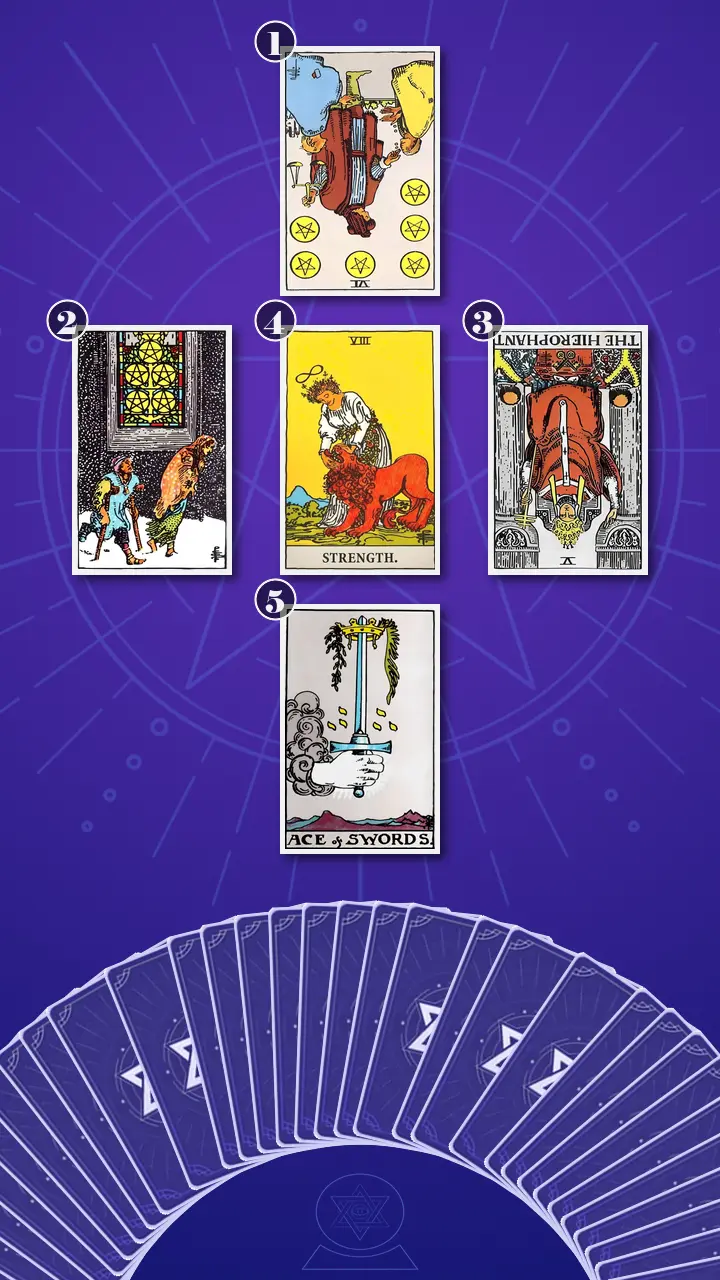
I chose The Shadow Spread · Context Edition, a five-card RWS tarot spread for exploring inherited family roles, exclusion fears, and boundary guilt. I chose it because Jordan was not asking me to predict another person's behavior. She was asking what happened inside her when she imagined stepping out of an identity that had once helped her stay connected.
This is how tarot works best in a question like this: the cards create a stable external structure for examining an internal loop. They let me put fear, behavior, inherited belief, inner resources, and actionable next steps in separate positions. Card meanings in context can then challenge a conclusion that feels inevitable without pretending to know the future.
I placed the cards in a compact cross. The top position would show the visible inherited role. The two side positions would reveal the feared loss and the old family rule supporting that fear. The central card would identify the quality Jordan could use to integrate guilt, grief, anger, and connection. The final card, below the center, would offer one grounded experiment rather than a permanent decision.
I explained that the layout resembled a person moving through a doorway. The old uniform waited above and behind. The threshold sat in the center. One deliberate step waited on the other side.
The Family Help Desk and the Price of Calm
Position One: The Invisible Mediation Shift
I said, “The card I am turning now represents the visible inherited family role: taking emotional labor, mediating conflict, and saying yes before checking your own capacity.”
I turned over the Six of Pentacles, reversed.
In the image, a red-clad figure holds a scale while distributing coins to two kneeling recipients. Upright, the card can describe generosity and the thoughtful distribution of resources. Reversed here, its energy showed an excess of responsibility and a blockage in reciprocity. Jordan had not lost her capacity to care. Care had become entangled with approval, relief, and access.
I translated the image into the scene she knew. The family group chat had become a customer-support queue in which every unresolved feeling appeared as a ticket she had to close before she could log off. Like the figure allocating coins, she distributed reassurance, softened messages, judged who needed an immediate response, and spent her own time without placing her plans on the scale.
“The private line underneath it is, If I do not reply first, who will keep this from getting worse?” I said. “The question is not whether you are generous. The question is which contributions you genuinely choose and which ones you use to purchase temporary calm or proof that you still belong.”
Jordan did not nod. First, her breath snagged. Then her fingers hovered over her face-down phone while her gaze drifted toward the edge of the table, as though she were replaying several message threads at once. Finally, she gave a short, bitter laugh.
“That is so accurate it feels a little cruel,” she said.
I let the comment land before answering. “Then we keep the cruelty out of the interpretation. This card is not accusing you of manipulation. It is showing a survival arrangement: you learned that usefulness could reduce tension quickly. That strategy makes sense. We are only asking what it costs now, and whether you still want it running automatically.”
Her jaw loosened by a fraction. “The relief is real when everyone calms down,” she said. “But then I am angry that I had to make it happen. And because I volunteered, I decide I am not allowed to be angry.”
I pointed back to the scale. “That sequence is the imbalance. Your resentment is not proof that you do not care. It may be the first honest signal that your capacity was never included in the calculation.”
Position Two: The Warm Window on the Other Side
I said, “The card I am turning now represents the feared loss beneath your question: what you imagine could disappear if you stop performing the role.”
I revealed the Five of Pentacles, upright.
Two figures move through snow beneath an illuminated stained-glass window. One is bandaged; the other leans on a crutch. I told Jordan that the card gave her fear a visible landscape: cold distance outside, warmth and membership glowing overhead.
In her modern life, this was the possibility of looking at a family photo or opening the group chat after an argument had settled without her. It was the thought, What if they still talk, laugh, and make plans, but there is no place for me unless I am fixing something?
I was careful with the distinction. “This card does not establish that your family will exclude you,” I said. “It shows the exclusion your nervous system predicts. Fear is being placed on the table as information, not promoted into evidence.”
Outside my window, a streetcar bell sounded once and receded. Jordan's shoulders drew inward as she looked at the lit window on the card. I watched her thumb press into the center of her palm.
“If they still included you but stopped relying on you to mediate,” I asked, “what would feel most unfamiliar?”
She was quiet long enough for the radiator to click twice. “I would not know why I was there,” she said. “That sounds awful. I know people can love me without needing a service from me. But being needed is the evidence I know how to read.”
“That is the feared loss,” I said. “Not necessarily the whole relationship. You may be afraid of losing the special status of being indispensable inside it. Being needed can feel like proof of belonging, even when it is costing you access to yourself.”
I also named the grief under that realization. Rest was not the only thing Jordan wanted. She wanted uncomplicated connection, the kind that did not require her to monitor the emotional temperature of every room. The Five of Pentacles allowed that longing to exist without turning it into a forecast of abandonment.
Position Three: The Rulebook Installed as an Operating System
I said, “The card I am turning now represents the inherited belief and the disowned need inside this conflict: the family rule you absorbed, and the autonomy or anger that rule has kept out of view.”
I turned over The Hierophant, reversed.
The Hierophant sits as a keeper of established teachings. Two acolytes kneel before him, and crossed keys rest at the base of his throne. Reversed, the card did not command Jordan to reject every family value or tradition. It showed inherited authority being questioned after functioning for so long as internal law.
I described the crossed keys as login credentials to family membership. The phrase “you are the reasonable one” had operated like a verification badge: it granted Jordan approval while quietly assigning unpaid emotional labor. The two acolytes looked to me like younger versions of her learning the approved posture for belonging.
“Try this sentence,” I said. “I value care, but I learned to prove care by...”
Jordan's answer came immediately. “By making myself available. By explaining everyone to everyone else. By making sure nobody can call me selfish.”
I thought of rehearsal rooms from my years as an artist, where an actor can keep hitting an old mark perfectly even after the scene has changed. Jordan's body still knew exactly where to stand in the family script. Accuracy had become indistinguishable from loyalty.
I also recognized a pattern I call Safe-Choice Sabotage Recognition. Jordan's apparently logical plan was to find boundary wording so flawless that nobody could feel hurt, disappointed, or critical. It looked responsible. In practice, it protected her from the inciting incident her next act required: discovering that another person's discomfort could exist without automatically becoming her assignment.
“Your search for perfect wording is not creating safety,” I told her. “It is postponing the test. You keep editing the message until the moment passes, and the old rule wins by default.”
Her fingers tightened around the edge of her sleeve, then released it. Her eyes had gone slightly bright.
“I have a Notes app graveyard full of boundaries,” she said. “I keep thinking I can set one as long as nobody has a negative feeling about it.”
“A negative feeling is not automatically evidence that your limit is wrong,” I said. “Guilt can be information about an old rule without being an instruction to obey it. Questioning one rule is closer to changing a recurring calendar setting than deleting the entire family archive.”
When Strength Rested a Hand on the Lion
Position Four: The Integration Point
The room became unusually still as I returned to the central card. Even the ordinary light across the table seemed to sharpen around the edges of the spread.
I said, “The card I am turning now represents the integration point: the inner quality that can hold guilt and grief while challenging the belief that connection requires automatic self-abandonment.”
I revealed Strength, upright.
The card shows a woman resting a gentle hand on a lion's jaw. An infinity symbol floats above her head; her white robe and red rose garland hold softness and vitality in the same image. This is not strength as domination. It is patient courage: the capacity to remain present with powerful instinct without suppressing it, obeying it, or attacking it.
In Jordan's life, Strength was the moment she noticed the urge to send another reassuring message and placed her phone face down while the thread remained unresolved. The lion was the tight chest, anger, grief, and fear of exclusion. The gentle hand was compassionate attention that refused to hand the keyboard to those feelings. The card's energy was balanced: neither appeasement nor shutdown, neither forced closeness nor dramatic withdrawal.
I returned her to 8:47 p.m.: the quiet apartment, fridge hum, open plans, warm phone, and locked jaw. Her thinking still demanded one correct decision that would preserve connection, prevent disappointment, and remove guilt before she acted. Strength did not offer that impossible bargain.
Instead, I used my Narrative Fork Analysis and laid out the competing plotlines. In the first, Jordan stayed the indispensable peacemaker and kept sacrificing access to her own preferences. In the second, she tried to defeat the role by refusing everything, turning a necessary boundary into a punishment neither she nor her relationships actually wanted. The third plotline was less dramatic and more demanding: she remained connected, declined one role task, allowed other adults to own their reactions, and learned who she could become without performing usefulness on cue.
“The most authentic plotline is not always the loudest one,” I said. “Here, it is the one in which you care without becoming the room's regulator. You may not be afraid of losing the role itself as much as losing the proof of belonging that the role has provided.”
You do not have to defeat the family role or obey it forever; you can hold the lion of guilt with compassionate firmness and let one clear boundary reveal what is yours to carry.
For one beat, Jordan's breath stopped. Her fingers froze beside the face-down phone, and her pupils widened as though the room had moved half a step away. Then her gaze lost focus; I could see her replaying the Sunday thread, the cancelled plans, and every carefully softened message. Her eyes reddened, but the first emotion out was anger. “But doesn't that mean I have been doing it wrong for years?” she asked, her voice suddenly sharp. I told her no: the role had once helped her preserve connection and predictability, and recognizing its present cost did not make her past self foolish. Her fist slowly opened. Her shoulders descended, and a wavering breath left her chest, followed by the slight, dizzy stillness that can arrive when a familiar burden is set down and responsibility returns to its real owner. I asked, “Now, using this new perspective, can you remember a moment last week when this insight might have made you feel different?”
“Sunday,” she whispered. “I could have felt guilty and still waited. I could have cared without taking control.”
I named the crossing she had just made. This was not simply a better communication trick. It was one small movement from earning belonging through automatic emotional labor and appeasement toward compassionate self-trust and differentiated belonging. The vulnerability remained: if guilt was no longer the director, Jordan would have to choose her next action herself. That blank space frightened her, but it also belonged to her.
Position Five: The Sentence Waiting Inside the Cloud
I said, “The card I am turning now represents the grounded experiment: one clear, limited form of communication that lets you practise this insight without making a permanent decision for anyone.”
The final card was the Ace of Swords, upright.
A hand emerges from a cloud holding a vertical sword and crown. I read the balanced Air energy as mental clarity becoming speakable. The gray mountains in the distance mattered too: a clean distinction could still be difficult. Clarity did not mean emotional ease.
For Jordan, the Ace was a direct sentence in her Notes app: “I care about this, but I am not available to mediate it tonight.” The sword was not a weapon aimed at her family. It separated what she could offer from what belonged to everyone else.
“One clear boundary can be an experiment, not a declaration of war,” I said. “You are not deciding the future of the relationship. You are testing whether you can stay honest and present while carrying one less task.”
Jordan frowned at the card. “But give me thirty minutes and I will spend all thirty rewriting the sentence. I can make five minutes disappear if I think somebody might call me cold.”
I adjusted the exercise. I set a sixty-second timer and asked her not to draft anything yet. I asked her to notice only her chest, jaw, shoulders, breath, and the impulse to explain. When the minute ended, I invited her to write one line beginning with I can or I cannot.
She wrote: “I can listen for ten minutes, but I cannot mediate this conversation tonight.”
Her thumb hovered over the screen, but I did not ask her to send it. I reminded her that she remained free to revise, postpone, or decide that this was not the right request to practise with. The exercise was observation and authorship, not forced confrontation. She placed the phone down again, this time without turning it over as if it might issue a verdict.
Drawing the Plotline Beyond the Old Uniform
I looked across the full spread and drew the cards into one coherent story. The reversed Six of Pentacles showed the visible exchange: Jordan supplied practical and emotional relief before checking her capacity. The Five of Pentacles revealed why that exchange felt difficult to interrupt: she imagined herself outside the warmth if she stopped being indispensable. The reversed Hierophant identified the inherited rule beneath the fear: good family members remain available, reasonable, and easy to approve of. Strength supplied the missing inner resource, allowing guilt, grief, and anger to exist without turning them into commands. The Ace of Swords converted that resource into one honest distinction.
The spread began in the heavy Earth of the Pentacles, where belonging had become tied to resources, reliability, and exchange. It moved through inherited authority, warmed at Strength, and ended in the clean Air of the Ace of Swords. No Cups appeared as a suit. I took that absence as a reminder to name the emotional water consciously: Jordan's grief over becoming less indispensable and her longing to be loved without performing a function were present even when they did not have their own card.
The old family role had become an inherited uniform mistaken for skin. Jordan's blind spot was not simply that she over-helped. She treated guilt as proof that a boundary was cruel, confused being indispensable with being loved, and assumed sufficiently perfect wording could control another person's response. That was why every attempt at clarity became a ten-line apology.
The direction of change was more precise than “set better boundaries.” Jordan could test whether belonging had room for an authentic, bounded self by declining one role task while remaining honest about the support she genuinely had available. She did not need to prove that every family tradition was wrong. She needed one piece of evidence that feeling guilty and acting with self-respect could happen in the same scene.
I turned The Shadow Spread · Context Edition from a reflective map into two small experiments. I called the first one her Protagonist Pivot because it moved the most authentic plotline forward within twenty-four hours, before analysis paralysis could reopen the old script.
Two Experiments in Belonging Without Buffering
- The 24-Hour Protagonist Pivot ActionWithin the next twenty-four hours, choose one low-stakes, non-urgent family request. Wait thirty minutes before replying. Then send one specific sentence naming what you can offer and what you cannot carry, such as: “I can listen for ten minutes, but I cannot mediate this tonight.” Offer one alternative only if you genuinely have capacity.Tip: Mute the thread during the pause so waiting does not become monitoring. If thirty minutes feels too activating, use a five-minute version. A pause is not permanent withdrawal.
- The Values-versus-Performance CheckSet a ten-minute timer in your Notes app and create two headings: “What I genuinely value” and “What I perform to avoid disapproval.” Put one concrete family expectation under each, then circle one performed expectation you are willing to question privately this week.Tip: Treat this as a sorting tool, not a verdict on your family. If ten minutes feels too large, write one sentence under each heading and stop.
I asked Jordan which action felt daunting enough to be honest but small enough to be real. She chose the reply pause. Not a speech, not a confrontation, and not a promise to change her whole family system. Just one gap between the notification and the familiar role.

A Week Later: The Message She Did Not Apologize For
Six days later, I received a message from Jordan. A relative had asked her to step into another disagreement, and she had watched her shoulders rise before putting both feet on the kitchen floor. She muted the thread, waited thirty minutes, and sent: “I care about both of you, but I am not available to mediate this. Please speak to each other directly.”
The response was not a cinematic resolution. One relative replied “Okay.” Another left the message unread for most of the evening. Jordan told me she stared at the thread for three minutes, felt the old urge to send a clarifying paragraph, and then kept her dinner plan with a friend.
She slept through the night, then woke with “What if I got it wrong?” as her first thought. This time, she smiled faintly, made coffee, and left the message where it was.
I did not consider the absence of instant certainty a failure. That small, imperfect scene was the proof: Jordan had remained caring without resuming the mediation shift. The cards had not created her boundary or determined its outcome. They had helped her see the competing plotlines clearly enough to choose her own next act.
I left the reading with the same conclusion I had offered at the table: clarity is not always a feeling of complete confidence. Sometimes it is the moment guilt remains in the room but no longer gets final approval over the script.
I know that when the family chat lights up and your chest tightens before you even read the message, it can feel safer to keep earning your place by being useful than to risk discovering whether you are still wanted as yourself. Simply noticing that bargain means the inherited uniform is no longer indistinguishable from your skin.
If the next message arrived tonight and you could rest a gentle hand on the lion without handing it the keyboard, what is the smallest honest I can or I cannot sentence you might let yourself imagine sending?