The 8:47 P.M. Support Account
I have met this moment in Toronto more times than I can count: you are a twenty-something communications coordinator with a client deck still open, a family WhatsApp message glowing beside it, and one ordinary "I can't tonight" suddenly feels more urgent than the work deadline in front of you.
Alex (name changed for privacy) came to me after one of those nights. At 8:47 p.m., she had placed her phone face up beside her laptop after declining a late-night family call. The laptop fan hummed beneath the cold blue wash of a half-finished presentation; outside, wet tires hissed along the street below. Her phone was warm under her fingertips. She had reread a two-line reply, drafted three apologies, deleted them, then added an offer to help tomorrow so that the original no would feel less dangerous.
"I can handle the boundary if I know they will still be there afterward," she told me. "Every no feels like I am spending from a support account that I cannot refill."
I could see the sequence in the way her hands kept returning to the phone: first the small relief of saying no, then a drop through the stomach when a reply sounded brief, then the frantic work of making herself easier to keep. Her fear did not look like a vague cloud. It looked like a fire door closing across her chest while she tried to type her way back into the room.
"You are not saying no because you do not care," I said. "You are saying no while calculating what the no might cost. We are not here to decide whether you should cut anyone off. We are here to find clarity about why one normal limit becomes a referendum on belonging, and to draw a map that gives you more choice."

A Map for Family Boundaries Without Losing Support
I asked Alex to take one slow breath, keep the question close, and shuffle with me. The cards were not a verdict on her family or a prediction of anybody's future. They were a structured way for us to separate what had happened, what her body expected, and what she could choose next.
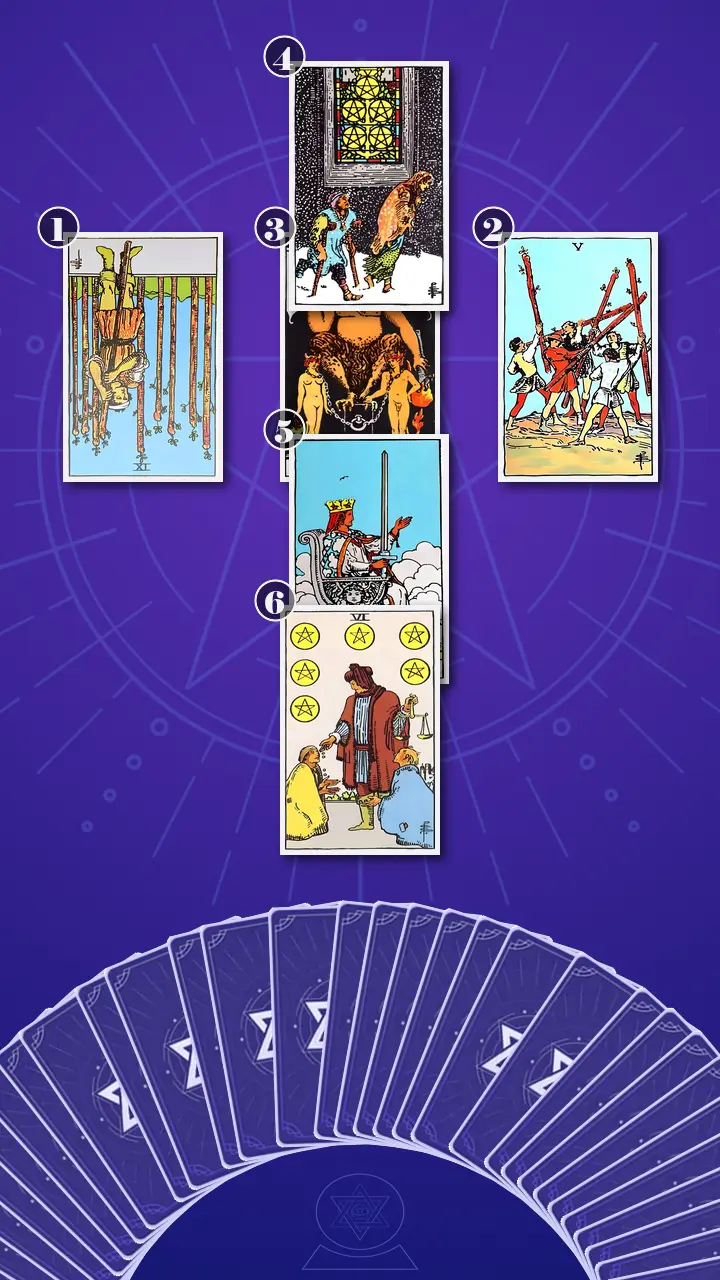
I used a Relationship Spread · Context Edition, a cross-shaped relationship tarot spread for family boundaries. I chose it because Alex's question was not only internal. It lived between her need for autonomy and the family pressure she experienced after claiming it. The spread lets me examine her current response, the friction in the interaction without pretending to know her relatives' motives, the hidden survival rule beneath it all, and a practical next step.
I told her I would begin with her current boundary stance and the family-system pressure she was feeling. Then I would move into the central pattern that linked support to compliance, before following the lower path toward a clearer inner resource and a more reciprocal support exchange.
The Cards Beneath the Group Chat
The Fence That Kept Moving
Now I turned the card representing Alex's current boundary stance, the place that shows the observable pattern of fear, apology, and reversal after pushback. It was the Nine of Wands, reversed.
I looked at the bandaged defender holding one staff before a fence of wands. "This is depleted protection," I said. "The boundary begins as something sensible, but the moment a message comes in, your nervous system treats it like an incoming threat."
The modern version was painfully familiar to her: she says, "I cannot take a call tonight," then reopens the thread every few minutes. Her limit is a fence built to protect an evening, but every delayed reply, critical tone, or "are you okay?" makes her add a gate, an exception, and an apology until the fence protects nothing at all.
Reversed, the card showed blocked resilience. Alex had spent so long bracing that she was trying to make discomfort disappear instead of letting a small boundary stand. I also named the other edge of that pattern: refusing every kind of help to prove independence would not be freedom either. It would turn a needed boundary into isolation.
Alex gave a short, dry laugh, then pressed her thumb into the side of her phone. "That is so accurate it feels a little rude," she said. The laugh landed first; then her gaze dropped; then her shoulders folded forward as if she had been carrying the whole fence alone.
When a Calendar Conflict Becomes a Contest
Next I turned the card for family-system pressure as Alex experienced it, the interactional friction of family boundary backlash without any claim about private intentions. The card was the Five of Wands, upright.
Five figures raised their wands in different directions. "This is what happens when a clear scheduling limit gets pulled into a crowded Slack thread about loyalty, gratitude, priorities, and who gets access to your time," I said.
For Alex, declining one late-night call had sometimes become repeated messages from more than one relative. The original question, "Can you talk tonight?" disappeared beneath commentary about her availability and whether she was becoming distant. The upright energy was active but scattered: friction without a single clear resolution.
"The card does not tell me that anyone is malicious," I said. "It shows the pressure you are actually navigating. The useful question is: which part of this exchange is still about the request, and which part has become a contest about access?"
She exhaled through her nose and looked toward the rain-striped window. "It is never only about the call," she said. "It becomes proof that I am changing."
The Hidden Access Contract
At the visual center of the spread, I turned the card for Survival-Bond Fusion, the co-dependent rule linking contact and compliance to safety and belonging. It was The Devil, upright.
I never read this card as a sentence handed down on a family. I read it as a binding assumption that deserves daylight. The chains in this card became, for Alex, an invisible always-on access contract: help, belonging, and emotional safety seemed available only while she remained reachable on demand.
"Your inner operating system says, 'I can ask for help only if I stay available whenever they want me,'" I told her. "A short reply becomes an account warning. Silence becomes proof that you have lost the whole network. But the card asks a sharper question: is this support freely offered, or are you paying for it with constant access?"
This was where I used what I call Family Casting Analysis. I look for the role someone may have learned to perform inside a family script: the peacemaker, the fixer, the person who smooths a scene before anyone else has to feel it. I asked Alex what role she feared losing if she let the message remain unanswered.
"The reasonable one," she said after a long pause. "The one who makes it less awkward for everyone."
I nodded. As an artist, I think of lives as films still in production. The Devil was not telling Alex that she had to burn down the set. It was showing her a scene she had stayed in for too long: the scene where keeping everyone comfortable was treated as the price of being supported.
The Lit Window Across the Snow
I turned the card for the feared consequence, the vulnerability that made a small family limit feel like exile. The card was the Five of Pentacles, upright.
The figures walked through snow outside a lit window. I felt the room grow quieter around that image. For Alex, the snow had a practical texture: rent, a ride across Toronto, an emergency, a call answered when life became too much. A brief message could make those forms of support feel visible but suddenly inaccessible.
"This card does not say that you will be left outside," I said. "It shows how quickly your body predicts that you will be. There is a difference between support actually being withdrawn and the feared outcome your mind supplies after a delayed reply."
I asked her to name the exact loss she imagined after her last boundary. Her fingers stopped tapping. Her eyes fixed on the lit screen between us as though it had become that stained-glass window. "That I would not get to ask for help later," she said quietly. "That needing them means I do not get to disappoint them."
When the Queen of Swords Raised Her Hand
The Clear Blade, Not the Final Cut
I turned the card for Alex's differentiated inner resource, the clarity and boundary language available to her without deciding the relationship's future. It was the Queen of Swords, upright.
Her sword stood upright. One hand was raised, not in rejection, but in a deliberate pause. I saw the Toronto scene return to Alex's face: 8:47 p.m., phone beside laptop, the two-line family message, three apology paragraphs waiting in Notes. Her old thought was already familiar: if I do not explain this perfectly, they will decide I am ungrateful.
Do not treat every limit as a severing of the bond; use the Queen of Swords' clear blade to name what you can give, what you need, and what support can remain without self-abandonment.
I let the sentence stay in the room. Then I added, "What if clarity is information, not a courtroom defense? You can say, 'I am not available for a call tonight. I can reply tomorrow,' and let the sentence stand. The raised hand is the pause before the old repair reflex takes over."
This was the moment I used my Narrative Enmeshment Diagnosis. I look for the point where a person's own story has been drafted to complete someone else's unfinished plot. In Alex's case, the inherited script seemed to read: a good daughter is always reachable, and a person who needs support must stay easy to access. The Queen did not ask her to become cold or self-sufficient overnight. She invited Alex to revise one line in that script: connection is not the same thing as constant access.
Her breath stopped first. One finger hovered above the phone, motionless. Then her eyes lost focus for a second, replaying a recent Tuesday night when she had added "sorry" four times to a message that had been clear after its first line. Finally, her mouth opened on a quiet, shaken "Oh." Her shoulders lowered, but the release made her look briefly unsteady, as if putting down a heavy bag had revealed how much space was suddenly around her.
"But does that mean I was wrong every time I tried to keep the peace?" she asked. There was a flash of anger beneath the question, followed by grief.
"No," I said. "It means that strategy probably helped you survive a real feeling of risk. We can respect why it developed without asking it to run every scene now."
Within ten minutes, I invited her to write two separate Notes app lines: "I am not available for..." and "Specific support I could ask for is..." She did not have to send either. When her jaw tightened, I reminded her that she could shorten the exercise to a few words or stop entirely. Choice was part of the practice.
I asked, "Now, using this new perspective, think back to last week: was there a moment when this insight could have let you feel different?"
"My aunt asked for a call at ten," Alex said. "I could have said no to the call and still asked for a ride to the station on Thursday. I treated those as the same conversation."
That was the crossing point in her Journey to Clarity: from fear-driven apology and reassurance seeking toward the first, vulnerable form of self-trust. A boundary was not proof that support must disappear. It was a way to make support explicit, reciprocal, and compatible with her autonomy.
Scales Instead of a Hidden Overdraft Fee
Finally, I turned the card for reciprocal support in practice, the next step that separated care from compliance. It was the Six of Pentacles, upright.
The central figure held balanced scales while giving measured coins. "This is not a moral scorecard," I said. "It is a way to make the exchange visible. You can ask, 'Could you pick me up from the station Thursday?' beside 'I cannot take calls after 10 p.m.' Neither sentence has to cancel the other."
The upright energy was grounded and practical. It did not demand perfect equality, especially where Alex still had genuine financial or emotional needs. It offered balance through specificity: what was freely offered, what could be negotiated, what she could give, and what she needed. I watched her sit a little straighter as the support account became less like a hidden overdraft fee and more like an exchange she could actually see.
A 30-Minute Pause and Two Separate Lines
When I looked back across the spread, its story was coherent. The Nine of Wands reversed showed Alex exhausted from defending herself; the Five of Wands showed how a simple limit could become noisy relational friction. The Devil revealed the hidden bargain beneath both: belonging had become fused with compliance. The Five of Pentacles gave that bargain its coldest image, the fear of being shut outside practical and emotional help.
The Queen of Swords and Six of Pentacles offered the counter-story. No Cups appeared in this reading, which did not mean there was no love. It suggested that feeling was being managed through obligation, conflict, availability, and resources rather than named directly. Alex's blind spot was treating the intensity of her prediction as evidence that support had already been withdrawn. Her transformation direction was not independence at any cost. It was differentiated connection: one clear limit and one separate, specific support need.
I gave her three small practices. I framed them as experiments, not tests of worth. A family relationship may respond in many ways; the point was to gather information and strengthen Alex's ability to stay present with her own choices.
- The one-sentence boundary This week, I asked Alex to choose one low-stakes time limit, such as ending a call by 10:00 p.m. or replying the next morning. She would write what she could do and when, then send only that sentence if she chose to. Draft it in Notes first. After family pushback, set a 30-minute timer before reopening the thread. The pause is optional and can be made shorter.
- The separate-lines support request I asked her to keep two lines distinct: "I am unavailable for ___" and "The specific support I could use is ___." Her real example was declining a late call while asking for a Thursday station ride. Record the result as offered, negotiated, declined, or unanswered. Do not turn any one result into a verdict about belonging.
- The Script-Flipping Rehearsal Before the next ordinary family check-in, I asked Alex to rehearse one safe, out-of-character response: "I hear that you want an answer now. I can decide tomorrow." This gently interrupts the old peacemaker role without attacking anyone. Practice it aloud for two minutes. If the interaction feels too charged, choose a less loaded moment, text it instead, or step back.
As I handed the pen back to Alex, I told her, "Ask for support without quietly offering your autonomy as payment. That is not a threat to connection. It is a clearer way of finding out what connection can hold."

A Week Later, a Different Kind of Silence
A week later, Alex sent me a message. She had ended one family call at 10:00 p.m., exactly as stated. She had left the phone untouched for twenty minutes, then checked it without adding an apology. She had also asked directly for the station ride. The reply was not perfectly warm, and she did not pretend it was easy.
That night, she slept through without rereading the thread. In the morning, her first thought was still, "What if I got this wrong?" Then she smiled at the thought, put both feet on the floor, and opened her client deck before opening WhatsApp.
I did not credit the cards with changing Alex's life. The cards gave us images and questions; Alex made the choice to keep one small promise to herself. That was the quiet proof of her journey: she could be separate without making herself disappear.
When a two-line no leaves your chest tight and your phone under your palm, it can feel as if staying separate means losing the people and support that make you feel safe. But noticing the hidden bargain is already a shift in the script.
If one clear limit could sit beside one honestly named support need, what small version of that coexistence would you be willing to imagine for yourself?
Every reading at AceTarot is a journey to connect with inner wisdom and empower the path ahead. This reading shared here is a psychological mirror, not a private record—crafted to reflect universal emotional loops and help restore personal clarity. Please note that these insights do not replace professional psychological, medical, legal, or financial advice, and should not serve as the sole basis for major life decisions.
Learn more about our Journey to Clarity.
How did this insight land for you?
🫂 This Resonates Deeply
🌀 Living This Story
✨ Now I See Clearly
🌱 Seeing New Possibilities
🧰 Useful Framework
🔮 The Confirmation I Needed
💪 Feeling Empowered
🚀 Ready for My Next Step
Author Profile
 AI
AI Juniper Wilde
1056 readings | 537 reviews
“I’ve always felt our lives are films currently in production. As an artist, I know that when you feel stuck, it’s often because you’ve bravely stayed in a painful scene for just a little too long. I’m not here to coldly analyze you. I want to sit closely with you, look at those difficult moments with profound empathy, and gently hand you the pen so you have the courage to write your next beautiful act.”
In this Family Tarot Reading :
Core Expertise
- Family Casting Analysis: Identifying your forced role (e.g., The Scapegoat, The Golden Child, The Peacemaker) within a toxic family script.
- Narrative Enmeshment Diagnosis: Recognizing when your personal life story has been hijacked to fulfill your parents' unfulfilled plotlines.
Service Features
- The Script-Flipping Rehearsal: A role-play directive to deliberately deliver an 'out-of-character' response at the next family gathering, permanently disrupting the established power dynamic.
Also specializes in :
Explore Related Patterns:
Anxious AttachmentYou say that you can handle a boundary only if you know your family will still be there afterward. Because support, belonging, and constant reachability have become linked in your inner rule, declining one call can feel less like managing your time and more like risking exclusion. That link explains why the repair reflex arrives so quickly after a no. The station-ride example introduces a more secure possibility without demanding distance from family: you can make one clear limit and one specific request for support, then allow both statements to be true at once.
Boundary DiffusionAfter you decline the late-night family call, the limit is quickly followed by apology drafts, an offer to help tomorrow, and repeated attempts to make the no feel safer. A boundary that begins as a clear statement of availability becomes crowded with exceptions designed to reduce the immediate fear of losing connection. That repair sequence can teach your system that a limit is only safe once it has been softened enough for everyone else. The later distinction between ending a call and asking for a station ride shows the alternative clearly: support and access do not have to be negotiated as one undivided decision.
Compulsive PeacekeepingAfter setting a limit, you draft multiple apologies and offer more help before anyone has clearly asked for it. You also describe yourself as the reasonable person who makes things less awkward, placing the burden of emotional smoothness on your side of the exchange. Repairing tension may bring fast relief, but it can turn one ordinary scheduling request into a test of whether you can keep everyone comfortable. Seeing that reflex as a learned protection gives you room to let a brief moment of awkwardness exist without immediately paying for peace with your own availability.
Family Role RegressionWhen the family call becomes tense, you move toward the role of the reasonable person who explains, apologises, and makes the scene less awkward. A simple question about availability then becomes entangled with whether you are becoming distant and whether you are still playing the part everyone expects. That role can make a present-day choice feel governed by an older family script rather than by what this evening actually requires. Recognising the role gives you a pause between feeling pressure and automatically becoming the person who must make everyone else comfortable.
Rejection SensitivityAfter you say no, a short response, a delay, or a change in tone can produce an immediate drop through your stomach. Your attention then moves toward repairing the connection before there is clear evidence that anyone has actually withdrawn support. This makes ordinary ambiguity feel personally loaded, as though every signal must answer whether you are still allowed to belong. The useful distinction is not whether you should stop caring about family responses, but whether a response is a fact about support or a cue that has activated your expectation of rejection.
CatastrophizingWhen a family reply sounds brief, you experience it as an account warning, and silence begins to stand for the loss of the whole support network. The meaning of one message expands past the call itself into rent, rides, emergencies, and whether you will be allowed to need help later. The prediction feels convincing because the bodily alarm is immediate, but the story itself separates a feared withdrawal from support actually being withdrawn. Naming that gap lets you treat the thought as a forecast to examine rather than a verdict you must urgently prevent.
Boundary DiscernmentYou practise two separate lines, one for what you are unavailable for and one for the specific support you could use. When you later end a call at 10 p.m. and still ask for the station ride, you test the idea that a limit and a support request do not cancel each other out. This is not detachment or a demand for perfect independence. It is a clearer way to distinguish care from constant access, so you can discover what support is freely available without quietly trading away your autonomy.
Reassurance SeekingAfter the two-line reply arrives, you reread it, draft apologies, delete them, and reopen the thread every few minutes. The phone stops being only a communication tool and becomes a place to look for evidence that you are still safe in the relationship. Each check can briefly lower uncertainty while making the next reply feel even more important. Leaving the phone untouched for twenty minutes after the 10 p.m. boundary creates a different data point: you can tolerate not knowing for a while without having to repair your way back into belonging.
Explore Related Struggles:
Support Access SplitWhen Alex remembers her aunt asking for a ten p.m. call, she can finally picture two separate actions: declining the call and asking for a ride to the station on Thursday. Before that moment, both needs had been folded into one conversation, so preserving her evening seemed to cancel her eligibility for help. You may recognize how quickly a practical request can become loaded with a question of whether you are still allowed to need people. That fusion makes support feel less like something that can be discussed and more like something that can vanish if you disappoint someone. Keeping the two lines distinct gives you a more usable map. A clear limit can state what you cannot offer now, while a direct request can name the help you need, allowing reciprocity to become visible rather than assumed or traded in silence.
Survival-Bond FusionAlex describes every no as spending from a support account she may not be able to refill. A late-night call, a future ride to the station, practical help in an emergency, and the feeling of still belonging all gather into one high-stakes calculation beside her open laptop. You can feel caught when access is treated as the price of safety. Saying no to one request then seems to place your whole right to ask for care under review, even when no one has explicitly withdrawn that care. Naming the bargain creates room to test its terms. You can let a limit and a support need occupy separate sentences, then gather real information about what the relationship can offer without automatically paying with constant availability.
Boundary CollapseAt 8:47 p.m., Alex declines a late-night family call, then rereads a two-line reply, drafts three apologies, and adds an offer to help tomorrow. The original limit is clear, but each new attempt to soften it shifts the evening back toward family access and away from the time she was trying to protect. You can see the strain when a boundary must keep proving that it is harmless before it is allowed to stand. A brief reply becomes enough to reopen the whole negotiation, so repair starts before there is evidence that anything has actually been lost. The later twenty-minute pause matters because it gives the limit a chance to exist without immediate revision. Holding that small space lets you notice that a boundary can be information about your availability, rather than a demand to erase your own needs in order to remain connected.
Inherited Role LockAsked what she might lose by leaving the message unanswered, Alex does not name a task first. She names the role of being the reasonable person, the one who makes things less awkward for everyone. That role appears again when a scheduling limit gets pulled into family commentary about loyalty, gratitude, and distance. You can become locked into a role when the same response that keeps the room smooth also keeps your own answer from being heard. The role offers a recognizable place in the group, while making any move toward separate timing feel like a risk to that place. Rehearsing one out-of-character sentence gives you a way to meet the role without letting it make every decision. You can acknowledge a request, keep your own timeline, and learn what remains possible when you are not doing all of the emotional smoothing alone.
Explore Related Emotions:
Boundary GuiltAfter declining the late-night family call, you reread the reply, draft three apologies, delete them, and then offer help tomorrow so that your original no will feel less dangerous. The boundary is no longer simply information about your evening; it starts to feel like a debt you owe the people who asked for access to you. That sequence turns self-protection into something that appears to require repayment. Boundary Guilt names the ache of feeling that your time, rest, or limit must be justified before you are permitted to hold it. Seeing the repair reflex as a response to fear can give you room to decide whether an apology is truly needed, rather than treating it as the automatic price of staying connected.
Cautious Self-TrustA week later, you end the call at 10:00 p.m. as stated, leave the phone untouched for twenty minutes, and ask directly for the station ride. The next morning, the question of whether you got it wrong is still there, yet you put both feet on the floor and open the client deck before WhatsApp. Cautious Self-Trust is not the absence of doubt or a claim that every interaction will feel easy. It is the growing ability to let your own stated limit remain valid while uncertainty is still present. Each small follow-through gives you evidence that you can stay connected to yourself without needing to erase your needs, your schedule, or your dependence on others.
Conditional Belonging FearYou describe each no as spending from a support account that cannot be refilled, while a brief reply begins to feel like a warning that the whole network could disappear. Help, belonging, and emotional safety become tied to an invisible rule that you must remain reachable whenever someone else wants access. Conditional Belonging Fear is the feeling that connection is available only under certain terms, especially compliance and constant availability. It makes a modest boundary feel like a referendum on whether you still deserve support. The story creates a clearer distinction between support that is actually withdrawn and the old condition your body expects, leaving more room to ask what terms of connection are genuinely present.
Need Exposure DreadWhen you name the loss you fear, it is not only that relatives may be upset about the missed call. It is that you may not get to ask for help later, because needing a ride, support, or care appears to require that you never disappoint the people you depend on. Need Exposure Dread forms when a genuine need feels dangerous to reveal because it seems to place your autonomy on the table. The later distinction between declining a call and asking for a station ride matters because it shows that these are two separate conversations. That separation makes it possible to recognize a need without automatically offering unlimited access in exchange.
Reassurance CrashAt 8:47 p.m., the first feeling after you decline the call is a small release, but a brief reply sends your hands back to the phone. You reread two lines, draft and delete apologies, and try to type your way back into a sense that the bond is intact. Reassurance Crash captures the sharp drop that follows a moment of self-assertion when another person's response feels uncertain. The difficulty is not that you lack a reason for the limit; it is that the space after the limit feels charged with the possibility of losing safety. Naming that drop can help separate the actual message on the screen from the urgent internal demand to repair everything immediately.
Relational Catastrophe DreadA delayed reply after one declined call pulls your attention far beyond that evening. The story moves quickly to the lit window across the snow, then to worries about rent, a ride, an emergency, and whether you will be allowed to ask for help later. Relational Catastrophe Dread is the feeling that a small moment of friction could become a total loss of refuge. It does not require the feared outcome to be happening in order to feel physically immediate. By tracing how the prediction expands from one message to an entire future, you can locate the point where a present interaction becomes much larger than the evidence currently available.
Grounded AgencyYou keep the 10:00 p.m. end time and still ask for the Thursday station ride. These actions place a boundary and a need beside each other without making either one into evidence against the relationship. Grounded Agency emerges when your choices become specific enough to hold. You can name what you are unavailable for, name what support would help, and allow the answer to be offered, negotiated, declined, or unanswered without letting one response define your entire belonging. That practical clarity returns some authorship to the exchange while keeping the relationship in view.
Explore Related Contexts:
Conditional Family SupportAt 8:47 p.m., Alex declines a late call, rereads a two-line reply, then drafts three apologies and offers help tomorrow. She later names rent, a station ride, an emergency, and an answered call as the practical forms of support that seem linked to staying reachable. The story does not establish that anyone has withdrawn help; it shows that the terms of access and care have become hard to separate. You are dealing with a family support arrangement whose limits are not yet explicit. Keeping an unavailable time separate from a direct support request can reveal whether help is offered, negotiated, declined, or left unanswered without making one response a total verdict on the relationship.
Designated Peacekeeper BurdenAfter declining the call, Alex drafts three apologies, deletes them, and adds an offer to help tomorrow. When asked what role she fears losing, she identifies herself as the reasonable person who makes things less awkward for everyone else. You are carrying a family role that turns other people's discomfort into work you are expected to perform. Naming that burden separates a clear time limit from the extra labor of restoring ease, so you can decide what care to offer without automatically making yourself responsible for the entire exchange.
Family Boundary BacklashAfter Alex declines one late-night call, several relatives send repeated messages and the exchange shifts from scheduling to her availability and distance from the family. A limit on one evening is placed inside a wider interaction where access to her time is publicly evaluated. You are navigating a boundary context in which a practical no receives more relational weight than the request itself. Separating the original calendar limit from the later commentary gives you a clearer basis for deciding which response is necessary and which pressure does not belong to the immediate request.
Family Loyalty TestWhen Alex says she cannot take a late-night call, the discussion moves beyond that evening into gratitude, priorities, and whether she is becoming distant. The request for contact is converted into a measure of how securely she still belongs in the family relationship. You are encountering an informal loyalty test when availability is treated as proof of care. Seeing that social rule makes it possible to distinguish genuine connection from a demand that every limit must also prove continued devotion.
Family Support RenegotiationA week later, Alex ends a family call at 10:00 p.m. as stated, leaves her phone untouched for twenty minutes, and asks directly for a station ride. Her time limit and her request for help are no longer presented as one bargain. You have a live structure for making family support more visible without presenting total availability as the price of care. This remains an early negotiation rather than a guarantee about anyone's response, but it gives you concrete information about what can be requested, what can be offered, and what can remain separate.