The 11:40 p.m. Cost of Family Support With Strings Attached
I met Jordan, a 27-year-old fixed-term UX designer in Toronto who could map a clean user journey at work but could not find a criticism-proof way to ask their family, “What would you expect if I accept?”
When Jordan described the previous Tuesday night, I could see it as clearly as if I had been sitting across from them. At 11:40 p.m., they were at the small kitchen table in their rental, rereading a family group-chat offer to cover an upcoming expense. The refrigerator hummed. Their tea had gone cold, but the phone felt warm in their palm. They typed the question, deleted it, typed it again, and finally sent, “Thank you, yes.” Then they opened Google Calendar and moved Saturday's plan with a friend, even though nobody had asked for Saturday yet.
The money problem became lighter for a moment. Jordan's shoulders did not. Their breath stayed caught high in their chest, and relief and resentment pulled against each other like two people trying to steer the same shopping cart down different aisles.
“I cannot tell whether this is help or a tab I will have to pay later,” Jordan told me. “I want the support, but I do not want it to become voting rights over my life.”
I heard the real question beneath the financial one. Jordan was not confused about whether the help mattered. They were afraid that asking about its terms could threaten both practical security and belonging. They were caught between accepting meaningful family support and protecting their time, privacy, honest self-expression, and right to make adult choices without shared approval.
“We do not need to decide tonight whether your family is entirely generous or entirely unfair,” I said. “We are going to make the exchange visible. Every thank-you does not have to become an unspoken yes. Let us draw a map through the fog and see what is actually being sacrificed, what is still worth protecting, and where your choice begins.”

Choosing the Bridge, Not a Verdict
I invited Jordan to place their phone face down and take one slow breath. I shuffled while they held the question in mind. The pause was not a mystical performance; it was a deliberate transition out of the notification loop and into focused observation.
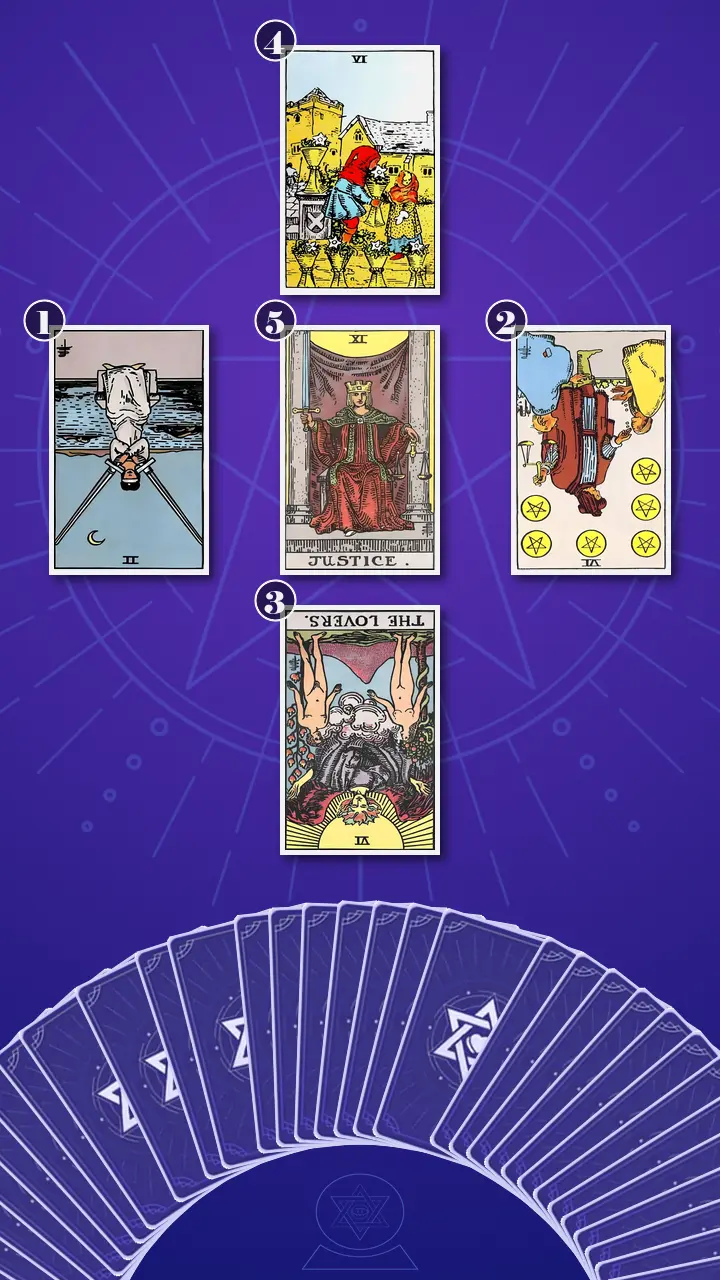
I chose The Bridge · Context Edition, a five-card tarot spread for conditional family support, values conflict, genuine care, and fair boundaries. I use this spread when a relationship cannot be reduced to a simple stay-or-leave decision. It gives me the minimum structure needed to examine both sides of an exchange, the hidden cost beneath it, the bond that still matters, and the principle capable of connecting support with autonomy.
I also explained an ethical adjustment I make to the traditional Bridge spread. The second card would not claim to reveal anyone else's private motives. It would map only what Jordan could observe: what was offered, what was later requested, and who currently had the power to define the terms. Tarot cannot tell me whether another person secretly intends to control, punish, or withdraw support. It can help me organize behavior, symbols, reactions, and consequences into a pattern Jordan can evaluate for themselves.
The first position would show Jordan's current response to receiving help. The third, placed below the center, would reveal what their outward agreement was costing. The fourth would show the genuine affection and history that made the situation emotionally complex. At the center, the fifth card would identify the bridge: the insight or behavior that could let support and self-direction coexist.
This is how tarot works best in my practice. It is not a verdict from outside Jordan's life. It is an externalized cognitive map, one that slows decision fatigue long enough for card meanings in context to become observable choices.
Reading the Map Between Relief and Resentment
Position 1: Two Browser Tabs, Neither Safe to Close
I turned over the card representing Jordan's current response to conditional family support, including delayed decisions, self-silencing, and automatic agreement. It was the Two of Swords, reversed.
In the card, the seated figure's blindfold blocks clear sight while two swords cross defensively over the chest. I read the reversal as Blockage, with Air trapped inside an Excess of analysis. Jordan was not lacking intelligence or information. They were using thought to postpone contact with two truths that felt impossible to hold at once.
At the kitchen table, Jordan had kept two mental browser tabs open. One said, “This help would solve a real expense.” The other said, “Asking about the terms could threaten belonging.” They rewrote the reply until the search for a perfectly safe question became its own form of avoidance. When they finally accepted without clarifying anything, the sudden quiet felt like relief, but pressure had made the decision by default.
“What was the sentence you deleted?” I asked.
Jordan's inhale stopped first. Their gaze drifted beyond the table as if the message thread were replaying in the air. Then they gave a short laugh with a bitter edge and let their shoulders drop half an inch. “That is so accurate it feels a little cruel. I wrote, ‘Would helping with this mean you expect me to visit more often?’ Then I thought it sounded transactional and deleted it.”
I did not treat that reaction as resistance. “The card is not calling you indecisive as a personality flaw,” I said. “It is showing a strategy that tries to protect financial stability and secure belonging at the same time. The problem is that a question cannot become criticism-proof. When you wait for perfect wording, the pressure eventually answers for you.”
I also cautioned Jordan against turning a useful pause into several days of silence. The Two of Swords reversed can overcorrect from immediate agreement into avoidance. A clear holding message protects thinking time without creating a new communication rupture.
Position 2: The Transfer With No Itemized Receipt
I turned over the card mapping the observable terms, expectations, and power imbalance within the support exchange. It was the Six of Pentacles, reversed.
The standing giver holds both the coins and the scales. Reversed, that image showed unequal reciprocity: an Excess of obligations that Jordan felt responsible for anticipating and a Deficiency of mutually stated terms. The problem was not the act of receiving. The problem was that the value of the help and the form of repayment seemed to be defined from the same side.
I asked Jordan to picture the sequence rather than judge anyone's character. An Interac transfer arrived to help with an expense. Days later came requests for a weekend visit, a detailed spending explanation, and faster replies in the family chat. No single follow-up proved a hidden motive. Together, however, they left Jordan tracking an undefined account balance. They could not tell whether repayment meant money, immediate availability, personal disclosure, or agreement with future family preferences.
“An invisible debt still collects real time,” I said. “It can collect Saturday afternoons, private information, attention, and the energy required to defend ordinary adult choices.”
Jordan pressed two fingers against the center of their chest. “No one said I owed them Saturday,” they said slowly. “But saying no afterward feels like breaking a contract I never saw.”
“That distinction matters,” I replied. “We do not need to prove that anyone drafted a secret contract. We need to separate what was explicitly requested from what fear has trained you to prepay. Once those are separated, you can evaluate the actual exchange instead of negotiating with every imagined consequence at once.”
Position 3: When “Sure” Costs an Honest Answer
I turned over the card revealing what the exchange was costing Jordan, particularly the separation between outward agreement and a values-aligned choice. It was The Lovers, reversed.
I read the reversal as Blockage in alignment. The relationship-facing part of Jordan sent “of course” into the family group chat. Meanwhile, their body, schedule, and values displayed a conflict warning. They removed an existing plan from the calendar and withheld personal details that might invite more scrutiny. Harmony remained visible on the surface, but Jordan's trust in their own answer weakened underneath it.
The image brought the Little Mermaid's voice-for-access bargain briefly to mind. I did not see Jordan's situation as a dramatic or irreversible fairy-tale contract. The comparison illuminated one specific fear: gaining security or continued belonging by surrendering the right to speak the price aloud. This spread was offering a different ending, one in which the price could be named before it was treated as fixed.
“Your message can say yes while your life is absorbing a no,” I told Jordan. “The deepest sacrifice is not only one cancelled plan. It is authorship. Each guilt-driven yes can trade away a little time, privacy, honest self-expression, and confidence in your own judgment.”
Jordan's jaw tightened. Their thumb rubbed the edge of the card, then stopped. “That is the part I hate admitting,” they said. “I get angry afterward and tell myself I chose it. But it never feels like my choice.”
“The anger may be delayed information,” I said. “It does not automatically mean the relationship is bad or that every offer must be refused. It may mean your spoken answer and your actual willingness did not match. Gratitude and consent have been presented to you as an either-or choice, but they are different functions. Gratitude names what you received; consent names what you agree to next.”
Position 4: The Care That Was Real
I turned over the card representing the genuine affection, shared history, and need for belonging that continued to connect Jordan with their family. It was the Six of Cups, upright.
The card showed a flower-filled cup offered in a sheltered courtyard. I read its upright Water as Balance, not because the whole relationship was uncomplicated, but because Jordan's memory of care could be acknowledged without being forced to erase the current cost.
I asked what specific memory came forward. Jordan described a frightening winter when a family member arrived with groceries, covered an expense without hesitation, and stayed on the phone late into the night. Jordan remembered the weight of the grocery bags, the familiar containers stacked in the fridge, and the warmth of being helped before they had found the words to ask.
Their face softened first. Then their eyes shone, and one hand loosened around the sleeve of their sweater. “That is why this is so hard,” they said. “The care was real. I do not want to rewrite all of it as leverage just because the present version feels complicated.”
“You do not have to,” I said. “Care can be sincere without making every condition fair. The Six of Cups lets two clauses remain in the same sentence: the care mattered to you, and the present arrangement still needs adult terms.”
I noticed how this card changed the emotional architecture of the spread. The Six of Pentacles reversed had shown material exchange with unclear repayment. The Six of Cups upright showed remembered tenderness. Putting the two Sixes beside each other prevented a false moral verdict. Jordan could honor what had been freely given without converting that gratitude into advance consent for every future request.
When Justice Took Back the Scales
Position 5: Justice Holds Its Own Measure
The radiator clicked off as I reached for the center card, and the room became unexpectedly still. A streetcar bell sounded once beyond the window, then faded. I turned over the card identifying the transformation that could connect support with autonomy through visible terms, balanced evaluation, and informed consent. It was Justice, upright.
I placed Justice beside the opening card. The Two of Swords figure wore a blindfold; Justice met the world with a direct gaze. The Six of Pentacles giver had controlled both the resource and the scale; Justice held an independent scale. Her upright sword turned a bodily sense of “something is off” into language precise enough to examine.
I read Justice as Balance: not emotional detachment, not punishment, and not a command to reject help. Its potential was fair assessment. Before answering one offer, Jordan could place four things on a single page: what was being given, what had actually been requested, what the exchange might cost in time, privacy, or choice, and which obligation they genuinely consented to. They could then communicate one condition without making it a referendum on whether their family was good or whether Jordan deserved belonging.
After a decade of reading life through cycles, I have learned that a difficult moment can distort signal quality without determining a person's direction. An orbit is context, not an order. Through my Decision Timing Calibration, I could see that 11:40 p.m., with rent pressure active, the phone glowing, the body braced, and an immediate reply seeming morally necessary, was not structurally optimal for a high-stakes crossroads choice. Jordan did not need to wait until fear vanished. They needed to stop treating temporary pressure as a deadline on consent.
I then used Cyclical Variable Filtering to separate the noise from the variables that would matter beyond that night. The late hour, notification pressure, recent Instagram comparison, and imagined criticism were temporary friction. The durable variables were simpler: the offer, the explicit ask, the personal cost, and the limit required for the arrangement to remain workable. That filtering changed an emotionally impossible verdict into four answerable questions.
Jordan returned to 11:40 p.m. in their mind: the cooling mug, the glowing family chat, the expense becoming lighter while Saturday disappeared. They were still trying to find one perfect answer that would secure the money, protect belonging, prevent resentment, and offend no one.
Gratitude does not require surrendering your voice; place both the help and its cost on Justice's scales, then answer from clear consent.
For one beat, Jordan's breathing stopped. Their fingertips froze above the table, and their pupils widened as if the sentence had interrupted a memory in progress. Then their brow pulled tight. “But does that mean I have been doing this wrong for years?” they asked. The words came out sharper than anything they had said so far. I let the resistance have room. “It means automatic agreement protected you from uncertainty and possible conflict,” I said. “We are not putting your past on trial. We are making the next exchange visible.” Jordan looked back at Justice. Their gaze lost focus, their fist slowly opened, and their shoulders sank with a long, unsteady exhale. Their eyes reddened, but the relief did not look simple; it carried the slight dizziness of realizing that clarity also creates responsibility. “Oh,” they said quietly. “I do not have to prove anyone is bad. I need enough information to know what I am agreeing to.”
I asked, “Now, using this new view, think back to last week. Was there a moment when this insight could have made you feel different?”
“Before I cleared Saturday,” Jordan said. Their voice was softer, with a small tremor underneath it. “I could have checked whether Saturday was even part of the request. I gave it away before anybody asked.”
I named the crossing we had just reached. This was not a completed transformation, but it was a real movement from contracted ambivalence, guilt, and self-silencing toward clear-eyed fairness, boundary confidence, and steadier self-trust. Jordan had stopped asking, “How do I guarantee belonging?” long enough to ask, “What do I genuinely consent to?”
To keep the insight from becoming another six-column analysis, I set a seven-minute timer and invited Jordan to open a private note. They wrote four lines: “What is being offered?” “What has actually been requested?” “What might this cost me in time, privacy, or choice?” and “What is one limit I would need?” I asked them not to send anything yet. The purpose was clarity, not confrontation.
I also made the safety boundary explicit. If housing, food, healthcare, income, or essential financial stability could be affected, Jordan could keep the exercise private and involve a trusted friend, counsellor, advocate, or relevant support service before changing the arrangement. Self-direction includes the right to move carefully.
The One-Page Orbit Back to Choice
When I read the spread as one story, its logic was direct. Earlier experiences had taught Jordan that family care could be real shelter, like accepting an umbrella during a hard season. Under current pressure, however, accepting the umbrella had gradually allowed the person holding it to choose the route. The Two of Swords reversed showed Jordan trying to avoid the conflict through analysis. The Six of Pentacles reversed exposed an undefined practical debt. The Lovers reversed revealed the sacrifice as self-authorship. The Six of Cups preserved the truth of genuine affection. Justice showed the available resource: Jordan's adult capacity to evaluate an exchange without punishing themselves for needing support.
The cognitive blind spot was the belief that Jordan needed a complete moral verdict on the relationship, or wording nobody could criticize, before asking one practical question. They did not. The key shift was smaller and more useful: before accepting one offer, name the stated condition, estimate the personal cost, and communicate one boundary. Finding clarity did not require certainty about how everyone would react. It required enough visible information for Jordan's yes, no, or partial yes to be genuinely theirs.
I gave Jordan three actionable next steps. Each was designed as a narrow experiment, not a permanent family policy.
Three Small Experiments in Clear Consent
- The Seven-Minute Justice Scale Before answering the next offer, open a private phone note and write four headings: Offer, Explicit Ask, Personal Cost, and My Limit. Set a seven-minute timer. Estimate at least one cost in visible units, such as two weekend hours, one spending detail, one cancelled plan, or one recurring check-in. Start with the minimum version, “offer / cost / limit,” if four lines feel too formal. If essential support could be affected, keep the note private and review it with someone trustworthy before communicating.
- The Orbital Pause Strategy For one genuinely non-urgent family offer, communicate a pause before giving a final answer: “Thank you for offering. I need up to 72 hours to check what I can realistically agree to. Can I come back to you by Friday?” During that window, use the Justice Scale and look at your actual calendar rather than negotiating with imagined reactions. A pause is communicated space, not silence. If the real deadline allows only 24 hours, use 24. The purpose is to leave the temporary pressure cycle before deciding, not to delay indefinitely.
- The One-Boundary Bridge Test Choose one low-stakes request and practise partial consent: “I can accept help with X, but I cannot agree to Y. Would that arrangement still work for you?” To protect an existing commitment, make only an alternative you genuinely have capacity for, such as, “I am not available Saturday, but I can offer a 20-minute call on Sunday.” Rehearse the sentence with a trusted friend first if needed. One boundary does not have to become a dramatic confrontation, and you can end a circular discussion with, “I need to think about that.”
“These are experiments, not loyalty tests,” I told Jordan. “You can accept one part, renegotiate another, or decline an arrangement whose cost is too high. The cards do not make that decision. They help you see the permissions screen before you grant full access.”

A Week Later, Saturday Stayed on the Calendar
Four days later, I received a message from Jordan. “I used the pause. I asked whether the help came with spending updates or weekly visits. I said I could accept the expense help, but Saturday was unavailable, and I offered a short call on Sunday. They replied, ‘Let us talk tomorrow.’ My stomach dropped, but I did not retract the message.”
That night, Jordan slept through. Their first thought in the morning was, “What if the help disappears?” They let the question exist, smiled once, and left Saturday on the calendar.
I did not treat that as a solved family system or a guarantee that future conversations would be easy. I saw it as the quiet proof of Jordan's Journey to Clarity: they had allowed gratitude and self-direction to occupy the same message. Justice had not granted them permission. Jordan had exercised a choice that was already theirs.
When help could disappear after one honest no, I know even a loving offer can leave us holding our breath, editing our calendars and our voices to keep belonging within reach. Noticing the invisible tab is already movement; it means the automatic yes is no longer the only active window.
Before your next thank-you becomes an unspoken yes, which line on your own Justice Scale would you make speakable first: the explicit ask, the cost to your calendar, or the limit that keeps the choice yours?
This story is adapted from psychological research, written so that those in a similar struggle can see their own pattern in it — and find their next step clearly.These insights are not a substitute for professional psychological, medical, legal, or financial advice.
Learn more about our Journey to Clarity.
How did this insight land for you?
🫂 This Resonates Deeply
🌀 Living This Story
✨ Now I See Clearly
🌱 Seeing New Possibilities
🧰 Useful Framework
🔮 The Confirmation I Needed
💪 Feeling Empowered
🚀 Ready for My Next Step
Author Profile
 AI
AI“After a decade of guiding people through the stars, I’ve come to see life much like the orbits of planets: everything has its inevitable cycles. When you feel lost, please don't blame yourself; you might just be in a natural low tide. I’m here to sit under the night sky with you, offering a gentle cosmic perspective to distinguish temporary pain from the beautiful breakthroughs just around the corner.”
In this Choice Tarot Reading :
Core Expertise
- Decision Timing Calibration: Assessing whether your current cyclical environment is structurally optimal for making a high-stakes crossroads choice.
- Cyclical Variable Filtering: Stripping away temporary situational friction to lock in the critical variables that will actually impact your long-term orbit.
Service Features
- The Orbital Pause Strategy: A calculated 72-hour delay tactic to prevent impulsive choices driven by temporary macro-friction, allowing the true optimal path to naturally emerge.
Also specializes in :
Explore Related Patterns:
Approval-Driven Decision ParalysisThe typed-and-deleted question at 11:40 p.m. shows Jordan trying to make one sentence protect the expense, family belonging, and immunity from criticism. Rewriting becomes an intellectualized safety strategy. Because no wording can control every reaction, the search for the perfect question ends with pressure choosing on Jordan's behalf. When you recognize Approval-Driven Decision Paralysis, the issue is not a lack of intelligence or information. The decision freezes because your answer is being asked to manage other people's approval as well as your own consent. What gets sacrificed is decision ownership, since the safest-looking answer may be the one least connected to what you genuinely agree to.
Boundary DiffusionOne offer to cover an expense expands in Jordan's mind into possible claims on Saturday, spending details, response speed, and future choices. Because the edge of the agreement is not visible, receiving help starts to feel like granting broad access to areas of life that were never explicitly included. Boundary Diffusion occurs when the difference between what was given, what was requested, and what you voluntarily choose becomes hard to maintain. The central sacrifice is self-authorship. Your calendar, privacy, and adult judgment can begin functioning as shared resources before you have consciously agreed to share them.
Boundary DiscernmentJordan eventually asks whether the help includes spending updates or weekly visits, states that Saturday is unavailable, and offers a short Sunday call. The response separates the financial offer from calendar access and gives the family a chance to decide whether the narrower arrangement works for them. Boundary Discernment does more than produce a firmer no. It distinguishes an explicit request from an anticipated obligation, appreciation from repayment, and voluntary flexibility from compelled availability. When you can see those lines, support no longer has to become a permissions bundle that silently includes your time, privacy, and future choices.
People-Pleasing Resentment CycleJordan's "Thank you, yes" is immediately followed by clearing Saturday, even though nobody has requested that time. The automatic accommodation reduces uncertainty for a moment, but the body remains tense and resentment arrives after the visible harmony has been secured. Anger then turns inward because Jordan tells themselves the concession was freely chosen. This is how a People-Pleasing Resentment Cycle can make support expensive without producing an itemized cost. When you protect connection by offering more than anyone has explicitly asked for, your time and honest preferences become prepayment against possible disapproval. The later resentment is useful data that your spoken agreement and actual willingness were not aligned.
Self-SilencingThe deleted question about visiting more often contains the exact information Jordan needs before accepting, yet the message that reaches the family contains only gratitude and agreement. Their concern remains visible in their breathing, resentment, and altered calendar, but it is removed from the conversation where it could shape the terms. Self-Silencing protects the relationship from immediate friction by making your uncertainty and limits less visible. The sacrifice is larger than one unsent sentence. When your voice is edited out of the exchange, other people can respond only to the agreeable version of you, while your privacy, time, and authentic preferences absorb the unspoken cost.
Values-Based Decision MakingJordan places the practical value of the expense help beside the cost to Saturday, privacy, and freedom of choice instead of letting immediate relief erase those variables. Keeping the friendship plan while accepting a defined portion of the support gives more than one value a place in the decision. Values-Based Decision Making asks whether an agreement reflects what matters across your life, not merely which option reduces pressure fastest. You can value family care, financial stability, friendship, privacy, and adult autonomy at the same time. The decision becomes genuinely yours when those values are weighed explicitly and no single source of relief is allowed to speak for all of them.
Mind ReadingSaturday disappears from Jordan's calendar before the family has mentioned it. The possibility of a future request is treated as though it were already a term of the transfer, and an anticipated reaction begins directing behavior before there is anything concrete to evaluate. Mind Reading turns relational uncertainty into a private contract assembled from predictions. When you act on what others might expect without checking what they have actually asked, you carry both sides of the negotiation inside your head. The sacrifice is the ability to respond to reality as it unfolds, because imagined obligations receive the same authority as stated ones.
Assertive CommunicationJordan's follow-up names the two possible expectations, protects Saturday, and offers a Sunday call they can genuinely provide. The message is specific enough to be answered and limited enough that it does not put the entire family relationship on trial. Assertive Communication makes an internal boundary available to the other person without trying to control their reaction. When you state what you can accept, what you cannot offer, and where flexibility remains, your voice participates in defining the exchange. The goal is not criticism-proof wording; it is language accurate enough that your yes or partial yes represents your actual capacity.
Uncertainty ToleranceThe family's "Let us talk tomorrow" makes Jordan's stomach drop, but they do not retract the question or clear Saturday again. The next morning, the possibility that the help might disappear is still present, yet it is allowed to remain a possibility rather than becoming an order to abandon the boundary. Uncertainty Tolerance lets you act without first obtaining a guarantee of approval, support, or an easy conversation. It does not minimize the practical stakes or insist that fear is irrational. It means uncertainty can stay in the room while your stated limit stays on the calendar, preventing immediate capitulation from becoming the only available way to regulate discomfort.
Reflective DistanceJordan places the phone face down, uses a short pause, and writes the offer, explicit ask, personal cost, and needed limit on separate lines. This does not remove the emotional stakes. It creates enough cognitive space to stop the late hour, notification pressure, and imagined criticism from blending into a false deadline. Reflective Distance is the deliberate space between receiving an offer and organizing your life around it. When you communicate that pause instead of disappearing, observation replaces both immediate agreement and indefinite avoidance. The benefit is not perfect calm but a clearer view of which pressure is temporary and which terms will continue to matter after the moment passes.
Self-GaslightingJordan becomes angry after agreeing, notices that the decision does not feel like their own, and then uses "I chose it" to dismiss the mismatch. Their tense body and disappearing Saturday provide observable evidence that the yes carried a cost, but the existence of the sent message is treated as proof that no internal conflict should count. Self-Gaslighting makes your own reactions appear unreliable precisely when they contain relevant information. It does not mean every uncomfortable feeling proves that an agreement is wrong. It means resentment, bodily tension, and reluctance deserve examination instead of being erased by self-blame, because formal agreement and freely endorsed consent are not always the same experience.
Explore Related Struggles:
Gratitude-Agency SplitAt 11:40 p.m., you typed a question about whether the help came with more visits, deleted it because it sounded transactional, and sent a simple yes instead. Before anyone asked for Saturday, you had already moved your plan, allowing gratitude and anticipated cooperation to speak on your behalf. The exchange gave you real relief while quietly taking over the decision that should have remained yours. When you later distinguished gratitude from consent, the pressure became easier to locate: thanking someone for what they gave does not automatically authorize what they may ask next. The sacrifice is agency at the exact point where receiving care gets treated as proof that you agree to the rest.
Privacy-Belonging SplitYou wanted to ask what accepting the money would mean, including whether it implied more visits, but you deleted the question because it might sound transactional. Later, requests for spending information and faster replies made the personal reach of the exchange more visible, even though the original offer concerned a specific expense. The conflict is not simply between being close and being distant. It is between belonging that can tolerate clear limits and belonging that seems to require access to your calendar, information, and immediate attention. When you keep the connection by withholding the question, privacy becomes the price of staying safely included.
Security-Choice SplitThe family offer made the upcoming expense lighter, but your next physical action was to open the calendar and remove Saturday with a friend. The money solved one practical problem while your time began accommodating a request that had not yet been made, and you named the fear directly when you said you did not want support to become voting rights over your life. That places security and choice on opposite sides of the same exchange. Refusing all help could create a practical cost, while accepting without visible terms can make ordinary adult decisions feel borrowed. The sacrifice is not the fact that you need support; it is the room to decide what that support does and does not buy access to.
Unseen Cost BindNo one explicitly asked for Saturday, yet you cleared it from your calendar before the support had even been discussed in detail. Later, you found yourself wondering whether repayment meant money, a visit, spending updates, faster replies, private information, or agreement with future preferences, because the transfer arrived without an itemized receipt for the relational cost. The financial problem became lighter while the undefined account grew larger in your body, schedule, and attention. This is how an invisible obligation can collect real resources before you have consented to it. Naming the offer, the explicit request, the personal cost, and your limit gives the exchange a visible boundary so that you are no longer prepaying for imagined consequences.
Conditional Nurture BindYour family has helped you in concrete ways, including bringing groceries, covering an expense, and staying on the phone during a frightening winter. In the present exchange, however, an offer to cover one expense is followed by requests for a visit, spending details, and quicker replies, leaving the earlier care and the current terms in the same emotional account. Because the care was real, you cannot simply dismiss the relationship or reduce every generous act to leverage. The bind appears when honoring what was freely given starts to feel like advance permission for whatever access may be requested later. You are being asked to hold two truths at once: the support mattered, and the current form of receiving it may require terms that protect your adult life.
Explore Related Emotions:
Autonomy Loss DreadJordan says they do not want family support to become voting rights over their life. That fear is already embodied when an existing Saturday plan disappears before anyone asks and when private information begins to feel potentially owed. Autonomy Loss Dread names the fear that accepting one resource could gradually transfer authority over unrelated adult choices. What you sacrifice under that pressure is not merely time or privacy in isolated pieces; it is confidence that the final decision still belongs to you.
Boundary GuiltJordan clears Saturday from the calendar even though nobody has asked for it. The pre-emptive concession reveals that an ordinary limit already feels incompatible with being sufficiently appreciative. When you experience a no as breaking a contract you never saw, a boundary can carry the weight of wrongdoing rather than simple information about your capacity. Boundary Guilt names the pressure that turns gratitude into advance compliance and makes protecting your own time feel morally suspect.
Cautious AutonomyFour days later, Jordan asks whether the help includes spending updates or weekly visits, states that Saturday is unavailable, and offers a short call on Sunday. They do not reject the support or issue a sweeping judgment about the family; they make one exchange more specific. Cautious Autonomy is the feeling of beginning to inhabit your own choice while remaining aware that the relationship and practical stakes still matter. Its strength lies in partial consent: you can receive what works, name what does not, and let your limit remain part of the answer.
Conditional Belonging FearJordan types the question about expected visits, deletes it, and sends only, "Thank you, yes." The deletion shows how one practical clarification has become entangled with the possibility of losing both material support and a valued place in the family. When belonging feels conditional on keeping the exchange frictionless, you may experience every boundary as a test of whether connection will remain available. Conditional Belonging Fear names that inner weather without deciding whether the family is generous or unfair; it makes visible the fear that has been answering before Jordan can choose.
Self-Betrayal AcheThe family chat receives Jordan's grateful yes while their calendar quietly absorbs a no. Their body remains braced, the friend plan disappears, and anger arrives later because the outward answer never represented the whole of their willingness. Self-Betrayal Ache is the pain of recognizing that you preserved surface agreement by overruling information coming from your own time, body, and values. The sacrifice is therefore larger than one Saturday; it is the felt loss of authorship each time your spoken answer and actual consent separate.
Transactional UneaseAn Interac transfer is followed by requests for a visit, spending details, and faster replies, while no one has itemized what the original help requires. Jordan therefore cannot tell whether each new request is ordinary family contact or another entry on an invisible tab. You can feel the practical benefit and still remain unable to settle inside it when the terms are undefined. Transactional Unease captures that persistent internal question: not whether care exists, but whether receiving it has quietly opened an account whose repayment can be set later by someone else.
Cautious Self-TrustAfter Jordan sends the message, their stomach drops, but they do not retract the boundary. They sleep through the night, wake with the thought that the help might disappear, and still leave Saturday on the calendar. Cautious Self-Trust does not require you to feel certain about another person's response. It grows when you can let uncertainty remain present without abandoning the answer you reached through visible information, honest capacity, and your own considered consent.
Hidden ResentmentThe expense becomes lighter, yet Jordan's shoulders do not, and they later become angry about a concession they insist they chose. Because disagreement was excluded from the original exchange, the emotional objection has no direct route out and appears only after the yes has taken effect. Hidden Resentment is what you may feel when your refusal is silenced before it can become language. The anger is not a verdict on the entire relationship; it is delayed information that your visible agreement and your genuine willingness did not match.
Nostalgia AcheJordan remembers the weight of grocery bags, familiar containers stacked in the fridge, an expense covered without hesitation, and a family member remaining on the phone late into the night. Their face softens because that care was concrete, timely, and real. Nostalgia Ache appears when a warm memory continues to hold you even as the present arrangement becomes harder to inhabit. It explains why clarity cannot come from rewriting the whole relationship as leverage: the remembered shelter matters, and its emotional weight makes the current need for boundaries more tender rather than less necessary.
Explore Related Contexts:
Conditional Family SupportAt 11:40 p.m., Jordan rereads an offer to cover an upcoming expense, deletes the question about expectations, and replies, 'Thank you, yes.' Days later, a weekend visit, spending explanation, and faster family-chat replies appear in the same exchange, while no shared terms identify what repayment means. The transfer solves a concrete cost, but the undefined return turns financial help into a social arrangement that reaches into time, privacy, and adult choice. You can evaluate the offer without deciding that the care was false; the relevant question is which conditions were actually stated and which obligations Jordan began prepaying to keep practical support and belonging available.
Delayed Autonomy NegotiationAt the kitchen table, Jordan can map a user journey at work but cannot find a criticism-proof way to ask the family what they expect in return. The question is postponed until the money is accepted and Saturday has already been moved, so adult choice enters the exchange after practical security has been prioritized. The structural issue is a delay in negotiating decision rights, not a lack of intelligence or care. You can keep the support question and the autonomy question in the same conversation, asking what you genuinely consent to before an unspoken expectation becomes the default authority over your time, privacy, or choices.
Family Financial Boundary NegotiationAn Interac transfer arrives for an expense, then requests for a detailed spending explanation and quicker replies enter the picture. Jordan cannot see an itemized receipt for the exchange, so a financial question becomes a negotiation over what information and responsiveness accompany the money. The structural issue is not whether receiving funds is wrong; it is that one side appears to hold both the resource and the scale of repayment. You can separate the explicit financial ask from the extra access being inferred, then decide which terms make the arrangement workable without treating gratitude as blanket consent.
Unspoken Expectations GapJordan types, deletes, and finally sends 'Thank you, yes' without asking what acceptance would require. The later sequence includes visits, spending details, and faster replies, but no mutually stated rule says whether those requests are part of repayment. The gap between the offer and its terms creates a negotiable structure that is being treated as if it were already a contract. You can make the missing information visible by distinguishing the offer, the explicit ask, and the cost you are willing to accept, without inventing a motive that the observable behavior cannot prove.
Family Boundary CreepJordan moves Saturday's plan before anyone asks, then later hears requests for a weekend visit and faster replies alongside the expense help. The calendar changes first, and the actual request arrives later, showing how a practical offer can expand into time and availability before the boundary is discussed. That sequence makes the external pressure concrete: support is no longer confined to the stated expense, but begins to organize Jordan's schedule and response access. You can name the original commitment, the request that was actually made, and the alternative capacity you genuinely have, so the family exchange stops writing terms into the calendar by anticipation.
Family Support RenegotiationFour days later, Jordan asks whether the help includes spending updates or weekly visits, keeps Saturday unavailable, and offers a short Sunday call instead. The family replies, 'Let us talk tomorrow,' leaving the arrangement open to adult terms rather than closing it through an automatic yes. That exchange shows support being renegotiated while the relationship remains intact and the practical need is acknowledged. You can accept one part, decline another, and use a time-bounded pause to turn an undefined obligation into a specific agreement that both sides can evaluate.