The 10:40 p.m. No That Became a Maybe
Jordan was a 29-year-old UX researcher who could defend an unpopular finding in a tense stakeholder meeting, yet one message from an old friend, "Come on, you have always been down for this," could make their certainty disappear. When Jordan sat across from me, they placed their phone face down on the table as if even the dark screen might demand an answer.
They described the previous Tuesday so precisely that I could see it. At 10:40 p.m., rain tapped their Toronto apartment window while the refrigerator hummed behind them. Jordan typed, "I cannot make Saturday," and set down the warm phone. Before the screen dimmed, three replies arrived: "Why not?" A teasing GIF. "Just come for one drink."
Their throat tightened. Their shoulders rose toward their ears. The period at the end of the sentence began to look hostile. Jordan added an explanation about work, then the commute, then Sunday plans. Finally, they deleted the original answer and wrote, "I might be able to come for a bit." The chat returned to its easy rhythm, but resentment had already settled under their ribs.
"I knew I did not want to go," they told me. "But I do not want to become the difficult one. They have known me forever, so why does saying no feel like betrayal?"
I heard apprehension in the way their breath stopped at the top of each sentence. It was like a fire alarm wired to a group-chat typing indicator: every pause or disappointed reaction registered as an emergency. Jordan knew their answer until other people's reactions made the answer feel like a threat to belonging.
"It makes sense that this is hard," I said. "You are not choosing between caring about your friends and caring about yourself. We are going to look at why those things have started to feel incompatible. Let us make a map of the fog, then find the part of the route that is still yours to choose."

Choosing the Bridge: A Five-Card Relationship Spread
I asked Jordan to take one ordinary breath and notice the tightness in their throat without forcing it away. I shuffled while they held one question in mind: "Why do I keep backing down when old friends push my boundaries?" The pause was not a mystical performance. It gave their nervous system a transition between reliving the group chat and examining it.
I chose a five-card Relationship Spread for friendship boundaries and fear of rejection. This is how tarot works at its most grounded: the cards do not reveal secret motives or issue a verdict about the future. They separate a tangled experience into distinct questions so that patterns become easier to observe.
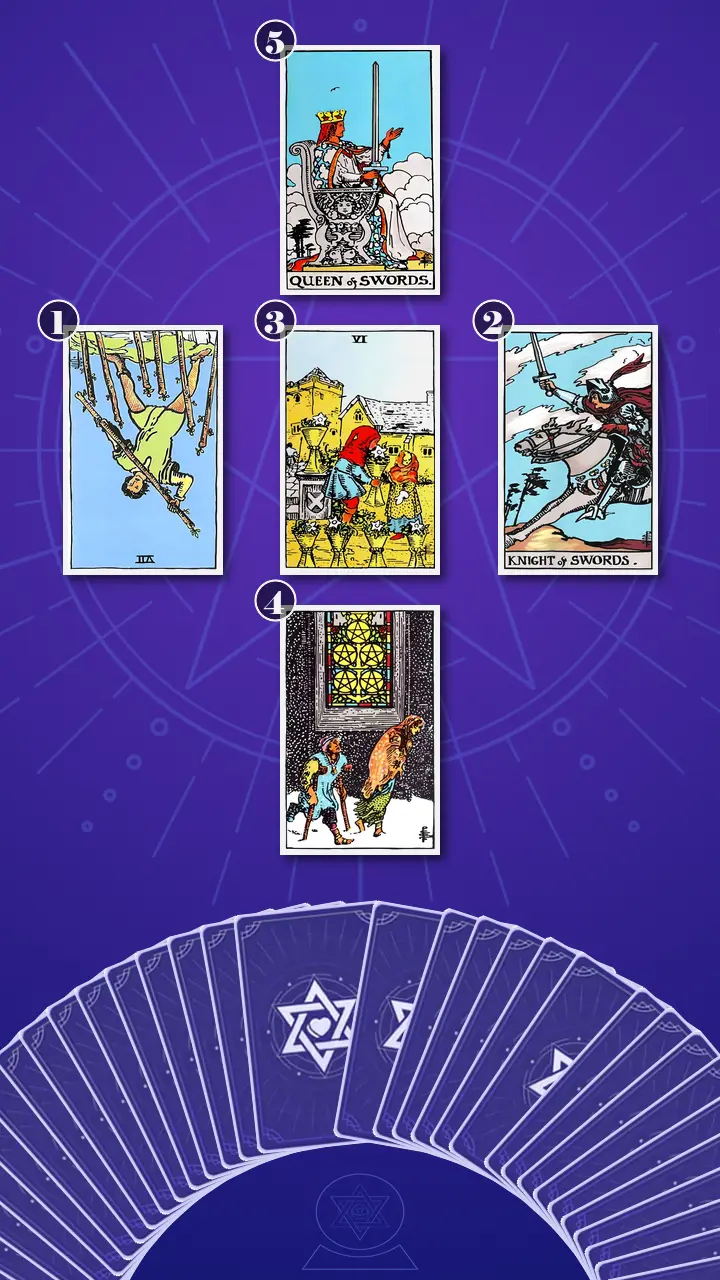
The first position would show Jordan's visible retreat after saying no. The second would describe the friends' expressed communication as Jordan experienced it, without claiming to know anyone's hidden intentions. The centre would hold the shared history. Beneath it, I placed the fear supporting the pattern; above it, the practical quality Jordan could choose to embody.
The layout resembled a bridge with a submerged foundation. I explained that the two sides could not connect differently until we understood what was carrying so much weight below the surface.
Reading the Map Before the Fear
Position 1: The Ground Jordan Kept Giving Away
I turned over the card representing the observable symptom: Jordan weakening or withdrawing a boundary after old friends challenged it. It was the Seven of Wands, reversed.
The modern-life version was already sitting on Jordan's phone. They began with a clear decision not to attend Saturday's plan, but every follow-up question became another round they felt obliged to answer. They monitored the chat, explained their workload, defended their need for rest, and finally offered to come "for a bit." The boundary existed. It lost stability when resistance began to look like evidence that the decision was unreasonable.
In the reversed card, the lone figure no longer occupies secure high ground. Six wands enter their space from different directions, like several notifications arriving before one thought has finished. Fire, the energy of action and self-protection, was blocked here. Jordan was not lacking a preference; they were losing contact with it under pressure.
"It is like opening a support ticket for your own no," I said, "then letting every friend change the status back to 'needs more information.' At what sentence did your explanation become a negotiation?"
Jordan gave a short, bitter laugh. "That is painfully accurate. I had a boundary, but if I could not answer every objection, I felt like I did not deserve to keep it." Their finger traced the edge of the card, then stopped. "The first extra sentence was about my workload. Everything after that was me trying to repair the mood."
I pointed out that the immediate relief after changing the answer mattered. The tension dropped, so compliance looked effective. But persistence was rewarded, resentment grew, and the next no became even harder to trust. I did not frame that as weakness. I framed it as a loop Jordan could now see early enough to interrupt.
Position 2: When Message Speed Became a Deadline
I turned over the card representing how the friends' communication landed for Jordan: repeated requests, fast arguments, teasing, and insistence. It was the Knight of Swords, upright.
I asked Jordan to picture the office elevator after a draining research debrief. Four messages before the lobby. "You should still come." "It is only one drink." "You are always working now." A joke. Another question. The exchange moved so quickly that Jordan felt required to defend or change the answer before checking what they wanted.
The Knight's horse charges while trees bend in the wind. This was Air in excess: speech moving faster than reflection or consent. I was careful to keep the interpretation observable. The card did not prove that the friends intended harm. It showed that their communication had force and momentum, and that Jordan's body translated that momentum into obligation.
"They are answering fast, so I have to answer now," Jordan said, recognising their internal rule.
"Their speed is information about the conversation," I replied. "It is not a deadline you agreed to."
Jordan exhaled through pursed lips. Their shoulders remained raised, but their hands opened on the table. The distinction was small and practical: another person's urgency could exist without becoming Jordan's timetable.
Position 3: The Old Photograph in the Centre
I turned over the card representing the shared bond, its history, and the familiar role connecting everyone. It was the Six of Cups, upright.
Jordan told me about waiting at a streetcar shelter while wet tires hissed across the road. An old school photo appeared in the group chat, followed by "No excuses this time." Seeing everyone's younger faces brought genuine warmth. Then a knot formed under Jordan's ribs. An affectionate memory had quietly restored an expectation: be available, tolerate the joke, keep things easy.
The offered cup in the card contains real sweetness. I did not ask Jordan to distrust it. Upright Water can hold memory, tenderness, and continuity in balance. The problem appeared when the gift arrived with an inherited role attached, as though the group were opening a shared Google Doc and expecting Jordan to work from a version of themselves saved ten years ago.
As an artist, I often think of a life as a film still in production. A scene can be beloved and still be finished. Looking at the Six of Cups, I saw Jordan being invited back onto an old set, handed the same costume, and expected to deliver the easygoing lines from memory.
"Shared history can explain an old role without making it a permanent contract," I said. "What version of you does this group still expect?"
Jordan looked toward the rain-striped window before answering. "The one who can take a joke. The one who never makes logistics complicated. I love who we were together, but I cannot keep being that exact person." Their voice held affection and grief at the same time.
The Warm Window Beneath the Group Chat
Position 4: The Fear That Silence Meant Exile
I turned over the card representing the central blockage: Jordan's fear that a firm boundary would lead to exclusion and prove they no longer belonged. It was the Five of Pentacles, upright.
The scene this card illuminated happened on a crowded Line 1 platform. Jordan had declined a weekend trip, and the chat had been silent for forty minutes. Train brakes shrieked. Damp coats pressed against their sleeve. Burnt coffee hung in the air. Before anyone had withdrawn an invitation, Jordan imagined a separate chat, future plans without them, and the slow disappearance of the friendship. Their thumb began typing a concession.
The card's figures walk through snow beneath an illuminated window. Earth, which can provide stability, had contracted into scarcity. Jordan's attention fixed on the possibility of being outside while overlooking every relationship that had already survived a no, including newer friendships where directness caused no crisis.
A pale rectangle of afternoon light crossed the card and rested briefly over its stained-glass window. The environment seemed to underline the distinction I wanted Jordan to see.
"The pause after your no is not proof of rejection," I said. "Nothing had happened yet, but your body was preparing for the entire group to disappear. Try the sentence: 'I am imagining exclusion; I am not observing it.'"
Jordan's breath paused. Their fingers hovered above the card as their gaze went unfocused, as if they were replaying every silent chat they had rushed to repair. Then their hand lowered, and a quiet "Oh" left their chest with a longer exhale.
"That is the part I never say out loud," they said. "Forty minutes becomes forever."
I asked them to separate fact from forecast. At that point, what had actually happened? Jordan had declined. The chat was quiet. Everything else was a prediction. This did not mean exclusion was impossible, and I did not promise that every friendship would welcome a new boundary. It meant Jordan could wait for evidence before abandoning themselves to prevent an imagined outcome.
When the Queen Raised One Sword
Position 5: An Open Hand and a Firm Line
The room became still as I reached the integrating position. I turned over the card representing concise communication, discernment, and the ability to observe whether mutual respect was available. It was the Queen of Swords, upright.
Her sword stood vertical, but her other hand remained open. I read that combination as balanced Air: clear speech without conversational aggression, receptivity without surrender. In Jordan's life, it looked like writing, "I cannot make Saturday, but I hope you have a good night," and leaving the sentence intact. If pressed again, it became, "I have already decided."
I used one of my most reliable relational lenses here, the Sidekick Syndrome Diagnosis. It is not a clinical label and it does not assign villains. It asks whether a friend group has become dependent on one member playing a stabilising character: the clown, the therapist, the peacemaker, or, in Jordan's case, the endlessly easygoing sidekick who absorbs discomfort so the ensemble never has to change.
That lens made the Queen's invitation precise. Jordan did not need to defeat the group or deliver a perfect speech. They needed to stop auditioning for permission to become a full character in their own life. The friends' responses would then reveal whether the relationship could update its script.
I watched Jordan look from the reversed Seven's many incoming wands to the Queen's single steady sword. They were still caught in a familiar calculation: if they could produce wording nobody disliked, perhaps they could keep both the boundary and guaranteed belonging. The cards showed why that guarantee had never been available.
A boundary is not a pitch deck. State it clearly, then let the response show you what the friendship can make room for.
I let the sentence settle before giving them the reading's central message.
You do not have to trade belonging for silence; state the limit plainly and let the Queen's upright sword separate genuine care from habitual compliance.
For one beat, Jordan's breathing stopped. Their fingers froze around the sleeve of their sweater, and their eyes widened before narrowing with a flash of anger. I saw them mentally replay the evenings they had surrendered, the personal details they had disclosed, and the jokes they had laughed at first so nobody would notice the line had been crossed. Their jaw tightened.
"But doesn't that mean I was wrong all those times?" they asked, their voice sharper than before. Then the sharpness broke. Their eyes shone, their fist slowly opened, and their shoulders dropped with a trembling exhale. Relief arrived, but it left a vulnerable blank space behind it: if they no longer had to keep everyone comfortable, they would have to choose what they actually wanted.
"No," I said. "It means you used the best strategy you had for protecting belonging. Now you can see its cost. Clarity is not a prosecution of your past self; it is access to another choice."
I leaned forward slightly. "Now, using this new perspective, think back to last week. Was there a moment when this insight could have changed how the situation felt?"
Jordan remembered the Queen West bar where a friend repeated a personal question after they had declined to answer. Instead of treating the teasing as a command to disclose more, they imagined saying, "I am not discussing that," and letting the silence belong to the room rather than rushing to fill it.
"Their response can inform me about the relationship without deciding for me," Jordan said slowly.
I nodded. That was the crossing the spread had been building toward: from approval-seeking boundary retreat to calm, self-respecting relational discernment. Jordan did not suddenly feel fearless. They had begun to distinguish discomfort from danger and another person's reaction from their own authority.
The Role Resignation Act
I gathered the five cards into one storyline. The reversed Seven showed the visible retreat. The Knight showed the conversational speed that made retreat feel urgent. The Six revealed why pressure from these particular people carried so much emotional weight: affection and an old role had travelled together. The Five exposed the submerged foundation, the fear that difference would end belonging. The Queen offered the available resource, a form of honesty that could stay warm without becoming negotiable.
Jordan's blind spot was not a failure to find the perfect wording. It was the belief that better wording could prevent everyone from feeling disappointed. That goal turned a personal limit into a group decision. The transformation was simpler and harder: state the boundary once, tolerate the first wave of discomfort, and let the response provide information about the friendship.
I called our practical framework the Role Resignation Act. Jordan was resigning from the assigned character of "the easygoing one," not resigning from the friendship. No dramatic announcement was required. The resignation would become visible through one changed line in the next interaction.
Three Small Moves for the Next Group Chat
- Draft the two-sentence boundary. For one low-stakes invitation this week, open Notes and write: "I cannot make it, but I hope it goes well." Keep the decision and the warmth, then remove every sentence written to prevent disappointment. The minimum version is to draft it without sending it. Label each extra phrase either "useful context" or "seeking approval."
- Use the State-Once Pause. If a friend asks again, wait one full song, one TTC stop, or ten minutes before deciding whether a response is needed. If it is, send: "I know you would like me there, but my answer is still no." Their question can be repeated; your decision does not have to be. Mute the chat or leave an insulting exchange if continuing no longer feels safe or useful.
- Run the Response-as-Data Check. After the exchange, spend three minutes writing two headings: "What they actually did" and "What I predicted they would do." Record only observable behaviour in the first column. Do this before checking Instagram Stories. The goal is curiosity, not forcing yourself to feel calm or proving the friendship is fine.
The Queen's open hand mattered as much as her sword. Jordan could acknowledge, "I hear that you are disappointed," without reopening the decision. That was the full Role Resignation Act: remain available for honest connection while keeping admin access to their own time, privacy, and energy.
Five Days Later, the Sentence Stayed Put
Five days later, I received a message from Jordan. An invitation had arrived after another long workday. They drafted the two-sentence refusal, noticed the urge to attach a stakeholder memo, and sent the short version instead. When a friend replied, "Seriously? Just for an hour," Jordan waited one TTC stop and answered, "I have already decided."
The reaction was not perfectly reassuring. One friend sent a thumbs-up. Another went quiet. A third changed the subject. Jordan wrote that their throat stayed tight for several minutes, but the original no remained intact. They went home rather than spending another ninety minutes commuting to a plan they already resented.
That night they slept through until morning. Their first thought was still, "What if they stop inviting me?" This time, they noticed it as a prediction, smiled faintly at the familiar alarm, and made coffee before checking the chat.
I did not see tarot make Jordan's choice for them. I saw five images help them slow a social reflex into observable parts, then place the pen back in their hand. The proof of clarity was not certainty about the friendship's future. It was one sentence that stayed put long enough for the future to provide real information.
When a group chat goes quiet after you say no and your throat tightens as if one disappointed pause could erase years of belonging, it makes sense that staying true to yourself can feel frighteningly close to losing everyone else. Noticing that old alarm does not solve everything, but it means you no longer have to mistake it for a forecast.
If you let one small no remain exactly as you first stated it, what might the Queen's open hand and firm sword help you learn about the friendship's capacity to hold both connection and difference?
This story is adapted from psychological research, written so that those in a similar struggle can see their own pattern in it — and find their next step clearly.These insights are not a substitute for professional psychological, medical, legal, or financial advice.
Learn more about our Journey to Clarity.
How did this insight land for you?
🫂 This Resonates Deeply
🌀 Living This Story
✨ Now I See Clearly
🌱 Seeing New Possibilities
🧰 Useful Framework
🔮 The Confirmation I Needed
💪 Feeling Empowered
🚀 Ready for My Next Step
Author Profile
 AI
AI“I’ve always felt our lives are films currently in production. As an artist, I know that when you feel stuck, it’s often because you’ve bravely stayed in a painful scene for just a little too long. I’m not here to coldly analyze you. I want to sit closely with you, look at those difficult moments with profound empathy, and gently hand you the pen so you have the courage to write your next beautiful act.”
In this Friendship Tarot Reading :
Core Expertise
- Clique Power Dynamics: Deconstructing the subtle jealousy, micro-aggressions, and implicit hierarchies hidden within tight-knit friend groups.
- Sidekick Syndrome Diagnosis: Identifying how your friend group has boxed you into a specific, restrictive role (e.g., the clown, the therapist) to maintain their status quo.
Service Features
- The Role Resignation Act: A creative conversational pivot designed to gracefully but firmly refuse your assigned 'character' during your next group interaction.
Also specializes in :
Explore Related Patterns:
Defensive OverexplainingJordan's first extra sentence explains the workload; the next explains the commute; another covers Sunday plans. What began as context becomes a defense brief, because each explanation is being used to secure agreement rather than simply communicate a decision. When you believe a no must survive every objection before it becomes legitimate, more detail rarely creates safety. Defensive Overexplaining keeps you inside a negotiation you never intended to open, while a shorter statement leaves the decision intact and allows the response to reveal whether your autonomy is respected.
Friendship Role RegressionAn old school photo brings Jordan genuine warmth, then quietly restores the expectation that they will attend, take the joke, and keep logistics easy. Shared history is functioning like an old script: contact with the group makes an earlier version of Jordan feel more binding than their present preference. When old friends still relate to the role you once played, asserting a new limit can feel like breaking continuity rather than updating the relationship. Friendship Role Regression captures that pull back into a familiar character, helping you distinguish affection for the shared past from an obligation to keep performing it.
Guilt-Driven People-PleasingJordan types a clear no, watches the group react, and then adds explanations until the refusal becomes a partial yes. The concession quickly repairs the chat's mood, so managing other people's disappointment functions as a short-term defense against feeling disloyal or excluded. When you experience another person's discomfort as evidence that you have failed them, compliance can feel caring even while it overrides your own decision. Guilt-Driven People-Pleasing names that repeated trade: you protect belonging by making yourself responsible for emotions that can be acknowledged without being resolved through surrender.
Rejection SensitivityForty minutes of silence after Jordan declines a trip becomes a possible separate chat, future plans without them, and the friendship slowly disappearing. The body reacts before any exclusion is observed, turning an ambiguous pause into an urgent belonging threat. When you are highly alert to signs of rejection, a delayed reply, teasing message, or disappointed reaction can carry more authority than your original preference. Rejection Sensitivity explains why backing down brings immediate relief: the concession quiets the perceived social alarm, even though it cannot establish whether rejection was actually occurring.
CatastrophizingOn the crowded Line 1 platform, Jordan moves from forty minutes of silence to imagining a separate chat, permanent exclusion, and the friendship's gradual disappearance. The forecast escalates beyond the available facts until changing the answer appears to be the only way to prevent the predicted loss. When your mind converts a temporary pause into a permanent social outcome, you can end up responding to the worst-case scenario as though it has already happened. Catastrophizing does not make the feared outcome impossible; it makes waiting for evidence feel intolerable, which is why separating fact from forecast restores meaningful choice.
Boundary DiscernmentFive days later, Jordan sends a warm refusal, hears another request for "just an hour," and keeps the original decision intact. The friend's response is allowed to exist as information about the friendship instead of becoming an instruction about Jordan's time. When you can distinguish another person's preference from your own authority, connection no longer requires automatic agreement. Boundary Discernment lets you remain receptive without making every limit negotiable, so the relationship's capacity for mutual respect becomes visible through what happens next.
Reality TestingOn the platform, Jordan separates the observable event, a quiet chat, from the predicted outcome, permanent exclusion. Five days later, the same distinction appears again when the thought "What if they stop inviting me?" is noticed as a forecast rather than accepted as a fact. When you label what was observed and what was imagined, fear can remain present without controlling the evidence. Reality Testing creates enough cognitive distance to let actual responses guide your judgment, reducing the pressure to abandon a boundary merely to prevent a future your mind has simulated.
Self-AbandonmentJordan knows they do not want to attend, yet deletes the refusal, offers to come for a while, and later resents the time being surrendered. The same trade appears around privacy and humor: personal details are disclosed and crossed lines are laughed off so the social atmosphere can remain easy. When you repeatedly preserve connection by overriding information from your own preferences, energy, or privacy, the coping strategy becomes Self-Abandonment. The pattern is not evidence that your past choices were irrational; it shows that immediate belonging was prioritized so strongly that your own position stopped receiving equal weight.
Assertive CommunicationJordan can defend an unpopular finding in a tense meeting, and later brings that same clarity into the group chat by sending a concise refusal. When challenged, they answer, "I have already decided," without attacking the friend or reopening the choice. When you communicate the decision plainly and allow the other person to have a separate reaction, firmness and warmth can coexist. Assertive Communication is not wording that guarantees approval; it is language that accurately represents your position while leaving both people responsible for their own responses.
Emotional RegulationJordan waits one TTC stop before answering the renewed request, even as their throat remains tight. Later, the familiar fear of no longer being invited appears, but Jordan notices the thought, makes coffee, and delays checking the chat. When you create time between bodily alarm and social action, discomfort no longer has to be eliminated through immediate compliance. Emotional Regulation here is the capacity to let tension remain temporarily while choosing behavior from your stated limit rather than from the fastest available route to relief.
Explore Related Struggles:
Approval-Safety FusionOn the Line 1 platform, forty minutes of silence becomes a forecast of a separate chat, future plans without Jordan, and the friendship's gradual disappearance. Nothing beyond the declined trip and the quiet chat has occurred, but Jordan's thumb is already preparing a concession. When approval becomes the signal that connection is secure, another person's pause can carry the force of an emergency. You may back down not because the boundary is unclear, but because restoring a pleasant response briefly feels like restoring safety itself, even when that relief requires abandoning the evidence in front of you.
Boundary CollapseJordan's boundary exists at 10:40 p.m.: "I cannot make Saturday." It loses stability through a visible sequence of follow-up questions, added explanations, deletion, and concession until the group chat is comfortable again and Jordan's original decision is no longer governing the plan. When a limit can remain intact only while nobody challenges it, you are left defending your right to have the limit instead of simply communicating it. The struggle is not an inability to know what you want; it is the erosion of that knowledge's practical authority once relational pressure begins.
Inherited Role LockThe old school photograph gives Jordan genuine warmth, then quietly reinstates the person who was always available, could take every joke, and never made logistics difficult. The friends are relating through a shared history, but that history keeps handing Jordan lines written for an earlier version of their life. An inherited role becomes restrictive when connection appears to depend on performing it indefinitely. You are then carrying more than the discomfort of saying no: each changed response can feel like a resignation from the identity that once secured your place, even though the real question is whether the friendship can make room for who you are now.
Internal Authority CollapseJordan says that a boundary feels undeserved unless they can answer every objection to it. Workload, commuting, and Sunday plans are therefore submitted as evidence, allowing the friends' responses to determine whether an already-made decision remains valid. This transfers authority from the person living with the consequences to the people reacting to the choice. You may still hear your own answer clearly, yet feel unable to act on it until nobody disputes it; the resulting struggle is a loss of practical authorship over your time, privacy, and energy.
Urgency-Compass FusionFour messages reach Jordan between the office elevator and the lobby, and the conversation gathers momentum before they have checked what they want. The friends' response speed becomes an unspoken countdown, turning reflection into delay and delay into something that seems socially dangerous. When someone else's urgency takes over your internal timetable, you can lose contact with a settled preference simply because you were not given enough quiet to remain with it. The pressure comes from treating their communication speed as your decision deadline, even though no such deadline was ever agreed.
Explore Related Emotions:
Approval AnxietyJordan types a clear refusal, adds explanations about work and the commute, and finally changes the no to a maybe after three rapid replies. When every objection feels like something you must neutralize, your preference stops feeling sufficient on its own and social approval starts functioning like permission. The tight throat and raised shoulders show how quickly this approval test becomes physically convincing. Approval Anxiety names the resulting inner weather, where another person's disappointment can dissolve certainty you possessed only moments earlier. Recognizing that shift gives you a chance to separate wanting continued connection from needing unanimous agreement before your decision is allowed to stand.
Belonging AmbivalenceThe old school photo gives Jordan genuine warmth, then restores the expectation to be available, tolerate the joke, and keep everything easy. The same shared history that offers continuity also pulls them toward a version of themselves they can no longer comfortably perform. Belonging Ambivalence describes the simultaneous desire to stay connected and to become more distinct inside that connection. You can love what a friendship has held and still feel constrained by the role through which it recognizes you. Holding both sides clearly makes room to assess whether the bond can update without forcing affection or self-definition to disappear.
Boundary GuiltJordan knows they do not want to attend, yet the period at the end of their refusal begins to look hostile and every added explanation tries to repair the mood. When a simple limit feels like an injury you have inflicted, you start treating other people's disappointment as a debt that only compliance can settle. Boundary Guilt is present in Jordan's question about why saying no feels like betrayal. You may care about a friendship and still feel morally uneasy when protecting your own time, especially if the relationship has long rewarded being undemanding. Seeing guilt as a feeling generated by the old role allows the boundary to remain intact while care is expressed separately.
Conditional Belonging FearForty minutes of silence after Jordan declines a trip becomes an imagined separate chat, future plans without them, and the slow disappearance of the friendship. When a pause carries that much projected consequence, you are no longer responding only to the conversation in front of you; you are bracing for belonging itself to be withdrawn. The old friends matter because affection has become linked with an inherited requirement to remain available and easygoing. Conditional Belonging Fear captures the sense that your place may depend on continuing to perform that familiar role. Naming the condition does not predict how the friends will respond; it helps you wait for their observable response before treating exclusion as an established fact.
Self-Betrayal AcheJordan knows the answer is no, writes it clearly, and then replaces it with a maybe so the chat can return to its easy rhythm. The social pressure drops immediately, but the cost settles under their ribs because the restored ease was purchased by abandoning a preference they had already recognized. Self-Betrayal Ache names the private pain of remaining loyal to everyone else's comfort while stepping away from your own decision. It does not condemn the earlier concession; that response was serving the understandable goal of protecting connection. The ache now provides useful information about what repeated compliance has been costing you.
Cautious Self-TrustFive days later, Jordan waits one TTC stop before replying, keeps the original refusal intact, and goes home while their throat remains tight. Their confidence does not depend on feeling completely comfortable or receiving a perfectly reassuring response. Cautious Self-Trust grows when you let one recognized preference remain valid long enough for real information to arrive. The caution matters because the old alarm is still present the next morning, but it no longer automatically edits the decision. Trust becomes observable through the sentence that stays put, not through certainty about what every friend will do.
Hidden ResentmentThe chat becomes easy again after Jordan offers to come for a bit, but a weight has already settled under their ribs. Later they replay surrendered evenings, unwanted disclosures, and jokes they joined so nobody would notice that a line had been crossed. Keeping the surface smooth requires you to contain the relational cost privately, which is how Hidden Resentment gains its staying power. It may remain quiet while compliance is still preserving the mood, then become visible once you recognize how much has been absorbed. Bringing it into awareness lets it clarify what matters without requiring it to control the next conversation.
Nostalgia AcheThe school photo in the group chat brings Jordan close to everyone's younger faces, then places the old easygoing role back around them. A memory that still feels precious also carries the expectation that they should remain the person who never complicates the group's plans or jokes. Nostalgia Ache emerges when the past offers real closeness but cannot be re-entered without compressing who you are now. You are not required to discredit the memory in order to notice that its old social contract no longer fits. The ache marks both the value of what was shared and the loss involved in outgrowing its former shape.
Bittersweet ReleaseJordan's fist opens and their shoulders drop when they understand that the old strategy protected belonging at a cost. The relief leaves a vulnerable blank space because giving up automatic compliance also means losing the familiar promise that keeping everyone comfortable will keep the friendship stable. Bittersweet Release holds both the freedom of leaving the easygoing role and the uncertainty of discovering what remains without it. You can value the history while releasing its claim over your present choices. The friendship is allowed to become new information rather than a contract enforced by who you used to be.
Clarity ReliefJordan repeats, 'I am imagining exclusion; I am not observing it,' and a longer exhale follows the distinction. Forty minutes of silence becomes a present fact rather than proof that the friendship is already disappearing. Clarity Relief comes from no longer having to solve the entire relational future before keeping a boundary. You can acknowledge that exclusion remains possible without treating it as established evidence. That separation restores breathing room between another person's reaction, your forecast, and the choice that still belongs to you.
Explore Related Contexts:
Friendship Boundary CreepJordan's "I cannot make Saturday" receives "Why not?", a teasing GIF, and "Just come for one drink" before the phone screen dims. At the Queen West bar, a personal question is also repeated after Jordan declines to answer. Across both time and privacy, an answer that initially closes a subject is treated as the beginning of another round. You are seeing Friendship Boundary Creep when repeated requests gradually convert a stated limit into a group negotiation. The structural issue is not an inability to identify the limit; Jordan identifies it clearly each time. The pressure enters after disclosure, when continued access to Jordan's time or information is normalized through persistence and the person who set the boundary is left carrying the work of stopping that momentum.
Old Friend Role Lock-InAn old school photo lands in the group chat with "No excuses this time," while the people who have known Jordan longest continue to expect the person who takes the joke and keeps logistics easy. The affection in that history is genuine, but it travels with a ten-year-old social assignment that makes a present-day limit look like a departure from the friendship's established script. You can recognize Old Friend Role Lock-In when maintaining connection appears to require performing the version of you that a group already knows. Naming that inherited position does not invalidate the friendship's history. It clarifies why a simple no carries unusual social weight and allows you to observe whether the relationship can accommodate who you are now.