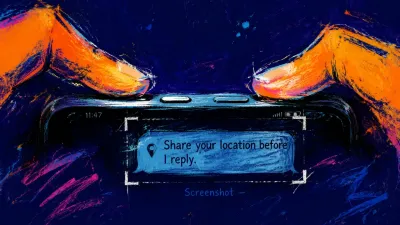
A Stalled Find My Pin Took Over Dinner—Then the App Stayed Closed

The 6:18 p.m. Pin That Took Over the Room
At 6:18 p.m. on a sleety Tuesday, Maya appeared on my screen from the narrow kitchen of her Toronto condo. At twenty-seven, she spent her workdays untangling ambiguous Figma comments as a junior UX designer, yet one stalled Find My pin had reduced her whole evening to a glowing timestamp. The microwave hummed behind her, sleet ticked against the glass, and wet tyres hissed on the street below. She held a warm phone against the counter while noodles curled dry at the edges of a bowl.
Her partner's pin had been sitting near a Line 1 station for fourteen minutes. I watched Maya refresh the map, open Messages, type “Where are you?”, delete it, and return to the map. No agreed arrival time had passed. No safety plan had been missed. Still, her breath stayed high in her chest, as if a drawstring had been pulled tight beneath her ribs.
“I know it could just be bad signal,” she said. “But what if they turned it off? I know it is just a dot on a map, but I relax when I can see it. Then I feel ridiculous because the relief only lasts until the next time the pin disappears.”
I heard the hidden shame beneath the question she had brought me: Why do I keep checking my partner's live location even when there is no emergency? Her insecurity did not look like a vague cloud. It looked like a restless thumb, a clenched stomach, half-eaten dinner, and the feeling of trying to hold an entire relationship steady through a piece of warm glass. This was compulsive live-location checking caught inside a reassurance-seeking loop.
“I do not want to control them,” Maya said, lowering the phone. “I just do not know how to stop checking.”
“I am not going to use tarot to tell you where your partner is, what they secretly think, or whether a delayed pin predicts anything about the relationship,” I told her. “The cards can help us examine what happens between the missing information and your next action. Let us give this live location anxiety a map that does not confuse fear with fact. The goal is clarity, but the choices will remain yours.”

Choosing a Map for the Map
I invited Maya to place her phone face down and take one slow breath before I shuffled. I explained that the pause was not a mystical requirement. It was simply an attentional doorway, a way to let the question become more precise than the urge to refresh.
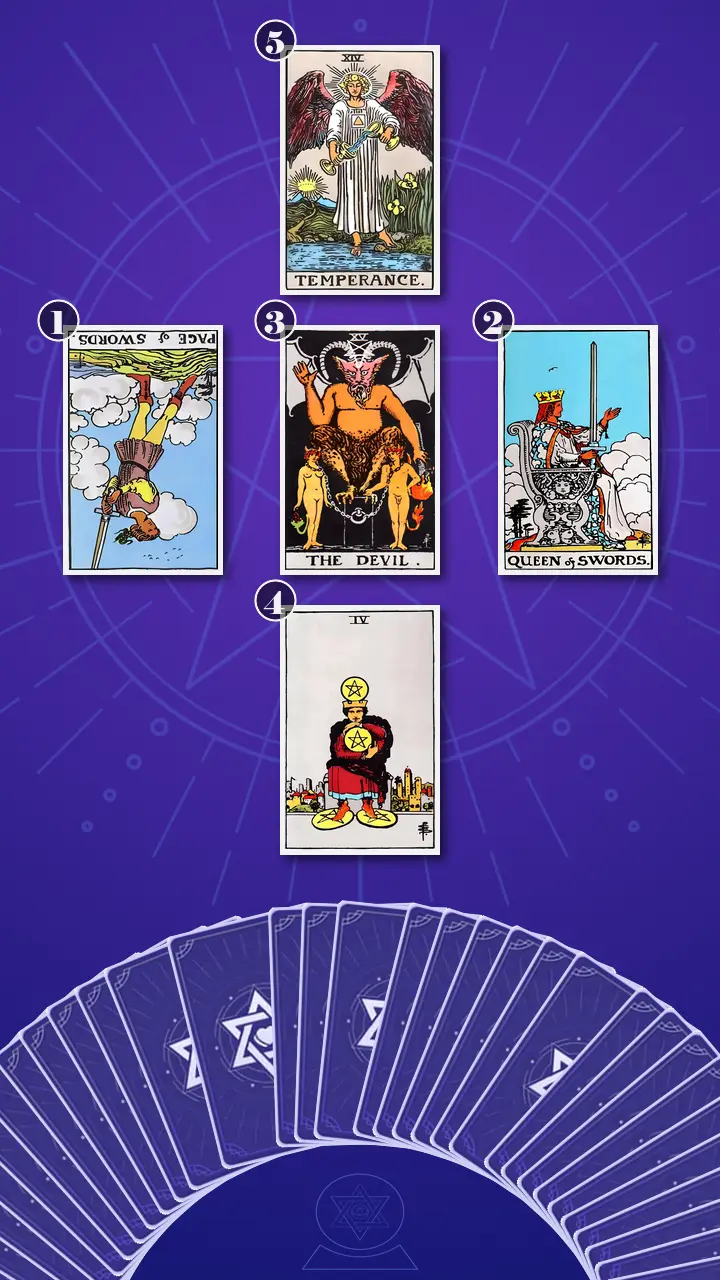
I chose a five-card Relationship Tarot Spread for live-location anxiety and consent boundaries. For anyone wondering how tarot works in a situation like this, I use the spread as a structured reflection tool. It separates observable behaviour from assumed motives, identifies the loop organising the conflict, and ends with practical guidance. It does not issue a verdict about who is right, and it does not give me access to another person's private mind.
I placed the first card on the left for Maya's current stance and the second on the right for her partner's observable boundary signal. I set the third in the centre for the recurring dynamic, the fourth below it for the challenge weighing on the relationship, and the fifth above it for the path toward integration. The layout resembled a bridge crossed by a vertical path: two viewpoints around a central loop, a grip below, and a possible direction above.
“The first card will show how your attention behaves when location data disappears,” I said. “The centre will reveal why checking feels compulsory even when you know the relief will not last. The final card will help us build security through more than one channel.”
Four Cards Inside the Reassurance Loop
Position 1: The Page Who Could Not Leave the Map
“The card I am turning over now represents your current stance: the contracted vigilance, the map refreshing, and the belief that visible location is necessary before you can settle,” I said.
I revealed the Page of Swords, reversed. I pointed to the Page's body moving in one direction while the head looked back, the sword still raised beneath a turbulent sky. The divided posture matched what I had just watched. Maya was physically in her kitchen, but her attention had left the room and stationed itself inside Find My.
“At 6:18, you were reheating dinner while the pin remained near a TTC station,” I said. “You refreshed, checked the timestamp, reread the last message, and drafted a casual question before any practical deadline. The facts did not change, but your attention treated the gap as unfinished evidence that had to be decoded.”
I explained that the Page's alert mental energy was in excess and partially blocked. Curiosity itself was not the problem. The blockage appeared when every status change began to carry more meaning than the available facts could support. It was like seeing a Slack status turn grey and treating that indicator as more reliable than the direct conversation, except the status had been given the impossible job of proving closeness.
“The inner sentence sounds like this,” I continued. “I know signal loss is ordinary, but what if this delay means they switched it off, and what if that means we are not okay? The first fact is plausible. The final verdict arrives without new evidence.”
Maya's breath paused. Her eyes drifted away from me as if she were replaying the previous several evenings, then she released a small, bitter laugh and rubbed her thumb against the edge of the phone case. “That is too accurate,” she said. “Honestly, it feels a little brutal.”
“Recognition can feel sharp when a private ritual is suddenly visible,” I replied. “I am not calling you foolish or inherently controlling. I am showing you where ordinary alertness has lost proportion. The useful question is: during the last non-urgent gap, what conclusion had you reached before you received any new information?”
Position 2: The Queen's Firm Sword and Open Hand
“The next card represents your partner's observable boundary signal: what they have actually said or done, without either of us inventing a story about their unspoken motives,” I said.
I turned over the Queen of Swords, upright. Her sword stood vertically in one hand while the other remained open. I read this as balanced air: precise language, independent judgement, and a limit that did not require emotional punishment.
Maya had already told me the relevant sentence. Her partner had said, “I do not want continuous location sharing, but I am open to using it when we are meeting in a crowd or travelling late.” I placed that observable statement beside the interpretation Maya's body had supplied: If they want privacy, I must matter less.
“The Queen asks you to separate those two lines,” I said. “Your first translation was rejection. The observable fact was a boundary with a stated purpose and an invitation to discuss alternatives. The upright sword is the clear limit. The open hand is the conversation that can remain available.”
I watched Maya loosen her folded arms by a fraction. Her mouth tightened before she said, “I keep hearing the limit as withdrawal, even though they are still sitting there trying to talk to me.”
“That distinction is the catalyst in this reading,” I said. “A permission setting is not a loyalty score. Ask for the reassurance; do not disguise it as surveillance-grade logistics. Instead of arguing for unrestricted access, you might ask, ‘Could we agree on an arrival text when our plans change?’ A firm boundary can coexist with a warm relationship, just as direct reassurance can coexist with privacy.”
Position 3: The Chain Trained by Short Relief
“The card at the centre represents the pattern organising the connection: the recurring dynamic that turns short-term digital reassurance into something that feels necessary,” I said.
I revealed the Devil, upright. I immediately told Maya that I did not read this card as a prediction, a moral judgement, or evidence that either person was bad. I focused on the loose chains around the two figures. They looked binding, but they were not fused shut. The image gave me a precise picture of a learned loop that felt compulsory while still containing moments of choice.
“You already know the next refresh may buy only five minutes of relief,” I said. “Still, the app feels like the one thing you must check before you can return to dinner, work, or sleep. The pin stalls. Your mind builds a feared story. You refresh. The pin moves or a reply arrives. Your shoulders drop. That drop teaches your nervous system to reach for the map faster next time.”
I traced the cycle with one finger beside the card: uncertainty, refresh, moving pin, short relief, repeat. The Devil showed blockage through reinforcement, with alertness and attachment in excess. The pattern worked like an algorithm learning from every tap. Each refresh that delivered relief trained the system to serve the urge again with greater urgency.
“Short relief can train a long loop,” I said. “The map is not creating lasting security. It is repeatedly renting you a few calmer minutes.”
Maya pressed her lips together. Her hand moved toward the face-down phone, stopped halfway, and settled on the counter instead. “I know the relief will not last,” she said quietly, “but in the moment I think I need this one check before I can settle.”
“That sentence is important,” I replied. “It shows us the chain without pretending the chain is fate. The next question is not whether you can promise never to feel the urge again. It is whether you can notice one link in the sequence early enough to create another option.”
Position 4: When Access Became Emotional Armour
“The fourth card represents the central relational challenge: how gripping location access for security creates pressure, reduces flexibility, and strains consent,” I said.
I laid down the Four of Pentacles, upright. The figure clutched one coin over the heart and pinned two beneath the feet. I described this as fixed earth in excess. The wish for stability had hardened into a grip, and the grip restricted the very movement the relationship needed.
Maya had described seeing the iPhone permission change from “Always” to “While Using.” Her stomach had dropped as though something relational had been taken away, even while her partner remained present and willing to communicate. Uninterrupted access had become possession-like proof. A privacy boundary therefore registered as loss rather than as information requiring a new agreement.
“The coin over the heart looks like data being used as emotional armour,” I said. “The central question is whether you need the information for agreed logistics or immediate safety, or whether you are asking the setting to silence uncertainty. Those needs are not interchangeable.”
This was where I used what I call a Boundary Permeability Assessment. I asked Maya to imagine three adjoining spaces. In the first was her internal experience: the tight chest, the feared conclusion, and the need for reassurance. In the second was her partner's autonomy: their movements, privacy, and right to change consent. Between them was a shared space containing plans, arrival times, direct requests, and mutually chosen location sharing.
“Healthy closeness does not require those three spaces to collapse into one,” I explained. “Your need deserves language and care. It does not automatically create a claim on their continuous visibility. Their boundary deserves respect. It does not automatically cancel your right to ask for reassurance.”
Maya looked down at the Four. Her fingers had been wrapped around her mug; I watched them release one by one. “If I cannot keep access, I am scared I cannot keep closeness,” she said.
“That is the real sentence beneath the permissions argument,” I replied. “Now we can work with it directly.”
When Temperance Made Room for Air
Position 5: Two Cups for Security Beyond the Pin
By the time I reached the final position, sleet had softened into thin streams on Maya's window. A line of water moved down the glass behind her just as I turned over the card representing the path toward integration: a consent-based combination of clear agreements, direct reassurance, and internal regulation that did not depend on continuous tracking.
It was Temperance, upright.
I showed Maya the water moving between two cups and the figure standing with one foot on land and one in water. I read the energy as balance: practical facts and emotional experience held in the same system, with neither one forced to carry the entire burden. One cup could hold logistics. The other could hold reassurance. The movement between them could be adjusted through consent and context.
I gave her a concrete version. Location sharing could be switched on by mutual choice for a late-night journey or a crowded event. Ordinary evenings could use an agreed arrival text or response window. During a non-urgent gap, Maya could pause, identify the feared conclusion, and decide whether she needed logistics, emotional reassurance, or no immediate contact. She did not have to choose between forced silence and unlimited access.
At that moment, my old perfumer's instinct supplied the clearest language. I remembered leaning over a scent blotter at my workbench years earlier, trying to evaluate a composition from almost no distance. Pressed too close, its notes collapsed into one loud impression. Given too much distance, the fragrance disappeared. At the right distance, air carried each note distinctly.
I call that lens Intimacy Distance Calibration. Applied here, continuous visibility had reduced the emotional distance toward suffocation, but total unexplained withdrawal was not the answer either. The aim was a breathable interval: close enough for reliable contact, spacious enough for autonomy, and supported by agreements that neither person had to treat as permanent. Like scent diffusion, intimacy needed room to travel. Zero distance was not maximum love.
When I gave Maya the basic reading, I could see the old binary tighten again: either keep the pin and stay calm, or release it and risk the bond. Her thumb had already drifted toward the phone, as if clarity still lived behind one more refresh.
You do not need to grip the map to protect the bond; build security by blending clear limits, direct reassurance, and a deliberate pause, as Temperance blends water between two cups.
I let the sentence remain in the quiet. The map could settle a moment, but it could not secure the bond.
Maya's inhale stopped. Her fingers hovered above the phone without touching it, and her eyes lost focus as though a week of stalled pins, deleted messages, and repeated boundary conversations were replaying behind them. Then her face shifted. Her brow released first; her shoulders dropped a moment later. Moisture gathered along her lower lashes, but the expression was not simple relief. I saw the slight dizziness that can arrive when a familiar defence is no longer being asked to run the whole system.
Her hand opened flat on the counter. “But does this mean I was wrong every time I checked?” she asked, a flash of anger sharpening the question. “Was I just making everything worse?”
I leaned closer to the screen. “It means checking worked briefly at the job of lowering discomfort, which is why your mind kept choosing it. It also carried a longer-term cost. Understanding that is not a verdict on your character. It is the moment you become able to choose a different tool.”
Her gaze returned to the card. She exhaled from deep in her chest, the sound unsteady but fuller than before. I asked, “Now, using this new perspective, think back to last week. Was there a moment when this insight could have made the gap feel different?”
Maya recalled the Sunday conversation when her partner had asked to limit continuous sharing. “I could have heard the boundary first,” she said. “Then I could have asked whether we could text if either of us was running more than twenty minutes late. I did not have to turn the setting into proof that they loved me.”
I named the crossing we had just witnessed: from hypervigilant dependence on live tracking to consent-based trust that can tolerate ordinary information gaps. It was not a leap into perfect trust. It was one measured step from automatic proof-seeking toward clearer recognition of the feared story, direct reassurance, mutual consent, and choice.
Pouring Security Into More Than One Channel
What the Five Cards Said Together
I gathered the reading into one sequence. The Page showed Maya trying to continue her evening while mentally looking backward at the map. The Queen introduced a partner's stated boundary as usable information rather than a secret verdict. The Devil exposed how earlier refreshes had taught her that checking produced relief, while the Four showed that repeated relief hardening into a grip on access. Temperance restored movement through several adjustable channels: a pause, direct language, purpose-specific sharing, and mutually chosen check-ins.
The past influence was not a hidden betrayal revealed by tarot. It was the repeated learning created whenever a moving pin briefly lowered the pressure in Maya's chest. The present symptom was map refreshing. The central conflict was wanting secure closeness while fearing that security would disappear without continuous access. Her available resources were already visible in the spread: her ability to observe the urge, the Queen's capacity for precise communication, and Temperance's willingness to replace one rigid rule with a flexible mix.
I named Maya's cognitive blind spot directly. She had been assuming that more information could solve a form of distress partly maintained by the way she used information. The location app had become a browser tab she kept reopening even though the page held no new answer. The real question was not where her partner was. It was whether the relationship could remain secure while some ordinary information stayed incomplete.
“The key shift is small and specific,” I said. “When uncertainty spikes, do not negotiate permanent access from inside the spike. Create a short pause, name the feared conclusion, and then use a check-in boundary you both chose at a calm time. Security needs more than one channel.”
The Blank Space Protocol and a Consent-Based Check-In Mix
I gave Maya two experiments rather than a new set of absolute rules. I wanted each one to be reversible, low-pressure, and realistic after a screen-heavy workday.
- The Blank Space Protocol: Facts Before Refresh During one non-urgent location gap this week, place the phone face down and set a ten-minute timer labelled “facts before refresh.” In Notes, complete three lines: “What I can observe is...”, “What I fear this proves is...”, and “What I need right now is...” When the timer ends, deliberately choose one response: keep waiting, use an existing check-in agreement, or send one direct reassurance request such as, “The missing update is bringing up uncertainty for me; when you have capacity, could you confirm whether our plan is still on?” The blank space is not punishment or a test. It is the breathable distance that lets another choice enter. If ten minutes feels impossible, use a two-minute version and write only one fact and one feared conclusion. Stop if the exercise becomes overwhelming. This pause is only for ordinary information gaps, never a concrete danger, missed safety protocol, emergency, or overdue practical commitment.
- The Fifteen-Minute Consent Mix At a calm time this week, ask the partner, “Can we separate when location sharing is genuinely useful from when I am using it for reassurance?” Cap the first conversation at fifteen minutes. Write two short lists together: “location useful for” and “another check-in works better for.” Choose one seven-day experiment, such as journey-specific sharing for late travel plus an arrival text if either person will be more than twenty minutes late. Treat every permission as optional, purpose-specific, and changeable. If the full discussion becomes loaded, test one journey only. Review what helped without turning the result into a loyalty test. Either person can decline continuous sharing, request a pause, or suggest another arrangement.
I told Maya that the Blank Space Protocol was not a demand that she become comfortable with unlimited uncertainty. It was one intentionally breathable interval between trigger and action. In perfumery, air allows a composition to reveal its structure. Here, a little space could reveal whether the moment required safety information, logistics, reassurance, or simply time.

Six Days Later: The Quiet Proof
Six days later, I received a message from Maya. Her partner had gone across the city for a late class, and they had agreed on an arrival text rather than continuous location sharing. At 9:05 p.m., standing beside the condo lift while the ventilation fan whirred, Maya felt the old flicker in her stomach. There was no moving dot to consult.
She used the two-minute version of the Blank Space Protocol. Her fact was that no agreed deadline had passed. Her story was that a delayed message might mean she mattered less. Her need was reassurance that the plan still stood. She kept the phone within reach, did not open Find My, and waited. At 9:17, the agreed message arrived: “Home now.”
Maya did not present the evening to me as a cure. She admitted that she looked toward the phone twice and felt the familiar pull. The empty screen felt lonely for a moment, but it no longer felt like a verdict.
She later told me that her first thought the next morning was, “What if I only managed because they texted on time?” Then she laughed. The fear had not vanished, but she could hear it as a story rather than an instruction.
I took that as the quiet proof of our Journey to Clarity. The cards had not fixed Maya's relationship or guaranteed an outcome. They had helped her distinguish vigilance, boundary, compulsion, grip, and integration. Maya created the change by pausing, speaking directly, and allowing both people to retain consent and choice. She remained the author of every next step.
If a silent map makes your chest tighten, I want you to remember that the choice is not limited to gripping for proof or risking the loss of closeness. Simply noticing that one phone setting has been asked to prove the entire bond means you are already standing somewhere new, with a little more air around the fear.
When the next ordinary gap appears, what could you pour into Temperance's two cups: one small pause that gives the bond room to breathe, and one mutually chosen form of contact that asks for closeness without gripping for proof?