Sibling Rivalry Over Parental Approval: From Ranking to Self-Respect

Why I Still Compete with My Sibling for My Parents' Approval When the Chat Lights Up
You are a Toronto junior communications coordinator who can explain a campaign result at work, but you start ranking your life against your sibling's the moment a parent praises their career update in the family group chat. I recognize that pattern as adult sibling rivalry shaped by the fear that parental approval is a limited resource, not as a character flaw.
I met Alex (name changed for privacy) at 8:47 p.m. on a Sunday in her small Toronto apartment. She sat at the kitchen table while the TTC rattled faintly outside, the warm phone screen lighting her fingers and the fridge humming behind her. She scrolled past her sibling's promotion update, opened Notes, and typed three possible accomplishments of her own before deleting the first polished reply.
Her shoulders had drawn toward her ears. Her jaw was tight, and one hand kept returning to the phone as if the next notification might settle something. She looked at me and said, "I can be happy for my sibling and still feel erased. Why am I still competing with my sibling for our parents' approval?"
I did not tell her to simply be happy for someone else or to get over an old family role. Her longing for recognition had the texture of a phone she could not put down: warm against her palm, bright enough to keep her awake, never delivering the message that would let her rest. I said, "You are not competing because you want your sibling to lose. You are competing because one compliment feels as if it leaves less room for you. Let us look at that feeling without making anyone the villain. Our Journey to Clarity can begin by giving this pattern a shape, then giving you the pen back."

Choosing a Map Instead of a Verdict
I asked Alex to place her phone face down, take one slow breath, and name the question she wanted the cards to explore. I shuffled gradually, using the movement as a practical transition from reacting to observing. Nothing in this preparation was meant to summon a fixed answer; it was a way to gather attention around an experience that usually scattered it.
For this consultation, I used the Relationship Spread · Context Edition, a custom six-card relationship tarot spread built from Rider-Waite-Smith symbolism. I explained to Alex, and to anyone reading along, that this is how tarot works here: the images act as an objective cognitive tool. They give us positions, symbols, and contrasts that can help separate a present-day fact from the childhood meaning attached to it. They do not predict whether a family will change, and they do not decide what Alex must do.
This spread suited the question because the problem was active and relational, not an inward excavation alone. Its first four positions show the visible behavior, the sibling's perceived pressure, the approval economy, and the inner-child root. The final two positions move toward adult guidance and a self-led response. The custom structure keeps the reading focused on self-exploration, clear boundaries, and choices Alex can control.
I told her that the eye of the spread would move from the noisy contest to its emotional source, then along a grounded lower path. The first card would show the visible rivalry pattern. The third would reveal how family recognition becomes a ledger. The fourth would touch the younger need beneath the reaction. The fifth would offer clear adult language, and the sixth would show a compassionate practice rather than a prediction.
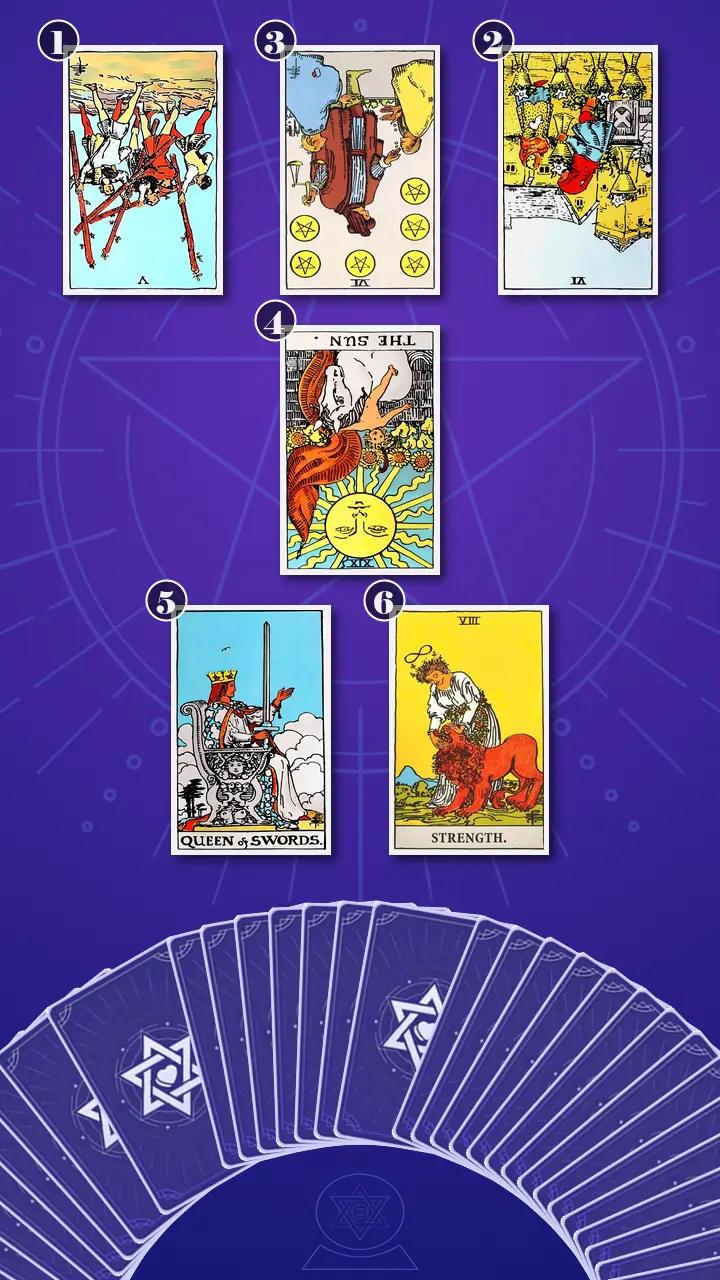
Reading the Map: Where the Scoreboard Begins
The Visible Rivalry: Five of Wands, Reversed
The card in position 1, the visible rivalry pattern, was the Five of Wands, in reversed position. This position normally describes the querent's current stance and way of participating in a relationship. Here, it asked what Alex did in the exact minute her sibling became the focus of parental attention.
The five crossed wands looked to me like several bids for attention happening at once: each figure pulling in a different direction, mismatched stances, and no clear victor. By 9:14 p.m., Alex had searched for an achievement of her own to add to the family chat, drafted a reply, deleted it, and told herself she did not care. The reversed Five of Wands translated the apparently casual conversation into an internal scoreboard: crossed signals, competing bids, and no one openly naming the contest.
Reversed, the Fire of the wands was not moving outward into an honest disagreement. It was blocked and turned inward. Alex might overexplain a success when she felt overlooked, or she might overcorrect by saying nothing and leaving the call early so no one could accuse her of competing. Either response hid the need without changing the ranking system in her body. I said, "The absence of an announced contest does not mean your nervous system has stopped competing. It may simply mean the contest has moved into your editing, your silence, and the replay after the call."
I use a lens I call Family Casting Analysis at moments like this. I am not assigning motives to Alex's parents or declaring her family harmful from one scene. I am identifying the forced role her nervous system seems to have learned to play. In this reading, the role was the Prove-Your-Worth Child: the person who scans the audience, collects evidence, and tries to make sure the family cannot overlook her.
As I studied the crossed staffs, I remembered working over a rough cut in my own studio, watching five competing moments fight for the same two seconds of screen time. Adding more footage had not created a clearer story; choosing a point of view had. I told Alex, "You may not need a more impressive achievement. You may need a different center from which to tell the truth about your own life."
Alex did not nod. She gave a short, bitter laugh and rubbed her thumb along the edge of her phone. "That is too accurate," she said. "I do not even call it competition out loud. I call it being prepared." I answered, "Preparation helps when it serves you. It becomes a trap when every family update creates a private task called prove I matter."
I invited her to notice the next trigger without judging it: when a parent praises her sibling, does she add an achievement, edit her story, go quiet, or check the thread again later? That question was not a demand for immediate change. It was the first act of taking the pattern out of the shadows and placing it where an adult could observe it.
The Childhood Filter: Six of Cups, Reversed
The card in position 2, the sibling's perceived pressure, was the Six of Cups, in reversed position. This position describes the other person's role as experienced within the relationship, not the sibling's private motives. I wanted to keep that distinction clear: the card could show how Alex interpreted her sibling's visible progress without claiming that the sibling intended to create a ranking.
The Six of Cups showed the child offering a flower-filled cup, another child receiving it, and a distant village beyond the archway. In modern life, I saw the Thursday video call when a parent praised Alex's sibling's new relationship and asked enthusiastic follow-up questions. Alex heard a current family update, but the younger part of her heard, "They chose them again." The reversed card was like an old draft pinned to the top of an inbox: a new message arrived, but the earlier interpretation opened first.
The Water here was flowing backward. That did not mean Alex was trapped in childhood or that the memory was false. It meant the present fact and the old meaning were being poured into the same cup. The present fact might be, "My parent praised my sibling's relationship." The childhood conclusion might be, "There will not be enough attention left for me." When those two sentences fused, a simple compliment became evidence in an unfinished case.
I asked Alex what she wanted to evaluate first: what had actually been said, or what the moment seemed to prove about her place in the family. Her fingers tightened around the mug, then loosened. She looked toward the window for several seconds before saying, "I know the current conversation is not literally my childhood. My body reacts before my adult mind can catch up."
"That is useful information," I said. "It means the first response does not have to be a message, a performance, or a withdrawal. It can be noticing the younger conclusion and allowing the adult facts to remain separate." I reminded her that separating the present from an old family role does not require rejecting warmth, skipping every call, or pretending the past had no effect.
The Approval Ledger: Six of Pentacles, Reversed
The card in position 3, the approval economy, was the Six of Pentacles, in reversed position. This is the shared relational dynamic: the pattern of giving, receiving, attention, power, and exchange operating between the people involved. In this spread, it was the major blockage.
The merchant's scales, raised hand, and coins moving toward kneeling figures gave the family group chat a startlingly modern shape. Alex counted how many follow-up questions each parent asked, who received a wall of hearts and exclamation marks, how quickly each person replied, and whose news came up again on the weekly call. She used the tally to decide whether her own update was worth sending. The reversed Six of Pentacles made recognition feel like a household budget: if her sibling received more, there must be less available for her.
I named the silent monologue I could hear in the pattern: "If they asked more about my sibling, there must be less room for me." I also said, "The ledger is real as an experience, but it is not proof that your parents consciously intended a ranking. It is the measuring system you have been using to protect yourself from the stomach drop of feeling overlooked."
Reversed Earth suggested an imbalanced exchange rather than a lack of worth. Alex was trying to receive a stable sense of value from an external giver, then checking the scales whenever that value seemed uneven. Brief relief could arrive if she received extra praise or sounded equally successful, but the relief expired quickly. The sibling became a scoreboard, and the younger need remained unaddressed.
Alex's thumb stopped above the family thread. Her breath caught, her gaze went briefly unfocused, and then she pressed her palm against her chest as if to steady the small drop forming there. "I have counted the questions," she said. "I know exactly when they ask three follow-ups for her and one for me." I replied, "You are not ridiculous for noticing. We are looking at what the noticing has been costing you."
I asked her to consider a gentler question for the next call: what would she want from her parents if her sibling's achievement were not part of the conversation? Attention? Warmth? Time to finish sharing? Reassurance? That question changed the exchange from competition to connection without pretending the family had always offered recognition evenly.
The Light Behind the Wall: The Sun, Reversed
The card in position 4, the inner-child root, was The Sun, in reversed position. This position uncovers the less visible influence beneath the relationship pattern: the childhood meaning and unmet recognition need that keep the old cycle active.
The child on the white horse, the large sun with its straight and wavy rays, the sunflowers, and the low garden wall all pointed toward uncomplicated visibility. Alex told me about finishing a difficult communications project and feeling proud for a few minutes. Then she imagined how her parents would react beside her sibling's latest success, and the warmth went out of the accomplishment. The reversed Sun showed dimmed access to self-recognition, not a deficiency of achievement.
The Fire of the Sun was present but filtered through an imagined family audience. When a parent praised the sibling, Alex qualified her own successes, changed the subject, or waited for a stronger compliment before allowing herself to feel proud. The overcorrection could also run the other way: posting more evidence, polishing a family update until it sounded senior enough, or seeking repeated reassurance. In both directions, her inner light waited for someone else to authorize it.
I introduced another of my personal lenses, Narrative Enmeshment Diagnosis. I use that phrase carefully. I am not claiming that Alex's parents consciously wrote a secret plan for her, and I am not saying that her sibling is responsible for the pain. I am asking whether Alex's personal life story has been hijacked by a family plotline, perhaps one in which each child's achievements are expected to confirm something about the household. If so, her adult choices begin to feel like auditions for a role she never consciously accepted.
"I keep waiting for my parents to give me the kind of approval I could finally believe," Alex said. She looked down at her hands instead of at the card. I said, "The younger wish to be unmistakably seen deserves care. It does not have to become the editor of every adult update you make." A parent can respond imperfectly and Alex can still decide whether the accomplishment belongs to her before anyone else reacts.
I asked her to write two private sentences after the next trigger: the present-day fact, and the childhood meaning her mind attaches to it. The exercise was small enough to begin in Notes, but precise enough to interrupt the old shortcut that launched before she could choose the adult response.
When the Queen Held Up One Clear Sentence
The Adult Resource: Queen of Swords, Upright
The card in position 5, the adult resource, was the Queen of Swords, in upright position. This position identifies the clarity, language, and boundary available to Alex when she wants to interrupt the defense strategy without attacking her sibling or demanding a perfect response from her parents.
The Queen held one sword upright and extended her other hand openly. That combination mattered. The sword offered discernment and a clean edge; the open hand kept clarity from becoming punishment. The modern translation was a family call in which Alex said, "I want to share this without turning it into a comparison. Could you stay with my update for a minute?" She did not mention her sibling's career, build a case for equal praise, or deliver ten impressive details as evidence.
Upright Air brought balance to the reversed Sun and gave the scattered wands a single direction. I compared the Queen's one sword with the Five of Wands' crossed staffs: one clear sentence could replace several competing explanations. I told Alex, "One clear sentence can do what ten impressive details cannot. It can tell the truth about the conversation you are willing to have."
We rehearsed the line once. Her first attempt came out too polished, with three explanations attached. I asked her to remove everything after the request. She tried again: "I want to finish sharing before we compare stories." The sentence sounded almost too simple to count as a boundary. That was exactly why it challenged the old performance.
Alex exhaled, then laughed softly without much humour. "If I say it that plainly, I cannot hide behind sounding impressive," she said. Her relief and resistance arrived together. I told her that direct language can feel exposed because it removes the protection of pretending not to care. A boundary does not guarantee that the other person will respond perfectly; it gives her a way to remain connected to herself while she finds out what happens.
I asked her to imagine the family call again and notice the pause after the sentence. Would she fill it with her sibling's achievements, apologize for having a need, or allow the request to stand? The Queen's open hand suggested that clarity could leave room for connection without making connection the price of self-respect.
When Strength Held the Lion Without Winning
Before I turned the final card, I let the room become quiet. The fridge clicked off, the apartment seemed briefly larger, and the blue reflection from the phone rested on the table beside the spread. I told Alex that this was not a forecast about the family. It was the card I most wanted her to experience as a choice she could practice.
The Self-Led Response: Strength, Upright
The card in position 6, the self-led response, was Strength, in upright position. It was the key card and the bridge of the reading. Its invoked energy was self-compassionate courage, emotional regulation, patient self-trust, and the ability to remain connected without turning recognition into a contest.
The woman with gentle hands around the lion did not defeat the animal, silence it, or make it perform. The infinity sign above her head suggested a repeatable practice, not a one-time victory. In the modern scene, a parent praises Alex's sibling and the familiar urge rises to check LinkedIn, produce better evidence, or disappear from the conversation. Strength asks her to notice the surge, name it, and choose whether to stay present or set a boundary without making the sibling an opponent.
I told Alex, "Strength is not deleting the comparison app. It is noticing the notification, putting the phone face down, and choosing whether to open it. The lion is the surge of longing and shame. The gentle hands are the adult capacity to stay with that surge without converting it into a performance."
This was also where I returned to Family Casting Analysis. The old role had been the Prove-Your-Worth Child, always auditioning for the lead. Strength did not ask Alex to cast her sibling out of the film or to win the family scene. It asked her to stop auditioning for a role that made another person's praise the evidence of her own value.
The Sentence That Changes the Casting
I asked Alex to picture Sunday at 8:47 p.m. in her Toronto apartment: her sibling's update still glowing in the family chat, her Notes app open, and her polished reply changing again and again. She was not simply sharing news; she was trying to stop one compliment from becoming evidence that she ranked second.
I said, "The rivalry is not proof that your sibling matters more; it is the old wish to be unmistakably seen asking for care. You can honor that wish without turning your sibling into evidence against yourself." I let the sentence settle between us. Then I gave her the key card's message in the clearest form I could find:
The old competition does not have to define your worth; meet the younger self with Strength's quiet hand and choose self-respect over outperforming your sibling.
Alex's breath stopped. For a beat, her fingers hovered above the phone and her thumb froze over the family chat. Then her gaze slid past the cards, losing focus as if it were replaying the Sunday screen: blue light, a deleted reply, and the imagined ranking. Her jaw trembled once. She looked down at her hands, and a quiet "ah" came from the bottom of her chest. The fists she had not realized she was making opened one finger at a time. Her shoulders dropped, but the new space left her briefly dizzy; without the contest, she could not instantly see what to do. She whispered, "I can feel erased and still not make my sibling responsible." I stayed quiet long enough for the sentence to belong to her. Then I asked, "Now, use this new perspective to recall whether there was a moment last week when this insight could have made you feel different?"
That was the first movement from comparison-driven longing and tension toward compassionate self-respect and clear adult boundaries. The cards did not remove the wish to be chosen. They showed Alex that the wish could be held by an adult self instead of handed over to the family scoreboard. The goal was not to win the conversation; it was to stop handing the conversation her definition of worth.
Finding Clarity When the Scoreboard Goes Quiet
The Story the Six Cards Tell
When I placed the six cards together, the logic became straightforward. The reversed Five of Wands showed Alex presenting competing achievements, editing her updates, or going quiet while an unspoken contest continued. The reversed Six of Cups showed why a current compliment could open an old draft of childhood meaning before the adult facts had time to arrive. The reversed Six of Pentacles revealed the approval ledger that turned questions, reactions, and praise into a scarce emotional currency. The reversed Sun showed the younger need to be seen and the way external approval had dimmed Alex's access to her own pride.
The Queen of Swords supplied the first adult interruption: precise language, an honest request, and a boundary that did not use the sibling as evidence. Strength carried that clarity into real time, where the body might still tighten and the old urge might still appear. The story was not that Alex needed a better career, a more polished relationship, or a more persuasive family update. The story was that an old family script had been asking her adult life to keep proving a childhood conclusion.
I named the cognitive blind spot gently. Alex had been treating comparison as the price of admission for asking to be seen. She believed she needed enough evidence first, and that if she stopped competing, nothing would prove that she mattered. The key shift was smaller and more powerful: when comparison starts, name the younger need for approval and choose one adult action she controls, such as a pause, a direct statement, or a boundary.
"I do not need a better achievement to make my hurt valid," I told her. "You can want attention without presenting a stronger case. You can be happy for your sibling and still feel erased. Both truths can exist without turning either of you into a problem to solve."
This is why I see the six-card Relationship Spread · Context Edition as a self-exploration tool for adult sibling rivalry and parental approval rather than a source of predictions. Its card meanings in context make the emotional mechanics visible: the crossed wands become internal ranking, the Six of Pentacles becomes an approval ledger, the Queen of Swords becomes a clear adult boundary, and Strength becomes compassionate self-command.
The No-Scorecard Response
I kept the next steps deliberately small. Alex did not need to stage a family summit, explain every childhood memory, or force her parents to distribute praise equally. I offered two low-stakes practices that could help her test a different response in ordinary Toronto work-and-family life.
- The Approval Ledger PauseWithin ten minutes of the next comparison trigger, whether it arrives in the family group chat or during a weekly call, open Notes and write three lines: "What happened," "What I decided it meant," and "What I need now." Keep the third line free of your sibling's achievements. Name attention, warmth, space, reassurance, or time to finish sharing. Before the next family call, reread only that third line and decide whether it belongs in the conversation or is simply information for you.Set a ten-minute timer and stop when it ends. This is a private observation tool, not evidence for a confrontation. If the old meaning feels too intense, write "I felt less visible" and return to a neutral task.
- The Script-Flipping RehearsalDuring one family call or message thread this week, deliberately give an out-of-character response: share one piece of your own news without mentioning your sibling, then say, "I want to share this without turning it into a comparison. Could you stay with my update for a minute?" Allow one full pause after the request instead of adding achievements, explanations, or a defence of why your news matters.Rehearse the sentence once aloud and keep it to one request. If the conversation becomes dismissive or mocking, say, "I am going to pause here," and return to the topic only if you decide you want to. The purpose is to interrupt an established power dynamic, not to guarantee a particular reaction.

A Week Later, the Quiet Proof of Self-Respect
A week later, I received a text from Alex: "I shared my project without mentioning my sibling and used the sentence." Her parents replied warmly but briefly. She still woke with "What if I am wrong?" in her mind; this time, she ate breakfast before checking the thread.
That was not a complete repair of the family dynamic, and it was not meant to be. It was a small piece of evidence from a new script: Alex could let her own news stand on its own, feel the old pull, and choose an adult response before the pull chose for her. The family group chat had not stopped being a possible trigger. It had stopped being the only author of the scene.
I think of our Journey to Clarity as a movement from standing on an old family stage, where every compliment feels like a score, to holding the pen in the present. Tarot offered structure, symbolism, and actionable advice. Alex supplied the recognition, the boundary, and the courage. The cards did not make her the master of her parents' reactions; they helped her become the author of what she did with those reactions.
When your sibling receives the praise you have been waiting for, your chest may tighten and your jaw may lock as a younger part hears, "There is less room for me," even while your adult mind knows their good news is not a verdict on your worth. A compliment is not a ranking, even when your body hears it that way.
If you could let the wish to be chosen exist without making your sibling the scorecard, what small adult response would feel most like your own voice in the next family conversation?