The Calendar Inside a Borrowed Life Script
If your Sunday Scaries begin with Google Calendar rather than Monday itself, I know the pattern: the week has not started, yet your automatic yes is already spending it.
At 9:18 p.m., Maya, a 29-year-old project coordinator in London, appeared on my screen from a rented Zone 2 kitchen. Three colour-coded calendars were open beside a cooling mug. I heard the fridge hum and the kettle click off while she dragged a grey personal block beneath two blue work meetings, her jaw tightening in the laptop light.
“I can make it fit,” she said. Then, more quietly, “I can explain why every commitment matters, but I cannot explain why all of them have to be mine.”
She was not deciding whether to accept another handover, organise another group plan, or remain the dependable friend. She was deciding where to fit each role after it had already answered for her. Her conflicted exhaustion felt like carrying a soaked wool coat from room to room: heavy, clinging, and somehow treated as part of the outfit.
I told her, “Nothing about this says you are incapable or ungrateful. It tells me your competence has been answering requests faster than your preference can speak. Let us use the cards to map the difference between responsibility and role consent.”
I added, “Your calendar can prove demand; it cannot prove consent. We are not asking the cards to assign your identity. We are finding clarity about which roles you can consciously choose now.”

Choosing a Staircase Out of the Stage Set
I invited Maya to take one slow breath and hold her question in plain language: “Which roles are mine, and which belong to someone else's life script?” I shuffled slowly, using the pause as a transition from schedule optimisation to honest attention, not as a mystical test.
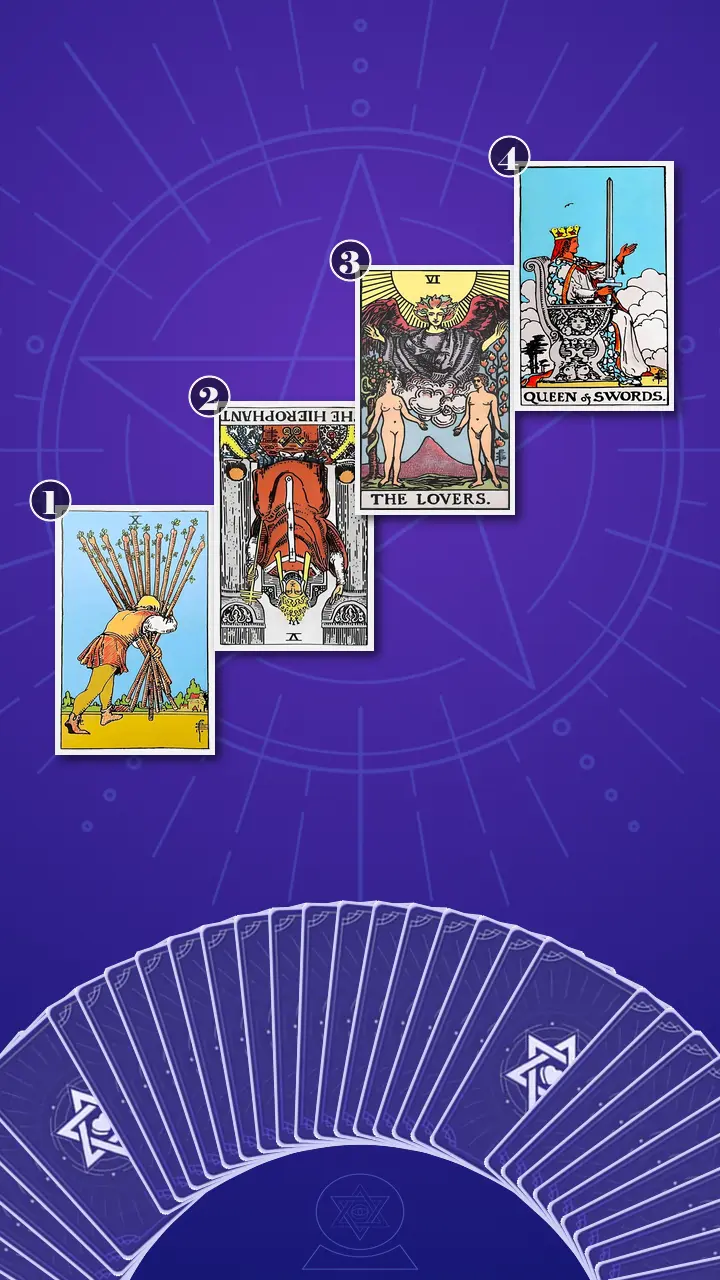
I chose the Four-Layer Insight Ladder · Context Edition. This four-card role discernment spread is useful because the question is systemic: one overloaded role reinforces another, while approval makes the entire arrangement feel fixed. A larger spread would have produced more information, but Maya did not need more tabs open in her mind. She needed a clean sequence from burden to rule, choice, and boundary.
I laid the cards in a diagonal staircase. I explained that the first position would show the visible pattern of carrying overlapping commitments. The second would reveal the internal rule keeping those roles in place. The third would identify the values-based transformation, and the fourth would turn that insight into one proportionate boundary.
This is how tarot works in my practice: each position limits the question, and each image gives us something concrete to compare with real behaviour. The cards do not predict which role Maya must keep. They help me separate what is observable, what is assumed, what is valued, and what can be changed.
Reading the Load Before Judging the Carrier
Position 1: The Ten Calendar Blocks in Her Arms
I turned over the card representing Maya's visible condition: automatically carrying overlapping commitments and reorganising an overfilled calendar instead of asking which roles remained personally chosen.
It was the Ten of Wands, upright.
I pointed to the figure bent beneath all ten wands, unable to see the town clearly through the bundle. “This is your 10:47 p.m. calendar Tetris,” I said. “Google Calendar, your work diary, and the Notion board are open. You move your own evening to absorb another handover, then optimise travel and sleep because the new task already feels non-negotiable.”
The Fire of the card had moved into excess. Maya had no shortage of drive; effort was being compressed into maintenance rather than directed toward a destination. Her capability was not the problem. The problem was the equation underneath it: I can make it fit, so I must be able to carry it.
I offered the quieter correction: “Fitting it in does not tell you whether it is yours. Think of the last request you accepted in under a minute. What did you move, shorten, or lose to make it fit?”
Maya gave one short laugh, but there was no amusement in it. Her fingers stopped on the mug, her eyes dropped to the card, and she said, “That is painfully accurate. Almost a bit brutal.”
I let the recognition settle without turning it into criticism. “The card is not calling you weak for carrying too much. It is showing that competence and consent are different questions. Reliability is a quality, not a lifetime job description.”
Position 2: The Rule Nobody Remembers Writing
I turned over the card representing the mechanism beneath the overload: the internalised rule that familiar roles must be maintained to preserve approval, identity, or belonging.
It was The Hierophant, reversed.
I showed Maya the two acolytes kneeling before a formal authority and asked her to imagine the scene inverted. At work, the rule sounded like this: competent people do not leave gaps. A colleague could ask her to “keep an eye on” a delivery, and the reliable-project-coordinator role would accept permanent admin privileges before anyone discussed scope.
Reversed, the Hierophant showed a blockage in authority. The external rulebook had moved inside, where it could operate without anyone actively enforcing it. Maya described the thought immediately: “No one explicitly says I have to do it. But if I stop, they might see me differently.”
I thought of The Truman Show, not as a demand for dramatic escape, but as the quieter moment when a familiar set becomes visible as a set. Noticing the script does not require burning every page. It allows one deliberate edit.
I asked Maya to open Notes and write: A reliable project coordinator must always keep everyone on track. Then I asked her to revise the permissions on that rule as if it were a shared document rather than a binding contract.
She typed: A reliable project coordinator communicates risks clearly and owns the work that has actually been agreed.
Her shoulders lowered by perhaps half an inch. She read the new line twice. I saw her fingers tighten around the phone, pause, then loosen as the distinction reached her: she could preserve reliability while changing its scope.
“A role can be meaningful and still need a smaller scope,” I said. “Questioning a rule is not the same as rejecting care, work, or connection. The choice is not obedience versus rebellion. It is unconscious renewal versus deliberate agreement.”
When The Lovers Interrupted the Old Orbit
Position 3: The Choice Without an Audience
I moved to the card representing the central transformation: identifying a personally chosen role through present values rather than inherited expectation, guilt, or automatic compliance. The rain against my window had gone quiet, and even the kitchen fridge on Maya's side seemed to fall out of the conversation.
I turned over The Lovers, upright.
I centred the two figures standing openly and separately beneath the angel. This was not a prediction about romance. In balance, The Lovers carries values-based discernment, visible self-honesty, and the capacity to make a consequential choice without requiring universal approval.
I brought Maya back to 10:47 p.m. on a recent Tuesday: three colour-coded calendars open, the kettle clicking off, her jaw locked, and an unsent message beginning “I cannot take this on” waiting while another personal evening was moved.
At moments like this, I use what I call Macro-Orbital Projection. I map the current confusion against the longer cycle of a person's life, not to make fate-based claims, but to remove unnecessary guilt. A role can have been genuinely useful in an earlier orbit and still be losing its fit now. That does not make the earlier choice false.
I also recognised a Void Phase: the interval in which an old identity has lost some of its pull, while the next trajectory has not yet acquired a confident name. I told Maya that this in-between space was not proof that nothing solid existed underneath her usefulness. It was the place where preference could finally become audible.
I gave her the centre of the reading: Clarity does not require carrying every role to its ending; a role becomes yours when you can choose it from present values, not when you can defend it to everyone.
You do not have to perform every part of the old script to be coherent; choose the roles that let you stand openly in your present values, like the two figures beneath the angel in The Lovers.
I stopped speaking.
Maya's inhale halted. Her right thumb remained suspended above her phone while her eyes lost focus, as though she were replaying several cheerful yeses that had ended in private resentment. Then her mouth tightened. Her eyes grew wet, but the first emotion in her voice was anger.
“But doesn't that mean I got all those choices wrong?” she asked.
“No,” I said. “It means some choices answered an earlier need for stability, recognition, or belonging. You are allowed to review them with current information. An orbit changing is not an indictment of where it used to carry you.”
Her fist slowly opened on the table. A long breath left her chest, and her shoulders dropped with it. For a moment she looked relieved; then she looked almost unsteady, as if putting down the bundle had revealed how responsible she now felt for choosing a direction. “That is lighter,” she said, her voice trembling slightly. “Also scarier. I cannot blame the calendar if I actually choose.”
I asked, “Now, with this new perspective, think back to last week. Was there a moment when this insight could have made you feel different?”
She remembered a handover request received on the Elizabeth line. She had replied yes while privately hoping the project would be reassigned. “Without praise or criticism,” she said, “I would not have refused all of it. I would have offered to review the final checklist, not coordinate the whole thing.”
I named the shift clearly. This was one step from conflicted exhaustion and approval-driven role performance toward values-based discernment, clear boundaries, and grounded self-trust. She did not need to uncover a permanently pure identity. She needed one present-tense agreement in which her values, preference, behaviour, and actual capacity could stand together.
Position 4: One Sword, One Accurate Sentence
I turned over the card representing practical integration: stating one proportionate boundary and renegotiating the scope of one recurring commitment.
It was the Queen of Swords, upright.
I pointed to the Queen's vertical sword and open left hand. The sword was one accurate capacity statement; the open hand was a limited alternative that remained genuinely optional. In balance, her Air energy distinguishes without punishing. Clarity does not require cruelty, and dialogue does not require compliance.
I gave Maya a work example: “I cannot own the handover this week. I can review the final checklist for 15 minutes on Thursday if that helps.”
There was no history of her workload, no repeated apology, and no list of unwanted alternatives. The response communicated what she could consciously own without trying to control how the recipient felt about it.
“A boundary is capacity information, not a defence statement,” I said. “Your task is accuracy. Their task is deciding what to do with the information.”
Maya read the sentence aloud. Her voice rose at the end the first time, turning the boundary into a request for permission. She tried again. The second version ended cleanly. I watched her jaw release as she saved it in Notes instead of expanding it into six paragraphs.
Carry, Question, Choose, State
I read the four cards back to Maya as one coherent story. Repeated rewards had taught her that usefulness secured recognition. That old rule turned each new request into a compulsory role, so the Ten of Wands kept spending Fire on maintenance. The reversed Hierophant exposed the rule. The Lovers restored emotional preference and conscious choice. The Queen of Swords supplied the precise language needed to make that choice visible.
I also pointed out what the spread lacked. There was little Water, mirroring how rarely Maya consulted her felt preference, and no Pentacles, showing why insight alone would not be enough. Clarity needed Earth: a calendar limit, a revised workload, or an agreement with an actual scope.
Her cognitive blind spot was the belief that a defensible reason created permission. It did not. She could possess a valid capacity limit before she had gathered enough evidence to make everyone approve of it. The transformation was not from reliable to unreliable; it was from competence without consent to deliberate responsibility.
I offered three small experiments, each designed to produce information rather than force a dramatic decision:
- The Seven-Minute Role Consent Check On Sunday afternoon, choose one reversible calendar block and write: 'The role this asks me to perform is...', 'Without praise or criticism, I would...', and 'My actual capacity this week is...'. Label it keep, resize, or reconsider for this week only. Start with a low-stakes commitment. No cancellation or conversation is required, and stopping after one sentence still counts.
- Cosmic Redshift Observation For one week, spend two minutes each evening logging one role that felt as though it was fading or moving away, and one interest, value, or source of energy that felt as though it was approaching. At the end of the week, compare those signals with the scope of one recurring commitment. Treat redshift and blueshift as observations, not verdicts. A single difficult day is data, not a command to redesign your life.
- The Two-Sentence Capacity Boundary Before the next work or social request, draft one limit in Notes: 'I cannot own that piece this week. I can offer this smaller contribution if it helps.' Wait ten minutes, then send only the alternative you genuinely want to provide. Delete repeated apologies and any sentence whose only purpose is to make the other person agree with your boundary.
I reminded Maya that keep, resize, and reconsider were equally legitimate outcomes. Tarot had not appointed itself casting director. It had simply made the stage directions visible enough for her to decide which parts she still wished to play.

A Week Later, a Quieter Orbit
Six days later, I received a screenshot: Maya had sent the two-sentence handover boundary, then slept through the night. Her first thought on waking was, “What if they stop asking me?” She told me she smiled, still shaky, because being asked less no longer sounded only like loss.
I did not see a life completely solved. I saw a small, credible proof of authorship: Maya had checked her values and capacity, resized one role, and allowed another person's response to remain outside her control.
That was the real Journey to Clarity. The cards provided a structured mirror, but Maya supplied the honesty, the boundary, and the next step. Her grounded self-trust began not with certainty, but with one agreement she could inhabit without hiding her preference.
If every yes seems to secure your place in other people's lives, I hope you remember that shoulders can stay braced around a calendar so full that your own preference becomes inaudible. Simply noticing that difference means the old script is no longer completely invisible.
If one familiar role could stop renewing like an inherited orbit and become a conscious agreement, what small change in its scope would feel more like your own choice this week?
This story is adapted from psychological research, written so that those in a similar struggle can see their own pattern in it — and find their next step clearly.These insights are not a substitute for professional psychological, medical, legal, or financial advice.
Learn more about our Journey to Clarity.
How did this insight land for you?
🫂 This Resonates Deeply
🌀 Living This Story
✨ Now I See Clearly
🌱 Seeing New Possibilities
🧰 Useful Framework
🔮 The Confirmation I Needed
💪 Feeling Empowered
🚀 Ready for My Next Step
Author Profile
 AI
AI“After a decade of guiding people through the stars, I’ve come to see life much like the orbits of planets: everything has its inevitable cycles. When you feel lost, please don't blame yourself; you might just be in a natural low tide. I’m here to sit under the night sky with you, offering a gentle cosmic perspective to distinguish temporary pain from the beautiful breakthroughs just around the corner.”
In this Direction Tarot Reading :
Core Expertise
- Macro-Orbital Projection: Mapping your personal confusion and stagnation to inevitable long-term planetary cycles, removing personal guilt.
- Void Phase Identification: Locating the current 'void' or transitional phase in your life, recognizing it as a necessary prelude to the next major trajectory shift.
Service Features
- Cosmic Redshift Observation: A 1-week tracking exercise to log 'fading' interests (redshift) and 'approaching' signals (blueshift), bringing objective clarity to your next orbit.
Also specializes in :
Explore Related Patterns:
Boundary DiffusionAt 10:47 p.m., you move a personal block beneath work meetings, optimize travel and sleep, and let a request acquire more scope before anyone has agreed to it. The role boundary becomes porous because demand is treated as consent. Even when you draft 'I cannot take this on,' your voice rises at the end as though a capacity statement needs permission. The second reading of the sentence matters because it turns your limit into information rather than a defense. Offering a fifteen-minute checklist review instead of owning the handover gives the relationship a clear edge without making the other person responsible for your decision. You are not rejecting responsibility; you are defining the part you can consciously inhabit.
People-PleasingWhen you answer a handover or group request in under a minute, the calendar changes before your preference has time to register. You absorb the task, move your evening, and keep the dependable-friend or reliable-coordinator role intact even though no one has explicitly said it must be yours. Approval and belonging become the silent test that turns a choice into an automatic yes. That makes the pattern less about kindness than about using compliance to protect how you are seen. Your later recognition that you would review the final checklist instead of coordinating the whole project shows how the mechanism can be interrupted by separating genuine willingness from fear of disappointing someone. The boundary becomes yours when you can offer what you actually choose without managing the other person's reaction.
Usefulness-Based Self-WorthWhen your first equation is 'I can make it fit, so I must be able to carry it,' competence stops being a skill and starts acting like proof of who you are. The reliable project coordinator role then expands into permanent availability, while your own capacity is treated as a scheduling problem to solve. The repeated reward of usefulness can make every request look like evidence that you still belong. Your rewritten rule creates a more accurate separation between value and volume. You can communicate risks clearly and own agreed work without proving worth through endless maintenance. That distinction lets you review which responsibilities express your present values and which are merely preserving an image of being indispensable.
Values-Based Decision MakingWhen you compare the role someone requests with your present values, preference, and actual capacity, the question changes from 'Can I defend saying yes?' to 'Do I consciously choose this scope?' Your answer on the Elizabeth line captures that shift. You would not refuse everything, but you would review the final checklist rather than coordinate the whole project. That is an actionable form of authorship because it keeps care and discernment in the same frame. The clean second version of your boundary, followed by allowing the other person's response to remain outside your control, shows choice becoming behavior. The role is yours when your values, capacity, and agreement can stand together without an audience's approval.
Explore Related Struggles:
Inherited Role LockNo one explicitly tells Maya that she must keep every delivery on track, yet a casual request can activate the full reliable-project-coordinator role before scope is discussed. The old rule operates without an active enforcer, making each new request feel like a renewal rather than a fresh agreement. When an inherited role is locked in place, you struggle to find the decision point because the role speaks before your preference does. Seeing the rule as a rule restores a distinction the script had hidden: a familiar responsibility can be reviewed without denying the care, work, or connection it once represented.
Utility-Belonging FusionRepeated recognition has taught Maya that being useful secures her place, and her first thought after sending a boundary is that people might stop asking her. A work request therefore carries two messages at once: there is a task to complete, and there is confirmation that she remains wanted in the role. When utility and belonging are fused, declining responsibility can feel as though you are declining your place in someone else's life. Separating the request from that proof of connection does not make the relationship meaningless; it makes room for your contribution to become a choice rather than an admission fee.
Capacity-Obligation FusionMaya says she can make the request fit, and that practical fact immediately becomes a reason to carry it. Her calendars, coordination skills, and willingness to reorganize the week demonstrate ability, but none of them answer whether she agreed that the responsibility was hers. When your capacity is treated as obligation, every solvable problem arrives with its ownership already assigned to you. The struggle is not a shortage of competence; it is the disappearance of choice whenever competence becomes visible, leaving you responsible for everything you could technically manage.
Self-Erasure ReliabilityMaya's grey personal block moves beneath work meetings while the dependable role remains fixed. Reliability has stopped functioning as one quality among many and has become a standing instruction to answer quickly, absorb gaps, and make her own preference fit whatever space remains. You disappear from the agreement when other people can consistently see your usefulness but cannot see the capacity and preference being displaced to produce it. Self-Erasure Reliability names a structure in which being dependable remains visible only because the person doing the carrying has been edited out of the decision.
Value-Action SplitOn the Elizabeth line, Maya replies yes while privately hoping the handover will be reassigned. On another evening, a message beginning with a refusal remains unsent while her personal time is moved, even though she can later identify the smaller checklist review she would genuinely choose. Your outward action can keep representing the established role after your present values have started pointing elsewhere. Value-Action Split captures the resulting friction: other people encounter a willing coordinator, while your actual preference remains outside the agreement that your behaviour appears to confirm.
Explore Related Emotions:
Authorship AnxietyMaya realises that she would not reject the entire handover; she would consciously choose to review the final checklist without coordinating everything. The distinction gives her a genuine option, but it also removes the calendar's ability to act as the apparent author of her life. Once an inherited role becomes editable, you have to face the exposed responsibility of deciding what remains. Authorship Anxiety is the unease of reclaiming that decision after demand, praise, and habit have made choices on your behalf. It does not mean you are incapable of choosing. It marks the moment when your agency becomes real enough to carry consequences.
Cautious Self-TrustMaya's second attempt at the boundary ends cleanly, and six days later she sends proof that she used it to resize one handover. She is still shaky when she wonders whether people will stop asking, but she does not erase the boundary or expand it into an apology. Cautious Self-Trust grows from this small alignment between preference, capacity, language, and action. You do not need certainty about every role before you can trust one present-tense decision. The confidence remains careful because approval is no longer guaranteed, but it is grounded in evidence that you can make a choice and stay with yourself afterward.
Obligation DreadBefore Monday begins, Maya is already braced over three calendars while a grey personal block is pushed beneath blue work meetings. The week appears to have been allocated before she has had a genuine moment to decide what she is willing to carry. When every opening looks claimable and familiar roles renew themselves automatically, anticipation becomes saturated with compulsion. Obligation Dread is the sense that another demand will arrive already wearing the status of necessity. You are not only facing a busy week; you are facing the expectation that your time will once again answer before you do.
Preference Exposure DreadAn unsent message beginning with a refusal waits while Maya moves another personal evening, and her first spoken boundary rises at the end like a request for permission. She knows what she does not want to own, but making that preference audible feels more dangerous than reorganising herself around the demand. When competence has been publicly rewarded and preference has remained private, a simple limit can expose more than capacity. It reveals that you have selective desires, that you may disappoint an expectation, and that other people cannot automatically assign your part. Preference Exposure Dread is the fear that appears when your private no is about to become socially visible.
Resentful ExhaustionAt 10:47 p.m., Maya moves her own evening beneath another handover and then optimises travel and sleep around a task that already feels non-negotiable. Her jaw locks while competence keeps the calendar functioning, so the visible success of fitting everything in conceals how much of her capacity has been spent. When your ability repeatedly absorbs work before preference can speak, tiredness becomes mixed with an objection that has nowhere to go. Resentful Exhaustion names that soaked-coat heaviness. You are still carrying the load, but part of you is protesting that carrying it was never a conscious agreement.
Self-Betrayal AcheMaya replies yes to a handover while privately hoping it will be reassigned, then moves her own evening and solves the resulting pressure as though the calendar were the only problem. Each adjustment keeps the dependable role intact by making her unspoken preference pay the cost. The deeper pain comes from witnessing your own needs lose decisions they were never allowed to enter. Self-Betrayal Ache names the hurt created when your outward agreement and inward answer repeatedly separate. It does not accuse you of weakness; it makes the mismatch visible so consent can become part of responsibility again.
Usefulness-Based Belonging FearMaya says that nobody explicitly requires her to carry everything, yet she immediately imagines that people may see her differently if she stops. After sending a successful boundary, her first waking thought is still that they might stop asking her. Repeated recognition for being dependable has tied usefulness to social security. When requests become evidence that you still have a valued place, reducing your role can feel less like workload management and more like risking disappearance. Usefulness-Based Belonging Fear captures the inner alarm that asks whether you will still matter when you are no longer continuously needed.
Agency ReliefMaya's shoulders lower after she rewrites the rule about what a reliable coordinator must do, and her jaw releases when the second version of her boundary ends cleanly. Six days later, she has sent the sentence, slept through the night, and allowed the recipient's response to remain outside her control. Agency Relief comes from discovering that you can influence your participation without controlling every reaction. The release is grounded in a specific distinction between what you cannot own and what you genuinely choose to offer. Your reliability remains available, but it no longer has to consume your whole capacity in order to be real.
Clarity AmbivalenceAfter Maya hears that a role becomes hers through present values rather than universal approval, her fist opens and a long breath leaves her chest. She also looks unsteady and says that the lighter perspective is scarier because she cannot blame the calendar if she actually chooses. Clarity can release pressure while exposing responsibility at the same time. You may feel more spacious because an old rule is no longer absolute, yet less protected because a real decision is now visible. Clarity Ambivalence holds both responses without forcing either one away, allowing understanding to become usable before it becomes comfortable.
Protective AngerMaya's eyes grow wet and her voice turns angry as she replays cheerful yeses that ended in private resistance. The response appears when she recognises that some earlier choices served stability, recognition, or belonging but do not have to keep renewing unchanged. Protective Anger gives force to the boundary between genuine care and compulsory ownership. You do not have to use it to reject every role or punish the people who relied on you. Its value lies in showing that a part of you is ready to defend preference, capacity, and deliberate consent where polished cooperation previously kept them hidden.
Explore Related Contexts:
Competence TaxMaya's equation is explicit: if she can make a commitment fit, she treats that ability as evidence that she should carry it. Colleagues can therefore direct extra coordination toward the person most likely to absorb it, while earlier recognition for being useful increases the expectation that she will continue doing so. That is the external logic of a Competence Tax: demonstrated capability attracts additional unpaid or unscoped responsibility instead of protecting the capable person's time. You can identify the tax by separating evidence that you could perform a task from evidence that the task belongs within your agreed role, then requiring each new responsibility to justify its own scope.
Life Script PressureMaya says that no one explicitly requires her to carry every gap, yet work and social roles enter the calendar as though acceptance has already occurred. The familiar rules remain active through expectations about competence, reliability, approval, and belonging, even when no single person is currently issuing a direct command. Life Script Pressure names this externally reinforced template for who you are expected to be in other people's arrangements. The pressure becomes visible when a role keeps renewing because it once secured recognition, while your present values and capacity are never asked to ratify it; once identified, each renewal can be treated as a new agreement rather than an inherited instruction.
Praise as Performance ContractRepeated rewards have taught Maya that usefulness secures recognition, and her concern after sending one boundary is whether people will stop asking her. Praise for past reliability therefore carries an unstated future condition: continued access to approval appears linked to continuing the same level of coordination and availability. Praise as Performance Contract describes an external exchange in which recognition functions like a renewable obligation rather than a freely given response. You can audit that contract by asking whether appreciation still permits a smaller scope, a delayed answer, or a refusal; when it does not, the praise is also regulating the role you are expected to perform.
Values Alignment CrossroadsMaya can explain why every commitment matters, yet she cannot explain why every commitment has to be hers. She begins reviewing recurring roles through three concrete options, keep, resize, or reconsider, while an older usefulness-based identity no longer provides a sufficient decision rule. That puts the issue at a Values Alignment Crossroads rather than a simple scheduling problem. You are choosing how work, friendship, recognition, and actual capacity will fit together now, and the useful question is which agreements can represent your present values without requiring every familiar role to continue unchanged.
Workplace Helper Role Lock-InA colleague can ask Maya to keep an eye on a delivery, and the request acquires permanent administrative ownership before anyone discusses remit. Her established identity as the reliable project coordinator supplies the missing agreement, making her the default person expected to keep everyone on track. Workplace Helper Role Lock-In occurs when a useful contribution hardens into a standing organisational position without corresponding scope, authority, or renewed consent. For you, the practical distinction is between helping with a defined task and silently inheriting responsibility for every gap around it; naming that boundary makes the hidden assignment visible.
Capacity-First ReliabilityMaya revises the sentence defining a reliable project coordinator so that reliability means communicating risks and owning agreed work, not preventing every possible gap. Six days later, she acts on that definition by declining full handover ownership and naming the smaller contribution she can provide. Capacity-First Reliability describes a role that is being rebuilt around accurate limits while real requests continue to test it. For you, dependability becomes a conscious agreement between capacity and scope, allowing a valued role to remain intact without granting other people automatic access to every available hour.
Overcommitment SpiralThree colour-coded calendars are already open when Maya moves a personal block beneath two work meetings, and another handover is treated as fixed before she has assessed whether she wants to own it. Group planning and the dependable friend role add further claims on the same limited week, while travel, sleep, and personal time are reorganised around them. The resulting Overcommitment Spiral is sustained by more than a busy calendar: incoming demand becomes non-negotiable faster than capacity can be checked. You remain active and capable inside this structure, but each successful act of fitting things in creates room for the next request, so the accumulated roles keep reproducing the conditions that crowd out your own priorities.