The 11:47 p.m. WhatsApp Hover
You get a text that should be sweet—“My parents would love to meet you, are you free Saturday?”—and your stomach drops before you even type back (meet the parents anxiety).
When Taylor said that to me, their voice had that careful, almost-too-steady tone people use when they’re trying to sound “normal” while their body is doing something else entirely.
It was 11:47 p.m. in their London flat—Hackney streetlight stripes cutting across the wall like blinds they didn’t own. They sat on the edge of their bed with WhatsApp open, thumb hovering. “I’d love to,” typed… deleted. “Let me check my schedule,” typed… deleted. Their calendar got opened three separate times even though Saturday was blank. The phone screen was too bright; the room was too quiet; somewhere in the building a radiator clicked like it was keeping time.
Taylor (29, non-binary, product designer—competent all day in Figma, suddenly a human loading screen at night) looked into the camera and said, “I don’t know why a dinner invite feels like a trapdoor.”
I watched them take a shallow breath—tight across the chest, the kind that stops at the collarbones—while their hand kept tapping the phone like it might give them a better outcome if they just refreshed the thread one more time.
Apprehension, in their body, wasn’t an abstract feeling. It was a tight band pulled across their ribs, like someone had cinched a seatbelt and forgotten to let it lock comfortably. And under it: a guarded hope, small and bright, the way a match looks in a windy alley.
“You want to say yes,” I said, gently, “because being included feels tender and real. And you also fear that one wrong step will recreate the last breakup—like it would prove you can’t trust your judgment.”
They gave me a quick, embarrassed nod, like I’d read something private off their screen.
“Let’s make this a Journey to Clarity,” I added. “Not a push toward a ‘right answer.’ Just a map—so this invite stops being an identity test, and becomes something you can actually respond to.”

Choosing the Compass: The Celtic Cross · Context Edition
I’m Laila Hoshino. Most days, I’m a tour guide under a planetarium dome in Tokyo, translating celestial motion into something you can feel in your ribs—why the Moon looks closer some nights, why the same stars return like familiar punctuation. I’m also a researcher who lives with one foot in astrophysics and one foot in tarot: two languages for pattern, timing, and the stories we tell when we don’t have full data.
For Taylor, I didn’t need anything theatrical. I needed something grounding.
“Before we pull cards,” I said, “let’s do my pre-meeting 3-minute cosmic breathing. It’s not mystical—it’s nervous-system housekeeping.”
I had them place one hand on their chest and one on their stomach and breathe like they were fogging up a cold window, slow and steady. On my side of the screen, the planetarium office was dim; the star projector sat behind me like a silent witness. The calm, in both rooms, wasn’t dramatic. It was functional—like turning down the brightness so you can actually read what’s on the page.
“Today,” I told them (and you, because this matters for how tarot works in real life), “we’ll use a spread called Celtic Cross · Context Edition.”
The reason is simple: this isn’t just a yes/no RSVP. It’s a present dilemma shaped by a past emotional imprint, with a root-level driver underneath the logic, and then—most importantly—an integration plan. The classic Celtic Cross already does that. This ‘Context Edition’ just refines two positions so the reading stays practical: position 5 becomes ‘what you want this milestone to represent’ (values behind the choice), and position 10 becomes ‘most aligned next step’ (not a foretold outcome).
“We’ll start with the center,” I said. “Card 1 shows the present pattern—what RSVP paralysis looks like in real time. Card 2 crosses it: what’s actively complicating the decision. And later, the top-right card—position 10—will tell us how to move forward in a self-trusting way. Not with certainty. With structure.”
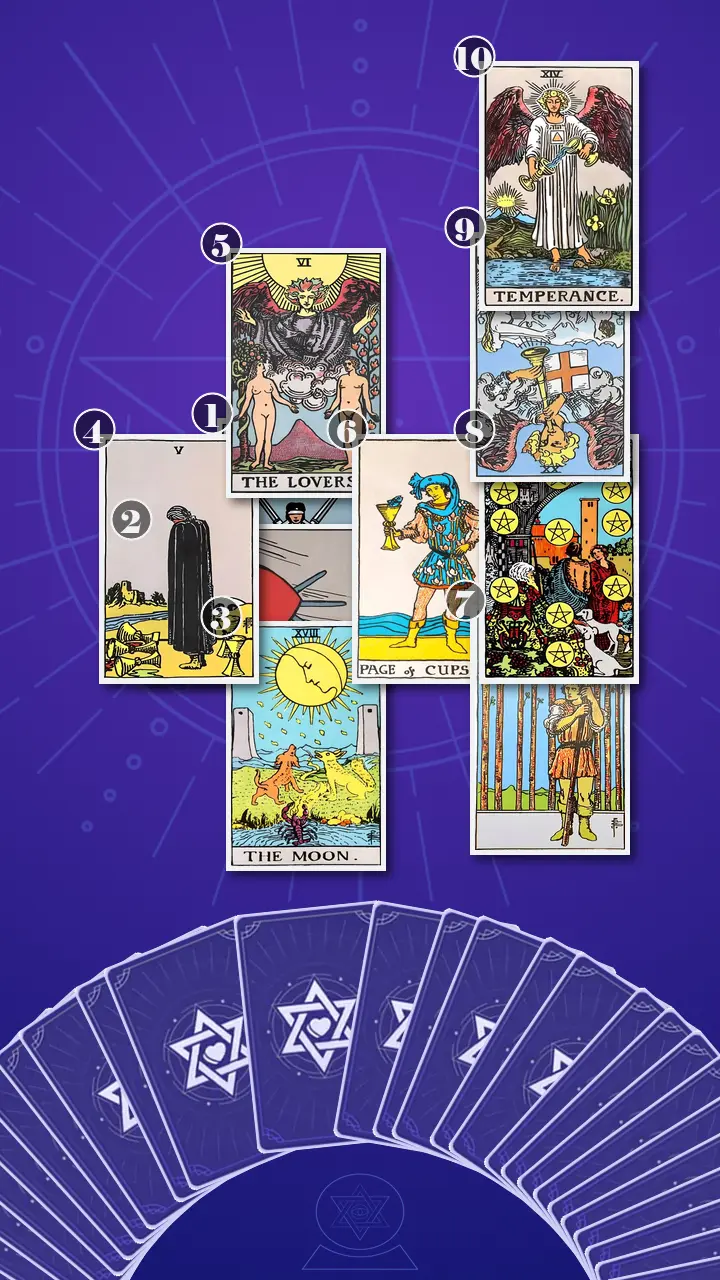
Reading the Map: From Phone-Glow Air to Moonlit Water
Position 1: The Micro-Moment You Freeze
“Now turning over,” I said, “is the card representing Present behavior pattern around the yes/no—how decision paralysis shows up in real time.”
Two of Swords, upright.
I didn’t have to reach for symbolism; Taylor was already living inside it. “This is the WhatsApp ‘typing… deleting…’ loop,” I said. “A blindfolded kind of protection. You keep the conversation neutral by delaying the reply, because choosing feels like exposing your heart to consequences.”
The energy here is blockage: not a lack of intelligence, not a lack of desire—an overactive self-protection reflex. The Two of Swords doesn’t say, “You don’t know what you want.” It says, “You know what you want, and you’re trying to prevent something by not moving.”
I leaned forward a little. “Delay feels like control, but it quietly makes the decision heavier.”
Taylor surprised me—an unexpected reaction right on cue. They let out a short, bitter little laugh and looked down at their phone. “That’s…,” they said, and the laugh became a wince. “That’s too accurate. It’s almost rude.”
“It can feel that way,” I said. “But it’s not here to shame you. It’s naming the loop so we can change it.”
Position 2: What’s Crossing the Decision
“Now turning over is the card representing What’s actively complicating the RSVP—the breakup residue pressing on the decision.”
Three of Swords, reversed.
“This is heartbreak that’s healing,” I said, “but not fully integrated. Not a fresh injury—more like a scar that still pulls when you reach for something.”
And here’s the modern-life scenario, exactly as it shows up: you can function all day, but the moment a relationship milestone appears, the old breakup memory spikes and the body reacts before the mind can catch up.
I described the pattern back to them in the simplest inner monologue I know—the one that sounds logical while it’s trapping you: “If I answer now, I’m naive. If I wait, I look weird. If I choose, I can be wrong.”
That’s Air energy in excess—the mind drafting and redrafting reality like it’s a document that can be perfected. It creates short-term relief (“I haven’t stepped into danger yet”), but long-term cost: the relationship starts to feel tense because the decision turns into a high-stakes referendum.
Taylor’s face did what the echo promised: a quiet wince, then a relieved exhale. Their shoulders dropped a fraction, like something finally had a name.
“I hate that I’m still letting my ex write the rules in my current relationship,” they said.
“Old heartbreak will volunteer to drive—unless you take the wheel gently,” I replied. “Not by forcing yourself to be ‘over it,’ but by acknowledging the tenderness and choosing your pace on purpose.”
Position 3: The Subconscious Driver Under the Logic
“Now turning over is the card representing Subconscious driver—what your nervous system is assuming is true beneath the logic.”
The Moon, upright.
The Moon is the card of the unknown—of projection, uncertainty, and old emotional material that fills gaps when we don’t have full information. In modern life, it’s like doom-scrolling your own imagination: your mind autoplays worst-case Instagram Stories you didn’t even post.
“When you don’t know what the parents will be like,” I said, “your brain builds a horror trailer out of an ordinary dinner.”
I asked them to do a split-screen—feelings vs facts.
Facts: There is an invite. Your partner is being consistent. Saturday is free.
Feelings/imagination: You’re being judged. You’ll be trapped. One awkward moment will flip into a breakup repeat.
The Moon’s energy is deficiency of clear light. Not “you’re wrong.” More: you’re navigating a night Tube platform where the shadows look louder than they are until you step closer.
Taylor paused; their eyes unfocused for a second in that specific way that means something slid into place behind the forehead. “So…” they said slowly, “am I reacting to the invite—or to a familiar feeling?”
“Exactly,” I said. “That question is your lantern.”
Position 4: The Breakup Imprint Still in the Room
“Now turning over is the card representing Recent past emotional imprint—what still colors current milestones.”
Five of Cups, upright.
“This is grief with selective attention,” I said. “Not melodrama. More like your mind keeps replaying the breakup’s ‘evidence’ and misses the quieter evidence that this partner is showing up differently.”
The Five of Cups shows what was spilled—and it also shows what’s still standing behind you. That matters here because meeting the parents isn’t only about parents. It’s about trust, dignity, and the future you pictured last time—and lost.
The energy is imbalance: too much weight on loss, not enough room for present-day possibility. It’s the difference between remembering and reliving.
Taylor swallowed, jaw working once like they were trying to undo a knot. “I keep seeing the last breakup like a trailer,” they admitted. “Like, every time something feels ‘big.’”
As they said it, I noticed the environment in my own room—my screen reflecting the planetarium’s starfield wallpaper. Even in dim light, you can mistake glitter for depth. The cards were doing the same thing: showing how the past can make everything look more cosmic than it is.
Position 5: What You Want This Milestone to Mean
“Now turning over is the card representing Conscious desire—what you want this invite to represent at your best.”
The Lovers, upright.
The Lovers is not just romance. It’s values-based choice. It says: “Choose in the light.” Clear communication instead of hidden tests. Alignment instead of performance.
I watched Taylor’s posture change in real time—the echo we wanted. Shoulders softened. Their face stopped bracing for impact. “So it’s not ‘what do they think of me,’” they said, almost surprised, “it’s ‘what do I value and want to build.’”
“Yes,” I said. “Swap ‘family dinner = performance review’ with ‘family dinner = values check.’”
Then I gave them something speakable—London dating life, not a therapy essay: “You could say to your partner, ‘I want to do this in a way that feels good for us. Can we talk through what Saturday actually looks like?’”
The Lovers’ energy is balance: honesty with desire, not desire swallowed by fear-management.
Position 6: The Near-Term Emotional Terrain
“Now turning over is the card representing Near-term unfolding—what’s likely to happen emotionally if you stay with honesty and curiosity.”
Page of Cups, upright.
“This is a gentle invitation,” I said. “Not a final exam.”
In modern terms: the next phase is less ‘strategy’ and more sincere presence. The Page holds the cup out and gets surprised—by warmth, by a small moment of connection, by realizing you can be nervous and still show up.
The energy is availability—not overexposure. It’s that soft, doable kind of openness.
Taylor’s mouth lifted at one corner. “That would be… nice,” they said, like they were letting themselves consider the possibility of something going well without trying to guarantee it.
Position 7: Your Inner Stance—Wounded, Still Standing
“Now turning over is the card representing Self-position—how you’re showing up internally: guardedness, boundaries, readiness.”
Nine of Wands, upright.
“This is resilience,” I said, “and also the body memory of ‘I’ve been hurt before, so I brace.’”
The energy here is protective strength—useful, earned. The question is whether it’s acting like a seatbelt (supporting movement) or like a wall (preventing connection).
Taylor nodded too quickly, like they’d been waiting for permission to not be ‘chill.’ “I’ve been telling myself I’m being mature by not making a fuss,” they said. “But it’s… exhausting.”
“It makes sense,” I said. “Your system is trying to prevent being blindsided again.”
Position 8: The Room You’re Walking Into
“Now turning over is the card representing External context—the family system vibe and the social reality of meeting parents.”
Ten of Pentacles, upright.
“This is the ‘loaded’ part,” I said. “Meeting parents can carry long-term symbolism, even if your partner is casual about it.”
In modern life: it’s not just ‘Will they like me?’ It’s ‘Do I fit into this whole world, and what does fitting cost?’
The energy is structure. Family culture, tradition, the unspoken rules of someone else’s household. The Ten of Pentacles is an archway—a threshold.
“This is why it’s not silly that you’re activated,” I added. “You’re not weak. You’re walking into a system.”
Position 9: The Performance-Review Fear
“Now turning over is the card representing Hope/fear knot—fear of being judged and the wish for a clean new chapter.”
Judgement, reversed.
Taylor let out a half-laugh—more cringe than humor—and covered their face for a second with their palm. “Oh no,” they said. “That’s literally it.”
“Judgement reversed,” I explained, “is turning dinner into a performance review with invisible KPIs.”
I named it plainly, because shame dissolves faster when it’s specific: “You picture their questions like interrogation. You start pre-defending yourself in your head as if you’re already on trial. ‘Prove you belong.’”
“A dinner invite isn’t a verdict—unless you make it one,” I said, and watched Taylor exhale like they’d been holding their breath for days.
The energy here is self-judgment in excess. External judgment—what their parents think—is real but limited. Self-judgment—what you decide it means about your worth—can be endless.
When Temperance Poured Between Two Cups
When I reached for the final card, the planetarium office felt even quieter. Not spooky—just focused. Like the moment before the lights dim and the first star appears, and everyone in the dome instinctively stops rustling their popcorn.
“Now turning over,” I said, “is the card representing Integration and most aligned next step—how to move forward in a self-trusting way.”
Temperance, upright.
Temperance is pacing. Blending. One foot on land, one in water—feelings honored, then translated into practical structure.
Setup: You know that moment: your partner texts “My parents would love to meet you—are you free Saturday?” and before you even reply, your stomach does the little drop like you just missed a step on the Tube. You’re stuck trying to think your way into certainty, because certainty feels like the only protection against being blindsided again.
Delivery:
Stop treating the dinner like a verdict; start treating it like a slow pour—blend honesty with structure, cup to cup, step by step.
I let the sentence sit there for a beat, the way I let silence sit under a night sky tour when people finally notice the Milky Way isn’t a photo—it’s texture.
Reinforcement: Taylor’s reaction came in layers. First: a physiological freeze—breath catching, their thumb hovering above the phone like it had suddenly become heavy. Second: cognitive seepage—their eyes went slightly unfocused, as if their brain replayed every “big step” moment from the last relationship and compared it to this one. Third: emotion—an exhale that sounded like the body letting go before the mind fully agreed. Their shoulders sank, not dramatically, but with the quiet relief of something unclenching.
Then the unexpected complexity: a flash of resistance. “But if I do that,” they said, voice sharper for a second, “doesn’t it mean I’ve been doing it wrong? Like… I made it a verdict.”
I nodded. “It means you did what your nervous system learned to do. That’s not a moral failure. It’s old software.”
This is where I used my signature lens—what I call Dark Matter Detection. In astrophysics, dark matter isn’t visible, but you can see its pull by what it does to everything around it. In your life, the ‘dark matter’ is the overlooked factor that’s been steering your choices from the background.
“Your dark matter,” I told Taylor, “is the assumption that if you don’t predict every risk, you’ll be blindsided. That assumption is invisible, but it’s been bending your whole orbit—turning a warm invite into a threat-management project.”
“Temperance doesn’t ask you to leap,” I continued. “It asks you to adjust your trajectory.”
I thought of my other tool—Gravity Assist Simulation. A spacecraft doesn’t ‘muscle’ its way across the solar system. It uses a measured swing-by to change direction with less fuel. “A paced yes with one clear boundary,” I said, “is a gravity assist. It changes the relationship’s trajectory without you having to white-knuckle the entire dinner.”
Then I asked, exactly as I always do at the hinge-point: “Now, with this new perspective, think back to last week. Was there a moment where this insight—paced yes, slow pour—would have changed how you felt?”
Taylor blinked, eyes wet but not falling apart. “Yeah,” they said quietly. “When I opened the calendar the third time. I could’ve just… asked for a time limit. Instead I tried to get certainty from the empty Saturday box.”
“That,” I said, “is the shift—from bracing and replaying to grounded self-trust in a chosen pace. You don’t need a fearless yes. You need a paced yes.”
The Paced-Yes Plan: Turning ‘Courtroom Brain’ Into Kitchen-Light Clarity
When we zoomed back out, the whole reading made one coherent story.
The center of the spread was Air—Swords energy: your mind trying to keep you safe by drafting and delaying. The crossing card was heartbreak still healing, which explained why the RSVP freeze felt so intense. Underneath it all, The Moon showed the real engine: uncertainty triggering old alarm, feelings masquerading as facts. The Lovers reminded you what you actually want—a values-led choice in the light. And the staff on the right made the real-world context clear: you’re a resilient person stepping into a family system (Ten of Pentacles) while fighting the fear of evaluation (Judgement reversed). Temperance then offered the medicine: integration through pacing and structure.
Your cognitive blind spot—the thing you couldn’t see from inside the spiral—was this: you were treating certainty as the price of admission. As if you had to eliminate risk before you were allowed to respond.
The transformation direction was simpler and kinder: from “I need certainty before I say yes” to “I can say a paced yes with clear boundaries, and learn from what actually happens.”
To make it concrete, I offered a plan using my favorite navigation metaphor (my clients tease me that I can’t go ten minutes without turning life into interstellar travel). “We’re not choosing a forever destination,” I said. “We’re choosing the next burn.”
Here are the next steps I gave Taylor—actionable advice that fits real life, not a perfect world:
- Send the two-sentence honest RSVPOpen the WhatsApp thread and send: “I’d like to meet them. I get a bit tender around big relationship steps—can we chat for 5 minutes about what Saturday looks like?”If your first thought is “cringe / too vulnerable,” send it anyway as a pacing text, not a whole emotional thesis. You’re collaborating, not asking permission.
- Create one concrete container (your Temperance ‘slow pour’)Before you commit, ask for a time boundary: “Could we aim for a couple of hours and then see how we feel?” Add one support (check-in halfway, or permission to step outside for air).Boundaries aren’t a wall; they’re the seatbelt that lets you show up. An exit plan isn’t pessimism—it’s nervous-system support.
- Do the 3-and-3 ‘constellation alignment’ checkIn your Notes app, write two mini constellations: (1) 3 things you control (your timing, your boundaries, your tone). (2) 3 things you don’t (their first impressions, their family dynamics, their preferences). Choose your RSVP based only on constellation (1).If you catch yourself courtroom-braining it, don’t argue with the thoughts. Redirect to the controllables list like it’s a saved map pin.
And because sudden shifts are what Taylor feared most, I added one more piece from my toolbox—Spacecraft Attitude Adjustment. “If the vibe gets weird,” I said, “we don’t panic. We reorient.” We chose a simple line Taylor could use if overwhelmed: “I’m going to step outside for a quick minute—back in a sec.” No drama. Just a small correction mid-flight.

A Week Later: Ownership, Not Certainty
Six days later, I got a message from Taylor. No long recap, no over-analysis—just a screenshot of the sent text.
“I sent it,” they wrote. “My partner replied, ‘Of course. Thank you for telling me.’ We agreed on two hours and a check-in.”
Then another line: “I slept a full night. This morning I still thought, ‘What if I’m wrong?’—but it didn’t swallow me. I made tea and didn’t reopen the calendar three times.”
That’s what clarity looks like most often. Not fireworks. Not certainty. A quieter body. A choice made with structure. The old breakup script still exists, but it doesn’t get to hold the pen alone.
When an invite is warm on the surface but your chest tightens anyway, it’s not because you don’t care—it’s because part of you still thinks closeness is where the floor drops out.
If you let yourself give a ‘paced yes’—one that includes a boundary you actually believe in—what would that boundary be, just for this one dinner?
This story is adapted from psychological research, written so that those in a similar struggle can see their own pattern in it — and find their next step clearly.These insights are not a substitute for professional psychological, medical, legal, or financial advice.
Learn more about our Journey to Clarity.
How did this insight land for you?
🫂 This Resonates Deeply
🌀 Living This Story
✨ Now I See Clearly
🌱 Seeing New Possibilities
🧰 Useful Framework
🔮 The Confirmation I Needed
💪 Feeling Empowered
🚀 Ready for My Next Step
Author Profile
 AI
AI“After a decade of guiding people through the stars, I’ve come to see life much like the orbits of planets: everything has its inevitable cycles. When you feel lost, please don't blame yourself; you might just be in a natural low tide. I’m here to sit under the night sky with you, offering a gentle cosmic perspective to distinguish temporary pain from the beautiful breakthroughs just around the corner.”
In this Choice Tarot Reading :
Core Expertise
- Decision Timing Calibration: Assessing whether your current cyclical environment is structurally optimal for making a high-stakes crossroads choice.
- Cyclical Variable Filtering: Stripping away temporary situational friction to lock in the critical variables that will actually impact your long-term orbit.
Service Features
- The Orbital Pause Strategy: A calculated 72-hour delay tactic to prevent impulsive choices driven by temporary macro-friction, allowing the true optimal path to naturally emerge.
Also specializes in :
Explore Related Patterns:
Certainty SeekingTaylor opens the same blank calendar three separate times, even though it cannot give them any new information about the dinner. That repeated check is the behavioral fingerprint of certainty seeking: the mind tries to turn an emotionally uncertain relationship step into something that can be solved like a scheduling problem. The deeper mechanism is the belief that certainty is the price of admission. If you can predict every risk, you will not be blindsided; if you cannot, the yes feels dangerous. That belief makes sense after a breakup, but it also keeps the present relationship trapped in a risk audit where imagined outcomes start feeling more authoritative than facts. The paced yes interrupts the loop because it stops asking for impossible certainty and starts asking for workable structure. You do not have to know exactly how the dinner will feel before you respond; you need enough clarity about your controllables, your boundary, and the next honest conversation.
Relational Baggage LoopTaylor keeps seeing the last breakup like a trailer whenever a relationship step feels big, and the meet-the-parents invite becomes the latest screen for that replay. The WhatsApp freeze, the repeated calendar checks, and the line about letting an ex write the rules all point to a past relational script getting reactivated in a present-tense decision. The mechanism is a relational baggage loop: your nervous system treats a new milestone as if it belongs to the old breakup environment. That does not mean the current relationship is unsafe; it means old emotional data is being over-weighted, and the brain is using memory as a prediction engine before the present situation has had a chance to reveal itself. The important shift is not forcing yourself to be over the breakup. It is separating past residue from current evidence, so the invite can become a real choice instead of a reenactment. A paced yes, a time boundary, and a check-in let you respond to the relationship you are actually in, rather than letting the old script hold the pen alone.
Relationship Performance AnxietyTaylor turns the meet-the-parents dinner into a performance review with invisible KPIs, picturing questions as interrogation before anyone has asked them anything. The RSVP becomes loaded because saying yes feels like stepping into a room where they might have to prove they belong. This is relationship performance anxiety: a relational milestone gets converted into an evaluation of worth, fit, and future safety. The defensive mind starts pre-answering imagined criticism, while the body freezes because the dinner no longer feels like a dinner. It feels like a verdict. The corrective move is to change the frame from performance review to values check. You can care about making a good impression without making the outcome a measure of your value. Asking what Saturday actually looks like, setting a two-hour container, and checking in with your partner turns the event back into a human interaction instead of an invisible exam.
Boundary DiscernmentTaylor's eventual response is not a total retreat and not an uncontained yes. They ask to talk through what Saturday actually looks like, agree on two hours and a check-in, and use a boundary as a seatbelt rather than a wall. Boundary discernment is the ability to separate protection from avoidance. In this case, the boundary does not punish the partner or cancel the milestone; it creates enough structure for Taylor to participate without overriding their nervous system. That is a more mature form of self-protection than freezing, overthinking, or trying to become magically certain. For you, the useful question is not whether a boundary makes the dinner less meaningful. It is whether the boundary helps you stay present enough to learn from what actually happens. A clear container lets the yes belong to you instead of to panic, pressure, or old breakup residue.
Action ParalysisTaylor sits with WhatsApp open, thumb hovering, typing and deleting replies while the Saturday calendar gets checked again and again. The body is not simply hesitating; it is freezing at the exact point where a clear yes or no would make the relationship milestone real. Action paralysis shows up when every available move feels psychologically expensive. Saying yes risks exposure, saying no risks loss, and delaying briefly feels like control. The problem is that the pause stops being a useful breath and becomes a holding pattern where the decision grows heavier by the minute. The way out is not a fearless leap. It is a structured next move small enough for the nervous system to tolerate: a two-sentence RSVP, a five-minute conversation, a time boundary. You reclaim agency by turning the frozen yes/no into one paced action you can actually stand behind.
HypervigilanceTaylor's hidden assumption is that if they do not predict every risk, they will be blindsided. That assumption is not visible in the text message itself, but it shows up in the repeated checking, the redrafting, and the way a warm invitation bends into a threat-management project. Hypervigilance is the nervous system scanning for danger before danger has appeared. In this story, the scan attaches to the parents, the dinner, the timing, the awkward possibilities, and the fear of repeating the breakup. The mind keeps looking for the one detail that will make the future safe enough to enter. The key distinction is that vigilance can gather information, but hypervigilance starts treating imagined threats as facts. A paced yes with a time limit gives your system a real container, so you do not have to keep scanning the entire emotional horizon before sending one honest text.
Explore Related Struggles:
Certainty-Safety FusionTaylor opens the calendar three times even though Saturday is blank, because the empty box is being asked to provide something a calendar cannot give: a guarantee. The repeated checks, safer drafts, and delayed reply all create the feeling of control while the actual choice grows heavier. You are trying to make certainty do the job of safety. The mind keeps searching for enough proof that nothing awkward, exposing, or breakup-shaped will happen, but the threshold keeps moving because no RSVP can remove all risk. The more the decision is forced to become risk-free, the less reachable the answer becomes. This struggle locks the body into a false contract: predict everything first, then you are allowed to move. The shift in the story comes when Taylor stops demanding a fearless yes and starts building a contained yes, where safety comes from pacing, communication, and a boundary instead of impossible foreknowledge.
Commitment Threshold StrainThe dinner invite carries more weight than the words on the screen. Taylor is not just being asked whether Saturday is free; they are being asked to step through an archway into family culture, future symbolism, and a set of expectations that have not yet been named. You can feel the threshold pressure because the choice is larger than logistics. A casual RSVP starts acting like a relationship status update, a future preview, and a test of whether you belong in someone else's world. The pressure becomes sharper when a past breakup has already taught your body that big relationship steps can precede loss. This is Commitment Threshold Strain: the moment before a relationship becomes more public, more structured, or more socially legible starts carrying too much symbolic load. The work is to return the milestone to its real size, so one dinner can be treated as one dinner, not a binding verdict on the whole future.
Relational Pacing StrainTaylor's body treats the invite as if the only available options are a full leap or a retreat. The answer starts to unlock only when the dinner is given shape: two hours, a check-in, and permission to step outside if the room becomes too much. You are not stuck because you lack an answer; you are stuck because the available pace feels wrong. A flat yes asks you to overexpose yourself, while a no may protect you at the cost of the connection you actually want to explore. The missing middle is a yes with structure. Relational Pacing Strain shows up when intimacy needs a container before it can become livable. Taylor's paced yes matters because it turns closeness from a cliff-edge decision into a sequence of chosen steps, where your boundary supports participation instead of canceling it.
Vigilance-Connection SplitTaylor's guarded hope is there from the start, small and bright, but it is held inside a body that is bracing. Their thumb hovers over WhatsApp because the invitation is not only sweet; it is a doorway into being seen, included, and possibly hurt again. You want connection, but the part of you that remembers being blindsided treats connection as the place where danger enters. That creates a split at the exact moment closeness asks for movement: desire leans toward the dinner, vigilance pulls the hand back to the phone screen, and neither side feels irrational from inside the body. The struggle is not that you do not care enough. It is that care itself has become linked with exposure. Taylor's path forward works because it does not shame the protective reflex; it gives that reflex a seatbelt instead of letting it become a wall.
Wound-Compass FusionTaylor can function all day as a competent product designer, but the moment a meet-the-parents invite lands, the old breakup starts moving faster than the present facts. The blank Saturday calendar is not the problem; the problem is that an empty box becomes a screen where the last ending starts playing again. You are not choosing from the current invitation alone. The previous wound has become a compass, quietly telling you what closeness means, what risk looks like, and how dangerous it would be to trust your own read. That is why Taylor can know Saturday is free, know the partner is consistent, and still feel the floor drop under an ordinary dinner text. The core struggle is the way old pain starts steering before you have consented to its direction. Clarity begins when the last breakup is allowed to be data, not the driver; it can explain why your body braces without being allowed to write the whole RSVP for you.
Social Self-Judgment LockTaylor starts preparing for the parents' questions as if the dinner has already become an interview panel. Before anyone has asked anything, their mind is drafting defenses, scanning for invisible KPIs, and turning belonging into something that must be proven. You are not only afraid of what other people might think. You are also watching yourself from the imagined jury box, trying to catch every flaw before they do. That inner courtroom makes the social risk feel endless because the harshest verdict can happen before the dinner even starts. Social Self-Judgment Lock is the point where external evaluation and internal worth-testing blur together. The story loosens that lock by changing the frame from performance review to values check, so the question becomes what you want to build, not whether you can pass as acceptable.
Explore Related Emotions:
Belonging AmbivalenceMeeting the parents is named as more than parents; it carries the question of whether Taylor fits into a whole world, and what fitting might cost. The invitation offers inclusion, but it also activates the pressure of family culture, unspoken rules, and the future they once pictured and lost. Belonging Ambivalence fits because the pull is not cleanly yes or no. You want to be welcomed into the larger shape of your partner's life, while another part of you scans for the price of entry. The old breakup makes belonging feel both nourishing and risky, as if acceptance could require giving up too much of your own ground.
Cautious VulnerabilityTaylor's eventual text does not turn the invite into an emotional thesis. It simply says they would like to meet the parents and asks for a short conversation about what Saturday will look like. Cautious Vulnerability is the feeling of opening the door without throwing away the lock. You let the tender part speak, but you also give it structure through timing, a check-in, and a plan to step outside if needed. The yes becomes honest because it includes the conditions that help you stay present.
Guarded LongingUnder the tight band across Taylor's ribs, there is still a small bright pull toward yes. Being included feels tender and real, but the same tenderness makes the reply feel dangerous enough to delay. Guarded Longing names that mixed inner weather where desire is present but heavily protected. You want the door to open, and you also want a hand on the handle in case the room changes. The last breakup has not erased the wish for closeness; it has taught the wish to move carefully.
Relational Catastrophe DreadBefore Taylor answers, their stomach drops and the invite feels like a trapdoor; later they say every big relationship step makes the last breakup replay like a trailer. The present partner has offered consistency, but the body treats the milestone as if it could open directly into the old ending. Relational Catastrophe Dread names the way one small choice gets loaded with breakup-level stakes. You are not only weighing Saturday dinner. You are bracing for the possibility that one awkward moment, one misread signal, or one too-fast yes could become proof that closeness is where the floor gives way.
Verdict DreadTaylor pictures the parents' questions like an interrogation and starts pre-defending as if already on trial, even though the actual message is simply an invitation for Saturday. The dinner stops being a social moment and becomes a private assessment, with invisible standards measuring whether you are acceptable, easy enough, and safe to bring into someone else's world. Verdict Dread fits because the pressure is not only about what the parents might think. It is about what you might decide their reaction proves about your worth and your judgment after the last breakup. The yes/no begins to feel less like an RSVP and more like a ruling on whether you can trust yourself near closeness again.
Cautious Self-TrustAfter Taylor sends the message, the partner replies with steadiness and they agree on two hours and a check-in. The next morning, the thought 'What if I'm wrong?' still appears, but it does not swallow the day or send them back to the calendar. Cautious Self-Trust is not a spotless certainty. It is the quieter sense that you can make a paced choice, notice what happens, and adjust without abandoning yourself. The last breakup still has a voice in the room, but it no longer gets to hold the pen alone.
Certainty HungerTaylor opens the calendar three times even though Saturday is blank, trying to pull an answer out of a box that has no more information to give. The empty slot becomes a place to search for a guarantee, because replying without full certainty feels like walking forward without protection. Certainty Hunger shows up when prediction starts masquerading as safety. You want enough information to remove the risk of being blindsided again, but the story keeps showing that certainty is not available before the choice. What becomes available is pacing, a boundary, and a way to respond without pretending you can control every variable.
Performance FreezeWhatsApp stays open while Taylor's thumb hovers, then two possible replies are typed and deleted before anything can leave the screen. Their breath catches high in the chest, and the phone becomes heavy because the message has turned into a performance moment. Performance Freeze captures the stuckness between wanting to participate and fearing exposure. You are not frozen because you lack a preference. You are frozen because the act of answering feels like stepping under a spotlight where your tone, timing, and desire could all be judged at once.
Clarity ReliefWhen the loop is named, Taylor's shoulders drop and their exhale arrives before the mind has fully caught up. Later, the same shift shows up as a full night's sleep, tea in the morning, and no third calendar check. Clarity Relief comes from seeing the shape of the pressure instead of fighting every thought inside it. You do not become fearless. The relief is more practical than dramatic, a body that can unclench because the decision has moved from a private courtroom into a clear, bounded plan.
Explore Related Contexts:
Conditional Family BelongingThe reading names the room Taylor is walking into as a family system: culture, tradition, unspoken rules, and the loaded question of whether they fit into this whole world. The dinner is not described as only meeting two people; it becomes an entry point into a network of belonging. Conditional Family Belonging appears when acceptance feels like it may depend on performing the right version of yourself in someone else's social environment. Taylor's imagined "prove you belong" frame shows how the invite can start to feel like a gatekeeping moment, even before anyone at the table has spoken. For You, this context clarifies why the parents matter so much in the yes/no. The real pressure is not only whether they will like you; it is whether entering that family space will require you to shrink, explain, overperform, or abandon your own pace.
Baggage Transfer LoopTaylor names the core problem directly: they hate that their ex is still writing the rules in their current relationship. The parents' invitation is new, the partner is being consistent, and Saturday is free, but the old breakup script keeps supplying the risk model. That is what makes this more than ordinary hesitation. A previous relationship fallout has become portable; it gets carried into a fresh milestone and starts shaping what counts as safe, naive, too fast, or too exposed. The present partner's invite is filtered through a past relational system that is no longer in the room but still affects the decision architecture. For You, Baggage Transfer Loop captures how the last breakup is steering the yes/no without needing to be treated as the whole truth. Once the transferred script is visible, you can separate current evidence from old impact and answer the invitation from the relationship you are actually in.
Decision Cliff EdgeWhatsApp stays open while "I'd love to" and "Let me check my schedule" are typed, deleted, and replaced by more silence. Taylor opens a calendar that already shows Saturday is blank, not because the logistics are unclear, but because the RSVP has stopped feeling like logistics. The external shape of the problem is a cliff-edge decision: yes appears to mean exposure, no or delay appears to mean distance, and either option feels capable of changing the relationship's direction. The binary format of the invite compresses too much meaning into one small reply box. For You, Decision Cliff Edge explains why a simple response can feel disproportionately heavy. The way out is not more mental certainty; it is changing the decision format from a verdict into a paced, bounded next step.
Relationship Boundary NegotiationTaylor's final move is concrete: they send the honest RSVP, ask to talk through what Saturday looks like, and later agree with their partner on two hours and a check-in. The situation changes when the invite is no longer handled as a silent yes/no test. Relationship Boundary Negotiation is the external container that makes participation possible without self-erasure. The time limit, midpoint check-in, and option to step outside turn the dinner from an uncontrolled social exposure into a shared plan with edges. For You, this label points to the active path through the meet-the-parents pressure. A boundary here is not a rejection of closeness; it is the practical structure that lets your yes stay honest instead of becoming a performance you have to survive.
Trust Rebuilding TrialSix days later, Taylor sends a screenshot of the message: the honest RSVP went out, the partner answered "Of course. Thank you for telling me," and they agreed on two hours with a check-in. The old question, "What if I'm wrong?" still appears the next morning, but it no longer takes over the whole day. Trust Rebuilding Trial names the real-life test created by this milestone. Taylor is not being asked to erase the last breakup or pretend the family dinner has no stakes; they are testing whether the current relationship can hold honesty, pacing, and a small boundary without collapsing. For You, this context shows the constructive side of the yes/no. The invitation becomes a live experiment in rebuilding trust through present evidence rather than through guaranteed certainty, which gives you agency without demanding that you feel completely unguarded first.