Acting Like Your Old Self With Old Friends: One Sentence Left Unedited

When an Old Friendship Role Walks Into the Restaurant
If you are a late-twenties city professional who can write precise UX copy all day but edits your own life updates before a monthly friend dinner, I want to start here: acting like your old self around longtime friends can be identity lag, not a character flaw.
When Alex (name changed for privacy) told me about the Friday evening it began, the scene was already painfully clear. At 6:40 p.m. outside a crowded restaurant on Toronto's Ossington strip, Alex reread a university group-chat joke about how they had literally never changed. Bass thumped through the brick wall, fryer oil hung in the cold air, and their shoulders rose toward their ears as they typed a correction, erased it, and walked inside rehearsing the old punchline.
Alex said, "They know everything about who I was and almost nothing about who I am now." They wanted longtime friends to recognise the person they had become, yet feared that a changed preference, ambition, or boundary would make the group stop recognising them altogether. They were not hiding because the friendship meant nothing; they might have been hiding because it meant enough to lose.
I heard apprehension in the tightened throat Alex described, grief underneath the nostalgia, guilt about disrupting an easy evening, and loneliness arriving after the laughter. The whole experience sounded like a group chat running a cached version of their profile: familiar, fast, and increasingly inaccurate. I told Alex that our work was not to decide whether the friendship was good, bad, permanent, or doomed. We would make the pattern observable, test what the relationship could actually hold, and let Alex remain the person with final authority over what they shared. Together, we would draw a map through the fog and begin this Journey to Clarity.

Choosing a Compass for Friendship Identity Lag
To begin, I invited Alex to put both feet on the floor, name the question in one sentence, and take one unforced breath before I shuffled. I treat that pause as a change of attention, not a supernatural performance: it gives the mind a clear surface on which to notice what it has been editing.
For this reading, I used the Relationship Spread: Context Edition. For anyone wondering how tarot works in a situation like this, the spread is a compact five-card map for relationship dynamics. It does not claim access to Alex's friends' private thoughts. Instead, it separates Alex's current stance, the atmosphere created by shared history, the bond Alex is trying to protect, the mental restriction maintaining the silence, and the self-directed path toward clearer participation.
This smaller structure suited the question better than a larger Celtic Cross because the central issue was not every detail of Alex's life. It was the specific chain of current self-editing, an old relational mirror, genuine affection, anticipated rejection, and one observable communication experiment. I would begin with the card showing how Alex was managing visibility, move through the friendship field and its real warmth, descend into the thought pattern underneath the problem, and then rise to the card that could turn recognition into action.
The cards would ask: What are you currently making smaller to remain recognisable? What does shared history keep placing in the room? What is genuinely worth protecting? Where are you treating a prediction as evidence? And what present-tense truth could become audible without requiring the whole friendship to stand trial?
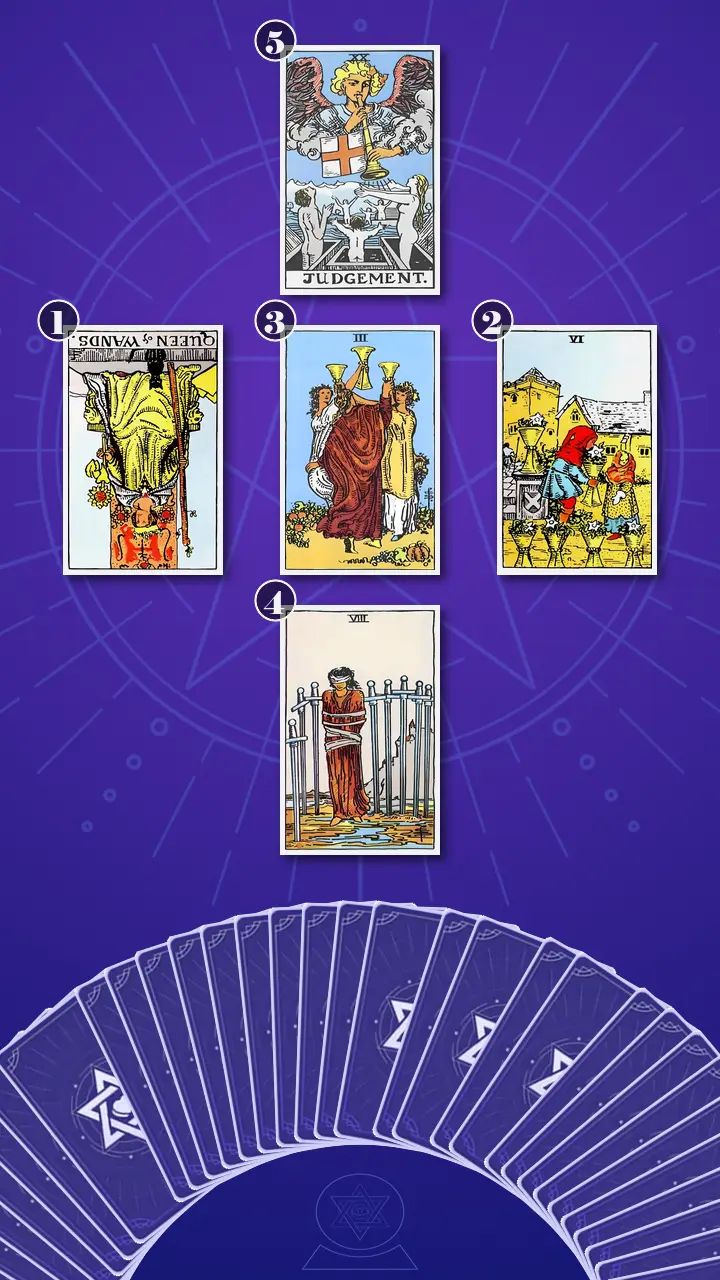
The Queen of Wands with the Volume Turned Down
I began with the position presenting Alex's observable self-editing: the current stance of performing warmth while withholding changed preferences, opinions, and boundaries. The card was the Queen of Wands, in reversed position.
In the image, the Queen holds a tall sunflower while a black cat watches from beside her throne. I saw the sunflower as the fully developed truth Alex was already carrying into the restaurant. The reversed energy did not show a lack of personality or social confidence. It showed expressive fire turned inward, a blockage in self-authorisation. Alex could be lively, funny, helpful, and socially fluent while measuring every sentence against the older version of them that the group already knew.
The modern-life scene was almost exact: Alex reached the restaurant with clear present-day preferences and enough confidence to express them, then turned that confidence into crowd management. If a friend looked surprised, Alex made the update funny, became extra animated, and helped carry the conversation so nobody could examine what they meant. The vivid sunflower went below the table while the familiar performance took the light.
I reflected the inner sentence I heard in that pattern: "I can be warm or I can be accurate, but not both." The card's invitation was deliberately small. Before the next meetup, Alex could name one current truth in one direct sentence, without apologising, overexplaining, or turning it into a joke. The risk on this reversed card was not only silence; it was swinging into an all-at-once declaration to prove authenticity. Neither concealment nor a courtroom presentation was necessary.
Alex gave a short laugh with a bitter edge instead of nodding. "That is too accurate," they said. "It feels a little cruel." I did not ask them to make the discomfort disappear. I said, "I hear the cruelty in having a voice and still feeling you have to lower its volume. The useful question is not whether you can perform confidence. It is whether you can let one accurate sentence exist without managing everyone's reaction first." Alex looked down at the card and rubbed a thumb along the edge of the table, recognition and reluctance arriving together.
The Six of Cups and the Pre-Filled Memory
Next, I turned to the position widening the other-party role into the relational field created by longtime friends, especially the shared memories and familiar identity cues that activate an old social role. The card was the Six of Cups, in upright position.
This card carried genuine tenderness. Before anyone asked what Alex currently wanted, the group might offer an affectionate university story, an old photo, or the familiar line, "You have always been the one who..." The warmth was real, but it arrived pre-filled with an identity. I described the flower-filled cup as an On This Day memory offered as a gift: beautiful and sincere, yet already containing answers written years ago.
Its Water energy was balanced when it allowed memory to nourish the present, but it became limiting when remembering quietly changed into reenacting. I asked Alex to notice the difference between receiving affection for an earlier self and being required to keep supplying that self as proof of membership. The inner sentence was, "I love that you remember me, and I am afraid memory is the only doorway you use."
Alex's shoulders softened for a moment, then their mouth pulled into a small, complicated smile. They told me about a birthday dinner where everyone finished a university story together, laughing before the ending arrived. The laughter had warmed their chest, but the table had spent forty minutes circling the archive while no one asked about the life Alex was living now. I said, "Shared history can be a home without becoming a dress code." Alex breathed out slowly, as though nostalgia could be loved without being obeyed.
The Three of Cups at the Centre
I placed the third card at the centre of the cross, where the position examines what Alex was trying to protect beneath the concealment: genuine affection, shared enjoyment, continuity, and a valued sense of belonging. The card was the Three of Cups, in upright position.
The three raised cups formed an open centre rather than a closed hierarchy. This was important. Alex's concealment was not simple evidence that the friendship was false. The bond had an active, mutual quality. In the middle of dinner, an unscripted laugh could travel around the table, and Alex could briefly stop monitoring every face. The body knew that part was real before the mind began analysing it again.
I read the card's energy as available connection rather than automatic acceptance. Belonging here was created through present participation, not granted to Alex for repeating an old performance. The Three of Cups could receive the Six of Cups' affection without requiring regression. It gave the reversed Queen a possible audience of people who might meet the person standing there now, provided that person was allowed to participate visibly.
Alex exhaled and leaned back. "This part is real," they said. "That is why I keep trying so hard not to disturb it." I agreed. I did not turn the reading into the easy internet answer that real friends will always accept every version of you instantly. Actual responses can be warm, surprised, mixed, slow, or revealing. The point was to stop deciding on behalf of the relationship before the relationship had received current information.
The Eight of Swords and the Pause That Became a Verdict
I moved below the central bond to the position exposing the psychological mechanism maintaining the problem: anticipated rejection treated as established fact, producing self-monitoring, silence, and no corrective evidence. The card was the Eight of Swords, in upright position.
The blindfold, the loose bindings, and the incomplete enclosure of swords gave me the clearest picture of Alex's feeling of social captivity. The restriction was not imaginary in the sense of being unimportant; it was embodied. Alex had a real tightened throat, a braced jaw, and a foot that started bouncing under the table whenever a changed preference became noticeable. But the card showed that the feared consequence had often arrived in Alex's mind before a friend had finished responding.
I replayed the restaurant moment Alex had described. Alex said, "I don't really do that anymore." A fork paused above a plate for two seconds. Before the friend could ask a question, Alex laughed, added, "God, listen to me becoming boring," and changed the subject. The inner chain moved too quickly to inspect: "They paused, I made it weird, I am becoming difficult, I could lose my place."
I separated the observable response from the predicted verdict. A pause was a pause. A raised eyebrow was a raised eyebrow. A question such as "Since when?" could be curiosity, surprise, confusion, or friction; it was not enough information to declare the relationship safe or unsafe. I told Alex, "A surprised pause is new information arriving, not a rejection verdict."
Alex's fingers tightened around their water glass. I watched their breath stop, their eyes lose focus as they replayed the fork and the silence, and then their foot settle flat against the floor. I asked them to revisit the scene without adding the joke. For three seconds, nothing was final. The new inner sentence was not "They will accept this." It was, "I do not know what that pause means yet."
That distinction mattered because it preserved uncertainty without turning uncertainty into doom. The Eight of Swords was the major blockage, but its loose bindings also showed the first available movement: leave one sentence unretracted long enough for another person to respond. I could hear the missing Earth in the spread. Insight would need a small, observable act before it could become a different way of belonging.
When Judgement's Trumpet Cut Through the Old Script
The Present Self Becomes Audible
The room grew quiet as I lifted the fifth card above the centre. This position reframed future potential as a self-directed integration task: recognising the present self, expressing one current truth, and evaluating the friendship through actual responses rather than imagined verdicts. The card was Judgement, in upright position.
The angel's trumpet sounded above figures rising from open grey coffins. I did not read it as a prediction that every friendship would remain the same. I read it as a call to stop using the group's old image as the final authority on Alex's current identity. The modern-life version was the quiet Annex bar where a friend might say, "You're still our last-minute plans person," and Alex might answer, "I used to be; now I need a little notice." The sentence would be clear enough to hear, but not loud enough to become a performance.
At this point, I used my signature diagnostic lens, Mental Noise Cancellation. I separated the overlapping frequencies that had been creating the friction: the genuine affection of shared history, the fear that visible change would threaten belonging, and the present-day identity waiting to be spoken. I did not treat the conflict as a moral failure or a lack of courage. It was a chaotic overlap of incompatible instructions: stay recognisable, stay easy, be honest, do not make the room change.
Then I applied Resonance Healing Calibration to the dissonant baseline. The loudest signal was not necessarily the friendship itself. It was the automatic conversion of silence into a verdict. The specific input Alex needed was not a grand identity speech. It was one calm, present-tense sentence followed by enough space for a real response.
Alex was on the train home again, phone warm in their hand, rewriting the sentence that had become a joke at dinner. Nothing openly terrible had happened, yet their shoulders stayed braced: the people with the longest archive had received the shortest update.
You are not betraying your history by outgrowing its script; answer Judgement's trumpet by letting one present-tense truth be heard.
First, Alex's breath stopped halfway in. Their eyes fixed on the trumpet card, fingers hovering over the edge of the table. Then their gaze went past me, replaying the two-second dinner pause: the fork, the raised eyebrow, the joke they had used as an escape hatch. Their mouth tightened as the old chain surfaced: they paused, I made it weird, I am difficult, I could lose my place. Finally, their shoulders dropped. They exhaled with a small, shaky sound, and their hands opened one finger at a time. A faint flush reached their eyes, not because the relationship had been guaranteed, but because the burden of keeping it unchanged had been named. For a moment, the clarity felt almost dizzying. A streetcar bell sounded outside the bar, bright and brief, like an ordinary city answering the card's trumpet. Alex looked at me and said, "I can let them respond instead of responding for them."
I set a ten-minute timer and asked Alex to write three single-sentence updates beginning with "These days, I..." I asked them to circle the lowest-stakes sentence and choose whether to keep it private, send it to one trusted friend, or say it at the next meetup. No explanation was required, and stopping was allowed. Then I asked, "Now, use this new perspective to remember: was there a moment last week when this insight could have made you feel different?"
This was the first clear movement from performing an agreeable old identity toward participating in shared history with present-tense self-recognition and clearer relational boundaries. Their memory of Alex belonged in the relationship. It did not get final edit rights over Alex's present. Judgement was not asking Alex to erase the archive. It was asking them to add a current page.
From the Old Script to One Present-Tense Truth
When I gathered the cards into one story, the sequence became practical. The reversed Queen of Wands showed a vivid, capable self lowering the volume before anyone had asked for silence. The Six of Cups showed affection arriving through an old scene, with yesterday's identity already entered on the form. The Three of Cups confirmed that the friendship contained genuine enjoyment worth protecting. The Eight of Swords revealed the blind spot: Alex was trying to protect belonging through concealment, while concealment prevented the present self from participating and gave the friendship no new evidence. Judgement supplied the bridge, not a guarantee.
The core contradiction was therefore not simply confidence versus insecurity. It was the wish to be seen as the person Alex had become alongside the fear that being seen accurately would end inclusion. The limiting pattern created short-term social smoothness and long-term invisibility. The new direction was bounded disclosure: move from pre-editing an entire identity to sharing one present-tense preference or boundary, then observe what actually happens.
There was no Pentacles card in the spread, so I told Alex that the reading still needed Earth. The insight had to touch a phone note, a sentence at dinner, a changed plan, or a three-second pause. Before choosing the action, I taught Alex The Frequency Reset Pause, my customised rhythmic grounding technique. Alex would place both feet on the floor, inhale for four counts, exhale for six with a quiet hum, and repeat twice before answering the urge to retract. I described it as a deliberate downshift from frantic beta-speed thinking toward a steadier, restorative alpha-like pace. It was not a promise that the body would become perfectly calm. It was a way to create enough rhythm for curiosity to arrive before the old script took over.
I gave Alex these actionable next steps. Each one was small enough to test and clear enough to produce information.
- The One-Truth Friendship UpdateBefore the next monthly meetup, open Notes and write one sentence beginning with "These days, I prefer..." Choose a low-to-medium-stakes truth, such as needing earlier notice for plans, drinking less, or no longer enjoying a familiar activity. At dinner, say it once in the present tense without apologising, overexplaining, or making it a joke. If the full group feels too exposed, send the sentence to one trusted friend who usually responds with care.Use a one-sentence energy budget. The minimum version is writing the sentence; the next-smallest version is sending it to one friend. If questions come, Alex can say, "I do not want to unpack all of it tonight, but I wanted you to know."
- The Pause-Is-Not-a-Verdict CheckWhen a friend pauses, looks surprised, or asks "Since when?" after Alex names a current preference, place both feet on the floor, use two rounds of The Frequency Reset Pause, and wait three ordinary seconds before retracting or joking. On the journey home, spend no more than five minutes making two columns labelled "What happened" and "What I predicted." Record exact behaviour in the first column, such as "asked a follow-up," and interpretations in the second.Do not turn the note into a courtroom transcript. Record one response that suggested adaptation, one that suggested friction, and one thing that remains unknown. Silence, surprise, or a question is not automatically rejection, but it does not need to be reframed as positive either.
- Memory Without the ScriptAt the next dinner or group-chat exchange, pair one shared memory with one present-tense update: "I still love that story, and these days I actually..." Ask one longtime friend a current-life question that cannot be answered with university history, then offer an equally current answer when the question comes back. If planning is involved, suggest one specific option that fits Alex now, such as a quieter cafe, an earlier dinner, or a planned gallery visit.Both halves can be true: Alex can love the old story and need different plans now. The minimum version is asking one present-focused question. A friend may decline the new activity, and Alex may decline an old one without either response deciding the entire friendship.
I reminded Alex, "Do not present your whole identity for review. Let one current truth be heard." That was the difference between a dramatic rebrand and a grounded communication experiment. The purpose was not to force closeness, secure approval, or prove that the friendship could hold every change. The purpose was to give the relationship accurate information and give Alex the right to assess the response.

A Week Later: The Quiet Proof
Five days later, I received a message from Alex. They had used the one-sentence update at the next monthly meetup, not as an announcement, but as current information. A friend asked what amount of notice worked. Another friend needed a moment. Nothing became a perfect scene, and nobody applauded, but the conversation had finally received something real to respond to.
At 7:51 p.m. in a quiet Annex bar, Alex heard, "You're still our last-minute plans person," and answered, "I used to be; now I need a little notice." A streetcar bell sounded outside, their face burned, and their hands stayed flat on the table. The old script was still available. Alex simply did not pick it up.
When Alex told me about that moment, I heard both relief and vulnerability. They had not solved the friendship or eliminated the fear of being misunderstood. They had created the first piece of evidence that the present self could enter the room. That is what finding clarity looked like here: not certainty, not universal approval, but a person allowing reality to answer a question that fear had been answering in advance.
In my work, I do not believe the cards own the outcome. Tarot gave us a structured way to notice the frequency clash, separate history from authority, and choose a small next step. Alex supplied the honesty, the pause, and the sentence. The movement was from performing familiarity to participating with a self-directed kind of belonging.
When your throat tightens around a changed preference and you hear yourself reaching for the old joke, the ache is not only that they may not recognise you now; it is that belonging has started to feel conditional on staying recognisable.
If one present-tense sentence could join your shared history without having to defeat it, which sentence would you be curious to let exist?