Post-Breakup Loyalty Testing: How to Set a Boundary, Not a Vote

The 11:40 p.m. Loyalty Vote After the Breakup
You are not just checking who liked your ex's post; you are trying to find out whether the breakup made you easier to replace. I have seen post-breakup loyalty testing hide inside perfectly reasonable-sounding fact-checking, especially when mutual friends still move through both people's lives.
At 11:40 p.m., Jordan (name changed for privacy) sat in their Toronto apartment with an Instagram Story paused on their phone. On our video call, I watched them zoom in on a jacket beside a table at the bar their old group used to visit. The screen cast a cold square of light across their face, and through my headphones I heard the radiator clicking into the quiet.
Jordan pressed the phone against their palm and told me it had gone warm from replaying the clip. Their jaw stayed fixed while they switched between the Story, the group chat, and three drafts of a message asking why nobody had mentioned the plan.
"I know friendship isn't a vote," they said. "But I keep checking the numbers. When someone says, 'I care about both of you,' it feels like they're neutral about losing me."
I could see the fear of social rejection working like a smoke alarm tuned too sensitively: a vague invitation, a delayed reply, or one half-visible jacket could set off the whole nervous system. Their chest tightened, their shoulders lifted, and grief came out wearing the sharper clothes of jealousy and resentment.
The contradiction was painfully clear. Jordan wanted their friends to have independent relationships, yet also wanted those friends to choose them as proof that their place had survived the breakup. The same mind that could calmly catch edge cases in a Figma prototype was treating every missing social detail like an error state that had to be investigated before it became permanent.
"If I stop checking," Jordan said, "I'm scared I'll miss the moment when I'm quietly replaced."
"I don't hear someone trying to control people for fun," I told them. "I hear someone trying to turn an ambiguous loss into a definite answer. We aren't going to shame that protective reflex, and the cards aren't going to predict who stays or leaves. Let's use them to map what the reflex is protecting, what it costs, and what you can actually choose."
I have spent a decade observing the cycles people move through, and I have learned that a low tide is not a moral failure. But neither is a cycle an instruction to remain still. Our Journey to Clarity that night was about separating temporary social turbulence from the decisions Jordan could make with self-respect.

Choosing the Map for a Fractured Friend Group
I asked Jordan to put the phone face down, place both feet on the floor, and take one unforced breath. I shuffled slowly while they held one question in mind: "Why do I need my friends to choose me after the breakup?" The pause was not a mystical test. It was a way to stop gathering new evidence long enough to examine the evidence already present.
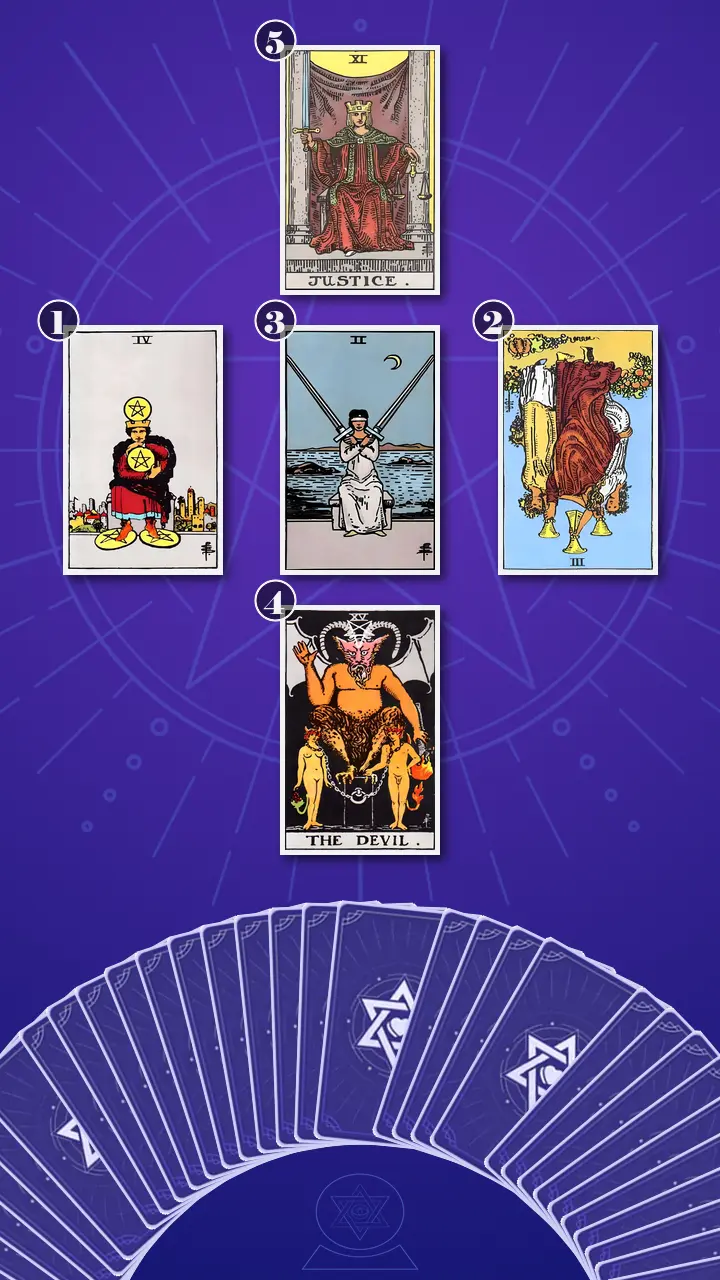
I chose a five-card Relationship Spread. I use this tarot spread for mutual-friend boundaries because the problem is relational but does not require the ten positions of a Celtic Cross. The five-card structure gives me the smallest complete map: Jordan's stance, the friends' position, the shared connection, the challenge sustaining the loop, and the guidance that can restore movement.
I placed Jordan's card on the left and the mutual friends' card on the right. The central card would show the interaction between them. Beneath it, I placed the card for the underlying attachment pattern; above it, the integrating response. The layout formed a cross, like a bridge intersected by a plumb line: two perspectives across the horizontal axis, then a movement from what binds below to what can rebalance above.
This is how tarot works at its most useful for me. The spread does not hand down a social verdict. It externalizes a pattern so I can examine card meanings in context, ask better questions, and return authority to the person whose life is actually being discussed.
Reading the Private Belonging Spreadsheet
Position 1: Four of Pentacles and the Grip on Proof
I turned over the card representing Jordan's current stance and contribution to the loyalty bind, including the checking, reassurance seeking, and attempt to secure belonging through control. It was the Four of Pentacles, upright.
I pointed to the figure pressing one pentacle against the chest while pinning two others beneath both feet. The image did not tell me that Jordan was inherently possessive. It showed me a protective strategy whose Earth energy had moved into Excess: security was being pursued through a grip so tight that movement and reciprocal choice were becoming difficult.
"This is the 11:40 p.m. scene," I said. "You hold the phone close, save the Story, compare who liked your ex's post, and keep the group chat open under your thumb. Each screenshot becomes an entry in a private belonging spreadsheet. It feels like evidence you can possess, but your clenched jaw shows the cost of holding it."
I followed the loop aloud: "I'm only checking because I need clarity." Then I changed the question: "If you need this much evidence, what are you asking the evidence to decide?"
Jordan let out a short, bitter laugh. "That's so accurate it's almost rude." Their fingers tightened around the edge of the phone, then loosened by a fraction.
"Accuracy isn't an accusation," I said. "The grip formed because belonging mattered. We're only checking whether that grip still delivers the safety it promises."
The Four of Pentacles asked me to move the question away from "Who is mine?" and toward "What consistent behavior makes this friendship mutual and safe?" Belonging based on direct consistency can be observed over time. Belonging based on an invitation scoreboard has no finishing line.
Position 2: Three of Cups Reversed and the Lost Group Rhythm
I turned over the card representing the mutual friends' place in the post-breakup limbo, including disrupted group cohesion, cautious communication, and their refusal to become a loyalty tribunal. It was the Three of Cups, reversed.
Upright, the three figures lift their cups toward a shared center. Reversed, that Water energy was in Blockage. The connection had not necessarily vanished, but its easy circulation had broken into separate channels.
I described the modern version I saw in the card: a once-effortless group chat producing vague Saturday plans, parallel messages, and careful sentences such as "I care about you both." A drinks invitation omitted the guest list, and the missing information became a ranking. The reversed card did not prove that the group had rejected Jordan. It showed a social rhythm disrupted by a breakup while everyone tried to avoid being appointed judge.
"A neutral friend is not automatically a rejecting friend," I said. "Neutrality can still hurt, and some friends may genuinely become less available. But this card asks you to assess each direct friendship instead of treating the whole circle as one unanimous verdict."
I could see the major blockage between the first two cards. Friendship needs circulation, while the Four of Pentacles tries to create certainty by closing around proof. The more Jordan asked several people to confirm the same ranking, the more guarded the conversations became. That guardedness then looked like evidence of displacement.
I call one part of this pattern Gravity De-linking Analysis. I use it when people try to force an old relational arrangement into alignment after the lives inside it have entered different phases. The friction does not automatically mean betrayal, and it does not require the friendship to end. It means the old group format can no longer be treated as the only valid form of connection.
Jordan looked down at the face-down phone. Their thumb moved toward it, stopped, and rested on the table. "So the side chats aren't necessarily proof that they're getting rid of me," they said. "But they're also not nothing."
"Exactly," I replied. "They are information about a disrupted group. They are not, by themselves, a measurement of your worth."
Position 3: Two of Swords in the Polite Stalemate
I turned over the card representing the current connection between Jordan and the friend group, especially the stalemate created by ambiguous invitations, indirect communication, and unspoken boundaries. It was the Two of Swords, upright.
The figure's eyes were covered, and two swords crossed defensively over the chest. Behind them, apparently calm water was interrupted by rocks. I read this as Air in Blockage: communication existed, but it was being used to suspend the issue rather than distinguish its parts.
In ordinary life, Jordan waited for a friend to volunteer a loyalty statement while the friend repeated that they did not want to take sides. The exchange remained technically calm, like a polite group chat in which nobody would clarify the guest list. One conversation was asking for emotional safety; another was defending each person's right to maintain independent relationships. Because those two subjects were never separated, everyone stayed still.
"The group chat is not a court transcript," I said. "A missing detail may need a direct question. It cannot automatically testify that you are disposable."
I asked Jordan to name one fact that required communication and one uncertainty no friend could eliminate. They stared past the screen for a few seconds, as if replaying the previous Saturday.
"The fact is that I need to know whether my ex will be at a small gathering before I say yes," they said. "The uncertainty is whether everyone secretly prefers them."
"Good," I said. "The first has a practical answer. The second is a fear asking for a level of certainty that no guest list can provide. I need clarity is different from I need a vote."
The Loose Chain Inside the Notification Loop
Position 4: The Devil and the Bargain That Never Stays Paid
I turned over the card representing the central challenge: treating exclusive allegiance as necessary proof of care, then repeating behaviors that briefly reduce uncertainty while tightening the attachment. It was The Devil, upright.
I told Jordan immediately that I was not reading the card as evil, danger, or a prediction about any person. In this position, The Devil illuminated compulsion and the bargain beneath it. The card's Fire was being diverted into a repetitive notification loop rather than carried forward as deliberate action.
The modern scene was already familiar. Jordan knew another Story would not create lasting security, yet opened it because the ritual offered a few minutes of relief. If no sign of the ex appeared, their chest loosened briefly. Then the next post generated a new question. If the ex did appear, the loyalty test intensified.
"I know this won't settle it for long, but I need to check now," I said, giving voice to the loop. "That urgency is real. It still isn't the only available choice."
I directed Jordan's attention to the chains around the figures' necks. They were loose. That detail did not erase the pain or pretend that self-control should be effortless. It revealed a small point of agency: the next Story, reassurance request, invitation, or exit could become a choice rather than an automatic command.
"A few minutes of relief is not the same as security," I said. "The loyalty test is a subscription to social certainty whose benefit expires almost as soon as it arrives."
Jordan's breath paused. Their eyes moved toward the phone and then back to the card. Finally, their shoulders dropped a little. "But if I don't check, how will I know whether something is changing?"
"You don't have to swear off information," I replied. "You can ask whether you are looking for logistics you can act on or a verdict no screenshot can provide. The loose chain is the two-minute gap in which you make that distinction."
I thought of orbital drift, the slow separation that occurs when familiar bodies no longer travel at precisely the same pace. The answer is not to declare one orbit virtuous and another wrong. It is to stop spending all available energy forcing an alignment that the current conditions cannot sustain.
When Justice Refused the Loyalty Vote
Position 5: The Scales, the Sword, and a Boundary
The radiator on Jordan's side of the call went quiet just as I reached for the final card. The sudden stillness felt exact. I turned over the card representing the integrating response that could distinguish a self-directed boundary from an attempt to control whom friends may see. It was Justice, upright.
The scales held two realities without pretending they were identical: Jordan's need for emotional safety and a friend's right to maintain an independent relationship with the ex. The upright sword offered precise language. Justice was balanced Air, communication finally doing the work that monitoring could not.
I placed a realistic message beside the image: "I am not ready for small gatherings with my ex, so please let me know in advance if they will be there." That sentence protected Jordan's access and choice. It did not require the friend to reject anyone.
I used a sentence frame to sharpen the distinction: "I can choose whether I attend, how much information I receive, and when I leave. I cannot require another adult to end a separate friendship so I can feel certain of mine."
At 11:40 p.m., Jordan had been trying to turn a jacket, timestamps, and a missing invitation into one social fact that could settle the fear of replacement. Justice showed why the search could not finish: the evidence was being asked to deliver a verdict on worth.
You do not need a verdict that makes one person lose; place your own boundary on Justice's scales and use the upright sword to say it plainly.
For one beat, Jordan stopped breathing. Their fingers stayed suspended above the phone, and their pupils widened as their attention shifted from the screen to the scales. Their gaze then lost focus, as if several old group-chat exchanges were replaying at once. The skin around their eyes tightened.
"But doesn't that mean I've been wrong this whole time?" they asked. The words came out sharper than anything they had said earlier, with anger protecting something newly tender. "I kept telling myself I was asking for basic fairness."
"It means your strategy made sense as protection and now has costs you can see," I said. "Recognition is not a retroactive conviction."
Jordan's clenched hand opened against the table. Their shoulders lowered, their eyes reddened slightly, and a long breath left their chest with a tremor. The relief did not look triumphant. It looked briefly disorienting, like setting down a heavy bag and discovering that the next step now belonged to them.
"Now, using this new perspective, can you think of a moment last week when this distinction might have changed how you felt?" I asked.
Jordan nodded slowly. "The Saturday invitation. I could have asked whether my ex would be there and decided for myself. I didn't have to ask whether everyone thought inviting them was fair."
I brought in my Orbital Drift Recognition framework to make the insight more objective. A breakup can alter the pace, boundaries, and emotional frequency of an entire friend group. When an old social routine no longer fits a new internal reality, the mismatch can hurt without proving that anyone is defective or disloyal. The framework does not automatically tell Jordan to outgrow these friends. It asks whether each friendship can adapt to the changed orbit through directness, consistency, and room for separate choices.
"A boundary describes my access; an ultimatum controls yours," I told them. "Justice does not ask you to become endlessly comfortable. It asks you to govern the part that is yours."
This was the central emotional movement of the reading: from monitoring social proof and seeking an external loyalty verdict toward tolerating independent relationships and expressing self-directed boundaries. It was not instant certainty. It was the first grounded step from feeling replaceable toward assessing belonging through direct consistency and mutual care.
Two Small Moves Beyond the Loyalty Test
I read the spread back to Jordan as one connected story. The breakup had disrupted shared dinners, birthdays, and casual plans that once carried belonging without explanation. Jordan responded by gripping visible proof more tightly. That grip met a friend group already communicating cautiously, which fragmented the social flow. The resulting silence created a stalemate, and the checking ritual offered short relief while giving fear more authority. Justice did not promise that every friendship would survive. It restored the distinction between what Jordan could request, what they could observe, and what they could choose.
The cognitive blind spot was not simply "checking too much." It was the assumption that more social data could eventually prove secure belonging. Because that standard had no finish line, every neutral detail produced another question. The transformation direction was therefore specific: replace requests for loyalty proof with one boundary or support request that did not rank anyone's relationships.
Jordan frowned when I suggested ten minutes in the Notes app. "Honestly, when this hits, I don't feel like I have ten calm minutes. I'm usually tired, or halfway through work, or already spiralling."
"Then we use the two-minute version," I said. "A workable tool has to survive the actual moment, not an idealized one."
- Make the Justice Scale NoteBefore Wednesday evening, open Notes for two to ten minutes and create two headings: "What I know" and "What I want them to prove." Add one fact, then draft one boundary under 25 words: "I am not ready for small gatherings with my ex, so please tell me in advance if they will be there." Send it privately to one mutual friend only when it feels clear enough.Tip: The first draft may feel too exposed or too mild. Keep the request about your access, information, or timing. You may revise it, wait, or choose not to send it.
- Use the Constellation Release ProtocolInvite one friend to a low-pressure, 30-minute coffee near the TTC or a walk after work. Say plainly that you want normal one-to-one time and do not need to discuss the breakup. Afterward, record three observable facts: whether they showed up, listened, and followed through. Let those facts guide how much energy you invest, while releasing the demand that the whole pre-breakup group keep its old shape.Tip: A constellation is a set of lines we draw between separate bodies. Releasing an old line does not require resentment or a dramatic goodbye; it can mean allowing one friendship to change while meeting another directly.
I asked Jordan to treat both actions as experiments, not tests they had to pass. A boundary could reveal compatibility, inconsistency, or the need for more distance. Any of those outcomes would be information. None would turn the tarot into an authority over their friendships.

A Week Later, the Quiet Proof
Six days later, I received a message from Jordan. They had sent one friend the advance-notice boundary without explaining it in five different ways. The friend replied, "That makes sense. I can do that," and suggested coffee near Jordan's office.
Jordan told me they kept the conversation focused on the friendship in front of them. They did not ask who had seen the ex, compare invitations, or request a ranking. Afterward, they wrote three facts in Notes: the friend arrived on time, listened without getting defensive, and set a date for another coffee.
The change was small and bittersweet. The old group chat was still cautious, and no social universe had snapped back into its previous shape. Jordan had not solved the entire breakup. They had made one direct connection without converting it into a referendum.
Clarity was not total: Jordan slept through the night, then woke with "What if I got it wrong?" as their first thought. They told me they laughed softly, read the respectful reply again, and got ready for work.
I did not credit the cards with making the choice. The five-card Relationship Spread made the pattern visible; Jordan decided what to do with that visibility. Tarot offered the map, but the boundary, the message, and the willingness to tolerate an incomplete answer belonged to them.
For me, that was the real Journey to Clarity. Jordan moved from waiting outside an imaginary polling station toward holding Justice's scales in their own hands. They could grieve the group without turning every invitation into a referendum, and they could allow old orbits to change without blaming themselves for the tide.
When a breakup leaves your chest tight outside a group chat, it is easy to treat every neutral choice as proof that you were simple to replace, while still longing for someone to show that the friendship mattered. Merely noticing that you are asking for a vote when what you need is a boundary means you are no longer standing at the exact beginning.
If your friends never had to cast a ballot for your worth, what small limit about your own access, timing, or emotional capacity would you quietly place on Justice's scales before the next invitation?