A Group Chat Became a Breakup Jury; One Boundary Changed the Question

When Mutual Friends Feel Like a Jury After a Breakup
You can write calm, audience-aware copy all day at a downtown office, then spend the TTC ride home reaction-auditing a group chat because your ex's laughing emoji has triggered post-breakup friend group anxiety.
Jordan sat across from me in my Toronto consultation room and described the scene at 8:47 p.m. on a Tuesday: riding north on Line 1 after work, phone warm in their palm, fluorescent carriage lights buzzing above damp winter coats that smelled faintly metallic. Their thumb stopped over the ex's joke and the three laughing reactions beneath it. They drafted an explanation, deleted it, and began again while the train rocked through the dark.
Jordan said, 'Why am I the one expected to act normal when I am the one who was hurt? I do not want to control the group, but I cannot stand watching everyone stay neutral.' They had retold the breakup to several mutual friends, checked who reacted to the ex's messages, and studied every invitation as though the group chat were quietly recording a vote.
I heard grief mixed with threatened belonging as something physical: a low electrical current under the ribs, making the hands search for the phone even when the mind begged for rest. A neutral group chat can feel like a verdict when belonging is the thing on trial. Jordan wanted mutual friends to pick their side, but feared that without their allegiance the hurt would remain unrecognized and their place in the circle would feel uncertain.
I did not ask Jordan to make the story more persuasive. I told them that tarot could help us separate what they knew, what they feared, and what they could choose. We would use the cards as an objective map for a difficult relationship dynamic, and our Journey to Clarity would end with Jordan holding the direction, not the deck.

Choosing a Compass for the Shared Circle
I invited Jordan to place both feet on the floor, take three unhurried breaths, and focus on one question: what would make the next shared social situation more workable? I shuffled slowly. The point was not to summon a verdict from somewhere outside the room; it was to give the nervous system a clean transition from reaction to observation.
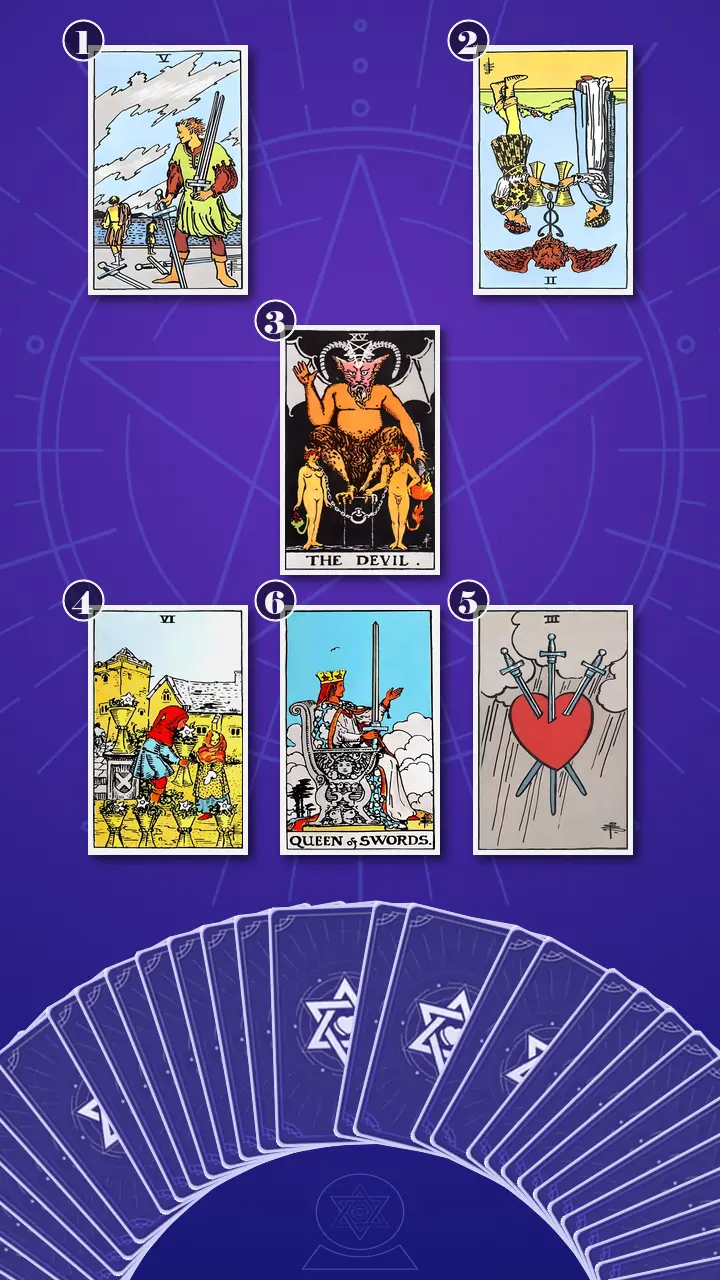
For this reading, I used the Relationship Spread · Context Edition, a six-card contextualized relationship tarot spread for post-breakup boundaries. This format fit because the question was about relational dynamics, perceived betrayal, a shared friend group, and the difference between mutual recognition and social control. A larger spread would have added layers when what Jordan needed was proportionate clarity.
How tarot works here is simple: each position gives a different angle on the same lived problem. The first card would show Jordan's observable post-breakup behavior. The second would reflect the former partner's position only as Jordan perceived it, without pretending to read anyone's private thoughts. The center would reveal the binding loyalty-test pattern. The lower cards would identify the genuine shared history and the wound underneath it. The final card would offer a self-directed boundary rather than a prediction about what anyone else would do.
I explained that we would read the upper pair first, move through the central knot, compare the resource with the wound, and finish with the practical next step. The cards would not decide who was right. They would help us read card meanings in context, so Jordan could stop asking a social system to carry a burden that belonged to their own healing and choices.
The Evidence Pile on Line 1
The Five of Swords and the Winner-Loser Frame
Now I turned over the card representing Jordan's observable post-breakup behavior of seeking a verdict from mutual friends and the contracted emotional energy behind it. It was the Five of Swords, in upright position.
The central figure in the card gathers the swords while two figures walk away beneath a gray sky. I connected that uneven aftermath to Jordan's train ride: screenshots, copied messages, reaction counts, and carefully edited paragraphs gathered as evidence. The modern scene was painfully exact. Jordan opened the group chat to see the ex joking normally with mutual friends, counted who reacted, and imagined that silence meant the ex's version had won. One friend agreeing brought a flash of victory, but the conversation became more guarded and Jordan ended the ride feeling even more alone.
Upright, the Five of Swords showed Air in excess: the mind using analysis defensively until every emoji became testimony and every invitation became a ruling. This was not a moral judgment on Jordan's need for validation. It was a picture of conflict organized around winning the account rather than protecting connection. The card asked what would still be known about the breakup if no friend declared a winner.
I asked Jordan to complete the sentence, 'If they understood what happened, they would...' Jordan looked down and said, 'They would stop acting normal. So why are they acting normal?' I held the contrast gently: being recognized was not the same as winning, and being cared for was not always expressed as public agreement.
Jordan gave a short, bitter laugh. 'That is too accurate. Almost cruel.'
I told them I was not going to shame the reaction. Wanting someone to say, 'I see why this hurt,' was human. The useful question was whether the next message sought care or quietly soft-launched a loyalty test. Jordan's fingers rubbed the edge of the phone case, and their shoulders stayed high, but their eyes moved from the imagined courtroom back to the card.
The Reversed Two of Cups and the Image That Became Evidence
Now I turned over the card representing the former partner's stance only as Jordan perceived or imagined it, revealing where mutuality and direct understanding felt disrupted without claiming access to the ex's private thoughts. It was the Two of Cups, in reversed position.
The two figures in the image once exchange cups in a balanced meeting. Reversed, the exchange no longer feels mutually understood. I connected it to the Instagram Story Jordan had described: the ex laughing with a mutual friend, ordinary restaurant music leaking from the phone, glasses clinking in the background. The visible fact was that two people were spending time together. The added conclusion was that they agreed about the breakup and that Jordan no longer mattered.
The reversed Water showed blocked reciprocity, not proof of anyone's hidden motives. I said plainly that a tarot card could not tell Jordan whether the ex felt guilty, whether the friend believed the story, or whether either person was secretly choosing against them. It could show how a broken emotional exchange was being experienced. Contact was observable. A verdict was an interpretation.
I asked, 'When you saw them laughing, what did you directly observe, and what meaning did your mind add?' Jordan's hand tightened around the cup on the table. For a moment, the imagined answer seemed to arrive before the question had finished. Then they said, 'I observed them laughing. I added that they must think I was the problem.'
I watched a brief sting cross their face, followed by a quieter concentration. The pain had not disappeared, but the two pieces had separated: lost mutual recognition on one side, continued social contact on the other. That distinction gave Jordan a little room to ask for a practical boundary instead of demanding that the entire group prove what the image meant.
The Devil and the Notification Loop with Loose Chains
Now I turned over the central card representing the binding mechanism that kept the breakup connected to mutual-friend allegiance, specifically the Possessive Attachment pattern. It was The Devil, in upright position.
The card's two figures sit beneath the Devil with chains around their necks. I drew Jordan's modern version of the image: a neutral message arrives, Jordan screenshots it, sends it to another friend, asks what it really means, receives reassurance, feels grounded for twenty minutes, and then starts checking again when the ex appears in a new event plan. The attachment was not simply to the former partner. It was to the hope that controlling the group's verdict would secure both the meaning of the breakup and Jordan's place in the circle.
Upright, The Devil showed a compulsion that felt absolute but was not the same as destiny. The chains were visibly loose. I described the loop as a notification badge that returns as soon as it is cleared because the underlying task has no external completion state: trigger, check, interpret, explain, receive temporary relief, then repeat. Reassurance can settle the moment without settling the wound.
I asked Jordan, 'After a friend reassures you, how long does the relief last before another message or invitation makes you need fresh confirmation?' Jordan answered immediately: 'Twenty minutes, sometimes less.' Then they added, 'I know I cannot control them, but I need one more sign that I still matter.'
Jordan's breathing paused. Their gaze went unfocused as if replaying the exact sequence of notifications. Their thumb moved toward the phone, stopped, and withdrew. I watched the pattern become visible without turning it into a character flaw. Belonging was the legitimate need; ownership was the strategy that had begun to hurt Jordan. The card did not accuse them. It showed them the point where a pause could enter.
The Six of Cups and the Photo Archive of Real Connection
Now I turned over the card representing the genuine shared history and community value that Jordan wanted to preserve within the post-breakup friend-group limbo. It was the Six of Cups, in upright position.
The flower-filled cups, the two children facing one another, and the familiar garden made me think of the Sunday café conversation Jordan had described near Trinity Bellwoods. The espresso machine hissed while Jordan and a mutual friend remembered university nights, shared birthdays, late-night takeout, and the group's annual summer picnic. Jordan had said, 'I miss how uncomplicated this used to feel.' The warmth in that memory was real.
Upright, the Six of Cups offered Water in a supportive, balanced form. It showed kindness, continuity, and the sustaining value of community. It did not turn history into a contract. I said, 'Shared history is evidence of connection, not ownership of the next chapter.' The memories could remain meaningful without requiring the friend to condemn the ex or publicly prove which relationship mattered more.
Jordan's shoulders lowered when I said that, then tightened again when they remembered the friend's refusal to take sides. I asked which mutual friendship or shared ritual would still matter if that friend never gave a public verdict. Jordan looked toward the window and named a Saturday walk and an old inside joke about terrible airport coffee. The answer was small, but it was not nothing. It identified a relationship that could exist outside the breakup's courtroom.
The Three of Swords and the Heart Beneath the Loyalty Test
Now I turned over the card representing the Betrayal-Closure Lock and the pain that made a neutral group response feel like invalidation. It was the Three of Swords, in upright position.
The red heart pierced by three swords hung against a gray, rain-filled sky. I connected it to the late-night moment when a bright photo of the ex at a shared dinner appeared on Jordan's dark phone screen. The original betrayal, the friends' neutrality, and the fear of being replaced collapsed into one heavy drop in the stomach. The image did not ask the group to exclude anyone. It gave the wound direct language: 'I am grieving what happened, and seeing this makes me feel unseen and socially displaced.'
Upright, the Three of Swords was the honest pain that could not be argued away or delegated to a panel. I told Jordan that the hurt deserved acknowledgment before any decision about attendance, contact, or boundaries. A neutral invitation could reopen the wound without proving that the friends had dismissed it. Anger might be the first visible layer, but underneath it could be grief, embarrassment, fear, and the longing to know that the loss had registered somewhere beyond Jordan's own body.
Jordan exhaled through their nose. Their eyes shone, and their grip loosened around the paper cup. 'I am afraid I have been replaced and nobody sees what this cost me,' they said. The sentence changed the temperature of the room. I did not rush to make it positive. I let the grief have its own name, separate from the demand that the group repair it.
When the Queen of Swords Changed the Question
The room became unusually quiet before I touched the last card. Even the traffic outside seemed to thin into one distant wash of sound. I told Jordan that this was the catalyst card, the one that would translate the search for clarity into a choice within their own control.
The Single Upright Sword Held in an Open Hand
Now I turned over the card representing the self-directed boundary or reflective action that could replace the group trial. It was the Queen of Swords, in upright position.
She held one sword upright, not a pile of collected evidence. Her other hand remained open. Behind her, the air and horizon were clear. In modern life, her message sounded like the difference between forwarding an entire email chain and sending one line that states the decision needed now. Before the next shared birthday, Jordan could write: 'I know the breakup hurt me, and I am not available to debate that experience. Could you give me advance notice if my ex will be there so I can decide what works for me?'
Upright, the Queen of Swords brought Air into balance: discernment, honest communication, independence, and a boundary informed by lived experience. She did not predict whether the friend would agree, whether the ex would change, or whether the group would reunite around Jordan. She asked Jordan to distinguish fact, interpretation, request, and choice.
I brought in one of my Wall Street-born lenses, Sunk-Cost Decoupling in Loyalty. It is not a demand to dismiss years of birthdays, park hangs, and shared routines. It separates the value of that history from the current question. Past investment can be real without purchasing a vote, exclusive access, or permanent allegiance. A saved photo archive can hold love without controlling who appears in the next album.
I also reminded Jordan that the Queen's clear sword was not meant to cut people out indiscriminately. It was meant to cut through the extra argument. The practical question was not, 'Will you prove that I was right?' It was, 'What information do I need, and what participation choice belongs to me?'
At 8:47 p.m. on the train home, Jordan sees their ex joking normally in the group chat. Their thumb hovers over a long explanation while their stomach drops: if nobody objects, does that mean their version no longer counts?
You do not need the group to hold up a verdict before your experience becomes real; like the Queen of Swords, name what you know, set one clean boundary, and let each friendship carry its own truth without turning the circle into a courtroom.
For several seconds, Jordan did not move. Their thumb remained above the screen, breath caught as if the fluorescent carriage had lost its air. Then their gaze left the card and went unfocused; I watched old messages, guest lists, and the phrase I do not want to take sides pass across their face like a slideshow. Their jaw tightened. Their fingers curled around the phone, then slowly opened. Their shoulders sank, and a small, uneven breath escaped, not quite a sob and not yet relief. Their eyes reddened. Jordan said, 'But if I stop asking people to choose, does that mean what happened gets minimized?' The question carried a flash of anger, then a quieter grief. I told them that self-validation was not forgiveness, and a boundary was not a retraction. Jordan nodded, looking almost dizzy at the open space where the verdict had been. The freedom was real, but so was the responsibility: nobody else could own the next decision. The phone finally rested face down.
I asked, 'Now, using this new perspective, can you remember a moment last week when asking for information instead of a verdict might have let you feel different?'
Jordan looked back at the train scene, then at the dinner photo, then at the neutral message. I could see the shift beginning: from threatened belonging and compulsive social scanning toward self-validation, practical clarity, and self-authored closure. It was not a promise that the ache would vanish. It was the first time the ache no longer had to appoint a jury.
Finding Clarity Beyond the Social Courtroom
When I placed the six cards together, the story became coherent. The Five of Swords showed the present-day case file: Jordan gathered screenshots, reactions, and retellings because a winner-loser frame seemed capable of proving that the hurt counted. The reversed Two of Cups showed the broken mutuality as Jordan experienced it, while keeping me honest about what could not be known about the ex or any friend's private beliefs. The Devil revealed the loyalty-test loop that kept the wound active. The Six of Cups showed the real warmth Jordan was trying to preserve. The Three of Swords named the grief beneath the anger. The Queen of Swords offered a clean base for the next move.
The core contradiction was now visible: Jordan wanted mutual friends to pick a side because private hurt felt unresolved, yet making recognition depend on a group vote made belonging even more fragile. The cognitive blind spot was treating a friend's continued relationship with the ex as evidence against Jordan's reality, then treating a friend's agreement as temporary proof of worth. I said, 'Your pain existed before the group knew the timeline. Their neutrality can be painful, but it cannot retroactively decide whether your experience happened.'
The key shift was not to stop caring about community. It was to replace asking mutual friends to certify a winner with naming what Jordan knew, requesting only the logistical clarity actually needed, and allowing each friend to keep an independent relationship. The friend group could become a set of separate relationships rather than a jury. That was the practical method for finding clarity without demanding certainty from other people.
To make the insight usable, I introduced my Reciprocity ROI Analysis. The phrase came from my Wall Street years, but the application was deliberately humane. I asked Jordan to measure the emotional give-and-take in a friendship by three questions: does this person listen when invited to listen, respect a stated boundary, and leave me with more agency rather than a stronger urge to prove the case? A friend can refuse to take sides and still offer real reciprocity. Another person can agree with every detail and still leave Jordan drained.
I explained that I use my Friendship Downgrade Strategy only when a connection repeatedly becomes high-drain and one-sided. It does not mean a dramatic cutoff or a punishment disguised as empowerment. It means gradually reducing access: fewer private updates, slower replies, shorter contact, and no more placing that person inside the breakup's evidence chain. Courtesy can remain while the relationship becomes a low-maintenance acquaintance. Jordan did not need to downgrade the whole group. They needed permission to choose the level of access that protected their nervous system.
These were the actionable next steps I gave Jordan. Each one was deliberately small enough to test rather than turn into another life-sized verdict.
- Keep one fact and one boundaryOn one evening this week, open the Notes app and set a seven-minute timer. Write one sentence beginning, 'What I know from my experience is...' without citing friends, likes, screenshots, or the ex's presumed motives. Under it, write, 'For the next shared event, I will...' and choose one action within your control, such as asking for advance notice, arriving with a support person, leaving early, or skipping the event.This is not the whole breakup. Do not send it immediately. Wait at least thirty minutes, and if your chest tightens or the exercise becomes too much, put the phone down and return later. The minimum version is one sentence about advance notice.
- Ask for a heads-up, not a verdictChoose one trusted friend and send only a specific logistical request: 'Could you give me a heads-up before inviting both of us to something for the next month?' For one upcoming gathering, ask whether the ex is invited, whether arrival can be flexible, or whether leaving early is workable. Do not attach the full case file.A logistical request is not forgiveness, retraction, or agreement that the breakup was acceptable. It keeps the request inside the friend's realistic role. The friend may say no, and Jordan may still choose a different attendance plan.
- Reset one friendship outside the caseList three mutual friends individually and write one shared interest or ritual with each that exists outside the former relationship. Invite one person to a contained twenty-minute coffee or Saturday walk, without making the ex the planned topic. Let one friendship exist in its own present tense.If one connection keeps demanding emotional evidence or leaves you more activated after every exchange, use the Friendship Downgrade Strategy gradually: share fewer private updates, choose shorter contact, and decline situations that drain you. No dramatic announcement is required.
The point of these exercises was not to force Jordan to attend shared events, forgive the ex, preserve every friendship, or become comfortable before they were ready. The point was to restore choice. The Queen of Swords could hold grief and boundaries in the same hand.

A Week Later, the Quiet Proof of Belonging
A few days later, I received a message from Jordan. They had used the two-line fact and boundary check, sent the heads-up request to one friend, and muted the main group chat for two hours while finishing a communications brief. The friend had not offered a verdict. They had answered the practical question clearly.
A week later, Jordan told me the heads-up request was ready and they had slept a full night. At breakfast, the first thought was still, 'What if I am wrong?' They smiled, checked the sentence, and chose whether to attend. The uncertainty remained, but it no longer held the phone.
I did not hear a miraculous resolution in that update. I heard something more reliable: Jordan had stopped using every shared event to measure whether they belonged. They could still feel a drop in the stomach when the ex appeared, but the sensation no longer automatically became a message, a screenshot, or a request for witnesses.
The cards had not chosen Jordan's side. They had helped Jordan become their own witness. The six-card contextualized Relationship Spread had moved from conflict, rupture, and attachment through shared history and grief toward a precise boundary. That is what self-authored closure looks like at first: not perfect peace, but a cleaner question and one decision that belongs to you.
When a mutual friend's neutral reply makes your stomach drop, the ache is rarely just about who is right; it is the fear that without their allegiance, both your hurt and your place in the group could disappear.
I leave the Queen of Swords' single upright sword beside this question: if your experience did not need a group verdict tonight, what one truth might you quietly keep for yourself, and what small boundary would make the next invitation feel more workable?