Finding Clarity in the 8:14 a.m. Streetcar Scroll
If you are a late-20s city tech worker who checks Slack before coffee and then gets hit with a bank alert on the streetcar, I can tell you right away: this is often less about bad time management and more about notification-driven burnout.
When Jordan sat across from me, they didn't start with a grand life crisis. They said, 'Slack ping, bank alert, unread texts—where am I stretched too thin?' Then, almost immediately: 'I am not even doing that much, so why does everything feel loud?' I asked them to walk me through that morning, and as they spoke I could practically feel the damp Toronto air come in with them.
It was 8:14 a.m. on the 504 King streetcar. The bell kept dinging. Wet winter coats smelled like rain. Their phone was already warm in their palm. From the lock screen, they answered a Slack ping, then tapped into their banking app to see if a payment had cleared, then typed half a reply to a friend before the streetcar jerked forward. Their shoulders had crept up toward their ears before breakfast. They wanted to be responsible in all three directions at once. What they did not have—because none of us do—was equal bandwidth for all three.
I could see the strain in the way they held their jaw even while talking. Overwhelm, for Jordan, wasn't an abstract word. It was like trying to hold an entire condo building's intercom system inside one rib cage: every buzz tiny, every buzz ignorable in theory, and together absolutely impossible to rest through.
I told them gently, 'I don't hear laziness here. I hear a nervous system that has been given too many front doors to guard at once.' Then I leaned in a little and said what I say when a reading is really about finding clarity, not chasing certainty: 'Let's make a map of the noise, and then let's decide what actually deserves you.'
Choosing the Compass: A 7-Card Tarot Spread for Digital Overload
I asked Jordan to take one slow breath, not as a mystical flourish but as a way to arrive. Then I shuffled slowly and had them hold the question in mind: not 'How do I become perfect at keeping up?' but 'What is actually pulling on my attention, and what no longer gets to?'
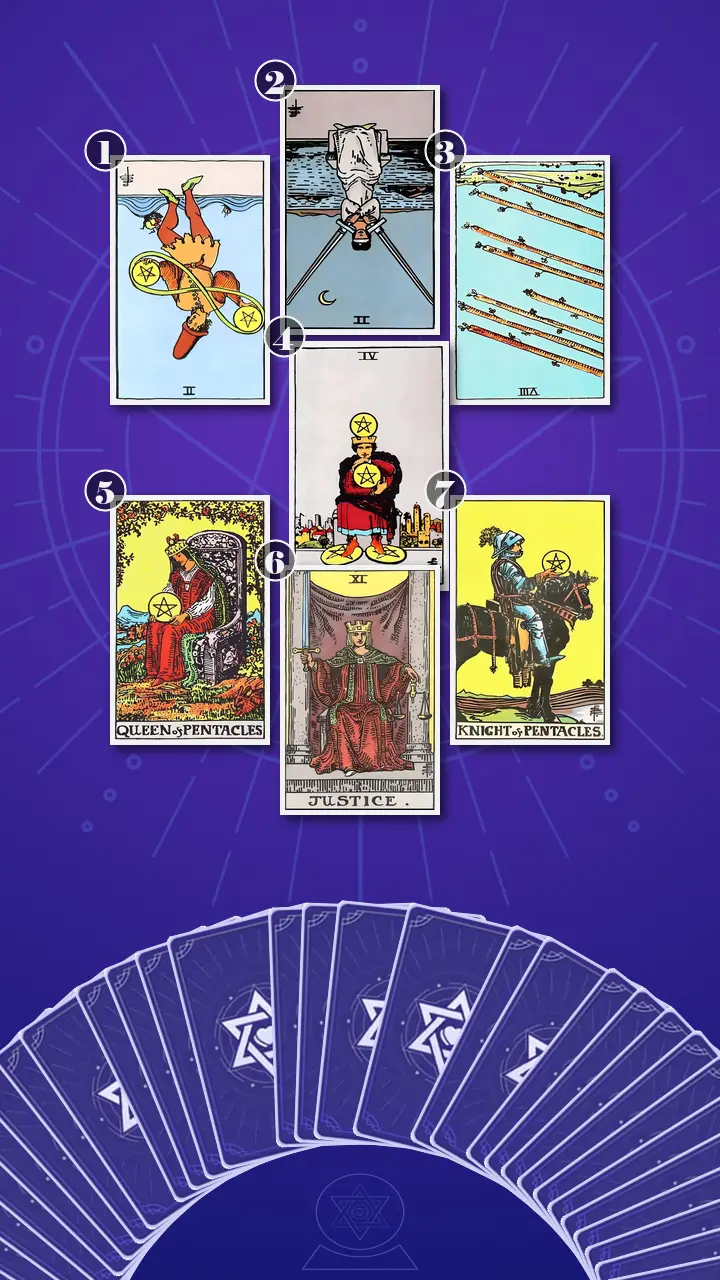
For this session, I used my Energy Diagnostic Map (7) · Context Edition, a 7-card tarot spread for overwhelm, prioritization, and boundaries. I reach for this spread when the problem isn't one decision but a networked overload loop—work stress, money stress, and unread texts all arriving through the same glowing rectangle. This is one of the clearest ways I know to show how tarot works in real life: not by making the day less real, but by separating symptom, inner split, outside pressure, core blockage, resource, turning point, and next steps.
I laid the cards in a circle like a dashboard. Card 4 went in the center as the pressure hub. Cards 1, 2, and 3 formed the upper arc: the visible pattern, the inner tug-of-war, and the outside demands crowding the nervous system. Cards 5, 6, and 7 made the lower arc: the resource already present, the key shift, and the practical rhythm that could protect bandwidth across work, money, and relationships. For a question like 'Why do Slack notifications make me anxious before work?' or 'Why do unread texts make me feel guilty at night?' I wanted a spread spacious enough to hold the whole system without flattening it.
I told Jordan, 'The first card will show me the pattern your day keeps performing. The center card will show me what fear keeps that pattern alive. And the sixth card—usually the hinge in this spread—will show us what changes everything.'
The Upper Arc Where Everything Feels Urgent
The Loop That Looked Like Competence
I turned over the first card, the one representing the visible symptom pattern active right now. It was the Two of Pentacles, reversed.
I told Jordan exactly what I saw. 'This is the app-switching loop. At 9:03 a.m., you've got a Slack thread on your laptop, a banking notification on your phone, a text conversation half-open, and the actual project brief sitting untouched in another tab. From the outside, it looks like you're on top of things. But your attention is getting spent on keeping the juggle alive rather than moving anything meaningful forward.'
In tarot terms, this was Earth energy destabilized. Not grounded productivity, but practical energy tipping into excess motion and unstable footing. The classic image shows a figure juggling coins inside an infinity loop against a rough sea. For Jordan, that loop had become: clear one badge, notice another badge, feel briefly safer, repeat. Constant motion can cosplay as competence. But motion is not the same thing as progress.
Jordan gave a short laugh, the kind people use when they feel seen a little too quickly. 'Okay,' they said, rubbing one thumb over the edge of their phone case, 'that's literally my morning.' Their smile lasted half a second; the wince underneath it lasted longer.
I asked, 'When that happens, what was the original task?' They didn't even need to think. 'The project tracker,' they said. 'It's always the project tracker.'
The Split Screen in Their Head
I turned over the second card, the one revealing the inner conflict shaping their reactions. It was the Two of Swords, reversed.
'This,' I said, 'is what happens after the juggling moves inside your head.' I explained that Jordan wasn't just dealing with too many demands; they were keeping work, money, and friendship demands all mentally open at once because choosing one first felt like failing the other two. They reread previews. They kept drafts half-finished. They carried three unfinished threads all afternoon like invisible grocery bags cutting into their fingers.
Here the energy was blocked Air: not a lack of intelligence, but discernment tied in knots. The blindfold on the card mapped perfectly onto not wanting to face finite bandwidth. The crossed swords over the chest showed what it costs to hold competing obligations rigidly in place. It had a little Severance quality to it—the responsive worker-self and the present human-self starting to feel like two incompatible jobs.
I said, 'The problem here isn't that you don't know not everything is urgent. It's that letting one thing wait feels morally dangerous.' Jordan looked down at the card and went still. Then they nodded once. Slowly. Not relieved yet. Just caught.
When Speed Borrowed Emergency Energy
I turned over the third card, the one mapping the outside demands crowding their nervous system. It was the Eight of Wands, reversed.
'Your phone and laptop have become a conveyor belt,' I told them. 'Badges, banners, previews. Even normal updates land with emergency energy because they arrive fast and stacked together.' The card's flying wands are usually about momentum and messages. Reversed, that speed gets scrambled. It becomes backlog, scatter, and a false sense that everything is happening at once.
For Jordan, this was the exact moment when The Bear energy kicked in: a Slack mention, an auto-pay alert, a 'hey you alive?' text, and suddenly their body reacted before meaning even had a chance to form. This was Fire energy without direction—activation with nowhere clean to go. The latest thing won, not the most consequential thing.
I asked them one of my favorite diagnostic questions: 'When three alerts hit at once, which part of your body tightens first?' They answered instantly. 'Jaw, then shoulders.' They touched both as they said it, like they had only just noticed they were bracing.
The Grip at the Center
The Phone Held Like a Pentacle
Then I turned the center card, the core blockage keeping the whole cycle in place. It was the Four of Pentacles, upright.
I felt the reading click into place. 'This,' I said, 'isn't only about volume. It's about gripping.' I described the scene that lived inside the card as clearly as I could: a low-balance alert lands during a meeting, and even if there is nothing actionable to do in that moment, the stomach drops, the phone gets checked under the table, and the mind starts recalculating rent, groceries, subscriptions, everything. The card shows a figure clutching a pentacle to the chest while coins pin the feet. For Jordan, the pentacle was the phone itself—kept close physically, and even closer psychologically.'
This was Earth energy hardened into blockage. Control had become a safety strategy. If they loosened their grip on work, money, or relationships for even twenty minutes, their body interpreted that as risk. Not because they were dramatic. Because somewhere along the line, being reachable had fused with being responsible.
'Just check once more and then I can relax,' I said, offering the thought back to them. Jordan inhaled sharply. Their jaw tightened before they answered. Then came a long exhale that seemed to leave from the center of their chest. 'I didn't realize control was the part underneath it,' they said quietly.
At that point I also noticed something important in the spread: there wasn't a single Cup on the table. No Cups at all. That told me Jordan had been treating feelings as tasks—turning dread, guilt, and loneliness into more admin to clear. When there are no Cups, I know the body has usually been drafted into emotional labor it never agreed to do.
The Softer Resource Already Waiting
I turned over the fifth card, the one showing the supportive capacity already available. It was the Queen of Pentacles, upright.
I smiled a little when I saw her. 'Good,' I said. 'Because your system is not asking for a lecture. It's asking for support.' I told Jordan that this card was the part of them that already knew stability comes from tended basics: eating before triaging, checking money at set times, answering one person fully, putting tea or toast or a notebook within reach before opening the laptop. The Queen doesn't clutch responsibility defensively; she holds it steadily in her lap.'
This was balanced Earth. Not hyper-control. Not collapse. Mature pacing. The kind that says, 'Nothing is on fire in this exact five minutes.' I could almost feel the room soften with her. The late-day light had gone honey-colored against the wall, and Jordan's shoulders finally dropped far enough for me to notice the difference.
'That sounds almost too small,' they said.
'Exactly,' I told them. 'That's why it works. Big fixes are catnip for an overwhelmed mind. Small support is what the nervous system can actually trust.'
When Justice Lifted the Sword Above the Noise
The Fair Rule That Changed the Reading
When I turned the sixth card, the room went unusually still. Even the radiator seemed to pause. Thin bars of afternoon light fell through the blinds and made clean rectangles across the table, which felt almost comically on-theme. The card representing the key turning point was Justice, upright.
'This is the hinge,' I said. 'This position names the shift from reflexive responsiveness to fair, reality-based prioritization.' Jordan had been living inside one repeating reflex: Slack badge, bank alert, unread text, thumb moves, shoulders rise. Their whole system had been organized around not becoming the person who missed something.
I said it plainly first, because sometimes the simplest line lands deepest: Fast is not the same as responsible. The problem is not that every ping matters. It is that your body has been giving every ping equal authority.
Whenever I see Justice, my mind flashes to a Mondrian canvas I once stood in front of for far too long in New York: black lines, bold rectangles, no two spaces equal, yet the whole painting held together with impossible calm. I call this my Mondrian Grid Method. A balanced life is not one where every square gets the same size. It is one where each square gets the right size. Slack, money, and friendships do not deserve identical portions of your nervous system every hour just because they can all reach you through the same screen.
You do not need to answer every alarm to prove you are responsible; let Justice's scales, not the loudest ping, decide what deserves your next move.
Jordan's breath caught halfway in. Their fingers froze around the mug between us. Then their gaze went slightly unfocused, the way people's eyes do when a sentence has started replaying the last seven days for them at once. What came next wasn't relief. It was resistance.
'But if I do that,' they said, voice thinner and sharper now, 'doesn't that mean I've been doing it wrong this whole time?'
I shook my head. 'No. It means you've been using an emergency rule in a life full of push notifications. We're not putting you on trial. We're updating the rule.' I pointed to the scales and then to the upright sword. 'This is not about becoming unreachable. It is about stopping equal access. Deadline. Dollar impact. Human consequence. Capacity. Those are your scales. The sword is the clean decision that follows.'
The reaction moved through them in layers: first a visible stillness, almost a freeze; then a faraway look, as if they were replaying one workday morning on the streetcar and one Friday in the coffee shop; then, finally, a long breath that lowered their shoulders an inch and loosened their mouth. Relief came in, but so did a little disorientation—the strange light-headedness that follows setting down a bag you forgot was heavy.
I asked, 'With this new lens, can you think of a moment last week that would have felt different?' Jordan nodded slowly. 'Yeah,' they said. 'The project blocker was actually Now. The bank alert could have been Later. And that text from my friend wasn't Not Important—it just wasn't mine to solve right then.' That was the moment I knew the shift had begun: not from chaos to perfection, but from hyper-vigilant task switching and guilt toward steadier focus and grounded relief.
The Knight Who Refused to Sprint
I turned over the seventh and final card, the one showing the grounded next step that begins integration. It was the Knight of Pentacles, upright.
I laughed softly, because the spread had become beautifully blunt by then. 'Of course,' I said. 'No dramatic reinvention. No perfect catch-up day. Just rhythm.' I explained that the Knight of Pentacles is reliability without panic: a still horse, a cultivated field, one task at a time. In modern life, it looks like two message windows instead of constant grazing, one money check instead of five reassurance checks, and one complete reply instead of a dozen half-starts.
This was Earth in motion, but steady Earth. Boring enough to work. That matters. When people are stretched thin, they often want a cinematic comeback montage. But the Knight doesn't do montage. The Knight does recurrence. The medicine here was simple: steady beats instantly available.
Jordan looked at the card and smiled for real this time. 'So the answer is basically,' they said, 'be less impressive and more repeatable?' I smiled back. 'Honestly? Yes. That's adulthood in a much healthier costume.'
From Insight to Action: Support, Sort, Sustain
Once all seven cards were down, the story they told was clean. The top arc showed destabilized Earth, blocked Air, and scattered Fire: visible juggling, inner gridlock, outer overload. At the center, the Four of Pentacles revealed the real bottleneck—not simply too many demands, but a fear-based grip that treated every alert as proof that life could unravel if it wasn't held in real time. Then the lower arc rebuilt the system in the opposite direction: first support the container with the Queen of Pentacles, then sort demands fairly with Justice, then sustain the new rhythm with the Knight of Pentacles.
I told Jordan their blind spot was this: they had been mistaking speed for responsibility and volume for value. That is how notification burnout gets to masquerade as maturity. The transformation direction was much kinder and much more adult—moving from equal access to filtered access, from reacting to the loudest ping to sorting by consequence, capacity, and care. Your nervous system does not owe equal access to every ping. And an unread message is not a character flaw.
Then I gave them three very concrete experiments. I wanted next steps that would feel actionable, not aspirational.
- Support-first 12-minute resetTomorrow, before you answer your first Slack message, eat something small and drink water. Put one grounding item within reach—tea, toast, a cardigan, or a notebook—then place your phone face down for one 12-minute focus block while you finish a single practical task: update one project doc, pay one bill, or send one complete text.If 12 minutes feels wildly optimistic, do 5. The point is care before reactivity, not a perfect morning routine.
- Justice grid in your Notes appCreate a note titled 'Now / Later / Not Mine Right Now.' For one 10-minute window, sort incoming alerts before replying to anything. Use one triage rule: deadline, dollar impact, or human consequence. If a message has none of the three, it waits.Expect discomfort before relief. You're testing whether every ping truly deserves access, not proving you are suddenly a boundary icon.
- Two-window replies with Oscars Speech TrainingBorrow my Oscars Speech Training and write two tiny scripts you can use without overexplaining: for Slack, 'Heads down till 10:30—checking messages then'; for a friend, 'I care about this and I don't have a full reply right now, but I didn't want to disappear.' Use them inside two pre-chosen message windows this week, such as 11:30 a.m. and 5:30 p.m.If saying it out loud makes you cringe, good—practice it once in under two minutes. Clear beats polished, and honest beats vanishing.
Jordan looked at the list and immediately hit the practical snag I expected. 'But my job does reward being fast on Slack,' they said. 'I can't just become mysteriously offline.'
'I agree,' I said. 'So don't start with all day. Start with one morning block and a status. This isn't a rebellion arc. It's a calibration. We're not trying to make you cold or flaky. We're trying to stop letting the unread count run your inner government.'
A Week Later, the Quiet Proof
A week later, Jordan messaged me. Not a dramatic life update. Just this: 'Ate toast before Slack. Did the note. Put up a heads-down status till 10:30. Nothing exploded.' Then, a second message a minute later: 'Also answered one friend properly instead of apologizing in fragments. Weirdly emotional about it.'
That was the proof I wanted for them. Not a transformed personality. Not an empty inbox. Just the first clean evidence that clarity had started to replace alarm. They still felt the old jolt sometimes. One morning, they told me, the first thought after waking was still, 'What if I missed something?' But this time they laughed, rolled onto their back, and checked at the window they had chosen instead of at 6:12 a.m. Clearer, yes. Also still human.
That is what a real Journey to Clarity looks like when I witness it up close: not a perfect life, but a fairer one. Not total silence, but a nervous system that no longer treats every knock at the door like a verdict.
If tonight you find yourself standing in a quiet kitchen with your phone in your hand and your shoulders still braced, please know there is a particular kind of exhaustion in living as if one missed ping could expose you as less capable than everyone else. Simply noticing that pattern is already the beginning of stepping out of it.
If one corner of your day got protected by Justice's scales instead of the lock-screen stack, which corner would you want to give that first?
This story is adapted from psychological research, written so that those in a similar struggle can see their own pattern in it — and find their next step clearly.These insights are not a substitute for professional psychological, medical, legal, or financial advice.
Learn more about our Journey to Clarity.
How did this insight land for you?
🫂 This Resonates Deeply
🌀 Living This Story
✨ Now I See Clearly
🌱 Seeing New Possibilities
🧰 Useful Framework
🔮 The Confirmation I Needed
💪 Feeling Empowered
🚀 Ready for My Next Step
Author Profile
 AI
AI“I’ve always felt our lives are films currently in production. As an artist, I know that when you feel stuck, it’s often because you’ve bravely stayed in a painful scene for just a little too long. I’m not here to coldly analyze you. I want to sit closely with you, look at those difficult moments with profound empathy, and gently hand you the pen so you have the courage to write your next beautiful act.”
In this Career Tarot Reading :
Core Expertise
- Workplace Typecasting Analysis: Identifying how your office ecosystem has boxed you into a marginalized or undervalued 'supporting role'.
- Leadership Narrative Construction: Rewriting the script of your professional identity to command authority and visibility.
Service Features
- The Protagonist Reframe Directive: A micro-behavioral script for your next cross-departmental meeting to instantly disrupt your established subordinate persona.
Also specializes in :
Explore Related Patterns:
Boundary DiscernmentJordan's turning point comes when they can say the project blocker is Now, the bank alert is Later, and the friend's text is important but not theirs to solve right then. Nothing gets dismissed, but everything stops receiving the same claim on their body. Boundary Discernment fits because the change is not emotional cutoff or becoming unreachable. It is the ability to sort access. Deadline, dollar impact, human consequence, and capacity become the scales that decide what deserves the next move, rather than the loudest badge or the most recent preview. For You, this pattern is the practiced skill of separating care from immediate availability. It lets work, money, and relationships stay real without letting them merge into one giant demand. The boundary is not a wall; it is a filter that gives each square the right size.
Compulsive CheckingJordan's morning starts with a Slack ping, a bank alert, and an unfinished text before breakfast, all handled from the same warm phone on the streetcar. The checking is not presented as random distraction; it has a regulating function. Each badge cleared gives a brief hit of safety, then another signal appears and restarts the loop. That is why Compulsive Checking fits the story so tightly. The behavior tries to reduce uncertainty by converting work stress, money stress, and relationship guilt into something immediately clickable. For a moment, checking feels like control. Over time, the ritual spends attention on monitoring the system rather than moving the project, the payment question, or the friendship forward in a grounded way. The key audit point is that You are not simply bad at focusing when this pattern shows up. Your nervous system has learned to treat checking as a micro-dose of reassurance, even when the alert does not require action. Clarity begins when the phone stops being the place where every discomfort has to be solved in real time.
Control CopingJordan keeps the phone physically close and psychologically closer, answering Slack, checking banking, and monitoring texts as if loosening the grip for twenty minutes would create real risk. The story names the core rule clearly: being reachable has fused with being responsible. Control Coping fits because the monitoring is being used as a safety strategy. Instead of trusting a sequence, a window, or a boundary, Jordan tries to reduce anxiety by keeping every channel visible at once. The defense makes sense in the short term: if everything is watched, maybe nothing can slip. But the cost is that vigilance becomes the operating system. For You, the pattern is not about wanting control for its own sake. It is about using control to create a felt sense of safety when work, money, and relationship demands all feel capable of becoming urgent. The shift begins when responsibility stops meaning constant access and starts meaning fair prioritization.
Productivity as SafetyJordan's whole system is organized around not becoming the person who missed something. The unread message is not just pending; it starts to feel like evidence that they might be careless, behind, or less capable than everyone else. Productivity as Safety names the deeper defense underneath the busyness. Responsiveness becomes a way to prove competence, and speed becomes a way to quiet the fear of being exposed. The problem is that this kind of productivity does not always move life forward; sometimes it only keeps the anxiety from speaking louder. For You, the pattern becomes visible when a task stops being just a task and starts carrying identity weight. Answering quickly, checking again, and clearing fragments are attempts to feel safe inside the role of 'responsible person.' Clarity comes from separating actual responsibility from the performance of constant availability.
Urgency BiasThe Slack mention, auto-pay alert, and 'hey you alive?' text all arrive through the same glowing rectangle, and Jordan's body reacts before meaning has time to form. The story makes the distortion concrete: the latest thing wins, not the most consequential thing. Urgency Bias is the mechanism that turns speed into false authority. Because alerts arrive fast and stacked together, the nervous system reads them as equally immediate, even when one is a real project blocker, one can wait, and one matters emotionally without needing to be solved right then. The bias collapses priority into arrival order. For You, the insight is not that alerts are meaningless. It is that fast does not automatically mean important. When every ping gets equal authority, your attention is governed by the lock screen instead of by consequence, capacity, and care.
Values-Based Decision MakingJordan's new rule sorts alerts by deadline, dollar impact, human consequence, and capacity. The same three demands are still there, but they no longer get to define themselves as equally urgent just because they arrived through the same screen. Values-Based Decision Making fits because the story moves from reflexive responsiveness into a deliberate priority system. The decision is no longer driven by alarm; it is driven by what actually matters in context. That creates a cleaner relationship between attention and consequence. For You, the pattern is the moment your next move starts coming from your standards instead of your startle response. It does not require ignoring work, money, or people. It requires letting your values, limits, and real-world impact outrank the lock-screen stack.
Explore Related Struggles:
Capacity MisalignmentYou start with Slack, a bank alert, and an unread text landing in the same morning window, and the story keeps the same phone in your hand while the project tracker waits untouched. The strain is not a lack of effort; it is one nervous system being asked to carry work, money, and friendship in the same breath, with no equal bandwidth for all three. That is why the body tightens before breakfast and the day turns into app-switching instead of actual progress. The problem is not that any single ping is impossible, but that each one is being treated like it deserves the same size of attention, so the morning never gets a fair shape.
Availability-Worth FusionYou keep reading unread texts as if the delay itself says something about you, and the story makes that logic explicit when being reachable gets fused with being responsible. That turns a normal pause into a moral event, so a half-written reply or a late answer starts to feel heavier than the message itself. By the end, the change is not about caring less. It is about answering one friend properly instead of apologizing in fragments, and letting availability stop acting like proof of worth. When care and constant access are no longer the same thing, the unread count loses some of its power over your day.
Monitoring-Safety FusionYou do not just check the phone here; you use checking as a way to quiet the body. The bank alert lands, your stomach drops, and the phone goes under the table before the moment has even settled, which is why the story says control has become a safety strategy. That loop keeps repeating in the small promise to check once more and then relax. It sounds harmless, but it turns monitoring into the thing that is supposed to finish the feeling, so the body stays braced even when nothing actionable is left on the screen.
Explore Related Emotions:
Reply AnxietyJordan starts a reply to a friend on the streetcar, then the movement of the day interrupts it before the message becomes complete. Later, the story returns to the same thread in a different form: one proper reply instead of apologizing in fragments. Reply Anxiety lives in that half-open space. You care enough to respond, but the unread text becomes tangled with work pressure, money checking, and the need to prove you have not disappeared. The message is no longer just a message; it becomes a small test of care, timing, and adequacy. The shift happens when Jordan can name that the friend's text is not unimportant, just not theirs to solve right then. That distinction matters because it lets connection remain real without letting every human need become an instant claim on your nervous system.
Verdict DreadNear the end, the story names the deepest exhaustion directly: living as if one missed ping could expose Jordan as less capable than everyone else. That line changes the meaning of the whole lock-screen stack, because the alerts are no longer just interruptions; they feel like possible evidence. Verdict Dread is the fear that a delayed reply, missed message, or late check will say something final about your character. The nervous system starts treating every knock at the door like a judgment waiting to be delivered. This is why Jordan freezes when the rule changes. If fast has been standing in for responsible, then slowing down can briefly feel like being put on trial. The work is not to become careless; it is to stop letting every alert act like a witness against you.
Clarity ReliefJordan's turning point is practical and precise: the project blocker is Now, the bank alert is Later, and the friend's text is not theirs to solve right then. The relief does not come from deleting the demands; it comes from finally seeing that they do not all deserve the same size square. Clarity Relief arrives when the noise becomes sortable. You do not need the day to become silent in order to breathe; you need a fair rule that lets your attention land somewhere cleanly. Deadline, dollar impact, human consequence, and capacity give the next move a shape. A week later, the proof is quiet: toast before Slack, a heads-down status, nothing exploded. That kind of relief is grounded because it does not ask you to become a different person. It gives you evidence that a less reactive rhythm can still hold the life you are responsible for.
Control FatigueThe center of the reading shows the phone held like a pentacle: close to the body, close to the chest, close to the part of Jordan that wants proof everything is still contained. The thought is simple and exhausting: check once more, then relax. Control Fatigue appears when checking stops being a choice and becomes the toll paid before rest. You may know, logically, that one more refresh will not solve work, money, or friendship all at once, but the grip still promises a few seconds of safety. The fatigue comes from having to keep holding the whole system in real time. Your control is working hard, but it is not giving you enough recovery in return, so responsibility starts to feel like a phone you are never allowed to put down.
Hypervigilant AnxietyJordan's body reacts before the messages have even become meaningful: jaw first, then shoulders, then the hand reaching for the phone. A Slack mention, an auto-pay alert, and a text can arrive as normal information, but the body receives them like several doors needing to be guarded at once. Hypervigilant Anxiety is the inner weather of constant scanning. You are listening for what might require you, what might expose a gap, what might prove you were not paying enough attention. The pressure is not just to respond; it is to never be caught unaware. That is why the story keeps returning to the fear of missing something. When every ping is given equal authority, your system never gets to stand down long enough to ask whether the alert is urgent, relevant, or even yours to carry right now.
Productivity GuiltWhen asked what the original task was, Jordan does not hesitate: the project tracker, always the project tracker. That detail turns the whole morning into something sharper, because Jordan is not doing nothing; they are doing a lot while the thing that matters most remains untouched. Productivity Guilt grows in the gap between visible motion and meaningful progress. You can be busy clearing badges and still feel accused by the task you never actually reached. The guilt is not about laziness; it comes from treating every interruption as a responsibility test. The story makes that moral pressure explicit when letting one thing wait feels dangerous. Your attention is not only being split by tasks, but by the sense that choosing a priority means betraying the other demands that are still blinking at you.
Scattered OverwhelmAt 8:14 a.m. on the 504 King streetcar, Jordan answers Slack, checks whether a payment has cleared, and starts a text before the streetcar jerks forward. The sequence matters because no single alert carries the whole weight; the strain comes from being pulled through work, money, and friendship in the same palm-sized window before breakfast. Scattered Overwhelm shows up when attention keeps reassigning itself before it has landed. The project tracker stays untouched while each badge briefly promises relief, then opens another loop. Your bandwidth is not failing; it is being divided into fragments too small to hold a full thought. The emotional weather here is loud, fast, and crowded. You are not simply managing too many tasks; you are absorbing too many claims on your attention without a fair way to decide which one actually deserves you next.
Disciplined CalmA week later, Jordan has not become unreachable or perfectly serene. They eat toast before Slack, use the note, put up a heads-down status until 10:30, and discover that nothing explodes. Disciplined Calm is the steadiness that comes from a repeatable container. Two message windows, one money check, and one complete reply are not dramatic, but they give your attention a rhythm it can trust. The calm is built through recurrence, not through an empty inbox. This feeling matters because it protects care without surrendering access to every ping. You can still answer people, handle money, and do the work, but the sequence is chosen instead of grabbed from you by the loudest notification.
Explore Related Contexts:
Adulting Performance PressureJordan says they are not even doing that much, yet the morning asks them to be a responsive employee, a financially vigilant adult, and a decent friend all before the day has properly started. The story keeps returning to the same social proof structure: answer the ping, check the money, reply to the text, and keep looking capable. That pressure is broader than any single app. It is the late-20s city-worker script where competence is performed through constant micro-responsiveness across work, money, and relationships. You are not only handling obligations; you are trying not to become the person who missed something. Adulting Performance Pressure names the external standard Jordan is measuring themselves against. It explains why small notifications feel oversized: each one seems to test whether they are doing adulthood correctly enough to stay trusted, employable, and connected.
Always On AvailabilityJordan answers a Slack ping from the lock screen, checks a bank alert on the streetcar, and starts a reply to a friend before breakfast. None of these actions is dramatic on its own, but together they show a day where work, money, and relationships can all demand access before the person has even arrived inside the morning. The structural issue is not simple busyness. The same device gives every domain a front door, and the story shows Jordan treating each knock as if it carries equal authority. You are not just managing tasks in this frame; you are managing a world where reachability has been mistaken for responsibility. Always On Availability names that external pressure system. It explains why Jordan can be doing ordinary things and still be stretched thin: the load comes from being continuously reachable across too many channels, not from failing to try hard enough.
Notification GuiltJordan keeps a text half-written, rereads previews, and carries unfinished threads through the afternoon because choosing one response first feels like failing the others. The unread text from a friend is not described as hostile, but it still joins Slack and banking alerts as another visible demand for proof that Jordan is present and responsive. The social structure underneath this is the moral weight that modern notifications can acquire. A badge count becomes more than information; it starts acting like a small accusation. You are pushed to treat delay as carelessness even when the real issue is finite bandwidth. Notification Guilt captures the way unread messages turn into social pressure. It is not an inner feeling floating in isolation; it is produced by concrete external signals, visible unread counts, preview snippets, and the expectation that access should become response.
Work Chat FirehoseJordan names the project tracker as the task that keeps getting displaced while Slack threads, badges, and alerts pull attention back into the stream. The story is specific about the work channel: Slack is not just a communication tool here, it is a conveyor belt that keeps making responsiveness feel like the job itself. A workplace that rewards speed on Slack can quietly turn every message into a micro-demand for proof of availability. You can be technically working while your actual project work gets pushed behind the visible labor of answering, checking, and staying caught up. Work Chat Firehose fits because the pressure is external and workplace-shaped. Jordan is not simply distracted; they are operating inside a work communication environment where volume and speed compete with the slower task that actually matters.
Work Life Boundary CreepSlack arrives before coffee, a bank alert can land during a meeting, and unread texts sit on the same lock screen as work demands. Jordan's day does not show clean borders between job, finances, and friendship; it shows all three crossing into the same commute, the same hand, and the same limited attention span. The boundary problem is external because the channels themselves collapse separate life domains into one access point. A work ping, a dollar-impact alert, and a human check-in all appear as similar digital interruptions, even though they deserve different kinds of response. You are forced to create the boundary that the technology does not provide. Work Life Boundary Creep captures the way Jordan is stretched thin across domains rather than simply within one domain. The strain comes from the spillover: work enters the morning, money enters the meeting, and friendship enters the same queue as professional urgency.
Life Admin Deadline Pile-UpJordan's morning contains a Slack thread, a bank alert, a half-written friend reply, and the project tracker that was supposed to be the real task. Later, the practical experiments include paying one bill, updating one project doc, or sending one complete text, which confirms that the pressure is spread across several small but consequential admin lanes. The pile-up matters because these obligations do not arrive as a neat list. They arrive through the same screen, often in the same few minutes, with no built-in distinction between deadline, dollar impact, social care, and personal capacity. You end up sorting the whole queue with attention that was already divided. Life Admin Deadline Pile-Up names the external stack Jordan is trying to process. It is the point where work admin, money admin, and relationship admin stop being separate chores and become one crowded queue competing for the same bandwidth.
Productivity TheaterJordan has Slack open, the banking app checked, a text half-started, and the project brief sitting untouched in another tab. From the outside, that can look like competence because there is constant visible motion, but the story is clear that the original task keeps losing the room. The structural pressure is a work and life culture that often rewards the appearance of being on top of everything. Fast replies, cleared badges, and quick checks can feel productive even when they are only maintaining the performance of control. You can spend the morning proving responsiveness while the meaningful work remains parked. Productivity Theater fits because the problem is not laziness or lack of effort. It is an external performance environment where motion gets mistaken for progress, and Jordan's attention is spent keeping the show running instead of moving the project forward.