Cold Coffee on a PTO Monday—Naming Recovery Debt, Moving One Deadline

The PTO Emergency Fund After an Ordinary Week
I opened with the sentence I wanted Jamie to hear before any card could speak: “You are a late-twenties hybrid ops worker in Toronto, and your version of ‘time off’ is opening the HR portal after an ordinary week to calculate whether you can afford another recovery Monday: the PTO recovery cycle.”
Jamie lay beneath a rumpled duvet at 8:15 on a Monday they had booked as PTO. Teams was open beside the bed, their thumb kept refreshing the chat list, and an untouched mug of coffee had gone cold while the laptop fan breathed warm air across the sheet. Their limbs felt too heavy to lift, although the calendar insisted they were off.
“Why do I keep using all my PTO just to recover from normal weeks?” Jamie asked. “Nothing dramatic happened this week, so why do I feel like I survived something? I am not using PTO for a life outside work. I am using it to become functional again.”
I heard the contradiction clearly: Jamie wanted to move through an ordinary workweek without spending every available leave day on recovery, yet they were staying in survival mode until each supposedly normal week created a recovery debt. Their exhaustion sat in the room like a phone stuck at two percent, blamed for needing a charger after being kept in low-power mode all week.
“You do not have to earn the right to rest by collapsing,” I told them. “We can look at the pattern without turning it into a verdict about your character. Today, we will use the cards to draw a map between what the week takes, what your body can sustainably give, and where one small choice might return some control to you.”

Choosing a Compass for a Loop, Not a Destiny
I invited Jamie to place both feet on the floor, take one slow breath, and hold the question in mind without trying to force an answer. Then I shuffled steadily. The movement was not a supernatural test; it was a practical transition, a way to bring scattered attention into one room and one honest inquiry.
For this reading, I chose the Transformation Path Grid · Context Edition, a six-card spread designed for a repeating system rather than a single decision. I explained that tarot works here as a structured mirror: the images give us a sequence for examining the pattern, while Jamie remains the person who decides what is accurate, safe, and useful.
The choice mattered because this was not really a Past-Present-Future question. Chronology alone would not show why an ordinary week kept ending in an emergency leave day. The first row of the grid would reveal the visible symptom, the maintaining blockage, and the root bargain. The return row would offer a catalytic insight, a practical interruption, and an integration rhythm.
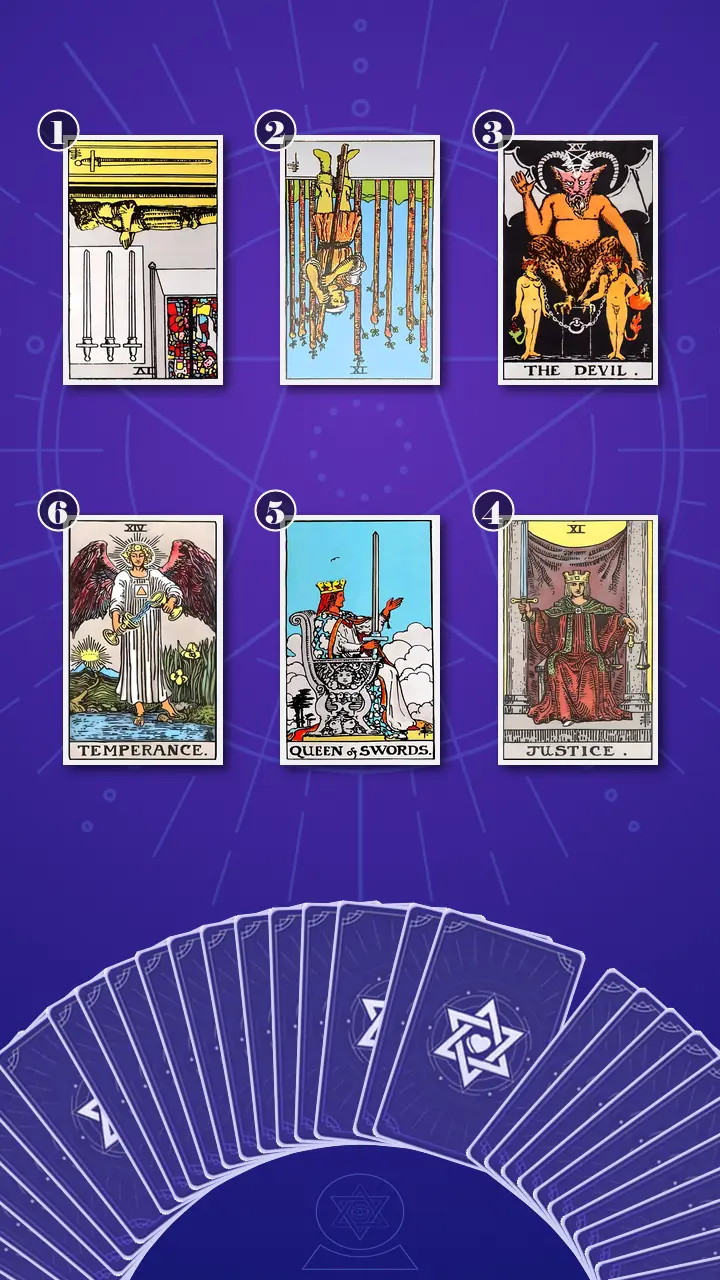
“The upper-left card will show what your PTO days actually look and feel like,” I said. “The next card will identify what keeps recovery outside the workweek, and the third will examine the belief beneath that pattern. Then Justice will offer the key trigger, the Queen of Swords will translate it into a boundary, and Temperance will show what sustainable recovery could become.”
The Map Begins Where Rest Fails
The Body That Is Off Duty on Paper
“Now I’m turning over the card for the observable symptom: PTO is used only after an ordinary week has produced enough depletion to force a stop, yet the stop does not feel fully restorative.”
The card was the Four of Swords, reversed.
I focused on the recumbent figure beneath the three suspended swords. The body has stopped, but the mental demands remain overhead. In Jamie’s life, that looked exactly like the PTO Monday: Teams open from bed, last week’s conversations replaying, and tomorrow’s return already occupying attention. They were physically away from work without experiencing a clean interruption in vigilance.
This was blocked Air, not a lack of permission on the calendar. Rest existed as a deficiency in timing and depth. Jamie waited until the body forced a pause, then carried unfinished errands, self-judgment, and return anxiety into the pause. The first part of the leave day was spent descending from overextension; the middle was spent sleeping, scrolling, or doing laundry; the end was shadowed by the knowledge that the same routine would begin again.
I returned us to the bedroom scene and gave the inner monologue its exact shape: “I am off, but I still need to check…” followed by “I can rest once I know…” The distinction was between physical absence and mental availability, between chosen rest and collapse-enforced stillness. PTO could be present without becoming restorative time.
Jamie gave a short, bitter laugh. “That’s too accurate,” they said. “Almost cruel.” I did not rush to turn the reaction into agreement. First, their breath caught and the hand near the coffee mug froze. Then their gaze went unfocused, as though replaying the last recovery Monday from the inside. Finally, a long breath moved through their chest, and their shoulders dropped by a fraction.
“I don’t hear a discipline failure in this card,” I said. “I hear a body trying to stop after the system has already spent the available reserve. A twenty-minute no-screen pause before depletion would not solve every cause, but it could give us information about whether recovery is being blocked before the leave day even begins.”
Four of Swords reversed asked a sharper question than “Did you take a day off?” It asked whether the day had ever been allowed to begin with enough available energy to feel like time belonging to Jamie. The cold coffee beside the bed became a small, exact symbol: even the ritual of starting the morning had been interrupted by the need to remain reachable.
The Guard Who Keeps the Office Door Open
“Now I’m turning over the card for the maintaining blockage: survival-mode vigilance, weak day-to-day boundaries, and exhausted endurance that keep recovery outside the workweek.”
The card was the Nine of Wands, reversed.
The bandaged figure and the fence of staffs looked to me like someone holding the office door open with their own body while requests arrived one by one. During a routine Wednesday, Jamie carried reheated pasta to the desk because Teams displayed a message labelled “quick question.” At 5:18 p.m. on Thursday, they accepted a last-minute deck update before checking what would have to move. No single request looked catastrophic. Together, they created a defensive perimeter that never switched off.
This was depleted Fire: the energy of persistence had been kept burning after it stopped protecting anything useful. The familiar internal chain ran, “It is only one quick thing” to “I will make it fit” to “I will recover this weekend.” Capability and capacity had become confused. Jamie could complete the task, but completing it still required moving lunch, groceries, sleep, a message to a friend, or the energy reserved for Monday.
“Your work may see the finished task,” I said. “It may not see the lunch, evening, or future energy you displaced to finish it. Constant availability can look like competence while quietly consuming capacity.”
Jamie’s shoulders climbed toward their ears. Their stomach seemed to drop before they answered, “If I ask which priority should move, won’t they think I can’t handle the role?” I acknowledged that hierarchy, job security, staffing, and workplace culture can make boundaries genuinely risky. The card was not asking them to refuse every request. It was asking them to distinguish what is urgent from what is merely new, and to notice the cost of treating both as an emergency.
I suggested one proportionate inquiry: identify a low-priority request that could be delayed, delegated, or answered with a stated trade-off. Not a dramatic confrontation. Just enough language to stop personal recovery time from becoming invisible overflow capacity. The Nine of Wands reversed showed why change felt difficult: boundary-setting itself required energy, and Jamie had been spending that energy proving they could endure.
The Subscription That Renews Your Worth
“Now I’m turning over the card for the underlying cause feeding the repetition: the binding belief that constant availability proves competence and that rest must be earned through collapse.”
The card was The Devil, upright.
I did not present the Devil as punishment, evil, or fate. I drew Jamie’s attention to the loose chains around the two figures. The arrangement felt binding, but the image contained a degree of agency that had been overlooked. In daily life, the chain sounded like an unwritten workplace contract: “If I respond quickly, I stay valuable; if I need limits, I become questionable.”
It was like an auto-renewing app subscription whose terms Jamie had never opened. Every instant reply renewed the expectation of instant replies. Every lunch surrendered to a quick request taught the surrounding system that lunch was available capacity. Every isolated PTO day lowered the immediate pressure while allowing the same bargain to renew when Jamie returned.
I also named the limits around that metaphor. Toronto rent does not disappear because a card highlights agency. A manager may hold more power, a team may be understaffed, and financial or health circumstances may narrow the available choices. The point was not that Jamie could simply walk away from every chain. The point was to separate what was structurally required, what was culturally encouraged, what had become habitual, and what was being maintained by fear.
Jamie went quiet and reread the card’s image. Their thumb rubbed the edge of the spread, and their eyes settled on the figures beneath the pedestal. “I keep calling it unavoidable,” they said, “but I’ve never actually checked which part is the rule.”
“That is the useful discomfort,” I replied. “Not ‘You chose all of this,’ because choice is never the whole story. Rather: which part of the bargain has been treated as an objective fact, even though it might be examined, documented, or negotiated?”
The Devil exposed the worth-for-availability bargain without blaming Jamie for having adapted to pressure. Professional reliability was real. So were the hidden costs: heavy limbs on Friday evening, cancelled plans, laundry on Sunday, and PTO used to become functional again. The root was not simply that Jamie needed better self-care. It was that collapse had become the event that made rest feel legitimate.
When Justice Counted the Cost
The Scales Beneath the Word Normal
The room grew quieter as I moved to the lower row. Rain traced thin lines down the Toronto window, and the grey light seemed to flatten the desk, the coffee, and the cards into one level surface. “Now I’m turning over the card for the key trigger for change: an evidence-based audit of actual workload, availability, skipped recovery, and consequences that challenges the label of a normal week.”
The card was Justice, upright.
Justice brought the level scales and the upright sword. I read them as a capacity audit: on one side, actual hours, interruptions, skipped lunches, after-hours checks, and weekend recovery; on the other, sleep, meals, social energy, and usable personal time. The key insight was simple but not small: repeated PTO depletion was data about the arrangement, not proof of personal inadequacy.
This is where I use my signature Psychological Bandwidth Audit. I do not ask only how many hours appear on the calendar. I look for the mental bandwidth already drained by unresolved stress, context switching, anticipatory checking, and the effort of staying emotionally available. A free hour can exist on paper while the mind has no clean bandwidth left to use it. That distinction helped Jamie see why an apparently normal workweek could still consume the whole evening.
As I watched the scales settle, I thought about what travelling across cultures had taught me: the word “normal” often carries the accent of a particular system. A schedule can be common without being sustainable. A workplace can call a pattern standard while one person’s body keeps paying the hidden invoice. I let that thought remain brief, then brought my attention back to Jamie and the facts in front of us.
I slowed down and gave the setup its full weight: “At 8:15 on a PTO Monday, the coffee is cold, the laptop is open to work chat, and your thumb keeps refreshing. Your body is technically off, but the ordinary week is still occupying the room.”
The problem is not that you fail to endure a normal week; let Justice's scales compare what the week actually takes with what your capacity can sustainably give, then let the sword name the imbalance clearly.
I let the sentence rest between us, then added the second truth Justice was carrying: A week that repeatedly requires a leave day to recover is not neutral just because nothing dramatic happened. Your PTO balance is recording a cost that self-criticism keeps trying to erase.
Jamie did not nod. First, their breath stopped and the thumb hovering over the phone went still. Next, their pupils widened; their gaze slid past Justice toward the rain-silvered window, as if three missed lunches and every after-hours badge were replaying there. Their jaw worked once. A flush gathered at the corners of their eyes, and one fist loosened on the tabletop. Then a small, unsteady breath left their chest. Their shoulders lowered, but the release brought a brief light-headedness—the vulnerability of seeing a path where there had only been a wall. “But if I track it,” Jamie said, voice rough, “does that mean I was wrong all along?” I answered, “No. It means we are separating capacity, workload design, habit, and pressure instead of making one tired body carry the verdict.” Their face remained damp-eyed, not triumphant, just less alone with the evidence.
“Now, use this new perspective to recall whether there was a moment last week when this insight might have made you feel different?” I asked.
For the grounding exercise, I suggested an eight-minute timer and a private note with two headings: “What the week took” and “What the week allowed me to restore.” I asked Jamie to add three observable facts under each—skipped lunches, after-hours checks, cancelled plans, protected breaks, sleep, meals, or social energy—without judging how well they had handled anything. Then they could circle one imbalance to track for two weeks. I made the limit clear: this was information gathering, not a demand to confront anyone that day. If it felt activating, Jamie could stop, shorten it to one fact, or close the note.
That was the first meaningful movement in the emotional journey: from guilt-driven endurance and collapse-based rest toward evidence-based self-trust. The body was still tired, and the job had not magically changed, but capacity had stopped being a character verdict. It had become relevant information.
The Sword That Moves a Ticket
“Now I’m turning over the card for the concrete action through which this insight can be applied: communicating a capacity limit, requesting a priority trade-off, or protecting a defined recovery period before collapse.”
The card was the Queen of Swords, upright.
Her raised sword and open hand gave me the clearest practical image in the spread. One hand established a firm line; the other remained available for honest exchange. This was balanced Air: not silent pressure suspended above a resting body, but clear language held consciously by the person who needed to use it.
Before drafting a message, I guided Jamie through my Ego Unplugging Protocol. I asked them to separate the fact from the identity attached to it: “Three meetings, two deadlines, and a new request require a priority decision” was a planning statement. “I am not capable enough” was a verdict. I invited Jamie to imagine unplugging the cable between the productivity metric and their self-worth. The metric could inform scheduling; it could not define their right to rest. This was not positive thinking. It was a mental boundary against delayed-return anxiety.
Then we rehearsed the Queen’s sentence: “I can take this on. Which of X or Y should move so I can meet the new deadline?” Jamie did not have to apologise for having limits or reject the work automatically. They had to make the trade-off visible and return the prioritisation decision to the person authorised to make it.
The response echo arrived quietly. Jamie opened a draft in Teams, typed the sentence, and changed the final punctuation twice. I saw the nervousness in the tight line of their mouth, but I also saw the old suspended sword becoming something they could hold. If a direct request felt unsafe, the smaller version was: “What is the latest acceptable delivery time for this?” A capacity limit was planning information, not a confession.
Water Between the Cups
“Now I’m turning over the card for the integration potential: a work rhythm where effort and recovery are adjusted continuously, and PTO becomes chosen time rather than the sole emergency exit.”
The card was Temperance, upright.
Water flowed between the two cups, and one foot stood on land while the other rested in water. I saw no promise of perfect balance. I saw ongoing regulation: recovery entering the week in small amounts instead of waiting behind a PTO request. In Jamie’s life, that could mean a protected lunch, a laptop-closing cue, a realistic stopping point, or a clearer priority before evening arrived.
Temperance restored the elements missing from the first row. Water offered replenishment that could move before the system ran dry. Earth offered a practical place for that replenishment to happen—a calendar block, a meal away from the desk, notifications out of sight, or a defined sign-off. The goal was not to turn every week into a wellness retreat. It was to make the week less dependent on emergency recovery.
I moved the image aloud from the beginning of the spread to its close: the swords that once hung over the resting figure were now represented by a deliberate boundary, and the guarded heat of the Nine of Wands could finally meet Temperance’s steady stream. Jamie saved the priority sentence and stared at the blank calendar space where lunch had been disappearing. Their shoulders did not fully relax, but their hand stopped hovering over the work app.
“This is a rhythm, not a performance,” I said. “Some pauses will be interrupted. Some requests will carry real risk. Integration means noticing what happened and adjusting again, not proving that you can maintain a flawless routine.”
The Ledger That Turns Recovery Debt into Next Steps
I placed the six cards in their switchback path. Four of Swords reversed showed the body lying still while work remained mentally suspended overhead. Nine of Wands reversed showed depleted vigilance defending the routine. The Devil revealed the auto-renewing bargain between constant availability and professional safety. Together, those three cards explained why a day off could disappear into sleep, laundry, scrolling, and the effort of preparing to return.
The lower row changed the direction without pretending to control every condition. Justice replaced the vague label “normal week” with evidence. The Queen of Swords turned evidence into a proportionate priority conversation. Temperance made recovery a recurring part of the week instead of a rescue transfer from a shrinking PTO balance. I told Jamie that the pattern resembled using the emergency brake at every TTC stop because the train never regulated its speed between stations: dramatic stopping was occurring where steady pacing should have been.
The blind spot was not simply poor time management. It was the belief that an ordinary week must be endured without slowing down, and that needing recovery exposed a flaw in professional worth. The transformation direction was therefore not from exhaustion to forced productivity. It was from survival-mode overfunctioning to cautious self-trust: distinguish personal capacity from workload design, name one safe limit, and distribute recovery before depletion becomes another emergency.
I reminded Jamie that the cards could not diagnose a health condition or determine whether a workplace was safe to challenge. If exhaustion became dangerous, made functioning unsafe, or raised health concerns, qualified care, accommodations, workplace support, or leave mattered more than any exercise in a reading. Taking PTO was not a failure, and no one needed tarot’s permission to seek help or stop.
The Two Tools for a More Honest Week
To make the insight usable, I kept the next steps deliberately small. The first would gather evidence without turning the audit into another productivity contest. The second would give that evidence one sentence to travel through the workplace.
- Build a five-checkbox workweek capacity logFor five workdays, Jamie would keep a private phone note and check whether they worked through lunch, checked messages after hours, received an unplanned request, cancelled a personal task, and ended the day with energy from 1 to 5. At sign-off, they would add the actual stopping time, including any later return to messages. Before booking another recovery day, they would spend five minutes identifying the demand most clearly connected to depletion.Keep it to one minute and record facts rather than productivity scores. If two weeks feels impossible, stop after three days; the smallest honest sample still provides information.
- Use the Priority-Moves ReplyJamie would save this line in a Slack or Teams draft: “I can pick this up. Which existing priority should move so I can meet the new deadline?” They would use it once this week on a low-priority request instead of automatically fitting the task into lunch or evening time. If a direct capacity request felt unsafe, they could ask in writing, “What is the latest acceptable delivery time for this?”Keep the message neutral, brief, and tied to priorities rather than worth. Choose the lowest-risk situation, and document the response so the result becomes part of the evidence rather than another private worry.
I asked Jamie to judge neither action by instant energy nor by whether the workplace responded perfectly. The useful measure was whether a little more information or choice entered the loop. That was Temperance in practice: not a perfect week, but a week with somewhere for recovery to begin.

A Week Later, the Quiet Proof
Four days later, I received a message from Jamie with a screenshot of the private note. It read: “Two interrupted lunches. One after-hours check. Three quick asks. Energy 2/5 at sign-off.” That afternoon, a new request arrived, and Jamie sent the Queen’s sentence before opening the file. The manager chose one existing deadline to move. Nothing about the job became effortless, but one evening no longer had to pay for the decision.
That night, Jamie slept a full night but woke with the old thought—What if I’m still getting this wrong?—beside the alarm. This time, they checked the note instead of Teams and smiled faintly. The fear remained; it simply no longer owned the whole calendar.
I think of that as the first proof in a Journey to Clarity. The cards did not grant Jamie permission to rest or manufacture a better workplace. They helped turn a blurred accusation into a map: evidence-based self-trust, proportionate boundaries, and recovery distributed through the week. The next decision still belonged to Jamie.
When your body drops the moment the week ends and your hand still reaches for work chat, the hardest part may be wondering whether your exhaustion exposes a flaw in you, even as every ordinary week keeps taking more than it gives back. I hope the scales let you see the cost without making you carry the blame.
If your capacity could count as information rather than a verdict, what is one small part of next week—the lunch you usually surrender, the green status dot you keep lit, or the priority that must move—that you would become curious about measuring or protecting?