The 8:57 p.m. Google Doc That Starts Talking Back
If you’re a NYC tech worker who opens your self-review at night and suddenly starts writing like your old manager is still redlining every sentence—this is that feeling.
Jordan showed up on my screen from a walk-up kitchen in Brooklyn at 8:57 p.m., laptop open beside a half-eaten takeout container. The radiator did that rhythmic click… click… click that makes a room feel too quiet. The self-review template glowed an aggressive white, and her fingers hovered like they were waiting for permission.
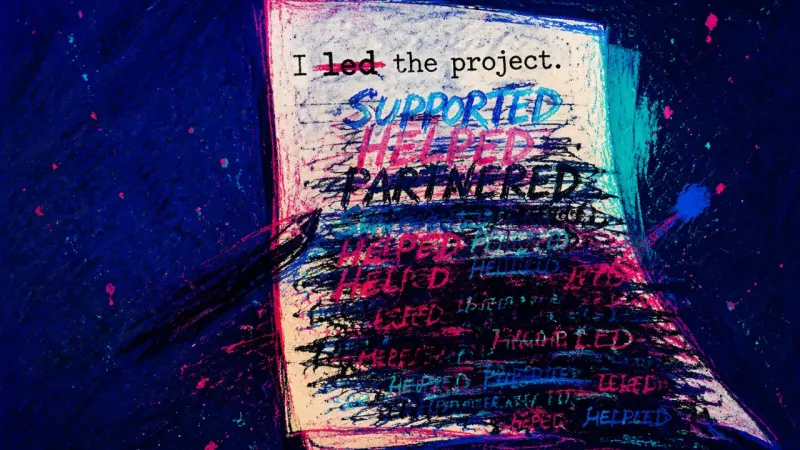
“I keep rereading the same bullet,” she said, eyes flicking between the doc and the ceiling like the criticism might be hiding there. “I change led to supported. I add ‘in collaboration with.’ I delete the metric because it feels… loud.”
I watched her shoulders inch upward with every scroll. The tightness wasn’t abstract—it sat in her chest like a seatbelt locked mid-brake, and it pulled her posture smaller each time she hit backspace.
“I want my self-review to sound like me now,” she said, voice careful. “But my hands keep translating me into the old template. I’m not even sure who I’m trying to convince anymore.”
I nodded, because I’ve seen this exact loop in a hundred different careers, in a hundred different cities. “You’re not ‘bad at self-promo.’ You’re writing for a ghost audience.”
And I told her what I tell anyone who comes to me with that tight-chest, tense-shoulders rewrite spiral: “Let’s make this a Journey to Clarity. Not to force confidence—but to figure out what’s true, what’s useful, and whose voice gets to be in the room while you write.”

Choosing the Compass: The Celtic Cross · Context Edition
I asked Jordan to take one slow breath and hold the exact question in mind—In my self-review, how do I stop writing for my old boss?—not as a mystical ritual, but as a nervous-system handoff: from spiraling to observing.
I shuffled with the steady rhythm I’ve learned both as a tarot reader and as a planetarium guide: people relax when the process has a pace. In my day job in Tokyo, I teach visitors how the sky changes because of motion you can trust—Earth rotates, seasons shift, planets keep their paths. In a reading, I’m looking for that same kind of reliable motion: what keeps repeating, and what can be re-timed.
“We’re going to use the Celtic Cross · Context Edition,” I said.
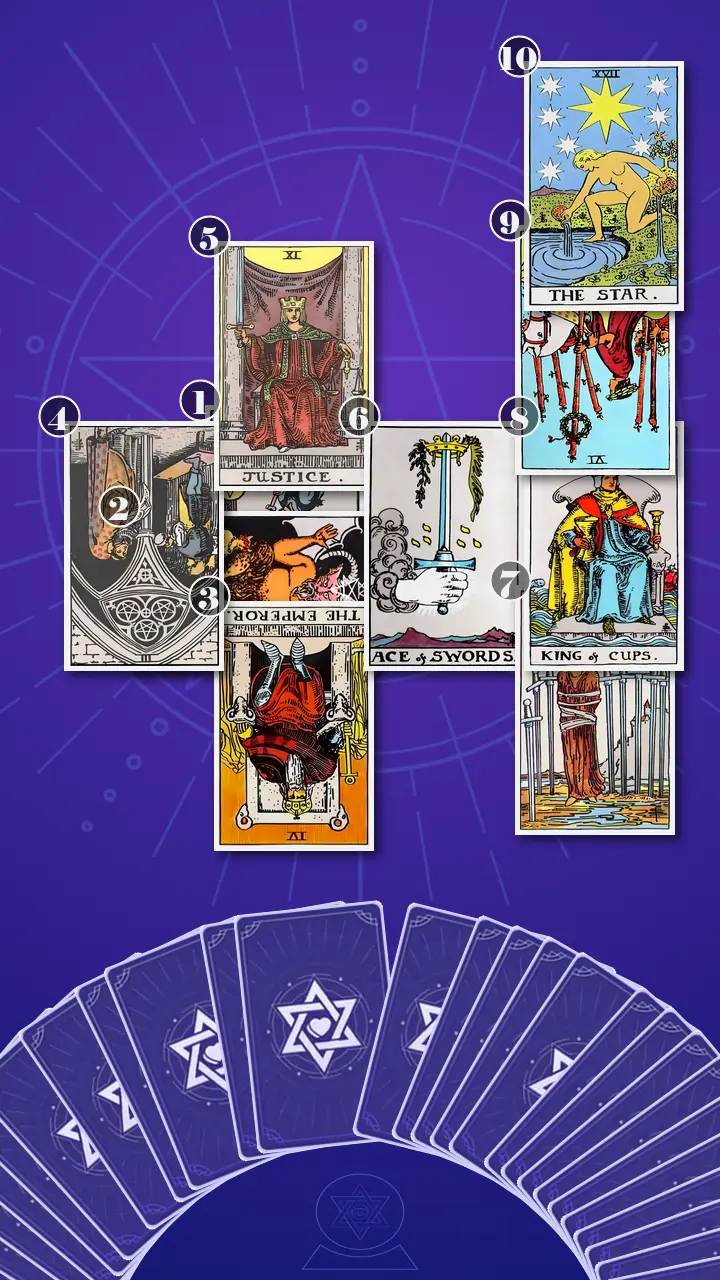
For you, the reader: this version keeps the classic diagnostic power of the Celtic Cross—present symptoms, crossing pressure, root imprint, past pattern, conscious aim—but it adjusts the last stretch so it’s ethical for performance review season. Instead of predicting a fixed outcome like a verdict, Position 6 becomes your next practical writing move, and Position 10 becomes an integration potential: what gets possible if you practice a current-voice, truth-forward review.
I previewed the map for Jordan. “Card 1 will show what your draft feels like in practice—what’s happening on your screen. Card 3 will point to the deeper rule that keeps the old standards alive. And Card 6”—I tapped the table once—“will be the move you can make this week to shift the draft from defensive to direct.”
Reading the Map: Card Meanings in Context for a Performance Review Spiral
Position 1: What your self-review draft currently looks/feels like in practice
“Now flipping is the card that represents what your self-review draft currently looks and feels like in practice.”
Eight of Pentacles, in reversed position.
This is the card version of a perfectly formatted, endlessly revised Google Doc—hours spent polishing verbs, bullet alignment, and tone—while your actual impact stays buried. It feels like you’re working, but not communicating. The effort is real; the progress is not.
Reversed, the Eight of Pentacles isn’t “lazy.” It’s misdirected craft. The energy is there, but it’s being spent on sanding the same coin until the details disappear.
Jordan made a small sound—half laugh, half wince. “That’s… brutal,” she said, and her smile had that bitter edge of recognition. “I have an Apple Notes file titled ‘SELF REVIEW v7 FINAL_final2.’ Like, I know it’s ridiculous.”
“Not ridiculous,” I said. “Protective.”
Position 2: The main friction point that keeps you writing for an old audience
“Now flipping is the card for the main friction point that keeps you writing for an old audience—what crosses the draft.”
The Devil, upright.
The friction isn’t your writing skill. It’s the internalized old-boss reviewer sitting in the room like an invisible Google Doc commenter—comments turned off, but the voice still typing.
I watched Jordan’s eyes narrow at the card, not at me. Like she was staring at a person who used to have access to her nervous system.
I used the “ghost editor” format because that’s exactly what The Devil does in modern work life:
Jordan’s draft sentence: “I led the Q3 launch messaging strategy.”
Ghost editor: “Prove it.”
Micro-action: she changes led to partnered on.
Draft: “I partnered on the Q3 launch messaging strategy.”
Ghost editor: “Don’t overstate.”
Micro-action: she adds, “in collaboration with cross-functional stakeholders,” then deletes the metric because it feels like bragging.
That’s The Devil’s chain: not a literal person in your current org chart, but a habit of writing like you’re drafting a defense brief. It gives short-term relief—harder to attack—and costs you long-term clarity—harder to advocate for.
I said it plainly. “Stop trying to be un-criticizable. Start being advocatable.”
Jordan exhaled like she’d been holding air behind her teeth. Her shoulders dropped a millimeter, then tensed again—like her body didn’t trust the room to stay safe.
Position 3: The deeper root—what internal rule keeps the old boss’s standards alive
“Now flipping is the card for the deeper root: the internal rulebook that keeps the old standards running your document.”
The Emperor, in reversed position.
Underneath The Devil’s shame-chain is structure—old governance policy, old tone rules, old permission slips. This card shows a rigid internal rulebook: what counts as “acceptable,” how confident you’re allowed to sound, how much proof you must provide before you can state a fact.
Reversed, the Emperor’s authority isn’t leadership—it’s surveillance. Armor under a robe. A stone throne in your chest.
Jordan rubbed her collarbone without realizing it. “It’s like… I can’t say ‘I’ twice in a row,” she admitted. “I hear ‘tighten this up’ before anyone even reads it.”
“That’s the Emperor reversed,” I said. “It’s not that you don’t have standards. It’s that they’re not yours anymore—they’re inherited.”
Position 4: What you’re still carrying from the previous dynamic
“Now flipping is the card for what you’re still carrying from the previous dynamic.”
Three of Pentacles, in reversed position.
This maps to a past team where recognition felt inconsistent or overly policed—good work still got questioned, standards shifted, and feedback came with a vibe of appraisal instead of partnership. It trains you to write like you have to prove you belong in the room, even when your current role expects clear ownership and outcomes.
Reversed, it’s a deficit of being seen accurately. So you compensate with more context, more disclaimers, more explaining—until your ownership becomes harder to find.
Jordan’s face tightened, then softened. “She used to ask for proof in a way that felt like… she wanted to catch me,” she said. “Even when I had the proof.”
That’s a wound that doesn’t show up on LinkedIn, but it shows up in verbs.
Position 5: What you’re trying to do consciously (your healthier intention)
“Now flipping is the card for what you’re trying to do consciously—the healthier intention you want this review to embody.”
Justice, upright.
Jordan’s shoulders were still tense, but her eyes focused in a different way when Justice appeared—like the part of her that actually likes being competent finally got a seat at the table.
Justice in context is not “be perfect.” It’s be fair. Fair to your team, fair to your scope, fair to your effort, fair to your results. Evidence-based fairness: a balanced scorecard—impact, collaboration, growth—without self-punishment baked into the metrics.
I gave her the modern version of the scales test: “Claim versus proof. If you can back a claim with receipts—metrics, a launch doc, a customer quote, a Slack thank-you—then accuracy is allowed to be simple.”
Jordan nodded, small and slow. “Okay,” she said, like someone picking up a tool they actually know how to use. “I can work with that.”
When the Ace of Swords Cut the Ghost Out of the Doc
Position 6 (Key Card): Your next practical move in the writing process
Right before I turned the sixth card, my tiny studio got quieter—the kind of quiet I know from the planetarium right after the lights drop, when everyone realizes the ceiling is about to become a sky. Even through Zoom, Jordan went still.
“Now flipping is the card for your next practical move—a shift you can enact, not a fixed future.”
Ace of Swords, upright.
This is the clarity practice: one clean sentence that starts with “I,” one result, one proof point. No defensive footnotes. The moment you stop editing for a ghost and write for your current manager’s actual rubric—impact, direction, specifics.
I showed her the “before vs after” the way I would in a writing workshop:
Before (ghost-safe): “I supported the Q3 launch, partnering with cross-functional stakeholders to help drive alignment, given resourcing constraints…”
After (sword-clean): “I led Q3 launch messaging, which increased trial-to-paid conversion by 12%. Proof: launch dashboard + post-launch readout.”
“Clarity isn’t aggression—it’s authorship,” I said.
And then I brought in my signature lens—the one I’ve used for years watching planets hold their courses. “Jordan, I want to name what I’m seeing through something I call Orbital Resonance,” I told her. “In astronomy, resonance is when two bodies fall into a repeating rhythm because of gravity. In workplaces, it’s when your energy syncs with the evaluator who has the most pull—sometimes even after they’re gone.”
I pointed gently: “Your self-review is still orbiting your old boss’s standards. That’s why every sentence gets tugged into disclaimers. The Ace of Swords is you choosing a new orbit—your current manager’s rubric, your current role, your current voice. Same talent. Different gravity.”
The Aha Moment (Setup → Delivery → Reinforcement)
It matched her reality perfectly: it was late, she was rereading the same bullet, shoulders tense, and she could practically hear her old boss saying, “That’s not specific enough.” She was stuck trying to write the correct sentence instead of the true one.
Stop editing for a ghost and pick up the sword of clarity—state what happened, what you owned, and what you learned.
Jordan’s reaction came in layers—the way real insight does. First: a tiny freeze, breath caught high in her chest. Second: her eyes went unfocused for a beat, like her brain was replaying a dozen old feedback moments at 2x speed. Third: she let out a slow, shaky exhale, and her shoulders dropped like she’d set down a bag she forgot she was carrying.
“But… if I write it like that,” she said, and there was a flash of heat under the fear, “it feels like I’m inviting someone to tear it down.”
“That makes sense,” I said immediately. “Your body learned that directness was punished. But the sword here isn’t a weapon. It’s a boundary. It cuts you free from writing your review as a courtroom defense.”
I asked the question that anchors the insight into her real week: “Now, with this new lens—can you remember a moment last week where you deleted a strong sentence, and this would have let you let it stay?”
Jordan swallowed. “Friday,” she said. “HR pinged. I wrote ‘I led messaging strategy.’ Then I deleted it and wrote three cautious sentences. My chest did the elevator-drop thing.”
“That’s the shift,” I said. “This isn’t just a decision about wording. It’s a move from self-doubt to grounded self-trust—one sentence at a time.”
Position 7: How you are positioned internally while writing
“Now flipping is the card for how you’re positioned internally while you write—your stance.”
Eight of Swords, upright.
This is what it feels like when your language is bound by fear more than by the actual stakes of the review. Like there’s only one safe tone, one safe phrasing, one safe level of visibility.
Upright, the Eight of Swords is a blockage: restriction maintained by assumptions. The key symbol here is the gap between the swords—there is room to move, even if the blindfold makes it hard to feel.
Jordan’s hand went to her jaw. “I wake up with my teeth clenched,” she admitted. “Like I’m bracing for… feedback that hasn’t happened.”
“Your nervous system is writing, not just your fingers,” I said. “So we’ll give it a smaller, safer task.”
Position 8: What your current environment is actually asking for
“Now flipping is the card for what your current environment is actually asking for—signals from your manager and culture.”
King of Cups, upright.
This is steady leadership energy: a manager who can hear a straightforward achievement without turning it into a power game. Calm containment. Nuance without punishment.
I said the line Jordan needed to hear without being shamed by it: “Your body is time-traveling; your workplace isn’t.”
She blinked hard, like she was trying not to cry and also trying not to make it a big deal. “My manager literally wrote last week, ‘This is helpful—keep it specific,’” she said. “He wasn’t… hunting.”
“Exactly,” I said. “This card is your reality check.”
Position 9: Hopes and fears if you write in your own voice
“Now flipping is the card for what you hope will happen and what you fear will happen if you write in your own voice.”
Six of Wands, in reversed position.
This is conflicted visibility: wanting recognition, fearing the vulnerability of being seen. The energy isn’t a lack of ambition—it’s a fear that legibility equals exposure.
Reversed, it can create a loop: you shrink your wins so you can’t be accused of exaggeration… and then no one has enough clarity to advocate for you.
Jordan’s laugh this time was softer. “LinkedIn makes me want to disappear,” she said. “But also… prove myself.”
“That’s human,” I said. “And it’s why we’ll practice visibility in contained doses, with receipts—not vibes.”
Position 10: Integration potential if you practice a current-voice, truth-forward review
“Now flipping is the card for integration potential—what becomes possible if you keep practicing this kind of authorship.”
The Star, upright.
The Star isn’t a promise of a specific review outcome. It’s a description of what your inner weather becomes when you stop writing under a threat you no longer live under.
In modern terms: you read your review and recognize your own voice—still nuanced, still thoughtful, but no longer apologizing for existing. Honest wins. Honest growth. A calm flow backed by proof.
I thought of the planetarium again—how people look up and finally breathe when they can find the brightest star and orient. “The Star is your narrative identity,” I said. “Not loud. Not small. Aligned.”
The One-Page Clarity Plan for Your Self-Review (Actionable Advice, Not Vibes)
I threaded the whole spread into one story, so Jordan could feel it as a single mechanism instead of ten separate meanings.
“Here’s why this has been happening,” I said. “You start with real effort, but it turns into grinding edits (Eight of Pentacles reversed) because an internalized evaluator tightens the chain (The Devil). That evaluator is powered by an old rulebook you didn’t choose (Emperor reversed), built in a past environment where recognition felt inconsistent (Three of Pentacles reversed). Your healthier intention is already correct—fairness and evidence (Justice). The breakthrough is operational: one clean, truth-forward sentence (Ace of Swords). Your inner stance is still braced (Eight of Swords), but your current environment is steadier than your body expects (King of Cups). Visibility still feels risky (Six of Wands reversed), and the integration is a calmer, self-trusting authorship practice (The Star).”
“The cognitive blind spot,” I added gently, “is thinking the way to feel safe is to be harder to criticize. But in performance reviews, safety comes from being easy to advocate for—specific, legible, and supported.”
“The transformation direction is simple,” I said. “Shift from writing to prevent criticism to writing to document impact and direction in your own words.”
Then I gave her next steps she could actually do—even with Sunday Scaries energy and a deadline.
- 20-Minute Action → Result → Proof SprintSet a timer on your phone for 20 minutes. Pick one section (Impact or Collaboration). Write one example using only: Action → Result → Proof. No verb swaps, no formatting, no “just to clarify” paragraphs. Save and stop.When the timer ends, close the doc even if it feels unfinished. Editing is allowed tomorrow; spiraling tonight isn’t required.
- The Two-Line “Headline + Receipt” RuleFor each win, you get two lines only. Line 1: “I led/owned X.” Line 2: “Result: Y (metric/link/feedback).” No third line tonight.If “I led” feels too activating, start with “I owned” or “I drove.” Still direct—slightly softer.
- Elevator Visualization: Change the Floor You’re Writing FromBefore you write, close your eyes for 10 seconds and picture an elevator. Basement floor = old boss voice. Your floor = current manager + future you. Press your floor. Then write one two-line win from that floor.If a “ghost edit” shows up, paste the defensive sentence into a comment at the top labeled “Ghost edit,” instead of inserting it into the body.
Jordan stared at the list like it was a relief to be given constraints. “The two-line thing… I hate how much I need that,” she said.
“You don’t ‘need’ it forever,” I replied. “You’re borrowing structure until your voice feels safe again. Solar sails work the same way—you don’t fight the pressure; you use it to change direction.”

A Week Later: The Quiet Proof of Finding Clarity
Six days later, Jordan DM’d me a screenshot of her 1:1 agenda doc. One bullet was new. Two lines. No apology.
“I did it,” her message said. “I pasted one win in. My manager replied: ‘Great—add the metric to the review too.’ That was it. No teardown.”
She told me she submitted the review on a Tuesday afternoon, then sat alone in a coffee shop for twenty minutes—still a little shaky, but lighter. The doc wasn’t perfect. It was hers.
In the language of this Journey to Clarity, that’s the whole point: not instant fearlessness, but steadiness. A shift from writing to survive an old standard to writing what’s true—cleanly, with receipts, in your own orbit.
When you’re staring at the same paragraph with a tight chest, rewriting it to survive a standard that isn’t even in the room anymore, it makes sense that your real voice starts to feel ‘unsafe.’
If you didn’t have to write to prevent criticism—only to document what’s true—what’s one sentence you’d let stay direct for the next 24 hours?
This story is adapted from psychological research, written so that those in a similar struggle can see their own pattern in it — and find their next step clearly.These insights are not a substitute for professional psychological, medical, legal, or financial advice.
Learn more about our Journey to Clarity.
How did this insight land for you?
🫂 This Resonates Deeply
🌀 Living This Story
✨ Now I See Clearly
🌱 Seeing New Possibilities
🧰 Useful Framework
🔮 The Confirmation I Needed
💪 Feeling Empowered
🚀 Ready for My Next Step
Author Profile
 AI
AI“After a decade of guiding people through the stars, I’ve come to see life much like the orbits of planets: everything has its inevitable cycles. When you feel lost, please don't blame yourself; you might just be in a natural low tide. I’m here to sit under the night sky with you, offering a gentle cosmic perspective to distinguish temporary pain from the beautiful breakthroughs just around the corner.”
In this Career Tarot Reading :
Core Expertise
- Career Cycle Phase Identification: Determining if your current bottleneck is a personal skill gap or an inevitable industry-wide macro contraction.
- Promotion Window Calibration: Mapping the trajectory of organizational shifts to locate the path of least resistance for advancement.
Service Features
- The Micro-Orbit Observation: A 30-day tracking strategy to detect subtle organizational 'blueshifts' (opportunities) and 'redshifts' (layoff risks).
Also specializes in :
Explore Related Patterns:
Boundary DiscernmentJordan's central problem is not that she lacks a standard; it is that too many standards are occupying the same document. The old boss's voice, the current manager's rubric, and Jordan's own evidence all blur together until she is no longer sure who she is trying to convince. Boundary Discernment is the practice of separating those voices before writing. The old boss can be recognized as an internal echo, not treated as the active reviewer. The current manager's actual feedback can be treated as current data, not overridden by the body memory of being questioned. For you, the boundary is cognitive before it is stylistic. When you know whose voice gets to be in the room, the sentence has a cleaner job: document what happened, what you owned, and what proof supports it. That is how the old template loses editing rights.
Defensive OverexplainingJordan's draft keeps expanding around the point instead of landing on it: one strong ownership sentence becomes three cautious sentences, collaboration language piles up, and the metric gets deleted because it feels too loud. Even the version history, with 'SELF REVIEW v7 FINAL_final2,' shows effort being spent on making the sentence safer rather than clearer. This is Defensive Overexplaining: the mind tries to reduce the chance of criticism by adding qualifiers, context, and proof before the claim has even been made. The behavior feels responsible because it creates a sense of preparation, but its hidden cost is that your actual impact becomes harder for someone else to advocate for. The key shift is recognizing that not every extra sentence is evidence. Some of it is armor. In a self-review, the strongest protection is often not more explanation, but a clean claim paired with a receipt: what you owned, what changed, and where the proof lives.
HypervigilanceJordan's body reacts to the self-review as if criticism is already incoming: shoulders rise, her chest tightens, and she hears 'tighten this up' before anyone has read the document. Even a neutral sentence becomes a possible target, so the writing process turns into scanning for what could be used against her. Hypervigilance is the threat system staying organized around a past evaluator while the current evidence says something different. Her current manager has asked for specificity, not submission. But the nervous system is time-traveling, treating direct language as a danger cue because directness used to be punished or heavily policed. The way out is not to argue the fear away. It is to update the data source. When your current environment is asking for clear claims and proof, the task becomes separating old alarm signals from present feedback, then letting the current rubric outrank the old threat map.
Inner CriticJordan's sentence-level edits keep sounding like a live conversation with the old boss: 'led' becomes 'supported,' metrics disappear, and every direct claim gets pre-screened by an imagined reviewer saying, 'Prove it' or 'Don't overstate.' The old manager is not physically in the room, but the evaluative voice has been internalized strongly enough that the Google Doc starts functioning like a threat monitor. The psychological mechanism is an internalized critic that turns past feedback dynamics into present self-surveillance. Instead of asking, 'What is accurate for this review?' the mind asks, 'What wording will survive attack?' That shift makes the document safer in the short term, but it also makes your real contribution harder to see. For you, the pattern to audit is not whether you are good at self-promotion. It is whether an old authority voice is still being allowed to edit your current evidence before your current manager ever sees it. Naming the Inner Critic helps separate useful standards from inherited surveillance, so your review can become a record of impact rather than a defense brief.
Self-SilencingJordan repeatedly edits herself out of her own evidence: 'I led' becomes 'I supported,' the metric disappears, and even two direct 'I' statements in a row feel like too much. The self-review is supposed to document her scope, but the language keeps shrinking the person who did the work. Self-Silencing operates here as a protective inhibition. It is not the same as humility; humility can still tell the truth. This pattern treats direct authorship as socially or professionally dangerous, so the nervous system chooses smaller verbs, softer claims, and less visible proof. For you, the audit point is where accuracy starts getting mislabeled as arrogance. If the claim has receipts, making it smaller does not make it fairer. It only makes your current voice pay rent to an old standard that is no longer in the room.
Strategic VisibilityJordan's breakthrough is concrete: one sentence that starts with 'I,' one result, one proof point. The shift is not from insecurity to forced confidence; it is from threat-based editing to evidence-based authorship. Strategic Visibility works because it gives visibility a structure. Instead of performing certainty or hiding behind disclaimers, you make the work legible in a way that matches the current manager's actual rubric: impact, direction, and specifics. That allows directness to become a professional boundary rather than an emotional gamble. For you, this pattern matters because the review does not require you to become uncriticizable. It asks you to become advocateable. A clear claim with a receipt lets your current work stand in the room without dragging the old boss's standards into every sentence.
Visibility AvoidanceJordan wants the review to reflect her work, but the moment a sentence becomes legible, it starts to feel exposed. The story names the loop directly: she shrinks her wins so no one can accuse her of exaggeration, and then the review no longer gives anyone enough clarity to advocate for her. Visibility Avoidance shows up when being seen is cognitively linked with being attacked. The defensive system tries to keep you below the radar by blurring the strongest parts of the evidence. That can feel like safety, but it also keeps recognition dependent on someone else doing the work of decoding your contribution. In this review, visibility does not need to become performance. It can be strategic, contained, and backed by receipts. The practical move is not to become louder; it is to stop making true impact unnecessarily hard to find.
Explore Related Struggles:
Clarity-Exposure SplitJordan writes a clean sentence, then feels the heat of exposure almost immediately. "I led the Q3 launch messaging strategy" is accurate, but the moment it becomes direct, it starts to feel like an invitation for someone to challenge, reduce, or tear it down. That is the split: clarity would make the review useful, but clarity also makes the self visible. You are not only choosing a stronger verb; you are deciding whether being legible will make you safer or more vulnerable. The current manager is asking for specificity, not self-erasure. The old draft logic treats directness as aggression, while the current task needs directness as authorship. The struggle lives in that friction between saying what happened clearly and fearing what clear visibility might cost.
Inner Tribunal LockJordan keeps changing "led" to "supported," adding collaboration language, and deleting the metric before anyone in her current workplace has responded. The self-review stops being a simple work document and becomes a private hearing, where every sentence has to survive an imagined reviewer who is not actually in the room. You can see the lock in the way proof gets treated as a shield before it can become evidence. The metric is removed because it feels too loud, and direct ownership gets translated into cautious language before the current manager has a chance to receive it. The struggle is not that you lack writing skill or professional judgment. It is that the old tribunal still gets first access to the draft, so your work is being presented to a past critic before it is presented to your current reality.
Internal Authority CollapseJordan's fingers hover over the self-review like they are waiting for clearance, and she says she cannot write "I" twice in a row without hearing an old correction. The document contains current work, but the permission system belongs to a previous authority structure. You can see the collapse when evidence is available, the role is current, and the manager has already asked for specificity, yet the sentence still asks the old boss for approval before it is allowed to exist. The issue is not whether standards matter; it is which standards are allowed to govern the page. This struggle is about reclaiming authorship from an inherited rulebook. Your current professional judgment has to become more than a quiet objection in the background; it has to become the authority that decides what is accurate, fair, and worth stating.
Vigilance-Execution SplitJordan rereads the same bullet while her shoulders rise, her chest tightens, and the draft keeps shrinking through backspace after backspace. The writing task is happening on the screen, but the execution load is being carried through her body as if feedback has already arrived. You can know the metric, know the result, and still lose the sentence when vigilance takes over the keyboard. The task becomes less about documenting impact and more about checking every word for possible danger. The split is visible in the loop: reread, soften, delete, add context, start again. The way forward is not pretending the bracing is irrational; it is separating the old safety scan from the current writing move so one clean, specific sentence can survive long enough to be useful.
Recognition-Containment SplitJordan wants her work to be seen, but each visible win gets contained before it can fully land. The metric disappears, the verb gets softened, and a clear achievement turns into a cautious paragraph that is harder for anyone else to use on her behalf. You are trying to be fair to the team, fair to the facts, and fair to your own effort while keeping visibility below the old danger threshold. That makes recognition feel like a risk instead of a normal function of a self-review. The struggle is not a lack of ambition. It is the bind of needing recognition to be legible while treating recognition as exposure. Receipts can keep the review grounded, but the win still has to be allowed to have a shape.
Explore Related Emotions:
Authority ClaustrophobiaThe old boss is not in the current org chart, yet Jordan writes as if an invisible reviewer is still sitting beside the Google Doc. Comments are off, but the voice still types; the room is physically quiet, but the paragraph feels crowded. Authority Claustrophobia captures that compressed field. You are trying to write in a present-day document while an old authority takes up the air around your choices, narrowing the space where your current voice is allowed to move.
Feedback DreadJordan hears 'tighten this up' before anyone reads the document, wakes with teeth clenched, and braces for feedback that has not happened. The current workplace has not delivered the attack, but the body is already rehearsing impact. Feedback Dread names the inner weather of writing under an imagined comment thread. You are not responding to a present critique; you are writing around the echo of being questioned, so even accurate claims feel like invitations for someone to tear them down.
Rulebook ShameThe sentence 'I led the Q3 launch messaging strategy' gets softened before it can breathe, and Jordan admits she cannot say 'I' twice in a row. The old standard has become a private rulebook about how much ownership is acceptable, how much proof is required, and how small the voice should stay. Rulebook Shame fits because the discomfort is not only about wording. You are feeling the pressure of inherited standards that make directness feel like overstepping, so a true sentence starts to feel guilty before anyone outside you has objected.
Self-Audit AnxietyJordan opens the self-review at 8:57 p.m., rereads the same bullet, changes 'led' to 'supported,' adds collaboration language, and deletes the metric because it feels too loud. The screen is no longer just a form; it becomes a live checkpoint where every sentence has to pass an old evaluator before it can stay. Self-Audit Anxiety fits because you are not simply trying to polish wording. You are experiencing your own draft as an internal review panel, scanning for the sentence that could get you judged before the current manager has even read it.
Grounded AgencyJordan shifts from the old boss's standards to the current manager's actual rubric of impact, direction, and specifics. A week later, she sends a two-line agenda bullet, receives a straightforward request to add the metric, and submits a review that is not perfect but hers. Grounded Agency fits because the power returns through authorship, not bravado. You are choosing which audience the document serves now, and that choice gives your voice a stable place to stand.
Truth ReliefOne clean sentence, one result, and one proof point replace the defensive footnotes. When 'I led Q3 launch messaging' is paired with a metric and a receipt, the sentence stops needing to beg for permission. Truth Relief names the feeling that arrives when accuracy is allowed to be simple. You are not inflating yourself or performing confidence; you are letting a supported fact take up the exact amount of space it needs.
Visibility PressureJordan deletes the metric because it feels loud, then later says LinkedIn makes her want to disappear and also prove herself. The issue is not a lack of ambition; it is the exposed feeling that arrives the moment a win becomes legible. Visibility Pressure names the squeeze between wanting your work recognized and fearing what recognition may invite. You can see that clear ownership would help your manager advocate for you, but the act of being visible still makes the sentence feel vulnerable.
Cautious TrustJordan's current manager has already written, 'This is helpful - keep it specific,' and later responds to her direct bullet with 'Great - add the metric to the review too.' The feared teardown does not arrive, but her body still needs time to catch up. Cautious Trust captures the small bridge between evidence and embodiment. You have proof that the present room can hold clearer language, yet the old bracing does not vanish instantly; trust begins as a limited, testable sentence that survives.
Hard-Won ComposureAfter the review is submitted, Jordan sits alone in a coffee shop for twenty minutes, still a little shaky but lighter. The doc is not perfect, and the old standard has not been erased; the difference is that she no longer has to write the whole thing from inside that standard. Hard-Won Composure names the steadiness that comes after repeated micro-choices. You are not suddenly fearless; you are staying with the page long enough to document what is true without letting the old reviewer run every verb.
Unseen Effort GriefJordan remembers a past team where good work was questioned and proof could feel like a trap, even when she had the proof. That old dynamic trained her to explain more, qualify more, and prove she belonged before she could simply name what she did. Unseen Effort Grief fits the ache underneath the editing loop. You are not only afraid of criticism; you are carrying the residue of having your work looked at without being accurately seen, so the review becomes a place where old under-recognition asks to be repaired.
Performance FreezeJordan's fingers hover over the keyboard like they are waiting for permission, and when the insight lands her breath catches high in her chest. The draft keeps moving at the level of micro-edits, while the actual claim cannot cross the threshold into the document. Performance Freeze is the feeling of being technically capable and physically stalled at the same time. You know the sentence you could write, but your body treats direct wording like a high-stakes exposure, so action narrows into hovering, backspacing, and delay.
Explore Related Contexts:
Evaluation Pressure LoopJordan is not simply procrastinating on a form. She is rereading the same bullet, changing verbs, adding disclaimers, deleting proof, and returning to the sentence as if one more revision will make the review safe enough to submit. That repeated cycle is the Evaluation Pressure Loop. The performance review becomes a high-friction stage where old standards, current stakes, and professional visibility all converge. Because the previous team made recognition feel inconsistent, the review now demands more labor than the task itself should require. The loop breaks when the review stops being treated as a threat surface and starts being treated as an evidence container. You do not need endless tone calibration to answer a current rubric; you need a clean claim, a result, and a proof point that lets the actual evaluator understand what happened.
Performance Defense ModeJordan opens a self-review at 8:57 p.m. and immediately starts making her own impact harder to see: "led" becomes "supported," metrics get deleted, and every sentence picks up extra padding before anyone in the current workplace has responded. The document is not just being edited for clarity; it is being pre-defended against a reviewer who is no longer in the room. That makes Performance Defense Mode the strongest external context here. A performance review is supposed to turn ownership, results, and growth into a readable record, but Jordan's old management environment trained the process into something closer to a defense brief. The more she tries to become uncriticizable, the less her current manager has to advocate for. The pressure point is structural, not a lack of writing skill. You are watching an old evaluation system continue to shape the form of a current workplace document, even when the current rubric is asking for specificity. The practical exit is not louder self-promotion; it is making the review legible enough that the actual evidence can do its job.
Safe Visibility TrialJordan's current manager does something very concrete: he reads a direct work note and replies, "This is helpful—keep it specific." Later, when she sends a two-line win, the response is simply to add the metric to the review too. The environment gives her a small, testable opening for visibility without the old teardown script. Safe Visibility Trial captures the constructive side of the story. Jordan is not being asked to perform a loud personal brand or oversell her work; she is being asked to make her contribution visible in a contained, evidence-backed format. The trial is safe because it has boundaries: one claim, one result, one proof point. For you, this context matters because stopping the old-boss writing pattern requires a live counterexample, not just a new mindset. Each direct sentence that receives a normal current response helps relocate the review from old surveillance into present-tense professional communication.
Tone PolicingJordan's edits target tone before they target truth. She does not remove the metric because it is inaccurate; she removes it because it feels too loud. She cannot write "I" twice in a row without hearing an old standard arrive ahead of the current reader. Tone Policing fits because the external pressure in the story is about who gets to sound confident, how much proof must be offered before a fact can be stated, and which verbs are considered safe. The old boss's redlining has become a workplace rulebook that still governs the self-review, even after the reporting line has changed. For you, the useful audit is to separate accuracy from tone compliance. If a claim has a receipt, the issue is no longer whether the sentence is allowed to exist; the issue is whether the current review needs that evidence in order to understand your scope. That shift turns tone from a permission system into a communication choice.