A Missing Skill Closed the Job Tab; One Message Scheduled a Call

The Missing Qualification at 10:47 p.m.
I have seen the pattern often: someone can be trusted to untangle complex work all day and still freeze when the next move belongs to her. The more meaningful a role looks, the longer her prerequisite list becomes.
Maya, a 29-year-old product operations coordinator, joined my late video session from her one-bedroom apartment near Toronto's Line 1. At 10:47 p.m., twelve job tabs glowed beside a color-coded skills matrix. Her laptop fan whirred through the call, the coffee beside her wrist had gone cold, and her shoulders sat so close to her ears that I could see the strain even through a small screen.
She shared one listing for work connected to community impact. Seven requirements matched her experience. Then she reached an unfamiliar tool, added a course to the prerequisite column, and closed the application. I watched her shoulders drop, but the release looked less like peace than the brief silence after postponing an alarm.
“My job is fine, which somehow makes leaving harder,” she said. “It pays Toronto rent. People trust me. But I keep looking for work that actually feels connected to something, and every time I find it, I decide I'm not ready.”
The feeling in her body was like standing on a subway platform while refusing to board until the transit app could guarantee every transfer, delay, and service change along the entire route. Her chest tightened at the thought of moving, then her energy dropped after another hour of trying to calculate the unknowable.
I told her, “I don't hear a lack of ambition, and I don't hear a sign that you must quit. I hear a capable person trying to make uncertainty harmless before taking any action. Your stability matters. Your longing matters too. Let's give both of them a place on the map and see why preparation keeps replacing evidence.”

Choosing a Four-Rung Map for the Career Crossroads
I asked Maya to place both feet on the floor, loosen her jaw if she could, and take one unforced breath. I shuffled slowly while she held one question in mind: “Why do I keep feeling unready to leave my role for meaningful work?” I use this small ritual as a transition from mental noise into focused observation, not as a test of faith or a way to surrender authority.
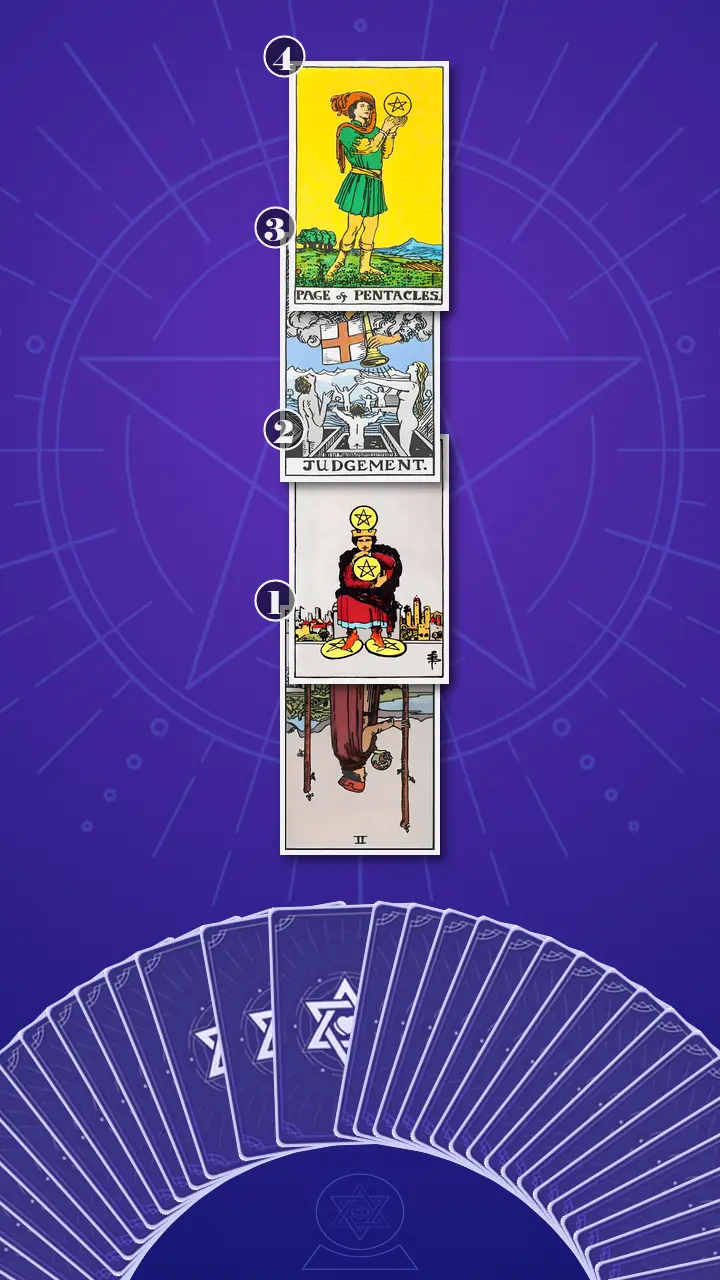
I chose the Four-Layer Insight Ladder, a focused tarot spread for feeling unready to change careers. I placed four cards on one vertical axis, beginning at the bottom and moving upward like rungs from a guarded wall toward an open field.
I chose this spread because Maya did not yet have two defined options that needed a stay-versus-leave verdict. Her real question concerned an internal threshold. The ladder could show the visible readiness ritual, the fear sustaining it, the perspective capable of interrupting it, and the practical action that could bring new evidence into daily life. A larger spread would have added detail without making that psychological chain clearer.
For anyone wondering how tarot works with career-change overthinking, I treat card meanings in context as an objective reflection tool. The cards do not decide whether someone should resign, predict whether an application will succeed, or reveal one predetermined calling. They make patterns visible enough to question. Maya would remain responsible for every choice, boundary, and next step.
I explained that the first position would show how “unready” appeared in her routine. The second would uncover what all that preparation was protecting. The third would challenge the belief that certainty must precede movement. The fourth would put the new perspective into her calendar through one bounded career experiment.
The Horizon Behind the Wall
Position 1: The Plan That Never Leaves the Screen
The first card I turned over represented Maya's observable readiness rituals and contracted planning: repeated research, comparison, course hunting, and timeline revision without an outward-facing test.
It was the Two of Wands, reversed.
I pointed to the figure holding a globe while remaining behind a battlement, with one wand fixed to the wall. “This is your laptop at 10:47,” I said. “You can see a city-wide field of possibility, but every action stays inside the architecture of your current role.”
In Maya's life, the reversed card looked exact: twelve meaningful-work listings, a color-coded matrix, and a transition timeline extended as soon as one appealing role exposed an unfamiliar skill. The research let her look beyond her job without contacting anyone beyond it. Closing the listing produced immediate relief because planning had become shelter from feedback.
The Fire of the Two of Wands was not absent. Her desire for contribution was clearly alive. In reversal, however, that Fire was blocked and turned inward. Instead of fuelling exploration, it powered increasingly elaborate simulations. The role became more “premature” each time it became more appealing.
I asked, “The last time you found a role you genuinely wanted, what happened between noticing the first missing qualification and closing the tab?”
Maya gave a short, bitter laugh. “That is so accurate it feels a little cruel. I told myself, 'I can see the direction; I just need one more credential before I'm allowed to move.' Then the deadline passed while I was comparing courses.”
I let the recognition settle without turning it into a judgment. “The card isn't accusing you of doing nothing. You have been doing a great deal. It is asking whether the work has produced contact with the field or only temporary relief from being evaluated by it.”
Position 2: The Coin Over the Heart
The second card I opened represented the mechanism beneath Maya's behaviour: the fear that moving without certainty could threaten financial control, expose future regret, and unsettle the professional identity in which she already felt competent.
It was the Four of Pentacles, upright.
The figure pressed one coin over his chest, balanced another over his head, and pinned two beneath his feet. I watched Maya curl both hands around her mug as I described the image. The radiator clicked behind her, giving the silence a rigid little rhythm.
I connected the card to her Sunday routine. She would check Monday's calendar, then the reliable salary deposit in her banking app, and open a risk spreadsheet instead of an application. Rent, benefits, and predictable income were legitimate security needs. I had no interest in romanticizing risk or treating caution as cowardice. The problem began when those practical protections were asked to guarantee that even a small exploratory step could never lead to regret.
The Earth energy of the Four of Pentacles can create a stable container. Here it had moved into excess and rigidity. It was protecting more than money. It was holding Maya's known title over her heart and pinning her established competence beneath her feet, as though becoming a beginner in one area would erase everything she had already learned.
I said, “You want evidence before taking the step that would give you evidence. Responsible caution asks for limits; fear disguised as caution asks for guarantees.”
Her fingers tightened once around the mug and then loosened. She looked away from the cards toward the dark window. “If I stay, I know who I am,” she said. “If I become a beginner again, I don't know what happens to the version of me who is good at things.”
After a decade of guiding people through changing cycles, I have learned to distinguish a natural low tide from a permanent verdict. I thought of planetary orbits: poor visibility at one point in a cycle does not erase the path, and a stable orbit does not require a body to remain frozen. Stability can become a base for observation rather than a wall against movement.
When Judgement's Trumpet Interrupted the Loop
Position 3: A Call from Maya's Own Values
The third card I turned over represented the transformation that could challenge the readiness myth directly: replacing total certainty with an honest, values-based threshold for one reversible next step.
It was Judgement, upright, the catalyst of the reading.
The room changed as the card came into view. Maya's laptop fan fell quiet, and for a moment I could hear only the faint traffic outside her window. On the card, the closed containers of the earlier images had opened. Figures rose with their arms unguarded toward a trumpet sounding above them.
I returned Maya to the 10:47 p.m. scene: twelve tabs, a color-coded matrix, the role she genuinely wanted, and the single unfamiliar tool that became another course. Her shoulders had dropped only after she postponed the decision. She had been interpreting that temporary relief as proof that waiting was responsible.
I explained that Judgement's trumpet was not an employer, authority figure, or cosmic command telling her to quit. It was a clear question from her own values: What must an ordinary workday contain to feel connected to contribution, and what limited experience could help her test that?
I used my Cyclical Variable Filtering lens to separate temporary friction from the variables likely to shape her longer career orbit. The temporary layer included late-night fatigue, a LinkedIn comparison spiral, one unfamiliar software tool, and the sting of imagining rejection. The enduring variables were different: the kind of contribution she wanted to make, the daily activities that held her attention, her genuine financial floor, and which skills practitioners said were actually necessary.
Then I applied Decision Timing Calibration. Tuesday at 10:47 p.m., after a full workday and twelve open tabs, was structurally poor timing for deciding an entire career. That did not mean waiting for a better omen. It meant separating a high-stakes resignation decision from a low-stakes evidence-gathering decision. Maya did not need to choose her whole future that night. She needed to decide whether one conversation was worth twenty minutes.
Readiness is not the feeling that appears before you move. It is the evidence you build by taking one reversible step without demanding a guaranteed ending.
Stop treating uncertainty as a verdict; answer your values with one practical test, just as Judgement's figures rise to meet the trumpet.
At first, I saw no relief. Maya's breath stopped, and her thumb hovered above the edge of her skills matrix. Her pupils widened while her gaze slipped away from me, as though she were replaying every course page and missed deadline at once. Then her mouth tightened. “But doesn't that mean I've been doing this wrong for two years?” she asked, with a flash of anger under the hurt. I answered, “No. It means preparation protected you from exposure when you needed that protection, and now you can decide whether it still deserves the same job.” Her fist slowly opened. Her shoulders lowered, but the release left her briefly unsteady, like someone setting down a heavy bag and only then noticing how tired her arms were. Her eyes reddened, and a thin laugh escaped with her next breath. I asked, “Now, using this new view, think back to last week. Was there a moment when this insight could have made you feel different?” She nodded. “I could have treated that CharityVillage listing as a question, not a verdict on whether I belonged.”
I named the shift carefully. This was not instant certainty, and it was not a promise that a different field would be right. It was the first movement from contracted apprehension and control-based preparation toward values-led curiosity, grounded self-trust, and reversible career exploration. Maya was beginning to replace “Am I ready for the whole move?” with “What evidence would make one test worth running?”
One Pentacle, One Ordinary Tuesday
Position 4: The Beginner Who Studies Reality
The fourth card I opened represented the practical integration of that insight: one bounded career experiment capable of producing direct evidence without requiring Maya to resign, buy a course, or promise anyone a career change.
It was the Page of Pentacles, upright.
The Page held one pentacle at eye level in an open, cultivable field. Unlike the Four, the Page did not clamp several coins against the body. I saw flexible Earth replacing rigid Earth: the same practicality, but now balanced by curiosity and movement.
I translated the image into Maya's week. Instead of opening twelve more job tabs, she could open one calendar slot for a twenty-minute conversation with someone doing values-aligned work. She could ask what the job looked like on an ordinary Tuesday, which entry-level capability mattered most, and what newcomers commonly misunderstood. Afterward, she could record what gave her energy, what drained it, and what question remained.
“That conversation would not be a resignation,” I said. “It would not be a referral request or an audition for your worth. It would be one practical object of study. This is data about fit, not a verdict on your value.”
The Page's energy was balanced and developmental. Maya's current role could remain a temporary base while she learned. Beginner status did not require her to discard her operational competence; it asked her to bring that competence into a sandbox environment where one workflow could be tested without pushing an entire career change into production.
Maya glanced at her calendar and pressed her feet more lightly into the floor. “I know exactly who I could message,” she said. “I've been following her work for six months. I kept telling myself I needed a smarter question first.”
I replied, “One honest question is smarter than twelve private assumptions. One experiment can inform you without obligating you.”
The Orbit Built from Evidence
I drew the four cards together into one story. Maya's years of success in product operations had taught her to anticipate complexity, close gaps, and protect delivery. At a career crossroads, that same strength had overextended itself. The reversed Two of Wands showed aspiration trapped inside planning. The Four of Pentacles revealed why the planning felt necessary: salary, identity, and control had been fused into one closed definition of safety. Judgement separated her values from the impossible demand for a guaranteed outcome. The Page of Pentacles returned her to practical reality, not through a dramatic leap, but through one learnable contact with the work.
I told her that the main cognitive blind spot was not caution itself. It was treating the absence of confidence as evidence that she lacked readiness, while underestimating how much confidence depends on information that private research cannot produce. Her Notion board and skills matrix functioned like an algorithm trained only on job descriptions, polished LinkedIn pivots, and imagined failures. It kept returning more refined versions of the same answer because no first-hand data had entered the system.
The transformation direction was specific: Maya would stop asking preparation to eliminate uncertainty and start asking experiments to clarify it. She would give Water a name by defining what meaningful work felt like in observable terms. She would invite Air through precise questions. Then she could use Earth as flexible support, keeping her salary and routine while testing one possibility at a time.
Two Small Tests with Firm Boundaries
- Create the Eight-Minute One-Test CardDuring one lunch break this week, set an eight-minute timer and open a phone note called One-Test Card. Write three provisional features of a meaningful workday, then add one question real experience could answer, one reversible way to investigate it, and the smallest first move. A valid first move is drafting a three-sentence message to one practitioner.Keep the boundary visible at the top: no resignation decision, no paid course, no need to continue, and permission to stop after writing only one sentence beginning with “A more meaningful workday would include...”
- Use the Orbital Pause, Then Gather One Data PointWhen an appealing listing triggers the urge to close it, buy another course, or redesign the entire transition plan, begin my Orbital Pause Strategy: delay costly or irreversible decisions for 72 hours while allowing one low-risk learning action. Within the first 24 hours, send one practitioner a three-sentence LinkedIn message naming the specific work you are exploring, requesting twenty minutes, and stating that you want an honest view of the day-to-day rather than a referral. After the conversation, log what energized you, what drained you, and what you want to ask next.The pause is a boundary around high-stakes reactions, not another form of indefinite delay. Cap the outreach at one person and the call at twenty minutes. If sending feels too exposed, draft the message during the pause and stop there.
I reminded Maya that neither action committed her to leaving. The purpose was to filter temporary macro-friction from the variables that mattered to her long-term orbit. She did not need the whole route through Toronto. She needed enough reliable information to choose the next transfer.

A Week Later, the Quiet Proof
Six days later, I received a message from Maya. She had written her three meaningful-work criteria during lunch and sent the practitioner note before she could improve it into silence. The reply was simple: “Happy to chat. Thursday works.”
Maya added, “I still felt exposed after I sent it. I wanted to close LinkedIn and buy the course anyway. But I waited, and then I realized I had a real conversation on the calendar. That was more evidence than the course page could give me.”
The following morning, her first thought was still, “What if I'm wrong?” She told me she noticed it, smiled once, and opened the One-Test Card instead of the skills matrix.
I did not see a solved career or a magically revealed calling. I saw a smaller and more credible transformation: Maya had moved from protecting herself with preparation to trusting herself with a bounded experiment. Tarot had offered the visual structure, but it had not sent the message, defined the boundary, or gathered the evidence. Maya had done that.
From my side of the table, I keep returning to this: when a job is secure enough to protect a life but disconnected enough to keep tugging at it, even opening an application can raise the shoulders and feel like risking control that took years to build. Noticing that pull does not require an immediate leap. It can be the first sign that an old orbit is ready for one careful new observation.
If readiness can be built rather than felt in advance, which Page-of-Pentacles-sized piece of evidence would you be curious to place in your orbit first: a three-sentence message, a twenty-minute conversation, or one deliberately unfinished sample task?