She Saved the Rough Figma Draft and Let the Learning Sink In Overnight

The 9:18 p.m. Figma Rush
I recognized the Career Progress Anxiety of a junior product designer squeezing a part-time course between a 6 p.m. Slack sign-off and the TTC ride home. For twenty years, I have listened to stories unfold over the warm aroma of coffee, and I have learned that people often call a repeating pattern a personal failure simply because they have not yet found a safe way to name it.
Alex (name changed for privacy) sat across from me at the small table, still wearing her work lanyard. At 9:18 p.m., she had opened a blank Figma frame in her Toronto rental near Yonge and Eglinton, trying to turn that evening's lesson into a polished case study before the day was over. The radiator clicked behind her; the laptop base warmed her wrists; beside it, cooling noodles carried a faint smell of sesame.
She told me, 'Why do I keep rushing for results before the learning sinks in?' Her jaw tightened as she spoke, and her fingers kept moving over the edge of her phone as if pausing might let something important escape. She had finished a lesson, opened a portfolio-sized project, compared the first rough pass with polished examples, and felt the familiar pressure to produce proof immediately.
Her impatience had a physical shape. It was like pulling a seedling out of the soil every evening to check whether it had grown, then blaming the plant for having no roots. Underneath it sat a quieter fear: if the result stayed ordinary, perhaps the learning was not real, and perhaps the ordinary result said something final about her ability.
'I keep mistaking motion for mastery,' she said. 'If the result is not visible, I assume the learning is not real.'
I told her that I did not hear a lack of effort in that story. I heard effort being converted into an emergency test. 'You are caught between rushing for results and letting the learning sink in first,' I said. 'We do not need to force an answer tonight. We can make a map of the loop, see what keeps it running, and find one small place where you can choose a different pace. That is our Journey to Clarity.'
The Shadow Spread: A Map for Finding Clarity
I invited Alex to place both feet on the floor, put her phone face down, and take one ordinary breath without trying to make it a perfect calming exercise. I shuffled slowly while she held the question in mind. The purpose was not to summon a prediction. It was to give her attention one steady object and let the cards function as an external pattern-recognition tool.
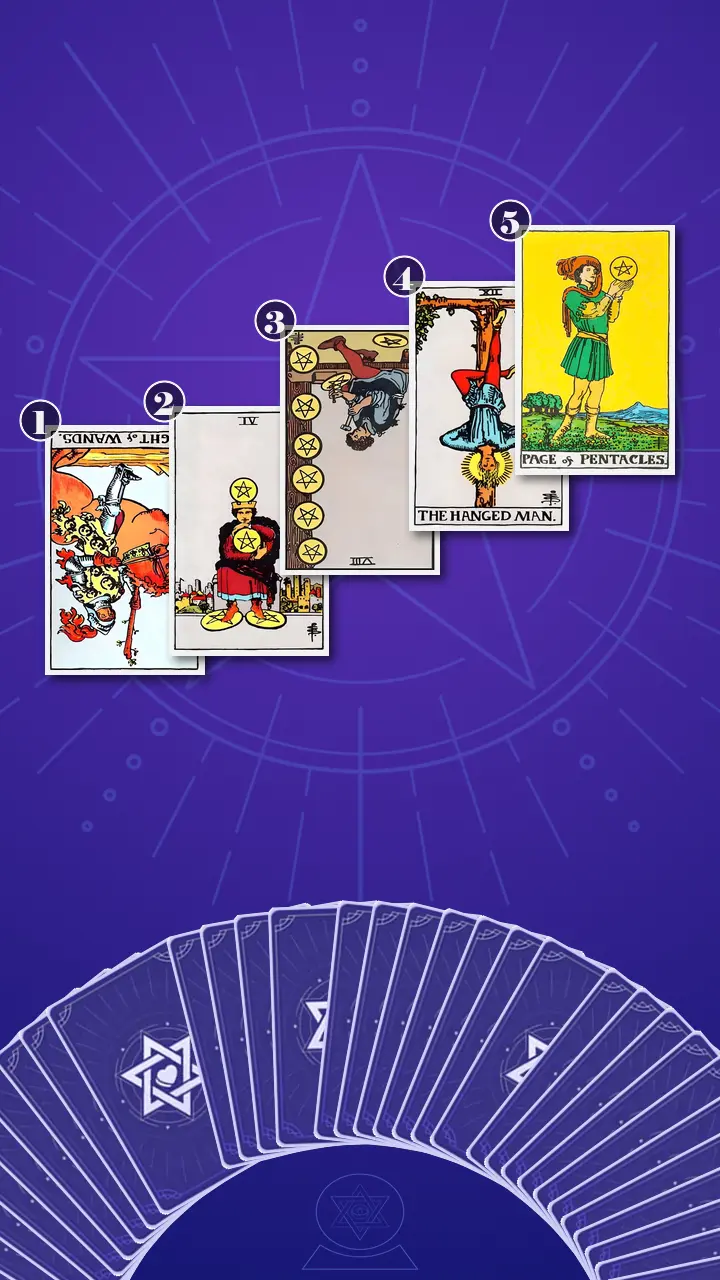
I chose The Shadow Spread, a compact five-card structure for an inner loop rather than an external forecast. For anyone wondering how tarot works in a question about impatience, learning, or self-doubt, this spread helps separate what is visible from what is driving it. Its five positions move through the complete chain: the rushing pattern, the hidden fear, the protective strategy and its cost, the perspective that can interrupt the cycle, and the small practice that can make a new perspective observable.
A Celtic Cross could have offered a wider landscape, but its additional outcome-oriented positions would have diluted this specific self-exploration. I wanted card meanings in context, close to Alex's actual tabs, deadlines, comparison spirals, and unfinished exercises. The first card would name the Surface Shadow. The second would ask what quick proof was trying to protect. The fourth, the Bridge, would show how a pause might become useful rather than threatening. The fifth would turn that insight into practical next steps.
Reading the Map: Card Meanings in Context
Position 1: The Rearing Horse
Now I turned over the card for the Surface Shadow: the visible rushing pattern described in the presenting problem. It was the Knight of Wands, in reversed position.
In the Rider-Waite-Smith image, the horse is already rearing beneath the raised wand. I read the reversed Fire as excess movement and insufficient absorption, a body launching before attention has caught up. In Alex's life, that looked like finishing an evening lesson, opening a portfolio-sized Figma project, trying to make the first pass presentation-ready, and checking it against polished examples. When the result looked ordinary, she scheduled a bigger sprint or opened another course.
I said, 'The card is not criticizing your ambition. It is showing what happens when ambition has to prove itself before the lesson has had a second pass. The motion starts too early, then scatters when speed cannot deliver certainty.'
I could hear the inner sentence underneath the rushing: 'I just need to get something good on screen, then I will know I understood it.' The lesson was being treated like a race, and the first attempt like a finish line. This was the visible motion-for-mastery loop, not because Alex refused to learn, but because staying visibly unfinished felt unsafe.
Alex gave a short, slightly bitter laugh instead of nodding. 'That is uncomfortably accurate,' she said. Her right shoulder lifted toward her ear, and she glanced at the phone she had placed face down.
I let the recognition stand without turning it into a judgment. 'You are not short on effort; your effort keeps being converted into proof,' I told her. Her mouth tightened, then loosened. The small change mattered: ambition had been separated from the frantic demand that every practice session produce a public-looking result.
Position 2: The Pentacle Held Too Tightly
Now I turned over the card for the Hidden Driver: the fear beneath treating quick results as proof of capability and self-worth. It was the Four of Pentacles, upright.
The figure in the card holds one pentacle against the chest while other pentacles occupy the head and feet. I read the Earth energy here as a blockage: something tangible has been asked to provide emotional security, professional belonging, and a stable sense of identity all at once. In Alex's everyday life, that something might be a polished case study, a certificate, a positive review, or a metric she could point to when she wondered whether she belonged in the room.
I connected it to the LinkedIn moment she had described. A former classmate posted one of those 'I'm thrilled to share...' launch and promotion updates, and the edited milestone became Alex's private deadline for that evening. She said, 'If I can point to one finished thing, maybe I can stop wondering whether I belong here.'
I asked, 'What is the result being asked to protect?' I was not asking her to abandon the desire for a good result. I was asking her to notice the extra responsibility placed on it. A single artifact could not reliably guarantee capability, safety, or self-worth, but the Four of Pentacles showed why a normal beginner's pause felt like a threat.
Alex went quiet. I watched a brief tightening move through her chest; her hands stopped at the edge of the table, and her eyes settled on the pentacle rather than the rest of the image. I offered the distinction I wanted her to carry: 'A rough first attempt is data, not a verdict on your ability.'
She breathed out through her nose, not quite relieved. The result still mattered to her, but it no longer had to carry the entire burden of proving she was capable. That was the hidden driver: not laziness, not a character flaw, but a wish to feel safe enough to remain a beginner.
Position 3: The Workbench Left Mid-Task
Now I turned over the card for the Protective Strategy and Cost: the concrete defense of compressing practice, checking output, or changing methods, along with the way it prevents learning from settling. It was the Eight of Pentacles, in reversed position.
The upright craftsperson in the Rider-Waite-Smith image works on one pentacle while an orderly row records accumulated effort. Reversed, the energy becomes deficient in continuity and blocked by premature judgment. Alex wanted the finished row while repeatedly leaving the single piece on the workbench. She watched tutorials at 1.5x speed, copied the finished example, skipped the second attempt, and called the lesson unhelpful when her version did not look polished.
I asked her to replay a Saturday morning at the Toronto Reference Library. At 10:42 a.m., espresso had drifted up from the lobby cafe while keyboard clicks echoed across the table. She had opened three recommended videos after the first copied exercise looked ordinary. Her explanation was simple: 'Maybe this method is the problem. One more explanation will make me ready.'
I said, 'More input can feel productive while protecting you from the repetition that would make the skill yours.' Tutorial hopping was not a moral failure. It was a quick way to lower the discomfort of being a beginner. The cost was that every new resource interrupted the practice that could have made the first skill reliable.
I watched Alex glance toward the saved-course queue on her phone. The glance lasted only a second, but then her hand stopped before touching it. The queue looked different now: less like preparation, more like a record of interrupted apprenticeship. She did not need another productivity system or a more intense sprint. She needed enough contact with one small exercise to notice what changed between attempts.
When The Hanged Man Changed the Pace
Position 4: The Bridge Above the Rut
The room grew quieter when I reached the fourth card. Even the radiator seemed to wait between clicks. Now I turned over the card for the Transformative Perspective: the key shift from demanding immediate proof to allowing a pause in which learning can become visible. It was The Hanged Man, upright, the Bridge of the reading.
The card's calm, inverted figure and halo change the meaning of apparent stoppage. I read the energy as receptive balance, a deliberate suspension of control, and a perspective shift that can interrupt the reversed Knight's urgency without adding another task. The modern translation was concrete: save a rough Figma draft, close the comparison tabs, write one return question, and leave the work untouched until the following evening.
I brought in my signature diagnostic lens, Syllabus Deconstruction. I use it to strip the paralyzing dread from a massive demand and reduce it to neutral, mechanical actions. In Alex's case, 'become good enough to show results' was too large and emotionally loaded to guide her. I reduced the learning loop to four plain movements: repeat one tiny action, write one factual observation, pause for a defined period, and return before opening another resource. The point was not to make her less ambitious. It was to give ambition a form that could survive repetition.
At 9:18 p.m., the Figma frame is still rough, LinkedIn has served you someone else's polished launch, and your jaw tightens as you open another tutorial. You call it staying productive, but the first lesson has not had a second pass yet. The demand for proof has turned a normal pause into a threat.
Do not pull the seedling up to prove it is growing; suspend the demand for immediate results, and let The Hanged Man's changed perspective turn waiting into learning.
For one full beat, Alex froze before she nodded: her inhale stopped, her right thumb hovered above her phone, and her jaw held hard. Then her eyes lost focus and moved toward the rain-dark window, as if the past week were replaying there: the accelerated videos, the polished examples, the draft she had abandoned before a second pass. Finally, her fingers opened against the tabletop and a rough breath left her chest.
She was not immediately peaceful. She pushed back, her voice edged with a small, honest anger. 'But does that mean I have been doing it wrong this whole time?'
'It means the strategy has been protecting you from one kind of discomfort while creating another,' I said. 'You were trying to buy safety with speed. Now you can test whether a defined pause gives you better information than another burst of effort.'
I added, 'A pause is not missing evidence. It is where repetition becomes evidence; when every unfinished attempt is treated as a verdict, learning never gets time to become yours.' I offered an eight-minute Proof-Free Practice Loop: repeat one tiny part of the current skill twice without polishing it, write one factual difference, and do not publish, score, or compare it that night.
Now, use this new perspective and think back to last week: was there a moment when this insight could have made you feel different?
Alex looked down at the card. The release was real, but it carried a brief, dizzying blankness. If she did not force the result, she would have to choose what to observe and what to try next. Her shoulders lowered; her eyes became wet without spilling; then she gave one long exhale that sounded less like surrender than room being made.
This was the crucial movement from urgent self-worth proving through speed toward grounded confidence built through patient repetition. The Hanged Man did not promise that waiting would make every result impressive. It gave her a way to stop treating waiting as failure.
Position 5: The Small Field of Practice
Now I turned over the card for Embodied Integration: the next small practice that turns patience into repeated, observable learning rather than passive waiting. It was the Page of Pentacles, upright.
The Page holds one pentacle at eye level while standing in cultivated ground. I read the Earth energy as balance and grounded curiosity: one object of attention, one modest skill, and enough repetition for evidence to accumulate. This was not passive patience. It was active study without the demand for a performance.
I translated the card into Alex's week. She could choose one narrow product-design skill, such as spacing a settings form or writing empty-state copy, and repeat the same ten-minute exercise on Tuesday, Thursday, and Saturday. After each attempt, she could record only the date, what she repeated, and one difference she noticed. The exercise did not need to become a portfolio piece, a LinkedIn post, or proof for anyone else.
'The result can stay small,' I said. 'Today you are only noticing what your hands understand more clearly.'
Alex saved the rough exercise instead of closing the file in embarrassment. I saw her shoulders relax at the small scale of the action. She was still looking toward the polished landscape in the card, but she was no longer scanning the whole landscape for a shortcut. Her attention had come back to one pentacle.
The Page of Pentacles gave the reading its practical ending: count the loop you completed, not the performance you forced. A small difference between two attempts could be more honest evidence than a rushed artifact designed to look finished.
Count the Loop, Not the Performance
When I laid the five cards in a line, the story became clear. Visible urgency began with the reversed Knight of Wands, but the deeper pressure came from the Four of Pentacles asking one finished result to guarantee safety. The reversed Eight of Pentacles showed the defense: accelerated tutorials, repeated output checks, course hoarding, and method-switching. Those habits created short-term relief because they kept Alex active, but they left the underlying skill without enough repeated contact to become dependable.
The Hanged Man opened the leverage point before the action step. Alex did not need to become less ambitious or wait indefinitely. She needed to replace the demand for an immediate result with one defined learning loop: practice, record one observation, and wait before judging the outcome. The Page of Pentacles then gave that perspective a body, a calendar, and one small exercise.
I named the cognitive blind spot plainly: Alex had been treating the pace of visible output as evidence of the quality of her mind. That made ordinary beginner uncertainty feel like a verdict. The transformation direction was from urgent proving to patient apprenticeship, from motion mistaken for mastery to grounded confidence built through small, observable evidence.
I also used my Study Environment Auditing lens. Before deciding that ability was failing, I asked Alex to notice the physical system around her: the warm laptop, the cooling dinner, the phone displaying LinkedIn, the tutorial queue, and the cramped table where every tab seemed to demand an answer. A disorganized environment was quietly spending the limited psychological bandwidth she still had after work. We did not need to optimize her entire life. We needed to restore enough visual order for one learning loop to have a fair chance.
- The 24-Hour Delayed Judgment WindowAfter the next low-stakes course session, save the rough Figma exercise with the date and add one comment: 'What became clearer while making this?' Close LinkedIn and comparison tabs, schedule a return for the following evening, and do not publish, score, or compare the draft before then.Tip: If twenty-four hours feels too loaded, begin with ten minutes. Define the return time before pausing so the gap feels voluntary rather than like lost momentum.
- The One-Skill Apprentice WeekChoose one narrow product-design skill and repeat the same ten-minute exercise on Tuesday, Thursday, and Saturday. Keep a three-line practice log with only Date, What I Repeated, and One Difference I Noticed. Before the third attempt, read the first two observations and test one detail again without adding a new tutorial.Tip: The minimum version is one action repeated twice and one factual sentence. These attempts can stay private; they do not need to become portfolio material.
- The Desktop Reset RitualBefore opening a textbook, course video, or Figma file, spend fifteen minutes clearing the physical learning surface: move dishes away, close unrelated tabs, put the phone out of reach, and leave only the current exercise visible. Then begin the eight-minute Proof-Free Practice Loop before evaluating the result.Tip: Treat the reset as a visual starting line, not another productivity project. If the full ritual is too much, clear one square of desk and close only the comparison tabs.
I reminded Alex that these were experiments, not new rules for proving discipline. Paid work and urgent deadlines still deserved practical judgment. The delayed window belonged to low-stakes learning, where a rough draft could safely teach her something. The Shadow Spread had not told her what fate would do. It had shown her a pattern she could interrupt, and she remained the person who chose the pace, the boundary, and the next move.

A Rough Draft That Stayed on the Screen
Six days later, I received a message from Alex while I was pouring coffee. She had used the delayed judgment window after a lesson on form layouts. She repeated the same spacing exercise twice, wrote that her second pass felt less crowded around the error message, and returned the next evening before watching another tutorial. The improvement was modest, but it was visible to her because she had finally left enough room for comparison between attempts.
She told me she had also completed the Desktop Reset Ritual on Saturday. The desk was not transformed into a showroom, and the course was not suddenly easy. It was simply clear enough for one file, one exercise, and one note. On Tuesday, Thursday, and Saturday, she had kept the same small practice instead of replacing it with a more exciting system.
She slept a full night after saving the draft. The next morning, she still thought, 'What if I am wrong?' She smiled, opened the file, and wrote one observation before touching the layout.
I did not give Alex patience, and the cards did not make the decision for her. I helped her see that the ability to wait was not a personality trait she had failed to develop; it was a practice she could make small enough to try. Her first evidence of grounded confidence was not a polished launch. It was a completed learning loop that she could repeat.
If an unfinished Figma draft makes your jaw tighten and slowing down feels like a test you might fail, remember this: noticing the old demand for proof means you are no longer entirely inside it. What tiny skill could you repeat once more this week, record in your own three-line log, and allow to become evidence before you ask it to perform?