Cold Coffee, a Blank Capstone Section, Then a Saved v0.1 Draft
The Blank Section at 9:03 p.m.
You can manage research shifts, deadlines, and a packed Toronto commute, but when the scheduled capstone block arrives, the blank section suddenly feels like an exam.
I met Maya (name changed for privacy) at 9:03 p.m. in her small Toronto apartment. The capstone document glowed beside a mug of cold coffee; the radiator clicked behind her, and the laptop fan warmed her wrists as she changed three headings, colour-coded six Zotero sources, and read the first sentence twice. I watched the word count remain unchanged while the screen became more organised.
When I asked what had brought her to my table, Maya said, "Why do I keep delaying my capstone when I care about finishing it? I was busy with it all evening, but I did not actually write anything." She told me she wanted to finish the project because it mattered, yet every scheduled drafting block became preparation, citation cleanup, outline surgery, or another move of the same task to tomorrow.
I did not hear a lack of care. I heard productive procrastination wrapped around academic perfectionism: the more important the capstone became, the more dangerous an imperfect paragraph seemed. Apprehension sat beneath her ribs like a small locked room with the lights left on, and after another postponed session, frustration and guilt settled over her like wet clothing.
I told her, "We are not here to force a prediction or turn this into a verdict about your ability. We are here to look closely at the pattern, separate present facts from imagined judgment, and draw a map toward finding clarity. You still make every decision. I am here to help you see the structure that has been difficult to see from inside it."
Choosing a Ladder Through the Ruins
I asked Maya to place her phone face down, take one slow breath, and name the question again without trying to make it sound impressive. Then I shuffled the cards slowly. For me, this small ritual is a psychological transition: it gathers scattered attention and creates enough distance to examine a problem without becoming swallowed by it.
I chose the Four-Layer Insight Ladder tarot spread. This is how tarot works in my practice: the cards provide a structured set of images and questions, not a supernatural sentence handed down about the future. Because Maya's visible delay conflicted so sharply with how much she cared, I wanted the smallest spread that could move from behaviour to hidden belief, from hidden belief to an available resource, and from that resource to a practical next step.
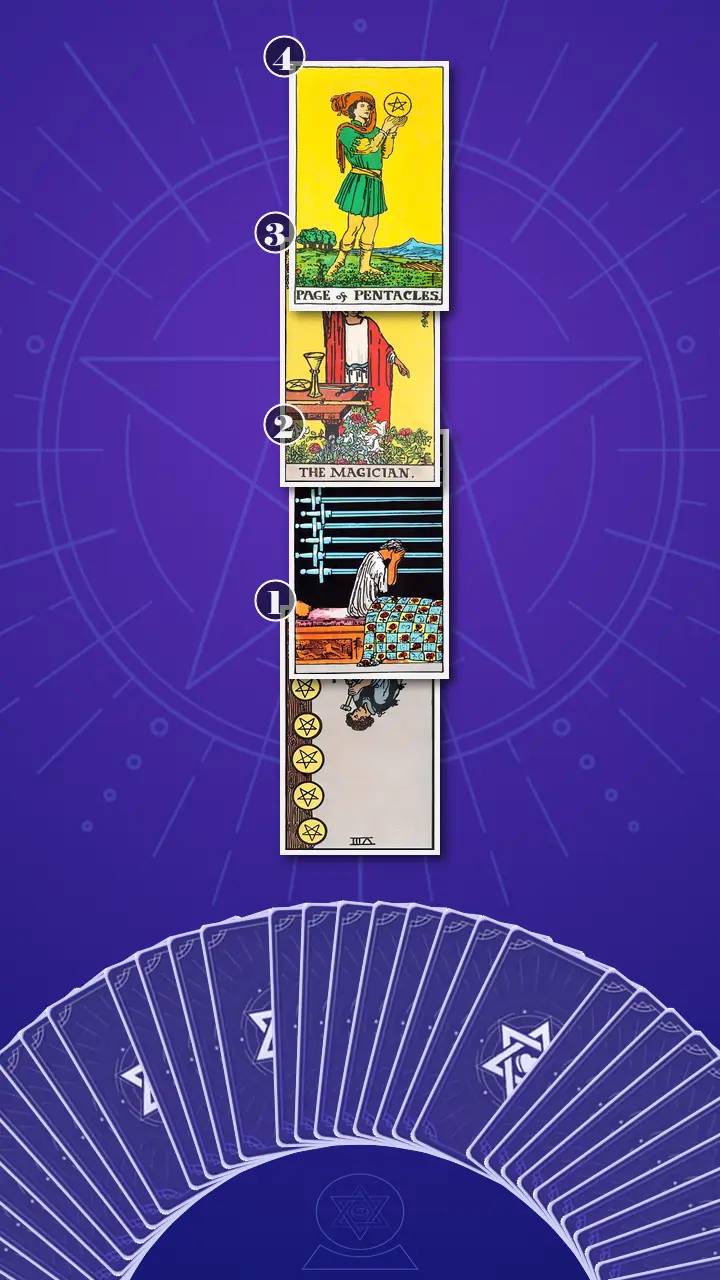
I arranged four cards in a vertical line, beginning at the bottom and moving upward. The present layer would show what Maya visibly did during a capstone work block. The root layer would examine the fear that made an imperfect draft feel personally dangerous. The transformation layer would identify the shift capable of interrupting the perfectionism-procrastination loop. The action layer would turn that shift into a modest drafting practice she could repeat.
The upward shape mattered to me. I have spent a lifetime at Cambridge and on archaeological digs, and I know that a fracture is not automatically a final collapse. Sometimes it reveals the layers that need to be understood before a structure can be rebuilt. This Four-Layer Insight Ladder gave us a way to examine the ruins without shaming the person who had been trying to stand inside them.
Reading the Map: The First Layer of Evidence
Position 1: The Hands That Never Reach the Page
The present layer reveals the observable capstone delay: replacing scheduled drafting with preparation, minor revision, and repeated rescheduling. I turned over the first card and found the Eight of Pentacles, reversed.
The card showed me the artisan's repeated work, the completed pentacles, and the distant town beyond the workbench. In Maya's life, that became a very specific Tuesday evening: correcting citation formatting, changing headings, rebuilding source tags, and making the document look increasingly competent while the analysis paragraph she had scheduled remained blank.
Reversed Earth is a blockage in the rhythm of practice. The effort is real, but it has been diverted into details that reduce exposure rather than create new argument text. I told Maya, "Being busy around the capstone is not the same as letting the capstone exist. The question is not whether you worked. The question is whether the work produced a piece of the thing you came to make."
I asked her to compare the last work block by output rather than by effort: which action produced new prose, and which action only made the document, sources, or calendar feel more controlled? Maya gave a short, bitter laugh instead of nodding. "That is almost rude," she said. "I really do spend the whole block working around the task." Her fingers kept moving over the rim of her mug, but the laugh had loosened something. I told her the card was not calling her lazy; it was showing that caring about quality had become separated from the repeated rough practice through which quality develops.
Position 2: The Verdict That Has Not Arrived
The root layer examines the limiting belief and underlying fear that imperfect capstone work could expose inadequate ability and threaten self-worth. I turned over the second card: the Nine of Swords, upright.
The figure sitting upright with their face covered, the nine swords suspended across the dark wall, and the patterned quilt became a late-night scene I recognised from Maya's description. At 11:36 p.m., she would close the laptop without drafting, lie in bed while her phone lit the ceiling, and replay an imaginary supervisor comment about a paragraph that had never been written or reviewed.
The Nine of Swords carries an excess of Air: thought detached from present evidence, multiplying in the dark. I asked, "What exact sentence appears when the blank section feels most threatening? And has any real evaluator actually said it?" Maya looked at the floor. Then she said, "If the paragraph is weak, they will see I am weak. If I do not write it yet, that verdict cannot arrive yet."
I repeated the distinction slowly: no evaluation had occurred, but anticipated judgment was already producing a tight chest, self-criticism, and a desire to delay the next visible attempt. Maya's breath paused. Her eyes moved toward the closed laptop as though she could see the unwritten paragraph inside it. Then her shoulders lifted, and she pressed two fingers against her sternum. I said, "The thought may be protecting you from a moment of exposure, but it is also making the next attempt carry more pressure. The capstone has become a stage on which one rough sentence is asked to testify about an entire person."
She was quiet for a few seconds. I could hear traffic hissing along the wet street outside, while the phone's bright screen reflected in the dark window. I invited her to write two separate lines in her notebook: "This text currently needs..." and "I am telling myself this means I am..." The first line belonged to revision. The second belonged to the imagined verdict. That separation did not solve the work, but it gave the fear a boundary.
When The Magician Put the Whole Table Within Reach
Position 3: The Hands That Make an Idea Real
The transformation layer identifies the cognitive and behavioural shift from seeking certainty about the final result to using available resources for one bounded act of creation. I turned over the third card, and The Magician appeared upright. The room seemed to become quieter around it.
The raised wand, the hand pointing toward the ground, and the Cup, Pentacle, Sword, and Wand arranged on the table offered a direct answer to Maya's paralysis. She already had care, knowledge, language, time she could realistically protect, and tools she had gathered through months of study. The problem was not the absence of resources. It was the constant expansion of setup before any resource was directed into material form.
At first, the modern translation was almost comically familiar. Maya could close Google Scholar, Zotero, Notion, the productivity video, and the extra calendar tabs until only one outline claim and one document remained. Then she could start a 25-minute timer and write one deliberately rough paragraph, leaving [CITE] markers where needed rather than stopping to perfect every reference.
My signature diagnostic is Academic Stratigraphy. On archaeological digs, I learned to distinguish a scattered fragment from a missing civilisation; one does not keep excavating forever simply because the layers are not yet arranged. I use the same principle with fragmented academic work. I looked with Maya at four layers already present beneath the clutter: the question she cared about, the claim already visible in her notes, the evidence she had collected, and the next form that claim could take on the page. The material was there. It needed structure and contact, not another indefinite search.
I also named the bottleneck through my Research Bottleneck Analysis. I was not asking, "Why are you failing to be disciplined?" I was asking, "At which point does information stop becoming output?" For Maya, the blockage appeared exactly where a source, an idea, or a sentence had to become visible enough to be revised. That was a research bottleneck, not a character flaw.
When Potential Stops Being a Verdict
At 9:00 p.m., the capstone was open beside cold coffee. Maya changed the headings, tidied six sources, reread one sentence, and moved the block to tomorrow. The screen looked more organised, but the word count had not moved. She was protecting the imagined quality of the capstone by protecting its unwritten potential from evaluation.
"You do not need a perfect plan to prove you are capable; use the tools already on The Magician's table and let one finished paragraph create real evidence."
I let the sentence remain between us for a moment, then added, "You do not need evidence that the final capstone will be excellent; the next rough paragraph is how evidence, revision, and authorship begin."
For three seconds, Maya's breathing stopped and her fingers stayed suspended above the notebook. Then her gaze went unfocused, as if she were replaying the cold coffee, the unchanged word count, and the late-night supervisor comment that no supervisor had ever written. Finally, her mouth parted on a long breath; her clenched hand opened one finger at a time, and her shoulders dropped with a small, almost startled movement. Her eyes grew wet, but her voice came out sharper than relieved. "But does that mean I was wrong to prepare all this time?" I told her no. Research and preparation still had legitimate uses; they simply could not guarantee that a first draft would never feel exposed. I asked, "Now, using this new view, can you remember one moment last week when a rough paragraph could have been treated as a work object instead of a verdict?"
Maya looked again at the four suits on the table. The Magician was not promising that apprehension would disappear or that one timer would finish a graduate programme. The card marked a smaller crossing: from contracted apprehension into the discomfort of producing an imperfect first attempt, and from that discomfort toward grounded self-trust built on something real enough to revise.
Position 4: One Pentacle at Eye Level
The action layer translates the shift into a modest drafting practice that treats the capstone as a learnable sequence of concrete tasks. I turned over the final card: the Page of Pentacles, upright.
The Page held one pentacle at eye level while the green field and distant mountain remained in view but secondary. I read this as a grounded next step. Maya did not need to understand the whole capstone before writing one paragraph. She needed to hold one manageable object in focus while allowing the larger educational journey to remain unfinished in the background.
I asked her to imagine saving the result as "Analysis paragraph v0.1, Tuesday" and leaving a note for her future self: "Next: explain why this evidence supports the claim." The Page's Earth was steady because it did not turn agency into another ambitious productivity system. It asked for one learning unit, one visible result, and one reachable entry point for the next session.
Maya's shoulders softened. She looked at the blank space in her notebook and said, "This page would not have to prove that I have mastered the whole project. It could show me what the argument needs next." Outside, a streetcar bell sounded once and faded. I wrote down the sentence she had just found: "Count saved paragraphs, not hours spent feeling behind."
The Thesis Beneath the Clutter
I placed the four cards in a row so Maya could see the whole story. The reversed Eight of Pentacles showed real effort losing its drafting rhythm. The Nine of Swords showed why: imagined judgment had turned the capstone into a test of competence, so postponement briefly protected an ideal version of the work and an ideal version of herself. The Magician gathered care, knowledge, time, and tools into one deliberate act. The Page of Pentacles gave that act a humble shape that could be repeated.
The core contradiction was not difficult to name once the cards were together: Maya wanted to finish the capstone because it mattered, yet that importance made the first visible attempt feel capable of exposing her limits. The project had been kept behind glass so nothing could damage its imagined quality. My work was not to break the glass for her. It was to help her notice that the glass was a protection she could choose to lower, one small section at a time.
I told her the cognitive blind spot was treating preparation as neutral. More research, cleaner tags, and a more detailed outline could feel like sensible progress, but when they repeatedly replaced drafting, they also became uncertainty-reducing actions that kept the actual work out of reach. Preparation can lower uncertainty, but it cannot write the paragraph. The transformation direction was therefore not from caring to caring less. It was from trying to guarantee a strong final result to creating a rough, revisable work object that could teach her what to do next.
The Thesis Stratigraphy Framework
For the next steps, I used my Thesis Stratigraphy Framework. Instead of asking Maya to rebuild her entire capstone architecture, I asked her to place one section under the microscope: the core claim on top, one piece of evidence beneath it, and one sentence explaining why the evidence matters. Any unresolved citation could remain visible as [CITE]. In this structure, the argument could pierce through intellectual clutter without requiring a perfect outline before the first paragraph existed.
I gave Maya the following actionable advice. Each step was deliberately small, because a useful next step must fit a real Toronto evening with work shifts, commuting, rent, and limited energy.
- The Rough Paragraph BlockBefore the next realistic study evening, at the kitchen table or in a campus library, create a 25-minute calendar event called "Rough paragraph: [specific section]." Paste one existing outline claim into the event notes, then open only the capstone document and the outline.If 25 minutes feels inaccessible, use a five-minute version. The smallest acceptable result is three unedited sentences, and Maya may stop when the timer ends.
- The Draft-First [CITE]-Later WindowDuring that block, write one claim, one piece of evidence in plain language, and one explanation of why it matters. Leave [CITE] markers for missing references, keep Zotero and Google Scholar closed, and do not edit any sentence until the timer ends.Treat the block as information about the argument, not a promise to keep every sentence. A rough paragraph is a work object, not a character reference.
- The Thesis Stratigraphy HandoffAt the end of the same work session, save the text as "Analysis paragraph v0.1, [day]." Spend up to ten minutes placing the claim, evidence, and explanation in a plain note, then add one starting instruction for the next session, such as "Next: explain why this interview excerpt supports the claim."If ten minutes starts to become another planning project, do this for one claim only. A plain note is enough; do not redesign the Notion dashboard or the entire capstone outline.
I reminded Maya that these practices did not override a real course deadline, a supervisor's requirements, or her own limits. They were experiments in directed attention. She could adjust the timer, use a private body-double check-in, or write the question she wanted to ask a supervisor without sending it yet. The point was authorship without self-punishment, not a new standard she could fail.
One Paragraph, Still a Person
Four days later, I received a message from Maya with a photograph of a document title: "Analysis paragraph v0.1, Thursday." She had written the starter line at a quiet cafe near a TTC stop, closed Zotero, left two [CITE] markers, and saved one paragraph before the 25-minute timer ended. The espresso machine had hissed, rain had tapped the window, and the sentence had looked clumsy enough to trigger the old urge to delete it. She had left it there.
She told me she slept a full night, although her first thought the next morning was still, "What if I am wrong?" This time, she opened the file before Google Scholar. The fear had not vanished, and the capstone was not finished. The first tab had simply changed.
That was Maya's first small proof of the Journey to Clarity. The Four-Layer Insight Ladder had not completed the project for her, and The Magician had not granted certainty. The cards helped her see the pattern; Maya chose the paragraph, the timer, the [CITE] marker, and the next instruction. The authority remained where it belonged: with the person making the work.
When the cursor starts blinking, the hardest part may not be the paragraph; it may be the tight-chested moment when a project you care about seems ready to turn into a verdict on whether you were ever capable enough. Naming that moment does not finish the capstone, but it gives you a layer you can examine rather than a fate you must obey.
If the next paragraph were allowed to be a learning object rather than a verdict on your ability, what small idea would you be curious to put on the page first?