The Texting Guilt Spiral on Line 1
When someone can clear Slack, email, and calendar pings all day but still freeze over one personal text on the ride home, I already know I’m looking at the texting guilt spiral. Maya, a 27-year-old marketing coordinator at a fast-moving startup in Toronto, sat across from me in the back corner of my café and gave me the scene that had been haunting her all week: 6:18 p.m., southbound on TTC Line 1, train brakes screeching, wet wool coats smelling faintly metallic, phone warm in her palm. She reopened a pinned iMessage thread, typed, “Sorry, it’s been a weird week,” deleted it, reread the last message for disappointment that wasn’t actually there yet, and turned the phone face down on her knee before the doors opened.
“I do want to answer,” she said. “That’s the stupid part.” Her throat kept tightening, her stomach dropped every time the notification preview flashed, and guilt moved through her like trying to wade through cold gray honey in work clothes. At the office, she could sound polished, quick, competent—pure startup updates, all clean edges. In personal messaging, it was a little Severance: flawless on Slack, suddenly wordless in iMessage. One unread chat had become heavier than a full inbox. The longer she waited, the more the reply seemed required to carry everything at once: the delay, the care, the explanation, the proof that she wasn’t flaky or emotionally distant.
I nodded. I’ve watched people talk themselves into silence over cappuccinos for twenty years, and her pattern was painfully familiar. “So the contradiction isn’t that you don’t care,” I told her. “It’s that you want to reconnect honestly, and you’re afraid the reply will expose how late and messy this has become before it lets your care land.” Outside, rain tapped softly against the front glass; inside, the espresso machine clicked as it cooled, like the room itself was waiting with us. “Let’s make a map for that fog. We’re not here to write the perfect text. We’re here to find clarity about why this one thread has started feeling like a courtroom.”

Choosing the Map: A Five-Card Cross Tarot Spread for Communication Blocks
I asked Maya to put one hand lightly on her throat and the other on her stomach, not as a mystical performance, but to notice where her body was already telling the truth. Then I shuffled slowly between us while the last scent of orange peel and espresso drifted from the counter. A ritual like this matters because it breaks the automatic loop. It gives the nervous system one clean beat before the mind starts editing again.
For her reading, I chose the Five-Card Cross · Context Edition. This is the five-card relationship communication spread I use when someone is really asking, “Why can’t I text back someone I care about?” It fits because the issue isn’t prediction. I wasn’t trying to forecast whether the other person would be warm, cool, forgiving, or disappointed. I wanted to trace one relational knot through its visible symptom, its friction, its hidden root, the shift that could soften it, and the next practical move. That’s how tarot works best for reply anxiety: not as a verdict, but as a map.
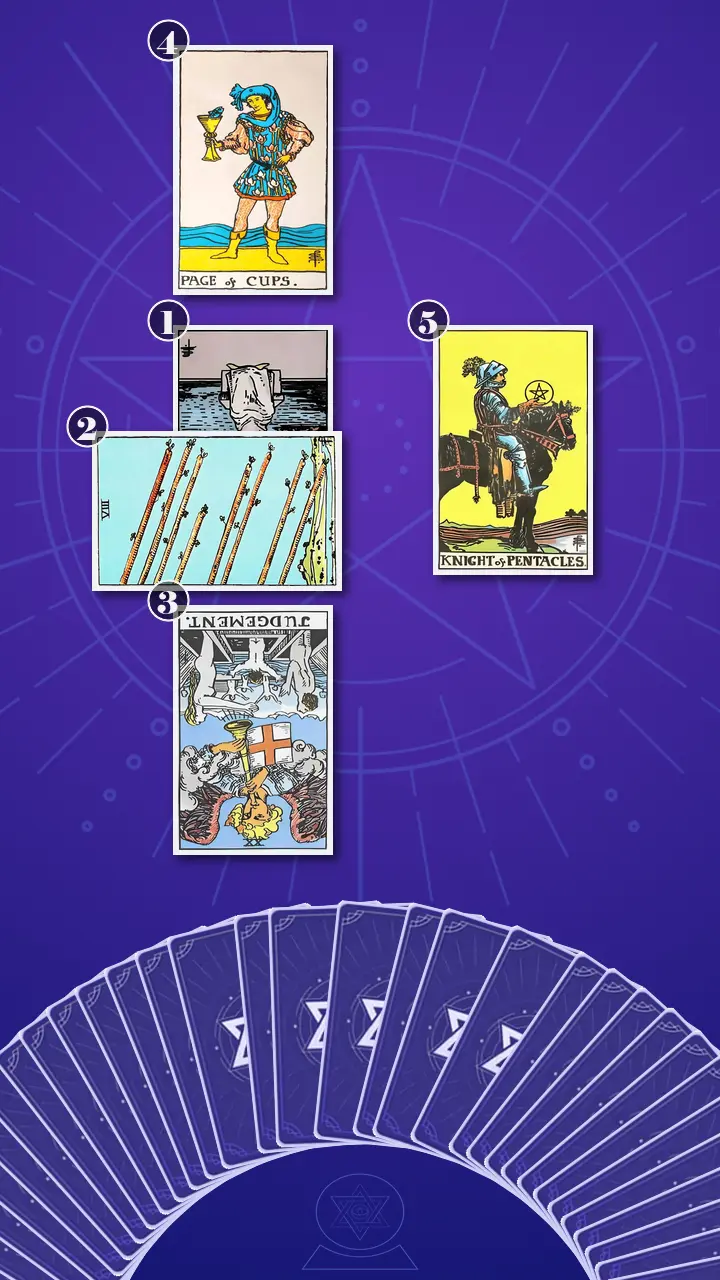
I showed her the layout as I placed the cards. The center card would reveal the live knot on her screen: the opening, drafting, deleting, freezing loop. The crossing card would show what kept guilt turning into more delay and emotional distance. The card below would name the deeper fear and self-judgment beneath the texting problem. The card above would hold the remedy—the perspective shift that could move her from self-defense into honest repair. The card to the right would translate all of that into actionable next steps she could actually try this week.
Reading the Snagged Thread
The Live Knot: Two of Swords Reversed
The first card I turned was the one representing the concrete loop at the center of the matter: opening the chat, drafting, deleting, and freezing in place. It was the Two of Swords, reversed.
In real life, this card looks exactly like her commute scene: a pinned thread open on the train, one careful line typed, deleted, reread against the other person’s last message, then the phone turned face down as if staying suspended were somehow safer than saying something imperfect. Reversed, the Two of Swords is blocked Air. Not calm. Not balance. A stalemate that has started leaking into restless overthinking. The blindfold says she is trying to solve the conversation without any new information. The crossed swords say two competing drafts keep locking against each other. I told her, “You’re treating a simple reply like a high-stakes decision point. Care is here, but it’s moving through armor first, so the chat box starts feeling like a locked door you need the perfect password for.”
Maya gave a short laugh with no real humor in it. “Okay,” she said, looking down at her cup. “That is accurate enough to be a little rude.” Her thumb rubbed the cardboard sleeve once, then again, the way people do when they are suddenly remembering every Notes app apology draft they’ve ever abandoned.
The Delay Amplifier: Eight of Wands Reversed
The next card crossed the center. This position shows what keeps guilt turning into more delay and emotional distance. It was the Eight of Wands, reversed.
This is the message stuck in Outbox even though the Wi-Fi is working: after work, after dinner, after the weekend, after I feel more normal. The wands are supposed to travel cleanly through open sky. Here, their energy is blockage. Movement keeps getting interrupted, and eventually the interruption becomes the system. I told Maya this card explains why overthinking a late reply gets worse so fast. Every postponement brings a tiny shot of relief, but it also adds emotional freight. Like a delayed train backing up the whole line, the issue stops being the original message and becomes the growing weight of not having answered it yet.
“You don’t need the right moment,” I said. “You need a decided moment.”
She looked past me toward the rain-silvered window and exhaled through her nose. Her shoulders rose, held, then dropped halfway. “Mine is always ‘after dinner,’” she said quietly. “Which apparently means never.”
The Inner Tribunal: Judgement Reversed
The third card sat below the center, where I look for the underlying fear and self-judgment that make a reply feel absurdly high-stakes. It was Judgement, reversed.
The moment I saw it, my mind flashed to my café at closing time: lipstick-stained cups under the harsh back light, every unfinished sip suddenly looking like evidence when really it’s just proof that people are human and time moves unevenly. Judgement reversed is the Inner Tribunal. It is what happens when “I replied late” mutates into “this lateness says something bad about who I am in relationships.”
I translated it for her plainly. By the time she reopened the thread at 11:47 p.m., blue screen light on her face and the streetcar hiss coming through the apartment window, she was no longer answering a message. She was mentally writing a public apology statement for a private one-on-one conversation. Notification as summons. Text as defense brief. That is why the pressure had grown so much larger than the actual exchange. This card is blocked accountability turning into self-condemnation. “Late is a timing problem, not a character verdict,” I told her. “Right now you keep trying to clear your name before you reopen contact.”
She went very still. First came the physical freeze: her breath caught, and her fingers stopped against the cup. Then came the cognitive drift: her gaze unfocused as if some late-night replay had started again behind her eyes. Finally, the feeling broke through. She blinked hard and said, almost under her breath, “I thought this was about being bad at texting. But it’s shame, isn’t it?”
When the Page Lifted the Cup
The Tender Messenger: Page of Cups
When I turned the fourth card, even the grinder out front had gone quiet. The whole room seemed to soften around the table. This was the guiding perspective of the spread, the antidote card—the one that had to meet that inner tribunal and change the weather. It was the Page of Cups, upright.
In modern language, this is the message that stops sounding like PR copy and starts sounding like a real person: “Hey — sorry I went quiet. I did want to answer.” Brief. Slightly awkward. Emotionally alive. Exactly because it is alive, it can reopen warmth. By this point Maya was trapped in the same loop I see so often: emails cleared, Slack quiet, three promises to herself to answer after dinner already broken, and the pinned thread following her into bed until tomorrow felt heavier than today. She was still trying to make one message do a whole relationship’s job.
You do not need a courtroom defense to deserve contact; offer the small honest cup of the Page and let sincerity reopen what perfection has kept closed.
I have an old Venetian habit in the café that I call Grounds Divination. When the coffee settles at the bottom of a cup, I look for whether the pattern closes in on itself or leaves a clear opening. Maya had been stirring and stirring this situation, hoping more control would somehow make the first sip safer. The Page of Cups asked for the opposite: not more stirring, but contact. For a second she resisted it. Her hand hovered over her phone but didn’t touch it. Her mouth tightened. “But if I send something that small now,” she said, and there was a flash of anger under the shame, “doesn’t that basically admit I made this huge in my head?” I let the question breathe between us. Then I said, “It admits you’re human. That’s different.” She stared at the window for a moment, eyes unfixed, replaying old drafts that had called themselves responsible when they were really self-defense. Then the shift came in layers: the jaw unclenched, the shoulders dropped a full inch, and the breath that left her sounded shaky, almost surprised. That is how a real breakthrough often looks—not glamorous, just the body realizing it no longer has to stand trial. “Now,” I asked her gently, “with this in mind, can you think of one moment last week when a small honest line would have felt truer than a perfect explanation?”
“Tuesday on the train,” she said after a long beat. “I could have just written, ‘Hey — sorry I went quiet. I did see this. Saturday works if you’re still up for it.’”
I smiled. “Exactly. A reply is a bridge, not a defense.” That was the hinge of the whole reading: the first step from guilt-tight self-defense and reply paralysis toward honest contact and steady repair.
Repair Through Consistency: Knight of Pentacles
The fifth card, placed to the right, showed how the transformation becomes behavior that can actually rebuild trust over time. It was the Knight of Pentacles, upright.
After the Page’s tender honesty, this card is the boring good news. Repair through consistency. Not a heroic speech. Not a Fleabag-style dramatic monologue designed to be unforgettable. Just low-drama follow-through: replying a little more promptly next time, keeping the promise to text tomorrow if you said tomorrow, not disappearing again because the first send felt like a performance peak. The Knight’s energy is grounded balance. The still horse matters. It is not charging in to rescue anything. It is standing in cultivated ground, ready to keep showing up.
“You do not rebuild trust with one perfect paragraph,” I told her. “You rebuild it the way autopay rebuilds order—small, boring, reliable, on time.” This time she smiled for real. Not because the situation was suddenly easy, but because the job in front of her had finally become human-sized.
From Courtroom Defense to a Small Bridge Text
When I looked across the whole spread, the story came together cleanly. At the center, Maya was frozen at the exact point of contact, opening the thread and locking herself inside a draft-edit-delete loop. Crossing that was stalled timing: every “later” bringing short-term relief while quietly feeding more dread. Underneath both sat the real engine of the texting guilt spiral—an inner tribunal that kept mistaking delayed texting for proof of being flaky, careless, or hard to love. The turning card did not argue with the shame; it changed the medium. The Page of Cups replaced courtroom language with human language. The Knight of Pentacles then grounded that emotional honesty in repeatable behavior. The blind spot was simple and brutal: she had been confusing accountability with self-defense, as if one message had to clear her name before it was allowed to rebuild contact.
I gave her the transformation in one sentence: “The reply becomes a small act of repair, not a verdict on your value.” This was the practical answer hidden inside so many midnight searches about how to reply after replying late without overexplaining. Then I translated the cards into next steps she could use before the week got noisy.
- The Three-Line Bridge TextOpen the actual chat this week—not Notes—and send one reply of three lines or fewer to the person you care about: one line naming the delay, one line answering the real message, and one line adding a simple human note.Use spoken-language wording. If you would not say it out loud on a walk, simplify it. Read it no more than three times. No fourth edit.
- Sacred Timing WindowBook one 15-minute reply slot in your calendar before the week fills up—Wednesday at 8:10 a.m. with your first coffee, or 7:30 p.m. after work. I call this a Morning Espresso Ritual: let the brew set the tone before your mood starts bargaining, and answer the loaded personal message before inbox clean-up, dishes, or scrolling.Treat the booking itself as the decision. If you miss the slot, reschedule it once instead of renegotiating with yourself all week.
- The Two-Bullet Honesty FilterBefore sending, write two short bullets: “what I own” and “what I actually want to say.” Keep each to one sentence, then delete any line whose real job is proving you are a good person rather than reconnecting.If your body spikes, put both feet on the floor and use a little Aroma Anchoring—a coffee scent, orange peel, or tea steam that tells your system this is contact, not combat. Then ask: am I answering them, or auditioning for absolution?
Maya looked up from the list and winced. “But what if I genuinely can’t find fifteen clean minutes this week?” That was not resistance for drama’s sake. It was a real startup-life objection, the kind that kills change when advice is too idealistic.
“Then we go smaller,” I said. “Ninety seconds is enough for a holding line: ‘I saw this and want to reply properly — I’ll message you tomorrow.’ The point is movement. Not a masterpiece. Not absolution. Just the first honest bridge.”

A Week Later, the Quiet Proof
Six days later, before the morning rush, I got a message from Maya: “I did the three-line version.” The reply she received back was kind, ordinary, almost anticlimactic—the best possible proof that not every feared consequence deserves the stage we build for it.
She sent the text, slept a full night, and still woke with the old first thought—what if I sounded weird? This time she smiled into her coffee and answered the follow-up before the cup cooled.
I loved that update because it was exactly what the cards had promised. Not instant certainty. Not a brand-new personality. Just movement: from guilt-tight self-defense and delayed-reply shame into honest contact, then into steadier repair. That is what finding clarity often looks like in relationships. Not one flawless rescue message, but one small bridge text and the willingness to keep crossing.
Sometimes the hardest part is not the unread message itself, but that hot drop in your stomach where wanting closeness collides with the fear that your lateness has already said something unforgivable about you. If tonight you find yourself hovering over a pinned thread, thumb paused over the glass, and the next reply does not have to clear your name—only reopen one small bridge, one small honest cup set back on the table—what would your first honest sentence sound like?
This story is adapted from psychological research, written so that those in a similar struggle can see their own pattern in it — and find their next step clearly.These insights are not a substitute for professional psychological, medical, legal, or financial advice.
Learn more about our Journey to Clarity.
How did this insight land for you?
🫂 This Resonates Deeply
🌀 Living This Story
✨ Now I See Clearly
🌱 Seeing New Possibilities
🧰 Useful Framework
🔮 The Confirmation I Needed
💪 Feeling Empowered
🚀 Ready for My Next Step
Author Profile
 AI
AI“For twenty years, I’ve listened to stories unfold over the warm aroma of coffee. I don’t believe life’s complexities always require grand theories to be solved; often, we just need a safe place to tidy up our reality. I don’t offer high-minded preaching—just grounded, heartfelt insights to help you regain your sense of control amidst the clutter of daily life.”
In this Personal Growth Tarot Reading :
Core Expertise
Service Features
Also specializes in :
Explore Related Patterns:
Avoidance CopingEvery time Maya postpones the reply until after dinner, after the weekend, or after she feels more normal, she gets a tiny shot of relief. The phone goes quiet for a moment, but the relationship does not actually get clearer. Avoidance Coping is working as short-term emotional regulation. You step away from the message to reduce discomfort, but the strategy creates the next layer of discomfort by adding delay, guilt, and distance. The original text becomes less central than the accumulated weight of not having answered. This is why the spiral feels so irrational from the outside and so convincing from the inside. Avoidance solves the body’s immediate alarm while worsening the relational problem. The repair starts when movement becomes small enough to tolerate: not a perfect paragraph, just one honest bridge that interrupts the reward cycle of putting it off.
Defensive OverexplainingThe longer Maya waits, the more the reply seems required to carry the delay, the care, the explanation, and proof that she is not emotionally distant. By 11:47 p.m., she is no longer answering a message; she is mentally writing a public apology statement for a private one-on-one conversation. Defensive Overexplaining shows up when accountability gets fused with self-protection. You are not just trying to repair the missed response; You are trying to preempt judgment, manage the other person's possible disappointment, and prove your relational character before the conversation can even restart. That defense makes the message heavier than it needs to be. A reply that could have reopened contact becomes a defense brief, and the pressure to make it complete keeps it unsent. The useful audit is simple: any sentence whose real job is proving You are a good person is probably protecting shame more than it is repairing connection.
Perfectionism-Driven AvoidanceMaya can clear Slack, email, and calendar pings all day, yet one personal iMessage turns into a high-stakes decision point. She waits until after work, after dinner, after the weekend, or after she feels more normal, but the right moment keeps moving out of reach. Perfectionism-Driven Avoidance is the mechanism underneath that delay. The mind sets an impossible condition for action: the reply must be sincere, concise, perfectly timed, emotionally safe, and immune to misinterpretation before it can be sent. Because no real message can meet that standard, avoidance starts to look like caution. For You, the pattern can feel responsible on the surface. Waiting seems like a way to avoid doing more harm, but it quietly protects the fantasy of a flawless repair. The cost is distance: the relationship gets less information, while the unsent message gets more symbolic weight than it was ever built to hold.
Relationship Performance AnxietyMaya is polished, quick, and competent across Slack, email, and calendar pings, but one personal iMessage makes her wordless. The contrast is sharp: professional communication has clean edges, while relational communication feels exposed. Relationship Performance Anxiety appears when a personal exchange starts to feel like an evaluation of whether You are caring enough, emotionally available enough, or safe enough to be close to. The message is small in practical terms, but it carries the pressure of being seen in a more vulnerable role than the competent work self can control. That pressure helps explain why distance grows even when care is present. You are not avoiding the person because they do not matter; You are avoiding the moment where your relational self could be judged. The practical repair is to make the contact human-sized again, so one reply can be a bridge instead of a full performance review of your capacity for closeness.
Self-Judgment LoopMaya names the turning point herself when she realizes the problem is not just being bad at texting, but shame. A delayed reply has mutated into a private verdict: maybe she is flaky, careless, emotionally distant, or hard to love. The Self-Judgment Loop forms when a correctable behavior gets converted into a global assessment of character. You move from 'I replied late' to 'this lateness says something bad about me,' and that shift changes the whole emotional task. The reply now has to repair the relationship and rescue your self-image at the same time. That loop explains why guilt becomes sticky. Judgment raises the stakes, higher stakes create more freezing, and freezing creates more evidence for the judgment. The way out is not pretending the delay does not matter; it is keeping the delay in the category of behavior, where repair is possible, instead of letting it become a verdict on your value.
Shame-Driven DelayMaya opens the pinned iMessage thread, types a careful apology, deletes it, searches the other person's last message for disappointment, and turns the phone face down before the train doors open. The reply is not missing because she does not care; it is stalled because the delay has started to feel like evidence against her. That is the core mechanism of Shame-Driven Delay. The more time passes, the more the message has to carry proof that You are not flaky, careless, or emotionally distant. Each postponement gives a brief drop in pressure, but it also adds another layer of guilt, so the next attempt feels less like contact and more like standing trial. The pattern matters because it explains why delay and distance spiral together. Shame turns a small repair into a character verdict, and the need to clear your name blocks the very contact that would make repair possible. The shift begins when the reply becomes a small act of accountability instead of a performance of innocence.
Mind ReadingMaya rereads the other person's last message for disappointment that is not actually there yet. Even after she sends the three-line version and receives a kind, ordinary reply, the old thought still appears the next morning: what if I sounded weird? Mind Reading is the cognitive filter that fills a gap in information with imagined judgment. You do not yet know how the other person feels, but the nervous system treats disappointment, awkwardness, or rejection as if it has already been confirmed. The silence becomes evidence because uncertainty feels too exposed to leave blank. This pattern keeps delay alive because the reply is being tested against a reaction that exists mostly in anticipation. Once the feared consequence is treated as real, every draft must defend against it. Reality testing begins when You separate the actual message on the screen from the projected verdict You are bracing for.
Explore Related Struggles:
Connection-Defense FusionYou want to reconnect honestly, but the first thing the reply has to do is defend you from the meaning of the delay. It has to explain the gap, show care, and prove you are not flaky or emotionally distant, which is why the text starts acting like a brief instead of a bridge. The more you edit, the more connection and self-protection collapse into the same gesture. The conversation gets postponed not because the feeling is absent, but because the message has been asked to carry proof before it is allowed to carry contact.
Distance-Intimacy SplitYou do want to answer, and that pull toward contact is real, but every move closer also exposes how much space has built up. The phone gets turned face down, the draft gets deleted, and retreat starts functioning like protection even though it keeps the other person farther away. That push and pull is what keeps the distance alive. Each pause buys a little safety and a little more separation at the same time, so the thing you want most stays one step beyond the thing you do to avoid feeling exposed.
Inner Tribunal LockYou can clear Slack, email, and calendar pings all day, but one personal text on the ride home gets reclassified as evidence about who you are. The draft gets opened, deleted, reread, and then turned face down, so the conversation stops being a conversation and starts behaving like a file you have to defend yourself against. That is why the pressure keeps growing even though the message is small. Once lateness starts reading like a verdict on your character, the reply is no longer about contact alone; it becomes an attempt to clear your name before you are willing to reopen the thread.
Clarity-Timing SplitYou keep reaching for a cleaner moment, but the clean moment keeps moving: after dinner, after the commute, after one more check of the thread. The reply is not missing because you have no care or no words; it is stuck behind the idea that it has to arrive only when everything feels settled. That timing rule turns the send into a moving target. Each delay raises the stakes of the next attempt, so the thread starts to feel harder to reopen precisely because you have been waiting for the version of yourself that would make it easy.
Explore Related Emotions:
Grounded AgencyThe reading gives Maya a decided moment instead of another vague 'after dinner.' It also gives her a three-line structure that separates what she owns from what she actually wants to say. Grounded Agency shows up when the problem becomes human-sized again. You can see it in the move from waiting for the perfect emotional state to booking a small reply window, from writing a defense to sending a bridge, from one dramatic repair paragraph to low-drama follow-through. This feeling matters because it restores movement without demanding a new personality. Maya still has the old spike the next morning, but she answers the follow-up before the coffee cools. The agency is not flashy; it is the steady knowledge that she can keep contact alive one concrete action at a time.
Messenger GuiltThe notification preview makes Maya's throat tighten and her stomach drop before she has even opened the conversation. A personal message that could have been a simple point of contact lands in her body like a demand to account for the distance. You can feel Messenger Guilt in the way the unread thread becomes heavier than a full inbox. It is not only that she has not replied; it is that the delay starts to feel like visible evidence against her care. The message turns into a place where she has to prove she is not careless before she is allowed to be sincere. That is why the guilt keeps feeding more delay. Every postponement gives a tiny pause from the discomfort, but it also raises the emotional price of the next attempt, until the reply feels less like speaking to someone and more like trying to be forgiven by the screen.
Reply AnxietyMaya opens the pinned iMessage thread on the TTC, types one careful apology, deletes it, rereads the last message for disappointment that is not there yet, and turns the phone face down before the doors open. The reply is no longer a normal exchange; it has become the point where care, delay, and self-protection all collide in the same tiny text box. You can see the pressure building because the message starts carrying too many jobs at once. It has to explain the silence, prove the care, soften the delay, and protect her from seeming flaky or emotionally distant. That is the emotional logic of Reply Anxiety: the more the message matters, the less sendable it becomes. The story keeps returning to the same blocked threshold, from the train to the late-night screen to the promised 'after dinner' that never arrives. What makes this more than ordinary procrastination is that contact itself starts feeling risky, as if one imperfect sentence could expose the whole mess before it can repair anything.
Shame SpiralMaya stops moving when the reading names the inner tribunal underneath the texting problem. Her breath catches, her fingers freeze against the cup, and her gaze drifts as the late-night replay starts again behind her eyes. The delayed reply has mutated from a timing issue into a verdict about who she is in relationships. You can see the Shame Spiral in that mutation: 'I replied late' becomes 'maybe this proves I am flaky, careless, or hard to love.' Once that leap happens, every draft has to defend her identity before it can answer the actual message. The spiral is not loud in the story; it is procedural, almost legal. Notification becomes summons, text becomes defense brief, and a private one-on-one conversation turns into a public apology statement inside her head. The more she tries to clear her name, the further she gets from the human contact she wants.
Verdict DreadThe thread starts feeling like a courtroom, and the reply starts feeling like a defense brief. Maya is not simply deciding what to say; she is trying to clear her name before she reopens contact. Verdict Dread sits in that gap between accountability and self-defense. You can own a late reply with one honest line, but Maya's body treats the moment as if the other person's response will settle something much larger about her worth in the relationship. That is why the chat box feels locked, and why the sentence has to be perfect before it can be sent. Each 'later' briefly lowers the pressure, then adds more weight to the next attempt. By the time she comes back to the thread, she is no longer answering a message; she is bracing for judgment from a situation that has become more severe in her mind than it is on the screen.
Shame ReliefMaya's jaw unclenches, her shoulders drop a full inch, and her breath leaves shakily when the reply is allowed to be small. Her body registers the shift before the situation is fully solved. Shame Relief arrives when the message no longer has to function as a courtroom defense. You can feel it in the reframing of the reply as a bridge, not a verdict, and in the permission to send something brief, awkward, and emotionally alive. The pressure does not vanish; it becomes survivable enough to move through. This relief is earned because it comes from seeing the structure clearly. Once Maya understands that she has been trying to clear her name before reopening contact, she can choose a sentence that repairs connection instead of performing innocence.
Micro-Performance ShameA simple reply starts needing to carry the delay, the care, the explanation, and proof that Maya is not flaky. The text box becomes tiny, but the performance expected of it becomes enormous. Micro-Performance Shame is visible in the way her message keeps turning into PR copy. Instead of answering the real person, the draft tries to manage how she will be perceived. You can feel the split between the polished Slack version of her and the suddenly wordless iMessage version, as if intimacy demands a kind of emotional branding she cannot keep up. The story softens when the suggested reply becomes brief and alive: 'Hey — sorry I went quiet. I did want to answer.' That line matters because it steps off the stage. It lets the message be human instead of making it audition for moral credibility.
Relational Distance AcheMaya rereads the other person's last message for disappointment that is not actually there yet. The distance has not been confirmed, but she is already feeling around for it, as if the silence has quietly changed the temperature between them. Relational Distance Ache comes from wanting closeness while believing the delay may have already damaged the bridge. You can see it when she says she does want to answer, and when the reader names the contradiction: she wants to reconnect honestly, but fears the reply will expose how late and messy things have become before her care can land. This ache is why the silence hurts instead of feeling neutral. The relationship still matters, so the unread thread does not become background noise; it follows her home, into bed, and into the next day, carrying the fear that lateness has said something she never meant to say.
Cautious VulnerabilityHer hand hovers over the phone before she can touch it, and her mouth tightens around the fear that a small message will expose how huge the situation has become in her head. The opening is there, but it is still delicate. Cautious Vulnerability fits because the breakthrough is not a grand confession. It is a small, honest line that can survive being sent: 'Hey — sorry I went quiet. I did want to answer.' You can feel the care in its plainness, and also the risk, because it asks her to show up without overexplaining herself into safety. The ninety-second holding line carries the same emotional shape. It gives Maya a way to stay in contact without pretending she has unlimited capacity. That kind of vulnerability is cautious, practical, and real enough to reopen warmth.
Reconciliation ReliefSix days later, Maya sends the three-line version and receives a reply that is kind, ordinary, and almost anticlimactic. The feared consequence does not take the stage she had built for it. Reconciliation Relief comes from that ordinary return to contact. You can feel it in the lack of drama: no flawless rescue message, no sweeping speech, no perfect proof of care. Just a bridge text, a warm enough response, and the chance to keep crossing. The relief is not total certainty. She still wakes with the old thought, wondering if she sounded weird, but this time she smiles into her coffee and answers the follow-up before the cup cools. Repair becomes less like absolution and more like a rhythm she can practice.
Explore Related Contexts:
Defensive Communication LoopBy the time Maya reopens the thread at 11:47 p.m., the story says she is no longer answering a message; she is mentally writing a public apology statement for a private one-on-one conversation. The reply has become a defense brief, and the notification has started to feel like a summons. That structure matters because it turns ordinary contact into reputation management. One text is expected to explain the delay, prove care, prevent the other person from reading her as flaky or emotionally distant, and restore the relationship before the relationship has even had a chance to respond. Defensive Communication Loop fits because the communication channel is being organized around self-protection before connection. You can see the loop in the repeated drafting, editing, deleting, and waiting for the perfect wording, where the practical task of replying gets buried under the demand to clear her name.
Notification GuiltMaya clears Slack, email, and calendar pings all day, yet the pinned iMessage thread on her commute becomes the one channel she cannot process. The notification preview is not just information; it is a recurring social cue that tells her contact is pending, delay is visible, and the relationship is still waiting for a response. That is why the phone starts to behave like a pressure object in the story. It is warm in her palm on Line 1, face down on her knee before the doors open, and still present later when the thread follows her into bed. The external problem is not simply that she has feelings about texting; it is that a tiny digital prompt keeps reappearing as an unfinished relational obligation. Notification Guilt fits because the guilt is attached to a concrete communication system: preview flashes, pinned threads, unread chats, and the modern expectation that personal availability should be continuous. You are looking at a situation where the device keeps reopening the social debt before the person has found a workable way to respond.
Response Time PressureMaya types “Sorry, it’s been a weird week,” deletes it, rereads the last message, and turns the phone face down instead of sending. Later, the same reply is still waiting, and her usual promise to answer “after dinner” has become a timing window that keeps collapsing. The pressure in this case comes from elapsed time becoming social meaning. Every postponement gives a brief escape from the send button, but it also makes the next reply carry more weight: the original answer, the apology for delay, the proof of care, and the reassurance that she has not been casually withdrawing. Response Time Pressure is the clearest external stage for the question because the spiral is organized around lateness. You are not dealing with a neutral scheduling issue; the delayed response changes the perceived stakes of the relationship, so time itself becomes part of the message before any words are sent.