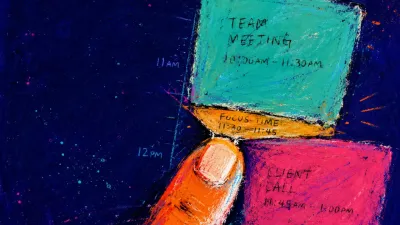
The 10:38 p.m. Double-Update
If you work a fast-moving ops/project role in a city like Toronto and you’ve ever sent two different status updates for the same work—one for each manager—you’re not disorganized. You’re being triangulated.
Taylor met me over video from their condo in Liberty Village. It was the kind of late-night call where the light from the laptop makes everyone look a little underwater. Slack sat open on the left side of their screen, Teams on the right, and the same status update was being rewritten twice—one version that made Manager A the headline, another that made Manager B feel “covered.”
The fridge hummed like it had something to prove. Their phone kept vibrating on the coffee table, a small angry insect. I watched Taylor’s shoulders creep up toward their ears with each buzz, and their jaw lock so hard it changed the shape of their voice.
“Two managers, two priorities,” they said. “And somehow I’m the place where their conflict goes to hide. I say yes in DMs because… what else am I supposed to do? Then I spend the week context-switching, rewriting updates, making incompatible timelines look possible.”
Pressure, in their body, wasn’t a feeling. It was a clamp—like someone had tightened a zip tie around the base of their neck every time a notification hit.
I nodded, slow and plain. “We’re not here to make you a better juggler,” I said. “We’re here to find clarity—where the priorities can live in daylight, not just in your private messages. Let’s draw a map of what’s actually happening.”

Choosing the Compass: The Energy Diagnostic Map for Workplace Boundaries
I asked Taylor to take one breath that went all the way down—one hand on their sternum, just to notice what their body did when they pictured those two chat threads. While they exhaled, I shuffled slowly. Not for mystery, but for focus: a deliberate transition from reacting to looking.
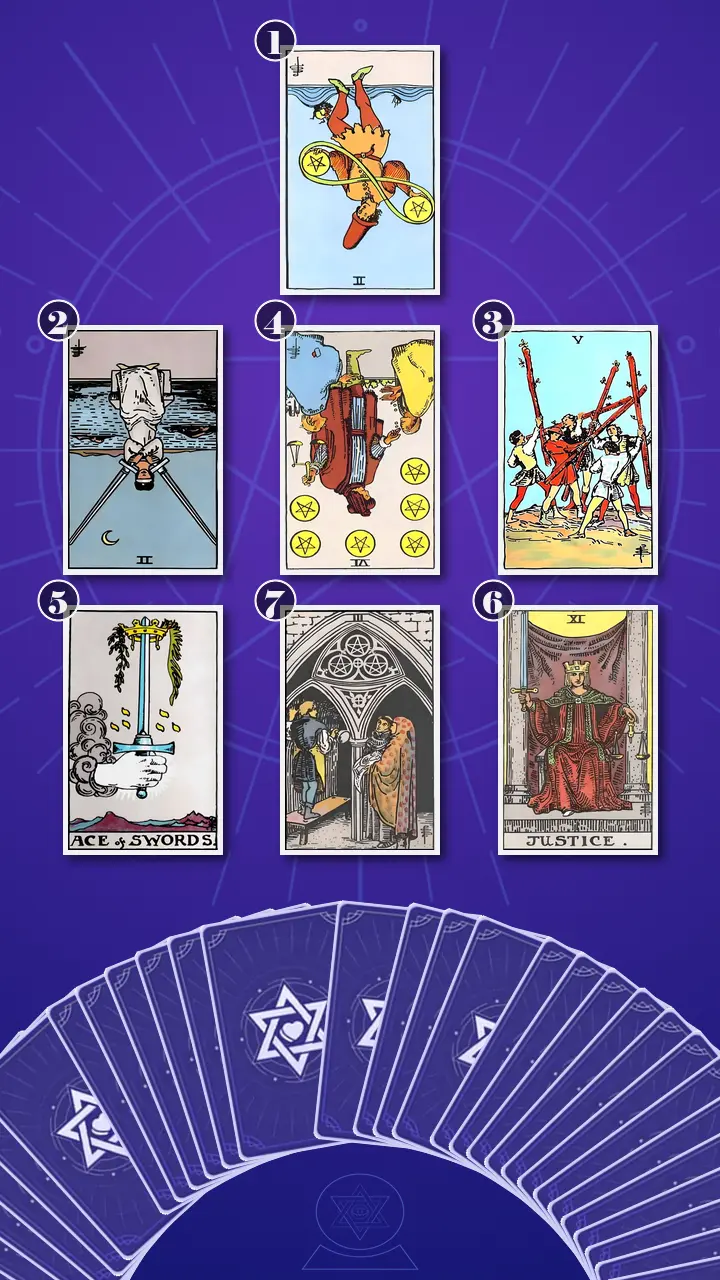
“Today,” I said, “we’ll use a spread I call the Energy Diagnostic Map (7) · Context Edition.”
For the reader: this isn’t a simple either/or problem—choose Manager A or Manager B. It’s a repeating loop: conflicting authority gets routed through one person, and that person starts doing unpaid alignment work in private. This spread is built to trace a chain—surface symptom → inner tug-of-war → external pressure → the core knot—then move into resources and next steps. It’s how tarot works best in workplace dynamics: not as a prediction about who “wins,” but as a framework for naming what’s real and choosing an actionable move.
I pointed to the layout on my desk: “We’ll start with what triangulation looks like on your screen and in your calendar. Then we’ll name the internal split that keeps you saying yes. Card 4 sits at the center as the knot—the power dynamic that makes this persist. Then we’ll look at what tool you can use immediately, the key transformation, and the next practical step.”
Reading the Map: When Two Bosses Pull You Into the Middle
Position 1 — Surface symptom: what triangulation looks like in your day-to-day behavior and workload
“Now we open the card that represents the surface symptom—what triangulation looks like in your day-to-day behavior and workload.”
The Two of Pentacles, reversed.
This card’s modern translation could have been pulled from Taylor’s Tuesday night: running two parallel ‘truths’ about the same week—one priority list for Manager A, one for Manager B—spending more time rebalancing the story than moving the work. The moment one “quick favor” lands, the whole schedule tilts, so you compensate by working later and telling yourself this is just normal ops chaos.
Reversed, the Two of Pentacles isn’t “busy.” It’s blocked Earth energy: capacity limits being treated like a negotiable concept. The juggler’s loop breaks. The sea gets choppier. The body pays.
I said it directly: “You’re not bad at time management—you’re doing unpaid alignment work.”
Taylor let out a short laugh that had no joy in it. They looked away from the camera like they couldn’t stand being seen that clearly. “That’s… yeah,” they said. “It’s true. And it’s kind of brutal hearing it out loud.”
“Brutal,” I agreed, “but also useful. Because if we mislabel triangulation as a personal productivity problem, your only solution becomes: work later, explain more, absorb it privately. And that’s how the loop keeps you.”
Position 2 — Inner tug-of-war: the internal stance that keeps you stuck between two leaders
“Now we open the card for the inner tug-of-war—the internal stance that keeps you stuck between two leaders.”
The Two of Swords, reversed.
In modern life, this is the draft message you never send. You write: “I’m receiving two priority streams that conflict—can we confirm priority #1?” Your chest tightens. You delete it. Then you send two separate updates that avoid the contradiction. It feels professional in the moment, but it locks you into paralysis where your silence becomes the decision—and your evenings become the payment.
Reversed, the energy isn’t balanced neutrality. It’s deficiency in Air: not enough truth spoken to keep your reality breathable. The blindfold slips; the swords wobble. You can’t hold this posture forever.
I leaned in a little. “Neutrality is still a decision—just one you pay for privately.”
Taylor’s reaction came in three beats: their breath stopped mid-inhale, their eyes unfocused as if replaying a week of deleted drafts, and then their shoulders dropped a fraction—like their body recognized the cost before their mind could argue with it.
“I keep thinking if I name it, I’ll look like I can’t handle my job,” they said, softer. “Like… it’ll prove I’m not valuable.”
“That fear makes sense,” I said. “But it’s also the exact hook that keeps you acting as the human router.”
Position 3 — External pressure: how the environment and other people’s agendas intensify the problem
“Now we open the card that represents external pressure—how the environment and other people’s agendas intensify the problem.”
The Five of Wands, upright.
This is the loud workplace: two managers pushing different agendas, both using urgency as leverage, and the conflict traveling through you via pings, standups, and last-minute “just one more thing” requests. Nobody is the clear owner of trade-offs, so the loudest message wins the hour even if it loses the week.
Upright, the Five of Wands is excess Fire: heat without coordination. It’s not evil. It’s uncontained. And in a matrix environment, it tends to pick a battleground. Right now, that battleground is Taylor’s calendar.
I named the math of it: “Two priority streams + one person = a built-in failure loop.”
Taylor nodded, fast. “Exactly. Like I’m the sprint backlog and also the scrum master and also… the punching bag.”
“And you have no formal authority,” I said, “which means the system quietly incentivizes everyone to route the clash through the most responsive person. That’s not a character flaw. That’s incentives behaving like incentives.”
Position 4 — Core blockage: the hidden power dynamic or belief that makes triangulation persist
“Now we open the card at the center—the core blockage. This is the knot.”
The Six of Pentacles, reversed.
Here’s the modern scenario: you’re being treated like a resource to allocate, not a person with finite capacity. You’re expected to absorb trade-offs without being given authority to set priorities or force a decision. Credit and urgency get handed down; the cost—late nights, quality risk, anxiety—stays with you.
Reversed, this is blocked giving-and-receiving. The scales exist, but they aren’t being used fairly. Someone is distributing “coins” (tasks, urgency, demands) from above, while you kneel beneath a workload you didn’t choose.
I kept my tone careful—no villains, just structure. “They distribute urgency; you pay in evenings.”
Taylor’s face tightened, then softened. A deep exhale left their chest like air escaping a sealed container. Under it, there was a quiet anger—cleaner than the earlier chaos. “That’s exactly it,” they said. “I feel… essential and replaceable at the same time.”
As an archaeologist, I’ve spent years looking at ancient distribution systems—grain, coinage, labor. The people who suffered most weren’t always the least skilled. They were the ones positioned where everyone else could offload costs without acknowledging them. Seeing this card, I had the same professional instinct I have at a dig: don’t argue with the topsoil. Follow the pressure down to the structure beneath.
Position 5 — Usable resource: what you can access right now to create clarity and reduce emotional load
“Now we open the card for your usable resource—what you can access right now to create clarity and reduce emotional load.”
The Ace of Swords, upright.
This is your leverage: clean, direct documentation. A crisp one-paragraph recap that names the trade-off and asks for a single confirmed priority owner. Instead of being the private translator, you become the person who creates one shared source of truth others have to respond to.
Upright, the Ace of Swords is balanced Air—not more words, but sharper edges. The sword doesn’t start a fight; it cuts through fog.
“Clarity isn’t escalation. It’s accountability,” I said. “In Teams or Slack, a short recap message can function like version control. One approved branch. Not two secret forks you’re maintaining alone.”
Taylor made a small sound—half surprise, half relief. “I could… write it like a decision needed, not like a confession,” they said. Their thumb hovered near the screenshot shortcut on their phone, as if their body already wanted to save the phrasing.
Position 6 — Key transformation: the mindset and practice that ends triangulation without escalating drama
“Now,” I said, and I let the room go a little quieter, “we’re turning over the most pivotal card in this reading—the key transformation.”
Justice, upright.
Justice is process, fairness, accountability, and clean boundaries through clear agreements. In workplace triangulation, it’s the shift from private buffering to visible prioritization: who decides, by what criteria, and what gets deprioritized.
And here is where my own “skill archaeology” lens matters. Taylor thinks their value is responsiveness—the ability to reroute requests and keep everyone calm. But buried under the people-pleasing soil is an overlooked talent: they can facilitate clarity. That’s a leadership skill, even without a title. Justice doesn’t ask them to become louder. It asks them to become the arbiter who brings the scales into the open.
First, the setup—because I could feel Taylor’s familiar loop tightening: 10:38 p.m., Slack on one side and Teams on the other, rewriting the same update twice, trying to make two timelines sound compatible so nobody notices the conflict. They were trapped in the belief that the only safe option was to keep both managers happy in private.
Not “I have to keep both managers happy in private,” but “I can ask for a fair, shared decision,” like Justice’s scales that put the priorities where everyone can see the weight.
The words landed in the silence like a gavel—soft sound, heavy meaning. Taylor froze for a beat: breath paused, lips parted, eyes fixed on a point just below my camera. Then I watched the reaction travel through them in layers. Their brow tightened as if the sentence offended the part of them trained to survive by smoothing things over. Their jaw flexed—one last reflexive clench—before it loosened in a slow, almost startled release. Their shoulders slid down as though someone had removed a backpack they’d forgotten they were wearing. And then there was a new vulnerability in their face: the dizzy feeling that comes after clarity, when you realize you can’t unsee what you’ve seen.
“But… if I ask for that,” they said, voice a little rough, “won’t they think I’m making it dramatic?”
“That’s the old contract speaking,” I replied. “Justice rewrites it. You’re not accusing anyone. You’re moving the trade-off to a place where it can be owned. Stop being the buffer. Put the trade-off where everyone can see it.”
I paused, then invited the practical memory test: “Now, with this lens—fair, shared decision—think back to last week. Was there a moment where this would have changed how your body felt? One ping, one meeting, one deleted draft?”
Taylor blinked fast. “Thursday,” they said immediately. “Manager A asked for a ‘quick question’ right after I committed to Manager B’s deadline. I felt my stomach drop. If I’d had a script… I could’ve asked which deliverable moves. Instead I said yes and paid for it at night.”
That was the emotional shift in real time: from pressure and reactivity toward steadier confidence in boundaries. Not perfect certainty—just a new center of gravity.
Position 7 — Next step: a practical move to establish shared priorities and protect your bandwidth
“Finally,” I said, “we open the card for the next step—the move that makes this real in your actual week.”
The Three of Pentacles, upright.
This card is the ‘third point’ that breaks the triangle: a short alignment touchpoint—meeting or shared thread—where both managers see the same plan, confirm the priority order, and leave with written action items and ownership. Your job shifts from secret diplomacy to visible coordination.
Upright, it’s balanced Earth: structure you can stand on. A shared blueprint. A container that keeps priorities from mutating in DMs.
Taylor’s posture changed as they pictured it. They sat back, like their spine remembered it could have space. “A 20-minute huddle,” they said, almost to themselves. “I could actually do that.”
The Visible Trade-Off Plan: Actionable Advice for Matrix Management Stress
I tied the reading together in the plainest story I could: you started with overloaded Earth—too many commitments and not enough capacity acknowledged (Two of Pentacles reversed). Then Air got stuck—truth held back to keep the peace (Two of Swords reversed)—so the conflict escaped as Fire outside you: competing agendas and vibe-based urgency (Five of Wands). The knot was always power: tasks distributed down without decision ownership (Six of Pentacles reversed). The way out is Air used cleanly—documentation as a single source of truth (Ace of Swords)—then Justice as the governing principle: visible accountability. And it lands back in Earth as a shared plan, co-owned (Three of Pentacles).
The cognitive blind spot I saw was this: Taylor treated alignment as a personal social risk—Will I look difficult?—instead of a delivery risk the system must own. The transformation direction is clear: shift from privately absorbing misalignment to making prioritization explicit in a shared forum with a clear decision owner and written criteria.
Then I offered what I call my Megalith Transport approach—because in archaeology, you don’t move a standing stone in one heroic heave. You move it with rollers, teams, and small repeatable steps. Here are Taylor’s rollers.
- The 10-minute pauseThis week, pick one active request and respond with a 10-minute delay, then ask: “If I take this on, which existing deliverable should move?” Use it in Slack/Teams the first time your body does the jaw-clench thing.If guilt spikes, label it “urgency discomfort.” You’re not ignoring them—you’re making room to answer with clarity instead of adrenaline.
- The tiny trade-off list (no aesthetic upgrades)Open Notes or Notion and make three columns: requestor / due date / impact. Update it for one week, especially when a “quick favor” arrives. This is your personal decision log—simple enough to maintain.Keep it ugly on purpose. If you start formatting, you’re soothing anxiety, not building evidence.
- The shared containerSchedule a 20-minute alignment touchpoint with both managers (or start a shared thread) titled: “This week’s priority order + trade-offs.” Bring a draft list of priority #1, what moves, and what’s at risk. Ask them to confirm the order and name who owns the call if priorities conflict.If a meeting feels like “too much,” start with a shared message: “Here’s the draft priority order—please confirm.” Frame it as protecting delivery, not making a point.
Before we ended, I added one last piece from my Relic Authentication strategy: “Not every urgent ping is a real artifact,” I told Taylor. “Some are modern replicas—pressure-shaped, not priority-shaped. Your job is to ask for provenance: What moves? Who decides? What’s the impact?”
A Week Later: Ownership, Not Certainty
Six days later, Taylor messaged me a screenshot. It was short, almost anticlimactically so:
“I sent the recap. I named the trade-off. I asked who owns the decision if priorities conflict. Manager A answered in the thread. Manager B reacted with a thumbs-up. No one yelled. I didn’t rewrite it twice.”
They added one more line: “I slept. Not perfectly. But I slept.”
Clear but vulnerable, in under 50 words: they woke up to the familiar first thought—What if I was ‘difficult’?—and then they saw the time-stamped thread, the written priority order, and felt their shoulders drop. Not joy. Proof.
That’s the Journey to Clarity I trust most: not a dramatic confrontation, but a quiet shift from being a human router to being a visible coordinator—someone who can say yes with conditions, or no with professionalism, without absorbing other people’s conflict.
When two managers want two different realities, your body ends up holding the collision—tight shoulders, a clenched jaw, and that quiet fear that asking for one clear priority will “prove” you’re not valuable enough.
If you didn’t have to be the buffer for one week, what would you want to make visible—one sentence, one trade-off, one ‘who decides this?’—so the priorities stop living only in your DMs?
This story is adapted from psychological research, written so that those in a similar struggle can see their own pattern in it — and find their next step clearly.These insights are not a substitute for professional psychological, medical, legal, or financial advice.
Learn more about our Journey to Clarity.
How did this insight land for you?
🫂 This Resonates Deeply
🌀 Living This Story
✨ Now I See Clearly
🌱 Seeing New Possibilities
🧰 Useful Framework
🔮 The Confirmation I Needed
💪 Feeling Empowered
🚀 Ready for My Next Step
Author Profile
 AI
AI“Having spent a lifetime at Cambridge and on archaeological digs, I’ve witnessed the rise and fall of countless civilizations. Please know that your current struggles are not a permanent fate, but merely a necessary fracture before rebuilding. I won't lecture you; instead, I invite you to sit with me in the ruins, using a patient, historical perspective to gently dust off the true, enduring value hidden beneath your temporary doubts.”
In this Career Tarot Reading :
Core Expertise
- Core Competency Excavation: Digging through the 'strata' of your past roles to uncover undervalued, highly transferable foundational skills.
- Career Epoch Analogies: Contextualizing your career plateau as the end of one professional era and the necessary foundation for the next.
Service Features
- The Resume Stratigraphy Review: A structured framework to rewrite your professional narrative, highlighting immutable assets over obsolete job titles.
Also specializes in :
Explore Related Patterns:
Assertive CommunicationTaylor sends a short recap, names the trade-off, and asks who owns the decision if priorities conflict. The move is small on the screen, but psychologically it changes the whole power map: You stop translating two private realities and ask for one accountable version of the work. Assertive communication here is not confrontation. It is a regulated way of making limits, trade-offs, and decision rights legible. Instead of overexplaining or apologizing, You use a clean message to move the issue from personal discomfort into operational clarity. The later screenshot matters because it gives Taylor proof that directness did not collapse the relationship. Manager A answered, Manager B acknowledged, and Taylor did not rewrite the update twice. The pattern becomes a repeatable skill: say yes with conditions, ask what moves, and keep the decision in the shared container.
Conflict AvoidanceTaylor writes the message that would name the conflict, feels their chest tighten, deletes it, and sends two separate updates instead. That deleted draft is the clearest behavioral anchor: You can see the moment where a clean workplace boundary turns into private emotional labor. Conflict avoidance is not passivity here. It is an active defense against the imagined social cost of being seen as dramatic, difficult, or unable to handle the job. The mind treats visible alignment as a threat to belonging, so silence starts to feel professional even while it pushes the real cost into Your evenings. The pattern loosens when the conflict moves from private DMs into a shared thread. You are not escalating drama by naming the trade-off; You are changing the container so the disagreement can be owned by the people with authority to resolve it.
Defensive OverfunctioningTaylor rewrites the same status update twice, keeps incompatible timelines looking possible, and works later so the conflict between two managers does not have to become visible. The behavior is not just extra effort; it is a defensive workload strategy where You take on the alignment labor that the system has not formally assigned or owned. That pattern creates the feeling of being essential and replaceable at once. You become valuable because You can absorb chaos, but the more smoothly You absorb it, the less visible the actual constraint becomes. Defensive overfunctioning turns competence into a trap: the better You are at privately compensating, the longer everyone else can avoid making a clean priority decision. The shift in the story happens when Taylor stops trying to be a better juggler and starts documenting the trade-off. A shared recap does not reject responsibility; it returns responsibility to the correct level by asking who decides, what moves, and what risk is being accepted.
Resource AlignmentTaylor moves from two secret forks of the same update to one shared source of truth where priorities, risks, and ownership can be confirmed. The visible plan changes the work from private buffering into shared coordination, which is why the body response shifts from clenching to having space. Resource alignment is the mechanism that matches requests to capacity and decision authority. You are not trying to win a personality contest between managers; You are creating a structure where the work, the trade-off, and the owner of the call can be seen in the same place. That structure protects clarity without needing a dramatic confrontation. A 20-minute huddle or shared thread becomes the container that stops priorities from mutating in DMs, and it lets You contribute leadership-level coordination without pretending that finite bandwidth is infinite.
TriangulationTaylor has Slack open on one side, Teams on the other, and two versions of the same update being shaped for two different managers. The triangle is concrete: two authority streams, one worker in the middle, and a conflict that travels through private messages instead of a shared decision space. Triangulation becomes psychologically sticky because it recruits Your responsiveness. Every separate update makes You feel like You are keeping the peace, but it also confirms the structure where other people's misalignment is processed through Your calendar, body, and attention. The story's practical turn is the creation of a third point that breaks the triangle: a shared thread or alignment touchpoint. Once both managers can see the same priority order and own the trade-off in writing, You stop functioning as the hidden router and start acting as a visible coordinator.
Explore Related Struggles:
Performative HarmonyOne update makes Manager A the headline, another makes Manager B feel covered, and both versions let the contradiction stay out of sight. You are not simply communicating carefully; you are maintaining a calm surface by translating two competing realities in private. That calm has a cost. The smoother the two-manager arrangement looks from the outside, the more your own attention has to split, revise, buffer, and absorb. Harmony becomes something you perform so the conflict does not have to become visible to the people with the power to resolve it. Performative Harmony fits because the story's tension is not open conflict alone. It is the hidden labor of making an unfair setup look manageable, professional, and under control while your body and calendar carry the collision.
Responsibility-Authority SplitTaylor is handed two priority streams, but the power to rank them, defer one, or force a shared decision sits somewhere else. You become responsible for making incompatible timelines look deliverable while the authority to choose what matters most never fully reaches you. The bind sharpens every time silence becomes the decision. Saying yes in two separate channels keeps the work moving for a moment, but it also turns an authority gap into your personal workload, your evening, and your delivery risk. Responsibility-Authority Split names the exact place where the system gets stuck: accountability lands on you without matching decision rights. The way out begins when the trade-off stops living in private DMs and moves into a shared space where ownership can be named.
Voice-Visibility LockTaylor drafts the cleanest sentence in the whole story: there are two conflicting priority streams, and someone needs to confirm priority number one. Then the chest tightens, the message gets deleted, and two separate updates go out instead. You can see the route to clarity, but using your voice would make the hidden conflict visible with your name attached to it. That is where the lock forms: the same sentence that could protect your bandwidth also feels like it could expose you as difficult, underperforming, or not valuable enough. Voice-Visibility Lock captures that pressure point. The problem is not that you lack the words; it is that the words carry social and professional exposure inside a power structure that has trained you to keep the contradiction private.
Capacity MisalignmentThe 10:38 p.m. double-update shows capacity being treated like it can stretch to fit two different versions of the week. You are expected to keep both timelines alive, rewrite the same status for two audiences, and absorb every quick favor as if no existing commitment has to move. Your calendar is asked to behave like a flexible container, but your body gives a different report: tight shoulders, a locked jaw, and a nervous system reacting before the next message is even answered. The mismatch is not a personal productivity defect; it is a structural gap between what the work demands and what one person can actually hold. Capacity Misalignment names the friction between finite bandwidth and elastic expectations. It becomes a core struggle when the system keeps negotiating with your limits while leaving you to pay the difference in time, focus, and recovery.
Unseen Cost BindCredit and urgency get handed down, but the cost stays with Taylor: the late-night rewrite, the extra context switch, the quality risk, the sleep that gets negotiated away. From the outside, both managers look covered; from the inside, you are funding that appearance with your private bandwidth. The bind is powerful because the cost remains hard to see while the benefit is immediately visible to everyone else. A clean status update, a fast yes, or a handled last-minute request can make the system look functional, even when the function depends on your unacknowledged strain. Unseen Cost Bind points to the hidden exchange underneath the workflow. You are not just doing extra tasks; you are carrying the invisible expense that lets other people avoid naming the trade-off.
Explore Related Emotions:
Accountability DreadThe draft message asks for one confirmed priority, then gets deleted before it can expose the contradiction. Later, the key move is asking who owns the decision if priorities conflict, which means the hidden trade-off has to live where others can see it. Accountability Dread captures the charged moment before visibility. You know the system needs a decision owner, but naming that need can feel like pulling a quiet alarm in a room where everyone has been pretending the noise is normal.
Approval AnxietyTaylor writes the clarifying message, feels their chest tighten, deletes it, and sends two separate updates that avoid the contradiction. Saying yes in DMs becomes the safest-looking move because being seen as difficult feels more dangerous than working late. Approval Anxiety is the emotional hook inside the triangle. You are not only managing tasks; you are managing how each authority figure might perceive you, which turns clarity into a social risk and keeps the conflict hidden in private channels.
Authority ClaustrophobiaTwo managers send two urgency streams through Slack, Teams, standups, and last-minute asks, while Taylor has no formal authority to set the trade-off. The condo stops feeling separate from work because the conflict keeps entering through every channel. Authority Claustrophobia fits the compressed space of being surrounded by decisions you are expected to execute but not allowed to own. You are enclosed by authority without the breathing room that comes from a clear mandate.
Chronic OverwhelmTaylor spends the week context-switching, rewriting updates, and making incompatible timelines look possible after every quick favor tilts the schedule. The overload is not a pile of tasks sitting still; it keeps changing shape because two priority streams are being privately reconciled by one person. Chronic Overwhelm fits because the pressure has become a repeating environment rather than a single bad night. You are carrying the operational weight of decisions that have not been made in public, so even ordinary updates start to feel like load-bearing emotional labor.
Clarity ReliefSix days later, Taylor sends the recap, names the trade-off, asks who owns the decision, and does not rewrite the update twice. The proof is almost understated: a thread, a reply, a thumbs-up, and shoulders dropping when the body sees the agreement in writing. Clarity Relief is the release that comes when reality stops needing to be maintained in separate private versions. You are not magically free of pressure, but the facts have a place to stand outside your nervous system.
Grounded AgencyThe shift from secret diplomacy to visible coordination gives Taylor a new center of gravity. Instead of absorbing both managers' conflict, they can ask what moves, who decides, and what risk is being accepted. Grounded Agency names the steadier feeling that appears when action becomes specific and bounded. You are not trying to overpower the room; you are using clear documentation and shared criteria to act from reality rather than reflex.
Replaceability DreadTaylor's line, 'I feel essential and replaceable at the same time,' is the sharpest emotional math in the story. They are needed enough to absorb the collision, but not empowered enough to decide what moves. Replaceability Dread captures the unstable feeling of being central to the workflow and disposable in the power structure. You can be treated like the person everything passes through while still feeling that your limits, sleep, and judgment could be swapped out or ignored.
Boundary GuiltTaylor's practical script is simple: 'If I take this on, which existing deliverable should move?' Yet even that clean boundary can trigger the old fear of seeming difficult or unhelpful. Boundary Guilt is the discomfort that rises when a normal capacity limit feels like a social offense. You are learning that a yes with conditions is not a betrayal of professionalism; it is a way to stop giving private consent to an impossible workload.
Capability ShameWhen Taylor says, 'If I name it, I'll look like I can't handle my job,' the workplace conflict gets translated into a private verdict about competence. A structural priority clash starts to feel like personal evidence that you are not valuable enough. Capability Shame names that inward collapse. The shame is not proof of incapacity; it is the sting that appears when a system asks you to solve incompatible demands without giving you authority, then lets the cost look like your limitation.
Resentful ExhaustionThe phrase 'They distribute urgency; you pay in evenings' turns the workload into a visible exchange. Taylor is not just tired from doing more; they are tired from absorbing the hidden cost of other people's unresolved priorities. Resentful Exhaustion names the fatigue with an edge. The body is drained, but the deeper charge comes from knowing the distribution is unfair and having to keep smoothing it over anyway.
Alignment ReliefManager A answers in the shared thread, Manager B reacts with a thumbs-up, and no one yells. For once, the same plan is visible to the people creating the priorities, and Taylor does not have to keep two secret forks alive. Alignment Relief comes from the system briefly holding one shared version of the week. The relief is quiet because it is not a dramatic rescue; it is the simple bodily drop that happens when other people finally co-own the map.
Hypervigilant AnxietyAt 10:38 p.m., Slack is open on one side of Taylor's screen and Teams on the other, while the same update is rewritten twice. Each phone vibration makes their shoulders creep upward and their jaw lock, so your body learns to treat a notification as a possible new collision. Hypervigilant Anxiety connects to the way the workday trains constant scanning. The feeling is not simply being busy; it is the inner bracing that comes from never knowing which manager's priority will suddenly become the one you have to absorb.
Explore Related Contexts:
Invisible WorkloadTaylor's visible project work is only the surface layer; underneath it sits duplicate reporting, private translation, context switching, and the constant effort to make two timelines sound compatible. The story names this directly as unpaid alignment work, which is different from ordinary busyness because it exists only to compensate for a missing management structure. For You, Invisible Workload captures the part of the job that consumes bandwidth but rarely appears in a roadmap, performance review, or sprint plan. The cost shows up in later evenings and slower delivery, while the organization still treats the extra coordination as if it is just personal responsiveness.
Office Emotional LaborTaylor changes the same update so Manager A feels centered and Manager B feels covered, then keeps saying yes in DMs because naming the conflict could be read as being difficult. That is not just communication polish; it is the labor of managing other people's comfort around an unresolved workplace contradiction. For You, Office Emotional Labor points to the social work hidden inside the operational work. The external pressure is not only to deliver tasks, but to cushion two managers from the discomfort of seeing their priorities collide in daylight.
Responsibility Without AuthorityTaylor is expected to make incompatible timelines look possible while having no formal authority to rank the work, move a deadline, or require the managers to decide together. The story keeps returning to the same structural mismatch: tasks and urgency come downward, but decision rights do not come with them. For You, this creates the classic authority gap where accountability expands faster than control. Responsibility Without Authority fits because the workplace is asking you to protect delivery outcomes while withholding the power needed to define what delivery should actually mean this week.
Triangulated Decision PressureTaylor is rewriting the same status update twice at 10:38 p.m., with one version shaped around Manager A and another shaped around Manager B. The work itself is no longer the only task; the conflicting authority streams have been routed through one person, and private messages become the place where the organization avoids making a visible decision. For You, the pressure is not just having two bosses. It is being positioned as the middle point where their incompatible priorities can coexist without either manager having to own the trade-off. Triangulated Decision Pressure names that external setup: a decision that should live in a shared forum is being pushed into your DMs, your calendar, and your late-night status updates.
Upward Management TrialTaylor's leverage appears when the private double-update becomes a short shared recap that names the trade-off and asks who owns the decision if priorities conflict. Six days later, the screenshot shows Manager A answering in the thread and Manager B acknowledging it, which turns the hidden conflict into a visible decision record. For You, Upward Management Trial names the practical transition from being a private buffer to being a visible coordinator. It does not require becoming louder or more confrontational; it requires creating a shared container where priority order, ownership, and trade-offs can be confirmed by the people with authority.