The 8:47 p.m. Ping That Steals Your Couch
You’re a late-20s project manager in Toronto who can feel your stomach drop the second your old boss’s name pops up on Slack—classic Sunday Scaries, just in notification form.
Jordan said that to me like she was confessing something slightly embarrassing, even though her body had already told the truth. It was 8:47 p.m. on a Thursday in her condo, TV running in the background like a screensaver. Her phone lay face-up on the coffee table. Slack lit up. The glow looked harsh against the dim room, and right on cue the fridge compressor clicked on—suddenly loud, like the apartment itself had noticed the message.
“My shoulders snap tight,” she told me, rubbing the place where neck becomes shoulder, like she could knead the reaction out. “And I’m typing before I even decide to. I write, ‘Totally!’ with, like, three exclamation points. I don’t even feel ‘totally.’”
A Slack ping can hijack your nervous system faster than your logic can catch up.
She exhaled, the kind of breath that sounds like you’ve been holding a shopping bag that’s cutting into your fingers. “I keep Slack installed. Notifications on. I answer outside work hours. It starts as a ‘quick’ thing and then it’s real labour. And then I replay the whole exchange afterward and I’m too drained to do my actual life.”
As she spoke, I watched her jaw do that tiny clench-release-clench loop, and I knew this wasn’t just a boundary question. It was decision fatigue dressed up as professionalism: an always-on accessibility disguised as reliability.
“I want rest,” she said, staring at her own hands, “but I don’t want to burn bridges. I don’t want to look ungrateful. Or… difficult.”
To me, it sounded like living with an always-unlocked door—anyone can knock and walk in, even when you’re trying to sleep. Her exhaustion had a texture to it: like swimming through grey syrup while someone keeps tapping the glass, asking, Quick question?
“Okay,” I said gently. “Let’s not debate this in your head for another week. We’ll give the fog a shape. We’ll look at what the ping activates, what keeps it running, and what boundary actually heals the burnout—something you can do without turning into a different person overnight. This is a journey to clarity, not a personality transplant.”

Choosing the Compass: The Celtic Cross · Context Edition
I asked Jordan to take one slow breath in through her nose and let it out longer than it came in. Not as a ritual to impress the universe—just a clean on-ramp from “reacting” into “observing.” Then I shuffled, steady and unshowy, the way I used to teach on ships crossing the Atlantic: not about magic, about attention. When attention steadies, choices appear.
“Today,” I said, “we’re using the Celtic Cross · Context Edition.”
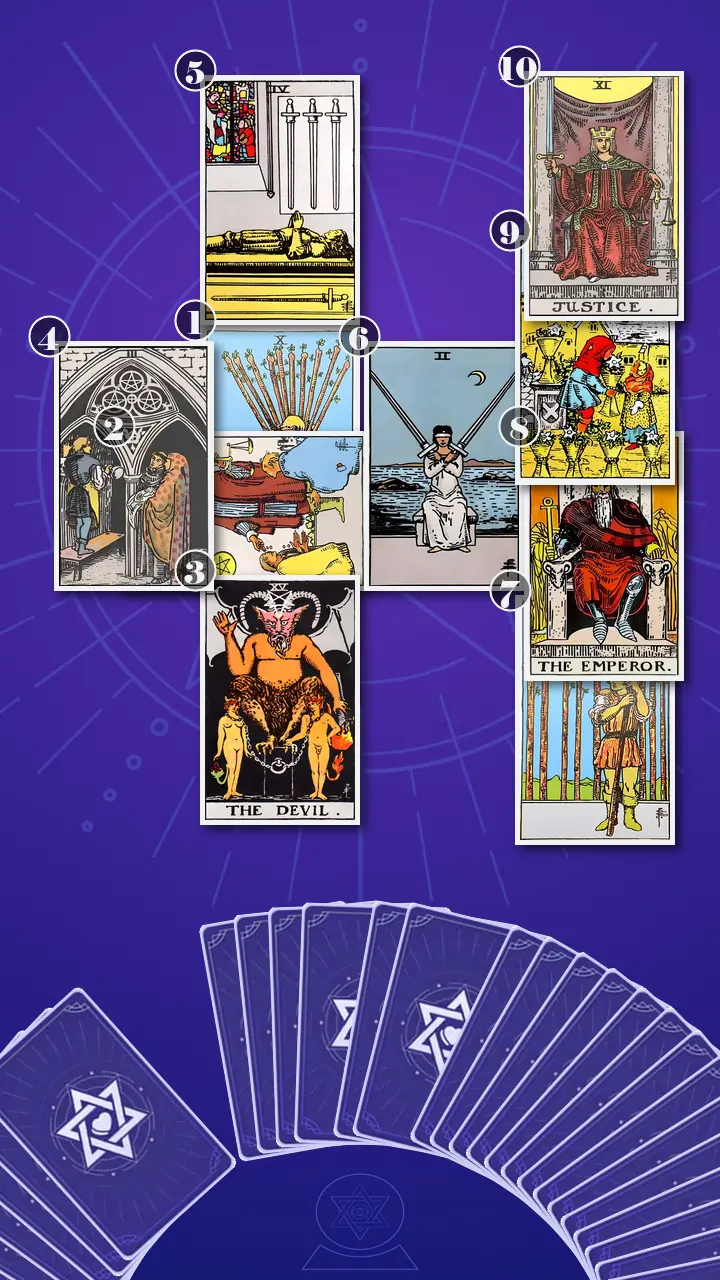
For anyone reading along and wondering how tarot works in a situation like this: I’m not using the cards to predict whether her old boss will become a villain, or whether Jordan will get punished for having boundaries. This spread is built to map a chain—present behavior → immediate obstacle → deeper fear → conditioning → conscious aim → next decision point—then it climbs into the external pressure, the emotional knot, and finally the most restorative boundary. It’s a practical map for a career crossroads where your nervous system is voting louder than your calendar.
This version of the Celtic Cross is especially good for a dynamic like “old boss + Slack” because the problem isn’t just workload; it’s power, access, and worth. Position 8 is tuned to the digital always-on environment. Position 10 is tuned to the healing boundary—what restores energy through clear terms, not wishful thinking.
“The first card,” I told Jordan, “shows what the ping activates in you right now—the visible burnout pattern. The second shows what makes a clean boundary hard in the moment. And the last card points toward the boundary that actually repairs your recovery—your next steps, not a vague vibe.”
Reading the Map: The First Cards in Context
Position 1: What the Slack ping activates right now
“Now opening,” I said, “is the card that represents what the Slack ping activates right now: the most visible burnout pattern in your behavior and attention.”
Ten of Wands, upright.
This is the card meanings in context moment where everything gets painfully literal. Ten of Wands is the “just one more thing” card—carrying, carrying, carrying until you’re bent around the load. And your modern-life version is exactly it: you’re ‘off’ for the night, but the second your old boss pings on Slack you pick up the whole invisible workload again—replying fast, offering extra help, and then feeling that heavy energy drop like you just carried work home in your arms.
Energetically, this is excess: too much responsibility flowing into one narrow channel. The bundle of wands blocks the figure’s view, and that’s what Slack does to you—one notification narrows your world until rest and choice disappear.
Jordan gave a small laugh that had no humor in it. “That’s… brutal,” she said. “Like, yes. It’s ‘one message,’ and suddenly I’m doing unpaid overtime in disguise.”
I nodded. “Your brain is running 28 browser tabs, and Slack is the one that auto-plays audio whenever it wants.”
She blinked hard, like she was trying not to be dramatic about how accurate that felt.
Position 2: The immediate challenge
“Now opening,” I said, “is the card that represents the immediate challenge: what makes it hard to hold a clean boundary in the moment.”
Six of Pentacles, reversed.
The hard part isn’t saying yes or no—it’s that the request arrives with implied authority but zero explicit terms. You end up donating time, attention, and emotional labour (tone management) because the channel (Slack) quietly sets expectations.
Reversed, this card is a blockage in fair exchange. Think of it as doing subscription-level support on a free trial. The “favour” has no scope doc, so it quietly becomes a project. You’re paying with nervous system bandwidth instead of getting a clear agreement.
As I spoke, I slipped into the echo that always lands here—a split-screen:
Screen A: “It’s just a favour.”
Screen B: “Why do I feel like I owe them?”
And right in the middle of that split-screen is the missing thing: terms. Not “nice tone.” Not extra context. Not three exclamation points. Terms.
“Don’t pay with burnout when you can ask for a scope and a channel,” I said, keeping my voice clean.
Jordan’s face did that slow shift from defending herself to recognizing herself. A slow nod. A quiet, almost embarrassed, “Oh… yeah.” Her fingers worried the edge of her sleeve like she was holding back the urge to explain herself to me, too.
Position 3: The root driver underneath it all
“Now opening,” I said, “is the card that represents the root driver: the deeper fear or attachment that keeps the pattern running.”
The Devil, upright.
You know you could mute Slack, but it feels like you can’t—because some part of you equates instant responsiveness with safety, stability, and future opportunity. The compulsion isn’t about the message; it’s about relief from the fear spike.
Energetically, this is a blockage that masquerades as control. The Devil doesn’t usually show up as “I’m trapped.” It shows up as “I’m being smart.” “I’m networking.” “I’m staying professional.” But the chains in this card are loose—meaning the door isn’t locked. Your nervous system just believes it is.
Jordan swallowed. “If I don’t reply fast, I’m scared… it proves I’m not safe. Like I’ll lose goodwill. Opportunities. Like it’ll confirm I’m not stable.”
“That’s the real sentence,” I said. “Not the Slack message.”
Position 4: The recent setup—what trained you
“Now opening,” I said, “is the card that represents the recent setup: what you’ve been trained or conditioned to do in work relationships that shaped this dynamic.”
Three of Pentacles, upright.
You learned to be ‘valuable’ by being evaluated well—fast replies, helpfulness, competence on display. So when your old boss messages, you slip back into being the person who’s trying to earn approval in real time, even though that job is over.
Energetically, this is balance in skill—but with an old hook: your body still behaves like it’s under review. Jordan’s shoulders lifted a fraction as I said it, like her posture remembered the performance before her mind did.
“Yeah,” she admitted. “Every message feels like a mini-review.”
Position 5: Your conscious aim
“Now opening,” I said, “is the card that represents your conscious aim: what you think you ‘should’ do to feel better or regain control.”
Four of Swords, upright.
You’re craving a real recovery container: an evening where your phone isn’t part of your body and your brain can actually come down. Not a more efficient way to keep engaging—an actual protected pause.
This is balance trying to return. The card shows a quiet, enclosed sanctuary. In plain language: rest doesn’t land when it’s merely desired. It lands when it’s protected.
Jordan’s eyes softened for the first time. “That’s… exactly it. I keep trying to ‘earn’ rest by finishing everything. But it never ends.”
Position 6: The next decision point
“Now opening,” I said, “is the card that represents the next decision point: the boundary moment that’s approaching and how your nervous system wants to respond.”
Two of Swords, upright.
A boundary moment is coming where you’ll feel frozen between being helpful and protecting yourself. You’ll want to write the perfect, painless reply—when what you actually need is one clean decision (like switching channels) delivered calmly.
Energetically, this is containment, not aggression. Crossed swords are a firm stop. The blindfold is the warning: don’t decide from imagined judgement alone.
I let the language go short here, on purpose—matching the freeze moment.
“Lock screen.”
“Thumb hovering.”
“Breath held.”
Jordan’s shoulders rose like she’d just watched herself do it.
“If it feels weird to set the boundary, that doesn’t mean it’s wrong—it means it’s new,” I reminded her.
She let out the tiniest exhale, almost a whistle. The kind of breath that says, Maybe I can do one small thing.
Position 7: Your stance—how you’re showing up internally
“Now opening,” I said, “is the card that represents your stance: how you’re showing up internally while trying not to burn out.”
Nine of Wands, upright.
You’re resilient, but you’re also bracing—functioning while half-expecting the next demand. You can hold the line, yet relying on willpower every night keeps you in guarded mode instead of true recovery.
This is excess in vigilance. The fence-like wands in the background are your clue: what you need is a built boundary—settings and scripts—so you don’t have to white-knuckle your evenings.
Jordan gave me a look that was half relief, half accusation. “So I’m not weak,” she said, “I’m just… constantly on guard.”
“Exactly,” I said. “And guards get tired.”
Position 8: External boundary pressure—the channel and power dynamic
“Now opening,” I said, “is the card that represents external boundary pressure: the channel, power dynamic, and implied expectations coming from the old boss and the always-on context.”
The Emperor, upright.
The ping feels ‘official’ because of who it’s from and the channel it’s in. Even casual wording lands like an order. This isn’t just personal anxiety—it’s a power-and-structure dynamic that calls for structural limits (rules, not vibes).
Energetically, this is structure—but it’s currently sitting outside you. The Emperor is the rule-setter. Right now, Slack is acting like his throne: same channel, same old hierarchy, same body response.
I watched Jordan’s jaw tighten again. “Even when it’s like, ‘Hey! Quick thing,’” she said, “my body hears, ‘Do it now.’”
“Yes,” I said. “Your body stored the org chart.”
Position 9: Hope and fear—the emotional knot
“Now opening,” I said, “is the card that represents hope and fear: the emotional knot that makes the boundary feel risky.”
Six of Cups, upright.
You want to keep the relationship warm and uncomplicated, because the past story matters: they helped you, you don’t want to seem ungrateful. But nostalgia can blur the present reality—your capacity changed, and the container needs updating.
Energetically, this is tenderness—and that’s not a flaw. The trouble is when tenderness replaces terms. A gift can be sincere and still need boundaries to stay healthy.
Jordan’s eyes went shiny, just for a second. “I don’t want them to think I’m… different now.”
“You are different now,” I said softly. “You’re more honest about your capacity.”
When Justice Spoke: Replacing Access with Fair Terms
I paused before turning the next card. The room felt quieter—like even the city had lowered its volume. Outside my window, I could hear a distant streetcar bell, and it reminded me of Venice: how a single clear sound can cut through water and fog. Some moments need that kind of clarity.
“Now opening,” I said, “is the card that represents the most healing boundary to restore burnout recovery: what ‘fair terms’ look like when you act with self-respect.”
Justice, upright.
And before I said anything else, I anchored it in the simplest professional truth in the room: Professionalism isn’t instant access; it’s clear terms.
Setup: It’s 8:47 PM, you’re finally off the clock, and then Slack lights up with your old boss’s name. Before you even read the message, your jaw tightens—like your body thinks you’re about to be evaluated. You’re trapped between “be helpful” and “be okay,” and your brain starts drafting the perfect reply to avoid imagined fallout.
Delivery:
Not “I have to stay instantly reachable,” but “I can be fair and clear,” like Justice’s scales that balance your energy with your obligations.
Reinforcement: Jordan’s reaction came in a chain—fast, physical, honest.
First: a freeze. Her breath stopped mid-inhale. Her hands went still in her lap, fingers slightly curled, like she’d been caught holding something too heavy.
Second: the thought landed. Her eyes unfocused for a heartbeat, as if her brain replayed a dozen Slack threads at once—the ones where she sounded bright and agreeable while her shoulders climbed toward her ears.
Third: the release. Her shoulders dropped a fraction. Her jaw unclenched. She let out a shaky breath that sounded like grief and relief mixed together. “But if I’m ‘fair and clear,’” she said, voice sharper than before, “doesn’t that mean I’ve been… wrong? Like I’ve been doing this to myself?”
There it was—the brief anger that sometimes shows up right when clarity arrives, because clarity implies choice.
“It doesn’t mean you were wrong,” I said. “It means you were coping. Your nervous system was trying to buy safety with speed.”
This is where my own work—Jungian psychology and the body’s language—always steps in. I use what I call an Energy Flow Diagnosis: not medical, not a diagnosis in that sense—just noticing where the psyche and the body hold the story. “When you talk about replying,” I said, “your shoulders creep up, and your jaw locks. That’s a classic ‘responsibility overload’ signal. Your body is acting like the canal gates are jammed—everything rushes into one narrow place and it backs up.”
She blinked. “A canal?”
“I’m Venetian,” I said with a small smile. “In Venice, water needs circulation. If you don’t set gates and routes, it stagnates—or it floods. Your evenings are flooding because access has no gates. Justice is a gate. A structure. A clean agreement.”
I leaned in, voice calm and very specific. “Where is your energy in the equation? Justice asks you to put it on the scales, not hide it as the invisible cost of being ‘nice.’”
Then I asked the question that makes this card practical instead of poetic. “Right now,” I said, “how much of your reply is actual work—and how much is tone-policing to avoid being judged?”
Jordan’s mouth opened, then closed. She stared at the card. “It’s… mostly tone,” she whispered. “I write paragraphs so they can’t misunderstand me.”
“And Justice holds a sword,” I said. “That sword is the short sentence. Not punishment. Precision.”
I let the silence sit for a beat, and then I invited her into the new lens. “Now, with this perspective, think back to last week. Was there a moment—one ping—where ‘fair and clear’ would’ve changed how you felt in your body?”
She nodded slowly. “Saturday,” she said. “Queen West. I had a latte. It was supposed to be a calm morning. And I just… volunteered. Again.”
Her shoulders dropped again, as if her body understood the alternative before her mind fully trusted it. That’s the shift: from hyper-alert obligation toward the first edge of steadier self-respect. Not certainty. But a container.
The One-Page Justice Policy: Actionable Advice and Next Steps
When I stepped back and looked at the whole spread, the story was coherent—and honestly, kind to Jordan.
The Ten of Wands showed the visible burnout loop: you pick up “just one more thing” until your evenings become unpaid overtime in disguise. The Six of Pentacles reversed explained why it keeps happening: the exchange is unclear, so you pay with energy instead of getting fair agreement. The Devil named the engine underneath: “access = safety,” a compulsion loop disguised as networking. The Three of Pentacles and Emperor showed the conditioning and power dynamic—your body still thinks you’re being evaluated. And the Four of Swords told the truth: you’re not craving a better system for being available; you’re craving a protected place to recover.
The cognitive blind spot here is subtle but relentless: believing that responsiveness is your value. The transformation direction is equally clear: shift from proving reliability through instant access to demonstrating professionalism through clear terms—channel, hours, scope. In other words: move from vibes-based work to terms-based work.
I told Jordan, “We’re going to make your boundary operational. Not inspirational.”
Then I offered next steps designed for real life—low friction, copy-paste-able, and gentle on a tired nervous system.
- The 3-minute Fair Terms DraftOpen Notes and write one reusable boundary sentence that sets channel + response window: “Hey—happy to help when I can. I’m not on Slack outside work; email me and I’ll reply during business hours.” Save it as “Justice Line.” Don’t send it yet.If your brain starts over-writing, stop at one sentence. One clean sentence beats ten perfect paragraphs.
- Build the fence (settings, not willpower)Tonight, set Slack to mute notifications from 6:30 PM to 8:30 AM (or use iPhone Focus / Android Focus). If full mute feels too big, turn off badges and banners first—reduce the “always-on” cue.Expect guilt. Treat it like weather, not a command. Start with a tiny container (evenings) rather than a forever rule.
- The one-line scope gateOn the next ping, reply with one clarifying line before doing any labor: “What’s the deadline and what exactly do you need from me?” Then stop. No bonus solutions. No extra context.If your chest tightens mid-reply, set a 60-second timer, exhale longer than inhale, and come back only to send that one line.
Because Jordan’s body was already carrying the story in her shoulders and jaw, I added a tiny nervous-system bridge—one of my Quick Recovery Techniques that can be done between meetings or on the TTC: “Drop your shoulders on an exhale. Unclench your teeth. Press your feet into the floor for five seconds. Then soften your gaze. It’s a three-minute reset, but it tells your body, ‘We’re not in trouble.’”
And I used my Venetian Aqua Wisdom frame to make it stick: “You’re not cutting someone off. You’re redirecting flow. Slack is a canal that floods your house. Email is a canal with banks. Business hours are gates. Justice is you deciding where the water is allowed to go.”
Finally, because she works at a desk all day, I offered one modern, non-mystical support: “When you draft your boundary, sit back in your chair, drop your shoulders, and let your jaw be loose. It’s a desk posture correction moment. Your body learns the policy along with your words.”

A Week Later: The Quiet Proof
Six days later, Jordan messaged me: “I did the Focus schedule. And I sent the redirect once. I didn’t explain. I didn’t apologize. I just… did it.”
She told me she’d done it on a Tuesday, alone in a coffee shop after work—no big victory lap. She hit send, stared at her empty inbox for three minutes, and felt a flicker of fear. Then, unexpectedly, her shoulders dropped. She drank her latte while it was still hot.
That’s what I mean by a journey to clarity. Not a perfect nervous system. Not a magically chill relationship with work. Just the first evidence that your rest can stop being negotiable.
When their name lights up your phone and your shoulders tense before you’ve even read the message, it can feel like you have to choose between being “good” and being okay.
If you didn’t have to prove your reliability through instant access, what’s one small ‘term’ you’d want your evenings to live by—channel, hours, or scope?
This story is adapted from psychological research, written so that those in a similar struggle can see their own pattern in it — and find their next step clearly.These insights are not a substitute for professional psychological, medical, legal, or financial advice.
Learn more about our Journey to Clarity.
How did this insight land for you?
🫂 This Resonates Deeply
🌀 Living This Story
✨ Now I See Clearly
🌱 Seeing New Possibilities
🧰 Useful Framework
🔮 The Confirmation I Needed
💪 Feeling Empowered
🚀 Ready for My Next Step
Author Profile
 AI
AI“Having traveled across cultures... I've learned that what we often lack isn't a simple answer, but a moment of being truly understood. I use a Jungian psychological lens to help you deconstruct your subconscious patterns—not to prove anything, but to be the gentle companion who helps you unravel your knots, free of judgment, so you can reconnect with your inner wisdom.”
In this Introspection Tarot Reading :
Core Expertise
- Shadow Integration Audit: Objectively mapping suppressed emotions (anger, shame, grief) that are covertly draining your psychological bandwidth.
- Inner-Critic Neutralization: Deconstructing the harsh, subconscious self-judgment loop that masquerades as 'self-discipline'.
Service Features
- The Active Imagination Protocol: A structured psychological journaling technique to safely dialogue with your 'Shadow', turning internal friction into deep self-compassion.
Also specializes in :
Explore Related Patterns:
Achievement FusionJordan's old boss messages after hours, and her body behaves like she is still being evaluated. Fast replies, extra helpfulness, and competence on display are not just workplace habits here; they are the old proof system for being valuable. Achievement Fusion fits because professional worth has fused with immediate availability. You are not simply choosing to help; you are using responsiveness as evidence that you are reliable, grateful, stable, and still worthy of future opportunity. That fusion is why the burnout feels so sticky. If rest means being less available, and being less available feels like being less valuable, then every boundary will feel like a threat to identity. The repair is to move value out of instant access and back into fair terms: clear scope, clear channel, clear hours.
Approval SeekingJordan says she wants rest, but she also does not want to look ungrateful or difficult. That tension is visible in the instant helpful reply, the extra exclamation points, and the way every old-boss message feels like a mini-review. Approval Seeking fits because responsiveness has become a way to regulate the fear of losing goodwill. Your mind is not only answering a request; it is trying to preserve an image of being easy, grateful, competent, and safe to keep in someone's professional orbit. The cost is that approval becomes more real than capacity. When you prove reliability through instant access, your body pays first: tight shoulders, locked jaw, replayed conversations, and rest that never fully lands. A healing boundary has to separate being respected from being constantly reachable.
Boundary DiffusionJordan keeps Slack installed, notifications on, and replies outside work hours even when the job relationship has changed. A single 'quick' message turns into real labour, then into replaying, then into being too drained to live the evening she was trying to protect. Boundary Diffusion shows up because the line between professional access and personal recovery has lost its shape. The problem is not that you are incapable of saying no; it is that the system has no clear gates around channel, hours, or scope, so every ping has a way to enter your body as an obligation. This pattern is central to the burnout question because rest cannot recover in a space that is still open for work intrusion. The healing move is to make the boundary operational: mute windows, email instead of Slack, business-hour response times, and one-line scope checks. The point is not to become cold; it is to stop making your nervous system serve as the boundary.
Fawning ResponseJordan's body reacts before her reasoning catches up: her shoulders snap tight, her jaw clenches, and she starts typing a bright 'Totally!' before she has actually chosen to agree. That sequence matters because the response is not just politeness; it is an appeasement strategy activated by implied authority. The old boss's Slack message carries more weight than the actual words on the screen. Because the channel and the relationship still feel evaluative, your nervous system tries to buy safety with speed, warmth, and instant cooperation. The fear is not only that a reply will be late; it is that a late reply might make you seem ungrateful, difficult, or less valuable. Fawning Response fits this story because the boundary collapse happens through automatic agreeableness. You are not consciously choosing extra labour from a calm place; you are trying to make the perceived threat go away by becoming easy to approve of. The healing boundary is therefore not a harsher personality, but a pause between the ping and the performance.
HypervigilanceJordan's body notices the Slack message before her conscious mind has finished reading it. Her shoulders rise, her jaw locks, her breath stops, and the phone becomes a threat cue sitting on the coffee table. Hypervigilance fits because the nervous system is scanning for the next demand even during supposed rest. The old boss's name, the work channel, and the late hour combine into a cue that says, 'Prepare to respond now,' whether or not the request is truly urgent. This pattern explains why willpower is not enough. If you have to guard your evening manually every time a notification appears, your body never receives the signal that it is off duty. The boundary that heals is structural, because settings and scripts reduce the number of threat cues your nervous system has to negotiate.
Defensive OverexplainingJordan admits that much of her reply is not actual work; it is tone management. She writes paragraphs so the old boss cannot misunderstand her, even when the boundary she needs could be one clean sentence. Defensive Overexplaining appears when precision gets replaced by self-protection. The extra context is trying to prevent judgement, soften disappointment, and make the boundary feel impossible to criticize. It is a cognitive safety ritual: if you explain enough, maybe no one can be upset. But the overexplaining keeps the old access pattern alive because it spends more energy proving that your boundary is reasonable than simply stating the terms. In this story, the healing edge is the Justice sword: a short sentence, a clear channel, and no apology for needing recovery time.
Explore Related Struggles:
Approval-Safety FusionJordan knows the mute control exists, yet delaying a reply feels capable of costing her goodwill, stability, or future opportunity. Sending the fast, agreeable answer gives immediate relief from that feared evaluation, even when the resulting work drains the rest of her evening. Each response therefore does more than communicate availability: it temporarily confirms that the professional connection is still secure. When you have to keep earning that confirmation through speed, approval and safety become fused, making ordinary response limits feel disproportionately dangerous.
Autonomy Guilt BindJordan names the conflict directly: she wants rest, but she does not want to burn bridges or be seen as ungrateful or difficult. Muting a channel therefore carries more than practical uncertainty; it feels like a statement about her character and her treatment of someone who once helped her. When you experience self-directed limits as evidence that you are letting someone down, autonomy comes bundled with guilt. The boundary remains difficult because protecting your capacity and preserving your identity as a good, appreciative professional appear to demand opposite actions.
Boundary CollapseSlack stays installed with notifications on, and the former boss can reactivate work from Jordan's coffee table even though the job itself is over. Her upbeat reply begins before deliberate choice, while the notification takes over the room, her body, and the attention meant for her personal life. The problem has moved beyond one difficult yes or no: access has become the default architecture of the relationship. When you have no stable separation between another person's request and your private recovery space, every evening remains conditionally available, and rest can be displaced without a fresh agreement.
Performance-Worth FusionJordan learned to be valuable through fast replies, visible helpfulness, and competence performed under evaluation. The old boss's name still activates that performance: "Totally!" appears before consent, and every message feels like another mini-review even though the formal review relationship has ended. You remain locked in evaluation mode when usefulness has become the evidence through which you recognize your professional worth. The repeated overdelivery is not only about completing a task; it is an attempt to keep your value legible to an authority figure whose assessment still seems to count.
Boundary Ambiguity LockThe old boss's "quick" Slack request arrives without a deadline, scope, response window, or agreement about whether Jordan is working at all. Because the message sits somewhere between a favor and an assignment, she fills the missing structure with immediate access, extra help, and careful tone. When a request has no clear edges, you have to guess where goodwill ends and obligation begins. That uncertainty keeps the boundary decision open long after work hours, making explicit terms about channel, timing, and scope the structure needed to restore choice.
Rest-Permission SplitJordan says she wants an evening where her phone is no longer part of her body, yet she leaves Slack active, answers after hours, and tries to earn rest by finishing work that never ends. The desired pause and the practiced response remain active at the same time, so even the couch becomes a place where work can restart. When you treat rest as something granted only after every request has been cleared, recovery has no stable entry point. The struggle is not a lack of desire to stop; it is the unresolved split between protecting your capacity and proving that you have done enough to deserve that protection.
Systemic DepletionEach quick request expands into task work, tone management, and replay, and Jordan later recognizes the same pattern in the Saturday when she volunteered during a calm coffee-shop morning. The exchange ends on Slack, but its demand on her attention continues until little energy remains for the life outside work. This is a system in which output repeats while replenishment is repeatedly interrupted. When you keep paying from the same limited reserve without a protected recovery interval, depletion becomes the predictable result of the access arrangement rather than an isolated response to one unusually busy night.
Unseen Cost BindOne Slack message begins as a small favor, expands into substantive labor, and continues afterward as Jordan replays the wording and possible judgment. The visible request stays light while the time, attention, tone management, and lost evening remain uncounted. When you preserve a smooth professional relationship by hiding what access costs you, fairness cannot be evaluated because one side of the exchange is missing from the record. The bind is not simply doing extra work; it is carrying an invisible price that the relationship never has to acknowledge or negotiate.
Explore Related Emotions:
Approval AnxietyEvery message feels like a mini-review, and her body moves as if performance is already being scored. Fast replies, helpfulness, and competence on display have become tied to the feeling of staying valuable. Approval Anxiety shows up in the fear that a slower response could cost goodwill, future opportunity, or the image of being stable. You are not simply choosing whether to answer a Slack ping; you are trying to protect your standing in someone else's invisible evaluation system. This is why the boundary feels risky even when it is reasonable. Clear terms ask you to stop buying approval with speed, and that can feel exposed before it starts to feel freeing.
Authority ClaustrophobiaThe old boss can write something casual like a quick thing, and her body hears do it now. Slack is not just an app in this story; it carries the old hierarchy into her condo and makes the evening feel smaller. Authority Claustrophobia captures that compressed feeling of having no real breathing room around power. You are technically off the clock, but the channel, the name, and the old reporting structure make access feel official. The healing boundary has to be structural because the pressure is structural. Moving the request into email, business hours, and scope gives your body a clearer room to stand in, instead of leaving authority free to enter through any glowing screen.
Boundary GuiltShe says she wants rest, then immediately worries about looking ungrateful, difficult, or like she is burning bridges. The boundary does not feel like a neutral adjustment; it feels like it could rewrite how she is seen. Boundary Guilt is the inner weather that appears when a practical limit gets mistaken for a relational offense. You can see it in the extra exclamation points, the paragraphs, and the instinct to manage tone before she has even clarified the work. This emotion matters because the burnout is being sustained by moral pressure, not just workload. The boundary that heals has to separate fairness from instant availability, so your need for recovery stops feeling like proof that you are letting someone down.
Message DreadHer stomach drops before the message has even been processed, and her shoulders snap tight at the sight of the old boss's name on Slack. The scene is small on paper, just a notification in a dim condo at 8:47 p.m., but her body treats it like an immediate demand for access. Message Dread fits because the emotional charge is attached to the arrival of contact itself. You are not only reacting to what is being asked; you are reacting to the history, hierarchy, and implied expectation packed into the ping. That dread steals the couch because it collapses the space between off-hours and obligation. Before you choose a boundary, the message has already made your body feel watched, summoned, and responsible.
Survival Mode FatigueShe answers outside work hours, turns a quick thing into real labour, replays the exchange afterward, and ends up too drained to do her actual life. Even when the apartment is quiet, her attention is still working like it has to stay ready for the next demand. Survival Mode Fatigue names the cost of living in that guarded state. You are functioning, replying, smoothing, and carrying the tone of professionalism, but your recovery window keeps getting converted into vigilance. The burnout question becomes clearer here: the healing boundary is not only about reducing tasks. It is about ending the state where your body has to stay mobilized after work, as if rest must remain available for interruption.
Clarity ReliefWhen the phrase fair and clear lands, her shoulders drop and her jaw unclenches. Later, she sends the redirect once without explaining or apologizing, then sits with the fear flicker until her body realizes nothing immediate has collapsed. Clarity Relief is the release that comes when the fog becomes a term. You are no longer trying to solve the entire relationship through tone; you have a channel, a response window, and a scope gate. The relief stays modest and believable, which is what makes it strong. A hot latte, a quieter inbox, and a body that drops its shoulders are enough evidence that the boundary is beginning to return choice to the evening.
Grounded AgencySix days later, she has set the Focus schedule and sent the redirect once. There is no dramatic victory lap, just a clean action taken in ordinary life and a body that begins to understand the new rule. Grounded Agency names the shift from reacting to designing terms. You are not trying to become a different person overnight; you are giving your tired system a structure it can actually follow. That matters because agency here is practical, not abstract. The boundary heals by moving power into settings, scripts, hours, and scope, so your evening no longer depends on willpower alone.
Rest GuiltShe craves an evening where the phone is not part of her body, but she keeps Slack installed, notifications on, and access available. Rest is wanted, yet it keeps being treated like something she can only have after every possible obligation is satisfied. Rest Guilt is the feeling that stopping requires justification. You can hear it when she says she keeps trying to earn rest by finishing everything, even though the stream of possible work never actually ends. The boundary that heals burnout has to make rest legitimate before the inbox is empty. Business hours, muted notifications, and channel limits give your recovery a container instead of asking your exhaustion to keep defending itself.
Guilt-Free RestAfter the redirect, she stares at the empty inbox for three minutes, feels a flicker of fear, and then her shoulders drop. She drinks her latte while it is still hot, which is the quiet proof that her evening was not immediately taken from her. Guilt-Free Rest fits the small but meaningful change at the end of the story. You are not chasing a perfectly calm nervous system; you are learning that recovery does not have to be earned by instant availability. The boundary gives rest a place to live. Focus settings, business hours, and a clean redirect make the pause feel less like avoidance and more like a fair term you are allowed to keep.
Decision FatigueShe freezes between being helpful and protecting herself, then starts drafting the perfect painless reply. The labour is not only the task; it is the mental maze of timing, tone, scope, gratitude, risk, and imagined judgment. Decision Fatigue belongs here because her energy is being spent before any clear decision is made. You can feel it in the hovering thumb, the held breath, the over-explained paragraphs, and the week-long internal debate. A healing boundary reduces the number of decisions her tired system has to make. One saved sentence, one response window, and one scope gate turn the boundary from a fresh emotional negotiation into a repeatable term.
Explore Related Contexts:
Always On AvailabilityJordan keeps Slack installed, notifications on, and replies outside work hours even when she is on her couch at 8:47 p.m. or trying to have a calm Saturday latte. The issue is not a single message; the old work channel remains open as a standing access point into time that is supposed to be off-limits. The external structure makes availability look like professionalism, so your energy gets pulled into fast replies before you can decide whether the request deserves your time. You are dealing with a system where reliability has been quietly measured through reachability, not through clear agreements. A healing boundary has to change the access conditions, not just your attitude toward the ping. Channel, hours, and notification rules give your rest a real container, so the next message has to pass through terms instead of walking straight into your evening.
Authority Approval BottleneckThe old boss's name on Slack makes even casual wording land like an order. Jordan describes every message as a mini-review, and the reading names the exact social residue: the old org chart is still active in the channel, even though the formal job relationship has ended. This creates an Authority Approval Bottleneck. You can want rest and still route the decision through whether a former authority figure will see you as helpful, grateful, or difficult. The bottleneck is not only inside your reaction; it is produced by a power relationship that never received new terms. The healing boundary moves approval out of the decision seat. When you set channel, hours, and scope, you are not asking the old hierarchy for permission to recover; you are updating the structure so your current professional position is clear.
Slack Scope CreepJordan names the pattern clearly: it starts as a quick thing and then becomes real labour. The request arrives through Slack with implied authority, but no deadline, no scope, and no clear channel agreement, so the small favour expands before she has had a chance to define what she is actually agreeing to. That is the structure of Slack Scope Creep. You are not simply being helpful; you are absorbing ambiguity that should have been held by terms. When a request has no edges, the person with the weakest boundary ends up supplying the missing project management for free. The boundary that heals this kind of burnout is not a warmer explanation. It is a scope gate: what exactly do you need, by when, and through which channel. That turns the exchange from open-ended access into a defined professional request.
Work Life Boundary CreepThe story keeps moving work into places that are supposed to belong to Jordan: the condo couch at night, the TV running in the background, the Saturday coffee on Queen West. Slack turns those private spaces into unofficial work sites because the old boss can still reach her there. The boundary problem is spatial and temporal as much as emotional. You are watching work cross the line from scheduled obligation into ambient access, where personal time stays technically yours but practically interruptible. Work Life Boundary Creep asks for operational fences. Muting notifications, moving requests to email, and naming business hours are not dramatic withdrawals; they are the infrastructure that lets home, evenings, and recovery stop functioning as overflow workspace.
Private Recovery WindowJordan says she wants an evening where the phone is not part of her body and her brain can actually come down. A week later, the proof is small but concrete: she uses the Focus schedule, redirects once, does not apologize, and drinks her latte while it is still hot. That is a Private Recovery Window beginning to hold. You are not trying to become unreachable forever; you are creating a protected slice of time where recovery is not constantly renegotiated by whoever can reach your phone. The boundary heals burnout by giving rest an external structure. Settings, business hours, and a reusable redirect sentence let your body learn that recovery is not a reward for finishing everything; it is a protected condition that makes sustainable work possible.
Office Emotional LaborJordan is typing bright agreement before she has even decided whether she wants to engage. Later, she admits that much of the reply is not the work itself but tone management: extra warmth, extra explanation, and paragraphs designed to prevent being judged or misunderstood. That is Office Emotional Labor sitting inside the Slack exchange. You are not only donating time; you are also packaging your availability so it appears effortless, grateful, and non-threatening to someone who still carries authority in your professional memory. A useful boundary cuts down the performance layer. One clean sentence does more repair than ten protective paragraphs because it stops making your recovery depend on sounding perfectly agreeable.