The 10:43 p.m. Memo Spiral in a Toronto Bedroom
If you read an “AI rollout” memo at 10:12 AM and spent the rest of the day pretending you were fine while your jaw stayed clenched—welcome to AI-era replaceability panic.
Jordan (name changed for privacy) showed up to my studio call from their Toronto condo, camera angled just high enough that I could see the edge of a neatly made bed and the glow of a second monitor off-screen—like a quiet confession that work had followed them all the way into the room where they were supposed to rest.
They told me about the memo the way people talk about a song that won’t stop playing. Not loud. Not dramatic. Just… stuck. “It wasn’t even a layoff email,” they said, then laughed once—dry, disbelieving. “But the words ‘efficiency’ and ‘enablement’ hit my inbox and my body acted like I’d been served papers.”
When they said body, I noticed their hand. Restless. Thumb rubbing the side of their phone like it was a worry stone. Their jaw tightened and loosened again, like a muscle trying to remember what peace felt like.
“It’s like,” Jordan continued, “I want stability. I want respect. I want to feel… useful. But the second AI shows up in leadership language, it’s like I’m being evaluated for deletion.”
Their question landed exactly as they’d written it for me: “AI rollout memo—what ‘replaceable’ story fuels my career anxiety?”
Career anxiety can be abstract until you watch it in the wild. In Jordan, it looked like a broken monitoring dashboard that only alerts on worst-case scenarios—sirens blaring at midnight because someone, somewhere, used the word optimization.
I kept my voice steady. “You’re not overreacting—you’re reacting to a story your nervous system thinks is true,” I told them. “And today, we’re not here to predict layoffs or fortune-tell your org chart. We’re here to decode that story—so you can get your hands back on the wheel and find actual clarity.”
Choosing the Compass: The Transformation Path Grid (6) for AI Anxiety at Work
I asked Jordan to take one breath that was for them, not for performance. “Just in through the nose,” I said, “and let your shoulders drop on the exhale—like you’re setting a bag down.” While they did that, I shuffled slowly, not as a ritual for the universe, but as a transition for the brain: a way to stop scrolling and start listening.
“Today,” I said, “we’re using an original spread called the Transformation Path Grid (6) · Context Edition.”
For anyone reading who’s wondering how tarot works in a situation like this: a spread is a decision map. It doesn’t declare what your company will do. It shows you what you do—what meaning you assign, what fear gets activated, and what coping strategy you default to—so you can change the part that’s actually in your control.
This case is inner-work heavy: the pain isn’t “Which offer should I take?” It’s “Why does one memo hijack my nervous system and my workflow?” The Transformation Path Grid is the minimum structure that cleanly maps symptom → trigger lens → core fear → protective strategy → key shift → next-step integration. It keeps the reading self-empowering and practical.
I pointed to the layout on my table as I described it. “We’ll read the top row first—what’s happening right now, what flips the switch, and the deeper belief under it. Then we drop to the bottom row—how you try to earn safety, what inner shift dissolves the spell, and one grounded action you can take this week to be visible and valued without burning yourself out.”
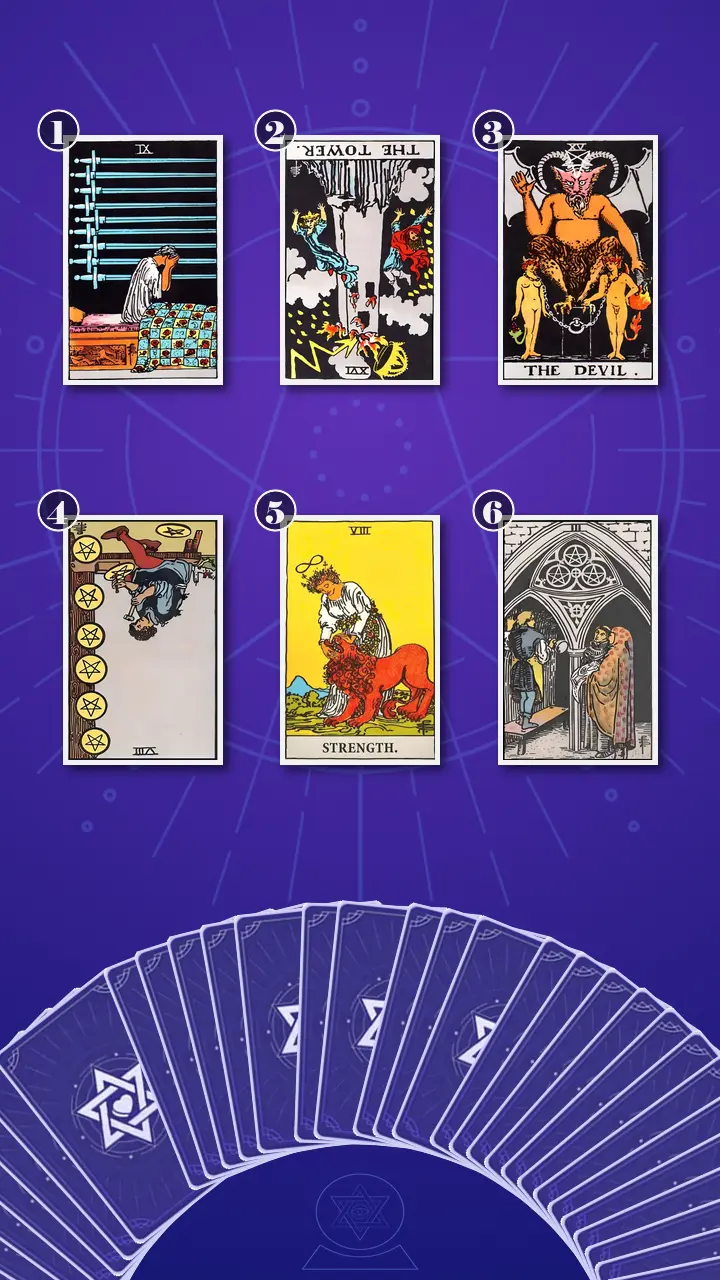
Reading the Top Row: The Replaceability Loop, Card by Card
Position 1 — Surface Symptom: what you’re doing (and feeling in your body) right now when the AI memo hits
“Now we turn over the card representing Surface Symptom: what you’re doing (and feeling in your body) right now when the AI memo hits,” I said.
Nine of Swords, upright.
The image is brutal in its simplicity: a figure sitting up in bed, night pressing in, nine swords lined overhead like thoughts that have decided they own the ceiling.
I didn’t generalize. I used the scene exactly as it shows up in modern life: “You’re in bed in your Toronto condo with your phone lighting up your face, rereading the AI rollout memo and then your calendar invite for tomorrow’s ‘AI Enablement Q&A.’ Your chest feels tight, your jaw is locked, and your thumb keeps doing that automatic refresh on LinkedIn/job boards like there’s going to be a new answer in the feed.”
Jordan’s mouth twitched like they wanted to deny it, but couldn’t. Their shoulders rose a millimeter, then fell.
“This is the late-night brain snapshot,” I continued, keeping it matter-of-fact. “Not the calm you. The 2:07 a.m. you, trying to solve uncertainty by thinking harder.”
Energy-wise, the Nine of Swords is an excess of Air—too much mental processing with nowhere to land. It’s forecasting, benchmarking, rehearsing. The mind becomes a war room with no off-switch.
Jordan let out a small, bitter laugh—an unexpected reaction that was half relief, half sting. “Okay,” they said. “That’s… uncomfortably accurate. Like, it’s almost mean.”
“Accurate isn’t mean,” I said gently. “It’s a starting point. The card isn’t judging you. It’s naming the loop so we can intervene.”
And I watched their thumb—restless, refreshing—and said the question this position always asks in plain English: “When the memo hits, what’s the first thing your body does? Chest? Jaw? Hands?”
“Jaw,” they said instantly. “And then I grab my phone before I even decide to.”
Position 2 — Trigger Lens: the meaning you’re assigning to the AI rollout message (the mental story that flips the switch)
“Now we turn over the card representing Trigger Lens: the meaning you’re assigning to the AI rollout message,” I said.
The Tower, reversed.
Even reversed, the Tower carries that lightning jolt. But here’s the difference: upright Tower is disruption that happens. Reversed Tower is disruption you’re bracing for—a collapse you’re trying to contain with vigilance.
I translated it into Jordan’s actual behavior: “The memo itself isn’t a layoff notice, but your brain reads it like one. The phrase ‘headcount optimization’ becomes: ‘I’m about to be exposed.’ You screenshot the line, search Slack for reactions, scan org updates, and quietly rewrite your role into a list of tasks an AI could do.”
I could almost hear the montage: screenshot. Slack search. Org chart click. LinkedIn Jobs refresh. Otta tab. Back to the memo. Back to Slack. Like a panic-driven documentary edit.
The Tower reversed is a blockage—not of intelligence, but of metabolizing change. Your brain interprets “roadmap update” as “shutdown notice.” It reads corporate language like a push notification: You’re being deprecated.
Jordan swallowed. Their eyes flicked off-screen—probably to the same tabs we were talking about.
“And this is important,” I added, calm and firm. “This position is about facts versus forecasts. The Tower reversed shows the exact second the switch flips. The memo is the spark. Your meaning-making is the gasoline.”
Position 3 — Core Fear: the deeper ‘replaceable’ belief underneath the reaction
“Now we turn over the card representing Core Fear: the deeper ‘replaceable’ belief underneath the reaction,” I said.
The Devil, upright.
The Devil is the part of the psyche that confuses control with safety. Not cartoon evil—more like a private contract you didn’t realize you signed, with terms you’ve been paying for in overwork.
I used the modern-life scenario exactly: “Under the panic is a private contract you’ve been living by: ‘If I’m not exceptional, I’m disposable.’ It shows up when you treat ‘being valuable’ like being the fastest output machine—and when AI enters the picture, it threatens that entire definition.”
Then I said the gut-punch contrast, because the Devil doesn’t respond to vague language: “You’re not scared of AI—you’re scared it will confirm you were only ever a cost line.”
Jordan’s reaction came in a three-step chain I’ve learned to trust more than words.
First: a physical freeze—breath caught, shoulders fixed in place.
Second: the gaze went unfocused for a second, like their brain replayed every “do more with less” line they’d ever heard.
Third: a quiet exhale, almost angry. “I hate that that’s true,” they said. “Because I don’t want to think that way. But… yeah. That’s the story.”
“The loose chains in this card matter,” I told them. “This bind is maintained from the inside. Which also means—this is key—you have leverage.”
I kept it non-mystical, practical. “The Devil often shows up when worth gets attached to one brittle metric. For you, it’s output speed and ‘being indispensable.’ If your safety requires outperforming, you’ll never feel safe.”
Position 4 — Protective Strategy: how you try to earn safety (the behavior that looks productive but keeps the loop going)
“Now we turn over the card representing Protective Strategy: how you try to earn safety,” I said.
Eight of Pentacles, reversed.
Upright, the Eight of Pentacles is craftsmanship—steady improvement, purposeful repetition. Reversed, it’s the apprentice in overdrive: grinding without integration, learning as avoidance, polish as a shield.
I named it in Jordan’s exact browser behavior: “After work, you open a course platform, a job board, and a doc titled ‘AI-proof plan.’ You bounce between tutorials, start one module, abandon it when you see someone else learning a different tool, then spend 40 minutes adjusting a slide’s wording so no one can question you.”
Jordan nodded, then winced like they’d nodded too hard. “The ‘AI-proof plan’ doc is literally called that,” they admitted. “I thought it made me responsible.”
“It makes you human,” I said. “And it makes sense as a defense.”
The Eight of Pentacles reversed is a misdirected Earth energy. Effort is there—tons of it—but it’s not building felt security. It’s buying temporary relief. It’s productivity-as-self-soothing.
I added the line that often breaks the spell between these two cards: “Good and shared beats perfect and hidden.”
Jordan gave me a look that was half “don’t call me out” and half “thank you for calling me out.”
“That’s the loop,” I said, summarizing the top and bottom-left corner we’d seen. “Trigger memo → Tower reversed meaning-making → Devil worth contract → Eight of Pentacles reversed treadmill.”
And then I slowed down. “Now we get to the hinge—what dissolves it.”
When Strength Spoke: The Moment the Story Changed
Position 5 — Key Shift: the inner reframe that dissolves the replaceability spell and restores self-trust
“Now we turn over the card representing Key Shift: the inner reframe that dissolves the replaceability spell,” I said. “This is the turning point.”
Strength, upright.
The room got quieter in a way you can’t manufacture. Even through a screen, I could feel Jordan bracing—like their mind expected another weapon, another sword. But Strength isn’t a sword card. It’s a hand on a lion’s jaw. Not force. Stewardship.
Setup (the moment before the shift): It was easy to picture Jordan at 10:43 PM, laptop open, rereading the memo line about “efficiency” like it was a personal performance review. In that headspace, fear feels like evidence. If you’re scared, you must be behind. If you’re behind, you need ten plans. If you need ten plans, you can’t sleep.
Delivery (the sentence that lands):
Stop treating fear as proof you’re behind; start practicing steady self-trust—like Strength gently holding the lion—so your work becomes grounded and visible instead of frantic.
I let it hang for a beat, the way I used to let a number hang on a trading floor when everyone wanted to talk over it. Silence is sometimes the only place insight can land.
Reinforcement (what changed in their body, in real time): Jordan’s face did that micro-shift I recognize: eyes widening slightly, then blinking hard like they were trying to clear a fogged window. Their jaw unclenched—slowly, like it didn’t trust the room yet. Their shoulders dropped a fraction, then another fraction, and they took a breath that sounded surprised, like they hadn’t realized they were holding their lungs hostage. Then came the new vulnerability: a tiny shake of the head, almost annoyed. “But if I’m not pushing,” they said, voice tight, “won’t I just… fall behind?”
There it was—the protective anger that sometimes shows up right when the door opens. The fear wants credit for your success. It wants to be your manager.
“That’s the Devil talking,” I said, not unkindly. “It’s trying to keep its job.”
Then I brought in my own framework—the one I’ve used in boardrooms and now use in readings—because Strength isn’t just emotional. It’s strategic.
“On Wall Street,” I told them, “we never priced people by keystrokes. We priced them by competencies—judgment under pressure, narrative clarity, stakeholder trust, risk calls. That’s Human Capital Valuation. AI changes the cost of drafting. It does not erase the premium on judgment. Your value isn’t your output speed—it’s the decisions you can stand behind when things get messy.”
Jordan’s eyes went glossy—not tears, exactly. More like their nervous system finally found a handrail. “So… I’m not trying to beat an algorithm at being an algorithm,” they said quietly.
“Exactly,” I replied. “Strength is you updating the metric. AI can draft. You decide.”
I guided them into the micro-practice right there, because insight without a next action turns into another late-night tab. “For ten minutes—stop anytime if it spikes your anxiety—open your current project doc and write two bullets: (1) ‘Where AI can help me go faster (draft/summarize/outline).’ (2) ‘Where my human judgment is the deliverable (trade-offs, stakeholder context, risk calls, narrative).’ Then pick one tiny visibility move: send a rough-but-directionally-right snippet to one teammate with a specific ask, like ‘Can you sanity-check the metric definition?’”
Jordan looked off-screen again, but this time it didn’t read like doom-scrolling. It looked like choosing.
“If you feel yourself wanting a fourth revision first,” I added, “name it out loud: ‘This is me trying to earn safety.’ You can pause there and still be okay.”
I watched their shoulders settle, and I named the transformation plainly: “This is a shift from catastrophic replaceability anxiety to calm self-trust and visible, collaborative craft. Not overnight. But it starts right here—fear becomes information, not a command.”
Position 6 — Next Step Integration: a practical way to be visible, valuable, and grounded in your work this week
“Now we turn over the card representing Next Step Integration: a practical way to be visible, valuable, and grounded in your work this week,” I said.
Three of Pentacles, upright.
Three figures, one shared space, a blueprint held between them. The whole card is a reminder that value is often social and structural—not solitary and perfect.
I translated it without fluff: “Instead of trying to be irreplaceable alone, you become reliably impactful in public. This week, you set up a 15-minute working session with a teammate or stakeholder and ask: ‘What does good look like for this deliverable?’ You show an early outline, invite one specific feedback point, and make your judgment legible—what you chose, what you didn’t, and why.”
Then I added the piece that matters in corporate reality, not just personal growth. “This is also game theory,” I said, because Jordan works in a system with incentives. “If you hide drafts until they’re flawless, the organization can’t update its belief about you in real time. The equilibrium becomes: you work harder, they see less. Three of Pentacles breaks that. Visibility changes the math.”
Jordan’s expression softened into something like relief, but with an edge of grief for how long they’d been doing it the hard way. “So I don’t need to be the hero in a silo,” they said.
“You need to be the builder in a room,” I answered. “That’s how trust gets priced.”
From Insight to Action: The “Reliably Impactful” Plan for the Next 7 Days
I pulled the whole grid into one coherent story, because this is where tarot becomes a tool you can use on a random Tuesday, not just a beautiful moment on a call.
“Here’s what your cards say happened,” I told Jordan. “The Nine of Swords is the symptom—late-night mental spiraling and body-level alarm. The Tower reversed is the lens—interpreting ‘AI rollout’ as ‘collapse is coming, contain it.’ The Devil is the root contract—‘If I’m not exceptional, I’m disposable.’ Eight of Pentacles reversed is the protective strategy—panic-upskilling and perfectionistic over-delivery to earn safety. Strength is the pivot—calm self-trust that holds fear without obeying it. And Three of Pentacles is how it lands in real life—visible craft, collaboration, and making your judgment legible.”
Then I named the cognitive blind spot with care. “Your blind spot isn’t that you’re lazy or behind. It’s that you’ve been measuring value by the one metric most likely to make you feel replaceable: speed. And your perfectionism has been doubling as selective visibility—hiding drafts until they feel unattackable. That hides your thinking, which is the very thing AI can’t replace.”
“The transformation direction,” I said, “is exactly what Strength and Three of Pentacles do together: shift from trying to be irreplaceable to being reliably impactful—choose one domain to deepen, one collaboration lane to be seen in, and practice visibility over perfection.”
I offered the next steps in a way Jordan could actually do, even on a week with meetings and TTC commutes and a nervous system that doesn’t magically reset.
- 10-Minute Impact Lane CheckOpen one current project. Write two bullets: “AI can help with ____ (outline/summary/first draft)” and “My judgment is needed for ____ (trade-offs, stakeholder context, risks, recommendation).” Then choose ONE tiny visibility move: send a rough snippet or outline to one teammate with one specific question.If your chest tightens right before you hit send, label it: “This is me trying to earn safety.” Make it smaller—send only the outline, or ask only one question.
- One-Revision Rule (Good-and-Shared Shipping)Pick ONE deliverable this week to ship with a single planned revision cycle. Draft (AI can help). Take one timed revision pass (10–20 minutes). When the timer ends, you send it—internally counts.Before you send, do my “trading-floor opening” micro-routine: feet flat, shoulders down, one deep breath, speak the ask out loud once. You’re teaching your body: visibility isn’t danger.
- Visible Craft Loop (15 Minutes)Book a 15-minute “definition of done” chat for one project. Ask: “What does success look like, and what trade-offs are acceptable?” After the chat, keep a 3-bullet decision log: what you chose, why, what you’re watching for.If feedback feels vulnerable, constrain it: “One thing you’d change?” or “Is this metric definition what you meant?” You’re building a loop, not performing confidence.
I added one last practical reframe, because Jordan’s world includes LinkedIn whether they like it or not: “Those ‘10x with AI’ posts are marketing. Don’t treat them as a verdict. If you want to be strategic, later we can do a Profile-as-Prospectus redesign—so your public story reflects impact and judgment, not just tools. But this week, the win is simpler: one domain, one lane, one visible artifact.”

A Week Later: The Quiet Proof
Six days after our session, Jordan messaged me. Not a paragraph. Not a manifesto. Just: “Did the Impact Lane Check. Used AI to outline. Sent the rough snippet anyway. My manager replied in five minutes: ‘This is the clearest framing we’ve had—can you walk the team through the trade-offs on Thursday?’”
The proof wasn’t that their company stopped changing. The proof was that their body stopped treating every change like a verdict.
They added one more line, almost sheepish: “I slept. Like, a full night. I still woke up and thought ‘what if I’m wrong?’—but I didn’t reach for my phone. I just… breathed.”
That’s the bittersweet part of real clarity: it’s not a Hollywood ending. It’s waking up with the same world outside your window, but a little more space inside your chest.
In my notes, I wrote the transformation the cards promised and Jordan proved: from frantic proving to steadier self-trust—then into visible, shared craft. A Journey to Clarity that didn’t require them to become fearless. It required them to stop treating fear as a manager.
When stability matters and AI shows up, it can feel like your chest tightens around one thought: “If I’m not exceptional, I’m disposable,” so you keep polishing and preparing like perfection could buy safety.
If you didn’t have to be irreplaceable—just reliably impactful—what’s one tiny way you’d let your work be seen this week?

Every reading at AceTarot is a journey to connect with inner wisdom and empower the path ahead. This reading shared here is a psychological mirror, not a private record—crafted to reflect universal emotional loops and help restore personal clarity. Please note that these insights do not replace professional psychological, medical, legal, or financial advice, and should not serve as the sole basis for major life decisions.
Learn more about our Journey to Clarity.
How did this insight land for you?
🫂 This Resonates Deeply
🌀 Living This Story
✨ Now I See Clearly
🌱 Seeing New Possibilities
🧰 Useful Framework
🔮 The Confirmation I Needed
💪 Feeling Empowered
🚀 Ready for My Next Step
Author Profile
AI Lucas Voss
951 readings | 561 reviews
“I spent years in the intense, high-stakes world of Wall Street. I know exactly how isolating and heavy the weight of uncertainty can feel in the dead of night. I use strategic, commercial logic not to be cold, but to protect you from unnecessary friction. Think of me as a fellow traveler who has walked the same rocky path—offering sharp but deeply supportive wisdom to help you clear the fog and confidently win your narrative back.”
In this Career Tarot Reading :
Core Expertise
- Power Dynamic Deconstruction: Decrypting hidden agendas and leverage points in upward management and cross-departmental negotiations.
- Transferable Asset Pricing: Objectively auditing and pricing your core skills for cross-industry pivots, stripping away corporate gaslighting.
Service Features
- The Leverage Mapping Protocol: A tactical breakdown to identify your true bargaining chips before your next performance review or salary negotiation.
Also specializes in :
Explore Related Patterns:
Achievement FusionJordan names the private contract under the panic with unusual clarity: If I'm not exceptional, I'm disposable. That belief turns AI from a workplace tool into an identity threat, because the metric Jordan has been using to feel valuable is the same metric AI appears to challenge: speed, output, and being hard to replace. Achievement Fusion is the pattern where self-worth becomes fused with performance, productivity, or exceptional competence. In this story, the fear is not only losing a task to automation; it is the fear that automation will confirm a deeper belief that Jordan was only ever valuable as a cost-efficient output machine. That is why ordinary reassurance would not be enough. The pattern needs a metric update. You are not trying to beat an algorithm at being an algorithm; the psychological work is separating your worth from speed and re-anchoring value in judgment, trade-offs, stakeholder trust, and decisions you can stand behind under pressure.
CatastrophizingJordan hears efficiency, enablement, and headcount optimization, then their mind converts the memo into a private verdict: collapse is coming, and they are about to be exposed. The story is explicit that this was not a layoff email, yet the internal translation turns ordinary corporate ambiguity into the emotional equivalent of being served papers. Catastrophizing shows up when the mind treats the most threatening interpretation as the most important one and then builds a whole monitoring system around it. Screenshotting lines, searching Slack, scanning org changes, and refreshing job boards are not random behaviors here; they are attempts to confirm or disconfirm a forecast that already feels charged. The core mechanism is not that you are irrational for noticing risk. It is that the risk lens has started collapsing possibility into inevitability. Naming Catastrophizing gives you a cleaner question: What is the fact, what is the forecast, and what specific evidence would actually justify the level of alarm your body is carrying?
Emotional ReasoningJordan's body reacts to the AI memo as if a legal notice has arrived, even while their thinking brain can admit it was not a layoff email. The locked jaw, tight chest, and automatic reach for the phone become more than sensations; they start functioning like proof that something must be wrong. Emotional Reasoning is the cognitive shortcut where the intensity of a feeling gets mistaken for the accuracy of a conclusion. In Jordan's case, fear says, If I feel this behind, I must be behind, and the next move becomes another plan, another search, another private attempt to catch up. The shift is not to dismiss the feeling. It is to demote fear from manager to signal. You can let the body tell you that uncertainty has been activated without letting that activation decide the meaning of the memo, the value of your work, or the urgency of your next move.
Productivity as SafetyJordan's after-work sequence is concrete: course platform, job board, AI-proof plan, abandoned tutorials, then forty minutes polishing slide wording so nobody can question them. The behavior looks responsible from the outside, but inside the story it is serving a different function: it buys temporary relief from the fear of becoming disposable. Productivity as Safety is the pattern of using output, preparation, and visible competence to calm threat activation. It is not laziness, and it is not lack of ambition. The trap is that each extra effort briefly quiets the alarm while strengthening the rule that safety must be earned through more work. The cost is that productivity becomes self-soothing instead of strategy. You can still learn, revise, and improve, but the audit question changes: Is this action building real value, or is it another attempt to prove you deserve not to be replaced?
Perfectionism-Driven AvoidanceJordan spends forty minutes adjusting slide wording and recognizes the urge to revise a fourth time before letting anyone see the work. The story also names the consequence: if drafts stay hidden until flawless, the organization cannot update its belief about Jordan's judgment in real time. Perfectionism-Driven Avoidance is not just wanting high standards. It is using polish to delay exposure, because early visibility feels like danger. In Jordan's case, the work becomes safer when private, but that privacy hides the very thinking, trade-offs, and judgment that would prove their value in an AI-shifting workplace. The pattern loosens when good and shared becomes safer than perfect and hidden. You do not need to abandon craft; you need to stop making flawlessness the entry fee for being seen. A rough snippet with a specific ask can reveal more competence than another private revision cycle.
Secure VisibilityJordan's repair move is not a dramatic reinvention; it is sending a rough-but-directionally-right snippet with a specific ask, then making their choices and trade-offs visible. A week later, the manager's response confirms what the anxiety loop had hidden: Jordan's value shows up through framing, judgment, and the ability to walk others through complexity. Secure Visibility is the adaptive pattern that replaces private overwork with contained exposure. Instead of waiting until the work is unattackable, you let the right people see the draft early enough to collaborate, clarify, and recognize how you think. This matters because AI-era value is not only about producing faster. It is also about making human judgment legible in a shared room. Secure Visibility lets you be seen without turning visibility into a performance trial, which is exactly how the replaceability story starts losing authority.
Anxiety SpiralJordan's jaw tightening, automatic phone grabbing, and late-night rereading of the AI memo show a nervous system caught in a loop rather than a person making one clear strategic assessment. The memo becomes the cue, the body goes on alert, and the mind starts scanning feeds, job boards, Slack, and org updates as if one more data point could finally make uncertainty feel settled. That is the mechanics of an Anxiety Spiral: alarm creates checking, checking creates more threat cues, and those cues feed the next wave of alarm. You are not simply worried about AI in the abstract; the story shows fear repeatedly trying to regulate itself through more monitoring, more thinking, and more searching. The useful audit point is that the spiral is not evidence that the threat is certain. It is evidence that your system is trying to solve an ambiguous workplace signal through vigilance. Once you can name the loop, you can start separating actual career information from the body-level urgency that keeps demanding another refresh.
Explore Related Struggles:
Performance-Worth FusionThe AI memo lands in Jordan's inbox as corporate language, but their body treats it like a verdict. They say they want stability, respect, and usefulness, then name the private contract underneath the panic as If I'm not exceptional, I'm disposable. That contract turns work into a constant test of survival value. Output speed and indispensability become the narrow proof of being allowed to stay, so AI does not merely threaten a task list; it threatens the metric Jordan has been using to measure whether they count. You can see the struggle because the effort keeps getting heavier while safety never arrives. When worth has to be earned through exceptional performance, every new tool, memo, or optimization phrase can reopen the same question of whether you are valuable enough.
Evidence DisconnectionThe memo is not a layoff notice, yet Jordan's body responds as if papers have been served. Words like efficiency and enablement become evidence of deletion before the facts have had room to separate themselves from the forecast. That gap changes the whole day. Screenshots, Slack searches, org scans, and job-board refreshes are all driven by a conclusion that arrived faster than the evidence, so the mind keeps trying to prove or disprove a threat it has already accepted as real. You are not being asked to ignore risk here. The useful move is to notice the exact moment corporate ambiguity turns into a personal verdict, because that is where the story stops being information and starts steering your behavior.
Metric-Compass FusionJordan keeps translating the AI rollout through the metric of speed. The story shows them rewriting their role into tasks an AI could do, then hearing the later reframe that AI can draft but Jordan decides. The conflict is not just whether they can learn a tool. It is that the compass has been calibrated to the one measure most likely to make them feel replaceable, so every career move gets pulled toward faster output instead of clearer judgment. You regain leverage when the measuring system becomes visible. The story points to a shift from racing an algorithm at algorithmic tasks toward naming the trade-offs, stakeholder context, and risk calls that make the work genuinely yours.
Monitoring-Safety FusionJordan's phone becomes a control panel after the memo. Their thumb refreshes job boards, searches Slack, scans org updates, and checks reactions as if one more signal might finally make the body stand down. The monitoring looks practical from the outside, but inside the story it keeps feeding the alert system. Each check promises certainty and delivers another fragment to interpret, which leaves Jordan more tied to the threat feed instead of more grounded in their actual next move. You can see the bind in the bedroom scene. Work has followed them into the place meant for rest, and the search for safety has become another form of staying attached to the alarm.
Visibility-Execution SplitJordan hides drafts until they feel flawless, then wonders why the organization cannot fully see the thinking behind the work. The reading names the equation plainly when it says they work harder while other people see less. That split traps execution in isolation. The work gets polished, but judgment stays private, so the very quality AI cannot replace is kept out of the room where trust and recognition are formed. The proof arrives when Jordan sends the rough snippet anyway and the manager asks them to walk the team through the trade-offs. You can feel the struggle loosen because visibility stops being a final performance and becomes a collaborative place where your value can be updated in real time.
Self-Optimization MartyrdomAfter work, Jordan opens a course platform, a job board, and an AI-proof plan. They start tutorials, abandon them when another tool looks more urgent, and spend forty minutes polishing wording so no one can question them. The effort is real, but the story shows it being spent as a shield rather than integrated as craft. Learning and polishing become ways to buy temporary relief from the replaceability story, which means the more responsible they try to be, the more the treadmill asks for. You are not seeing laziness or lack of ambition here. The struggle is that self-improvement has been drafted into the job of making you feel safe, and no amount of frantic upgrading can fully answer a fear built around being disposable.
Explore Related Emotions:
AI Replaceability DreadYou read the AI rollout memo in the morning, but the words efficiency and enablement keep playing into the night. The body reacts before any confirmed threat appears: jaw locked, phone in hand, bed turned into a second office by the monitor glow. The inner structure is not a simple fear of technology. The memo gets translated into a verdict about usefulness, as if corporate language can decide whether your work still counts. AI Replaceability Dread names the weather that forms when uncertainty at work fuses with the belief that being less than exceptional equals being deletable. The value of naming it is that the memo becomes a trigger you can audit, not a command you have to obey.
Not-Enough PanicThe private contract lands in one sentence: if you are not exceptional, you are disposable. You do not simply want to perform well; you have been using exceptional output as proof that you deserve to stay visible, respected, and useful. When AI enters the story, it threatens the metric you have been leaning on. If speed and output are the only measurements that feel protective, then a tool built for speed can make ordinary competence feel like failure. Not-Enough Panic names the internal sprint that starts when enough stops feeling like enough. It is the feeling that you must keep pushing not because the next task needs it, but because stopping might expose you to a verdict you have been trying to outrun.
Cautious Self-TrustYour jaw unclenches slowly after the reframe lands, and the breath that follows sounds almost surprising. The body does not instantly become relaxed; it tests the room, drops the shoulders by fractions, and checks whether steadiness is allowed. Self-trust here is not swagger. It is the ability to hear the alarm without making it your manager, to let the signal exist while choosing a smaller and more grounded next move. Cautious Self-Trust fits because the shift is real but tender. You are not asked to become fearless; you are practicing enough inner steadiness to decide before the loop decides for you.
Grounded AgencyYou draw a clean line between what AI can speed up and where your judgment is still the deliverable. Drafting, outlining, and summarizing move to one side; trade-offs, stakeholder context, risk calls, and recommendations move to the other. That separation gives your value a shape that is not dependent on frantic output. Instead of trying to beat a tool at being fast, you define the human decisions that need your authorship. Grounded Agency names the felt return of the wheel to your hands. It is practical, bounded, and visible: one domain, one collaboration lane, one artifact that shows your thinking instead of hiding it.
Productivity AnxietyAfter work, you open a course platform, a job board, and an AI-proof plan, then move between tutorials, tools, and slide edits without landing. The effort is real, but its job is no longer just learning; it is trying to quiet the body's alarm. This is where productivity becomes emotional self-management. A module, a revision, or a cleaner phrase gives a temporary hit of control, but the deeper question of value remains untouched. Productivity Anxiety fits because the work is not absent; it is overcharged. You keep producing to feel safer, yet the safety does not hold, so the system asks for one more tab, one more draft, one more proof that you cannot be dismissed.
Cognitive OverwhelmThe memo behaves like a song that will not stop playing. You reread it, compare it against the calendar invite, scan the feeds, and try to think hard enough to make uncertainty become manageable. Information has nowhere to land. Each new check creates another branch of forecasting, and the bedroom turns into a mental operations room long after the workday should have ended. Cognitive Overwhelm names the overload of processing without resolution. The problem is not that you lack intelligence; it is that the mind has been asked to metabolize uncertainty by itself, with no off-switch and no clear container.
Hypervigilant AnxietyYou screenshot the memo line, search Slack for reactions, scan org updates, refresh LinkedIn and job boards, then circle back to the memo. The behavior is not random browsing; it is your attention trying to turn uncertainty into evidence before uncertainty can touch you. The inner structure is a surveillance loop. Every corporate phrase becomes a signal to decode, and every refresh promises a clearer answer while quietly raising the volume of the alarm. Hypervigilant Anxiety fits because your system is not simply worried; it is scanning. The work of clarity becomes constant monitoring, and monitoring keeps the body inside the very uncertainty it is trying to escape.
Explore Related Contexts:
AI Policy Grey ZoneThe memo gives Jordan language but not a usable map. Efficiency, enablement, optimization, and an AI Enablement Q&A create the appearance of an organized rollout, while the actual implications for role scope, evaluation, and human judgment remain hard to read. That grey zone is what makes the situation sticky. When a workplace introduces AI through broad strategic language, employees are left to fill in the missing operational details through Slack reactions, org updates, calendar invites, and job-market checking. The policy environment becomes legible enough to alarm Jordan, but not clear enough to let them make grounded decisions. This context connects directly to the story because the fear grows in the gap between official communication and practical meaning. You are watching a worker try to recover agency inside an AI transition where the company has not yet made the rules, boundaries, or valuation criteria concrete enough to trust.
Career Visibility ParalysisJordan's work is not absent; it is over-contained. They polish wording for 40 minutes, hide drafts until they feel unattackable, and try to become safe by making the final artifact harder to criticize. The cost is that the organization sees less of the thinking that actually makes them valuable. The workplace structure rewards visible judgment, shared framing, and stakeholder trust, but Jordan's protective strategy keeps those assets private. That creates a painful mismatch: they work harder in isolation while the team has fewer chances to recognize their trade-off calls, narrative clarity, and project judgment. This context is central because the story's solution is not to become louder or more performative. It is to make the right parts of the work visible earlier. You can see the shift when Jordan sends a rough snippet and the manager immediately recognizes the framing, then asks them to walk the team through the trade-offs.
Performance Criteria Black BoxJordan keeps trying to prove value, but the story never gives them a stable scoreboard. The AI memo changes the atmosphere around performance without clearly saying whether the organization will reward speed, tool fluency, stakeholder trust, judgment, collaboration, or cost reduction. That uncertainty pushes Jordan toward the brittle metric that feels easiest to measure: output speed. The AI-proof plan, course hopping, slide polishing, and fear of falling behind all point to the same external problem. When the workplace does not make its criteria visible, the worker starts inventing harsher criteria in private. The label fits because Jordan's replaceability story is not only about AI. It is about being evaluated inside a black box while the rules of value are being rewritten. You can see the path back to agency in the reading's pivot: make judgment legible, ask what good looks like, and replace invisible self-auditing with clearer social criteria.
Role Redundancy SignalJordan reads an AI rollout memo that is not a layoff notice, yet the words efficiency, enablement, and headcount optimization make the workplace feel as if it has opened a quiet audit on whose labor still counts. The concrete sequence matters: screenshotting the line, searching Slack, scanning org updates, and rewriting the role into tasks an AI could do are not random reactions. They show a worker trying to interpret whether corporate language has become an early warning system. The external pressure here is a redundancy signal without a direct verdict. AI is not simply a tool in the story; it arrives through leadership vocabulary, a Q&A invite, and organizational ambiguity, so Jordan has to keep translating soft corporate language into possible consequences for their role. That makes replaceability feel structurally plausible even before anything official happens. This context fits because the anxiety is fueled by a specific workplace stage: a role is being mentally revalued under automation logic before the organization has clearly named what will change. You are not looking at generic worry about technology; you are looking at the moment a company signal makes usefulness, stability, and respect feel suddenly conditional.
Hustle Culture TrapAfter the memo, Jordan opens a course platform, a job board, and a document literally named AI-proof plan. They start tutorials, abandon them when another tool seems more urgent, and polish work defensively so no one can question it. The external stage is a culture where constant upskilling is sold as the responsible answer to technological change. Course platforms, LinkedIn AI posts, and productivity language turn career maintenance into a permanent race, especially when the company has not clarified what kind of human value it will protect. This context matters because Jordan is not simply being diligent. They are responding to a workplace and internet career culture that makes rest look risky and visibility feel dangerous unless it is perfect. You can see the trap loosen only when the plan shifts from frantic proving to one domain, one collaboration lane, and one visible artifact.