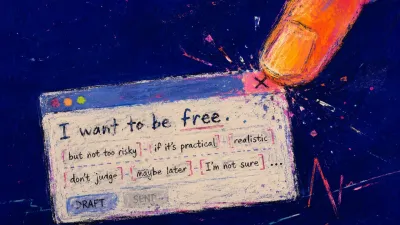
The 10:47 p.m. Cursor Blink
If you’ve ever opened LinkedIn “just to fix one line,” rewritten your headline 15 times, and still closed the tab like it was safer not to be perceived at all—yeah, this is that Sunday Scaries spiral.
Taylor’s camera came on from a Toronto condo that looked like every “I’m doing fine” Sunday night: overhead light off, laptop glow on. It was 10:47 p.m. in their world. The blue-white screen light made their eyes look slightly watery, like they’d been staring into a snowstorm. I could hear the fridge hum through their mic and a thin ribbon of street noise outside. Their shoulders sat just a little too high, and their thumb kept flicking between a Notes app and three peers’ profiles like it was a nervous tic.
“I hate how one line of text can make me feel like I’m failing,” they said, not dramatic—more like tired. “I want a headline that sounds clear and ambitious. But when I try to write it, my chest tightens like I’m about to be called out. Like… my title is my worth.”
I watched their jaw shift, the way it does when someone is holding a thought back with their teeth. “That makes so much sense,” I told them. “Not because your worth is actually in that box—but because your nervous system is treating that box like a stage and a courtroom at the same time.”
“You want clarity and momentum,” I added, “but your body hears a verdict. Let’s make this session a Journey to Clarity—something practical. Not ‘perfect headline forever.’ Just a map out of the loop.”

Choosing the Compass: The Celtic Cross · Context Edition
I asked Taylor to take one slow breath—not as an incantation, just as a reset. “Hold the exact moment in your mind,” I said, “the cursor blinking in the headline field. The urge to swap one prestige word and feel relief for three seconds.” I shuffled while they watched, the cards making that soft, papery riffle sound that always reminds me of turning pages in an old screenplay.
“Today,” I explained, “we’ll use the Celtic Cross · Context Edition. It’s a classic spread, but I use it like a diagnostic layout for modern decision fatigue. It separates what you’re doing on the surface—like the LinkedIn edit loop—from the hidden engine underneath—like status attachment, validation hunger, and an inner critic that edits like a prosecutor.”
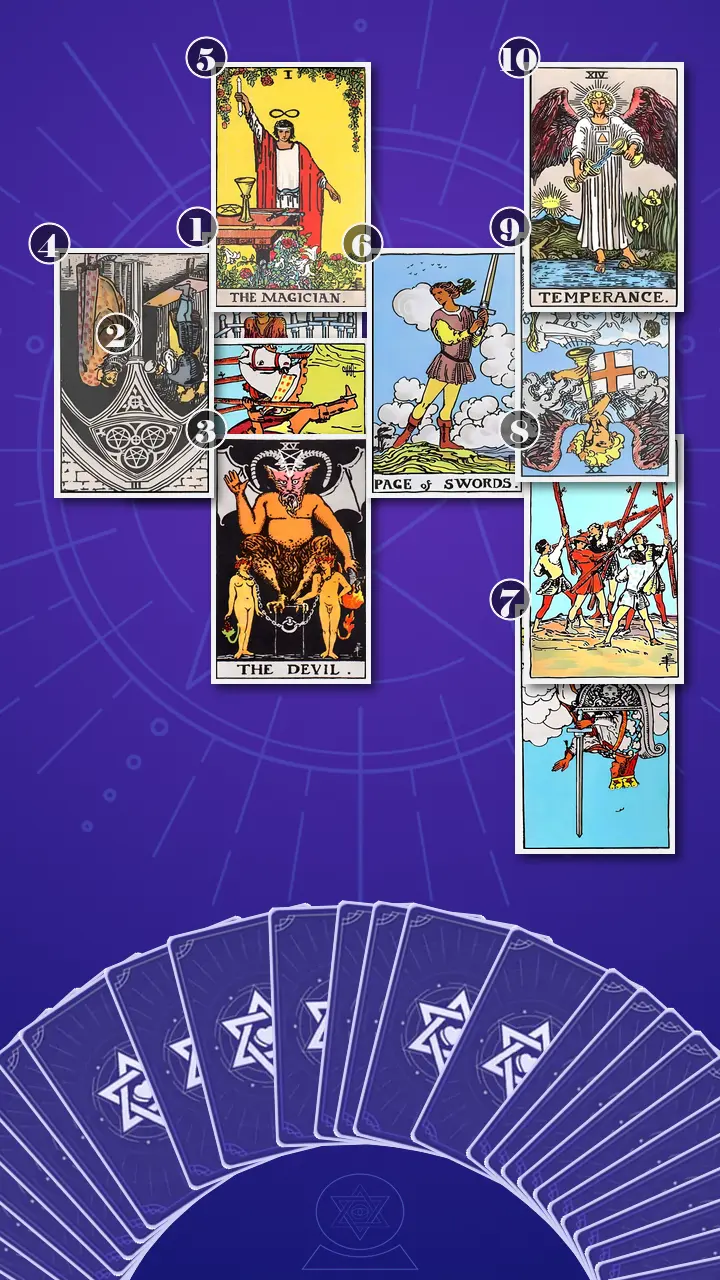
To you reading this: this is also part of how tarot works when it’s used well. Not as a prediction machine, but as a structured conversation tool. The Celtic Cross spread is especially good for a “why am I stuck?” problem because it shows (1) the observable pattern, (2) what’s crossing it, (3) the root fear, and (4) how to move forward with actionable advice instead of more spiraling.
“We’ll look at the center first,” I told Taylor. “Card 1 names the lived experience in your body. Card 3 goes under the floorboards—the root. Card 10 isn’t a fate stamp; it’s the integration principle. The thing you can carry into your next steps.”
Reading the Map: Card Meanings in Context (When Words Become a Cage)
Position 1 — The current lived experience: the headline edit loop
“Now flipped over,” I said, “is the card representing the current lived experience: the specific, observable LinkedIn headline editing loop and how it feels in the body.”
Eight of Swords, upright.
I didn’t have to work hard to translate it—Taylor was already living inside the image. “This is exactly like your cursor blinking in that headline field while ten imagined audiences argue in your head,” I said, “and you feel stuck even though, technically, you could save a version and move on.”
In tarot terms, the Eight of Swords is restriction and mental paralysis—but the detail most people miss is the looseness. The bindings aren’t iron. The blindfold isn’t welded on. This is an Air card (thought, language) in a blockage state: your mind is trying to think its way into safety.
And the loop has characters. I named them the way I’ve learned to—because once you can hear the voices distinctly, they stop sounding like Truth.
“It’s like a group chat in your head,” I said. “Recruiter Voice: ‘Make it senior.’ Peer Voice: ‘Everyone else sounds confident and simple.’ Inner Judge: ‘If you pick the wrong words, you’ll prove you don’t know who you are.’ And then there’s Reasonable Self, the one that just wants a clean label so you can send the application.”
Taylor let out a small laugh that had a bitter edge. “That’s… so accurate it’s kind of rude,” they said, and their eyes flicked away from the camera like the card had exposed their browser history.
That reaction mattered. It was the first crack in the spell: not denial, but recognition. Their shoulders dropped a millimeter, like even being seen in the loop was a kind of relief.
Position 2 — The immediate blocker: validation pressure
“Now we’re looking at the immediate blocker: the pressure source that makes the headline feel high-stakes,” I said.
Six of Wands, reversed.
“This is the applause card,” I said, “but reversed it’s like the crowd is there—and you can’t feel them as support. You feel them as a scoreboard.”
In modern terms: this is when headlines start reading like medals. When your brain measures a line by how much respect it might win rather than whether it reflects your real work. That’s a deficiency of steady internal validation mixed with an excess need to be un-questionable.
“You’re trying to write a headline that guarantees a reaction,” I said gently. “But LinkedIn is a weird stage. Silence doesn’t mean failure. And a lack of likes isn’t a verdict on capability.”
Taylor’s fingers—restless—stopped tapping the desk for a beat. It was subtle, but it told me the card landed: they weren’t just editing a sentence; they were negotiating with the fear of being overlooked.
Position 3 — The underlying root: status as protection
“Now we go under the floorboards,” I said. “This card represents the underlying root: the deeper attachment or fear that makes title = worth feel true.”
The Devil, upright.
Taylor went still in the way people do when a truth gets named without being weaponized. The Devil isn’t “you’re bad.” It’s: you’re attached. You’re chained to a belief because it once felt like protection.
“Here’s the concrete version,” I told them. “You’re treating your headline like airport security. Like if you don’t pass the ‘impressive enough’ scanner, you won’t be allowed through. Through applications. Through respect. Through being taken seriously.”
I paused, then added the part I’ve learned to say out loud: “That makes sense in a marketplace. It’s not shallow to want safety. But it becomes a chain when rank starts feeling like protection.”
My mind flashed—briefly—to Wall Street, to the archetype of status-as-armor: the suit, the title, the certainty that’s actually fear in expensive fabric. I didn’t say it to be clever; I said it because archetypes help people see the pattern as a pattern, not a personal flaw.
“This is the Gordon Gekko problem,” I said. “Not because you’re greedy—because the culture whispers: if you don’t look powerful, you are disposable.”
Taylor swallowed, throat moving like they’d just tasted something sharp. Then they nodded once, small. A sting of recognition—without shame.
Position 4 — Recent backdrop: missing mirrors at work
“Now we’re looking at the recent backdrop: what happened lately that intensified the headline sensitivity,” I said.
Three of Pentacles, reversed.
“This is the ‘worksite’ card,” I said. “Craft. Collaboration. Clear recognition inside a structure. Reversed, it often shows: you’re doing real work, but the mirrors are blurry.”
In modern translation: your responsibilities have grown beyond your official title, but nobody has named it cleanly. You got “Great work!” without the concrete language that would help you trust your own contribution. That’s an Earth energy (tangible skill) feeling blocked by vague feedback.
“So you’re trying to correct a recognition gap with wording alone,” I said. “Like: if the platform can’t see me, maybe the headline can force it.”
Taylor’s expression pinched—resentment, then self-critique, then back to tiredness. “Yeah,” they admitted. “It’s like… if my title sounded bigger, maybe people would finally see it.”
“That’s honest,” I said. “And it’s also exactly why the headline starts to feel like life or death.”
Position 5 — Conscious intention: wanting agency with language
“Now flipped over is your conscious intention: what you’re trying to achieve through the headline,” I said.
The Magician, upright.
“I’m glad this is here,” I told them. “Because it means: you’re not wrong to care about language. You’re craving a way to translate your real work into clear, confident terms.”
The Magician is agency. Tools on the table. Communication as craft. This is balanced power when used cleanly: language as a tool, not a verdict.
“You’re a marketing professional,” I said, “so you already understand messaging. You’ve helped a product find the right words without pretending the words are the product. This card says: you can do that for yourself.”
Taylor’s eyes finally came back to the camera. There was a tiny spark—less panic, more capability.
Position 6 — Near-term direction: experiment, don’t confess
“Now we’re looking at the near-term direction: the most helpful next approach to shift momentum without needing certainty first,” I said.
Page of Swords, upright.
“This is the A/B testing card,” I said, and Taylor smiled despite themself. “Curiosity. Iteration. Version 1, Version 1.1.”
It’s still Air, still language—but not trapped Air. This is Air that moves. Wind that helps you stand, not a thought spiral that pins you down. In energy terms, it’s a shift from blockage to lightweight motion.
“The Page doesn’t treat the headline like a confession of identity,” I said. “They treat it like a product iteration. A small release. You ship a good-enough MVP. You observe what conversations it starts.”
Taylor exhaled through their nose—one of those almost-laughs that signals relief. “Version 1 is allowed to exist,” they murmured, like they were trying the phrase on for size.
“Exactly,” I said. “That’s the momentum shift.”
Position 7 — Self-position: the inner courtroom editor
“Now we’re looking at your self-position: the inner stance you bring to this problem,” I said.
Queen of Swords, reversed.
“This is the editor who thinks she’s protecting you,” I said, “but she’s holding a gavel, not a red pen.”
Reversed, the Queen’s clarity becomes sharpness turned inward. That’s excess discernment, a brittle standard. Every word becomes evidence. Every draft becomes cross-examination.
“If you’re trying to write something no one can question, you’ll end up writing nothing at all,” I said—softly, like a fact, not a scold.
And the group chat voices returned—because this is where the Eight of Swords and the Queen link arms.
“Inner Judge: ‘Objection.’ Recruiter Voice: ‘Sounds junior.’ Peer Voice: ‘That’s not what people are doing now.’ Reasonable Self: ‘Can we just… hit Save so I can apply to the job?’”
Taylor’s mouth tightened, then loosened. They looked down at their hands like they were surprised to find them clenched. That quiet “oh…yeah” moment arrived—the one where you recognize how tired your own inner courtroom has made you.
Position 8 — Context: the Five-of-Wands feed
“Now we’re looking at the context and external pressure: the environment that amplifies comparison and FOMO,” I said.
Five of Wands, upright.
“This is LinkedIn as an algorithmic stage,” I said. “Everyone performing a different kind of ‘winning’ at once.”
This isn’t about you being weak. This is about noise. Too many signs in a crowded farmers market. Ten headline formulas. Five definitions of success. One brain trying to compete with all of them. In energy terms, it’s excess stimulus—friction that makes even a normal career crossroads feel like an emergency.
Taylor’s eyes narrowed slightly, like the card gave them permission to blame the feed a little. “It does feel like… my mood tracks other people’s titles more than my actual week,” they said.
“That’s the Five,” I agreed. “It’s not personal. It’s loud.”
Position 9 — Hope/fear knot: visibility as a summons
“Now we’re looking at the hopes and fears: what you long for and what you dread in one place,” I said.
Judgement, reversed.
“This is the card that makes LinkedIn feel like a trumpet blast,” I said. “Like updating your headline is a permanent public announcement.”
Reversed, Judgement becomes postponement. Self-evaluation that feels like a trial. You want to be seen—and you fear being seen will trigger scrutiny. That’s a blockage in self-acceptance.
“You’re demanding your story be clean before you allow it to be public,” I said. “And early-career stories are rarely clean. They’re real.”
Taylor’s eyes unfocused for a second, like they were replaying a moment: a friend’s promotion post, a recruiter message, that instant chest-drop on the TTC. Then their gaze came back, steadier. “So it’s not that I don’t know who I am,” they said slowly. “It’s that I think I have to be… fully earned before I can say it.”
“That’s it,” I said. “That’s the knot.”
When Temperance Poured Between Two Cups
Position 10 — Integration and guiding principle: the way forward
I let myself slow down before turning the last card. The room always changes here—especially on video. Even through pixels, you can feel when someone is ready to stop arguing with themself. Somewhere in Taylor’s condo, a radiator clicked, and the sound landed like a period at the end of a long sentence.
“Now flipped over,” I said, “is integration and guiding principle: the grounded mindset and practical synthesis to carry forward. Not a fixed prediction. A way out.”
Temperance, upright.
Setup. I watched Taylor’s face as the meaning approached them. They were right back in that 10:38 p.m. moment: cursor blinking like a countdown, chest tight, mind prosecuting each word because it felt like the whole career depended on a single line—like the title field was a moral grade, not a label.
Delivery.
Stop treating your title like a trophy to win, and start blending truth and direction like Temperance pouring between two cups.
I let the sentence sit. No extra commentary. Just air.
Reinforcement. Taylor’s reaction came in a chain—three small movements that told the real story. First: a freeze. Their breath caught, and their hand hovered in front of their mouth like they’d almost interrupted. Second: a seep. Their eyes went slightly unfocused, like a memory buffering—every time they swapped “Coordinator” for “Strategist” for that quick relief-hit, then panicked about being found out. Third: an exhale that came from lower in the chest, not the throat. Their shoulders dropped. Their jaw unclenched so visibly I could almost hear it, and their eyes went shiny in a way that wasn’t quite crying, more like releasing pressure.
“I feel… weirdly mad,” they admitted, voice a little rough. “Because if that’s true, it means I’ve been treating myself like I’m on probation.”
“That anger makes sense,” I said. “It’s the part of you that’s tired of being measured.”
I leaned in slightly. “Here’s the body-check Temperance gives us: If your body braces when you read it, it’s probably trying to be armor. Temperance isn’t armor. It’s a steady tool. It blends what’s true now with what you’re building next, without overpromising and without shrinking.”
Then I gave them the practical micro-ritual, because insight without a container turns into another midnight spiral. “Set a 10-minute timer. Don’t even write in LinkedIn first—write in Notes. Two lines:
1) TRUTH (now): ‘Marketing professional — [two concrete skills you use weekly].’
2) DIRECTION (building): ‘Building toward: [one role lane or outcome you’re moving into].’
Then merge them into one sentence. Paste it. Hit Save once. Tell yourself: ‘This is Version 1 for the next 90 days.’ Close the tab—no extra edits tonight.”
I saw Taylor’s lips part like they were about to bargain with the idea—then close again. A nod. Not ecstatic. Grounded.
“Now,” I asked them, as the last step of the Temperance moment, “use this new lens and think back to last week. Was there a moment—TTC scrolling, a friend’s ‘Excited to announce,’ a job listing—where this insight could’ve changed how you felt?”
Taylor looked up toward their ceiling, searching. “Thursday,” they said. “My manager said ‘Great work’ but didn’t name what I did. I went home and tried to fix my headline like it would… make me real.” They blinked hard once. “If I’d heard this then, I think I would’ve… asked for specifics instead. Or written the headline as a tool, not a plea.”
“That’s the shift,” I said. “This isn’t just about a LinkedIn headline edit. It’s moving from self-conscious tension to grounded clarity—from proving you’re enough to communicating what you do and where you’re going.”
From Insight to Action: A Mondrian Grid and a Two-Minute Pitch
I gathered the whole spread into one story for them, because integration is where tarot becomes usable. “Here’s what the cards are saying,” I told Taylor. “You’re at a career crossroads, and the feeling-stuck part isn’t a lack of skill. It’s an Air trap: the Eight of Swords loop, amplified by a Queen-of-Swords inner courtroom, in a Five-of-Wands environment that keeps yelling ‘rank yourself.’ Underneath, The Devil ties status to safety. And because the Three of Pentacles is reversed, you haven’t gotten clean mirrors for your real contribution—so the headline tries to become proof.”
“But your way out isn’t ‘stop caring.’ The Magician says you can author your message. The Page of Swords says do it experimentally. And Temperance says blend truth + direction, then do the next real step.”
I named the blind spot plainly: “Your cognitive blind spot is treating the headline as a verdict on your value instead of a navigation label. When it becomes a verdict, you spend energy polishing the nameplate instead of opening the door.”
Then I brought in my own tool—something I use as an artist when I’m tempted to turn a bio line into a referendum on my entire life.
“I want to offer you my Mondrian Grid Method,” I said. “Mondrian made clarity by committing to simple blocks—no block had to be the whole painting. Your headline can be the same. Three clean rectangles, not one perfect sentence that carries your entire worth.”
“Block 1: what you do. Block 2: who/what you help. Block 3: the outcome or direction. Balance, not drama.”
Taylor’s eyebrows lifted. “That feels… less like a performance,” they said. “More like design.”
“Exactly,” I said. “Now let’s turn it into next steps.”
- The One-Save Rule (20-minute Page-of-Swords sprint)Once this week, set a 20-minute timer. Draft ONE headline using the Mondrian Grid blocks (Truth + Direction), paste it into LinkedIn, and hit Save exactly once—then close LinkedIn when the timer ends.Expect your brain to say “cringe” or “they’ll question it.” Treat that as the Queen-of-Swords inner judge trying to keep you safe. Say out loud: “Version 1 is allowed to exist.” Then stop.
- The Comparison Fence (Five-of-Wands noise reduction)Mute or unfollow 3 people whose titles reliably spike your shame-tinged anxiety—especially the ones who trigger the Sunday night spiral. You’re not burning bridges; you’re budgeting attention.Pick accounts based on your body: if your chest drops when you see their updates, they go behind the fence for now.
- Oscars Speech Training (2-minute headline-to-human translation)After you save your headline, record a 2-minute voice memo as if you’re accepting an award for “Most Clear Marketing Professional.” Say: what you do, who you help, and one outcome you create—no disclaimers like “kind of” or “basically.” Then write your headline to match that calm spoken version.If you feel yourself rushing, pause and do one slow exhale. If it sounds steady out loud, it will read steady on-screen.
Taylor hesitated, then offered the real obstacle—exactly the kind that keeps people stuck if it isn’t met with respect. “But I don’t have 20 minutes,” they said. “I’m exhausted after work, and if I open LinkedIn I’ll just… spiral.”
“That’s real,” I said. “So we shrink it.” I kept my voice practical. “Do the 10-minute version in Notes only. No LinkedIn. Two lines—Truth and Direction. Save it as a note called ‘Headline v1.’ That still breaks the loop, because it moves you from ‘verdict’ to ‘draft.’ Then tomorrow, paste and save in under two minutes.”
I watched their shoulders lower again. Not magically—just enough to make it possible.

A Week Later: The Quiet Proof
Six days later, Taylor texted me a screenshot: a plain, specific headline—no trophy language, no defensive over-explaining. Under it: “Saved once. Closed the tab. Sent the application right after.”
They added, “Celebrated by… making pasta alone and not checking profile views. It felt weird. But also lighter.”
That’s what I mean when I talk about a Journey to Clarity. Not a perfect identity. A small, steady shift: from polishing the nameplate to opening the door. From a headline as a report card to a headline as a tool for navigation. From shame-tinged anxiety to grounded self-trust that can survive being seen.
When the cursor blinks in that headline box and your chest tightens, it’s not because you don’t know what you do—it’s because part of you is trying to make one line of text protect you from ever being dismissed.
If your headline only needed to be true for the next 90 days—not forever—what would you allow it to say about what you do now, and what you’re quietly building next?
This story is adapted from psychological research, written so that those in a similar struggle can see their own pattern in it — and find their next step clearly.These insights are not a substitute for professional psychological, medical, legal, or financial advice.
Learn more about our Journey to Clarity.
How did this insight land for you?
🫂 This Resonates Deeply
🌀 Living This Story
✨ Now I See Clearly
🌱 Seeing New Possibilities
🧰 Useful Framework
🔮 The Confirmation I Needed
💪 Feeling Empowered
🚀 Ready for My Next Step
Author Profile
 AI
AI“I’ve always felt our lives are films currently in production. As an artist, I know that when you feel stuck, it’s often because you’ve bravely stayed in a painful scene for just a little too long. I’m not here to coldly analyze you. I want to sit closely with you, look at those difficult moments with profound empathy, and gently hand you the pen so you have the courage to write your next beautiful act.”
In this Career Tarot Reading :
Core Expertise
- Workplace Typecasting Analysis: Identifying how your office ecosystem has boxed you into a marginalized or undervalued 'supporting role'.
- Leadership Narrative Construction: Rewriting the script of your professional identity to command authority and visibility.
Service Features
- The Protagonist Reframe Directive: A micro-behavioral script for your next cross-departmental meeting to instantly disrupt your established subordinate persona.
Also specializes in :
Explore Related Patterns:
Achievement FusionTaylor's headline field stops feeling like one editable sentence the moment they say their title feels like their worth, then rewrite the line 15 times and close the tab as if being unseen would be safer. That is Achievement Fusion: a practical career label starts carrying the emotional weight of identity, competence, and value. The mind tries to make wording do the work of self-worth, so every draft becomes a referendum instead of a communication choice. For you, the useful audit is not whether the headline is impressive enough. It is where the headline has been asked to prove something about your value that no title field can actually certify.
External ValidationTaylor measures the headline by how much respect it might win, while silence, lack of likes, and vague praise at work all start to feel like verdicts on capability. External Validation becomes active when the nervous system treats audience response as the main evidence of whether the self is credible. Because Taylor has not received clean mirrors for their actual contribution, the headline is pressured to generate the recognition the workplace has not clearly named. For you, the pattern is not simply caring what people think. It is using imagined reaction as the final authority on whether your work is real, which makes every public sentence feel like it must secure approval before it can be allowed to exist.
Status DefenseTaylor treats the headline like airport security: if the wording does not pass the impressive enough scanner, they may not be allowed through applications, respect, or being taken seriously. Status Defense forms when rank, title, or prestige language becomes psychological armor. The headline is no longer just saying what Taylor does; it is being recruited to protect them from the fear of being dismissed as junior, unclear, or disposable. For you, this pattern asks where status language has become a shield rather than a signal. The clearer move is not to strip ambition out of the sentence, but to stop making the sentence responsible for protecting your entire place in the room.
Imposter SyndromeTaylor's chest tightens like they are about to be called out, and changing a title word can create a quick relief hit before the fear of being found out returns. Imposter Syndrome fits the moment where self-description feels like making a claim that could be exposed. The lack of concrete recognition at work makes the headline carry too much evidentiary weight, so clearer language starts to feel like overclaiming even when it may simply be accurate. For you, the key distinction is between truthful visibility and defensive inflation. A headline can name real work and real direction without pretending to be the final proof that you belong.
Inner CriticTaylor's internal group chat has a Recruiter Voice, a Peer Voice, an Inner Judge, and a Reasonable Self, but the judge is the one holding the most power when every draft becomes cross-examination. The Inner Critic is trying to protect Taylor from public embarrassment by attacking the sentence before anyone else can. That defense can feel smart and discerning, but in practice it turns editing into a courtroom where no wording is innocent enough to pass. For you, the signal is the tone of the edit. If the voice in your head is not helping you communicate more accurately, but punishing you into silence, it is no longer clarity; it is self-prosecution dressed up as quality control.
Visibility AvoidanceTaylor closes the tab because it feels safer not to be perceived at all, even though the actual task is only changing one public line of text. Visibility Avoidance emerges when being seen is coded as exposure to judgment rather than connection or opportunity. The headline becomes a summons, not a label, so hiding starts to feel like the only way to avoid scrutiny. For you, the avoidance is understandable, but it also keeps the platform in charge of your nervous system. A safer visibility practice is not to disappear; it is to make the public act smaller, time-limited, and less dependent on immediate audience response.
Analysis ParalysisTaylor technically can save a version and move on, but the cursor becomes a pressure point where recruiters, peers, and an internal judge all seem to argue before the sentence is even posted. Analysis Paralysis shows up when thinking becomes a safety behavior. More drafting gives the illusion of control for a few seconds, but each new version also creates another possible mistake to evaluate, so the mind keeps circling instead of choosing. For you, the freeze is not evidence that you lack clarity or skill. It is a sign that the decision has been overloaded with identity threat, and the way out is to shrink the decision back into a draft, a timer, and one save.
Comparison TrapTaylor's thumb keeps flicking between Notes and three peers' profiles, and later they admit their mood tracks other people's titles more than their actual week. Comparison Trap turns other people's positioning into a distorted mirror. The feed supplies endless examples of confidence, status, and momentum, but it strips away context, so Taylor's own headline starts being judged against a moving wall of curated signals. For you, the risk is letting the platform define the scale before you define the task. The headline only needs to describe your work and direction; it does not need to win a silent contest against every title your nervous system has absorbed that week.
Secure VisibilitySix days later, Taylor sends a screenshot of a plain, specific headline, saved once, with the tab closed and the application sent right after. Secure Visibility is the shift from performing an identity to communicating a usable signal. Taylor can be seen without immediately checking profile views, because the headline has been downgraded from verdict to navigation label. For you, this is the practical opposite of hiding or overproving. Visibility becomes safer when it is bounded, accurate, and temporary enough to update, while your worth remains outside the box you are editing.
Explore Related Struggles:
Approval-Safety FusionTaylor describes the headline box like airport security: if the title does not pass the “impressive enough” scanner, access to applications, respect, and being taken seriously feels threatened. The public line stops being a tool for communication and starts acting like protective armor. You can feel the fusion in the way external signals carry safety value. A recruiter might approve, a peer might compare, the feed might stay silent, a manager might offer vague praise, and each signal becomes a possible measure of whether Taylor is secure in the professional world. This is Approval-Safety Fusion because approval is no longer just pleasant or useful; it becomes the thing that seems to keep dismissal away. The cost is that Taylor’s body keeps bracing before visibility, trying to make status do the work of steadiness.
Clarity-Exposure SplitTaylor wants a headline that sounds clear and ambitious, yet the moment that clarity has to become public, their body treats the screen like a stage and a courtroom. The same sentence that could help them move forward also exposes them to imagined evaluation. You can hear the split in the competing demands around the cursor. One part wants a clean label so the application can be sent; another part hears every word as something recruiters, peers, and the inner judge might cross-examine. Clarity-Exposure Split names that exact pressure point. Taylor is not stuck because the headline is impossible to write; they are stuck because becoming legible also feels like becoming available for scrutiny. The way through is not a perfect public identity, but a version clear enough to support the next step without pretending to protect the whole self.
Identity Verdict LockTaylor keeps returning to one LinkedIn headline field as if the sentence has the authority to confirm or disqualify their whole professional self. A title that should describe what they do becomes a public verdict, and each word starts carrying more weight than any single line of text can hold. You can see the lock in the way every draft becomes evidence. “Strategist,” “Coordinator,” “Marketing professional,” and every other possible label is tested not only for accuracy, but for whether it will make Taylor look senior enough, clear enough, real enough, and safe from being questioned. The struggle is not that Taylor lacks language. The struggle is that identity has been routed through a verdict system: if the headline sounds right, they feel temporarily legitimate; if it sounds off, their whole sense of worth gets pulled into review. Clarity becomes possible only when the line is allowed to be a navigation label again, not a final ruling on who they are.
Comparison EntrapmentTaylor’s thumb keeps moving between Notes and peers’ profiles, turning a private edit into a live comparison field. LinkedIn looks like an open professional network, but in the moment it behaves like a scoreboard where everyone else’s title becomes another standard Taylor has to answer to. The pressure does not come from one person or one clear rule. It comes from too many competing signals at once: recruiter language, peer confidence, promotion posts, headline formulas, and the feed’s constant performance of progress. Comparison Entrapment captures the way Taylor’s attention gets pulled away from their actual week and into other people’s public labels. The struggle is not ordinary curiosity; it is the narrowing of self-trust when the platform’s noise starts deciding what counts as enough.
Rumination EntrapmentTaylor rewrites the headline again and again, gets a brief relief hit from swapping one prestige word, then lands back in the same pressure a few seconds later. The cursor keeps blinking, the application waits, and the line keeps asking to be perfected before anything else can move. You can see how the loop protects itself. Each edit feels productive enough to justify staying in it, but not resolving enough to let Taylor hit Save and leave. The action consumes energy while postponing the very step it was supposed to support. Rumination Entrapment fits because the mind is trying to manufacture safety through one more revision, one more comparison, one more check against imagined judgment. The trap loosens when the headline is treated as a temporary draft with a defined use, not as an endless thought chamber where worth has to be solved.
Explore Related Emotions:
Shame SpiralTaylor rewrites the headline 15 times, swaps one prestige word for another, gets a tiny hit of relief, then feels the panic come back. The loop keeps promising that the next wording choice will finally make the exposure safe. Shame Spiral shows up when the edit is no longer about clarity. Each draft becomes a new chance to find something wrong with yourself: too junior, too inflated, too vague, too visible, too much. Closing the tab feels safer because being unseen briefly interrupts the spiral. The emotional truth is that the headline has become a place where self-worth gets repeatedly tested and found unstable. Naming the spiral helps you stop treating another rewrite as the cure for a deeper feeling of being insufficiently earned.
Status AnxietyTaylor keeps flicking between Notes and peers' profiles while one headline field starts to carry applications, respect, capability, and being taken seriously. The title is no longer a label for what they do; it becomes a social signal that has to prove they belong in the room before anyone has even responded. You can see Status Anxiety in the way senior enough, impressive enough, and truthful enough all compete for the same sentence. The platform turns status into armor, so the headline has to protect you from being underestimated, overlooked, or treated as disposable. The emotional pressure is not vanity. It is the body trying to survive a marketplace where rank can look like safety. Naming that pressure gives you a way to separate your actual work from the status costume you feel pushed to wear.
Verdict DreadThe cursor blinks in the headline field while Taylor's chest tightens as if they are about to be called out. The story makes the box feel like a stage and a courtroom at the same time, where every word can be entered as evidence. Verdict Dread forms when self-description stops being communication and starts feeling like judgment. You are not just choosing wording; you are bracing for the imagined ruling of recruiters, peers, managers, and strangers who might decide whether you are credible. The title feels like worth because the nervous system hears a verdict before the sentence is even saved. Once that courtroom is named, the headline can return to being a navigation label instead of a public trial.
Visibility PressureTaylor wants to be seen clearly, but the moment of updating the headline feels like a permanent public announcement. The platform turns one sentence into a spotlight, and the spotlight brings imagined scrutiny with it. Visibility Pressure is the strain of wanting recognition while bracing against exposure. You want the right people to understand your work, but being visible also feels like inviting review, correction, or quiet dismissal. The title feels like worth because visibility has become the place where worth might be confirmed or challenged. Separating visibility from judgment lets the headline become a signal, not a summons.
Approval AnxietyTaylor is not just trying to describe their work; they are trying to write a line that will guarantee respect. The crowd is imagined before anyone has reacted, and silence is already being translated into failure. Approval Anxiety builds when recognition has been inconsistent enough that you start trying to control the audience in advance. The headline has to win approval, prevent doubt, and answer criticism before it arrives. This is why the title feels so heavy. It is carrying the wish for a clean external signal that you are doing well, especially where work feedback has been too vague to give you that steadiness internally.
Imposter Exposure FearTaylor's body tightens at the exact point where the headline would become public. The fear is not only that the wording might be imperfect; it is that the wording might make them look like they claimed too much and are now waiting to be challenged. Imposter Exposure Fear lives in that gap between real capability and the permission to name it. You have done the work, but the public label feels like an overstatement until someone else officially certifies every part of it. The story keeps returning to the need to be fully earned before being visible. That is why a simple title can feel dangerous: it threatens to expose the part of you that has not yet accepted your own legitimacy.
Cautious Self-TrustTaylor finally saves a plain, specific headline, closes the tab, sends the application, and does not check profile views afterward. The proof is quiet: the headline can exist without immediately becoming a referendum. Cautious Self-Trust is not loud confidence. It is the steadier feeling of letting a truthful version stand for now, even while part of you still knows visibility can feel charged. The title begins to separate from worth because you allow it to be provisional. It can represent what you do now and where you are building next without needing to contain all of you forever.
Clarity ReliefTaylor's shoulders drop by tiny degrees when the inner voices are named, and later the exhale comes from lower in the chest. The body responds when the loop becomes legible instead of private and shapeless. Clarity Relief comes from seeing the mechanism: the headline was carrying status, recognition, exposure, and self-worth at once. Once those pieces are separated, the pressure has somewhere to go. That relief does not erase the problem, but it makes the next move possible. You can work with a named structure; you do not have to keep wrestling an unnamed weight inside one blinking cursor.
Comparison FatigueTaylor's thumb keeps moving between their Notes app and three peers' profiles, as if the right title might be found by measuring themselves against other people's public versions. The feed supplies endless examples of confidence, seniority, and clean self-positioning. Comparison Fatigue settles in when every profile becomes another standard to absorb. You are no longer listening to the shape of your own work; you are trying to make your sentence survive ten competing definitions of success. The exhaustion comes from letting the feed narrate your value back to you. The headline starts to feel like worth because comparison has made your own evidence harder to hear.
Grounded AgencyTaylor moves from the blinking cursor into a bounded sequence: write in Notes, merge Truth and Direction, paste once, save once, close the tab. The action becomes small enough for the body to complete. Grounded Agency arrives when the headline is treated as a tool rather than a confession. You still care about language, but the language no longer has to prove your entire professional value before it can be used. The emotional shift is practical and internal at the same time. By giving the title a 90-day shelf life, you reclaim movement from the demand for a perfect permanent identity.
Unseen Effort GriefTaylor's responsibilities have grown beyond the official title, but the feedback they receive stays vague. 'Great work' lands without the concrete language that would help them trust what they actually contributed. Unseen Effort Grief gathers around that missing mirror. You are not only chasing a better headline; you are grieving the gap between the work you have done and the recognition that has not named it cleanly. That gap makes the title feel like worth because the headline is being asked to repair what the workplace did not reflect. Asking for specifics becomes part of reclaiming the evidence from the platform and returning it to reality.
Performance FreezeTaylor can technically type a headline, paste it, and hit Save, but the body does not experience the task as simple. Shoulders rise, the chest tightens, fingers tap, and the cursor becomes a visible countdown. Performance Freeze appears when the action is small but the perceived stakes are enormous. You are not blocked by a lack of skill; you are frozen because the task has been inflated into proof of identity, competence, and future acceptance. The freeze makes sense inside this pressure system. If saving the line feels like stepping onto a stage, then doing nothing can feel safer than giving the imagined audience something to judge.
Explore Related Contexts:
Access as Proof PressureTaylor describes the headline like airport security, as if the wording has to pass an impressive enough scanner before applications, respect, or being taken seriously are allowed through. That image shows why the title feels bigger than a title. It has become a checkpoint for access. You are facing a professional environment where being legible can feel like the price of entry. The danger is that legibility starts turning into proof of worth, and proof of worth starts demanding stronger and stronger status signals. The headline then becomes less about communication and more about securing permission to move. This context matters because it separates the real access problem from the false burden placed on one line of text. Your headline can support access by being clear, specific, and directional. It does not need to certify your entire value before you are allowed to apply, ask for feedback, or be seen.
Algorithmic Comparison LoopTaylor keeps moving between their draft and three peers' profiles, while promotion posts, recruiter cues, and headline formulas keep feeding new standards into the room. The comparison is not happening in a neutral space. It is happening inside a platform designed to surface other people's most polished career signals. You are trying to write a grounded label while the feed keeps changing the benchmark for what looks credible. One person sounds senior, another sounds niche, another sounds effortlessly confident, and the algorithm turns all of that into background pressure. A normal profile edit starts to feel like a competitive ranking exercise. The way out is not to pretend peers do not exist. It is to fence off the comparison field long enough to hear your own evidence again. Muting, limiting profile checks, and drafting outside LinkedIn are practical boundary moves because they reduce the external noise that keeps hijacking the headline decision.
LinkedIn Performance LoopTaylor opens LinkedIn to fix one line, rewrites the headline 15 times, checks peers' profiles, and still closes the tab because being perceived feels too costly. The problem is not the sentence by itself. The platform turns a small edit into a public performance surface where recruiters, peers, likes, silence, and job applications seem to crowd around the cursor. You are dealing with a digital career stage that compresses identity, marketability, and visibility into a single box. When that box starts acting like a scoreboard, the headline stops functioning as copy and starts functioning like a test of whether your professional self is acceptable enough to be seen. That is why the loop has such a strong grip. The action looks simple from the outside, but the external setting makes every word carry social risk. Regaining clarity means separating the platform's performance pressure from the practical job of naming what you do now and what you are building next.
Manager Feedback VoidTaylor's manager says Great work but does not name what Taylor actually did, what skill showed up, or what contribution mattered. Later, Taylor recognizes that after this vague praise they went home and tried to fix the headline as if better wording could make the work real. You are missing usable mirrors from the workplace. When responsibilities grow but feedback stays generic, the organization fails to provide the concrete language that would help you locate your own contribution. The title field then becomes an unofficial recognition system, carrying work that management should have helped clarify. This makes the headline feel heavier than it should. Without specific feedback, you are left trying to manufacture external proof through public wording. A cleaner path would include asking for named specifics, because accurate recognition gives the headline evidence to draw from instead of forcing it to invent legitimacy on its own.
Personal Brand PerformanceTaylor is not only editing a headline. They are trying to produce a version of themselves that can survive recruiter judgment, peer comparison, and the silent metrics of a public profile. The line starts reading like a medal, which makes ordinary wording feel too exposed and ambitious wording feel risky. You are caught in the performance layer of professional visibility. In that layer, a bio line is expected to sound confident, marketable, current, and polished before anyone has actually entered a real conversation with you. That turns language into a stage prop instead of a working tool. The story loosens when Taylor shifts from trophy language to plain specificity. A personal brand does not have to become a public trial. It can be a limited interface that helps the right people understand what you do, who you help, and what direction you are moving in.
Status Anxiety CircleTaylor says the title feels like worth, then keeps testing wording that might sound more senior, more impressive, or harder to question. The headline becomes a rank signal instead of a description, which is why a single phrase can start to carry the weight of respect, employability, and being taken seriously. You are not simply choosing between cleaner wording and flashier wording. You are navigating a social field where status language is treated as armor, especially in career spaces that reward confidence before they have actually verified contribution. That makes every title choice feel like it has to protect you from being dismissed. The circle tightens when each new prestige word gives a brief hit of relief, then immediately raises the standard again. Naming this as status pressure gives you a way to stop asking the title to prove your human value and start asking whether it accurately marks your current work and direction.
Undefined Role ScopeTaylor's responsibilities have grown beyond the official title, but the workplace has not given that growth a clean name. That is why words like Coordinator and Strategist become charged. They are not just style choices. They are attempts to make the public label catch up with the actual scope of work. You are trying to describe a role that has not been fully stabilized by the structure around it. When the organization does not define the expanded scope, the headline has to do too much at once. It has to be accurate enough to avoid overclaiming, strong enough to avoid shrinking, and clear enough to be legible to recruiters. The pressure comes from the mismatch between lived responsibility and formal recognition. Once that mismatch is visible, the task becomes more concrete. You can build the headline from weekly skills and outcomes rather than forcing one title word to settle the whole role question.