The Sunday-Night LinkedIn Spiral
If you’ve ever told yourself you’re “happy for them” while your chest tightens scrolling a friend’s LinkedIn promotion post on a Sunday night—welcome to the LinkedIn comparison spiral.
Taylor showed up on my video call from a downtown Toronto condo where the light had that late-evening, slightly blue glow that makes everything feel like it’s happening inside your head. She’d tossed a throw blanket over one shoulder like armor. Somewhere off-screen, Netflix was doing the low-volume autoplay thing—dialogue you can’t quite follow, but it still fills the room so you don’t have to hear your own thoughts.
“It was 9:37,” she said, and I believed her because people remember the exact minute something hits their nervous system. “My phone was face-up on the coffee table. LinkedIn lit up. I picked it up just to clear the notification… and then I saw it. ‘I’m excited to announce…’”
Her thumb mimed the same movement I’ve watched a hundred times: tap the post, tap the comments, tap the profile, tap the new title like it might reveal a secret map. The glass screen warms under your fingertip and somehow your body treats that warmth like proof you should keep going.
“I’m happy for her,” Taylor said quickly, like a disclaimer. “But why does it make me feel smaller?”
I tracked the way her jaw worked—tight, then tighter—like she was grinding down a thought she didn’t want to taste. Her hands kept reaching for her phone even when she wasn’t holding it, restless and searching.
Jealousy can sound petty in your head, but in the body it’s often blunt: a tight chest, a clenched jaw, a pulse that says danger when nothing is actually chasing you. Taylor’s jealousy felt like trying to breathe through a scarf that’s suddenly pulled too high—your world is technically fine, but your air is not.
“Jealousy isn’t your personality—it’s your nervous system reacting to a scoreboard,” I told her. “And we can work with it. Not to judge it. To learn what it’s pointing at, and to find clarity—something you can actually do next, not just think about.”

Choosing the Compass: Celtic Cross · Context Edition
I asked Taylor to put her phone face-down for a minute—no dramatic ritual, just a boundary that gives your brain fewer doorways to run through. “One slow inhale,” I said, “and on the exhale, name the topic in one sentence.”
She tried, then laughed once—small, tight, almost annoyed at herself. “Seeing my friend’s promotion post. What does my jealousy reveal?”
“Perfect,” I said. I shuffled slowly, the sound soft and papery through my mic. I like the shuffle because it’s a psychological transition: your hands do something simple while your mind stops sprinting for a second. My work as a perfumer trained me to trust tiny sensory shifts—how the body changes before the story does.
“Today, we’ll use the Celtic Cross · Context Edition,” I explained. “It’s based on the classic Celtic Cross, but tuned for moments like this—where you’re not trying to predict a fate. You’re trying to decode a trigger.”
For anyone reading: this is how tarot works when it’s practical. The spread gives us a chain—present trigger, the block that keeps it stuck, the deeper rule underneath, what’s been building, what you’re consciously chasing, the near-future pivot, and then the ‘staff’ on the right: your inner stance, your social environment, the hope/fear story inside the jealousy, and finally the integrated outcome. In other words, it’s not “what will happen?” It’s “what pattern am I in, and what’s the next step I can control?”
“The first card will show the jealousy in the moment,” I told Taylor. “The crossing card shows what makes it louder. And the final card—position ten—shows the most empowering stance you can practice after you’ve seen what the jealousy is really doing.”
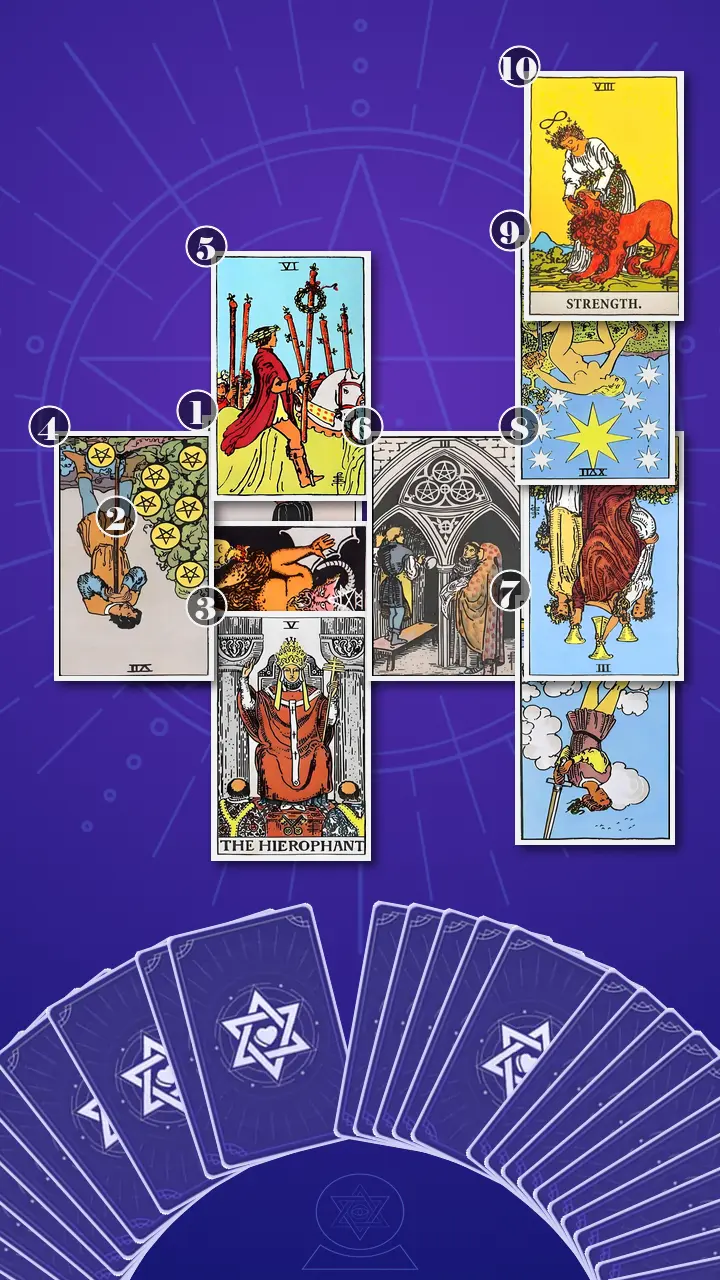
Reading the Map: From Trigger to Pattern
Position 1 — The present trigger and immediate felt reaction
“Now we’re turning over the card that represents the present trigger and the immediate felt reaction—what jealousy is doing in the moment,” I said.
Five of Cups, upright.
“This is like what you described,” I told her, keeping my voice calm and plain. “You see the promotion post and your attention instantly narrows to what you don’t have: the title, the public praise, the timeline proof. You reread the caption and comments like they’re evidence. And at the same time, your steady progress—skills, reliability, relationships, competence—is still there… just behind you, invisible to your jealous brain in that moment.”
In energy terms, the Five of Cups is contraction. Not ‘bad emotion’—just narrowed focus. It’s grief-shaped: not necessarily grief for the friend’s win, but grief for the version of your life you thought you’d be living by now.
Taylor made that tight-laugh again, but this time it had a little bitterness in it. “That’s… kind of mean,” she said. “Like, accurate, but mean.”
“It can feel brutal,” I said. “Because the Five of Cups doesn’t let you pretend you’re ‘fine’ while your body is clearly not. But it’s also a relief—because it tells us the jealousy is specific. It’s not random.”
Position 2 — The main block: what keeps the feeling stuck or makes it louder
“Now we’re turning over the card that represents the main block—what keeps the feeling stuck or makes it louder,” I said.
The Devil, upright.
“This is where jealousy stops being a passing feeling and becomes a compulsion,” I said. “You feel forced to check, compare, and fix. You open LinkedIn, job boards, salary threads, old classmates’ profiles—like your safety depends on monitoring the scoreboard. The trap is it feels productive while it quietly drains your focus and self-respect.”
I leaned into the card’s most practical symbol: the chains around the figures’ necks. “They’re loose,” I reminded her. “It feels locked, but it isn’t locked.”
And then I used the echo technique I’ve learned hits home for people who live online: “It’s like having two tabs open in your mind. One tab is the promotion post—hurt. The other tab is LinkedIn and job boards—control.”
“You’re not even jealous,” I said, letting myself switch into that quick, second-person inner monologue. “You’re just… checking. You’re being proactive. You’re gathering data. You’re ‘researching.’”
Taylor covered her mouth for a second, eyes narrowing like she’d just been read out loud. “Oh no,” she said, and then she nodded, slow. “That’s exactly it.”
“And here’s the Devil’s trick,” I added. “The body tenses and the mind says: scrolling equals safety. But if you close the app, nothing explodes. The only thing that happens is you have to feel the feeling.”
Her shoulders lifted toward her ears without her noticing, and when she noticed, she forced them down. A tiny loosening—choice returning.
Position 3 — The deeper root: the hidden rule jealousy is protecting
“Now we’re turning over the card that represents the deeper root—the hidden rule or belief jealousy is protecting,” I said.
The Hierophant, upright.
“Under the jealousy is a strict internal rule,” I told her. “There’s a ‘correct’ career ladder, and promotions are the official stamp that you belong. You’re not only comparing yourself to your friend—you’re comparing yourself to an invisible authority figure in your head that grades adulthood by titles, timelines, and recognizability.”
I’ve smelled this pattern in people long before they can name it. It’s that sterile, institutional feeling—like fluorescent lights on the TTC at 8 a.m., like the word ‘Senior’ in someone’s email signature looking bigger than it should.
“A promotion post is an announcement, not a verdict,” I said, and I watched her blink as if that sentence hit a tender spot she’d been protecting.
In energy terms, the Hierophant is structure—but here it’s structure that’s become a cage. Not because structure is evil, but because Taylor didn’t consciously agree to the rubric. She just inherited it.
“Whose standards are you using?” I asked. “And which parts of that script don’t fit your actual life anymore?”
She looked down and to the left—memory access. “Probably… my old agency friends,” she admitted. “And my dad, honestly. He’s not even mean, but he’s very… title-y.”
Position 4 — Recent past pattern: what’s been building pressure
“Now we’re turning over the card that represents the recent past pattern—what’s been building the pressure leading to this trigger,” I said.
Seven of Pentacles, reversed.
“Lately you’ve been scanning your progress for proof and coming up impatient,” I said. “Because your growth is quiet—skill-building, consistency, experience—you judge it too early and conclude it’s not working. Then one promotion post hits and it confirms your worst interpretation: ‘See? My effort doesn’t count.’”
This reversal is a timing distortion. The energy isn’t lack of effort—it’s effort that’s being evaluated like a daily stock chart. (I’ve seen this logic on trading floors and in office careers: you refresh for a number because numbers feel clean, and human growth is not.)
“Where have you been expecting a harvest on a timeline that only allows seedlings?” I asked.
Taylor swallowed. Her jaw unclenched for the first time since we started, and then clenched again—like letting go was unfamiliar.
Position 5 — Conscious aim: what you think you need to feel okay right now
“Now we’re turning over the card that represents your conscious aim—what you think you need in order to feel okay about yourself right now,” I said.
Six of Wands, upright.
“What you consciously want is recognition that’s easy to understand at a glance,” I said. “A title change, public praise, a clear win other people instantly validate. It’s not shallow—it’s human. But when recognition becomes the only way you feel okay, every other kind of growth starts to feel pointless.”
This is where my Personal Brand Management lens quietly comes in—not as a corporate buzzword, but as a diagnostic tool. “The Six of Wands is about visibility,” I told her. “And your jealousy is showing you that your current visibility doesn’t match your effort. That gap hurts.”
“So I’m not crazy for wanting… something official?” she asked, almost cautiously.
“Not crazy,” I said. “Just human. We’re going to separate nourishing recognition—being seen accurately—from an applause badge you chase to quiet fear.”
Position 6 — Near-future pivot: what helps convert comparison into constructive movement
“Now we’re turning over the card that represents the near-future pivot—what helps convert comparison into constructive movement,” I said.
Three of Pentacles, upright.
“This is the pivot I love,” I said. “Choosing craft over scoreboard: one concrete project, one measurable skill, one feedback loop. Instead of spiraling, you move the energy into something you can point to—a portfolio piece, a campaign teardown, a case study, a mentorship chat. Progress becomes real because you’re building in public-to-a-few, not performing in public-to-all.”
Then I used the echo technique: two rooms.
“There’s the party room,” I said. “Where everyone’s toasting and you’re secretly counting who got what. And there’s the workshop room—blueprints, tools, feedback, real growth. Same community. Different mirror.”
“Build > browse,” I added, letting the phrase land like a small handle she could grab.
Taylor exhaled, a real one—shoulders dropping a couple millimeters. “Okay,” she said. “That… actually feels doable.”
Position 7 — Self-position: how you’re showing up internally
“Now we’re turning over the card that represents your self-position—how you’re showing up internally, including your mental habits around comparison,” I said.
Page of Swords, reversed.
“Inside, your mind is on patrol,” I said. “You screenshot titles, reread posts for subtext, and run mental simulations you never act on. You confuse vigilance with progress—like if you gather enough data you’ll avoid a wrong move. But the monitoring keeps you anxious and scattered, not clearer.”
In energy terms, this is Air in excess—too much scanning, not enough choosing.
Taylor’s fingers were twisting the drawstring of her hoodie now, tight-tight-loose. “It feels like if I stop watching, I’ll miss something,” she admitted.
“That makes sense,” I said. “But the Page of Swords reversed is the part of you that’s trying to prevent shame by preventing risk. And it’s exhausting you.”
Position 8 — Social field: what your environment reinforces
“Now we’re turning over the card that represents your social field—what your friend group, workplace culture, and social media feed are reinforcing,” I said.
Three of Cups, reversed.
“Your social world is a mixed mirror right now,” I told her. “Celebrations are happening—but when you’re already tender, a toast can feel like a tally. You might congratulate, then withdraw from group chats, or stop sharing your own updates because it feels safer to be invisible than comparable.”
This is where my Social Pattern Analysis skill clicks in as more than empathy—it’s diagnosis. “The hidden interaction barrier here,” I said, “is that the group chat has become a stage. And when you’re hurting, your nervous system treats stages as unsafe.”
“So you pull back,” I continued, “and then you feel more invisible, which makes the next promotion post sting harder. Not because you’re a bad friend—because the social container stopped feeling supportive.”
Her eyes softened. “I’ve been… ghosting a little,” she said. “Not in a dramatic way. Just… less.”
“That’s the Three of Cups reversed,” I said gently. “And it’s fixable. We can move you from the party room to the workshop room without isolating you.”
Position 9 — The comparison narrative: the hope/fear hidden inside jealousy
“Now we’re turning over the card that represents the comparison narrative—the hope or fear hidden inside the jealousy, what you imagine it means about your future,” I said.
The Star, reversed.
I let a brief silence settle. Even through a screen, the room felt quieter—like Toronto traffic turned down a notch.
“This isn’t just a sting,” I said. “This is the hope dip underneath it. The post doesn’t only make you want a promotion. It makes your imagination go blank.”
And I gave her the vivid line the card demanded: “It’s like you open your own resume and feel nothing—no direction, no spark—just this flat, gray static. Your brain treats someone else’s spotlight as proof your path is dim.”
Taylor stared past her webcam, eyes unfocusing. Micro-reaction chain: her breath paused; then her gaze went distant like a memory replay; then her throat moved as she swallowed hard. “Yeah,” she said, quieter. “That’s… exactly it.”
“What would progress be if nobody could clap?” I asked, softly, not as a motivational quote—more like a flashlight.
She didn’t answer right away. She just nodded once, like she’d found the real question under the loud one.
When Strength Spoke: The Quiet Hand on the Lion
Position 10 — Integration outcome: the most empowering stance you can embody
“We’re turning over what I consider the core integration card,” I said. “This represents the most empowering stance you can embody after seeing what jealousy reveals.”
Strength, upright.
The imagery is simple and radical: a woman with gentle hands on a lion. The lion’s mouth is open—raw feeling, not prettied up. The woman isn’t wrestling it into submission. She’s in relationship with it.
“Your jealousy isn’t asking you to become less ambitious,” I told Taylor. “It’s asking you to stop outsourcing your worth. Strength is self-respect, emotional containment, and gentle discipline that doesn’t require external applause.”
The Aha Moment (and the sentence that changed her posture)
Here’s the setup I could see on her face: that Sunday-night moment—phone face-up, chest tight, rereading the caption like it contains the map to your life—feels so personal it’s almost embarrassing. Taylor had been trapped in the logic of: I need a louder win to feel okay, because quiet progress doesn’t stop the fear.
Not ‘I need a louder win to feel okay,’ but ‘I can steady my heart and choose my next step’—Strength is the quiet hand on the lion, not another scroll through the crowd.
I let the sentence hang for a beat.
Taylor’s reaction came in layers. First, a freeze: her lips parted slightly, and she stopped moving entirely, like her body was waiting to see if the truth would hurt. Then her eyes went glossy—not full tears, but that edge-of-waterline shine when you recognize yourself too clearly. Her shoulders, which had been lifted all session, sank on a slow exhale she didn’t seem to plan.
Then—unexpected reaction—she got a flash of anger. “But if that’s true,” she said, voice sharper, “doesn’t that mean I’ve been doing it wrong? Like… I’ve been wasting time?”
I didn’t rush to soothe. I stayed steady. “It means you’ve been doing what your nervous system thought would keep you safe,” I said. “Scrolling for benchmarks is a safety behavior. It gave you a 10-second hit of control. That’s not ‘wrong.’ It’s just expensive.”
Her hands unclenched in her lap. The anger drained into something more honest—sadness, then relief. “Okay,” she whispered. “I don’t want to keep paying for it.”
I asked the invitation that turns insight into lived memory: “Now, with this new lens, think back to last week. Was there a moment—on the TTC, in bed doomscrolling, at your desk—where this could have changed how you felt? Even by 5%?”
She nodded immediately. “Tuesday night,” she said. “I was in bed, brightness low. I kept refreshing like it was going to show me the answer. If I’d just… put my feet on the floor and picked one thing…” Her voice broke a little, then she steadied herself. “I would’ve slept.”
“That’s the shift,” I said. “Not from jealousy to saintliness. From jealousy spike to one chosen action. This is you moving from harsh comparison loops toward quiet confidence—self-trust built through consistent, measurable effort you can actually control.”
And because my world is scent and presence, I added the metaphor that always makes Strength concrete for my clients: “Strength is like sillage control,” I said. “In perfumery, sillage is the trail—how far your scent travels. You can blast a room, or you can choose a close, steady presence. You don’t need to be louder to be real. You need to be intentional.”
Taylor gave a small, surprised laugh. “That’s… such a good way to put it.”
Build > Browse: Actionable Next Steps for Finding Clarity
I summarized what the whole spread had just told us, in plain language: your jealousy isn’t the villain. The Five of Cups shows the instant loss-focus. The Devil shows the compulsion that pretends to be productivity. The Hierophant reveals the hidden rule—success equals legitimacy. The reversed Seven of Pentacles shows impatience that makes quiet growth feel worthless. The Six of Wands names the real need for recognition. And the Three of Pentacles offers the pivot: move from the highlight reel room to the workshop room. Page of Swords reversed and Star reversed show how monitoring kills hope. Strength is the antidote: hold the feeling, don’t obey it.
“Your cognitive blind spot,” I told Taylor, “is believing that if progress isn’t public, it doesn’t count. That’s the Hierophant’s old script talking.”
“And the transformation direction is clear,” I continued. “From treating achievement as the only proof of worth to building self-trust through consistent, measurable effort you can control.”
Then I offered a few small experiments—actionable advice, not life-overhauls:
- The 7-minute “One Question, One Action” sprintRight after a jealousy trigger, set a 7-minute timer. On paper, write one question: “What skill would make me feel more capable this month?” Then do one tiny build action for the same 7 minutes (open a doc and outline one portfolio piece, draft one slide, or send one email asking for feedback).Your brain will insist scrolling is “research.” Treat this as a temporary experiment: stop when the timer ends—even if you could do more. Quitting on time is allowed.
- Move from the party room to the workshop roomThis week, pick one person you trust (a coworker, mentor, or friend in marketing) and ask for specific input: “Can you look at this one-slide case study and tell me what reads strong vs weak?”Keep the ask small and concrete. One slide, one paragraph, one question. Feedback becomes your mirror—not the feed.
- A 72-hour scoreboard detox (without deleting your life)For three days, turn off LinkedIn push notifications on your phone and keep LinkedIn desktop-only. If specific accounts reliably spike comparison, mute them (not unfollow) for the same 72 hours.Expect the “but what if I miss opportunities?” thought. Remind yourself: this is a short calibration, not a personality change.
Before we wrapped, I offered one of my fragrance-based strategies as a somatic anchor—not a magic trick, just a cue your body can learn. “If you want, use a cleansing citrus spray—bergamot or grapefruit—right after you close the app,” I said. “It’s a sensory line in the sand. Then do your 7-minute sprint. Over time, your nervous system starts associating ‘reset’ with ‘build,’ not ‘browse.’”

A Week Later: The Quiet Proof
Six days later, Taylor messaged me. Not a paragraph, not a manifesto—just a screenshot of her calendar with a 30-minute block labeled: Build > Browse. Under it: a draft case study doc in Google Docs.
“I did the 7-minute thing,” she wrote. “I didn’t feel inspired. I did it anyway. And then I slept. I still woke up and thought, ‘What if I’m behind?’—but this time I laughed a little and opened the doc for ten minutes before touching my phone.”
That’s what a real Journey to Clarity looks like most of the time: not fireworks. A quieter morning. A steadier hand. A life that isn’t being graded by one tiny, shiny snapshot.
When you’re staring at someone else’s promotion with a tight chest and a clenched jaw, it can feel like your whole future is being graded from one tiny, shiny snapshot—and that’s a brutal place to live.
If you didn’t have to earn the right to feel okay through a title change this week, what’s one small, real action you’d choose—just to build trust with yourself again?
This story is adapted from psychological research, written so that those in a similar struggle can see their own pattern in it — and find their next step clearly.These insights are not a substitute for professional psychological, medical, legal, or financial advice.
Learn more about our Journey to Clarity.
How did this insight land for you?
🫂 This Resonates Deeply
🌀 Living This Story
✨ Now I See Clearly
🌱 Seeing New Possibilities
🧰 Useful Framework
🔮 The Confirmation I Needed
💪 Feeling Empowered
🚀 Ready for My Next Step
Author Profile
 AI
AI“As a perfumer for fifteen years, I’ve learned to perceive human boundaries through the delicate metaphor of scent. Relationships need the right amount of space to breathe, and I've seen too many kind souls exhaust themselves trying to please everyone. I’m here with warmth and understanding—not to teach you to be guarded, but to help you gently clear the air and rediscover the comforting, safe boundaries that are rightfully yours.”
In this Friendship Tarot Reading :
Core Expertise
- Boundary Permeability Diagnosis: Identifying friends whose lack of limits is metaphorically 'bleeding into your space' and causing emotional suffocation.
- Vibe Contamination Auditing: Recognizing when a highly sensitive or negative friend is unconsciously polluting your personal psychological atmosphere.
Service Features
- The Space Calibration Ritual: A behavioral directive to implement specific 'digital and physical blank spaces', preventing enmeshment and restoring breathable boundaries.
Also specializes in :
Explore Related Patterns:
Comparison TrapTaylor's thumb moves through the post, the comments, the profile, and the new title as if one more tap might explain why her friend's progress feels like evidence against her. The jealousy does not stay as a single emotional sting; it becomes a comparison loop where the visible markers of someone else's career start crowding out the quieter facts of her own growth. That is the core mechanism of Comparison Trap: the mind turns another person's milestone into a scoreboard, then treats the gap as proof of personal failure. You can see the trap in the way titles, public praise, and timeline proof become louder than skill-building, consistency, relationships, and competence. What jealousy reveals here is not that Taylor is a bad friend. It reveals that her attention has been trained to use other people's visibility as a mirror for her own worth, which makes every public win in her social field feel like both a celebration and a threat.
Achievement FusionTaylor names the private logic almost directly: she feels trapped in the belief that she needs a louder win to feel okay. The promotion post hurts because it is not only being read as her friend's achievement; it is being processed as a public measurement of whether Taylor herself is legitimate enough. Achievement Fusion is the pattern where accomplishment and self-worth become welded together. A title change, public praise, or official recognition no longer feels like one meaningful form of progress; it becomes the emotional permission slip to feel okay about being a competent adult. This is why the jealousy lands so deeply. You are not just seeing envy of a role or salary band. You are seeing a worth system where quiet progress does not register unless it becomes visible, named, and validated by a structure outside the self.
Compulsive CheckingTaylor keeps reaching for the phone even when it is not in her hand, and the checking expands from one promotion post into LinkedIn, job boards, salary threads, and old classmates' profiles. The behavior looks like research on the surface, but the nervous system logic underneath is much more urgent: if she keeps monitoring the scoreboard, maybe she can feel less exposed. Compulsive Checking fits because the scroll is functioning as a safety behavior. It gives a short hit of control, then quietly drains focus and self-respect because the checking never actually resolves the emotion it is meant to manage. The important reveal is that Taylor is not simply curious about career information. You are watching the mind convert jealousy into surveillance, using data gathering to avoid the more vulnerable question underneath: what would she choose next if she stopped trying to calm herself through benchmarks?
Deficit FixationTaylor sees the promotion post and her attention immediately contracts around what is missing: the title she does not have, the praise she is not receiving, the timeline proof that seems to belong to someone else. At the same time, her existing competence, reliability, relationships, and steady skill-building are still present, but they become psychologically unavailable. Deficit Fixation is the cognitive pattern of scanning for the gap until the gap starts to feel like the whole truth. The jealous mind does not simply notice a difference; it edits the self-assessment until only lack remains visible. This matters because the pain is not created by comparison alone. It is intensified by selective attention, where one shiny external marker becomes more believable than all the less dramatic evidence that Taylor is already building something real.
Visibility AvoidanceTaylor does not only compare privately; she starts pulling back socially. The story shows her congratulating, then withdrawing from group chats or sharing less, because the group space has begun to feel like a stage where she might be measured. Visibility Avoidance is the protective move of becoming less seen so you cannot be compared. It reduces exposure in the short term, but it also cuts Taylor off from the kind of workshop-level support, feedback, and belonging that could make her feel less alone. The jealousy reveals a social safety strategy. You can understand why invisibility feels safer when comparison hurts, while also seeing the cost: the less Taylor participates, the more other people's visible milestones become the only mirror left in the room.
Social Clock ComplianceTaylor's jealousy is organized around a very specific rubric: the correct career ladder, the official title, the recognizable marker that says adulthood is on schedule. When she mentions old agency friends and a title-focused father, the promotion post becomes more than a friend's update; it activates an inherited standard she did not fully choose. Social Clock Compliance describes the habit of measuring your life against an external timetable for what should have happened by now. The psychological pressure comes from treating promotions and titles as official stamps of belonging, rather than as one possible expression of a much wider career path. What the jealousy reveals is a borrowed scoreboard. You can feel the difference between ambition that comes from self-respect and ambition that comes from trying to satisfy an invisible authority figure who keeps grading your timeline.
Explore Related Struggles:
Comparison EntrapmentTaylor sees one friend's promotion post and her body treats it like a ranking event: the tight chest, the clenched jaw, the exact timestamp, the tap into comments and profile details. The post is not only information about someone else's career; it becomes a mirror that shrinks her own progress while making the public scoreboard feel urgent. You can see the struggle in the way comparison promises clarity but keeps moving the target. Checking titles, salary threads, classmates' profiles, and job boards feels like getting oriented, yet each check routes her attention through someone else's visible win before she can name her own next step. Comparison Entrapment fits because the trap is structural, not petty. Taylor is not simply jealous of one friend; she is caught in a field where visible advancement becomes the measuring system for safety, timing, and self-respect, and the exit begins when she moves from browsing the scoreboard to building something she can actually choose.
Inner Compass NumbnessTaylor describes the deeper dip under the jealousy as opening her own resume and feeling nothing: no direction, no spark, just gray static. Someone else's spotlight does not only make her want a promotion; it makes her own future briefly harder to imagine. You can see the compass go numb when the feed becomes the only orientation system. Refreshing promises a map, but each pass through the scoreboard makes her own path feel less vivid, until direction has to be rebuilt through one small chosen action rather than another comparison scan. Inner Compass Numbness fits because the story's central reveal is not simply envy; it is a temporary loss of contact with her own desire and direction. The jealousy points to the place where external benchmarks have become louder than the internal signal she needs in order to move.
Performance-Worth FusionTaylor keeps returning to the same equation: a title change, public praise, and a clean promotion announcement would make her feel okay about herself. Her own skills, reliability, relationships, and competence are still there, but they stop feeling like proof once they are not stamped by a recognizable external win. You are watching worth get routed through performance evidence. The friend's promotion does not only trigger wanting; it activates a grading system where adulthood, legitimacy, and belonging are measured by titles, timelines, and whether other people can instantly understand the achievement. Performance-Worth Fusion fits because the story shows achievement becoming more than achievement. When progress has to be public before it feels real, self-respect becomes dependent on applause, and quiet growth starts to feel pointless even when it is still building a life.
Prestige Path LockTaylor names the hidden rule under the jealousy: there is a correct career ladder, and promotions are the official stamp that she belongs. The friend is not the whole issue; the post activates an older rubric shaped by agency peers, title-heavy environments, and the idea that recognizable advancement is the only legitimate track. You can feel the lock when an announcement starts behaving like a verdict. A normal career update becomes evidence in a private evaluation system, and Taylor's actual life has to defend itself against a prestige script she did not fully choose. Prestige Path Lock fits because the jealousy is tied to a narrow map of success. The struggle is not ambition itself; it is being pinned to a path where legitimacy depends on visible ladder movement, even when her own craft, pacing, and values may need a different measurement system.
Recognition-Progress SplitTaylor's steady progress is named in the story: skills, reliability, relationships, competence, consistency, and experience. But when the promotion post lands, her attention narrows to the friend's title, the comments, the praise, and the timeline proof, while her own quieter evidence drops out of view. You can see the split between progress and recognition in how quickly the visible marker outranks the lived work. The promotion is easy to understand at a glance, while her own growth requires slower attention, context, and trust in evidence that does not automatically generate applause. Recognition-Progress Split fits because Taylor is not empty-handed; she is disconnected from the forms of progress that are not publicly certified. The jealousy reveals a painful mismatch between what she has actually been building and what her nervous system is willing to count as proof.
Delayed Reward FatigueTaylor has been scanning her progress for proof and coming up impatient. The story makes the timing distortion concrete: she evaluates skill-building and consistency like a daily stock chart, then reads one promotion post as confirmation that her effort has not counted. You can hear the fatigue in the harvest metaphor. Something may be growing, but the measurement system demands proof too early, so early-stage development gets misread as stagnation and effort starts to feel unrewarded before it has had time to compound. Delayed Reward Fatigue fits because the jealousy is intensified by a broken relationship with time. Taylor is not only comparing outcomes; she is exhausted by waiting for quiet work to become visible, and that exhaustion makes another person's public milestone feel like evidence against her own process.
Vigilance-Execution SplitTaylor's mind goes on patrol after the promotion post: LinkedIn, job boards, salary threads, old classmates' profiles, screenshots, rereads, and mental simulations. The activity looks like staying informed, but the story keeps showing that monitoring becomes a substitute for choosing. You can feel the split in the line between safety and execution. Watching the scoreboard gives Taylor a brief sense of control, while the next useful step is much smaller and more exposed: outline a case study, ask for feedback, open the document before touching the phone. Vigilance-Execution Split fits because the struggle is not a lack of intelligence or effort. It is an attention system caught in scanning mode, where preventing the wrong move takes up the energy that could have gone into one grounded action.
Explore Related Emotions:
Comparative JealousyTaylor sees the promotion post at 9:37, then follows the chain from caption to comments to profile to new title, as if the title might contain a map she is missing. Her chest tightens, her jaw works, and the line 'I am happy for her' comes out like a disclaimer rather than a settled truth. Comparative Jealousy names the sting that appears when someone else's visible milestone becomes a measuring device for your own life. You are not simply envying the promotion; you are watching your own progress get temporarily erased by the brightness of another person's public proof. The reveal is specific: part of you wants evidence that your effort is real, visible, and moving somewhere. Once that need is named, the feeling stops being a character flaw and becomes data about what kind of recognition and self-trust you are hungry for.
Hollow RecognitionTaylor says she wants something official: a title change, public praise, a clean win other people can understand at a glance. The reading separates nourishing recognition from the applause badge she chases when she needs a fast way to feel okay. Hollow Recognition is the empty aftertaste of being seen only through visible achievement. You may get the badge, the post, or the praise, but if it is being used to quiet a deeper insecurity, the validation has to be refreshed again and again. The jealousy reveals that recognition itself is not the problem. The problem is when external applause becomes the only container strong enough to hold your sense of worth, leaving every quieter kind of growth feeling pointless.
Quiet ShameTaylor's first move is to insist she is happy for her friend, quickly, as if the acceptable response has to arrive before the real one is noticed. Later, when the insight lands, she gets sharp and asks whether she has been doing it wrong or wasting time. Quiet Shame is the private shrinking underneath the comparison. It is not a dramatic collapse; it is the subtle sense that your reaction exposes something embarrassing, immature, or behind schedule. The jealousy reveals a tender place where you have been judging the feeling instead of listening to it. When shame is allowed to soften into information, it can show you what you want without turning that want into a verdict against who you are.
Status AnxietyTaylor does not just see a new job title; she sees the caption, the comments, and the word 'Senior' acting like an official scoreboard. Old agency friends, workplace culture, and a title-focused parent all gather into an invisible standard that grades adulthood by recognizability. Status Anxiety is the pressure that rises when public rank starts feeling like proof of personal safety. You begin reading titles, timelines, and applause as signals of whether you belong in the room, even when your actual skills and relationships have not disappeared. What the jealousy reveals is a borrowed metric sitting too close to your self-respect. The work is not to stop wanting progress; it is to notice when the public ladder has started making private worth feel conditional.
Timeline ShameThe promotion post lands on top of a quieter story Taylor has already been telling herself: by now, there should have been a clearer harvest. Her growth has been skill-building, consistency, and experience, but she keeps checking it like a daily stock chart and then hears the friend's update as confirmation that she is late. Timeline Shame is the shrinking feeling that comes from measuring your life against an imagined schedule. You are not only seeing where your friend arrived; you are suddenly standing beside the version of yourself you thought would exist by this point. The emotion reveals how harshly your inner clock has been supervising you. It asks for a cleaner distinction between genuine ambition and the old pressure to prove that your life is happening on time.
Unseen Effort GriefTaylor's steady progress is named in the reading: skills, reliability, relationships, and competence are still there, but they sit behind her when the jealous brain narrows onto the promotion post. The painful line is not that she has done nothing; it is that what she has done does not look shiny enough to count. Unseen Effort Grief captures the ache of working, learning, and staying consistent while the visible world seems to reward only announcements. You can know you have been building and still feel hollow when no title change or public celebration reflects it back. The jealousy reveals a need to make quiet growth tangible before resentment turns it invisible. Your effort needs a mirror that is more accurate than the feed: a portfolio piece, a feedback loop, a case study, a record of real competence.
Cautious Self-TrustSix days later, Taylor sends a screenshot of a calendar block labeled Build > Browse with a draft case study underneath it. She still wakes up with the thought, 'What if I am behind?', but this time she laughs a little and opens the doc before touching her phone. Cautious Self-Trust is not the instant certainty that everything is fine. It is the early evidence that you can feel the comparison hit and still choose a response that protects your future self. The jealousy reveals a place where trust has to be rebuilt through proof, not hype. Each small kept promise makes the feed less powerful, because your body starts learning that you have another way to regain steadiness.
Grounded AgencyTaylor puts the phone face-down, takes one slow inhale, and names the topic in one sentence. Later, the shift becomes practical: feet on the floor, one question, one tiny build action, and a draft case study instead of another scroll through the crowd. Grounded Agency is the feeling of returning to the part of your life you can actually touch. You do not have to win the whole comparison argument in your head; you need one controllable movement that proves you can respond without obeying the spike. The jealousy reveals where your power has been leaking into the feed. Agency comes back in small units: a boundary, a breath, a document, a feedback request, a next step that belongs to you.
Hypervigilant AnxietyAfter the post, Taylor's attention scatters across LinkedIn, job boards, salary threads, and old classmates' profiles. Her fingers reach for the phone even when she is not holding it, and later she admits that if she stops watching, it feels like she might miss something. Hypervigilant Anxiety is the body-level sense that constant monitoring is keeping you safe. The scrolling feels like research and the checking feels proactive, but underneath it, your system is trying to outrun the discomfort of not knowing where you stand. The reveal is that control has become expensive. You are gathering more inputs than your self-trust can digest, and the next clear step comes only when the phone goes face-down long enough for one chosen action to become possible.
Explore Related Contexts:
Algorithmic Comparison LoopThe promotion post does not stay as one post. Taylor's thumb moves from caption to comments to profile to title, and the story later names the wider circuit: LinkedIn, job boards, salary threads, and old classmates' profiles all become places to keep checking. A platform like LinkedIn packages other people's milestones into quick, repeatable comparison units. The algorithmic surface makes it easy for a friend's career update to become a chain of professional benchmarks, where every click seems to promise useful information but mostly renews the pressure to measure yourself. Your jealousy is revealing the shape of that external loop. The issue is not that you noticed someone else's progress; it is that the feed keeps converting their visibility into evidence about your own timeline.
Life Script PressureTaylor identifies old agency friends and her father's title-focused standards as part of the comparison frame. The promotion post lands inside a script she did not fully choose, where the right title appears to prove that a person is on the proper adult path. The structural pressure comes from a career culture that makes legitimacy look narrow and public. Titles, seniority markers, and recognisable advancement become shorthand for being on track, even when a person's real work is more complex than the label attached to it. Your jealousy is pointing at the inherited script around success. It shows where you may be using a social rubric that makes your life easier to grade but harder to inhabit with agency.
LinkedIn Performance LoopTaylor sees the phone light up at 9:37, opens the promotion post, then taps through comments, the profile, and the new title as if the screen might reveal a secret map. The story keeps returning to LinkedIn, job boards, salary threads, and old classmates' profiles, which turns one friend's announcement into a whole professional surveillance circuit. The external pressure here is not just envy between two people. LinkedIn turns career movement into a public feed where titles, applause, and timing are made instantly visible, while quieter forms of progress stay harder to verify. You are placed inside a platform environment that rewards checking, comparing, and performing certainty. That is why the jealousy reveals more than a private feeling. It points to a loop where professional visibility becomes the scoreboard, and where scrolling can feel like control even when it drains the focus needed for real next steps.
Personal Brand PerformanceTaylor's attention locks onto the new title, the promotion caption, the comments, and the public praise. The story explicitly names her wish for recognition that is easy to understand at a glance: a title change, a clear win, and validation other people can instantly read. That creates a professional stage where visibility starts to outrank substance. Skills, reliability, relationships, and competence may be present, but they do not travel through the feed as cleanly as a promotion announcement does. The jealousy reveals a mismatch between effort and visibility. You are seeing the pressure of a personal-brand economy, where work can feel less real until it becomes publicly legible.
Social Clock PressureTaylor does not only see a friend's new title; she reads it against a timeline. The story names the hidden rule directly: there is a correct career ladder, and promotions look like the official stamp that someone belongs. That rule gives the promotion post its weight. Old agency friends and a title-focused parent become part of a wider social clock, where adulthood is measured through recognisable milestones and public career movement. Under that pressure, quiet competence can look late simply because it is less visible. The jealousy reveals the pressure of being graded by timing. You are not just reacting to a friend's success; you are confronting an external timeline that tries to decide whether your progress is legitimate.
Friendship Spotlight TestTaylor says she is happy for her friend, but the friend's promotion post still makes her feel smaller. Later, the story shows how she may congratulate, withdraw from group chats, or stop sharing her own updates because being invisible feels safer than being comparable. The friendship space is being reshaped by public achievement signals. A celebration that should belong to connection starts functioning like a tally, and the group chat becomes a stage where everyone can be silently ranked. Your jealousy is revealing a social test inside the friendship. The question is not whether you can be a good friend while hurting; it is how to stay connected when the spotlight turns peer success into a mirror you did not ask to stand in.