Version 17 Stayed Closed: Publishing Became Contact, Not a Verdict
The Upload Window That Felt Like a Verdict
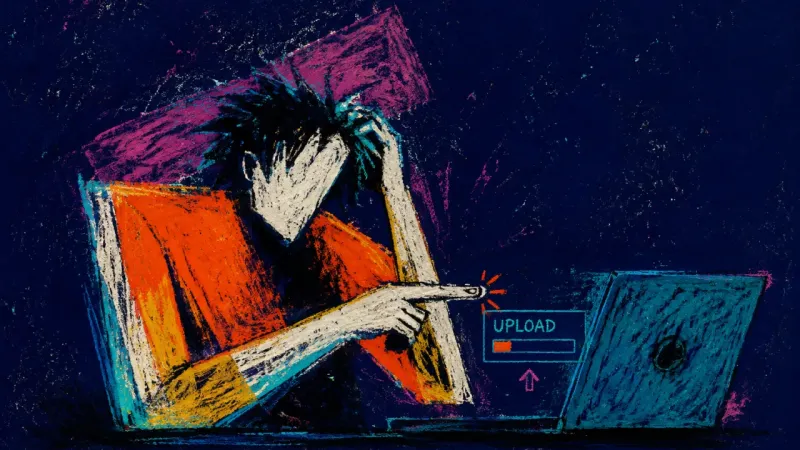
I recognized Casey, a Toronto freelance illustrator, in the familiar moment when a nearly finished personal piece is open after dinner but the upload window makes one more color adjustment feel essential. That is creator visibility anxiety, not a lack of ideas.
At 8:47 p.m. on a Tuesday, I watched Casey zoom into version 17 of an illustration in their apartment studio. The laptop fan pushed warm air over their right hand, the fridge hummed behind them, and a mug of cooling coffee smelled faintly burnt. On the second monitor, Adobe sat beside an Instagram launch from another artist, a polished public result beside Casey's private draft. Their fingers hovered over Upload, then returned to the line break.
Casey had already met the brief they had set for the piece. Unlike client work, which came with a deadline and a clear handoff, this personal illustration could remain in a private Dropbox folder forever. They wanted to publish creative work, but feared exposing it before it felt perfect.
“I am not procrastinating because I am protecting the quality,” Casey told me. “I want people to see my work, but I want to control what they see first. One more pass will make it undeniable.”
The apprehension in their body looked like a drawstring pulled tight around a bright wish. Their jaw locked, their chest held a heavy pause, and their hands kept searching for measurable flaws because a flaw on the screen felt easier to manage than a stranger's opinion.
I did not treat that pattern as laziness or a character failure. I could see the intelligence of the protection, and also the cost of keeping the work outside real contact. “We can look at the pattern without shaming it,” I said. “Our aim is to make a map of this fog, so you can decide how much visibility is honest and workable for you.”
From Workbench to Window
I asked Casey to place their phone face down, take three unhurried breaths, and hold the question in a single sentence: What keeps me polishing my creative work instead of publishing it? I shuffled slowly, using the pause as a psychological transition from reacting to observing, not as a way to summon a fixed prediction.
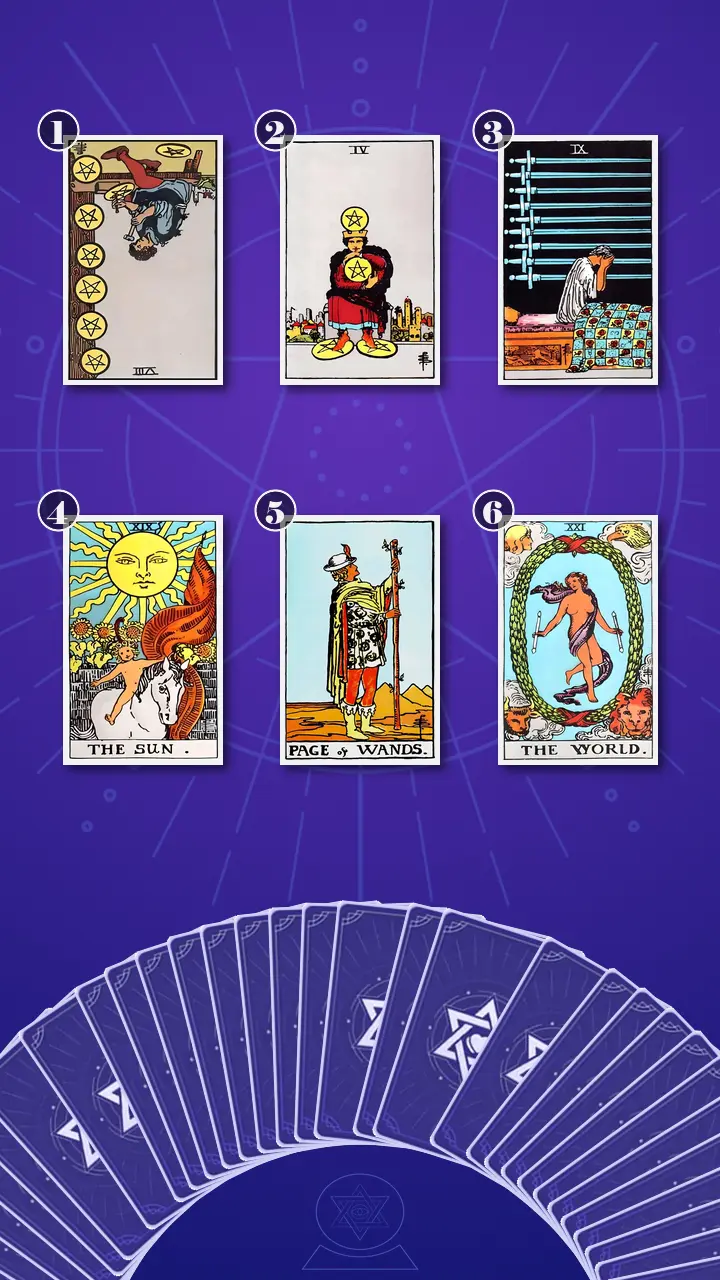
I chose the Transformation Path Grid (6) · Context Edition, a six-card spread designed for a repeating system rather than a one-time decision. Tarot, as I use it through a Jungian psychological lens, is a visual thinking tool: the symbols give shape to a pattern that can otherwise remain diffuse, while Casey remains the person who evaluates the evidence and chooses what to do.
For anyone wondering how tarot works in a creative publishing reading, this spread maps the full handoff from making to sharing. The top row shows the visible symptom, the protective blockage, and the underlying root. The lower row shows the turning point, the immediate action, and the integrated lesson. A Celtic Cross could hold more material than this question needs, while a simple decision spread would make publication look like a single yes-or-no choice instead of a loop that repeats every time the Upload button appears.
I told Casey that the first card would show the concrete polishing behavior, the second would reveal what withholding was protecting, and the third would expose the imagined judgment beneath it. Then The Sun would act as the bridge, the Page of Wands would offer a small publishing experiment, and The World would ask how completion could include the handoff.
The Private Loop, Card by Card
The Workbench of Version 17
Now I turn over the card for the visible manifestation of the problem: the concrete polishing and delayed-publishing behavior identified in the presenting problem. It is the Eight of Pentacles, in reversed position.
In the Rider-Waite-Smith image, a worker bends over one pentacle while a neat row of completed pentacles waits on the wall. I saw the digital equivalent immediately: at 10:02 p.m., Casey reopens an illustration whose line break is already readable and whose colors already work, then lifts the shadows by two percent because the upload page has made the file feel newly unfinished.
Reversed, the disciplined earth energy is not absent. It is overextended and blocked. Practice has become repetitive labor without a stopping rule, and technical effort is doing the emotional job of postponing visibility. The extra edit provides a small burst of relief, but it does not necessarily improve meaning, readability, or access. It simply returns Casey to the workbench, where control feels available.
One more pass can be craft, or it can be a hiding place.
Casey gave a short, bitter laugh. “That is too accurate. Almost cruel.”
“I hear why it lands that way,” I said. “The card is not asking you to lower your standards. It is asking you to notice whether the next change genuinely serves the viewer or mainly makes the moment of being seen disappear for another hour.”
Casey's hand stopped above the trackpad, then moved to the mug. They rubbed the warm ceramic with their thumb and looked away from the screen, recognizing that the problem was not a lack of care. It was care being recruited to keep a private loop alive.
I asked, “When you say one more edit, what exact detail are you changing, and what do you imagine would happen if you left it alone?”
The Coin Held Against the Chest
Now I turn over the card for the immediate blockage: how Potential Hoarding protects the work and reinforces Creator Visibility Paralysis through control and withholding. It is the Four of Pentacles, in upright position.
The figure presses one coin against the chest, pins two beneath the feet, and balances another on the head, with a walled city behind them. In Casey's life, the coin became the high-resolution master file in a private Dropbox folder, the cropped screenshot sent to a collaborator instead of the portfolio link, and the carefully selected preview that allowed reassurance without ordinary audience contact.
Upright, this is control and security held in excess. I did not read it as selfishness. I read it as a protective grip that has become too tight to receive new information. Casey can control the file, the folder order, the caption, and the imagined best version. What they cannot learn while the work stays protected is how an actual viewer experiences it, which detail communicates clearly, and which uncertainty is merely being predicted.
I placed two sentences beside each other in my notebook: “I am protecting the quality” and “I am protecting myself from a possible verdict.” The difference mattered because the first sentence described a professional standard, while the second named the fear beneath the standard.
Private potential feels safe because it has never had to answer back.
I also told Casey that privacy itself was not the enemy. A small trusted exchange, a limited audience, or a scheduled release could all be valid choices. The point was not to make public visibility morally superior to privacy. The point was to let Casey choose the size of contact instead of allowing fear to choose zero contact by default.
Casey's shoulders lifted toward their ears. They pressed both palms against their thighs, then let one hand open. A flicker of shame crossed their face, followed by something steadier: recognition of the short-term relief that polishing provided and the isolation it quietly maintained.
The Comment Thread That Never Arrived
Now I turn over the card for the underlying psychological mechanism: the feared judgment and self-worth threat that make another revision feel safer than publication. It is the Nine of Swords, in upright position.
The seated figure with their head in their hands and the nine swords mounted on the wall turned invisible criticism into a visible nighttime script. I connected it to 11:36 p.m. on the TTC, when Casey had scrolled through a peer's polished launch under buzzing fluorescent lights, saved the carousel, and reopened their own draft. I could also see the bedroom version: a caption being mentally rewritten while the post did not yet exist.
Here Air is in excess. The mind is rehearsing every possible comment, low-engagement outcome, and stranger's interpretation before any of those events have occurred. Casey edits the illustration the next morning to quiet a conversation that never happened. The fear is not simply that someone may dislike a line or caption. It is the feared conclusion underneath: If this visible version is weak, perhaps I am not worthy of being taken seriously as a creator.
I asked Casey to listen for the sentence beneath the revision. They said, “If I publish this version, everyone will see the gap between what I can imagine and what I can make.” I answered with the question I use when a private review panel has begun to sound like evidence: “What is the difference between changing something because it clarifies the work and changing it because it quiets an imagined verdict?”
Casey stopped breathing for a beat. Their eyes unfocused as if a sequence of old upload screens were replaying behind the current one. Then they winced, exhaled through their nose, and gave a small nod that contained both discomfort and relief. The fear had been loud, but it was no longer invisible.
When The Sun Made the Upload Screen Smaller
I paused before turning the next card. The room remained quiet except for the laptop fan, yet the blue light from the monitor seemed less like a wall and more like a frame around the work.
Now I turn over the card for the turning point: the quality of visibility and self-expression that can challenge the Manifestation Gap without requiring perfect certainty. It is The Sun, in upright position. This is the key card, and its strategic role is the Bridge.
The radiant sun, the child on the white horse, the red banner, and the sunflowers offered a direct contrast to the Nine of Swords' dark bedroom. The Sun did not promise praise, a successful launch, or instant confidence. It changed the conditions. One clearly framed illustration could be seen in honest light without being submitted as a final exam for Casey's talent.
At this point, I used my signature Imposter Syndrome Auditing. I drew two columns: verifiable professional competence and subconscious fears of exposure. In the first column, I wrote that Casey had delivered client work under real deadlines, met briefs, managed digital content projects, and built an illustration through seventeen versions. In the second, I wrote the predictions: strangers will notice the gap, silence will prove inadequacy, criticism will define the creator.
The audit did not demand that Casey pretend criticism would never happen. It separated objective evidence of competence from an old fear trying to wear the costume of evidence. That distinction was the sharpest tool in the reading.
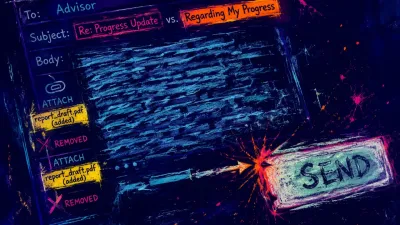
At 8:47 p.m. in the Toronto apartment turned studio, Casey had reopened an illustration to adjust one line, checked a peer's polished launch, and left the upload page glowing beside cooling coffee. The edit felt like craft, but the upload button felt like judgment. I could see the whole loop in one small rectangle of light.
You do not need to keep Potential Hoarding in place until visibility feels risk-free; let The Sun's open light turn one clear, finished experiment into honest contact.
The work does not become safer by staying invisible. One bounded release lets it meet real people without asking it to prove your entire worth.
Casey went still. Their breath paused high in their chest, and their pupils seemed to widen before their gaze dropped to the exported file. Then their eyes lost focus, as if the glowing upload screen had opened onto every private comment thread they had simulated in Notes. Their jaw trembled once. Finally, their clenched fingers loosened against the table, their shoulders lowered, and their eyes grew slightly red. “But does that mean I have been wrong all along?” they asked, their voice smaller than before. I waited until the question had room to exist. “No,” I said. “Your protection made sense. It simply cannot also provide the contact you need to learn.” A shaky breath left them, followed by a brief, almost startled smile. The relief carried a little dizziness: clarity had removed the old excuse, and the open path now belonged to Casey.
Now, use this new perspective to recall last week: was there a moment when separating being visible from being evaluated could have made your body feel different?
This was the first meaningful movement from fear-driven over-refinement and private potential hoarding toward bounded visibility, curious creative contact, and grounded completion. The Sun's open self-expression was not a command to floodlight an entire portfolio. It was permission to make one honest frame, choose its audience, and observe what real contact taught.
The Small Message on the Wand
Now I turn over the card for the immediate action: a small, bounded publication experiment that converts the key shift from endless refinement into observable practice. It is the Page of Wands, in upright position.
The Page gazes at a budding wand in an open landscape. I read that gaze as curiosity directed toward what a release might teach, not toward whether Casey had achieved permanent mastery. In contemporary terms, this could be one personal post, a short process clip, or a limited portfolio update with a simple format and one defined audience.
The Page's fire is available but not theatrical. Casey did not need to announce a new artistic identity, launch a full brand, or make one illustration represent an entire career. They needed a beginner's message: a piece carried into the world while the creator was still learning.
Casey looked at the upload button again. Their hand did not reach for it yet, but their fingers stopped opening the file. “I could share one process clip,” they said. “That feels less like presenting a finished self.”
“Exactly,” I said. “The question is not, Will this prove I am good enough? The question is, What might real contact teach me?”
The Wreath Around a Finished Loop
Now I turn over the card for the integrated learning: a new definition of completion in which sharing becomes part of the creative cycle rather than evidence of fixed worth. It is The World, in upright position.
The central figure inside the oval wreath, the four figures in the corners, and the two wands held in the hands created an architecture of integration. The workbench was becoming a window. Making, finishing, sharing, receiving information, and moving to the next project could belong to one cycle instead of existing as separate rooms.
In practical life, I asked Casey to imagine exporting the exact published file into a folder named Released, writing two lines about what was completed and what might come next, and closing the source file until a chosen review time. The World did not say the piece was perfect or that Casey's development was over. It said a published piece could be complete without being definitive.
Casey drew a slow circle around the words completion includes the handoff. Their mouth tightened with a trace of sadness, the way it can when an old ritual has finally been named. Then they nodded. The next project would not be proof that this one had failed. It could simply be a new surface.
A One-Pass Boundary for Finding Clarity
I read the six cards as a system. Client deadlines had supplied Casey with an external stopping line, while personal work had none. The reversed Eight of Pentacles showed craft turned inward and overworked. The Four of Pentacles showed the protective grip that kept the master file, the audience, and the imagined best version under private control. The Nine of Swords revealed the mental review panel that converted uncertainty into a threat to worth. Then The Sun opened the conditions, the Page of Wands made visibility curious and small, and The World restored the missing handoff.
The cognitive blind spot was not simply believing that more editing could improve a piece. Some edits do improve a piece. The blind spot was mistaking the relief that follows another edit for evidence that the edit was necessary. The deeper pattern was a self-reinforcing loop: visibility activated fear, polishing restored short-term control, private non-publication prevented real contact, and the lack of contact was then used as proof that the work was not ready.
The key shift was clear: move from using endless refinement to prevent judgment toward a one-pass quality boundary and a bounded visibility experiment. The goal was not to force public exposure or promise a positive response. It was to let one finished-enough version meet one real person, collect limited information, and leave Casey in charge of the next choice.
Three Small Next Steps
I offered Casey the following actionable advice. I framed each step as a testable option, not a courage exam. The Six-card Transformation Path Grid had made the mechanism visible; these next steps would let Casey learn from it without turning the solution into another perfectionist project.
- Set a one-pass quality boundaryTonight, choose one personal illustration already marked nearly finished in your private Dropbox or Google Drive folder. Write down the single change that would improve clarity for a viewer, set a 20-minute timer, make that one edit, and export the file. Add the note "Finished enough for contact: [date]" beside the filename.Define what is out of scope before opening the file. If the whole piece feels too exposed, use a crop or process clip and take the 10-minute version. A smaller boundary still counts.
- Make a Bounded Sun ReleaseWithin the next seven days, choose one finished illustration, short process clip, or limited portfolio update on a platform Casey already uses. Write the plain caption "A finished experiment in [subject, texture, or idea]. Sharing it to practice letting the work meet people." Publish or schedule it for a specific time, then close the app and place the phone out of reach for 30 minutes.Choose one defined audience, and limit comments or notifications if that preserves choice. Afterward, record only what was shared, what happened in the body, and one fact learned. Engagement is information, not a verdict on identity.
- Anchor competence and close the loopAfter the release, use my Competence Anchoring Exercise in a plain note for five minutes. Write three verifiable facts about the work, such as meeting the brief, completing the export, or delivering client projects under deadline, then add two lines: "What I completed" and "What I may explore next." Save the exact published export in a folder named Released - [project name], and set one 15-minute review later in the week.The exercise is there to separate demonstrated competence from predicted exposure, not to create another scorecard. At the review time, note useful information, close the old file, and let the next creative session begin on a new surface.
I reminded Casey that stopping was allowed at every stage. A limited collaborator share could replace a public post. A scheduled release could replace an immediate one. The boundary belonged to the creator, and the creator, not the cards, remained the person with authority over the size and timing of contact.
A Week Later, the File Stayed Closed
Six days later, I received a message from Casey. They had chosen one illustration, made one clarity pass, used the finished-experiment caption, and scheduled the post with notifications limited. The message did not announce a transformed career or a perfect wave of confidence. It said, “I posted it, closed the source file, and did not reopen it when the first hour was quiet. I noticed I wanted to, though.”
That was the small proof. The pattern had not vanished; Casey had noticed the urge without automatically obeying it. A collaborator later asked for the portfolio link, and Casey sent the existing link before reorganizing the folders. The act was ordinary, which made it useful.
A week later, Casey had slept a full night after posting; on waking, the first thought was still, “What if I got it wrong?” This time they smiled, left the file in Released, and made coffee before opening analytics.
I saw the journey as a movement from fear-driven over-refinement and private potential hoarding to bounded visibility, curious creative contact, and grounded completion. Tarot had not made the work safe, chosen an audience, or guaranteed approval. It had helped us see the difference between a clarity edit and a hiding place, then Casey made the decision that brought the insight into lived practice.
When you are staring at the publish button with your jaw locked and your chest tight, it can feel safer to keep the work flawless in private than to let one visible version test whether you deserve to be taken seriously as a creator. That feeling deserves care, but it does not get to write the whole conclusion.
If one release could be a bounded experiment rather than a verdict, what small piece would you feel curious to let meet one real person?