Retitling the Thesis Advisor Draft, Then Sending One Bounded Question
The 9:40 p.m. Draft Loop: Delaying an Advisor Email When a Thesis Stalls
I recognized the pattern immediately: a 26-year-old master's student doing part-time research-assistant work in Toronto, ending a low-output week with the same calendar reminder, 'Email advisor,' moved forward again as academic help-seeking procrastination quietly compounds.
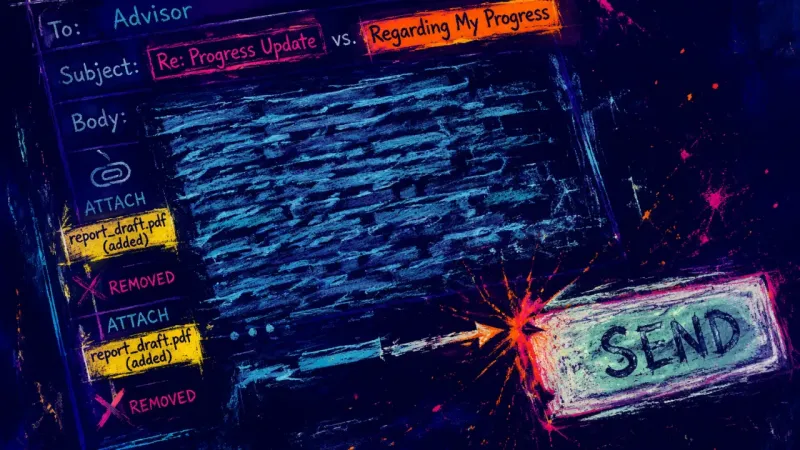
Alex sat at a nearly empty downtown university library table at 9:40 p.m. The frozen thesis paragraph occupied the left side of the laptop, the advisor email draft occupied the right, fluorescent lights hummed overhead, and stale coffee cooled beside the warm keyboard. Alex changed 'Thesis update' to 'Quick question,' attached the same file, removed it, and attached it again.
I watched their hand hover over Send, retreat to the trackpad, and open Zotero instead. They wanted advisor contact to restart the stalled analysis, but delaying the email kept the unfinished part temporarily unseen. The calendar reminder could move to tomorrow, although the question underneath it had not moved at all.
Alex said, 'I keep waiting to recover before I ask for help recovering. Writing the message somehow feels harder than writing the thesis.'
Their apprehension looked to me like a handbrake pulled inside the chest: every breath started, caught, and returned to the draft. Frustration sat underneath it, with the quiet self-consciousness of someone comparing a private low-output week with polished cohort posts that only showed the words, 'Chapter submitted.'
I said, 'I am not going to treat this as laziness, and I am not going to make the cards into a verdict about your degree. We can look at the loop objectively, find where it protects you for ten minutes and costs you for another week, and draw a smaller route back into the work. That is our Journey to Clarity today.'

Choosing a Compass for a Self-Reinforcing Loop
I asked Alex to put the phone face down, take one slow breath, and name the question without polishing it: why do I keep delaying advisor emails when my thesis stalls? I shuffled slowly, using the movement as a practical transition from solitary editing to shared observation. Nothing about the preparation required belief in a supernatural answer. It simply gave the mind one clear object to attend to.
I chose the Problem-Cause-Advice-Outcome · Context Edition, a four-card Rider-Waite-Smith spread. For readers wondering how tarot works in a practical consultation, I use a spread like this as a structured cognitive tool: it separates what is visible from what sustains it, identifies a resource, and turns that resource into a working state. It can give card meanings in context without pretending to predict an academic result.
This was the smallest useful map for the problem. The question contained a self-reinforcing loop: a thesis section stalled, the advisor email was delayed, short-term relief arrived through citations or file cleanup, timely feedback disappeared, and the deeper stall made the next email feel even more exposing. A full Celtic Cross would have added positions without adding much clarity to this particular mechanism. The four-card RWS Problem-Cause-Advice-Outcome tarot spread let me keep the focus on advisor email avoidance, thesis procrastination, and the practical question of how to email an advisor when stuck.
The first position would show the observable symptom, the draft-and-withhold behavior. The second would reveal the belief that kept contact feeling forbidden. The third would identify the recovery lever, and the fourth would show the grounded working state Alex could practice if the advice proved useful. The last position was contextualized as a state of integration, not a fixed future.
Reading the Map: When Fire Stops Mid-Flight
Position 1: The Email That Never Leaves the Outbox
Now I turned over the card for the observable symptom identified in the diagnosis: drafting, editing, and withholding the advisor email when thesis momentum stops.
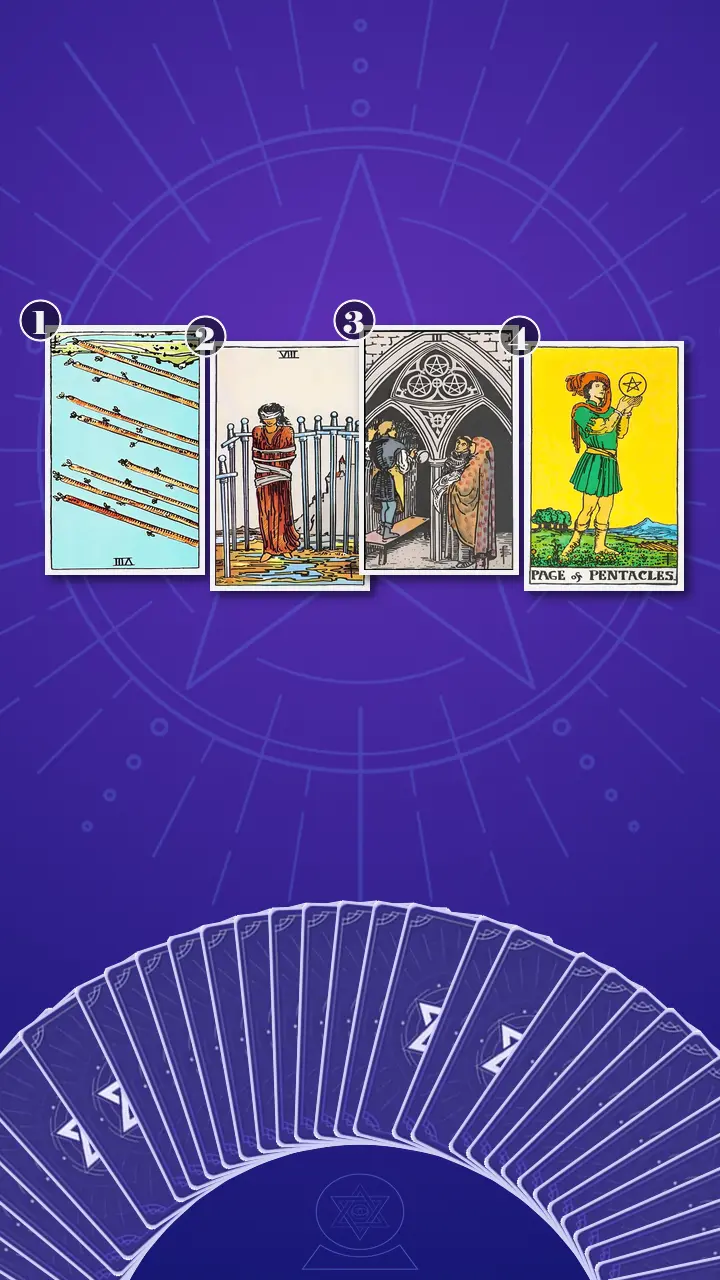
The Eight of Wands, in reversed position.
In the Rider-Waite-Smith image, eight staffs normally cross an open sky with speed and a clear destination. Reversed, the trajectory looks interrupted. I saw the warm laptop, the fluorescent hum, the attachment toggling, and Alex's hand returning to Send before pulling away. The email had an address and a reason, but every extra edit became another object placed in its path.
This was not a deficiency of effort. It was blocked fire, effort repeatedly inserted between intention and transmission. Alex's side quest looked respectable: revise the subject line, soften the opening, clean the citations, rename a PDF, make the attachment more useful. The hidden sentence underneath was, 'The route is clear, but before I let it leave, I need to fix just one more thing.' The more preparation Alex added, the more the message began to resemble a report that needed to prove competence instead of a request for information.
I asked, 'What is the most convincing side quest your brain offers when you are about to email your advisor: citations, attachments, another paper, or rewriting the opening?'
Alex gave a short laugh with a bitter edge. 'That is almost rude. Usually citations. I can make that look productive.' Their eyes dropped to the drafts folder, and one thumb rubbed the cardboard sleeve around the coffee cup.
I said, 'The card is showing an observable loop, not a character flaw. If the email is repeatedly pulled back for another preflight check, the useful question is not how to become more motivated. It is what small sending condition would let the message complete its route.'
Position 2: The Permission System Written in Pencil
Now I turned over the card for the belief that sustains the procrastination loop: contact appears permissible only after the stalled work has already become coherent or defensible.
The Eight of Swords, in upright position.
The blindfold and incomplete ring of swords gave me a precise image of the rule Alex had been living inside: contact allowed only after coherent progress. The enclosure was serious, but it was not sealed. There was visible ground beyond it, and the bindings looked more like a restriction being believed than an external law being enforced.
In ordinary life, this was the moment when Alex read an email as a verdict on competence rather than a request about one research problem. Their internal rehearsal ran in a perfect circle: 'I cannot ask until I understand the block, but if I understood it, I would not need to ask.' Air had become constricting. Analysis was no longer opening options; it was narrowing the field until a simple route, naming one unfinished transition, became difficult to see.
I asked, 'Which part of this readiness rule did your advisor actually state, and which part appeared when your hand reached Send?'
Alex went quiet. Their shoulders rose, their jaw held for a beat, and then their gaze shifted from the card to the blank progress-summary line. I could almost see the permission screen they had built for themselves, like a Notion task with a self-created dependency called Become coherent first.
I did not tell Alex to relax or simply be confident. I asked them to separate control from access to information. Keeping the problem private offered a brief reduction in exposure, but it also prevented the feedback that could make the problem smaller. The Eight of Swords did not promise that the reply would be easy. It showed that the readiness rule was not the same thing as a requirement.
When the Unfinished Arch Became a Bridge
The air in the room changed as I reached the recovery lever. Now I turned over the card for the practical resource that could interrupt avoidance: using the advisor relationship for bounded collaboration around one unfinished thesis problem.
The Three of Pentacles, in upright position.
The craftsperson in the image is not standing before a completed building, waiting for an inspection. The work is still under construction. Two other figures consult the architectural plan, and the unfinished arch gives their conversation a shared object. For Alex, that object could be the stalled transition between the literature review and the analysis, brought to the workshop table while it was still unfinished.
The energy had shifted from interrupted fire and constricting air into grounded earth. The advisor email could say what was done, what was blocked, and what question needed another mind. That was not a confession and not a performance report. It was the first collaborative step in thesis recovery.
This was where I used my Institutional Resource Leverage lens. I do not mean treating a mentor like a transaction or assuming that a university relationship removes every power concern. I mean recognizing that supervision, faculty networks, a graduate coordinator, and student advocacy channels are strategic resources that work better when a student makes a bounded request, chooses what to disclose, and keeps ownership of the decision. Proactive upward management can be warm and ethical when it means making the next useful exchange easier to have.
My years on Wall Street had taught me to ask what a message is designed to move, what information the recipient actually needs, and what decision is being requested. I remembered the difference between a long document that explained every condition and a short one that made the next action unmistakable. Strategic logic did not have to make this cold. In this case, it protected Alex from unnecessary friction.
At 9:40 p.m., the blocked paragraph and advisor draft still shared the screen. Alex had retitled the message, detached the chapter, and opened Zotero, while their hand kept returning to Send and their chest stayed tight. The whole problem had begun to look like a verdict.
I said, 'A stalled thesis is not a problem you must hide until it is fixed. The bounded email that names the block can be the first piece of the repair.'
You do not have to earn contact by producing a finished result; place one unfinished problem on the shared plan, just as the Three of Pentacles turns private effort into collaborative craft.
For three seconds, Alex did not move. Their fingertips hovered above the trackpad, their breath paused high in the chest, and the fluorescent hum seemed to pull farther away. Then their eyes lost focus, not dramatically, but as if the last week were replaying in the reflection of the screen: the empty progress line, the attachment toggled twice, the calendar reminder dragged to tomorrow. Their jaw tightened before their shoulders lowered by a fraction. A small flush rose around their eyes. When they finally breathed out, the sound carried both relief and resistance. 'But does that mean I should have emailed weeks ago?' they asked, with a flash of anger at the time already lost. I heard the vulnerability underneath it. Letting one unfinished problem become visible did not erase the delay; it stopped the delay from being the only private witness. The room did not become magically safe or certain. It became specific. Alex's hand unclenched, then hovered again, this time over a fresh line rather than the old apology. The new openness brought a brief, light-headed blankness: a route was visible, and choosing it still belonged to them.
I asked, 'Now, use this new angle to think back to last week: was there a moment when this insight could have made you feel differently?'
I explained that this was the central movement from contracted apprehension, private overanalysis, and fear of visible stagnation toward bounded collaborative agency. It was not sudden confidence. It was a change in what contact meant. The email was not proof of progress; it was part of the work. Feedback belongs during construction, not only after completion.
Position 4: The One Practical Thing to Learn Next
Now I turned over the card for the integrated working state to practice rather than a predicted event: translating outreach and feedback into one grounded learning task while retaining ownership of the thesis.
The Page of Pentacles, in upright position.
The Page holds one pentacle at eye level while the wider landscape remains present. That concentration mattered. The thesis could remain large, uncertain, and unfinished while Alex selected one concrete object of study. The card's earth was not a demand to stage a total comeback. It was disciplined curiosity applied to one next test.
I connected the image to the likely reply from an advisor. Alex would not need to convert every comment into an emergency list. They could copy one actionable point into the thesis document under a temporary heading called Next test, rewrite one paragraph for twenty minutes, compare the new version with the original claim, and record what became clearer.
Alex opened the notes app and typed, 'My next job is not to fix the thesis; it is to see what happens when I test this clarified claim in one subsection.' Their breathing steadied. They still looked tired, and the old instinct to plan the entire recovery had not disappeared, but their attention had narrowed to something observable.
I said, 'You can receive information without surrendering ownership. A reply is data for you to evaluate, not an instruction to hand over every thesis decision.'
The One-Block Shared Plan: Actionable Advice for the Next 24 Hours
When I placed the four cards in a row, I could see a movement from many uncontrolled objects to one handled object. The two eights multiplied pressure: staffs flying but never arriving, swords surrounding a blindfolded figure, eight imagined requirements competing for control. The Three of Pentacles introduced a shared plan, and the Page of Pentacles reduced the next task to one visible piece. Reversed fire had not needed more intensity. Air had not needed more analysis. The missing correction was earth: name, ask, send, examine, test, revise.
The past influence was not a hidden curse. It was the repeated relief Alex received from keeping the stall private. The current symptom was task displacement, and the inner cause was a self-authored readiness rule mistaken for an advisor requirement. The resource was collaboration around a bounded problem. The integrated state was a learner making evidence from feedback while keeping the thesis in their own hands.
I named the cognitive blind spot plainly: Alex was evaluating the quality of the entire thesis before allowing a conversation about one transition. My Academic ROI Auditing lens helped separate the strategic yield of the next piece of evidence from the emotional pressure surrounding all the hours already invested. One stalled subsection could not answer whether the whole research direction was worthwhile.
Then I introduced my Research Sunk-Cost Audit. I asked Alex to distinguish between sunk effort, live evidence, and the next test. Time already spent on the transition could not be recovered, but it also could not justify polishing the same problem forever. A useful audit asks what the current evidence supports, what question would change the next decision, and whether a twenty-minute experiment suggests revising, narrowing, persevering, or pivoting that particular subsection. That framework made the academic choice more objective without pretending that emotion was irrelevant.
I kept the actions small enough to begin during a real library session, and precise enough that the phrase 'email advisor' could stop being a vague demand.
- Send a bounded work-in-progress update.During the next library session, open a fresh email to the advisor and set a seven-minute phone timer so the old overedited draft does not dictate the structure. Write three labelled lines: Done, naming one completed item; Blocked, naming the exact thesis transition or claim that is not moving; and Question, asking one thing the advisor can answer without reviewing the entire thesis. Add no more than three context sentences, read once for clarity, and send within 24 hours of recognizing the stall.Treat six sentences as containment, not as proof that the problem is simple. Attach a document only if it is needed for the specific question, and leave out an apology for the entire timeline. If the advisor relationship raises a genuine safety or power concern, take the draft to a trusted faculty member, graduate coordinator, or student advocate instead.
- Run the Research Sunk-Cost Audit on one reply.When feedback arrives, copy one actionable point into the thesis document under Next test. Spend 20 minutes rewriting one paragraph or outlining one subsection around that point, then compare the result with the original claim. Record two brief lines: What this test clarified, and What I still need to decide. Use the evidence to choose whether this small part should be revised, narrowed, continued, or reconsidered.Feedback is information, not a command to surrender ownership. The minimum version is one paragraph and one ten-minute test. Do not turn one useful comment into a new demand to rebuild the entire thesis.
- Name the threshold before it becomes another side quest.Before editing the email, pause for 30 seconds and write one directly observable body signal and one emotion in a private note, such as shallow breath and apprehension. Complete the sentence, 'I am trying to manage the possibility that the advisor will ...' Then set a calendar trigger: when the same thesis block has remained unchanged for one day, start the three-line update instead of rebuilding the progress summary.This is a threshold check, not a requirement to disclose personal information to the advisor. If body attention feels uncomfortable, use the visible cue of the hovering cursor and begin with Done, Blocked, Question.
I told Alex that these were experiments, not commandments. A tarot reading could help make the loop visible, but it could not send the message, choose the research direction, or decide whether feedback fit the thesis. Those decisions remained Alex's. The point was to create enough structure for their own judgment to come back online.

A Week Later, One Clearer Line
Four days later, I received a message from Alex: 'I used Done, Blocked, Question. Six sentences. It felt weird, but I sent it before I could clean Zotero again.' The advisor's reply did not solve the thesis or guarantee a smooth timeline. It did give Alex one useful distinction about the transition and an invitation to discuss the narrowed question in their next meeting.
Alex used the Research Sunk-Cost Audit before changing the whole chapter. They tested the advisor's suggestion on one paragraph, saw that the claim became more precise, and wrote down one remaining decision instead of opening twelve new tabs. The change was small, but it produced evidence that contact could lead to work rather than judgment.
The next morning was clear but not weightless. Alex slept through the night, woke with the thought that the revision might still be wrong, and opened the subsection for a twenty-minute test anyway.
I summarized the Journey to Clarity for Alex this way: the goal was never certainty before contact. It was a steadier relationship with the work, built through one bounded question, one relevant response, and one experiment that Alex could assess for themselves.
This four-card RWS Problem-Cause-Advice-Outcome spread did not determine an academic result. It gave a practical language for noticing delayed supervisor outreach, separating a self-authored readiness rule from an actual requirement, and turning advisor feedback into a manageable next step.
When the paragraph stalls and your hand freezes over Send, the hardest part may be wanting contact to restart the work while fearing that the contact will expose how little control you feel you have. Naming that tension does not make the stalled section disappear, but it gives the problem a visible edge instead of leaving it to fill the whole screen.
If contact did not have to prove that you had already recovered, what is the one unfinished question you might be willing to let another person see?