The Pinned Group Chat: From Automatic Yes to One Honest Reply

The Pinned Chat: Dependable-Friend Burnout and the Fear of Losing Friends
I began the consultation with a sentence I had written after listening carefully to the pattern: "You keep the group chat pinned, rearrange your evening around someone else's crisis, and type "no problem" while privately wondering whether dependable-friend burnout is the cost of staying close."
Alex (name changed for privacy) sat across from me in the warm, coffee-scented corner of my Toronto studio. At 8:47 PM on a Tuesday, they had been stirring pasta with one hand and opening the pinned group chat with the other; the exhaust fan hummed above the kitchen, the phone felt warm in their palm, and their shoulders lifted before they even read the urgent message.
"It was just another friend asking if I was awake," Alex told me. "But my body reacted like I had been assigned something. I wanted to protect my dinner and my evening, but I also wanted to prove I was available. What do I fear losing if I stop being the dependable friend?"
I heard fear of relational loss in the way their fingers kept returning to the phone. It was not merely an emotion in the abstract; it was like a smoke alarm wired to every notification, blaring before Alex knew whether there was any fire. Under the guilt sat resentment, and under the resentment was a longing for care to move in both directions.
I leaned forward and said, "I understand why a slower reply can feel much bigger than a delayed reply. We do not have to decide the friendship's future tonight. We can use the cards to tidy up what is observable, what is imagined, and what you genuinely have capacity to offer. Our Journey to Clarity begins by drawing a map rather than treating your fear as a verdict."

Choosing a Map at the Friendship Crossroads
I asked Alex to put both feet on the floor, take three unhurried breaths, and hold the question without trying to solve it. I shuffled slowly while the coffee grinder clicked off in the next room. For me, this was a psychological transition into attention, not a mysterious performance: the pause gave Alex a chance to notice the impulse to answer before the impulse answered for them.
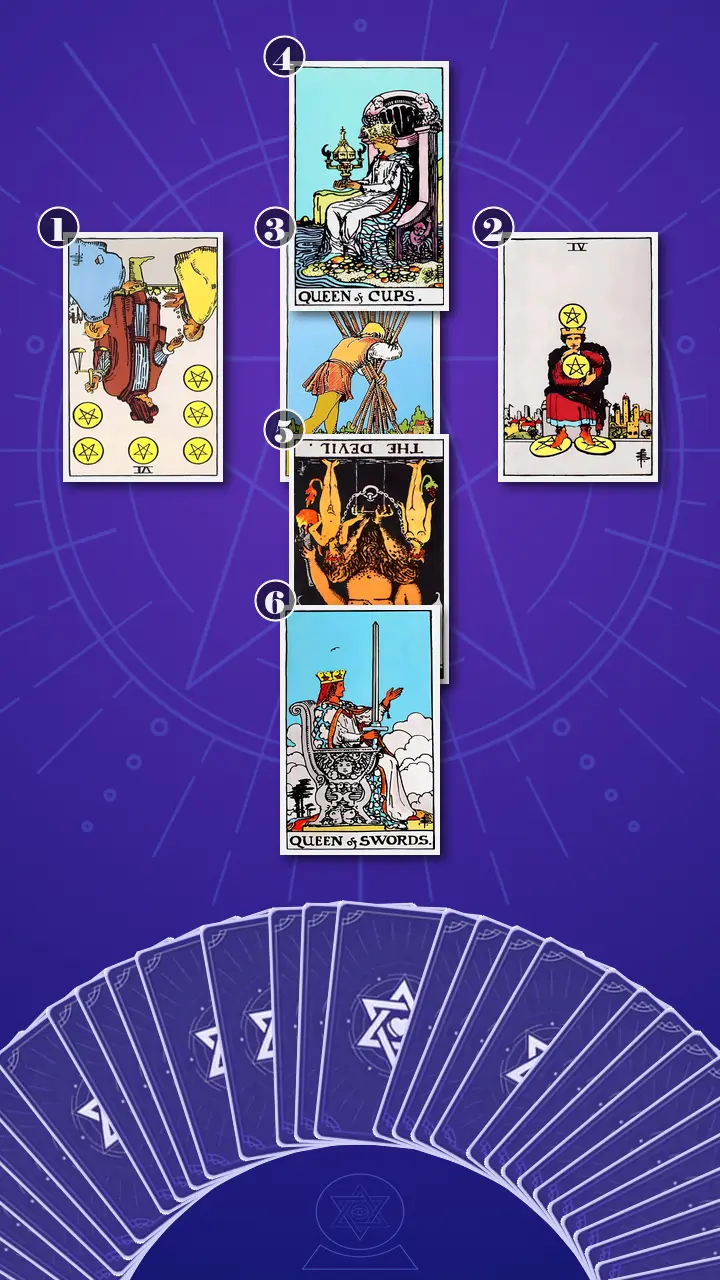
I chose the six-card Relationship Spread - Context Edition. I use this spread when a relationship question contains several layers that need to be separated: the visible behavior, the perceived risk, the exchange between people, the available emotional resource, the shadow pressure, and one self-directed experiment. It is a focused way of exploring how tarot works as an objective cognitive tool. The cards cannot announce what a friend secretly thinks or guarantee who will stay; they can help us examine the story Alex is carrying and compare it with the facts in front of them.
The cross layout placed the third card at the center as the relational hinge. The first card would show Alex's present role and contribution, the second would explore the perceived relational stakes without claiming to know the friend's private expectations, and the third would reveal how unequal giving and hidden needs were functioning together. Above the center, the fourth card would show genuine relational strength. Below it, the fifth would expose the shadow pressure, and the sixth would offer a clear, self-directed boundary experiment rather than a prediction.
I wanted the reading to move from the pinned chat to the body, from the body to the hidden bargain, and from the hidden bargain to language Alex could actually use. That sequence is why this six-card relationship tarot spread was more useful here than a broad forecast. It could meet the friendship boundary crossroads at the exact point where care had become confused with constant access.
Reading the Map: From Holding to Seeing
The Unequal On-Call Desk: Six of Pentacles Reversed
Now I turned over the card representing the present role and contribution: what Alex was actually doing in the friendship, especially the observable dependable-friend behavior. It was the Six of Pentacles, in reversed position.
The RWS image showed a standing giver holding scales while coins moved downward toward two kneeling figures. In modern life, that became Alex as the friendship group's unofficial on-call desk: answering first, booking the appointment, smoothing the awkward group-chat moment, offering the practical fix, and saying "no problem" before checking the time. Support was flowing outward while Alex's own need to receive remained off-screen.
The reversed energy showed an imbalance, with an excess of giving and a deficiency of receiving. The blockage was not Alex's generosity. Their care was real. The blockage was the reflex to give before checking capacity, as if usefulness had quietly become the price of staying close. I asked, "What can you genuinely offer without hiding your limit?" That question moved the scales from private scorekeeping toward honest information.
Alex gave a short, bitter laugh rather than nodding. "That is too accurate," they said. "I say no problem when it is very much a problem. Then I wait for someone to notice without telling them anything."
I did not rush to make the card gentler. "The Six of Pentacles is not accusing you of caring too much," I said. "It is showing that your care has become the main way you participate, while receiving care has become difficult to request. We can work with that without turning your friends into villains or your generosity into a mistake." Alex's fingers stopped tapping the mug, and the first layer of dependable-friend burnout became visible without shame.
The Coin Held to the Chest: Four of Pentacles Upright
Now I turned over the card representing the perceived relational stakes: what Alex believed might be lost if dependability decreased, while keeping the focus on their perception rather than claiming to know what the friend privately expected. It was the Four of Pentacles, in upright position.
The figure on the card pressed one coin against the chest, anchored two beneath the feet, and balanced another above the head. I connected that image to a familiar Toronto scene: a friend sends "Can you talk?" Alex holds the phone close, checks the read receipt, and moves a solo plan in Google Calendar before finding out what is needed. The guarded coin becomes the dependable identity itself. Releasing availability feels capable of releasing security, closeness, and the reassurance of being needed.
Here the energy was an excess of control and a deficiency of trust in connection beyond immediate access. I asked Alex to complete the sentence, "If I do not answer now, they might..." Their chest tightened before they finished the thought. The imagined ending was not simply that the friend would be disappointed. It was that the friendship would cool, the group would adjust, and Alex would discover they had only been valued because they were useful.
"Being needed is not the same as being known," I said. "Which loss is actually being imagined: the friendship, the dependable role, or the reassurance that arrives when you are the person they need first?"
Alex went quiet. I watched their gaze move from the coin on the card to the phone face down beside the spread. After a long pause, they named one specific task they always carried: organizing plans, remembering details, and repairing tension before anyone asked. The pause did not solve the fear, but it separated losing the relationship from losing a familiar position inside it.
The Load That Blocks the View: Ten of Wands Upright
Now I turned over the card representing the interaction pattern: how the exchange between Alex and their friends functioned, including hidden needs, overgiving, and accumulating strain. It was the Ten of Wands, in upright position.
The bundled wands covered the carrier's view. I translated them into a busy Wednesday: a project tracker open at work, a Slack message from a colleague, three friend-group threads, a promise to mediate a disagreement, and a late call added before dinner had even started. Alex kept moving toward the next problem, but the load made it difficult to see what they personally wanted or what could have been shared.
The upright energy was an excess of responsibility and a blockage of perspective. The card did not prove that anyone was exploiting Alex, and it did not make endurance a character flaw. It showed how commitment had become a one-person carrying pattern. The same responsiveness rewarded in an early-career coordination role had followed Alex into friendship, turning every message into an open task that had to be closed.
"I can handle it," Alex said quietly. Then they looked down at their hands. "But I wish someone would notice that I am handling too much."
I answered, "That wish is part of the relationship, too. When you say yes and hide the cost, the other person receives an incomplete picture. You are hoping they will discover a limit you have not named, and when they cannot discover it, resentment grows. The question is not whether you can carry one more thing. It is whether carrying it is the only form of care you are allowing yourself to offer."
The Closed Cup Beside the Water: Queen of Cups Upright
Now I turned over the card representing genuine relational strength: what emotional capacity could support care without requiring Alex to overfunction or suppress their own needs. It was the Queen of Cups, in upright position.
The Queen sat beside the water, holding an ornate closed cup with focused attention. I connected her to a practical scene rather than a grand ideal: Alex listens to a friend's voice note at the kitchen table, notices their own tired shoulders, and asks, "Do you want company, ideas, or just someone to hear you?" They can offer fifteen minutes of genuine presence without promising to solve the entire situation.
This upright energy was balanced emotional attention. It was not emotional withdrawal, and it was not unlimited availability. The Queen of Cups showed that Alex's care did not need to be reduced; it needed to begin with noticing. I asked, "What are you feeling before you decide what you can do?" That question let empathy include Alex instead of turning empathy into another assignment.
Alex's shoulders lowered slightly. They touched the edge of the card and said, "I usually ask what they need before I even know whether I am tired, angry, or scared." I told them, "Care can stay warm without staying on call." For the first time, the strength in the spread felt like something Alex could use without becoming indispensable.
The Loose Chain Between a Message and a Story
The Gap After the Automatic Yes: The Devil Reversed
Now I turned over the card representing shadow pressure and the integration task: where attachment, resentment, or the disowned wish for reciprocity kept the dependable-friend role locked in place. It was The Devil, in reversed position.
I treated the card as a picture of attachment, not a warning about a person. The loose chains around the figures suggested that a pattern could feel restrictive without being unbreakable. In modern life, this was the moment after Alex sent, "I care about you, but I cannot do a long call tonight," reread the friend's brief reply, and began drafting an apology essay with an offer of extra help.
The reversed energy showed recognition and a beginning release. The actual request was one thing; the consequence story fear added afterward was another. The hidden bargain sounded like this: "I agreed because I wanted to help, and because I feared that if I did not help, I would lose my place." The role might be familiar, but familiarity was not the same as belonging.
I asked Alex to replay a 9:04 PM TTC streetcar scene. The bell cut through the carriage, wet glass cooled their shoulder, and the phone glowed with the already-sent message. Their breath paused first, and their thumb hovered over the apology. Then their eyes lost focus as they replayed every imagined next scene, from the friend's disappointment to the friendship quietly ending. Finally, their hand loosened, and a deep exhale moved through their chest.
"I said no, so now I have to repair the whole friendship," Alex said. I replied, "That is a fear-driven story, not a confirmed event. We can respect the fear without letting it make the next decision." The Devil reversed did not promise that every response would be easy. It gave Alex a small gap in which choice could exist.
When the Queen of Swords Cleared the Air
The room grew noticeably quieter when I reached beneath the shadow card. Even the traffic outside seemed to pull farther away. Now I turned over the card representing the self-directed boundary experiment: what honest action Alex could try while leaving the friend's response and choices with the friend. It was the Queen of Swords, in upright position.
Her sword rose straight into the open air, while her other hand remained lifted and human. In the context of a friendship boundary, the image held two truths at once: discernment without punishment, and warmth without self-erasure. The Queen of Swords did not tell Alex to accept every request, disappear to make a point, or predict what the friendship meant. She asked Alex to state what was true and offer only what was genuinely available.
When Alex began rehearsing every possible outcome, I reached for the diagnostic lens I have developed over twenty years of listening over coffee: Analysis Paralysis Deconstruction. I separated the grounded facts from the abstract what-ifs. The facts were simple: a friend had made a request, Alex had limited time and energy, and Alex could choose a specific form of support. The what-ifs were that a slower reply would prove abandonment, that one limit would erase Alex's place, and that Alex had to decide the friendship's meaning before sending one honest sentence.
Then I used Complexity Reduction. I did not reduce the relationship to a crude yes-or-no verdict. I reduced the immediate decision to a clean practical binary: available within a stated limit, or not available tonight. That was enough. Alex did not have to solve belonging, reciprocity, and the entire history of the friendship before answering one message.
For twenty years, I have watched people mistake a complicated story for a problem that requires a grand theory. Sometimes the most respectful thing I can do is clear the table, name the actual constraints, and let one honest choice become visible.
Before I said the central sentence, I asked Alex to picture 8:47 PM in the Toronto kitchen: dinner waiting, shoulders tired, an urgent message glowing, and the thumb reaching for "I'm on it" before capacity was checked. The familiar move bought a moment of closeness while keeping the need to be met off-screen.
You do not have to preserve the friendship by carrying every request; you can practice clear, mutual care through an honest boundary, like the Queen of Swords separating truth from obligation.
For a second, Alex did not blink. Their breath paused, and their fingers stayed suspended above the phone as if the next tap might settle the entire relationship. Their pupils widened, then their gaze went unfocused, replaying the pinned chat, the moved calendar blocks, and the many times they had said "no problem" with tired shoulders. When they looked back at the Queen, their eyes had begun to shine. Their fist slowly opened against the table. "I want to be kind, but I do not want to make my whole evening the proof," they said, their voice low and slightly unsteady. A small "Ah" followed, more recognition than relief. Their shoulders dropped, but the new space brought a brief, tender blankness: if they were no longer carrying every request, what would they do with the room? I set a ten-minute timer and opened a note with them. They wrote, "What can I genuinely offer without hiding my limit?" Then they drafted, "I care about you, and I cannot do a long call tonight. I can check in tomorrow." I reminded them that sending it was optional. Then I asked, "Now, use this new perspective to recall last week. Was there a moment when this insight might have let you feel different?"
I named the movement plainly: this was the first step from securing belonging through constant availability toward trusting that friendship can include honest limits and reciprocal care. The clarity did not arrive as certainty about the friend's reaction. It arrived as self-trust about Alex's next sentence.
The Coffee Bean Filter and the First Honest Boundary
When I gathered the six cards, their story was coherent. The reversed Six of Pentacles showed the past and present influence of care becoming a one-way exchange. The Four of Pentacles explained why that pattern had such a grip: Alex was holding the dependable role like a security deposit. The Ten of Wands showed the result, a friendship carried through accumulated labor until Alex's own view disappeared. The Queen of Cups revealed that emotional presence was already a genuine strength, but it had to include Alex's feelings and capacity. The Devil reversed exposed the hidden bargain, and the Queen of Swords turned recognition into language.
The cognitive blind spot was not that Alex cared too much. It was that Alex had been treating the role as evidence of the relationship, then deciding the friend's response in advance. The key shift was to test whether dependability could include honest limits: pause before answering, name what was genuinely available, and allow care to move in both directions. That is capacity-first care, a practice rather than a personality replacement.
I offered three small next steps. None was a test of the friendship, and none required Alex to become suddenly fearless.
- Run the Coffee Bean Filter ProtocolFor one 24-hour period, use the next non-emergency friend request as a practical sorting exercise. Set a ten-minute timer, then write three facts in a Notes app: what the friend actually asked for, how much time or energy Alex genuinely has, and what type of support is available. Physically place each decision variable under Absolute Must-Haves or Emotional Noise. The second category does not mean feelings are fake; it means fear stories are not instructions. Choose one specific limit, such as ten minutes of texting or a check-in tomorrow.Start with a routine planning request rather than the most emotionally intense message. If ten minutes feels too difficult, use five minutes and keep the pause private.
- Save a Warm Boundary TextSave this template in the phone and use it once this week when it genuinely fits: "I care about you. I do not have capacity for a long call tonight. I can text for ten minutes or check in tomorrow." Alex can replace the final offer with whatever support is actually available, without adding an apology essay or promising more than they can give.After sending, place the phone face down for ten minutes. Notice whether the urge to add help comes from available care or from guilt asking for reassurance. The friend's response belongs to the friend.
- Ask for One Reciprocal Check-InBefore the end of the week, choose one trusted friend and say, "I have been holding a lot lately. Could you check in with me this weekend?" I asked Alex to keep the request concrete and short, then write one sentence afterward about what it felt like to participate as someone receiving care, not only someone organizing it.Do not turn the request into a test or keep score afterward. A fifteen-minute check-in is enough to practise asking for reciprocity without disappearing or presenting the entire history of the imbalance at once.
The practical direction was clear: name your capacity before guilt writes the reply. A warm boundary is not a punishment, and a pause is not abandonment. It is a way to let observable reality have a voice alongside the fear.
A Week Later: The Quiet Proof
Four days later, I received a message from Alex. They had used the warm boundary text for a routine request, offered ten minutes instead of an entire evening, and asked a trusted friend for a weekend check-in. The friend replied, "No worries, tomorrow works," but I reminded Alex that the important evidence was not a pleasant response. It was that Alex had participated honestly without deciding the relationship's meaning in advance.
That night, Alex slept a full night. In the morning, the first thought was, "What if I got it wrong?" They smiled anyway. The doubt had not vanished; it simply no longer had the power to write the reply before breakfast.
I had not used the cards to tell Alex who would stay, and I had not asked them to stop caring. The reading helped them move from being needed to being known, from constant access to chosen dependability, and from private resentment toward a clearer request for mutual care. The friendship remained a living relationship, not a loyalty exam. Alex was the one holding the pen.
When your thumb reaches for the phone before you have checked your own energy, I hope you can recognize the old bargain without judging yourself for having needed it. It can feel safer to carry the friendship than to risk discovering whether you still belong when you need a limit. But a slower reply can be an honest account of your capacity, not a friendship verdict.
If one slower reply could be an honest account of your capacity rather than a verdict on the friendship, what small boundary would you feel curious to imagine this week, one that lets care stay warm without staying on call?